The Complete Dallas Sports Fan's Travel Guide
Experience Every Major League Team, Stadium, and Sporting Event in the Metroplex
Plan the ultimate Dallas sports pilgrimage and experience all six major professional teams in one of America's greatest sports cities.
191 pages9 chaptersAug 15, 2026Dallas Travel Guide
About this book
This guide takes you beyond basic stadium tours to create comprehensive travel itineraries that maximize your time and enjoyment across the Dallas-Fort Worth Metroplex. Discover the iconic venues where the Cowboys, Mavericks, Rangers, Stars, FC Dallas, and Wings compete, along with insider tips on parking, transportation, and game-day logistics. Learn how to strategically plan multi-team visits, navigate the historic 2026 FIFA World Cup matches at AT&T Stadium, and prepare for the groundbreaking 2027 NHL Stadium Series outdoor game. Whether you're a devoted fan planning a sports vacation or a casual enthusiast wanting to catch multiple games, this guide provides everything you need to create unforgettable memories in Dallas sports culture.
Table of contents
- IntroductionWhy Dallas Is a Premier Sports Destination, Six Major Teams, Endless Possibilities, How to Use This GuideRead below
- Chapter 1: The Dallas Metroplex: Geography and Getting AroundUnderstanding the Dallas-Fort Worth Metroplex, Transportation Options and Public Transit, Strategic Accommodation Choices for Sports Fans, Timing Your Visit: Seasons and Schedules
- Chapter 2: The Dallas Cowboys: America's Team at AT&T StadiumThe Cowboys Legacy and Cultural Significance, AT&T Stadium: Architecture and Amenities, Planning Your Cowboys Game-Day Experience, Arlington: Beyond the Stadium
- Chapter 3: Downtown Dallas: Mavericks, Stars, and WingsAmerican Airlines Center: Home of Three Teams, Dallas Mavericks: NBA Basketball Excellence, Dallas Stars: NHL Hockey Thrills, Dallas Wings: WNBA Women's Basketball
- Chapter 4: Baseball and Soccer: Rangers and FC DallasTexas Rangers: MLB Baseball at Globe Life Field, Globe Life Field: Modern Stadium Features, FC Dallas: MLS Soccer in the Metroplex, Toyota Stadium and the Soccer Experience
- Chapter 5: Multi-Team Itineraries: Creating Your Perfect Sports TripWeekend Sports Getaway: Three-Team Experience, Week-Long Adventure: All Six Teams, Seasonal Considerations and Schedule Coordination
- Chapter 6: The 2026 FIFA World Cup: Historic Opportunity at AT&T StadiumDallas Hosting Nine World Cup Matches, The Semi-Final: A Once-in-a-Lifetime Event, Planning Your World Cup Visit, International Fan Considerations and Logistics
- Chapter 7: The 2027 NHL Stadium Series: Outdoor Hockey at AT&T StadiumUnderstanding the NHL Stadium Series Concept, Dallas Stars' Historic Outdoor Game, What Makes Outdoor Hockey Special
- Chapter 8: Practical Game-Day Logistics and TipsParking Strategies and Costs, Ticket Purchasing and Secondary Markets, Stadium Policies and What to Bring, Food, Beverage, and Dining Options
- Chapter 9: Beyond the Games: Dallas Sports Culture and AttractionsSports Museums and Hall of Fame Exhibits, Victory Park: Downtown Sports and Entertainment Hub, Sports Bars and Fan Gathering Spots
- ConclusionYour Dallas Sports Adventure Awaits
- AppendixQuick Reference: Teams, Venues, and Contact Information, Sports Terminology Glossary, Additional Resources and Websites
Introduction
Picture a single week where you watch a football game in Arlington on Sunday, an NBA game downtown on Monday, and a Major League Soccer match on Wednesday, all without leaving the same metro area. That kind of week is not a fantasy for a handful of lucky season ticket holders. It is a realistic plan for anyone willing to map out the Dallas-Fort Worth Metroplex and follow a smart schedule. Few regions in the country pack this much professional sports variety into a drivable radius, and even fewer are about to host the kind of global events headed to North Texas in the coming years.
This guide exists because planning a sports trip to Dallas is not the same as planning a trip to see one team in one city. You are not just booking a hotel near a stadium and buying a ticket. You are coordinating across multiple cities within the Metroplex, multiple leagues with different seasons, and multiple venues with their own quirks, parking rules, and transit connections. Without a plan, it is easy to waste a day driving in the wrong direction or miss a game because you did not realize two venues sit forty minutes apart during rush hour.
The chapters ahead break this challenge into manageable pieces. Later sections walk through the geography and transportation of the region, the individual venues and franchises, and the emerging global events that make this a particularly exciting moment to visit. This introduction sets the stage by explaining why Dallas deserves a place on any serious sports traveler's list, what makes the six-team lineup here unusual, and how to get the most out of the guide itself.
None of this requires you to already be a die-hard fan of every team involved. Whether you grew up cheering for the Cowboys, discovered the Mavericks through a playoff run, or simply want to say you watched a World Cup match in person, this book is built to help you turn that interest into a concrete, workable itinerary.
Why Dallas Is a Premier Sports Destination
Most American cities have to choose a sports identity. Some are football towns, some basketball towns, some baseball towns, and that single focus shapes everything from local media coverage to bar culture. Dallas never had to choose. The Metroplex supports a full slate of major league franchises across football, basketball, baseball, hockey, soccer, and women's basketball, all competing at the top level of their respective leagues at the same time.
That density matters for travel planning in a way that is easy to underestimate. In a lot of metro areas, seeing two major league teams in one trip means catching a flight between cities. In the Metroplex, it can mean a rideshare or a stretch of highway driving. The distance between downtown Dallas and Arlington is manageable in a single day, which means a visitor can realistically build a trip around three or four different sports without ever changing hotels.
The region's sports culture also runs deeper than the teams themselves. College football has a serious following here, and the presence of programs like the SMU Mustangs, who play home games at Gerald J. Ford Stadium, adds another layer for visitors who want to extend a fall weekend beyond the professional ranks. That kind of layered sports calendar is part of what separates a city that merely has teams from a city that lives and breathes sports year-round.
Dallas is also entering a stretch of years that will not repeat anytime soon. The city is set to host a large slate of matches during the FIFA World Cup 2026, an event that will draw international attention and fans from around the world to AT&T Stadium. On top of that, the Dallas Stars are set to play in the NHL Stadium Series, bringing outdoor professional hockey to Texas in a way that has never happened before. Both of these events get their own dedicated treatment later in this guide, but they are worth flagging here because they change the calculus of when to visit.
Consider what this means in practical terms. A sports fan planning a trip five years ago might have simply picked a weekend during football season and built a visit around one Cowboys game. A fan planning a trip now has the option to time that same visit around a global tournament match or a historic outdoor hockey game, then add regular season games from other franchises around it. The range of experiences available in a single visit has expanded considerably.
Weather and infrastructure play a role too. North Texas summers are hot, but many of the region's venues are built with climate control or retractable roofs, which keeps the fan experience comfortable regardless of the outside temperature. That matters for a traveler trying to schedule multiple games across different seasons, since it removes some of the guesswork about whether a particular month is a good time to visit.
Affordability compared to some other major sports markets is another factor that draws travelers here. While ticket prices vary by team, opponent, and time of year, the overall cost of a multi-team trip to the Metroplex, including lodging and transportation, tends to be more approachable than similar trips built around cities with more limited hotel inventory or more congested transit systems. That affordability opens the door to more ambitious itineraries, including the kind of week-long, multi-team trips covered later in this guide.
Finally, Dallas benefits from strong air connectivity, with Dallas Love Field Airport serving as one of the key gateways into the region for travelers arriving from other parts of the country. Easy air access combined with a compact driving radius between venues is a rare combination, and it is a major reason the Metroplex functions so well as a base for a multi-sport trip rather than just a single-game destination.
Six Major Teams, Endless Possibilities
Six professional franchises across six different leagues call the Dallas-Fort Worth Metroplex home. That is the foundation this entire guide is built around, and it is worth laying out clearly before diving into the details of any single team or venue. Understanding the full roster of options helps frame every itinerary decision covered in later chapters.
Here is the full lineup you will be working with throughout this guide:
- Dallas Cowboys (NFL), playing at AT&T Stadium in Arlington
- Dallas Mavericks (NBA), playing at American Airlines Center in downtown Dallas
- Dallas Stars (NHL), also playing at American Airlines Center
- Dallas Wings (WNBA), also based at American Airlines Center
- Texas Rangers (MLB), playing at Globe Life Field in Arlington
- FC Dallas (MLS), playing at Toyota Stadium in Frisco
Notice the pattern here. Three of the six teams share a single venue, American Airlines Center, which immediately simplifies part of your planning if basketball and hockey are on your list. Two others, the Cowboys and the Rangers, both play in Arlington, close enough to each other that a determined fan can plan a day trip touching both stadiums. FC Dallas stands somewhat apart in Frisco, which means it usually deserves its own slice of a trip rather than being squeezed in as an afterthought.
This clustering has real consequences for how you should think about a visit. A fan with only a weekend to spare might reasonably focus on the Arlington cluster, catching a Cowboys game and a Rangers game within the same 48 hours. A fan with a full week could realistically work through all six franchises, provided the schedules cooperate. Later sections work through exactly these kinds of itineraries in detail, including a three-team weekend plan and a full six-team week-long plan.
Each team also brings a different flavor to the experience beyond just the sport being played. Cowboys games carry a scale and spectacle that reflects the franchise's outsized cultural footprint. Mavericks and Stars games offer a more intimate arena atmosphere while still delivering top-tier competition. Rangers games bring the slower rhythm and family-friendly pace typical of a baseball afternoon. FC Dallas matches carry the passionate, chant-driven energy common to soccer crowds. Wings games showcase some of the best women's basketball talent in the country in a setting that tends to be more accessible for first-time attendees.
It helps to think of these six teams not as six separate obligations but as six different lenses on the same regional sports culture. A visitor who only watches football misses the different rhythm of a hockey game, just as a visitor who only watches basketball misses the outdoor, open-air feel of a soccer match at Toyota Stadium. Sampling multiple sports in one trip gives a fuller picture of what makes this region distinct.
Scheduling around six leagues does require some awareness of overlapping and non-overlapping seasons, since football, basketball, hockey, baseball, soccer, and women's basketball do not all run at the same time of year. That seasonal rhythm gets its own detailed treatment in the chapter on the Metroplex's geography and travel logistics, along with a dedicated look at multi-team itinerary planning later in the book. For now, the key takeaway is simple: six major franchises means six good reasons to plan a visit, and a wide range of ways to combine them depending on how much time is available.
It is also worth remembering that this lineup does not exist in isolation. College sports, including the SMU Mustangs, add texture to the calendar, and major events like the FIFA World Cup 2026 and the NHL Stadium Series layer entirely new opportunities on top of the standard season schedules. The six-team foundation is the baseline. The chapters that follow show how to build on top of it.
How to Use This Guide
This book is organized to move from the general to the specific, then back out to practical planning tools. Starting with the region's geography and transportation network gives a foundation for everything that follows, since almost every other decision in this guide, from where to stay to how long to allow between games, depends on understanding how the Metroplex fits together and how to move through it.
From there, the guide works through each venue and franchise in turn. AT&T Stadium and the Dallas Cowboys get dedicated attention, followed by a look at American Airlines Center and the three teams that share it. Baseball and soccer follow, covering Globe Life Field and the Texas Rangers alongside Toyota Stadium and FC Dallas. Reading these chapters in order builds a mental map of the region team by team, which makes the later itinerary planning far easier to follow.
A dedicated chapter on building multi-team itineraries pulls all of this together into concrete trip plans, including options for a shorter weekend visit and a longer week-long trip covering all six franchises. This is where the earlier chapters pay off, since the itinerary suggestions assume familiarity with the venues, distances, and seasonal patterns covered earlier in the book.
Two chapters are dedicated entirely to the major events reshaping the region's sports calendar. One covers the historic run of FIFA World Cup 2026 matches at AT&T Stadium, including how to plan around a global tournament with international visitors and heightened demand. The other covers the 2027 NHL Stadium Series outdoor game, a rare chance to see professional hockey played outdoors in Texas. Treat these chapters as a natural extension of the itinerary planning that comes before them, not as a separate, unrelated topic.
Practical logistics get their own focused treatment as well. Rather than repeating parking instructions or ticket-buying tips separately in every venue chapter, this guide consolidates that information into a chapter dedicated to game-day logistics that apply across the Metroplex, covering parking strategies, ticket purchasing, stadium policies, and food and beverage options. Use that chapter as a reference to revisit before any specific game, regardless of which team or venue is on the agenda.
A final chapter looks beyond the games themselves, covering the museums, entertainment districts, and gathering spots that round out a sports-focused trip, including the Victory Park entertainment ecosystem near downtown Dallas. These sections are useful for filling the hours between games or for travel companions who want a taste of local sports culture without attending every event.
Here is a simple way to approach the book depending on your situation:
- If you are planning your first trip, start with the geography and transportation chapter, then read straight through to the multi-team itinerary chapter before picking a plan.
- If you already know which teams or events you want to see, jump directly to the relevant venue chapter, then read the logistics chapter before you travel.
- If your trip centers on FIFA World Cup 2026 or the NHL Stadium Series, read the geography chapter first, then go straight to the dedicated chapter for that event.
The appendix at the end of the book is designed as a quick-reference companion rather than a read-through section. It includes a summary of teams, venues, and contact details, a glossary of sports terminology for readers less familiar with certain leagues, and a list of additional resources for checking current schedules and ticket availability. Keep that section handy while you are actually booking your trip, since it is built for quick lookups rather than deep reading.
Above all, treat this guide as a flexible framework rather than a rigid script. The exact games, opponents, and ticket prices you encounter will shift from season to season, but the underlying structure, how the venues relate to each other, how the seasons overlap, and how to move between them, stays useful no matter when you plan your trip. The next chapter starts building that structure from the ground up, with a close look at the Metroplex itself.
This is the end of the free sample. The full book has 9 chapters.
Want this book written for you?
Tell us your goals and background, and get your own version of this book, tailored by AI to you.


Benefits of AI-tailored books
- Read one book, not ten:
- all the Dallas Travel Guide knowledge you need, gathered into a single book.
- Save days of learning:
- tell us your goals, choose your topics, and the whole book is built around them.
- Learn effortlessly:
- Dallas Travel Guide book written for your specific background and expertise.
- Understand at a glance:
- includes charts, tables, timelines, checklists, decision trees, and more.
- Stay current:
- written the day you order it, not years ago.
- Trust what you read:
- every book is checked for accuracy, with real research when your subject needs it.
Create your unique book in 3 steps
- 1. Select your focus
Select the focus of your Dallas Travel Guide book and share your background
- 2. Personalize your book
Specify your goals and choose sub-topics to include
- 3. Get your tailored book
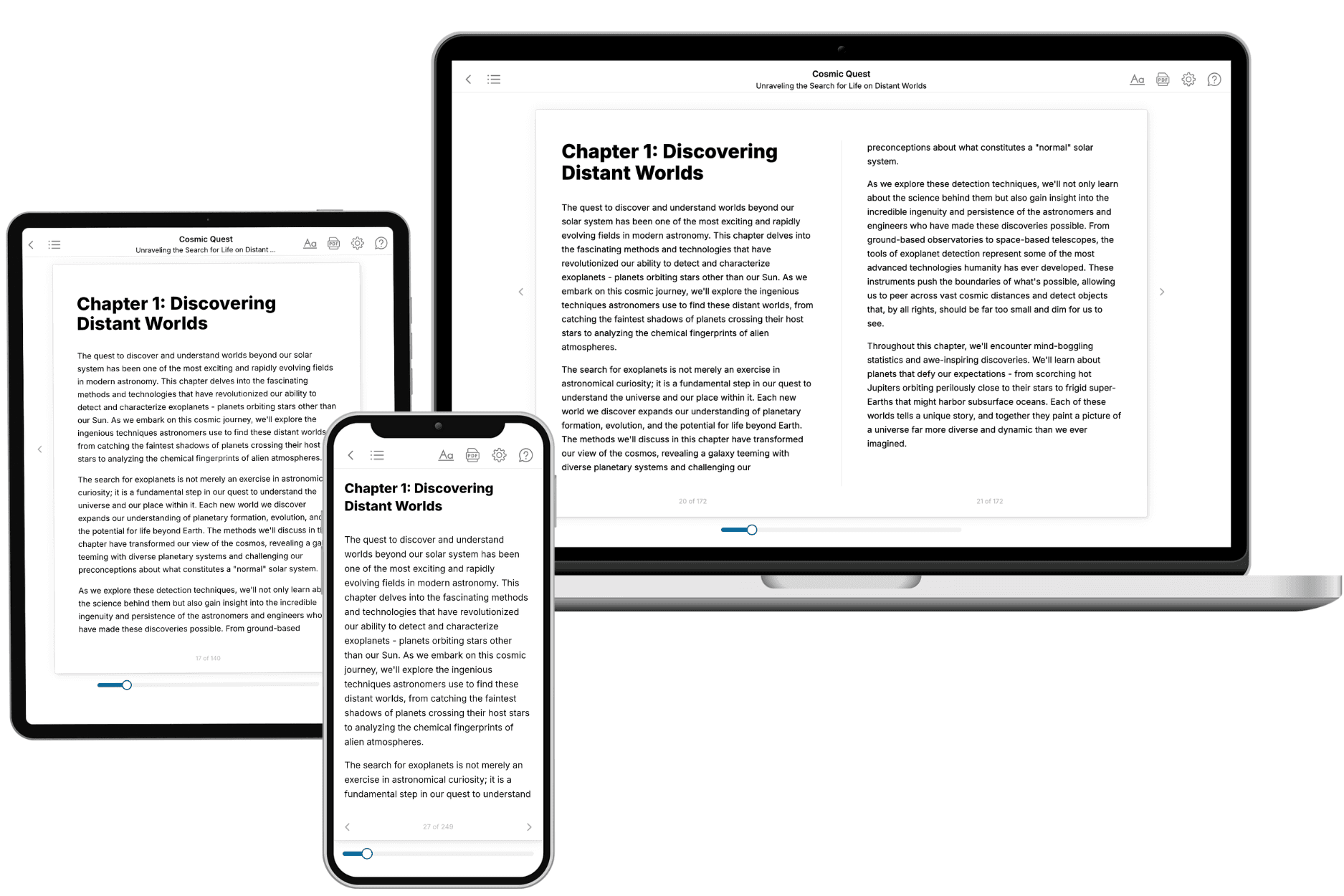
Your book is ready in 10 minutes. Read it online, download as EPUB or PDF, or send to Kindle.
Frequently asked questions
- What is TailoredRead?
TailoredRead creates complete, full-length nonfiction ebooks, written specifically for you. Tell us what you want to learn and why, and TailoredRead writes you a complete ebook on it, with charts, tables, and diagrams throughout. Read it online, on Kindle, or on any e-reader, or download it as a PDF or EPUB. Every book is written fresh the day you order it.
- How is the book tailored to me?
Before anything is written, you answer a few short questions about your goals, your background, and the topics you care about. Your book is then planned around your answers: written at your level, focused on your goals, and covering the topics you chose, instead of the one-size-fits-all book a store sells everyone.
- Will it read like generic AI content?
No. Your book isn't a chat transcript: it's planned chapter by chapter before a single word is written, told in a clear book voice, and explains ideas visually with charts, tables, and diagrams. After writing, every book goes through an editorial pass that polishes chapters so the book reads consistent from start to finish. Judge for yourself: browse thousands of sample books on our Explore Books page.
- How accurate is the content?
Our AI first checks whether your subject needs live research. Niche and fast-moving subjects are researched before writing, and the book plan and chapters are grounded in what it finds. After writing, every book goes through a quality pass that checks its facts and consistency, and researched books list their sources in a Notes section at the back.
- How long is the book?
You choose the length: Comprehensive (250-300 pages), Detailed (150-200 pages), Essential (70-100 pages), or Short (30-50 pages).
- Does the book include visuals?
Yes. Every book includes charts, tables, and diagrams: timelines, checklists, step-by-step guides, decision trees, comparison tables, matrices, and bar charts. A typical book includes dozens of these visual elements.
- Can I read it on Kindle? What formats can I download?
Yes. Every book can be read in our online reader or downloaded as a PDF or EPUB. The EPUB can be opened with Kindle, Apple Books, Kobo, and any e-reader. The Commercial and Author licenses also include an editable Word (DOCX) and Markdown download.
- How much does it cost?
About the price of a regular ebook. The exact price depends on your book's length and complexity, from $2 for the shortest books to $35 for the most comprehensive, and it's shown when you review your book, before you commit to anything. Each book is a one-time purchase, yours to keep, no subscription. Licenses that let you share, teach, or publish your book range from $35.99 to $49.99.
- Can I preview the book before purchasing?
Before you pay, you'll see what your book will cover: the title, a detailed description, the estimated length, and the complete chapter-by-chapter table of contents, so you know what you're getting before you decide. The full text itself is written after you purchase.
- How long does it take to create a book?
About 10 minutes. You can start reading the opening chapters while the rest is still being written.