The Complete Drummer's Pocket
Master Groove Consistency, Speed, Rudiments, and Creative Expression from Pop to Jazz
Your drumming has reached a plateau.
222 pages12 chaptersOct 19, 2025Drums
About this book
You can play the beats, execute the fills, and keep time—but something's missing. The groove doesn't lock in with the unshakable consistency you hear in your favorite recordings. Your hands hit speed barriers you can't seem to break through. Your fills feel mechanical rather than musical. This comprehensive guide takes you deep into the mechanics, musicality, and mindset that separate competent drummers from truly great ones. You'll discover the anatomical secrets of pocket consistency, learn systematic approaches to building speed and chops, and develop a rich vocabulary of fills and patterns across pop, Latin rock, and jazz styles. Through structured exercises and clear explanations, you'll master single stroke mechanics, drag rudiments, triplet fills, and beat displacement. You'll develop authentic swing feel, learn mambo bell patterns, and understand ride cymbal variations that bring sophistication to your playing. Most importantly, you'll train your internal clock to achieve the kind of pocket consistency that makes bassists and producers smile. Whether you're laying down modern pop grooves or exploring jazz vocabulary, this book provides the roadmap to technical mastery and creative freedom behind the kit.
Table of contents
- IntroductionWhat the Pocket Really Means, The Technical Foundation of Great Drumming, How to Use This BookRead below
- Chapter 1: The Anatomy of the PocketThe Physics and Feel of Groove, Developing Your Internal Clock, Methods for Finding Your Pocket, Analyzing Great Groove Performances
- Chapter 2: Building Unshakable Pocket ConsistencyThe Fundamentals of Tempo Stability, Pocket Training Exercises, Daily Consistency Drills, Advanced Metronome Practice Techniques
- Chapter 3: Single Stroke MasteryThe Mechanics of the Perfect Single Stroke, Proper Technique and Hand Motion Biomechanics, Stroke Velocity and Dynamic Control, Progressive Single Stroke Exercises
- Chapter 4: Building Speed and Breaking BarriersUnderstanding Speed Mechanics, Techniques for Breaking Through Speed Barriers, Building Speed Around the Kit, Systematic Chops Building Programs
- Chapter 5: Essential Rudiments for Musical DrummingRudiment Mastery Paths, Drag Rudiment Practice and Application, Making Rudiments Musical
- Chapter 6: Modern Pop Drum GroovesPocket Groove Fundamentals for Pop, Contemporary Pop Groove Patterns, Cymbal Crash Timing and Placement, Achieving Pocket Groove Consistency
- Chapter 7: Latin Rock Grooves and PatternsLatin Rock Groove Foundation, Mambo Bell Rhythms and Patterns, Essential Latin Rock Groove Patterns
- Chapter 8: The Art of the FillDynamic Fill Creation Principles, Triplet Fill Patterns and Vocabulary, Flow Around the Drums and Kit Transitions, Creating Musical and Purposeful Fills
- Chapter 9: Beat Displacement and Creative ConceptsBeat Displacement Theory and Application, Developing Creative Drumming Flow, Practical Beat Displacement Exercises
- Chapter 10: The Art of Jazz DrummingUnderstanding Swing Feel and Timing, Swing Timing Precision Development, Jazz Drum Fill Vocabulary
- Chapter 11: Ride Cymbal MasteryRide Cymbal Pattern Fundamentals, Ride Pattern Variations and Applications, Integrating Ride Patterns with Groove
- Chapter 12: Practice Systems for Continuous GrowthBuilding Effective Practice Routines, Tracking Progress and Setting Goals, Maintaining Skills While Developing New Ones
- ConclusionIntegrating Everything You've Learned, Your Path Forward
Introduction
You've been playing drums for a while now. Your hands know the basic patterns, your feet can handle the kick drum, and you can make it through most songs without losing the beat. But when you listen back to recordings of your playing, something feels off. The groove doesn't lock in with that magnetic quality you hear on professional tracks. Your fills sound technically correct but somehow lack the musical flow that makes great drumming feel effortless. You practice regularly, yet certain speed barriers remain frustratingly out of reach, and your consistency wavers when the pressure is on.
This gap between competent drumming and truly great drumming isn't about talent or natural ability. It's about understanding the deeper mechanics of what makes drumming work at a fundamental level. The difference between a drummer who keeps time and a drummer who creates an irresistible pocket comes down to specific, trainable skills. The separation between mechanical fills and musical expression emerges from deliberate practice approaches that most drummers never encounter. The breakthrough from speed plateaus to fluid velocity happens when you address the biomechanical and neurological foundations that govern stick motion and muscle memory.
This book exists to bridge that gap. It takes you beyond surface-level instruction into the anatomical, physical, and musical principles that transform your playing from adequate to exceptional. You'll discover why the pocket isn't just about playing in time, but about the relationship between your body, the drums, and the emotional center of the music. You'll learn systematic approaches to building speed that address the actual barriers holding you back, not just generic advice to practice more. You'll develop a rich vocabulary of patterns, fills, and grooves across multiple styles, all built on a foundation of technical mastery that makes creative expression possible.
The journey ahead is structured, progressive, and practical. Each chapter builds on the previous one, creating a comprehensive system for developing every aspect of your drumming. You'll work on pocket consistency through specific training exercises that rewire your internal clock. You'll master single stroke mechanics that unlock speed at any tempo. You'll explore rudiments not as abstract exercises but as musical vocabulary that enhances your storytelling behind the kit. Whether you're laying down modern pop grooves, exploring Latin rock patterns, or developing authentic jazz swing feel, you'll have the technical foundation and creative tools to express yourself fully.
The concepts and exercises in this book come from a deep understanding of what separates good drummers from great ones. They address the specific challenges that intermediate drummers face when trying to reach the next level. You won't find vague encouragement to feel the music or generic practice routines that lead nowhere. Instead, you'll get concrete, actionable methods for developing the skills that matter most. The path forward is clear, and the results are measurable. Your drumming is about to change in fundamental ways.
What the Pocket Really Means
The term pocket gets thrown around constantly in drumming circles, but few drummers truly understand what it means beyond a vague sense of good timing. The pocket is not simply playing on the beat or maintaining steady tempo. It's the specific placement of notes within the rhythmic framework that creates a gravitational pull in the music. When a drummer is in the pocket, the groove feels inevitable and irresistible. Other musicians lock into it effortlessly, and listeners feel compelled to move. This quality emerges from the precise relationship between where notes land in time and how they interact with the underlying pulse.
Think of the pocket as a three-dimensional space rather than a single point in time. Every note you play exists not just at a moment but with a specific attack, sustain, and decay. The way your bass drum hits relates to where the bass guitar sits. The placement of your snare backbeat creates tension or release depending on whether it sits slightly ahead, directly on, or just behind the beat. These micro-timing relationships, often measured in milliseconds, determine whether a groove feels urgent and driving, laid-back and relaxed, or perfectly centered and balanced. Great drummers develop conscious control over these placements.
The anatomical component of pocket consistency is rarely discussed but absolutely critical. Your body's relationship to the drums determines how consistently you can place notes in time. When your posture is optimal, your stick heights are consistent, and your muscle engagement is appropriate for the dynamic level, your timing naturally stabilizes. Conversely, when you're fighting your setup, reaching awkwardly for cymbals, or using excessive tension in your grip, your timing becomes erratic. The pocket begins with physical efficiency and biomechanical optimization, not just with listening skills or musical intuition.
Consider how different drummers approach the same basic groove. One drummer might play a standard rock beat that feels stiff and mechanical. Another plays the identical pattern, but it grooves hard and makes you want to move. The difference isn't in the notes themselves but in the micro-timing, the dynamic shaping, and the physical relationship to the instrument. The second drummer has developed what we might call pocket awareness—a heightened sensitivity to exactly where notes land and how they feel in relation to the pulse. This awareness can be systematically developed through specific training approaches.
The emotional center of the music lives in the pocket. When you're truly locked in, you're not just keeping time—you're creating the foundation that allows every other element of the music to breathe and flow. The bass player finds their notes settling naturally into the spaces you create. The guitarist's rhythm parts lock with your hi-hat pattern. The vocalist feels supported and free to phrase expressively because the rhythmic foundation is so solid. This is why producers and bandleaders value pocket consistency above flashy chops or complex fills. A drummer who can establish and maintain a deep pocket makes everyone else sound better.
Understanding the pocket also means recognizing that it's style-dependent. The pocket in a modern pop track sits in a different place than the pocket in a jazz swing tune or a Latin rock groove. Pop drumming often demands a very centered, metronomic pocket where every element aligns precisely with the grid. Jazz swing requires a looser, more elastic pocket where the ride cymbal pattern creates a rolling, triplet-based feel. Latin grooves often feature a forward-driving pocket where certain elements push slightly ahead to create urgency and energy. Mastering the pocket means developing the flexibility to find the right placement for each musical context.
The journey to pocket mastery begins with awareness and progresses through deliberate practice. You'll learn to hear the subtle differences in note placement, feel them in your body, and reproduce them consistently. You'll develop exercises that train your internal clock to maintain steady time while allowing for expressive micro-timing variations. You'll discover how your physical setup and technique either support or undermine your pocket consistency. Most importantly, you'll learn that the pocket isn't a mysterious gift that some drummers have and others don't—it's a specific, trainable skill that improves with the right approach.
Throughout this book, pocket consistency serves as the foundation for everything else. Speed development, rudiment mastery, fill creation, and stylistic vocabulary all build on the ability to maintain a solid groove. When your pocket is strong, you have the freedom to explore creative ideas without losing the rhythmic center. When your pocket is weak, even technically impressive playing falls flat. The chapters ahead will give you the tools to develop unshakable pocket consistency, but the journey starts with understanding what the pocket really means and why it matters more than any other aspect of your drumming.
The Technical Foundation of Great Drumming
Technical mastery in drumming isn't about playing fast or executing complex patterns for their own sake. It's about developing the physical skills that allow you to express musical ideas freely and consistently. When your technique is solid, you don't think about how to execute a pattern—you simply play what you hear in your mind. When your technique has gaps, you're constantly fighting your own limitations, and the music suffers. The technical foundation we'll build in this book serves one purpose: removing barriers between your musical imagination and what comes out of the drums.
The foundation begins with single stroke mechanics. Every note you play on the drums is fundamentally a single stroke, whether it's part of a roll, a fill, or a groove pattern. The quality of your single strokes determines the quality of everything else. When your single strokes are clean, even, and controlled at any tempo, you have the raw material for building any pattern or technique. When your single strokes are inconsistent, with uneven dynamics or timing, every complex pattern built on them inherits those flaws. This is why we dedicate significant attention to perfecting single stroke technique before moving to more advanced concepts.
Speed development follows naturally from proper single stroke mechanics. Many drummers hit speed barriers not because they lack the physical capacity for velocity, but because their technique breaks down as tempo increases. They might use excessive grip pressure, inefficient stick heights, or improper muscle engagement that works at moderate tempos but fails at higher speeds. Breaking through speed barriers requires identifying and correcting these technical inefficiencies. The systematic approach you'll learn addresses speed development from multiple angles:
- Biomechanical optimization: Adjusting grip, stroke motion, and muscle engagement for maximum efficiency
- Progressive tempo training: Building speed gradually while maintaining perfect technique
- Barrier identification: Recognizing specific technical issues that limit velocity
- Targeted correction exercises: Addressing identified weaknesses with specific drills
Rudiments form the vocabulary of drumming technique. They're not abstract exercises to be practiced in isolation from music—they're the building blocks of fills, grooves, and musical expression. A drag rudiment becomes a ghost note embellishment in a funk groove. A paradiddle pattern creates a flowing tom fill. A flam adds accent and texture to a backbeat. When you master rudiments as musical vocabulary rather than technical exercises, they become tools for creative expression. The key is understanding not just how to execute each rudiment, but when and why to use it in musical contexts.
Dynamic control is an often-overlooked aspect of technical foundation. The ability to play at any volume level, from whisper-quiet ghost notes to full-volume accents, with consistent tone quality and timing, separates professional drummers from amateurs. Dynamic control requires precise regulation of stick height, grip pressure, and stroke velocity. It demands the ability to play different dynamic levels simultaneously—a loud backbeat with quiet hi-hat notes, for example. Developing this control takes specific practice approaches that train your hands to execute independent dynamic levels while maintaining timing and tone quality.
Coordination between limbs represents another critical technical element. Your ability to play independent patterns with each limb while maintaining overall groove consistency determines what you can express musically. Basic coordination allows you to play standard grooves. Advanced coordination enables complex polyrhythmic patterns, displaced accents, and sophisticated jazz independence. The progression from basic to advanced coordination follows a logical path, with each level building on the previous one. You'll learn systematic approaches to developing coordination that work with your nervous system rather than fighting against it.
Physical efficiency and injury prevention are inseparable from technical development. Proper technique isn't just about sounding good—it's about sustaining your playing over time without pain or injury. Tension, poor posture, and inefficient motion patterns lead to fatigue, inconsistency, and eventually injury. The technical approaches in this book emphasize relaxation, efficiency, and biomechanical soundness. You'll learn to identify and release unnecessary tension, optimize your setup for your body, and develop motion patterns that you can sustain for hours without strain. This isn't separate from musical development—it's the foundation that makes long-term musical growth possible.
The relationship between technical mastery and musical expression is direct and powerful. When you have solid technique, you can focus entirely on the music. Your hands execute what your mind hears without conscious effort. You can respond spontaneously to what's happening in the music because you're not thinking about how to play the notes. This is the ultimate goal of technical development: reaching a level where technique becomes transparent, and only the music remains. Every exercise, drill, and practice approach in this book serves this goal. The technical foundation you'll build isn't an end in itself—it's the platform from which your musical voice emerges.
Building this foundation requires patience, consistency, and intelligent practice. You can't rush technical development, but you can make it efficient and systematic. The chapters ahead provide clear roadmaps for developing each aspect of your technique. You'll know exactly what to practice, how to practice it, and how to measure your progress. You'll learn to identify your specific technical weaknesses and address them with targeted exercises. Most importantly, you'll understand how each technical element connects to musical expression, so your practice always serves your ultimate goal: becoming a more complete, expressive, and consistent drummer.
How to Use This Book
This book is structured as a progressive system, with each chapter building on the concepts and skills developed in previous chapters. While you might be tempted to jump directly to topics that interest you most—speed development, jazz swing, or fill creation—you'll get far better results by working through the material in order. The early chapters on pocket consistency and single stroke mechanics establish the foundation that makes everything else possible. Skipping ahead might give you some useful ideas, but you'll miss the systematic development that creates lasting improvement. Think of this book as a training program, not a reference manual.
Each chapter follows a consistent structure designed to move you from understanding to application. You'll start with the conceptual framework—why a particular skill matters and how it functions within your overall drumming. Then you'll dive into the specific mechanics and techniques required to develop that skill. Finally, you'll work through progressive exercises that build the skill systematically. This structure ensures you understand not just what to practice, but why you're practicing it and how it connects to your musical goals. The exercises aren't arbitrary—each one serves a specific purpose in your development.
The practice exercises throughout the book are designed to be worked on over time, not completed in a single session. When you encounter a new exercise, start at a comfortable tempo where you can execute it perfectly. Spend several practice sessions at that tempo, focusing on consistency, tone quality, and relaxation. Only increase the tempo when the exercise feels effortless at the current speed. This approach might feel slow initially, but it builds solid technique that doesn't break down under pressure. Rushing through exercises at tempos you can barely manage creates sloppy habits that are difficult to correct later.
Your practice routine should incorporate material from multiple chapters simultaneously. A typical practice session might include:
- Pocket consistency work: 10-15 minutes of metronome exercises from Chapter 2
- Technical development: 15-20 minutes on single strokes or rudiments from Chapters 3 and 5
- Speed building: 10 minutes of targeted speed exercises from Chapter 4
- Stylistic application: 15-20 minutes working on grooves and fills from Chapters 6-11
- Musical playing: 10-15 minutes playing along with recordings or working on songs
Recording yourself regularly is essential for tracking progress and identifying areas that need attention. Your perception of your playing while you're behind the kit differs significantly from how it actually sounds. You might feel like you're playing with great pocket consistency, but a recording reveals subtle timing fluctuations. You might think your fills are smooth and flowing, but the recording shows uneven dynamics or rushed transitions. Set up a simple recording device—even your phone works fine—and record yourself working through exercises and playing grooves. Listen back critically, comparing your playing to the standards described in each chapter.
The metronome is your most important practice tool, but it must be used intelligently. Many exercises in this book specify particular metronome approaches—playing with the click on different beats, using it intermittently, or setting it at subdivision levels. These aren't arbitrary variations—each approach develops different aspects of your timing and pocket consistency. Don't fall into the trap of always practicing with the metronome clicking on every quarter note. That approach can actually limit your development by making you dependent on constant external reinforcement rather than developing a strong internal clock.
Pay attention to the distinction between maintenance practice and development practice. Maintenance practice involves working on skills you've already developed to keep them sharp. Development practice focuses on building new skills or pushing existing ones to higher levels. As you progress through the book, you'll accumulate skills that need maintenance while simultaneously developing new ones. Chapter 12 provides detailed guidance on balancing these two types of practice, but the principle is simple: dedicate most of your practice time to development work while ensuring you don't neglect skills you've already built.
The examples and exercises in this book span multiple styles—pop, Latin rock, and jazz—because each style develops different aspects of your drumming. Pop grooves teach pocket precision and consistency. Latin patterns develop coordination and polyrhythmic awareness. Jazz swing builds independence and subtle timing control. Don't skip styles that aren't your primary interest. A pop drummer who works on jazz swing develops timing sophistication that makes their pop playing more musical. A jazz drummer who practices pop grooves develops the rock-solid consistency that makes their swing feel more authoritative. The cross-pollination between styles makes you a more complete drummer.
Set specific, measurable goals for your practice. Instead of vague intentions like get better at fills
or improve my speed,
define concrete objectives: Execute the triplet fill pattern from Chapter 8 cleanly at 140 BPM
or Play single strokes at 180 BPM with even dynamics and relaxed grip.
Specific goals allow you to track progress objectively and adjust your practice approach when you're not making the progress you expect. Chapter 12 provides detailed frameworks for goal-setting and progress tracking, but start thinking in these terms from the beginning.
Finally, remember that technical development serves musical expression. Every exercise, drill, and practice routine in this book exists to make you a more musical drummer. When you're working on single stroke mechanics, you're not just building speed—you're developing the control that allows you to play exactly what you hear in your mind. When you're practicing pocket consistency exercises, you're not just improving your timing—you're learning to create grooves that make people move. Keep the musical goal in mind even during the most technical practice sessions. The path ahead is challenging but clear, and the results will transform your playing in fundamental ways. Let's begin.
This is the end of the free sample. The full book has 12 chapters.
Want this book written for you?
Tell us your goals and background, and get your own version of this book, tailored by AI to you.


Benefits of AI-tailored books
- Read one book, not ten:
- all the Drums knowledge you need, gathered into a single book.
- Save days of learning:
- tell us your goals, choose your topics, and the whole book is built around them.
- Learn effortlessly:
- Drums book written for your specific background and expertise.
- Understand at a glance:
- includes charts, tables, timelines, checklists, decision trees, and more.
- Stay current:
- written the day you order it, not years ago.
- Trust what you read:
- every book is checked for accuracy, with real research when your subject needs it.
Create your unique book in 3 steps
- 1. Select your focus
Select the focus of your Drums book and share your background
- 2. Personalize your book
Specify your goals and choose sub-topics to include
- 3. Get your tailored book
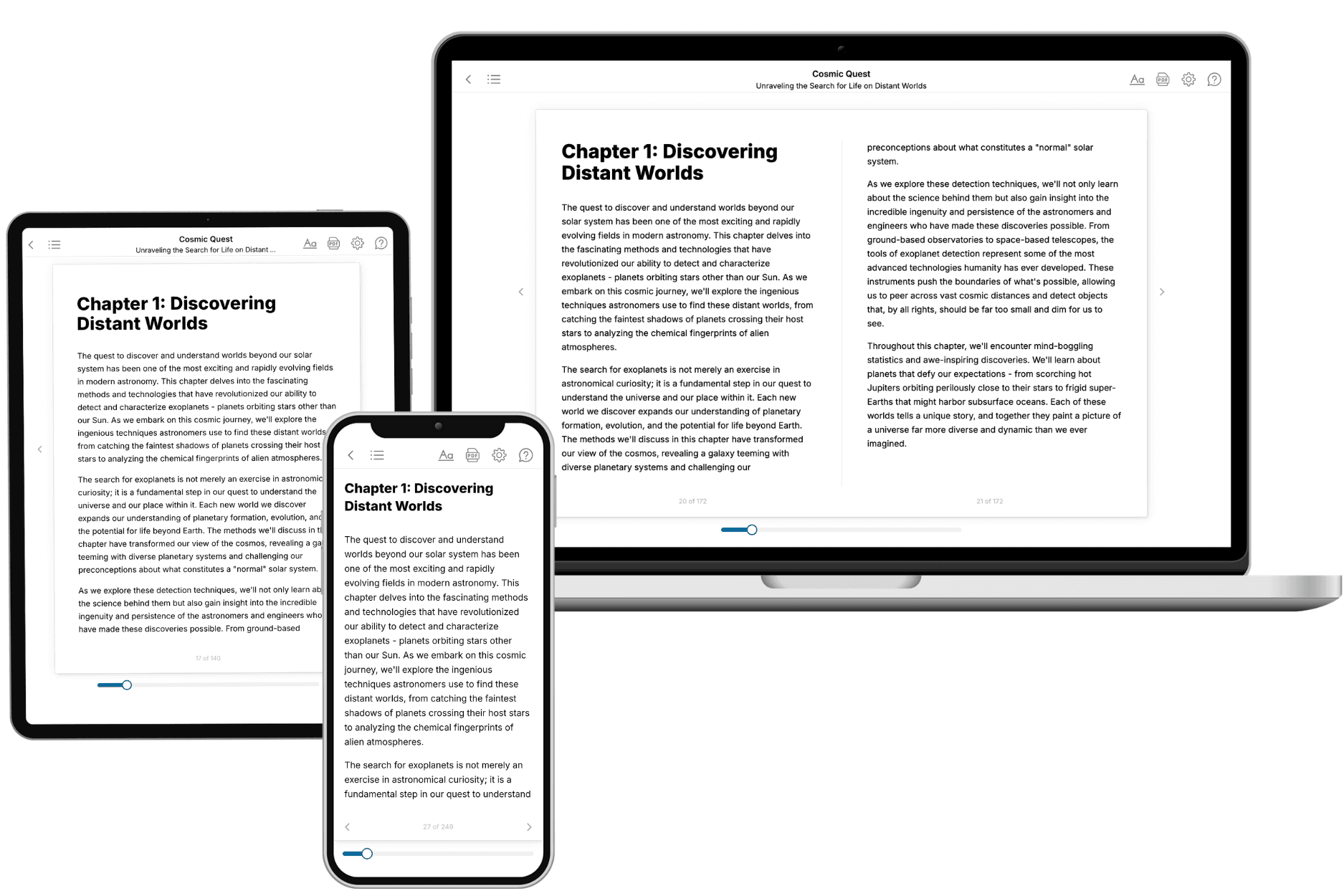
Your book is ready in 10 minutes. Read it online, download as EPUB or PDF, or send to Kindle.


Frequently asked questions
- What is TailoredRead?
TailoredRead creates complete, full-length nonfiction ebooks, written specifically for you. Tell us what you want to learn and why, and TailoredRead writes you a complete ebook on it, with charts, tables, and diagrams throughout. Read it online, on Kindle, or on any e-reader, or download it as a PDF or EPUB. Every book is written fresh the day you order it.
- How is the book tailored to me?
Before anything is written, you answer a few short questions about your goals, your background, and the topics you care about. Your book is then planned around your answers: written at your level, focused on your goals, and covering the topics you chose, instead of the one-size-fits-all book a store sells everyone.
- Will it read like generic AI content?
No. Your book isn't a chat transcript: it's planned chapter by chapter before a single word is written, told in a clear book voice, and explains ideas visually with charts, tables, and diagrams. After writing, every book goes through an editorial pass that polishes chapters so the book reads consistent from start to finish. Judge for yourself: browse thousands of sample books on our Explore Books page.
- How accurate is the content?
Our AI first checks whether your subject needs live research. Niche and fast-moving subjects are researched before writing, and the book plan and chapters are grounded in what it finds. After writing, every book goes through a quality pass that checks its facts and consistency, and researched books list their sources in a Notes section at the back.
- How long is the book?
You choose the length: Comprehensive (250-300 pages), Detailed (150-200 pages), Essential (70-100 pages), or Short (30-50 pages).
- Does the book include visuals?
Yes. Every book includes charts, tables, and diagrams: timelines, checklists, step-by-step guides, decision trees, comparison tables, matrices, and bar charts. A typical book includes dozens of these visual elements.
- Can I read it on Kindle? What formats can I download?
Yes. Every book can be read in our online reader or downloaded as a PDF or EPUB. The EPUB can be opened with Kindle, Apple Books, Kobo, and any e-reader. The Commercial and Author licenses also include an editable Word (DOCX) and Markdown download.
- How much does it cost?
About the price of a regular ebook. The exact price depends on your book's length and complexity, from $2 for the shortest books to $35 for the most comprehensive, and it's shown when you review your book, before you commit to anything. Each book is a one-time purchase, yours to keep, no subscription. Licenses that let you share, teach, or publish your book range from $35.99 to $49.99.
- Can I preview the book before purchasing?
Before you pay, you'll see what your book will cover: the title, a detailed description, the estimated length, and the complete chapter-by-chapter table of contents, so you know what you're getting before you decide. The full text itself is written after you purchase.
- How long does it take to create a book?
About 10 minutes. You can start reading the opening chapters while the rest is still being written.