The Complete Guide to Injury Prevention in College Soccer
Master the Science and Strategies to Keep Players Healthy and Performing at Peak Levels
You'll gain a complete understanding of how to systematically reduce injuries and keep your soccer program healthy and competitive.
207 pages10 chaptersMay 31, 2026Soccer
About this book
This comprehensive guide combines cutting-edge sports science with practical, field-tested strategies specifically designed for college soccer. Learn the biomechanical principles behind common injuries, implement evidence-based conditioning programs, and develop screening protocols that identify at-risk players before problems occur. Discover how to optimize warm-ups, manage training loads, and create recovery strategies that enhance performance while minimizing injury risk. Whether you're a coach, athletic trainer, or player, you'll find actionable frameworks for building a culture of injury prevention that extends careers and maximizes team success. This book bridges the gap between sports science research and real-world application, giving you the tools to make informed decisions that protect your athletes and improve outcomes.
Table of contents
- IntroductionWhy Injury Prevention Matters in College Soccer, What This Book Covers and How to Use It, The Science Behind Prevention StrategiesRead below
- Chapter 1: Understanding the Injury Landscape in College SoccerMost Common Injuries in College Soccer, How and Why These Injuries Occur, Identifying Risk Factors and Vulnerable Populations
- Chapter 2: Biomechanics and Movement FundamentalsUnique Biomechanical Demands of Soccer, Critical Movement Patterns and Technique, Identifying Movement Dysfunction and Asymmetries
- Chapter 3: Screening and Assessment ProtocolsPre-Season Screening and Baseline Testing, Functional Movement Screening Tools, Ongoing Monitoring and In-Season Assessment
- Chapter 4: Warm-Up and Movement PreparationThe Science of Effective Warm-Ups, Dynamic Stretching and Mobility Work, Activation Exercises for Soccer-Specific Movements
- Chapter 5: Strength and Conditioning for Injury PreventionSoccer-Specific Strength Development, Eccentric Training and Deceleration Control, Core Stability and Lower Body Integration
- Chapter 6: Periodization and Training Load ManagementPeriodization Principles for Soccer, Monitoring and Managing Training Load, Recovery Strategies and Rest Days
- Chapter 7: Equipment, Footwear, and Environmental FactorsFootwear Selection and Fit, Field Conditions and Surface Management, Protective Equipment and Bracing
- Chapter 8: Psychological Factors and Injury PreventionBuilding Mental Resilience and Stress Management, Managing Injury Anxiety and Fear, Creating a Prevention-Focused Team Culture
- Chapter 9: Return-to-Play Protocols and RehabilitationEvidence-Based Return-to-Play Framework, Rehabilitation Progression and Clearance Criteria, Secondary Prevention and Re-Injury Risk
- Chapter 10: Building and Implementing Your Prevention ProgramDesigning a Comprehensive Prevention Program, Coordinating Coaches, Trainers, and Medical Staff, Measuring Success and Continuous Improvement
- ConclusionKey Takeaways and Action Steps, Building a Sustainable Injury Prevention Culture
- Additional Resources and References
Introduction
College soccer is one of the most physically demanding environments in all of amateur athletics. Players compete in a sport that combines explosive sprinting, constant direction changes, aerial challenges, and physical contact, all compressed into a season that runs from August through November, with some programs extending into spring. The demands are relentless, and the margins are thin. A single injury to a key player can shift a team's trajectory for an entire season, and in some cases, it can alter a player's athletic future permanently.
The numbers tell a sobering story. Research published through the NCAA Injury Surveillance Program consistently shows that soccer ranks among the highest-injury sports at the collegiate level, with ankle sprains, knee ligament injuries, and muscle strains accounting for the majority of time lost.[1] What makes this particularly frustrating is that a significant portion of these injuries are preventable. They are not random events. They follow patterns, they respond to specific risk factors, and they can be reduced through deliberate, systematic action.
This book was built on a straightforward premise: most soccer injuries do not have to happen. When coaches, athletic trainers, strength and conditioning specialists, and players understand the mechanisms behind injuries and apply evidence-based prevention strategies consistently, injury rates drop. Performance improves. Careers last longer. Teams stay competitive deeper into the season. The goal here is not to eliminate all risk, because that is impossible in a contact sport. The goal is to give every person involved in a college soccer program the knowledge and tools to dramatically reduce preventable injuries and respond intelligently when injuries do occur.
What follows is a practical, science-grounded guide designed for real-world application. Whether you are a head coach trying to keep your roster healthy through a grueling conference schedule, an athletic trainer building a pre-season screening protocol, a strength coach designing a conditioning program, or a player who wants to understand your own body better, this book has something concrete to offer. Each chapter connects research to practice, explaining not just what the evidence says, but how to actually implement it on the field, in the weight room, and in the training room.
Why Injury Prevention Matters in College Soccer
The case for injury prevention in college soccer goes well beyond keeping players on the field, though that alone would be reason enough. At the collegiate level, athletes are balancing academic demands, social development, and athletic performance simultaneously. An injury does not just sideline a player from games. It disrupts their academic schedule, affects their mental health, strains their relationships with teammates, and in some cases, ends their playing career entirely. The full cost of a serious injury is far greater than most programs account for.
Consider the ACL injury, one of the most feared in soccer. Recovery typically takes nine to twelve months, and research suggests that fewer than 65% of athletes return to their pre-injury level of competition.[2] For a college player, that timeline can consume an entire season or more. For a freshman or sophomore, it can reshape their entire college career. For a senior, it may mean never playing competitive soccer again. These are not abstract statistics. They represent real athletes whose trajectories are permanently altered by an injury that, in many cases, could have been prevented.
From a team performance standpoint, the impact of injuries is equally significant. Programs that experience high injury rates tend to underperform relative to their talent level. When key players are unavailable, coaches are forced to adjust tactics, overload healthy players, and make lineup decisions based on availability rather than strategy. This creates a compounding problem: the players who remain healthy face higher training loads, which increases their own injury risk. A single serious injury can trigger a cascade that affects the entire roster.
There is also a financial dimension that athletic departments cannot ignore. The cost of treating a serious knee injury, including surgery, rehabilitation, imaging, and follow-up care, can easily exceed $20,000 to $50,000 depending on the institution and insurance structure.[3] Prevention programs, by contrast, are relatively inexpensive to implement. The FIFA 11+ warm-up program, one of the most well-studied injury prevention protocols in soccer, costs essentially nothing beyond staff time and education. Studies have shown it can reduce overall injury rates by up to 35% and ACL injuries by up to 50% when implemented consistently.[4] The return on investment for prevention is extraordinary.
Beyond the physical and financial arguments, there is a duty-of-care dimension that every coach and athletic trainer carries. College athletes trust the adults in their programs to make decisions that protect their long-term health. That trust is not just a moral obligation. It is increasingly a legal and institutional one, as NCAA guidelines and institutional policies around athlete welfare continue to evolve. Building a robust injury prevention program is part of fulfilling that responsibility.
Finally, injury prevention matters because it directly enables peak performance. Healthy players train harder, develop faster, and compete more confidently. A program that keeps its athletes healthy does not just avoid losses from injury. It actively creates conditions for higher performance. Prevention and performance are not competing priorities. They are deeply interconnected, and the most successful college soccer programs treat them that way.
Key insight: Injury prevention is not a separate program running alongside your soccer program. It is woven into every training session, every warm-up, every recovery day, and every equipment decision. When it is done well, it becomes invisible because injuries simply stop happening at the rates they used to.
What This Book Covers and How to Use It
This book is organized to take you from foundational understanding to practical implementation. It begins with the injury landscape in college soccer, establishing a clear picture of what injuries occur most frequently, how they happen, and who is most at risk. From there, it moves through biomechanics, screening, warm-up protocols, strength and conditioning, load management, equipment, psychology, and return-to-play frameworks. The final chapter brings everything together into a blueprint for building and sustaining a comprehensive prevention program.
Each chapter is designed to stand on its own, so you can jump directly to the topic most relevant to your current situation. If you are an athletic trainer preparing for pre-season, Chapter 3 on screening and assessment protocols will be immediately useful. If you are a strength coach designing an off-season program, Chapter 5 on strength and conditioning for injury prevention is your starting point. If you are a coach who has just experienced a wave of hamstring injuries and wants to understand why, Chapter 1 and Chapter 2 will give you the context you need.
That said, reading the book in sequence will give you the most complete picture. The chapters build on each other in important ways. Understanding biomechanics makes the screening protocols more meaningful. Understanding screening makes the conditioning program design more targeted. Understanding load management makes the recovery strategies more effective. The whole is genuinely greater than the sum of its parts when you see how these elements connect.
Throughout the book, you will find several recurring features designed to make the content immediately actionable:
- Practical frameworks: Step-by-step processes you can implement directly with your program, from screening checklists to warm-up sequences to return-to-play criteria.
- Real-world examples: Specific scenarios drawn from the college soccer environment that illustrate how concepts apply in practice.
- Evidence citations: References to the research behind each recommendation, so you can evaluate the quality of the evidence and explore further if needed.
- Common mistakes: Explicit identification of the errors that programs most frequently make, so you can avoid them proactively.
- Implementation tips: Practical guidance on how to introduce new protocols to coaches, players, and administrators who may be skeptical or resistant to change.
One important note about how to use this book: the recommendations here are evidence-based, but they are not one-size-fits-all prescriptions. Every program operates in a different context. Your roster composition, staff resources, facility access, competitive schedule, and institutional culture all shape what is feasible and what will work best. Use the frameworks here as starting points, not rigid scripts. The goal is to give you enough understanding of the underlying principles that you can adapt intelligently to your specific situation.
This book is also not a substitute for qualified medical and sports science professionals. Athletic trainers, team physicians, physical therapists, and certified strength and conditioning specialists bring expertise and clinical judgment that no book can replace. The goal here is to give coaches, players, and support staff a strong enough foundation in injury prevention science that they can collaborate more effectively with those professionals, ask better questions, and make more informed decisions together.
Finally, this book is written for the full range of people involved in a college soccer program. Coaches will find strategic frameworks for program design and culture building. Athletic trainers will find clinical protocols and screening tools. Strength coaches will find conditioning principles and periodization models. Players will find explanations of their own bodies and practical steps they can take to protect themselves. The language is intentionally accessible throughout, because the best injury prevention happens when everyone in a program understands the same principles and works toward the same goals.
The Science Behind Prevention Strategies
Sports science has advanced dramatically over the past two decades, and the field of injury prevention has benefited enormously from that progress. What was once a domain of intuition, tradition, and anecdote is now supported by a growing body of rigorous research. Randomized controlled trials, prospective cohort studies, biomechanical analyses, and systematic reviews have given practitioners a much clearer picture of what actually works to reduce injuries, and what does not.
The foundation of modern injury prevention science rests on a few core principles. First, most sports injuries are not purely accidental. They follow predictable patterns related to training load, movement mechanics, physical conditioning, and environmental factors. This means they can be studied systematically and addressed through targeted interventions. Second, the relationship between training stress and injury risk follows a dose-response curve. Too little training leaves athletes underprepared and vulnerable. Too much training, especially when increased too rapidly, overwhelms the body's capacity to adapt and leads to overuse injuries and fatigue-related breakdowns. Finding the right balance is both a science and a skill.
One of the most important conceptual frameworks in modern injury prevention is the acute-to-chronic workload ratio, developed by sports scientist Tim Gabbett and colleagues.[5] This model compares an athlete's recent training load (the past week) to their longer-term average load (the past four weeks). When the ratio spikes above 1.5, injury risk increases significantly. This framework has been validated across multiple sports and provides a practical tool for load management that you will encounter in detail in Chapter 6.
Biomechanical research has also transformed how practitioners think about injury prevention. High-speed video analysis, force plate measurements, and motion capture technology have revealed exactly how injuries like ACL tears and ankle sprains occur at the mechanical level. This knowledge has directly informed the design of neuromuscular training programs that teach athletes to move more safely. The FIFA 11+ program, for example, was developed based on biomechanical research identifying the movement patterns most associated with lower extremity injuries in soccer, and its effectiveness has been validated in multiple large-scale trials across different countries and competition levels.[6]
It is worth being honest about the limitations of the research as well. Sports science studies often face challenges with sample size, participant compliance, and the difficulty of controlling variables in real-world athletic environments. Some findings that look promising in controlled studies do not translate as cleanly to the messy reality of a college soccer season. Where the evidence is strong and consistent, this book presents it with confidence. Where it is more preliminary or contested, that uncertainty is acknowledged. The goal is to give you an accurate picture of what the science actually supports, not an oversimplified version that sounds more certain than it is.
The evidence base for injury prevention in soccer specifically has grown substantially since the early 2000s. Key research institutions and organizations, including FIFA's Medical Assessment and Research Centre (F-MARC), the American Orthopaedic Society for Sports Medicine, and the NCAA's own injury surveillance infrastructure, have produced a substantial body of literature that informs the recommendations throughout this book. Where possible, recommendations are grounded in studies conducted specifically in soccer populations, because the demands of the sport are distinct enough that findings from other sports do not always transfer directly.
One area where the science has been particularly clear is the role of neuromuscular training in preventing lower extremity injuries. Neuromuscular training refers to exercises that improve the nervous system's ability to control movement, particularly in high-speed, high-load situations like landing from a jump or changing direction at full speed. Multiple systematic reviews have confirmed that neuromuscular training programs reduce ACL injury rates in female soccer players by 50% or more, and show meaningful reductions in male players as well.[7] This is one of the strongest effect sizes in all of sports medicine prevention research, and it forms a cornerstone of the conditioning recommendations in this book.
Understanding the science also means understanding why compliance matters so much. Prevention programs only work when they are actually implemented consistently. Research consistently shows that the effectiveness of programs like FIFA 11+ drops sharply when compliance falls below 80%.[8] This is not just a logistical challenge. It is a cultural one. Getting coaches to prioritize warm-up protocols, getting players to take recovery seriously, and getting administrators to allocate resources for prevention requires the same kind of intentional effort as any other aspect of program building. The science tells you what to do. The culture determines whether it actually gets done.
Throughout this book, the science is presented in service of practice. Every research finding is connected to a concrete application. Every protocol is explained in terms of the mechanism it targets. The goal is not to turn coaches and trainers into researchers, but to give them enough scientific literacy to evaluate new information critically, implement proven strategies confidently, and adapt intelligently when circumstances change. That combination of knowledge and practical skill is what separates programs that consistently keep their athletes healthy from those that simply hope for the best.
A note on terminology: Throughout this book, the term injury prevention is used broadly to include both primary prevention (stopping injuries from occurring in the first place) and secondary prevention (reducing the risk of re-injury after an athlete has returned to play). Both are essential components of a complete program, and both are addressed in depth in the chapters that follow.
The chapters ahead represent a synthesis of the best available evidence combined with practical wisdom from the field. The science of injury prevention is not static. New research emerges regularly, and recommendations evolve as the evidence base grows. The frameworks and principles presented here are designed to be durable enough to remain useful as the field advances, because they are grounded in fundamental principles of human physiology, biomechanics, and sports performance rather than in any single study or trend. That foundation is what makes them reliable guides for the decisions you will face every day in your program.
Notes
Introduction
- 1. J. Agel and others, "Descriptive epidemiology of collegiate men's soccer injuries," Journal of Athletic Training, 2007
- 2. C. L. Ardern and others, "Return to sport following anterior cruciate ligament reconstruction surgery," British Journal of Sports Medicine, 2011
- 3. R. C. Mather and others, "Societal and economic impact of anterior cruciate ligament tears," Journal of Bone and Joint Surgery, 2013
- 4. T. Soligard and others, Comprehensive warm-up programme to prevent injuries in young female footballers: cluster randomised controlled trial, BMJ, 337, a2469, 2008
- 5. T. J. Gabbett, "The training-injury prevention paradox," British Journal of Sports Medicine, 2016
- 6. M. Bizzini and J. Dvorak, "FIFA 11+: an effective programme to prevent football injuries in various player groups worldwide-a narrative review," British Journal of Sports Medicine, 2015
- 7. G. D. Myer and others, "The influence of age on the effectiveness of neuromuscular training to reduce anterior cruciate ligament injury in female athletes," American Journal of Sports Medicine, 2013
- 8. K. Steffen and others, "High adherence to a neuromuscular injury prevention programme (FIFA 11+) improves functional balance and reduces injury risk in Canadian youth female football players," British Journal of Sports Medicine, 2013
This is the end of the free sample. The full book has 10 chapters.
Want this book written for you?
Tell us your goals and background, and get your own version of this book, tailored by AI to you.


Benefits of AI-tailored books
- Read one book, not ten:
- all the Soccer knowledge you need, gathered into a single book.
- Save days of learning:
- tell us your goals, choose your topics, and the whole book is built around them.
- Learn effortlessly:
- Soccer book written for your specific background and expertise.
- Understand at a glance:
- includes charts, tables, timelines, checklists, decision trees, and more.
- Stay current:
- written the day you order it, not years ago.
- Trust what you read:
- every book is checked for accuracy, with real research when your subject needs it.
Create your unique book in 3 steps
- 1. Select your focus
Select the focus of your Soccer book and share your background
- 2. Personalize your book
Specify your goals and choose sub-topics to include
- 3. Get your tailored book
Your book is ready in 10 minutes. Read it online, download as EPUB or PDF, or send to Kindle.


Frequently asked questions
- What is TailoredRead?
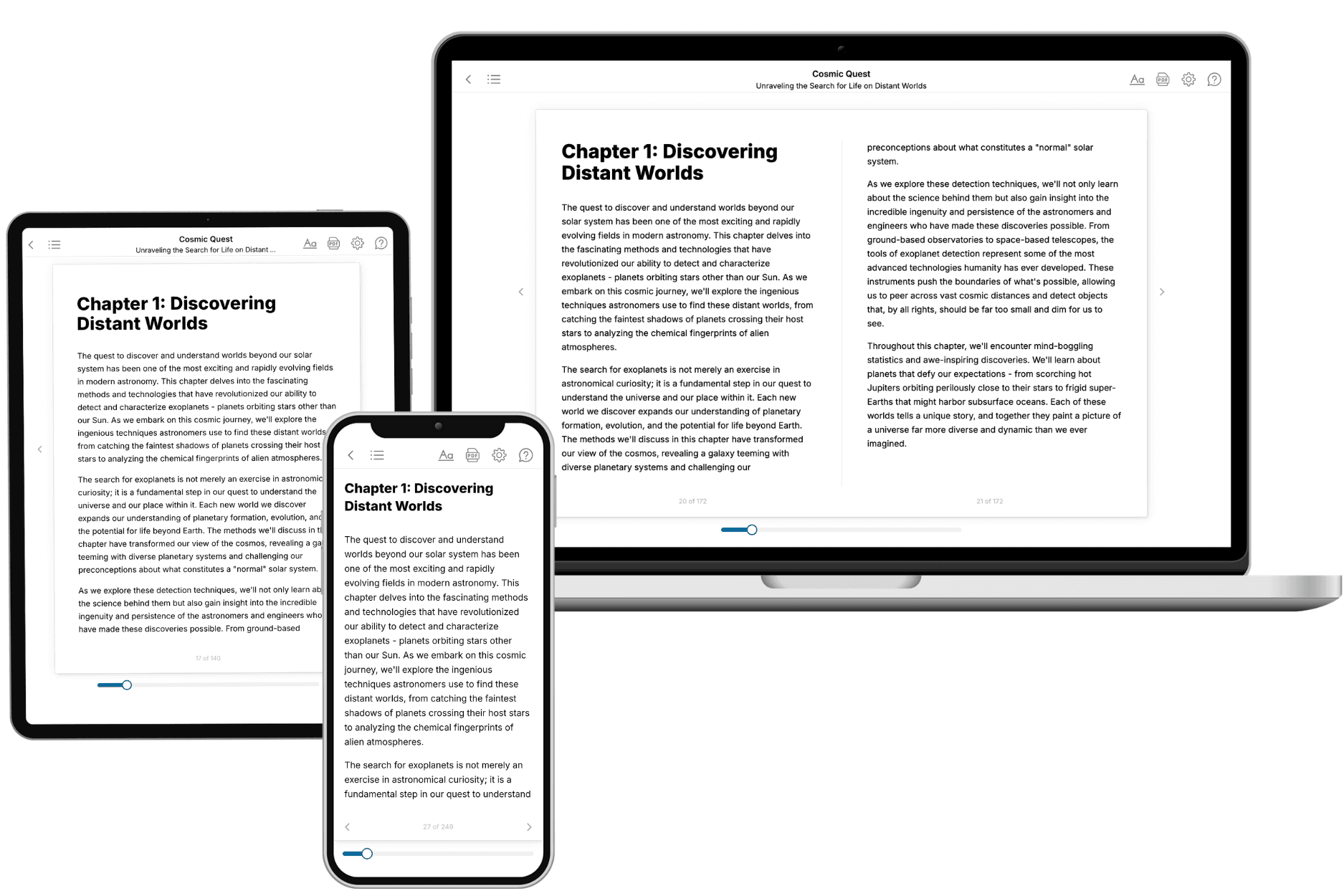
TailoredRead creates complete, full-length nonfiction ebooks, written specifically for you. Tell us what you want to learn and why, and TailoredRead writes you a complete ebook on it, with charts, tables, and diagrams throughout. Read it online, on Kindle, or on any e-reader, or download it as a PDF or EPUB. Every book is written fresh the day you order it.
- How is the book tailored to me?
Before anything is written, you answer a few short questions about your goals, your background, and the topics you care about. Your book is then planned around your answers: written at your level, focused on your goals, and covering the topics you chose, instead of the one-size-fits-all book a store sells everyone.
- Will it read like generic AI content?
No. Your book isn't a chat transcript: it's planned chapter by chapter before a single word is written, told in a clear book voice, and explains ideas visually with charts, tables, and diagrams. After writing, every book goes through an editorial pass that polishes chapters so the book reads consistent from start to finish. Judge for yourself: browse thousands of sample books on our Explore Books page.
- How accurate is the content?
Our AI first checks whether your subject needs live research. Niche and fast-moving subjects are researched before writing, and the book plan and chapters are grounded in what it finds. After writing, every book goes through a quality pass that checks its facts and consistency, and researched books list their sources in a Notes section at the back.
- How long is the book?
You choose the length: Comprehensive (250-300 pages), Detailed (150-200 pages), Essential (70-100 pages), or Short (30-50 pages).
- Does the book include visuals?
Yes. Every book includes charts, tables, and diagrams: timelines, checklists, step-by-step guides, decision trees, comparison tables, matrices, and bar charts. A typical book includes dozens of these visual elements.
- Can I read it on Kindle? What formats can I download?
Yes. Every book can be read in our online reader or downloaded as a PDF or EPUB. The EPUB can be opened with Kindle, Apple Books, Kobo, and any e-reader. The Commercial and Author licenses also include an editable Word (DOCX) and Markdown download.
- How much does it cost?
About the price of a regular ebook. The exact price depends on your book's length and complexity, from $2 for the shortest books to $35 for the most comprehensive, and it's shown when you review your book, before you commit to anything. Each book is a one-time purchase, yours to keep, no subscription. Licenses that let you share, teach, or publish your book range from $35.99 to $49.99.
- Can I preview the book before purchasing?
Before you pay, you'll see what your book will cover: the title, a detailed description, the estimated length, and the complete chapter-by-chapter table of contents, so you know what you're getting before you decide. The full text itself is written after you purchase.
- How long does it take to create a book?
About 10 minutes. You can start reading the opening chapters while the rest is still being written.