The Complete Guide to Vegetarian Turkish Cooking
Authentic Recipes and Techniques for Plant-Based Mediterranean Flavors
Discover how to create authentic vegetarian Turkish dishes that rival any meat-based meal.
238 pages11 chaptersAug 3, 2026Turkish Cooking
About this book
This comprehensive guide teaches you the essential techniques, ingredient knowledge, and time-tested recipes that form the foundation of Turkish plant-based cooking. From vibrant meze platters that showcase fresh vegetables and herbs to hearty grain and legume dishes that satisfy completely, you'll learn how Turkish cooks transform simple ingredients into extraordinary meals through proper technique and flavor layering. Explore regional specialties, master traditional cooking methods, and understand the cultural significance of vegetarian dishes in Turkish dining. Whether you're preparing a casual weeknight dinner or hosting an elegant Turkish feast, this book provides the knowledge and confidence to cook authentic vegetarian Turkish food that honors culinary traditions while celebrating plant-based ingredients.
Table of contents
- IntroductionWhy Vegetarian Turkish Cuisine Matters, How to Use This Book, The Turkish Cooking Philosophy, Getting Started on Your Turkish Cooking JourneyRead below
- Chapter 1: The Turkish Pantry: Essential Ingredients and StaplesOils, Vinegars, and Condiments, Spices, Dried Herbs, and Aromatics, Legumes, Grains, and Dried Vegetables, Fresh Produce and Seasonal Vegetables
- Chapter 2: Fundamental Techniques and Cooking MethodsKnife Skills and Vegetable Preparation, Building Layers of Flavor, Traditional Turkish Cooking Methods, Mastering Salt, Acid, and Spice Balance
- Chapter 3: Meze: Turkish Appetizers and Small PlatesCreamy Dips and Spreads, Roasted and Marinated Vegetables, Cheese, Bread, and Pastry Meze, Creating Authentic Meze Platters
- Chapter 4: Soups and Stews: Warming Vegetarian ClassicsLentil and Legume Soups, Seasonal Vegetable Soups, Hearty Vegetable Stews and Braises, Regional Soup Traditions
- Chapter 5: Stuffed Vegetables: Dolma and BeyondGrape Leaf Dolma Techniques, Stuffing Peppers, Tomatoes, and Eggplants, Rice, Herb, and Spice Filling Variations, Cooking and Serving Stuffed Vegetables
- Chapter 6: Grains and Legumes: Nutritious Main DishesTurkish Pilaf Variations and Techniques, Bean and Lentil Main Courses, Bulgur Wheat Dishes and Preparations, Creating Complete Proteins with Grains and Legumes
- Chapter 7: Vegetable-Forward Dishes: Seasonal and Regional SpecialtiesEggplant Preparations and Classics, Leafy Greens and Wild Vegetables, Seasonal Vegetable Dishes, Regional Vegetable Specialties Across Turkey
- Chapter 8: Turkish Breads and Pastries for VegetariansTraditional Flatbreads and Yeast Breads, Savory Pastries and Börek Variations, Pairing Breads with Vegetarian Dishes
- Chapter 9: Salads and Vegetable Sides: Fresh and Vibrant AccompanimentsTraditional Turkish Salads, Cooked Vegetable Side Dishes, Turkish Dressing and Sauce Techniques
- Chapter 10: Desserts and Beverages: Sweet Endings and RefreshmentsTraditional Turkish Desserts, Desserts with Nuts and Dried Fruits, Turkish Beverages and Tea Culture
- Chapter 11: Planning Turkish Vegetarian Meals and EntertainingBuilding Balanced Turkish Vegetarian Meals, Hosting Turkish Vegetarian Dinners, Creating Authentic Turkish Menus
- ConclusionContinuing Your Turkish Cooking Journey
- Glossary of Turkish Cooking Terms
- Further Reading and Resources
Introduction
Turkish cuisine has sustained entire civilizations on plant-based food for thousands of years, long before vegetarian cooking became a modern lifestyle choice. Across Anatolia, the Aegean coast, and the mountains of eastern Turkey, cooks have always known how to coax extraordinary depth from lentils, eggplant, bulgur, and olive oil. The result is a culinary tradition that is simultaneously ancient and immediately relevant, one that offers home cooks a genuinely different way to think about vegetables, grains, and legumes.
What makes Turkish vegetarian cooking distinct is not any single ingredient or technique, but the way everything works together. A bowl of mercimek çorbası is not just lentil soup. It is the result of blooming spices in butter, building a base with onion and garlic, and finishing with a squeeze of lemon that lifts the whole dish. That sequence, that instinct for layering, runs through nearly every recipe in this tradition. Once you understand it, you can apply it far beyond any single dish.
This book is organized to teach that understanding progressively. The early chapters build your foundation: the pantry, the techniques, the flavor logic. Later chapters apply that foundation to specific categories of dishes, from meze and soups to stuffed vegetables, grains, breads, and desserts. By the final chapter, you will have the knowledge to plan and host a complete Turkish vegetarian meal from start to finish. The goal throughout is not just to follow recipes, but to cook with the confidence and intuition that comes from genuinely understanding a cuisine.
Why Vegetarian Turkish Cuisine Matters
Turkish cuisine is often misrepresented outside Turkey as a meat-heavy tradition built around kebabs and grilled lamb. That picture is incomplete. Historically, meat was expensive and reserved for special occasions across much of Anatolia. Everyday cooking relied on what the land produced: lentils, chickpeas, dried beans, seasonal vegetables, wheat, and olive oil. The vegetarian dishes that emerged from this reality are not simplified versions of meat dishes. They are fully developed recipes with their own logic, their own techniques, and their own flavor profiles.[1]
The zeytinyağlı tradition is one of the clearest examples of this depth. Zeytinyağlı literally means "cooked in olive oil," and it describes an entire category of dishes where vegetables are slow-cooked in generous amounts of good olive oil with aromatics and sometimes a little tomato or lemon. These dishes are served at room temperature, which concentrates their flavor and makes them ideal for entertaining. Dishes like zeytinyağlı fasulye (green beans in olive oil) or zeytinyağlı enginar (artichokes in olive oil) are not side dishes in the Turkish kitchen. They are centerpieces.
Beyond zeytinyağlı, the meze tradition offers an enormous range of vegetarian possibilities. A well-composed meze spread might include haydari (a thick yogurt dip with herbs), muhammara (a roasted pepper and walnut paste), roasted eggplant preparations, stuffed grape leaves, and a dozen other small plates, all of them plant-based. This is not a compromise or a workaround. It is the authentic heart of Turkish hospitality and dining culture.
From a nutritional standpoint, Turkish vegetarian cooking is also remarkably well-balanced. The combination of legumes with grains, the use of fermented dairy like yogurt, and the abundance of fresh and cooked vegetables creates meals that are satisfying and nutritionally complete. Dishes like kısır (a bulgur salad with herbs and pomegranate molasses) or piyaz (a white bean salad with onion and sumac) deliver protein, fiber, and complex carbohydrates in a single bowl.
There is also a strong environmental argument for exploring this tradition. Turkish vegetarian cooking is inherently seasonal and regional. Cooks in the Aegean use wild greens and fresh herbs that grow nearby. Cooks in southeastern Turkey build dishes around dried legumes and bulgur that store well through winter. This connection to local, seasonal ingredients is not a trend. It is simply how the cuisine has always worked, and it aligns naturally with more sustainable approaches to eating.
Finally, Turkish vegetarian cooking matters because it is genuinely delicious in ways that surprise people who encounter it for the first time. The combination of pul biber (Turkish red pepper flakes) with olive oil and garlic, the tartness of sumac over a simple salad, the deep sweetness of pomegranate molasses stirred into a walnut paste: these are flavor combinations that feel both unfamiliar and immediately right. They expand your palate and your cooking vocabulary in ways that stay with you long after the meal is finished.
How to Use This Book
This book is designed to be read progressively, but it also works as a reference you can dip into at any point. The chapters follow a deliberate sequence: pantry and ingredients first, then techniques, then specific dish categories. If you are new to Turkish cooking, working through the first two chapters before attempting recipes will make everything that follows significantly easier. If you already have some familiarity with the cuisine, you can move directly to the chapters that interest you most.
The chapter on the Turkish pantry covers the essential ingredients that define this cuisine. Understanding what pul biber, tahin, pekmez, and pomegranate molasses actually taste like, and how they behave in cooking, is more valuable than any single recipe. That chapter is not just a shopping list. It explains why each ingredient matters and how to use it effectively. Once your pantry is stocked, you will find that most recipes come together quickly from ingredients you already have on hand.
The techniques chapter that follows covers the foundational skills that appear repeatedly across Turkish cooking. These include:
- Knife work for vegetables, including how to cut eggplant and onions for different applications
- Blooming spices in oil or butter to release their full flavor
- Building a kavurma flavor base with onions, tomato paste, and aromatics
- Balancing salt, acid, and heat at the end of cooking
- Managing moisture in vegetable dishes to achieve the right texture
These techniques are not complicated, but they are specific. Learning them properly will improve every dish you cook from this book.
From chapter three onward, the book moves through specific categories of Turkish vegetarian cooking. Each chapter is self-contained, with its own context, techniques, and recipes. Cross-references appear throughout to connect related ideas. For example, the dough technique introduced in the breads and pastries chapter connects directly to the börek variations discussed there, and the flavor-building logic from the techniques chapter reappears in the soups, stews, and grain dishes.
Recipes throughout the book include practical notes on timing, substitutions, and common mistakes to avoid. Where a dish has significant regional variations, those variations are noted so you can understand the range of possibilities rather than treating any single recipe as the only correct version. Turkish cooking is a living tradition with enormous regional diversity, and that diversity is worth celebrating rather than flattening into a single standard.
At the back of the book, you will find a glossary of Turkish cooking terms, a guide to further reading and resources, and a concluding chapter on planning complete Turkish vegetarian meals. That final chapter is where everything comes together: how to balance a meze spread, how to sequence courses, how to plan a dinner party menu that flows naturally from beginning to end. Think of it as the practical application of everything that came before.
A note on authenticity: this book aims to be faithful to Turkish culinary traditions while being practical for home cooks outside Turkey. Where an ingredient is genuinely difficult to source, a workable substitute is suggested. But the goal is always to get as close as possible to the real flavor, not to create a simplified approximation. Turkish cooking deserves to be cooked properly.
The Turkish Cooking Philosophy
Turkish cooking is built on patience and attention. It is not a cuisine of shortcuts or quick fixes. A proper mercimek çorbası takes time to develop its flavor. A zeytinyağlı dish needs to cook slowly so the vegetables absorb the olive oil fully. Dolma requires careful rolling and a long, gentle simmer. This patience is not a burden. It is the mechanism by which simple ingredients become extraordinary food.
The concept of layering flavor is central to this philosophy. Turkish cooks rarely add all their seasonings at once. Instead, they build flavor in stages: first the aromatics in oil, then the tomato paste or pepper paste, then the vegetables, then the liquid, then the final seasoning at the end. Each stage adds something distinct. The onions caramelize and sweeten. The tomato paste deepens and loses its raw edge. The spices bloom and become fragrant. By the time the dish is finished, the flavor has a complexity that no single ingredient could provide on its own.
Olive oil is not just a cooking medium in Turkish vegetarian cooking. It is an ingredient with its own flavor and presence. The zeytinyağlı tradition uses olive oil generously, and the quality of the oil matters. A good Turkish or Greek extra-virgin olive oil with a slightly fruity, peppery character will make a real difference in dishes where the oil is prominent. This is not the place to use a neutral vegetable oil or a low-quality olive oil.
Yogurt occupies a similarly important role. Turkish yogurt is thick, tangy, and rich, and it appears throughout the cuisine as a sauce, a dip base, a marinade, and a finishing element. The combination of warm, spiced food with cool, tangy yogurt is one of the defining flavor contrasts of Turkish cooking. When a recipe calls for yogurt, full-fat plain yogurt is almost always the right choice. Strained yogurt (similar to Greek yogurt) is even better for dips and sauces.
Herbs in Turkish cooking are used with a generosity that can surprise cooks from other traditions. Fresh flat-leaf parsley, dill, and mint appear in large quantities, not as garnishes but as genuine flavor components. A kısır without a full bunch of parsley is not really kısır. A çoban salatası without fresh mint is missing something essential. Do not be timid with fresh herbs. They are not decoration.
The Turkish approach to spice is also worth understanding clearly. This is not a cuisine that relies on heat for its character. Pul biber adds warmth and a subtle fruitiness, but it is not meant to overwhelm. Cumin, coriander, allspice, and cinnamon appear in savory dishes, adding depth and complexity rather than heat. The goal is always balance: a dish where no single element dominates, where the flavors work together to create something greater than the sum of its parts.
Finally, Turkish cooking has a strong relationship with the seasons. The best Turkish vegetarian dishes are made with vegetables at their peak. Eggplant in late summer, fresh fava beans in spring, wild greens in early spring, dried legumes through winter: the cuisine follows the calendar naturally. Cooking seasonally is not a constraint. It is the reason Turkish vegetarian food tastes as good as it does.
Getting Started on Your Turkish Cooking Journey
Before you cook your first recipe from this book, there are a few practical steps that will make the experience significantly better. The most important is stocking your pantry with the core Turkish ingredients. You do not need everything at once, but having the essentials on hand means you can cook most recipes without a special shopping trip for every meal. The pantry chapter covers this in detail, but the short list of priorities includes: good olive oil, pul biber, sumac, pomegranate molasses, tahin, red pepper paste (biber salçası), dried red lentils, bulgur, and a selection of dried legumes.
Most of these ingredients are available at Middle Eastern or Mediterranean grocery stores, and many are now stocked in well-supplied supermarkets or available online. Turkish grocery stores, where accessible, are the best source for authentic versions of ingredients like pul biber and biber salçası, which vary significantly in quality. If you have access to a Turkish or Middle Eastern market, a single visit to stock up on pantry staples will serve you well for months of cooking.
Equipment requirements for Turkish vegetarian cooking are minimal. A heavy-bottomed pot or Dutch oven is essential for soups, stews, and zeytinyağlı dishes. A large skillet or sauté pan handles most other cooking. A sharp chef's knife and a sturdy cutting board are more important than any specialized tool. A food processor is useful for dips and spreads but not strictly necessary. A fine-mesh strainer and a wooden spoon round out the basics. You do not need a special kitchen to cook this food well.
A few technique habits are worth establishing from the start. Get comfortable tasting as you cook, not just at the end. Turkish cooking requires ongoing adjustment: a little more lemon here, a pinch more salt there, a drizzle of olive oil to finish. Develop the habit of tasting at each stage of cooking so you understand how the flavor is developing. This is the single most important skill in any cuisine, and Turkish cooking rewards it particularly well.
Also get comfortable with room-temperature serving. Many Turkish vegetarian dishes, particularly zeytinyağlı preparations and meze, are served at room temperature rather than hot. This is not a compromise. These dishes are specifically designed to be eaten this way, and their flavors are often better at room temperature than straight from the stove. Cooking ahead and letting dishes rest is not just convenient. It is often the correct technique.
As you work through this book, try to approach each recipe with curiosity rather than strict adherence. Turkish home cooking has always been flexible and adaptive. Cooks substitute what is available, adjust seasoning to their taste, and vary recipes based on the season and what is in the market. The recipes here are reliable guides, not rigid formulas. Once you understand the underlying logic of a dish, you will naturally start to make it your own.
The Turkish meal structure itself is worth understanding early. A traditional Turkish meal often begins with meze and soup, moves through main dishes of vegetables, grains, or legumes, and ends with something sweet alongside çay (tea). This structure is not just a sequence of courses. It reflects a philosophy of hospitality and abundance, of offering variety and generosity at the table. Even a simple weeknight dinner benefits from thinking in these terms: a small salad or dip alongside a main dish, a piece of fruit or a few nuts to finish, a glass of tea to close. That rhythm, once you feel it, makes Turkish cooking feel natural rather than foreign.
The chapters ahead cover everything from the specific flavor of tahin to the technique of rolling grape leaves to the ritual of brewing çay in a çaydanlık. Each one builds on the last. The cuisine that emerges from all of it is one of the most satisfying and complete vegetarian food traditions in the world, and it is waiting for you to cook it.
Notes
Introduction
- 1. Nevin Halıcı, "Turkish Cookbook," Dorling Kindersley, 1989
This is the end of the free sample. The full book has 11 chapters.
Want this book written for you?
Tell us your goals and background, and get your own version of this book, tailored by AI to you.


Benefits of AI-tailored books
- Read one book, not ten:
- all the Turkish Cooking knowledge you need, gathered into a single book.
- Save days of learning:
- tell us your goals, choose your topics, and the whole book is built around them.
- Learn effortlessly:
- Turkish Cooking book written for your specific background and expertise.
- Understand at a glance:
- includes charts, tables, timelines, checklists, decision trees, and more.
- Stay current:
- written the day you order it, not years ago.
- Trust what you read:
- every book is checked for accuracy, with real research when your subject needs it.
Create your unique book in 3 steps
- 1. Select your focus
Select the focus of your Turkish Cooking book and share your background
- 2. Personalize your book
Specify your goals and choose sub-topics to include
- 3. Get your tailored book
Your book is ready in 10 minutes. Read it online, download as EPUB or PDF, or send to Kindle.


Frequently asked questions
- What is TailoredRead?
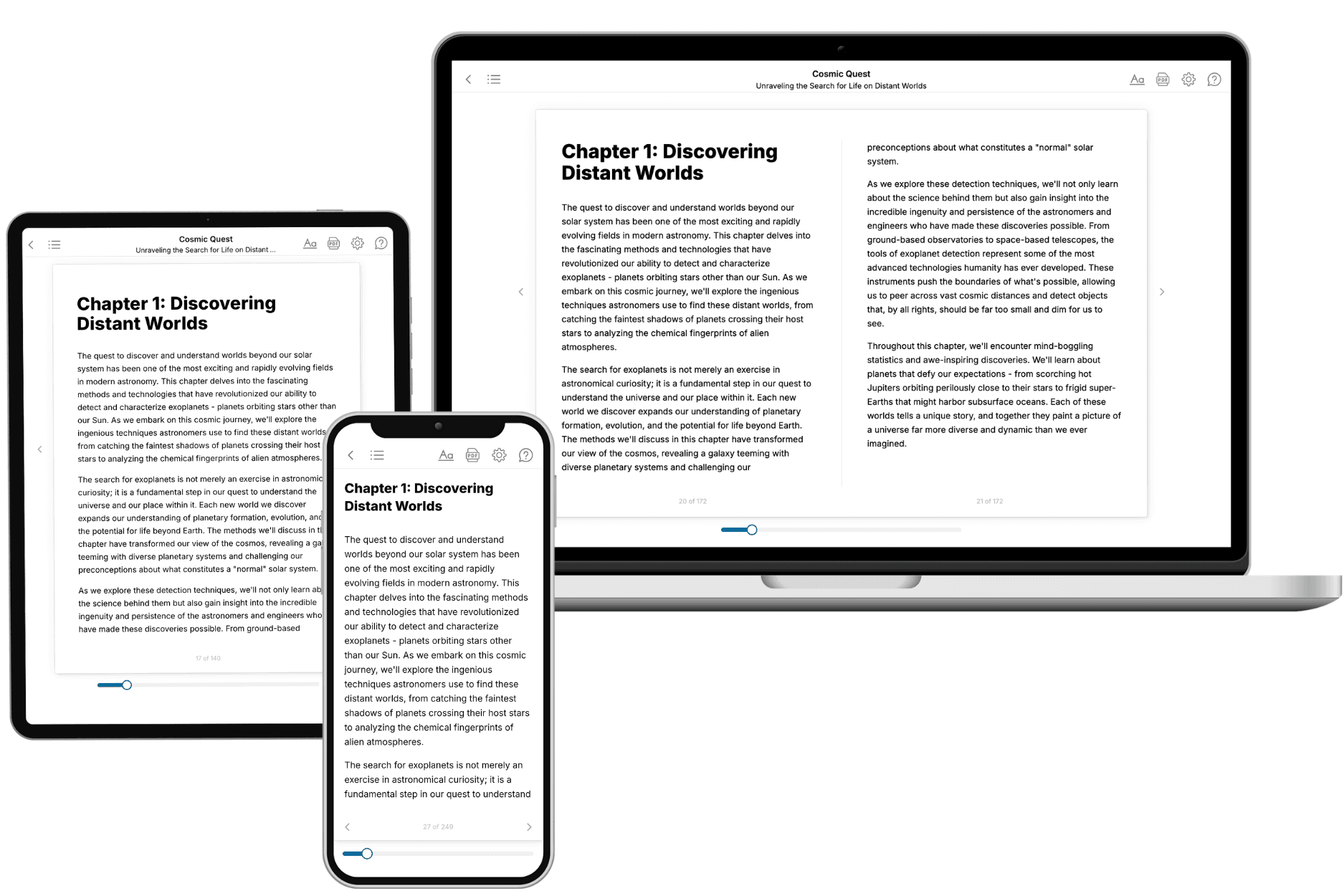
TailoredRead creates complete, full-length nonfiction ebooks, written specifically for you. Tell us what you want to learn and why, and TailoredRead writes you a complete ebook on it, with charts, tables, and diagrams throughout. Read it online, on Kindle, or on any e-reader, or download it as a PDF or EPUB. Every book is written fresh the day you order it.
- How is the book tailored to me?
Before anything is written, you answer a few short questions about your goals, your background, and the topics you care about. Your book is then planned around your answers: written at your level, focused on your goals, and covering the topics you chose, instead of the one-size-fits-all book a store sells everyone.
- Will it read like generic AI content?
No. Your book isn't a chat transcript: it's planned chapter by chapter before a single word is written, told in a clear book voice, and explains ideas visually with charts, tables, and diagrams. After writing, every book goes through an editorial pass that polishes chapters so the book reads consistent from start to finish. Judge for yourself: browse thousands of sample books on our Explore Books page.
- How accurate is the content?
Our AI first checks whether your subject needs live research. Niche and fast-moving subjects are researched before writing, and the book plan and chapters are grounded in what it finds. After writing, every book goes through a quality pass that checks its facts and consistency, and researched books list their sources in a Notes section at the back.
- How long is the book?
You choose the length: Comprehensive (250-300 pages), Detailed (150-200 pages), Essential (70-100 pages), or Short (30-50 pages).
- Does the book include visuals?
Yes. Every book includes visual elements such as timelines, checklists, step-by-step guides, decision trees, comparison tables, and matrices, and many include bar charts. A typical book includes dozens of these visual elements.
- Can I read it on Kindle? What formats can I download?
Yes. Every book can be read in our online reader or downloaded as a PDF or EPUB. The EPUB can be opened with Kindle, Apple Books, Kobo, and any e-reader. The Commercial and Author licenses also include an editable Word (DOCX) and Markdown download.
- How much does it cost?
About the price of a regular ebook. The exact price depends on your book's length and complexity, from $2 for the shortest books to $35 for the most comprehensive, and it's shown when you review your book, before you commit to anything. Each book is a one-time purchase, yours to keep, no subscription. Licenses that let you share, teach, or publish your book range from $35.99 to $49.99.
- Can I preview the book before purchasing?
Before you pay, you'll see what your book will cover: the title, a detailed description, the estimated length, and the complete chapter-by-chapter table of contents, so you know what you're getting before you decide. The full text itself is written after you purchase.
- How long does it take to create a book?
About 10 minutes. You can start reading the opening chapters while the rest is still being written.