The Complete Lo Mein Mastery Guide
Master Authentic Wok Cooking Techniques and Create Restaurant-Quality Lo Mein at Home
Elevate your home cooking by mastering the art of authentic lo mein preparation.
207 pages9 chaptersJul 25, 2026Asian Cooking
About this book
This comprehensive guide takes you beyond basic recipes to teach you the fundamental wok cooking techniques that professional chefs use daily. You'll discover how to select the right noodles, build complex flavor profiles with traditional Asian ingredients, and execute the precise heat and timing that creates that signature restaurant texture. Whether you're working with chicken, shrimp, beef, or vegetables, you'll learn the principles that apply across all variations. Each recipe is designed to reinforce core techniques while introducing new skills progressively. By the end, you won't just follow recipes—you'll understand the why behind every step, giving you the confidence to improvise and create your own signature lo mein dishes. Perfect for home cooks ready to move beyond takeout and into genuine culinary mastery.
Table of contents
- IntroductionWhy Lo Mein Matters in Your Kitchen, The Fundamentals of Wok Cooking, How to Use This GuideRead below
- Chapter 1: Essential Wok Cooking TechniquesChoosing and Seasoning Your Wok, Mastering Heat Control and Temperature, The Art of Tossing and Flipping
- Chapter 2: Lo Mein Noodles and Sauce FoundationsUnderstanding Different Noodle Varieties, Building Authentic Sauce Profiles, Achieving Perfect Flavor Balance
- Chapter 3: Building Your Asian PantryEssential Ingredients for Lo Mein, Where to Source Quality Ingredients, Proper Storage and Shelf Life
- Chapter 4: Chicken Lo Mein RecipesClassic Chicken Lo Mein, Spicy Szechuan Chicken Lo Mein, Garlic and Ginger Chicken Lo Mein
- Chapter 5: Shrimp and Seafood Lo MeinPreparing and Cooking Shrimp Perfectly, Traditional Shrimp Lo Mein, Mixed Seafood Lo Mein Variations
- Chapter 6: Beef and Pork Lo Mein DishesSelecting and Preparing Beef Cuts, Tender Beef Lo Mein, Pork Lo Mein and Variations
- Chapter 7: Vegetable and Vegetarian Lo MeinChoosing Vegetables for Optimal Texture, Satisfying Vegetarian Lo Mein, Tofu and Mushroom Lo Mein
- Chapter 8: Advanced Techniques and Flavor VariationsAchieving Wok Hei (Breath of the Wok), Regional Lo Mein Styles and Adaptations, Mastering Mise en Place for Speed and Consistency
- Chapter 9: Troubleshooting and Common MistakesCommon Cooking Mistakes and How to Avoid Them, Fixing Texture and Consistency Problems, Adjusting Flavors and Seasoning
- ConclusionYour Path to Lo Mein Mastery, Next Steps in Your Wok Cooking Journey
- Glossary of Terms
- Further Reading and Resources
Introduction
Lo mein has a reputation problem. Most people think of it as the greasy, clumped noodles sitting in a takeout container, eaten cold from the fridge at midnight. That version exists, sure. But authentic lo mein, cooked properly in a screaming-hot carbon-steel wok with the right sauce balance and the right timing, is something else entirely. The noodles are silky and separate. The vegetables still have a little snap. The sauce coats everything evenly without pooling at the bottom. And there's that faint smoky depth, the wok hei, that no microwave or delivery bag can preserve.
The gap between takeout lo mein and restaurant-quality lo mein comes down to a handful of specific techniques. Heat management is the biggest one. Most home stoves don't get as hot as a commercial wok burner, but there are ways to work around that limitation and still get excellent results. Beyond heat, the difference lies in how you prepare your ingredients before the wok even gets turned on, how you build your sauce, and how you time each element so nothing overcooks while something else is still raw. These are learnable skills, not secrets guarded by professional chefs.
This guide is built around a simple idea: understanding the why behind each step makes you a better cook than any recipe alone can. When you know why velveting makes chicken tender, you can apply that logic to beef and pork too. When you understand how dark soy sauce and light soy sauce serve different functions in a sauce, you stop guessing and start adjusting with confidence. The recipes here are teaching tools. Each one is designed to reinforce a core principle while introducing something new, so that by the time you've worked through the book, you're not dependent on the page in front of you.
Whether you're cooking for yourself on a Tuesday night or trying to impress people at a dinner party, lo mein is one of the most versatile dishes in any cook's repertoire. It adapts to whatever protein you have, whatever vegetables are in the crisper drawer, and whatever heat level your guests prefer. The foundation stays the same. The variations are nearly endless. That combination of consistency and flexibility is exactly what makes it worth mastering.
Why Lo Mein Matters in Your Kitchen
Lo mein is one of the most practical dishes you can add to your regular cooking rotation. It comes together in under 30 minutes once your mise en place is ready. It uses ingredients that store well and cost relatively little. And it scales easily, whether you're making a single serving or feeding a group of six. For a home cook looking to expand beyond pasta and stir-fry basics, lo mein sits at a sweet spot: it's approachable enough to attempt on a weeknight but technical enough that mastering it genuinely improves your overall wok cooking skills.
The dish also teaches you something that transfers to almost every other wok recipe you'll ever make. The principles of heat control, sauce layering, and tossing technique that you develop while cooking lo mein apply directly to fried rice, chow mein, and countless other Chinese-American and Chinese dishes. Think of lo mein as a training ground. The skills compound. Once you've learned to manage a wok at high heat with noodles, managing it with rice or vegetables feels straightforward by comparison.
There's also a practical financial argument. A quality lo mein dish at a mid-range Chinese restaurant typically costs between $14 and $18 per plate. Made at home with good ingredients, the same dish costs roughly $4 to $6 per serving, depending on your protein choice. Over the course of a month, for a household that orders takeout regularly, that difference adds up fast. More importantly, the home version can be fresher, less oily, and tailored exactly to your taste preferences in ways that ordering from a menu simply can't match.
Lo mein also gives you control over ingredients that takeout doesn't. You choose the sodium level in your sauce. You decide how much oil goes into the wok. You pick the vegetables at their peak freshness rather than whatever was prepped hours ago. For anyone managing dietary preferences, allergies, or simply trying to eat cleaner without giving up food they love, cooking lo mein at home is a genuinely meaningful upgrade.
Beyond the practical benefits, there's something satisfying about the cooking process itself. Wok cooking is active and fast. You're making decisions in real time, adjusting heat, adding ingredients in sequence, tossing noodles with a flick of the wrist. It engages you in a way that slow-cooker recipes or oven dishes don't. Many home cooks who start making lo mein regularly find that it reignites their enthusiasm for cooking in general, because the feedback loop is immediate and the results are visible right in the pan.
Finally, lo mein is a dish with genuine cultural depth. It has roots in Chinese culinary tradition stretching back centuries, and its evolution through Chinese-American cooking tells a story about adaptation, immigration, and the way food travels across cultures.[1] Cooking it well is a way of engaging with that history respectfully, understanding what makes the dish work on its own terms rather than treating it as a blank canvas for whatever happens to be in the fridge.
Lo mein, at its most fundamental, is a dish about balance: the balance of textures between soft noodles and crisp vegetables, the balance of flavors between salty, savory, and subtly sweet, and the balance of timing that keeps every element at its best when it hits the plate.
That balance is what this guide will help you find. Not through rigid rules, but through understanding the principles well enough to apply them intuitively. Once you have that, lo mein stops being a recipe you follow and becomes a dish you genuinely know how to cook.
The Fundamentals of Wok Cooking
Before getting into specific recipes, it helps to understand what makes wok cooking different from other methods. A wok is not just a curved pan. Its shape creates distinct heat zones: the bottom of the wok gets the most intense heat, while the sloping sides are cooler. A skilled cook uses those zones deliberately, pushing ingredients up the sides to slow their cooking while something else gets seared at the bottom. That spatial control is one of the things that separates wok cooking from cooking in a flat skillet, where everything sits at roughly the same temperature.
The carbon-steel wok is the standard tool for this style of cooking, and for good reason. Carbon steel heats up fast, responds quickly to temperature changes, and develops a natural non-stick surface over time through a process called wok seasoning. A well-seasoned carbon-steel wok that's been used regularly for a year behaves very differently from a brand-new one. The seasoning builds up in layers, creating a surface that releases food easily and contributes a subtle depth of flavor to everything cooked in it. The chapter on essential wok cooking techniques covers wok selection and seasoning in detail.
Heat is the single most important variable in wok cooking. The Maillard reaction, the chemical process that creates browning and the complex flavors associated with seared meat and toasted ingredients, requires surface temperatures well above the boiling point of water.[2] When a wok isn't hot enough, ingredients steam in their own moisture instead of searing. The result is pale, soft food with a flat flavor profile. Getting the wok genuinely hot before adding oil, and keeping it hot throughout the cooking process, is the single most common adjustment home cooks need to make.
Tossing technique is the other foundational skill. In a restaurant kitchen, cooks toss ingredients by flicking the wok forward and up in a smooth motion, keeping everything moving so it cooks evenly without burning. At home, you can approximate this with a long-handled spatula and a scooping motion, but learning even a basic toss gives you much better control. The chapter on tossing and flipping breaks this down into steps you can practice before you ever turn on the stove.
Mise en place, the French culinary term for having everything prepared and in place before cooking begins, is not optional in wok cooking. It's a requirement. A lo mein dish can go from start to finish in five minutes once the wok is hot. There is no time to stop and slice a vegetable or measure out a sauce ingredient mid-cook. Everything needs to be prepped, portioned, and arranged in the order it goes into the wok before the heat goes on. This is a habit that takes some adjustment if you're used to more forgiving cooking methods, but it becomes second nature quickly.
Oil choice matters more than many home cooks realize. You need an oil with a high smoke point for wok cooking, because the temperatures involved are high. Neutral oils like vegetable oil, canola oil, or peanut oil are the standard choices. Sesame oil, which has a lower smoke point and a strong flavor, is used as a finishing oil rather than a cooking oil. Adding it at the end of cooking, off the heat, gives you its characteristic nutty aroma without burning it into bitterness.
Understanding these fundamentals before you start cooking lo mein means you're not just following steps blindly. You know why the wok needs to be hot before the oil goes in. You know why you prep everything first. You know why sesame oil goes in last. That understanding is what lets you adapt when something doesn't go exactly as planned, which, especially early on, it sometimes won't.
Here's a quick reference for the core wok cooking principles that apply throughout this guide:
- Preheat the wok until it just begins to smoke before adding oil.
- Use high smoke-point oil (vegetable, canola, or peanut) for cooking; reserve sesame oil for finishing.
- Cook in batches if needed to avoid overcrowding the wok, which drops the temperature and causes steaming instead of searing.
- Keep ingredients moving to prevent burning and ensure even cooking.
- Add sauce along the sides of the wok, not directly on top of ingredients, so it heats and reduces slightly before mixing in.
- Finish quickly once noodles are in; lo mein noodles can go from perfectly coated to clumped and overcooked in under a minute.
How to Use This Guide
This guide is structured to build your skills progressively, but it's not a book you have to read cover to cover before you can cook anything. If you already have a seasoned wok and some experience with high-heat cooking, you can jump directly to the recipe chapters and refer back to the technique sections when something isn't working the way you expect. If you're newer to wok cooking, working through the first three chapters before attempting recipes will save you a lot of frustration and wasted ingredients.
The first chapter covers essential wok cooking techniques: how to choose and season a carbon-steel wok, how to manage heat on a home stove, and how to develop your tossing technique. These skills underpin everything else in the book. The second chapter focuses on lo mein noodles and sauce foundations, explaining the differences between noodle types, how to build a sauce with proper umami balance, and how to adjust flavors on the fly. The third chapter is a practical guide to building your Asian pantry, including where to source ingredients like Shaoxing wine, oyster sauce, and dark soy sauce, and how to store them properly.
Chapters four through seven are the recipe chapters, organized by protein: chicken, shrimp and seafood, beef and pork, and vegetarian options including tofu and mushroom preparations. Each recipe is designed to teach something specific beyond just the dish itself. The classic chicken lo mein, for example, introduces chicken velveting in a straightforward context. The spicy Szechuan chicken lo mein builds on that foundation while introducing Szechuan peppercorn and the principles of building heat into a sauce without overwhelming the other flavors.
Chapter eight moves into advanced territory: achieving wok hei on a home stove, understanding regional lo mein styles, and developing the mise en place habits that let you cook with speed and consistency. This chapter is worth reading even if you feel comfortable with the basics, because wok hei in particular is something many home cooks think is impossible without a commercial burner. It's not impossible. It just requires a specific approach that the chapter explains in practical terms.
Chapter nine is the troubleshooting chapter, and it's one of the most useful sections in the book. Soggy noodle diagnosis, overcrowded wok problems, seasoning adjustments when a dish tastes flat or too salty, texture issues with proteins that came out tough instead of tender: all of these common problems are addressed with specific, actionable fixes. Keep this chapter in mind as a reference you can return to whenever a dish doesn't come out the way you expected.
A few practical notes on how the recipes are written. Ingredient quantities are given in both volume and weight measurements where it matters for accuracy. Sauce components are listed as a pre-mixed sauce in most recipes, because mixing them ahead of time and adding them all at once gives you better control than adding each ingredient separately mid-cook. Timing notes are based on a standard home gas stove; if you're cooking on electric or induction, you may need to adjust slightly, and the heat management section covers those differences.
The glossary at the back of the book defines every canonical term used throughout the guide, from velveting to wok hei to sauce layering. If you encounter a term you're not familiar with, the glossary is the fastest place to look it up. The further reading section points toward additional resources for anyone who wants to go deeper into Chinese culinary history, regional cooking traditions, or the food science behind wok cooking.
One last thing worth saying before you get started: expect the first few attempts at any new technique to be imperfect. The first time you try to toss noodles in a wok, some of them will probably end up on the stove. The first time you velvet chicken, the texture might not be quite right. That's normal, and it's part of the process. Wok cooking rewards repetition. Each time you make a dish, you're calibrating your sense of heat, timing, and proportion in ways that no written instruction can fully substitute for. The goal isn't a perfect dish on the first try. The goal is understanding what happened and knowing what to adjust next time.
The cooks who get the most out of this guide are the ones who treat each recipe as an experiment rather than a test. Notice what works. Notice what doesn't. Adjust one variable at a time. That's how real cooking skill develops, and lo mein is an excellent dish to develop it with.
Start with the technique chapters if you're new to wok cooking. Start with the pantry chapter if your kitchen isn't stocked yet. Start with whichever recipe sounds most appealing if you're already comfortable with the basics and just want to cook something good tonight. The guide is designed to meet you where you are and take you somewhere better.
This is the end of the free sample. The full book has 9 chapters.
Want this book written for you?
Tell us your goals and background, and get your own version of this book, tailored by AI to you.


Benefits of AI-tailored books
- Read one book, not ten:
- all the Asian Cooking knowledge you need, gathered into a single book.
- Save days of learning:
- tell us your goals, choose your topics, and the whole book is built around them.
- Learn effortlessly:
- Asian Cooking book written for your specific background and expertise.
- Understand at a glance:
- includes charts, tables, timelines, checklists, decision trees, and more.
- Stay current:
- written the day you order it, not years ago.
- Trust what you read:
- every book is checked for accuracy, with real research when your subject needs it.
Create your unique book in 3 steps
- 1. Select your focus
Select the focus of your Asian Cooking book and share your background
- 2. Personalize your book
Specify your goals and choose sub-topics to include
- 3. Get your tailored book
Your book is ready in 10 minutes. Read it online, download as EPUB or PDF, or send to Kindle.


Frequently asked questions
- What is TailoredRead?
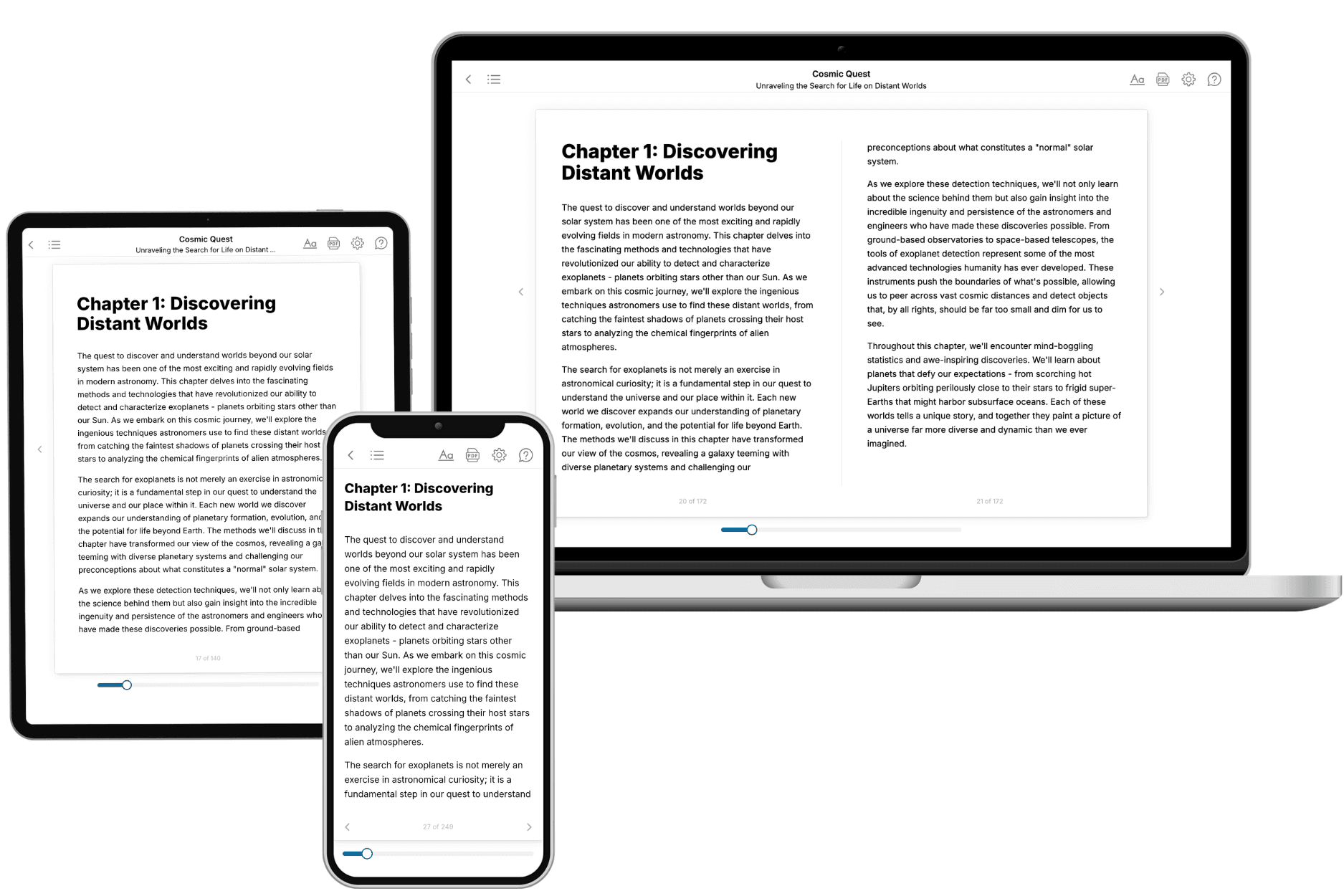
TailoredRead creates complete, full-length nonfiction ebooks, written specifically for you. Tell us what you want to learn and why, and TailoredRead writes you a complete ebook on it, with charts, tables, and diagrams throughout. Read it online, on Kindle, or on any e-reader, or download it as a PDF or EPUB. Every book is written fresh the day you order it.
- How is the book tailored to me?
Before anything is written, you answer a few short questions about your goals, your background, and the topics you care about. Your book is then planned around your answers: written at your level, focused on your goals, and covering the topics you chose, instead of the one-size-fits-all book a store sells everyone.
- Will it read like generic AI content?
No. Your book isn't a chat transcript: it's planned chapter by chapter before a single word is written, told in a clear book voice, and explains ideas visually with charts, tables, and diagrams. After writing, every book goes through an editorial pass that polishes chapters so the book reads consistent from start to finish. Judge for yourself: browse thousands of sample books on our Explore Books page.
- How accurate is the content?
Our AI first checks whether your subject needs live research. Niche and fast-moving subjects are researched before writing, and the book plan and chapters are grounded in what it finds. After writing, every book goes through a quality pass that checks its facts and consistency, and researched books list their sources in a Notes section at the back.
- How long is the book?
You choose the length: Comprehensive (250-300 pages), Detailed (150-200 pages), Essential (70-100 pages), or Short (30-50 pages).
- Does the book include visuals?
Yes. Every book includes charts, tables, and diagrams: timelines, checklists, step-by-step guides, decision trees, comparison tables, matrices, and bar charts. A typical book includes dozens of these visual elements.
- Can I read it on Kindle? What formats can I download?
Yes. Every book can be read in our online reader or downloaded as a PDF or EPUB. The EPUB can be opened with Kindle, Apple Books, Kobo, and any e-reader. The Commercial and Author licenses also include an editable Word (DOCX) and Markdown download.
- How much does it cost?
About the price of a regular ebook. The exact price depends on your book's length and complexity, from $2 for the shortest books to $35 for the most comprehensive, and it's shown when you review your book, before you commit to anything. Each book is a one-time purchase, yours to keep, no subscription. Licenses that let you share, teach, or publish your book range from $35.99 to $49.99.
- Can I preview the book before purchasing?
Before you pay, you'll see what your book will cover: the title, a detailed description, the estimated length, and the complete chapter-by-chapter table of contents, so you know what you're getting before you decide. The full text itself is written after you purchase.
- How long does it take to create a book?
About 10 minutes. You can start reading the opening chapters while the rest is still being written.