The Complete Rabbit Hunting Guide
Master the Skills, Techniques, and Strategies for Successful Hunting Adventures
Become a skilled and confident rabbit hunter who consistently finds and harvests rabbits in any season or terrain.
222 pages10 chaptersApr 10, 2026Hunting
About this book
This comprehensive guide takes you beyond basic hunting knowledge to master the specialized techniques that separate successful hunters from novices. Learn how to scout effectively, understand rabbit behavior and habitat preferences, select the right equipment for your hunting style, and execute proven hunting methods in the field. Discover how to read sign, adapt to changing conditions, and make ethical decisions that respect both the animal and the land. Whether you prefer hunting with dogs, stalking through brush, or driving rabbits from cover, you'll find detailed strategies tailored to your approach. This book combines practical field wisdom with scientific understanding of rabbit ecology, giving you the knowledge and confidence to pursue rabbits successfully across different seasons and landscapes while maintaining the highest standards of safety and conservation.
Table of contents
- IntroductionWhy Rabbit Hunting Matters, What You'll Learn in This Guide, How to Use This Book for Maximum SuccessRead below
- Chapter 1: Understanding Rabbit Species and HabitatCommon Rabbit Species and Their Characteristics, Habitat Preferences and Geographic Distribution, Seasonal Movements and Population Patterns
- Chapter 2: Rabbit Behavior and EcologyDaily Activity Patterns and Movement, Feeding Habits and Food Preferences, Predator Response and Escape Behavior, Breeding Cycles and Population Dynamics
- Chapter 3: Essential Equipment and Gear SelectionChoosing the Right Firearms and Ammunition, Hunting Dogs: Breeds, Training, and Care, Clothing, Footwear, and Weather Protection, Field Gear and Accessories
- Chapter 4: Scouting and Pre-Hunt PreparationReading Sign: Tracks, Droppings, and Runs, Selecting Prime Hunting Locations, Securing Permission and Understanding Access Rights, Pre-Hunt Checklist and Mental Preparation
- Chapter 5: Stalking and Spot-and-Stalk HuntingStalking Fundamentals and Approach Techniques, Wind, Scent, and Stealth Considerations, Shot Placement and Ethical Harvesting
- Chapter 6: Hunting with DogsDog Selection and Basic Training, Working Effectively with Your Dog in the Field, Dog Safety, Health, and Post-Hunt Care
- Chapter 7: Driving and Group Hunting TacticsDriving Basics and Group Coordination, Positioning Strategy and Communication, Safety Protocols for Group Hunts
- Chapter 8: Making Decisions in the FieldReading Weather and Environmental Conditions, Adapting Tactics Based on Rabbit Behavior, Making Ethical Decisions During the Hunt
- Chapter 9: Field Dressing and Meat ProcessingField Dressing Steps and Techniques, Meat Care, Storage, and Transportation, Processing and Culinary Preparation
- Chapter 10: Legal Requirements and Conservation EthicsUnderstanding Hunting Regulations and Licenses, Conservation Responsibility and Sustainable Practices, Habitat Stewardship and Land Management
- ConclusionYour Journey to Rabbit Hunting Mastery, Continuous Learning and Improvement
- Glossary of Hunting Terms
- Further Reading and Resources
Introduction
There is something deeply satisfying about rabbit hunting that other forms of hunting rarely match. It is accessible enough for beginners to enjoy on their first outing, yet complex enough to keep experienced hunters engaged for a lifetime. Rabbits are found across nearly every region of North America, from brushy farm fields in the Midwest to dense thickets in the South, from high desert scrub in the West to overgrown hedgerows in New England. That widespread availability means you do not need to travel far or spend a fortune to find good hunting. What you do need is knowledge, preparation, and a willingness to learn the habits of a surprisingly clever animal.
Most hunters who struggle in the field share a common problem: they treat rabbit hunting as a casual walk through the woods, expecting rabbits to simply appear. The reality is that consistent success requires understanding how rabbits think, where they live, and why they move when they do. A cottontail sitting motionless in a brush pile is not being lazy. It is executing a survival strategy refined over thousands of years. Once you understand that strategy, you can work with it rather than against it. That shift in perspective is what separates hunters who come home empty-handed from those who fill their game bags regularly.
This guide was built for hunters who already have some time in the field but want to sharpen their skills specifically around rabbit hunting. Whether you have chased rabbits a handful of times or spent years pursuing other game and are now turning your attention to cottontails and hares, the chapters ahead will give you a structured, practical foundation. The goal is not just to help you harvest more rabbits. It is to help you become a more observant, more ethical, and more capable hunter overall. Rabbit hunting, done well, teaches skills that transfer to every other form of hunting you will ever pursue.
The information in this book draws on field-tested techniques, wildlife biology research, and the accumulated wisdom of experienced hunters across different regions and hunting styles. You will find specific strategies for hunting with dogs, stalking through cover, and organizing group drives. You will also find guidance on equipment selection, scouting, field dressing, and the legal and ethical responsibilities that come with every hunt. Each chapter builds on the last, creating a complete picture of what it takes to hunt rabbits successfully and responsibly across different seasons and landscapes.
Why Rabbit Hunting Matters
Rabbit hunting holds a unique place in the hunting tradition of North America. For generations, it served as the entry point into hunting for millions of people. A young hunter with a single-shot .22 rifle and a few hours on a Saturday morning could learn the fundamentals of woodsmanship, patience, and marksmanship without the expense or complexity of big-game hunting. That tradition remains alive today, and for good reason. Rabbit hunting is one of the most democratic forms of hunting available, requiring minimal investment while delivering genuine challenge and reward.
Beyond tradition, rabbit hunting plays a meaningful role in wildlife management. Cottontail rabbits are among the most prolific game animals in North America, with populations capable of rebounding quickly from hunting pressure when habitat is healthy.[1] Regulated hunting helps keep populations in balance with available food and cover resources. Hunters who understand this dynamic become active participants in conservation rather than passive observers. That sense of participation and responsibility adds depth to every outing.
Rabbit hunting also delivers something that many modern hunters find increasingly rare: frequent action. Unlike deer hunting, where you might sit for hours without seeing a single animal, rabbit hunting in good habitat can produce multiple flushes and shooting opportunities within a short walk. That pace keeps you engaged, sharpens your reflexes, and builds the kind of practical shooting experience that makes you a better hunter across the board. For hunters who want to stay sharp during the off-season for other species, rabbit season offers an ideal training ground.
The table is another compelling reason to pursue rabbits seriously. Rabbit meat is lean, mild, and versatile in the kitchen. It has been a staple protein source in rural communities for centuries, and it remains one of the finest wild game meats available to any hunter willing to put in the effort. A well-prepared rabbit dish is something to be genuinely proud of, connecting the hunt directly to the table in a way that reinforces the full cycle of ethical, sustainable food sourcing.
There is also a social dimension to rabbit hunting that deserves recognition. Group drives, where hunters work together to push rabbits from cover toward waiting shooters, are among the most collaborative and enjoyable experiences in all of hunting. Hunting with a well-trained beagle adds another layer of partnership and skill. These social elements make rabbit hunting an excellent way to introduce new hunters to the sport, strengthen friendships, and build the kind of shared experiences that last a lifetime.
Finally, rabbit hunting demands a level of environmental awareness that sharpens your connection to the natural world. Reading tracks in fresh snow, identifying the subtle signs of a well-used rabbit run, and understanding how weather shifts affect rabbit movement all require you to pay close attention to your surroundings. That attentiveness is a skill that enriches every moment spent outdoors, whether you are hunting or simply walking through the woods. Rabbit hunting, at its best, is as much about learning to see as it is about pulling a trigger.
What You'll Learn in This Guide
This guide covers the full arc of rabbit hunting, from understanding the animal itself to processing your harvest at the end of a successful day. Each chapter is designed to give you both the conceptual understanding and the practical tools you need to apply what you learn immediately in the field. The progression is intentional: knowing the animal comes first, because everything else flows from that foundation.
The early chapters focus on rabbit biology and behavior. You will learn to distinguish between the major species you are likely to encounter, including the Eastern cottontail, the desert cottontail, the New England cottontail, and the snowshoe hare. Each species has distinct habitat preferences, behavioral patterns, and seasonal movements that directly affect how and where you hunt them. Understanding these differences is not academic trivia. It is the practical knowledge that tells you where to look and when to go.
From there, the guide moves into equipment selection. This section is deliberately practical rather than exhaustive. Rather than listing every possible firearm or piece of gear, it focuses on helping you make smart choices based on your hunting style, terrain, and budget. Key topics include:
- Choosing between shotguns and rifles for different hunting scenarios
- Selecting appropriate ammunition for clean, ethical harvests
- Evaluating hunting dog breeds and understanding basic training principles
- Assembling a field kit that covers safety, comfort, and efficiency
Scouting and pre-hunt preparation receive dedicated attention because they are consistently undervalued by hunters who struggle to find consistent success. You will learn how to read rabbit sign, including tracks, droppings, feeding areas, and runs, and how to use that information to select hunting locations with confidence. A hunter who scouts effectively before the season opens arrives on opening day with a significant advantage over one who simply shows up and hopes for the best.
The hunting methods chapters form the practical core of the guide. Three primary approaches are covered in depth:
- Stalking and spot-and-stalk hunting, which relies on slow, deliberate movement and sharp observation to locate and approach rabbits before they flush
- Hunting with dogs, which uses trained beagles or other breeds to locate, chase, and circle rabbits back toward the hunter
- Driving and group hunting tactics, which coordinate multiple hunters to push rabbits from cover in a controlled, safe manner
Each method has its strengths and ideal conditions. By the time you finish these chapters, you will understand not just how each method works, but when to use it and how to adapt it when conditions change. Real-world scenarios and specific examples are woven throughout to make the strategies concrete and immediately applicable.
The guide also addresses the decisions you make during the hunt itself. Reading weather conditions, adjusting tactics when rabbits are not behaving as expected, and making ethical choices about shot selection are all covered in a dedicated chapter on field decision-making. These are the skills that separate hunters who adapt and succeed from those who repeat the same mistakes and wonder why their results never improve.
Field dressing, meat care, and culinary preparation round out the practical content. Proper handling of harvested rabbits is both a matter of food safety and a mark of respect for the animal. You will find clear, step-by-step guidance on field dressing technique, meat storage, and basic preparation methods that make the most of your harvest. The final chapter on legal requirements and conservation ethics ensures that everything you do in the field is grounded in responsibility and long-term thinking about the resource you are pursuing.
How to Use This Book for Maximum Success
This guide is structured to be read from beginning to end, and that sequential approach is recommended for anyone who wants to build a complete, integrated understanding of rabbit hunting. Each chapter assumes some familiarity with the concepts introduced in earlier chapters. Reading in order ensures that the pieces fit together logically and that nothing important gets missed. That said, the guide is also designed to function as a practical field reference that you can return to again and again as specific questions arise.
Before your first hunt of the season, the most valuable chapters to revisit are the ones on scouting and pre-hunt preparation. These chapters contain the highest concentration of information that directly affects your success rate on any given day. Spending thirty minutes reviewing sign identification and location selection before heading out will sharpen your focus and help you make better decisions in the field. Think of those chapters as your pre-season checklist rather than content you read once and set aside.
If you are new to hunting with dogs, the dog hunting chapter deserves extra attention and multiple readings. Working effectively with a hunting dog is a skill that develops over time, and the foundational concepts covered in that chapter will help you avoid the most common mistakes that new dog hunters make. Consider pairing your reading with time spent observing experienced dog hunters in the field whenever possible. Watching a well-trained beagle work a rabbit run in real time will make the written guidance click in ways that reading alone cannot fully achieve.
For hunters who primarily pursue one method, such as stalking or group drives, it is still worth reading the chapters on other methods. Understanding how rabbits respond to different types of pressure gives you insight into their behavior that improves your performance regardless of which method you prefer. A stalker who understands how rabbits circle when pushed by dogs will be better at predicting where a flushed rabbit is headed. A group driver who understands stalking fundamentals will move more quietly and effectively through cover.
The legal and conservation chapter is not optional reading. Hunting regulations vary significantly by state and region, and they change from season to season. The chapter provides a framework for understanding how to find and interpret regulations, but it is your responsibility to verify the specific rules that apply to your location before every hunt. Ignorance of the law is not a defense, and no hunting guide can substitute for checking your state wildlife agency's current regulations directly.
A practical tip for getting the most from this guide: Keep a hunting journal alongside your reading. After each outing, note what you observed about rabbit behavior, habitat, and sign. Record what worked and what did not. Over time, that journal becomes a personalized field guide that reflects the specific conditions, terrain, and rabbit populations in your area. The knowledge in this book provides the framework; your own observations fill in the details that make it truly yours.
Pay particular attention to the examples and scenarios woven throughout each chapter. These are not decorative additions. They are the practical illustrations that show how abstract principles play out in real hunting situations. When a chapter describes how a cottontail responds to pressure by circling back to its starting point, the accompanying example of a specific hunting scenario shows you exactly what that looks like and how to position yourself to take advantage of it. Reading the examples carefully and visualizing yourself in those situations is one of the most effective ways to internalize the material.
If you are hunting with a partner or a group, consider reading key chapters together and discussing how the strategies apply to your specific hunting area. Group hunts benefit enormously from shared preparation and a common understanding of tactics, safety protocols, and communication methods. A group of hunters who have all read and discussed the driving tactics chapter will execute a drive far more effectively than a group relying on improvised coordination in the field. Shared knowledge multiplies the effectiveness of every individual in the group.
Finally, approach this guide with the understanding that hunting skill is built through repetition and reflection, not just reading. The information here will give you a significant head start, but the real learning happens in the field. Every outing, whether successful or not, teaches you something if you are paying attention. Come back to relevant chapters after difficult hunts to identify what you might have done differently. Use the guide as a tool for continuous improvement rather than a one-time read. That ongoing engagement with the material is what will ultimately make you the skilled, confident rabbit hunter this book is designed to help you become.
The chapters ahead represent a complete system for rabbit hunting success. Each piece supports the others, and the whole is greater than the sum of its parts. Approach the material with curiosity, take it into the field with commitment, and bring your own observations back to refine your understanding over time. That cycle of learning, application, and reflection is the path to genuine mastery, and it starts right here.
Notes
Introduction
- 1. J. A. Chapman and J. E. C. Flux, Rabbits, Hares and Pikas: Status Survey and Conservation Action Plan, IUCN, Gland, Switzerland, 1990
This is the end of the free sample. The full book has 10 chapters.
Want this book written for you?
Tell us your goals and background, and get your own version of this book, tailored by AI to you.


Benefits of AI-tailored books
- Read one book, not ten:
- all the Hunting knowledge you need, gathered into a single book.
- Save days of learning:
- tell us your goals, choose your topics, and the whole book is built around them.
- Learn effortlessly:
- Hunting book written for your specific background and expertise.
- Understand at a glance:
- includes charts, tables, timelines, checklists, decision trees, and more.
- Stay current:
- written the day you order it, not years ago.
- Trust what you read:
- every book is checked for accuracy, with real research when your subject needs it.
Create your unique book in 3 steps
- 1. Select your focus
Select the focus of your Hunting book and share your background
- 2. Personalize your book
Specify your goals and choose sub-topics to include
- 3. Get your tailored book
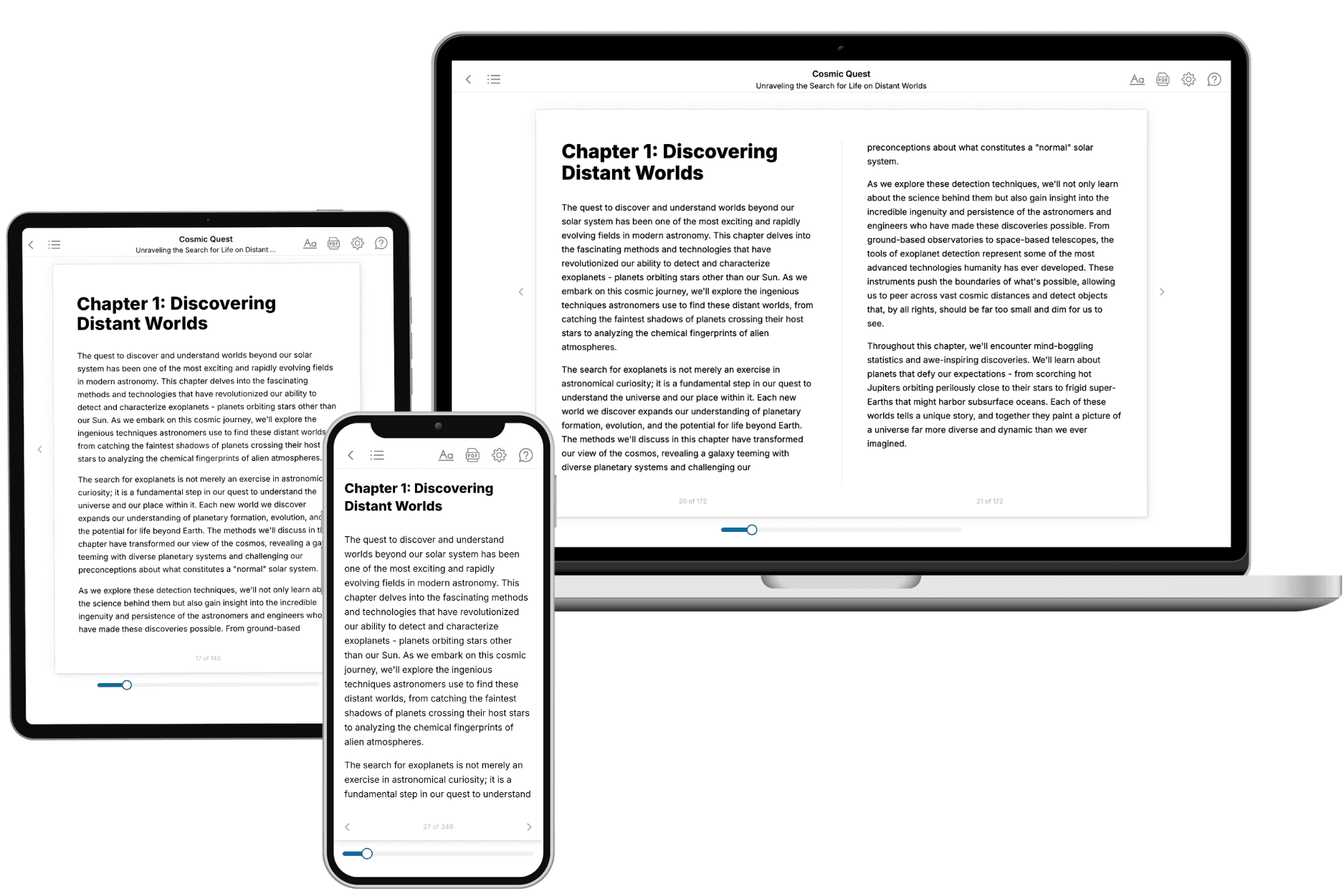
Your book is ready in 10 minutes. Read it online, download as EPUB or PDF, or send to Kindle.

Frequently asked questions
- What is TailoredRead?
TailoredRead creates complete, full-length nonfiction ebooks, written specifically for you. Tell us what you want to learn and why, and TailoredRead writes you a complete ebook on it, with charts, tables, and diagrams throughout. Read it online, on Kindle, or on any e-reader, or download it as a PDF or EPUB. Every book is written fresh the day you order it.
- How is the book tailored to me?
Before anything is written, you answer a few short questions about your goals, your background, and the topics you care about. Your book is then planned around your answers: written at your level, focused on your goals, and covering the topics you chose, instead of the one-size-fits-all book a store sells everyone.
- Will it read like generic AI content?
No. Your book isn't a chat transcript: it's planned chapter by chapter before a single word is written, told in a clear book voice, and explains ideas visually with charts, tables, and diagrams. After writing, every book goes through an editorial pass that polishes chapters so the book reads consistent from start to finish. Judge for yourself: browse thousands of sample books on our Explore Books page.
- How accurate is the content?
Our AI first checks whether your subject needs live research. Niche and fast-moving subjects are researched before writing, and the book plan and chapters are grounded in what it finds. After writing, every book goes through a quality pass that checks its facts and consistency, and researched books list their sources in a Notes section at the back.
- How long is the book?
You choose the length: Comprehensive (250-300 pages), Detailed (150-200 pages), Essential (70-100 pages), or Short (30-50 pages).
- Does the book include visuals?
Yes. Every book includes charts, tables, and diagrams: timelines, checklists, step-by-step guides, decision trees, comparison tables, matrices, and bar charts. A typical book includes dozens of these visual elements.
- Can I read it on Kindle? What formats can I download?
Yes. Every book can be read in our online reader or downloaded as a PDF or EPUB. The EPUB can be opened with Kindle, Apple Books, Kobo, and any e-reader. The Commercial and Author licenses also include an editable Word (DOCX) and Markdown download.
- How much does it cost?
About the price of a regular ebook. The exact price depends on your book's length and complexity, from $2 for the shortest books to $35 for the most comprehensive, and it's shown when you review your book, before you commit to anything. Each book is a one-time purchase, yours to keep, no subscription. Licenses that let you share, teach, or publish your book range from $35.99 to $49.99.
- Can I preview the book before purchasing?
Before you pay, you'll see what your book will cover: the title, a detailed description, the estimated length, and the complete chapter-by-chapter table of contents, so you know what you're getting before you decide. The full text itself is written after you purchase.
- How long does it take to create a book?
About 10 minutes. You can start reading the opening chapters while the rest is still being written.