The Compromise of 1877
How America's Backroom Deal Ended Reconstruction and Shaped a Nation
Imagine understanding the single moment that fundamentally altered the trajectory of American race relations and democracy for the next century.
207 pages10 chaptersMar 14, 2026United States History
About this book
The Compromise of 1877 was that moment—a backroom deal that decided a presidential election and abandoned millions of Americans to systematic oppression. This book reveals how Republican and Democratic elites negotiated away the rights of freed slaves in exchange for political power, effectively ending Reconstruction and ushering in the Jim Crow era. Through meticulous historical analysis, you'll discover the key players, their motivations, and the secret negotiations that shaped this pivotal agreement. You'll understand how a single compromise created the conditions for decades of segregation, disenfranchisement, and racial violence. More importantly, you'll gain insight into how political power operates, how constitutional principles can be compromised, and why this moment remains essential to understanding modern America. This is not just history—it's a crucial lesson in how political decisions made in elite circles can transform the lives of millions.
Table of contents
- IntroductionWhy 1877 Matters Today, What You'll Learn in This Book, How to Use This BookRead below
- Chapter 1: Reconstruction and Its PromiseThe Civil War's Aftermath and Reconstruction Goals, Radical Reconstruction: Federal Protection and Black Citizenship, Southern Resistance and the Rise of Redemption, The Decline of Federal Will and Northern Fatigue
- Chapter 2: The Disputed Election of 1876Hayes, Tilden, and the Campaign, Election Night and the Disputed Results, A Constitutional Crisis Unfolds, The Electoral Commission and Its Controversial Decisions
- Chapter 3: The Architects of CompromiseRepublican Leaders and Their Interests, Democratic Strategists and Southern Demands, Moderate Voices and Backroom Negotiators
- Chapter 4: The Secret NegotiationsThe Wormley Hotel Meeting and Other Backroom Deals, What Was Promised: The Terms of the Deal, Why Secrecy Mattered and Who Knew What
- Chapter 5: The Terms of the CompromiseHayes Gets the Presidency, Federal Troops Withdraw from the South, Southern Concessions and Infrastructure Investment, The Unspoken Cost: Black Rights Abandoned
- Chapter 6: Immediate Consequences and ImplementationHayes Takes Office and Troops Depart, Southern Redemption: White Democratic Control Restored, The Black Community's Response and Resistance
- Chapter 7: The Rise of Jim CrowDisenfranchisement Strategies: Literacy Tests and Poll Taxes, Segregation Laws and Separate But Equal, Violence, Intimidation, and Racial Terror, Economic Exploitation and Sharecropping
- Chapter 8: Long-Term Consequences and Historical SignificanceA Century of Segregation and Oppression, Political Realignment and the Solid South, Regional Development and Economic Inequality, The Long Path to Civil Rights and Reconstruction's Legacy
- Chapter 9: Interpreting 1877: Historical PerspectivesWas the Compromise Necessary or Inevitable?, Alternative Outcomes and Counterfactual History, How Historians' Understanding Has Evolved
- Chapter 10: Lessons for the Modern EraWhen Political Compromise Comes at Human Cost, The Fragility of Constitutional Governance, How Power Operates Behind Democratic Institutions
- ConclusionUnderstanding 1877 in Full Context, Moving Forward with Historical Awareness
- Further Reading and Resources
Introduction
There are moments in history that don't announce themselves as turning points. They arrive quietly, in hotel rooms and private parlors, spoken in hushed voices between men who understand exactly what they are trading away. The Compromise of 1877 was one of those moments. On the surface, it resolved a constitutional crisis over a disputed presidential election. Beneath the surface, it was something far more consequential: a deliberate decision by America's political elite to abandon millions of Black citizens in exchange for political stability and sectional peace.
The deal struck in the winter of 1876 and 1877 effectively ended Reconstruction, the ambitious federal effort to rebuild the South and integrate formerly enslaved people into American civic life. When Republican and Democratic negotiators reached their agreement, they were not simply deciding who would occupy the White House. They were deciding, with full awareness of the consequences, that the federal government would no longer stand between Southern Black communities and the forces determined to strip them of their rights. The results of that decision shaped American society for nearly a century.
Understanding this compromise is not merely an exercise in historical curiosity. It is essential context for understanding how American democracy actually functions, how political power operates behind institutional facades, and how the choices made by a small group of elites can reverberate across generations. The patterns established in 1877, including the disenfranchisement of Black voters, the entrenchment of racial segregation, and the subordination of civil rights to political convenience, did not disappear until the Civil Rights Movement forced a national reckoning nearly ninety years later. In many ways, the echoes of 1877 have never fully gone silent.
This book tells the full story of the Compromise of 1877: where it came from, how it was negotiated, what it cost, and why it still matters. It draws on the historical record to reconstruct the backroom conversations, the competing interests, and the human consequences of a deal that most Americans have never fully examined. The story is complicated, morally troubling, and deeply instructive. It deserves to be told clearly and completely.
Why 1877 Matters Today
Most Americans learn about Reconstruction in school, but the story often ends abruptly, with a vague sense that it "failed" before moving on to the Gilded Age. What gets lost in that transition is the specific mechanism of failure: a deliberate political transaction that traded Black civil rights for partisan advantage. The Compromise of 1877 is that mechanism, and understanding it changes how you see everything that followed, from Jim Crow laws to the Civil Rights Movement to ongoing debates about voting rights and racial equity.
The compromise matters today because it established a template. It demonstrated that constitutional protections for marginalized groups could be negotiated away when powerful interests found it convenient to do so. The Fourteenth and Fifteenth Amendments, which guaranteed equal protection and voting rights for Black men, did not disappear after 1877. They remained in the Constitution. But the federal will to enforce them evaporated, and that evaporation was not accidental. It was the direct result of a political bargain.[1]
Consider the scale of what was lost. During Reconstruction, Black men voted in large numbers across the South. They served in state legislatures, in Congress, and in local offices. Schools were built, communities organized, and the foundations of Black civic life were laid. Within a decade of the compromise, virtually all of that had been dismantled. By 1900, Black voter registration in Mississippi had fallen from tens of thousands to a few hundred. That collapse did not happen naturally. It was engineered, and the compromise of 1877 gave it the political space to occur.
The relevance to modern debates is direct and undeniable. Discussions about voter suppression, gerrymandering, and the enforcement of civil rights laws all have roots in the post-1877 era. When the Supreme Court weakened the Voting Rights Act in Shelby County v. Holder in 2013, legal scholars and historians immediately drew comparisons to the federal retreat of 1877.[2] The historical parallel was not rhetorical flourish. It was a recognition that the same structural dynamics, federal protection withdrawn, states empowered to restrict access, vulnerable communities left exposed, had reappeared in a new form.
There is also a broader lesson about how political systems work. The Compromise of 1877 was not the product of public deliberation or democratic debate. It was negotiated in private by party insiders who understood that their deal would never survive public scrutiny. The secrecy was not incidental. It was essential. That dynamic, where consequential decisions affecting millions are made by a small group of elites operating outside public view, is not unique to 1877. Recognizing it in historical context helps you identify it in contemporary politics.
Finally, 1877 matters because it complicates the comfortable narrative of American progress. The United States did not simply move steadily forward from slavery toward freedom and equality. There were reversals, and the compromise of 1877 was the most significant reversal of the nineteenth century. Acknowledging that reversal honestly, understanding its causes and its costs, is a prerequisite for understanding where the country has been and where it still needs to go.
A key insight: The Compromise of 1877 did not just end Reconstruction. It actively reversed it, dismantling protections that had been built over more than a decade and replacing federal oversight with state-level power that was immediately used to oppress Black citizens. The distinction between "failing to protect" and "actively enabling harm" is crucial to understanding the moral weight of what happened.
Historians have debated for generations whether the compromise was inevitable, whether Reconstruction was already doomed, and whether the negotiators had any real alternative. Those debates are worth engaging seriously, and this book does engage them. But the starting point must be a clear-eyed recognition of what the compromise actually did and who it actually harmed. Without that foundation, the historical analysis floats free of its human consequences.
What You'll Learn in This Book
This book is organized to take you through the full arc of the Compromise of 1877, from the conditions that made it possible to the consequences that made it catastrophic. Each chapter builds on the previous one, so by the time you reach the final pages, you will have a complete picture of one of the most consequential and least understood episodes in American history.
The journey begins with Reconstruction itself. Before you can understand what was lost in 1877, you need to understand what had been built. Chapter 1 examines the goals and achievements of Reconstruction, the federal programs and constitutional amendments that transformed the legal status of Black Americans, and the fierce resistance those changes provoked from white Southerners determined to restore the racial hierarchy of the antebellum South. This context is not background noise. It is the essential foundation for everything that follows.
From there, the book moves to the election of 1876, which was genuinely one of the most chaotic and contested in American history. You will learn about the candidates, Rutherford B. Hayes for the Republicans and Samuel Tilden for the Democrats, and about the specific disputes in Florida, Louisiana, and South Carolina that threw the outcome into doubt. The constitutional crisis that followed was real and serious. Understanding it requires understanding both the mechanics of the Electoral College and the political pressures that made a negotiated resolution seem necessary.
The heart of the book covers the negotiations themselves. This includes:
- The key figures on both sides and what they were trying to achieve
- The specific venues where deals were struck, including the famous Wormley Hotel meeting
- The explicit and implicit terms of the agreement
- The role of secrecy in making the deal possible
- What each party gained and what was sacrificed to make the numbers work
After the negotiations, the book examines the immediate aftermath: Hayes's inauguration, the withdrawal of federal troops from the South, and the rapid reassertion of white Democratic control across the former Confederate states. This section pays particular attention to the Black community's response, which ranged from organized resistance to the heartbreaking recognition that the federal government had chosen to look away.
The long-term consequences receive sustained attention in the chapters on Jim Crow and the century of segregation that followed. You will learn about the specific mechanisms used to disenfranchise Black voters, including literacy tests, poll taxes, grandfather clauses, and outright violence. You will understand how the legal architecture of segregation was constructed and how it was maintained through a combination of law, custom, and terror. These chapters are not easy reading, but they are necessary reading for anyone who wants to understand the full cost of the 1877 compromise.
The book also engages seriously with historical debate. Historians have not always agreed about the compromise, its necessity, its alternatives, or its significance. Chapter 9 walks through the major interpretive frameworks that scholars have applied to 1877, from the early twentieth-century view that Reconstruction was a misguided experiment to the revisionist scholarship of the civil rights era and beyond. Understanding how historical interpretation has evolved is itself an important lesson in how societies process their own difficult pasts.
The final chapter draws explicit connections between 1877 and the present day. The lessons here are not abstract. They concern the fragility of constitutional protections when political will to enforce them disappears, the way elite negotiations can override democratic principles, and the long shadow that a single political compromise can cast across generations. These lessons are as relevant now as they were in the Gilded Age.
By the end of this book, you will have a thorough, nuanced understanding of the Compromise of 1877 that goes well beyond what most history courses provide. More importantly, you will have a framework for thinking about political compromise, constitutional governance, and the relationship between power and rights that you can apply to contemporary events.
How to Use This Book
This book is designed to be read straight through, from Chapter 1 to the conclusion, because the story it tells is cumulative. Each chapter builds on what came before, and the full weight of the compromise only becomes clear when you have followed the complete arc from Reconstruction's promise to Jim Crow's reality. That said, if you already have a strong background in Reconstruction history, you may find it useful to move more quickly through the early chapters and spend more time with the negotiation and consequence sections.
Throughout the book, you will encounter several recurring features designed to deepen your engagement with the material. Historical context boxes provide background on specific events, figures, or concepts that are relevant to the main narrative but would interrupt the flow if included in the body text. Key term definitions appear when specialized historical or political vocabulary is introduced, ensuring that the analysis remains accessible regardless of your prior background. Footnotes point you toward primary sources and major scholarly works for each topic, so you can pursue any thread that particularly interests you.
The book also includes several features specifically designed to help you connect historical events to broader analytical frameworks:
- Comparative examples that place the 1877 compromise in the context of other political deals and their consequences
- Counterfactual questions that invite you to consider what might have happened under different circumstances
- Contemporary connections that draw explicit lines between nineteenth-century events and modern political dynamics
- Primary source excerpts that let you hear directly from the people who lived through these events
One important note about sources and interpretation: this book draws heavily on the revisionist and post-revisionist scholarship that has dominated academic history since the 1960s. Historians like Eric Foner, C. Vann Woodward, and more recently scholars like Douglas Egerton and Gregory Downs have fundamentally transformed our understanding of Reconstruction and its end.[3] This book engages with that scholarship seriously, but it also acknowledges where historians disagree and where the historical record leaves genuine uncertainty. History is not a settled body of facts. It is an ongoing conversation, and the best way to engage with it is to understand the debates, not just the conclusions.
You will also notice that this book does not shy away from moral judgment. Some historical writing tries to maintain a studied neutrality that treats all political actors as equally reasonable people responding to their circumstances. That approach has its place, but it can also obscure the human costs of political decisions. The Compromise of 1877 had real victims: millions of Black Americans whose rights were traded away by men who knew exactly what they were doing. Acknowledging that moral reality does not require abandoning historical rigor. It requires combining rigorous analysis with honest recognition of consequences.
If you are a student using this book for coursework, the chapter structure maps well onto a seminar format, with each chapter providing enough material for a focused discussion session. The footnotes and further reading section at the end of the book will point you toward the primary and secondary sources you will need for research papers. If you are a general reader coming to this topic out of personal interest, the book is designed to be engaging and accessible without sacrificing depth or accuracy.
Consider keeping a notebook nearby as you read. The Compromise of 1877 raises questions that extend well beyond the specific events of 1876 and 1877. Questions about when political compromise is legitimate and when it becomes complicity, about how constitutional protections can be rendered meaningless without being formally repealed, about who gets to make decisions that affect millions of people who have no seat at the table. These are not just historical questions. They are live questions in contemporary American politics, and thinking through them carefully as you read will make the historical material more meaningful and more useful.
The story you are about to read is not a comfortable one. It involves betrayal, cynicism, and the deliberate sacrifice of vulnerable people for political gain. But it is also a story about resilience, resistance, and the long struggle to hold America to its stated ideals. Both parts of that story deserve to be told, and both parts deserve your full attention. The Compromise of 1877 is not just a chapter in American history. It is a lens through which the entire American experiment comes into sharper, more honest focus.
A note on terminology: Throughout this book, the term "Black" is used (capitalized) to refer to African Americans and their communities, following current scholarly and journalistic convention. The term "white" is used (lowercase) in accordance with the same style guidelines. Historical terms that were common in the nineteenth century but are now considered offensive are used only when directly quoting historical sources, and their use in those contexts is clearly marked. The goal is to discuss this history with both accuracy and respect for the people whose lives it describes.
Notes
Introduction
- 1. Eric Foner, Reconstruction: America's Unfinished Revolution, 1863-1877, Harper & Row, 1988
- 2. Shelby County v. Holder, 570 U.S. 529 (2013). See also Berman, Ari (2015). Give Us the Ballot: The Modern Struggle for Voting Rights in America. Farrar, Straus and Giroux.
- 3. Woodward and C. Vann, Reunion and Reaction: The Compromise of 1877 and the End of Reconstruction, Little, Brown and Company, 1951
This is the end of the free sample. The full book has 10 chapters.
Want this book written for you?
Tell us your goals and background, and get your own version of this book, tailored by AI to you.


Benefits of AI-tailored books
- Read one book, not ten:
- all the United States History knowledge you need, gathered into a single book.
- Save days of learning:
- tell us your goals, choose your topics, and the whole book is built around them.
- Learn effortlessly:
- United States History book written for your specific background and expertise.
- Understand at a glance:
- includes charts, tables, timelines, checklists, decision trees, and more.
- Stay current:
- written the day you order it, not years ago.
- Trust what you read:
- every book is checked for accuracy, with real research when your subject needs it.
Create your unique book in 3 steps
- 1. Select your focus
Select the focus of your United States History book and share your background
- 2. Personalize your book
Specify your goals and choose sub-topics to include
- 3. Get your tailored book
Your book is ready in 10 minutes. Read it online, download as EPUB or PDF, or send to Kindle.


Frequently asked questions
- What is TailoredRead?
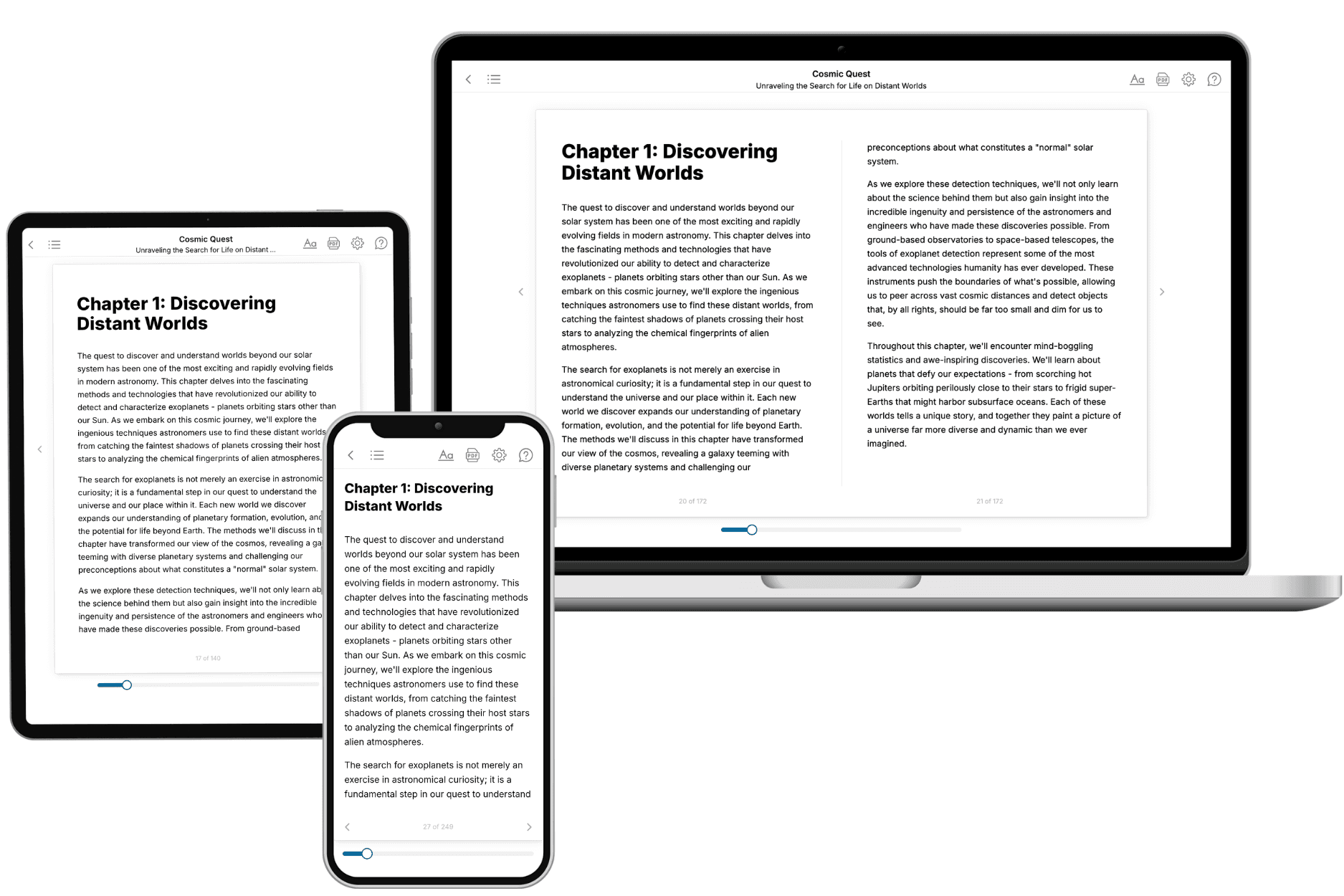
TailoredRead creates complete, full-length nonfiction ebooks, written specifically for you. Tell us what you want to learn and why, and TailoredRead writes you a complete ebook on it, with charts, tables, and diagrams throughout. Read it online, on Kindle, or on any e-reader, or download it as a PDF or EPUB. Every book is written fresh the day you order it.
- How is the book tailored to me?
Before anything is written, you answer a few short questions about your goals, your background, and the topics you care about. Your book is then planned around your answers: written at your level, focused on your goals, and covering the topics you chose, instead of the one-size-fits-all book a store sells everyone.
- Will it read like generic AI content?
No. Your book isn't a chat transcript: it's planned chapter by chapter before a single word is written, told in a clear book voice, and explains ideas visually with charts, tables, and diagrams. After writing, every book goes through an editorial pass that polishes chapters so the book reads consistent from start to finish. Judge for yourself: browse thousands of sample books on our Explore Books page.
- How accurate is the content?
Our AI first checks whether your subject needs live research. Niche and fast-moving subjects are researched before writing, and the book plan and chapters are grounded in what it finds. After writing, every book goes through a quality pass that checks its facts and consistency, and researched books list their sources in a Notes section at the back.
- How long is the book?
You choose the length: Comprehensive (250-300 pages), Detailed (150-200 pages), Essential (70-100 pages), or Short (30-50 pages).
- Does the book include visuals?
Yes. Every book includes charts, tables, and diagrams: timelines, checklists, step-by-step guides, decision trees, comparison tables, matrices, and bar charts. A typical book includes dozens of these visual elements.
- Can I read it on Kindle? What formats can I download?
Yes. Every book can be read in our online reader or downloaded as a PDF or EPUB. The EPUB can be opened with Kindle, Apple Books, Kobo, and any e-reader. The Commercial and Author licenses also include an editable Word (DOCX) and Markdown download.
- How much does it cost?
About the price of a regular ebook. The exact price depends on your book's length and complexity, from $2 for the shortest books to $35 for the most comprehensive, and it's shown when you review your book, before you commit to anything. Each book is a one-time purchase, yours to keep, no subscription. Licenses that let you share, teach, or publish your book range from $35.99 to $49.99.
- Can I preview the book before purchasing?
Before you pay, you'll see what your book will cover: the title, a detailed description, the estimated length, and the complete chapter-by-chapter table of contents, so you know what you're getting before you decide. The full text itself is written after you purchase.
- How long does it take to create a book?
About 10 minutes. You can start reading the opening chapters while the rest is still being written.