The Conflict of Interest Playbook
How to Navigate, Identify, and Resolve Competing Loyalties in Governance and Politics
What happens when the people making decisions have financial stakes in the outcomes?
222 pages10 chaptersJul 30, 2026Governance
About this book
Conflicts of interest are woven into the fabric of governance and politics, yet most people struggle to recognize them, let alone manage them effectively. This book cuts through the confusion with practical, actionable guidance on identifying conflicts before they become scandals, managing them transparently, and building institutions that resist corruption. You'll learn the difference between actual and perceived conflicts, discover why disclosure matters more than prohibition, and explore real-world case studies that illustrate how conflicts play out across government, nonprofits, and corporate boards. Whether you're a policymaker, board member, or simply someone who cares about institutional integrity, you'll gain the frameworks and tools to navigate competing loyalties with confidence and protect the institutions you serve.
Table of contents
- IntroductionWhy Conflicts of Interest Matter in Modern Governance, What This Book Covers and How to Use It, The Real-World Stakes: From Local Boards to National PolicyRead below
- Chapter 1: Understanding Conflicts of InterestDefining Conflicts of Interest: Beyond the Obvious, Three Types: Actual, Potential, and Perceived Conflicts, Why Conflicts Arise: The Nature of Competing Loyalties
- Chapter 2: The Anatomy of Institutional CorruptionHow Conflicts Escalate: From Disclosure Failure to Corruption, Systemic Vulnerabilities: Where Institutions Break Down, Case Studies: How Real Conflicts Became Real Problems
- Chapter 3: Disclosure and TransparencyThe Power of Disclosure: Why Transparency Prevents Corruption, What to Disclose: Financial Interests, Relationships, and Obligations, Disclosure Mechanisms: Forms, Timing, and Public Access
- Chapter 4: Managing Conflicts: Practical Tools and StrategiesRecusal and Abstention: When to Step Back, Divestment and Blind Trusts: Separating Yourself from Interests, Structural Solutions: Redesigning Roles and Responsibilities
- Chapter 5: Conflicts in Government and Public ServiceElected Officials: Campaign Finance, Lobbying, and Post-Service Employment, Civil Servants: Navigating Impartiality and Personal Interests, Regulatory Agencies: The Revolving Door and Industry Influence
- Chapter 6: Conflicts in Nonprofit and Board GovernanceBoard Member Conflicts: Fiduciary Duties and Self-Dealing, Nonprofit-Specific Issues: Compensation, Related-Party Transactions, and Mission Drift, Managing Board Conflicts: Policies, Committees, and Accountability
- Chapter 7: Systemic Conflicts: Campaign Finance, Lobbying, and Political InfluenceCampaign Finance: How Money Creates Structural Conflicts, Lobbying and Access: The Influence Industry, The Revolving Door: Government Service and Private Sector Employment
- Chapter 8: Building Conflict-Resistant InstitutionsPolicy Frameworks: Creating Clear Standards and Expectations, Training and Culture: Building Ethical Awareness and Accountability, Enforcement Mechanisms: Consequences and Accountability
- Chapter 9: Perception, Trust, and Public ConfidenceThe Appearance of Impropriety: Why Perception Matters as Much as Reality, Building and Maintaining Public Trust Through Conflict Management, Communication Strategy: How to Explain Conflicts and Resolutions
- Chapter 10: Navigating Conflicts in Your RolePersonal Assessment: Identifying Your Own Potential Conflicts, Decision-Making Framework: When and How to Act, Seeking Guidance: Ethics Officers, Legal Counsel, and Institutional Resources
- ConclusionKey Takeaways: The Essentials of Conflict Management, The Future of Governance: Toward More Transparent and Accountable Institutions
- Glossary
- Further Reading and Resources
Introduction
A city council member votes to approve a zoning change that benefits a real estate developer. She also happens to own shares in that developer's parent company. Nobody asks. Nobody checks. The vote passes. Six months later, a local journalist pulls the financial disclosure forms, and the story runs on the front page. The council member insists her vote was based purely on the merits. Maybe it was. But the damage to public confidence is already done, and no amount of explanation fully repairs it. That gap between what actually happened and what the public now believes is where conflicts of interest do their most lasting harm.
Situations like this play out constantly across every level of governance, from small municipal boards to federal regulatory agencies. The people involved are not always corrupt. Many are experienced, well-intentioned professionals who simply did not recognize the problem in front of them, or who recognized it and assumed their good judgment was enough to manage it. That assumption is one of the most common and costly mistakes in public life. Good intentions do not neutralize a Conflict of Interest. Only deliberate, structured management does.
This book is built around a straightforward premise: conflicts of interest are not exceptional events that happen to bad actors. They are a predictable feature of governance and politics, arising naturally whenever people hold multiple roles, relationships, or financial stakes at the same time. The question is never whether conflicts will appear. The question is whether the people and institutions involved are equipped to recognize them, disclose them honestly, and manage them in ways that protect both the decision and the decision-maker. That is a learnable skill set, and this book lays it out in practical terms.
The chapters ahead move from foundational concepts to sector-specific applications to personal action frameworks. Whether you are an elected official, a civil servant, a nonprofit board member, a policy advisor, or a citizen trying to make sense of what you see in the news, the frameworks here are designed to be immediately useful. The goal is not to make governance conflict-free, which is impossible, but to make it conflict-aware, which is entirely achievable with the right tools and habits in place.
Why Conflicts of Interest Matter in Modern Governance
Governance depends on a basic social contract: the people making decisions on behalf of the public are doing so in the public's interest, not their own. When that contract is broken, or even appears to be broken, the consequences extend far beyond any single decision. Public trust erodes. Institutions lose legitimacy. And once legitimacy is lost, it is extraordinarily difficult to rebuild. Research on institutional trust consistently shows that perceived corruption and self-dealing are among the strongest predictors of public disengagement from civic life.[1] The stakes, in other words, are not just ethical. They are structural.
Modern governance has made the conflict problem more complex, not less. Officials today operate in environments where financial portfolios are diversified across dozens of industries, where professional networks span the public and private sectors, and where the line between policy expertise and industry advocacy is frequently blurred. A regulator who spent fifteen years in the pharmaceutical industry before joining a drug approval agency brings genuine expertise. She also brings relationships, loyalties, and financial interests that may not align with the public mission she now serves. Both things are true simultaneously, and pretending otherwise helps no one.
The three categories that structure most conflict analysis are the Actual Conflict, the Potential Conflict, and the Perceived Conflict. An Actual Conflict exists when a decision-maker's private interest directly affects, or is directly affected by, a decision they are making in their official capacity. A Potential Conflict exists when the circumstances could produce that direct effect under foreseeable conditions. A Perceived Conflict exists when a reasonable outside observer would conclude that a conflict is present, regardless of whether one actually is. All three categories matter. All three require management. The chapter on foundational definitions explores each in depth, but understanding that these distinctions exist is the starting point for everything else in this book.
The cost of ignoring conflicts is not hypothetical. Regulatory agencies captured by the industries they oversee have approved products that harmed consumers. Municipal officials with undisclosed financial ties to contractors have steered public contracts toward those contractors at inflated prices. Nonprofit boards with self-dealing members have diverted charitable resources toward private benefit. These are not rare edge cases. They are documented patterns that repeat across jurisdictions and sectors because the underlying conditions that produce them, competing loyalties, inadequate disclosure, and weak accountability, are common features of institutional life.[2]
What makes conflicts particularly dangerous is the Normalization of Deviance that tends to develop around them over time. When a minor undisclosed interest goes unaddressed, it sets a precedent. The next undisclosed interest is slightly larger, and it also goes unaddressed. Gradually, the informal standard shifts. What was once understood as a clear violation becomes accepted practice. By the time the pattern becomes visible to outsiders, the institution has often traveled a long way down the Escalation Pathway from a single lapse to something that looks much more like Institutional Corruption. The chapter on institutional corruption traces this pathway in detail, using real case studies to show how the slide happens and where it could have been interrupted.
Understanding why conflicts matter is not just an academic exercise. It is the foundation for every practical decision covered in the rest of this book. When you understand what is actually at risk, the discipline required to manage conflicts properly starts to feel less like bureaucratic compliance and more like genuine professional responsibility. That shift in perspective is worth making early, because it changes how you approach every situation that follows.
The Transparency Principle sits at the center of modern conflict management for a reason. Disclosure does not eliminate a conflict, but it transforms the conflict from a hidden liability into a managed condition. An official who discloses a financial interest and then recuses herself from the relevant decision has done exactly what the system requires. An official who conceals the same interest and votes anyway has done something categorically different, even if the vote itself was substantively correct. The difference is not just legal. It is the difference between a system that can self-correct and one that cannot.
Conflicts of interest also matter because they are contagious in institutional terms. When one official's undisclosed conflict goes unaddressed, colleagues observe that the norm is not enforced. Some will conclude that disclosure is optional. Others will feel that their own careful compliance puts them at a competitive disadvantage. Over time, the culture shifts toward tolerance of undisclosed interests, and the institution becomes progressively harder to trust from the outside. Building conflict-resistant institutions, which is the focus of a later chapter, requires understanding this dynamic and designing systems that interrupt it before it takes hold.
What This Book Covers and How to Use It
This book is organized to move from the general to the specific and from the conceptual to the practical. The early chapters build the vocabulary and analytical framework you need to recognize and categorize conflicts accurately. The middle chapters apply those frameworks to specific sectors and situations. The later chapters focus on institutional design, public communication, and personal decision-making. Each chapter is designed to stand on its own if you need to jump to a specific topic, but the full arc of the book builds a cumulative understanding that is more useful than any single chapter in isolation.
The foundational chapter on understanding conflicts establishes the core vocabulary used throughout the book. Terms like Fiduciary Duty, Competing Loyalties, Disclosure Obligation, and Appearance of Impropriety are defined precisely and used consistently. This matters because loose language around conflicts of interest is itself a governance problem. When people use "conflict of interest" to mean anything from a minor scheduling overlap to outright bribery, the term loses its analytical usefulness. Precision in language enables precision in action.
The chapters on disclosure and management tools are the most immediately practical sections of the book. They cover:
- What must be disclosed, including financial interests, personal relationships, and organizational affiliations
- How disclosure forms work, when they must be filed, and who has access to them
- When Recusal or Abstention is required versus when it is merely advisable
- How Divestment and Blind Trusts work in practice and when each is appropriate
- Structural Redesign options for situations where individual management tools are insufficient
These are not abstract concepts. Each one is illustrated with concrete scenarios drawn from government, nonprofit, and board governance contexts so you can see exactly how the tool applies in practice.
The sector-specific chapters address the distinct conflict landscapes of government and public service, nonprofit and board governance, and the systemic conflicts embedded in the Campaign Finance System and the Lobbying Industry. Each sector has its own legal framework, its own professional norms, and its own characteristic failure modes. A civil servant navigating a potential conflict faces different constraints than a nonprofit board member facing a Related-Party Transaction, even though the underlying ethical principles are similar. The sector chapters make those distinctions explicit and provide guidance tailored to each context.
The chapter on systemic conflicts deserves special mention because it addresses a category of problem that individual actors cannot solve on their own. The Revolving Door between government service and private sector employment, the influence of Dark Money and Super PACs on elected officials, and the structural dependencies created by the lobbying industry are not conflicts that any single official can manage through personal virtue or careful disclosure. They require policy-level solutions, and understanding them as structural rather than individual problems is essential for anyone working on governance reform.
The final chapters shift to institutional design and personal practice. The chapter on building conflict-resistant institutions covers Conflict-of-Interest Policy design, Ethics Training programs, Whistleblower Protection mechanisms, and the role of the Ethics Officer in maintaining accountability. The chapter on perception and trust addresses the Appearance of Impropriety standard and explains why managing public perception is a legitimate governance responsibility, not just a public relations concern. The closing chapter on personal navigation provides a Personal Conflict Assessment framework and a Decision-Making Framework you can apply to your own role immediately.
How you use this book will depend on where you are starting from. If you are new to formal conflict-of-interest frameworks, reading straight through will give you the most complete foundation. If you are already familiar with the basics and need guidance on a specific situation, the sector chapters and the management tools chapter are the most directly applicable. If you are working on institutional policy or reform, the chapters on institutional design and systemic conflicts will be most relevant. The glossary at the back of the book provides quick reference definitions for all canonical terms used throughout.
One thing this book does not do is provide legal advice for specific situations. Conflict-of-interest law varies significantly across jurisdictions, levels of government, and organizational types. The frameworks here are designed to help you think clearly about conflicts and make better decisions, but when a specific legal question arises, consulting qualified legal counsel or your institution's Ethics Officer is always the right move. The chapter on seeking guidance covers exactly how to do that effectively.
The Real-World Stakes: From Local Boards to National Policy
The scale of a governance role does not determine the significance of a conflict of interest. A school board member who votes to award a facilities contract to her brother's construction company is engaging in Self-Dealing with consequences that are immediate and concrete: public money flows to a private interest, the competitive bidding process is corrupted, and the community loses confidence in the board's independence. The dollar amounts may be modest compared to federal contracting scandals, but the structural harm is identical. Conflicts at the local level are not minor versions of the real problem. They are the real problem, experienced by the communities most directly affected by the decisions involved.
At the national level, the stakes multiply in proportion to the scope of the decisions being made. Consider the dynamics of Regulatory Capture, the process by which a regulatory agency comes to serve the interests of the industry it is supposed to oversee rather than the public interest. When senior officials at a financial regulator have spent their careers at the banks they now supervise, and when they know they may return to those banks after their government service ends, the incentive structure is fundamentally compromised. The decisions they make about capital requirements, enforcement priorities, and rule interpretations affect the entire financial system. The conflicts embedded in those decisions are not personal failings. They are structural features of how the revolving door operates, and they require structural solutions.[3]
The nonprofit sector presents its own version of high stakes. Charitable organizations exist to serve a public or community mission, and they receive significant tax advantages in exchange for that commitment. When board members or executives engage in Related-Party Transactions that benefit themselves or their associates, they are not just violating fiduciary duty. They are diverting resources that were donated or granted for a specific public purpose. The harm falls on the beneficiaries the organization was created to serve. Mission Drift, the gradual shift of an organization's activities away from its stated purpose toward the interests of its leadership, is one of the most insidious forms of conflict-driven harm in the nonprofit world because it happens slowly and is often invisible until significant damage has been done.
To make the stakes concrete, consider three scenarios that illustrate how conflicts play out differently depending on context:
Scenario A: The Planning Commissioner. A county planning commissioner owns a small stake in a commercial real estate partnership. The partnership has no active projects before the commission. He does not disclose the interest because he considers it immaterial. Two years later, the partnership acquires a parcel that requires a variance from the commission. He votes in favor. The variance is approved. A competing developer files a complaint. The investigation reveals the undisclosed interest. The variance is voided, the project is delayed by eighteen months, and the commissioner resigns. The conflict was manageable at the outset. The failure to disclose transformed it into a crisis.
Scenario B: The Agency Director. A federal agency director responsible for approving new pharmaceutical products previously served as a senior executive at one of the major drug manufacturers. She recuses herself from decisions involving her former employer and files the required financial disclosures. Her recusal is documented, her decisions on other matters are made transparently, and her former employer's applications are handled by a designated deputy. The potential conflict is real, but it is managed correctly. No scandal follows because the system worked as designed.
Scenario C: The Nonprofit Board Chair. A nonprofit board chair approves a consulting contract with a firm owned by his spouse without disclosing the relationship to the full board. The contract is renewed annually for four years. A new board member eventually asks about the vendor selection process. The relationship is discovered. The organization faces an IRS inquiry, loses a major foundation grant, and spends two years rebuilding donor confidence. The financial cost of the consulting contracts was modest. The reputational and operational cost of the undisclosed conflict was enormous.
These scenarios share a common structure. In each case, the conflict itself was not the ultimate problem. The problem was the failure to disclose and manage it properly. Scenario B shows that the same type of conflict, a prior industry relationship, can be handled in a way that protects both the official and the institution. The difference between Scenario A and Scenario B is not the nature of the conflict. It is the presence or absence of deliberate management.
The Reputational Risk dimension of conflicts deserves particular attention because it operates independently of legal liability. An official can be entirely within the law and still cause serious institutional damage through the Appearance of Impropriety. The standard used in most ethics frameworks is not whether a conflict actually influenced a decision, but whether a reasonable, informed member of the public would conclude that it might have. That is a higher bar than legal compliance, and it is the right bar for public service. The chapter on perception and trust explores this standard in depth and provides practical guidance on how to apply it to real situations.
Public Trust is not an abstract value. It is the operating condition that makes governance possible. When citizens trust that decisions are being made in the public interest, they comply with regulations, pay taxes, participate in civic processes, and accept outcomes they disagree with because they believe the process was fair. When that trust breaks down, compliance becomes coercive, civic participation declines, and the legitimacy of institutions erodes in ways that are very difficult to reverse. Managing conflicts of interest is, at its most fundamental level, an act of institutional maintenance. It keeps the machinery of governance working in the way it is supposed to work.
The tools and frameworks in this book are not designed for a world where conflicts are rare exceptions. They are designed for the world as it actually exists, where competing loyalties are a normal feature of professional life in governance and politics, where the line between public duty and private interest is frequently tested, and where the difference between a well-managed institution and a scandal-ridden one often comes down to whether the people involved had the knowledge and the habits to handle conflicts correctly when they arose. That knowledge starts here.
Notes
Introduction
- 1. Bo Rothstein and Jan Teorell, "What Is Quality of Government?," Governance, 2008
- 2. Dennis Thompson, "Mediated Corruption: The Case of the Keating Five," American Political Science Review, 1993
- 3. James Kwak, "Cultural Capture and the Financial Crisis," in Preventing Regulatory Capture, Cambridge University Press, 2014
This is the end of the free sample. The full book has 10 chapters.
Want this book written for you?
Tell us your goals and background, and get your own version of this book, tailored by AI to you.


Benefits of AI-tailored books
- Read one book, not ten:
- all the Governance knowledge you need, gathered into a single book.
- Save days of learning:
- tell us your goals, choose your topics, and the whole book is built around them.
- Learn effortlessly:
- Governance book written for your specific background and expertise.
- Understand at a glance:
- includes charts, tables, timelines, checklists, decision trees, and more.
- Stay current:
- written the day you order it, not years ago.
- Trust what you read:
- every book is checked for accuracy, with real research when your subject needs it.
Create your unique book in 3 steps
- 1. Select your focus
Select the focus of your Governance book and share your background
- 2. Personalize your book
Specify your goals and choose sub-topics to include
- 3. Get your tailored book
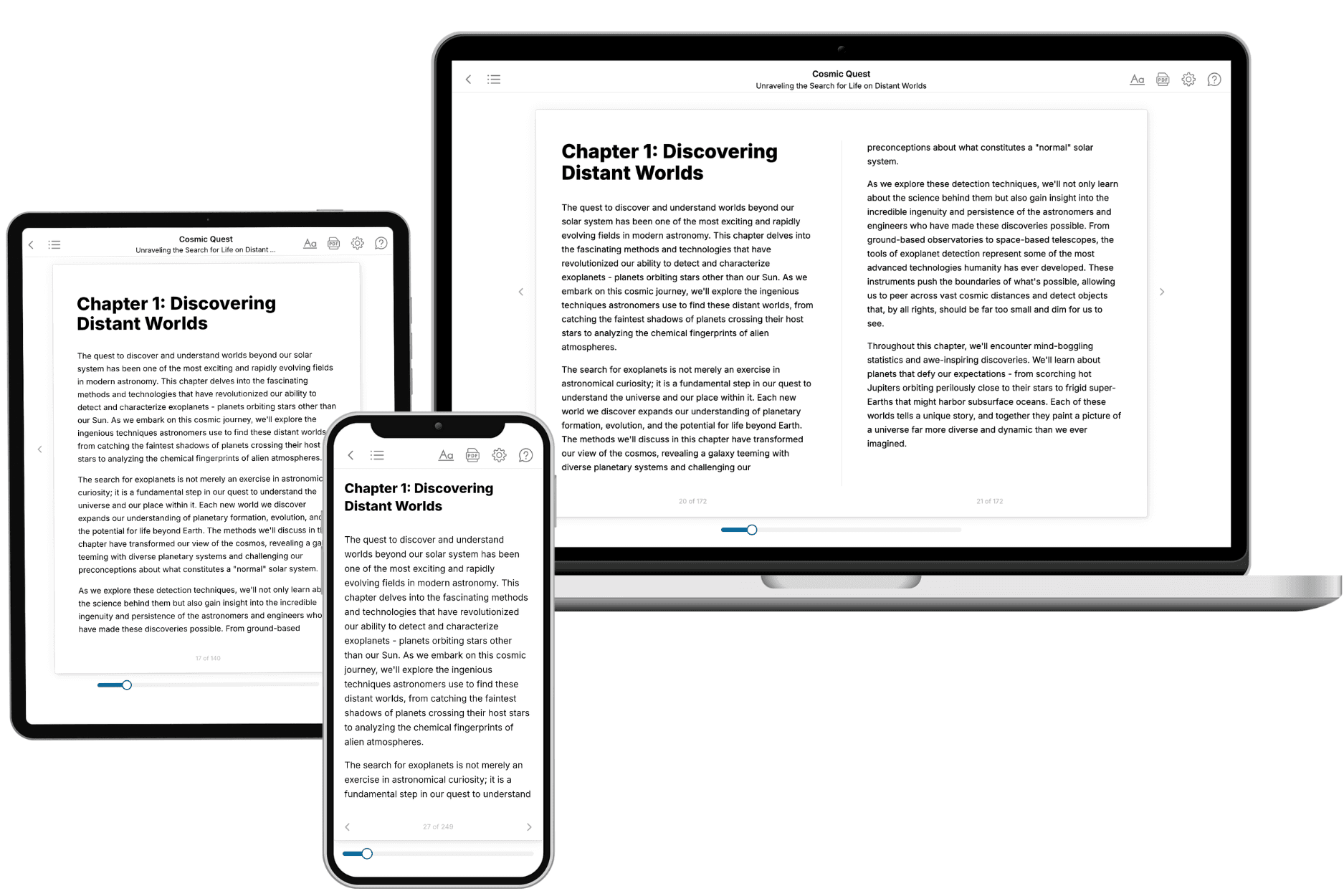
Your book is ready in 10 minutes. Read it online, download as EPUB or PDF, or send to Kindle.

Frequently asked questions
- What is TailoredRead?
TailoredRead creates complete, full-length nonfiction ebooks, written specifically for you. Tell us what you want to learn and why, and TailoredRead writes you a complete ebook on it, with charts, tables, and diagrams throughout. Read it online, on Kindle, or on any e-reader, or download it as a PDF or EPUB. Every book is written fresh the day you order it.
- How is the book tailored to me?
Before anything is written, you answer a few short questions about your goals, your background, and the topics you care about. Your book is then planned around your answers: written at your level, focused on your goals, and covering the topics you chose, instead of the one-size-fits-all book a store sells everyone.
- Will it read like generic AI content?
No. Your book isn't a chat transcript: it's planned chapter by chapter before a single word is written, told in a clear book voice, and explains ideas visually with charts, tables, and diagrams. After writing, every book goes through an editorial pass that polishes chapters so the book reads consistent from start to finish. Judge for yourself: browse thousands of sample books on our Explore Books page.
- How accurate is the content?
Our AI first checks whether your subject needs live research. Niche and fast-moving subjects are researched before writing, and the book plan and chapters are grounded in what it finds. After writing, every book goes through a quality pass that checks its facts and consistency, and researched books list their sources in a Notes section at the back.
- How long is the book?
You choose the length: Comprehensive (250-300 pages), Detailed (150-200 pages), Essential (70-100 pages), or Short (30-50 pages).
- Does the book include visuals?
Yes. Every book includes charts, tables, and diagrams: timelines, checklists, step-by-step guides, decision trees, comparison tables, matrices, and bar charts. A typical book includes dozens of these visual elements.
- Can I read it on Kindle? What formats can I download?
Yes. Every book can be read in our online reader or downloaded as a PDF or EPUB. The EPUB can be opened with Kindle, Apple Books, Kobo, and any e-reader. The Commercial and Author licenses also include an editable Word (DOCX) and Markdown download.
- How much does it cost?
About the price of a regular ebook. The exact price depends on your book's length and complexity, from $2 for the shortest books to $35 for the most comprehensive, and it's shown when you review your book, before you commit to anything. Each book is a one-time purchase, yours to keep, no subscription. Licenses that let you share, teach, or publish your book range from $35.99 to $49.99.
- Can I preview the book before purchasing?
Before you pay, you'll see what your book will cover: the title, a detailed description, the estimated length, and the complete chapter-by-chapter table of contents, so you know what you're getting before you decide. The full text itself is written after you purchase.
- How long does it take to create a book?
About 10 minutes. You can start reading the opening chapters while the rest is still being written.