The Conscience of Resistance
Understanding Civil Disobedience and the Struggle for Political Freedom
Imagine living in a society where your voice matters, where injustice cannot hide behind the veneer of legality, and where ordinary people possess the power to reshape the political landscape through principled action.
238 pages11 chaptersOct 18, 2025Political Activism
About this book
This is the promise that civil disobedience offers to those willing to understand and wield it responsibly. This book takes you deep into the theory and practice of civil disobedience, exploring how deliberate, nonviolent resistance has shaped the course of political freedom throughout history. You'll discover the philosophical foundations that distinguish justified resistance from mere lawlessness, examine landmark movements that changed nations, and understand the strategic considerations that separate effective campaigns from futile gestures. From Thoreau's solitary stand to the mass movements that toppled segregation and authoritarian regimes, you'll see how civil disobedience operates as both moral statement and political strategy. You'll grapple with difficult questions about when breaking the law serves justice, how to balance individual conscience with collective responsibility, and what tactics work in our interconnected, surveilled modern world. Whether you're contemplating your own role in social change or simply seeking to understand this powerful force in democratic societies, this book provides the analytical framework and historical insight you need.
Table of contents
- IntroductionThe Defining Moment of Conscience, The Scope and Approach of This Book, Why Civil Disobedience Matters TodayRead below
- Chapter 1: Philosophical Foundations of Civil DisobedienceDefining Civil Disobedience, The Moral Justification for Breaking the Law, Distinguishing Just and Unjust Laws, Individual Conscience Versus Community Obligation
- Chapter 2: Historical Roots and Early ThinkersAncient Precedents of Principled Resistance, Thoreau's Vision of Individual Resistance, Gandhi and the Philosophy of Satyagraha, The Evolution of the Concept
- Chapter 3: Civil Disobedience and Democratic TheoryThe Tension Between Obedience and Democracy, Challenging Majority Rule, How Disobedience Strengthens Democratic Systems
- Chapter 4: Landmark Movements in HistoryThe Suffrage Movements, The American Civil Rights Movement, Anti-Apartheid Resistance in South Africa, Other Global Examples of Successful Resistance
- Chapter 5: Strategic Elements of Effective Civil DisobedienceChoosing the Right Targets and Tactics, The Principle of Nonviolence, Public Communication and Framing, Accepting Consequences to Maintain Moral Authority
- Chapter 6: Risks, Costs, and Personal SacrificePersonal Risks and Sacrifices, Social and Economic Consequences, State Response and Repression, Weighing the Decision to Resist
- Chapter 7: The Role of Public Opinion and MediaHow Civil Disobedience Shifts Public Opinion, Media Coverage and Narrative Control, Building Broad Coalitions for Change
- Chapter 8: Civil Disobedience in the Digital AgeOnline Activism and Digital Resistance, Surveillance and New Challenges, Social Media as Organizing Tool, Adapting Traditional Tactics for Modern Context
- Chapter 9: Boundaries and Limits of Civil DisobedienceWhen Is Civil Disobedience Justified?, The Question of Violence and Property Destruction, Distinguishing Civil Disobedience from Disorder, Maintaining Ethical Boundaries
- Chapter 10: Contemporary Issues and ApplicationsClimate and Environmental Activism, Racial Justice Movements, Resistance in Authoritarian Contexts, Emerging Issues and Future Challenges
- Chapter 11: Practical Considerations for ParticipantsPreparation and Training, Organizational Structures and Leadership, Safety and Security Measures
- ConclusionThe Enduring Relevance of Civil Disobedience, Your Role in the Ongoing Struggle for Freedom, Final Reflections on Conscience and Action
- Further Reading
- Glossary
Introduction
Picture a moment when you must choose between following the law and following your conscience. The government has enacted a policy you believe is fundamentally unjust, one that violates basic human dignity or denies essential freedoms to a group of people. You've exhausted conventional channels—petitions, letters to representatives, peaceful protests within designated zones—yet nothing has changed. The machinery of state power continues grinding forward, indifferent to your objections. Now you face a question that has confronted conscientious people throughout history: Do you comply with laws you consider immoral, or do you deliberately break them to challenge injustice?
This is the territory of civil disobedience, a form of political action that sits at the intersection of morality, strategy, and democratic theory. Civil disobedience is neither simple lawbreaking nor mere protest. It represents a carefully considered decision to violate specific laws or policies as a public act of conscience, accepting the consequences while maintaining respect for the broader framework of democratic governance. Throughout history, this form of resistance has served as a catalyst for profound social change, expanding political freedoms and forcing societies to confront contradictions between their stated values and actual practices. From the suffragettes who demanded voting rights to the civil rights activists who dismantled segregation, civil disobedience has repeatedly proven itself as one of the most powerful tools available to those seeking justice.
Yet civil disobedience remains deeply controversial and widely misunderstood. Critics argue it undermines the rule of law and opens the door to chaos, while supporters contend it strengthens democracy by providing a mechanism for challenging unjust laws when normal political processes fail. This tension reflects fundamental questions about political obligation, the nature of justice, and the relationship between individual conscience and collective governance. Understanding civil disobedience requires grappling with these difficult questions, examining both its philosophical foundations and its practical applications. This book provides that comprehensive examination, offering you the analytical tools and historical perspective needed to understand this powerful form of political action and its continuing relevance in contemporary struggles for freedom.
The Defining Moment of Conscience
The decision to engage in civil disobedience represents one of the most consequential choices a person can make in political life. Unlike casting a vote or signing a petition, civil disobedience requires you to place your body, your freedom, and potentially your future on the line for a principle. Consider Rosa Parks on December 1, 1955, refusing to give up her seat on a Montgomery bus. This wasn't a spontaneous act of frustration but a deliberate decision to violate a segregation ordinance she and many others considered fundamentally unjust. Parks knew she would be arrested. She understood the personal costs. Yet she also recognized that sometimes the only way to challenge an unjust system is to refuse cooperation with it, even when that refusal carries serious consequences.
What distinguishes civil disobedience from ordinary lawbreaking is precisely this element of conscience and public purpose. A person who robs a bank breaks the law for personal gain and tries to avoid detection and punishment. A person who engages in civil disobedience breaks the law to make a moral statement and willingly accepts punishment to demonstrate the seriousness of their conviction. This willingness to suffer consequences serves multiple purposes:
- Moral authenticity: Accepting punishment demonstrates that you're acting from genuine conviction rather than mere convenience or self-interest
- Public communication: Your willingness to sacrifice communicates the gravity of the injustice you're protesting
- Respect for law: Accepting legal consequences shows you're not rejecting the entire legal system, only specific unjust laws
- Strategic pressure: Mass arrests and prosecutions can overwhelm systems and force authorities to reconsider unjust policies
The defining moment of conscience arrives when you recognize that remaining complicit with injustice has become morally intolerable. This recognition often develops gradually as you witness the human cost of unjust policies. Perhaps you see families separated by discriminatory immigration enforcement, or communities poisoned by environmental negligence, or people denied basic rights because of their identity. At some point, the gap between society's professed values and its actual practices becomes so glaring that you can no longer reconcile your participation in the system with your moral commitments. This is when civil disobedience transforms from an abstract concept into a personal imperative.
However, this moment of recognition must be accompanied by careful reflection about whether civil disobedience is truly warranted and likely to be effective. Not every injustice justifies breaking the law, and not every instance of lawbreaking serves justice. The decision requires weighing several considerations:
- Have conventional political channels been genuinely exhausted, or are there still viable legal avenues for change?
- Is the law or policy you're challenging truly unjust according to defensible moral principles, or merely inconvenient or disagreeable?
- Will your act of disobedience effectively communicate your message and build support for change, or will it alienate potential allies?
- Are you prepared to accept the consequences of your actions, including potential harm to your personal life, career, and relationships?
- Does your proposed action maintain the distinction between civil disobedience and violence or chaos?
The history of civil disobedience is filled with individuals who faced this defining moment and chose resistance over compliance. Henry David Thoreau spent a night in jail rather than pay taxes supporting the Mexican-American War and slavery. Mohandas Gandhi organized mass campaigns of noncooperation with British colonial rule in India, enduring imprisonment and physical assault. Martin Luther King Jr. wrote his famous letter from Birmingham jail, explaining why he and others could not wait any longer for justice. These figures didn't act impulsively or recklessly. They engaged in careful moral reasoning about when breaking the law serves higher principles than obeying it.
What makes these moments defining is not just the personal courage they require but the way they force entire societies to confront moral questions they would prefer to avoid. When someone you respect—a neighbor, a teacher, a community leader—goes to jail for refusing to comply with a law, it compels you to ask why. It disrupts the comfortable assumption that legality equals morality. It creates what King called creative tension
that forces communities to negotiate and change. The defining moment of conscience for the individual becomes a defining moment for society as well, an opportunity to examine whether current laws and practices align with fundamental values of justice and human dignity.
Understanding civil disobedience begins with recognizing these moments of conscience and the complex moral reasoning they involve. It requires appreciating that people who engage in civil disobedience aren't simply breaking laws they find inconvenient but are making profound statements about the relationship between law and justice. They're asserting that legal authority, while generally deserving respect, is not absolute and must ultimately answer to higher moral principles. This assertion lies at the heart of civil disobedience and explains both its power and its controversy. It challenges us to think deeply about political obligation, the sources of legitimate authority, and the conditions under which resistance becomes not just permissible but morally necessary.
The defining moment of conscience is also deeply personal and varies for each individual. Your threshold for civil disobedience may differ from others based on your experiences, your position in society, and your assessment of risks and potential benefits. Some people arrive at this moment early in life, while others never reach it at all. There's no universal formula for when civil disobedience becomes justified, which is precisely why it requires such careful thought and moral deliberation. What matters is that when you do face this moment, you have the conceptual tools and historical understanding to make an informed, principled decision about how to respond to injustice while maintaining your integrity and contributing to meaningful change.
The Scope and Approach of This Book
This book provides a comprehensive examination of civil disobedience as both a philosophical concept and a practical strategy for political change. The approach is analytical rather than prescriptive, offering you the frameworks and historical knowledge needed to understand civil disobedience in its full complexity. You won't find simple formulas or universal prescriptions here, because civil disobedience by its nature requires contextual judgment and careful reasoning about specific situations. Instead, you'll gain the intellectual tools to think critically about when, how, and why civil disobedience might be justified and effective in various circumstances.
The book is organized to build your understanding progressively, moving from philosophical foundations to historical applications to contemporary challenges. The structure reflects the reality that civil disobedience cannot be understood through theory alone or practice alone, but requires integrating both dimensions. Each chapter addresses a distinct aspect of civil disobedience while connecting to broader themes:
- Philosophical foundations: Examining the moral reasoning that distinguishes justified resistance from mere lawlessness
- Historical roots: Tracing the development of civil disobedience as a concept and practice from ancient times through key thinkers like Thoreau and Gandhi
- Democratic theory: Exploring the paradoxical relationship between civil disobedience and democratic governance
- Landmark movements: Analyzing successful campaigns that expanded political freedom through strategic civil disobedience
- Strategic elements: Identifying the tactical considerations that separate effective resistance from futile gestures
- Risks and costs: Acknowledging the real personal sacrifices civil disobedience entails
- Public opinion: Understanding how civil disobedience shifts broader social attitudes and creates pressure for change
- Digital age challenges: Examining how technology has transformed both the opportunities and risks of civil disobedience
The analytical approach emphasizes critical thinking over advocacy. While the book takes seriously the moral claims of civil disobedience and its historical importance in expanding freedom, it also examines counterarguments and limitations. You'll encounter difficult questions about when civil disobedience crosses into violence or disorder, how to balance individual conscience with collective responsibility, and whether certain tactics undermine rather than advance the cause of justice. The goal is to equip you with the ability to make your own informed judgments about these questions rather than simply accepting predetermined conclusions.
Throughout the book, concrete examples and case studies illustrate abstract concepts and demonstrate how civil disobedience operates in practice. You'll examine specific campaigns and movements, analyzing what made them successful or unsuccessful. For instance, the book explores how the American civil rights movement strategically selected targets like lunch counters and buses to dramatize segregation's injustice, how the suffragettes escalated tactics when peaceful petitioning failed to secure voting rights, and how anti-apartheid activists maintained international pressure on South Africa's racist regime. These examples aren't presented as simple templates to copy but as rich case studies revealing the complex strategic thinking and moral reasoning involved in effective civil disobedience.
The book also addresses practical considerations for those contemplating participation in civil disobedience. While maintaining an analytical rather than prescriptive stance, it examines questions of preparation, organization, safety, and communication that anyone considering civil disobedience must address. This includes understanding potential consequences, developing organizational structures that can sustain campaigns over time, and maintaining nonviolent discipline even when facing provocation or repression. These practical dimensions are essential for understanding civil disobedience as a real-world political strategy rather than merely an abstract philosophical concept.
A key feature of the approach is attention to the relationship between civil disobedience and broader political contexts. Civil disobedience doesn't occur in a vacuum but within specific historical, cultural, and institutional settings that shape both its justification and its effectiveness. The same tactics that work in a relatively open democratic society with free press and independent judiciary may fail or prove counterproductive in an authoritarian context with tight media control and brutal repression. Understanding these contextual factors is essential for assessing when and how civil disobedience can contribute to expanding political freedom.
The book maintains objectivity while acknowledging that civil disobedience is inherently a normative topic involving questions of right and wrong, justice and injustice. The approach is to present the strongest arguments on various sides of contested questions, examine the evidence and reasoning supporting different positions, and help you develop your own informed perspective. This means taking seriously both the claims of those who see civil disobedience as essential for challenging entrenched injustice and those who worry it undermines the rule of law and democratic stability. The goal is analytical clarity rather than ideological advocacy.
Finally, the book connects historical understanding to contemporary relevance. While examining landmark movements from the past, it consistently asks what lessons apply to current struggles for political freedom. How do digital technologies change the dynamics of civil disobedience? What new forms of resistance have emerged in response to contemporary challenges like climate change or mass surveillance? How can the strategic insights of past movements inform current activism while adapting to changed circumstances? These questions ensure that historical analysis serves present understanding rather than becoming merely antiquarian. By the end of the book, you'll have both a deep appreciation for civil disobedience's role in expanding freedom throughout history and a framework for thinking about its continuing relevance in addressing contemporary injustices.
Why Civil Disobedience Matters Today
Civil disobedience remains as relevant today as at any point in history, perhaps more so given the complex challenges facing democratic societies in the twenty-first century. Despite significant expansions of political freedom over the past century, injustices persist that conventional political processes seem unable or unwilling to address. Climate change threatens human civilization while governments fail to take adequate action. Racial and economic inequalities endure despite formal legal equality. Surveillance technologies enable unprecedented monitoring of citizens. Authoritarian movements challenge democratic norms in countries once considered stable democracies. In this context, understanding civil disobedience as a tool for challenging entrenched power and demanding change becomes essential for anyone concerned with political freedom and justice.
One reason civil disobedience matters today is that conventional political channels often prove inadequate for addressing urgent injustices, particularly those that benefit powerful interests. Democratic systems theoretically provide mechanisms for peaceful change through voting, lobbying, and public advocacy. In practice, however, these mechanisms can be captured by wealthy elites, distorted by gerrymandering and voter suppression, or simply too slow to address crises requiring immediate action. When the political system becomes unresponsive to legitimate grievances, civil disobedience provides an alternative avenue for demanding attention and forcing change. It allows those without traditional political power—the poor, the marginalized, the young—to make their voices heard and disrupt business as usual until their concerns are addressed.
Consider the contemporary climate movement as an example of why civil disobedience remains vital. Despite overwhelming scientific consensus about the urgency of climate change, governments have failed to implement policies adequate to prevent catastrophic warming. Conventional advocacy has achieved some progress but not at the scale or speed required. In response, movements like Extinction Rebellion and Ende Gelände have turned to civil disobedience, blocking roads, occupying coal mines, and disrupting business districts to dramatize the climate emergency and pressure governments to act. These tactics have generated significant controversy, with critics arguing they alienate the public and undermine democratic processes. Yet supporters contend that when the political system fails to respond to an existential threat, more disruptive forms of protest become morally justified and strategically necessary.
Civil disobedience also matters today because it serves as a check on majority tyranny and a mechanism for protecting minority rights. Democratic systems operate on majority rule, but majorities can enact unjust policies that violate the rights of minorities. Constitutional protections and judicial review provide some safeguards, but these mechanisms aren't always sufficient or timely. Civil disobedience allows minorities to resist unjust laws and mobilize broader support for change even when they lack the votes to prevail through normal political channels. The civil rights movement demonstrated this dynamic powerfully, with a minority population using civil disobedience to challenge segregation laws supported by white majorities in the South and eventually building national support for federal civil rights legislation.
The digital age has created both new opportunities and new challenges for civil disobedience, making understanding of this topic more important than ever. Social media enables rapid mobilization and coordination of protests, as seen in movements from the Arab Spring to Black Lives Matter. Digital tools allow activists to document injustices and share them globally, building support and applying pressure on authorities. At the same time, digital surveillance gives governments unprecedented ability to monitor and suppress dissent. Facial recognition, data mining, and predictive policing create new risks for those engaging in civil disobedience. Understanding how to adapt traditional tactics of civil disobedience to this changed technological landscape is essential for contemporary activists and for anyone seeking to understand modern political movements.
Civil disobedience matters today because it embodies and defends fundamental principles about the relationship between law and justice that remain contested and under threat. The core claim of civil disobedience—that legal authority is not absolute and must answer to higher moral principles—challenges both authoritarian governments that demand unquestioning obedience and democratic majorities that assume their decisions are automatically legitimate. This claim asserts that individuals have both the right and sometimes the duty to resist unjust laws, even at personal cost. In an era when authoritarian movements are gaining strength globally and democratic norms are under pressure, defending this principle becomes crucial for preserving political freedom.
The contemporary relevance of civil disobedience is also evident in ongoing struggles for racial justice. Despite formal legal equality, racial minorities continue facing systemic discrimination in policing, employment, housing, and other domains. The Black Lives Matter movement has used civil disobedience—blocking highways, occupying public spaces, disrupting political events—to force attention to police violence and systemic racism. These tactics have generated intense debate about their appropriateness and effectiveness, with supporters arguing they're necessary to disrupt complacency about ongoing injustice and critics contending they alienate potential allies. Understanding the strategic logic and moral reasoning behind such tactics requires engaging seriously with the theory and practice of civil disobedience.
Civil disobedience matters today because it provides a framework for thinking about political obligation and resistance that goes beyond simple obedience or rebellion. It offers a middle path between passive acceptance of injustice and violent revolution, maintaining respect for democratic institutions while challenging specific unjust laws or policies. This framework becomes especially important in polarized societies where political disagreements increasingly take on existential stakes. Understanding civil disobedience helps distinguish principled resistance from mere partisan obstruction, genuine moral conviction from strategic manipulation, and legitimate protest from dangerous extremism. These distinctions are essential for maintaining democratic discourse and preventing political disagreements from escalating into violence.
Finally, civil disobedience matters today because it represents one of the most powerful tools available for ordinary people to shape their political destiny and expand freedom. Throughout history, major expansions of political rights—from voting rights to civil rights to labor rights—have resulted not just from elite decision-making but from mass movements willing to engage in civil disobedience. This pattern continues today as movements around the world use civil disobedience to challenge authoritarian regimes, demand action on climate change, resist discrimination, and defend democratic institutions. Understanding how civil disobedience works, when it's justified, and what makes it effective empowers you to participate more thoughtfully in democratic life, whether as an activist, a supporter, or an informed observer. In a world facing urgent challenges to political freedom and human dignity, this understanding has never been more important.
This is the end of the free sample. The full book has 11 chapters.
Want this book written for you?
Tell us your goals and background, and get your own version of this book, tailored by AI to you.


Benefits of AI-tailored books
- Read one book, not ten:
- all the Political Activism knowledge you need, gathered into a single book.
- Save days of learning:
- tell us your goals, choose your topics, and the whole book is built around them.
- Learn effortlessly:
- Political Activism book written for your specific background and expertise.
- Understand at a glance:
- includes charts, tables, timelines, checklists, decision trees, and more.
- Stay current:
- written the day you order it, not years ago.
- Trust what you read:
- every book is checked for accuracy, with real research when your subject needs it.
Create your unique book in 3 steps
- 1. Select your focus
Select the focus of your Political Activism book and share your background
- 2. Personalize your book
Specify your goals and choose sub-topics to include
- 3. Get your tailored book
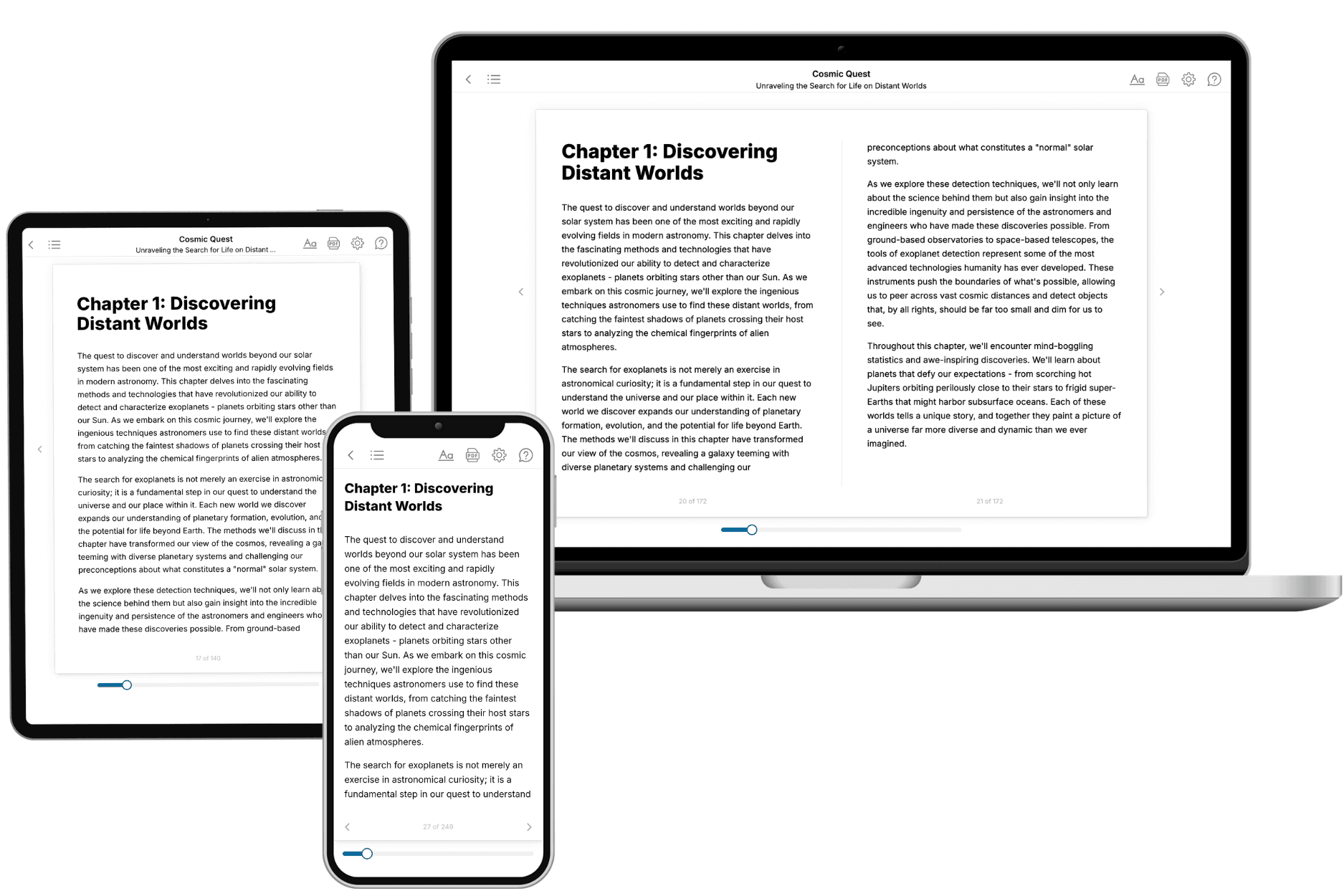
Your book is ready in 10 minutes. Read it online, download as EPUB or PDF, or send to Kindle.

Frequently asked questions
- What is TailoredRead?
TailoredRead creates complete, full-length nonfiction ebooks, written specifically for you. Tell us what you want to learn and why, and TailoredRead writes you a complete ebook on it, with charts, tables, and diagrams throughout. Read it online, on Kindle, or on any e-reader, or download it as a PDF or EPUB. Every book is written fresh the day you order it.
- How is the book tailored to me?
Before anything is written, you answer a few short questions about your goals, your background, and the topics you care about. Your book is then planned around your answers: written at your level, focused on your goals, and covering the topics you chose, instead of the one-size-fits-all book a store sells everyone.
- Will it read like generic AI content?
No. Your book isn't a chat transcript: it's planned chapter by chapter before a single word is written, told in a clear book voice, and explains ideas visually with charts, tables, and diagrams. After writing, every book goes through an editorial pass that polishes chapters so the book reads consistent from start to finish. Judge for yourself: browse thousands of sample books on our Explore Books page.
- How accurate is the content?
Our AI first checks whether your subject needs live research. Niche and fast-moving subjects are researched before writing, and the book plan and chapters are grounded in what it finds. After writing, every book goes through a quality pass that checks its facts and consistency, and researched books list their sources in a Notes section at the back.
- How long is the book?
You choose the length: Comprehensive (250-300 pages), Detailed (150-200 pages), Essential (70-100 pages), or Short (30-50 pages).
- Does the book include visuals?
Yes. Every book includes charts, tables, and diagrams: timelines, checklists, step-by-step guides, decision trees, comparison tables, matrices, and bar charts. A typical book includes dozens of these visual elements.
- Can I read it on Kindle? What formats can I download?
Yes. Every book can be read in our online reader or downloaded as a PDF or EPUB. The EPUB can be opened with Kindle, Apple Books, Kobo, and any e-reader. The Commercial and Author licenses also include an editable Word (DOCX) and Markdown download.
- How much does it cost?
About the price of a regular ebook. The exact price depends on your book's length and complexity, from $2 for the shortest books to $35 for the most comprehensive, and it's shown when you review your book, before you commit to anything. Each book is a one-time purchase, yours to keep, no subscription. Licenses that let you share, teach, or publish your book range from $35.99 to $49.99.
- Can I preview the book before purchasing?
Before you pay, you'll see what your book will cover: the title, a detailed description, the estimated length, and the complete chapter-by-chapter table of contents, so you know what you're getting before you decide. The full text itself is written after you purchase.
- How long does it take to create a book?
About 10 minutes. You can start reading the opening chapters while the rest is still being written.