Continual Learning in Neural Networks
Master Adaptive AI Systems That Learn Without Forgetting
Most neural networks face a fundamental problem: they forget.
191 pages8 chaptersMay 6, 2026Machine Learning
About this book
When trained on new data, they lose knowledge from previous training—a phenomenon called catastrophic forgetting. This limitation prevents AI systems from truly adapting to changing environments and learning continuously like humans do. This book provides a comprehensive guide to continual learning in neural networks, equipping you with both theoretical understanding and practical implementation skills. You'll explore how replay-based methods, regularization techniques, and architectural innovations solve the forgetting problem. Learn to navigate different learning scenarios—from task-incremental to domain-incremental settings—and understand which approaches work best for your specific challenges. Discover how to evaluate continual learning systems fairly, optimize for memory and computational constraints, and combine multiple techniques for superior performance. Whether you're building recommendation systems that adapt to user preferences, autonomous agents that learn from new environments, or any AI system that must evolve over time, this book provides the knowledge and tools you need to implement robust continual learning solutions.
Table of contents
- IntroductionWhy Continual Learning Matters, From Static Models to Adaptive Systems, What You'll Learn in This Book, How to Use This Book EffectivelyRead below
- Chapter 1: The Catastrophic Forgetting ProblemUnderstanding Catastrophic Forgetting, Why Neural Networks Forget, Real-World Impact and Consequences
- Chapter 2: Continual Learning FundamentalsCore Concepts and Terminology, Task-Incremental, Class-Incremental, and Domain-Incremental Learning, Key Evaluation Metrics and Benchmarks
- Chapter 3: Replay-Based MethodsExperience Replay and Memory Buffers, Exemplar Selection Strategies, Generative Replay and Pseudo-Rehearsal, Memory-Performance Trade-offs
- Chapter 4: Regularization-Based ApproachesElastic Weight Consolidation (EWC), Synaptic Importance and Parameter Protection, Knowledge Distillation for Stability
- Chapter 5: Architectural SolutionsDynamic Network Expansion, Modular and Compositional Approaches, Adapter Modules and Parameter-Efficient Learning
- Chapter 6: Hybrid and Advanced TechniquesCombining Multiple Continual Learning Strategies, Meta-Learning for Rapid Adaptation, Biological Inspiration and Brain-Inspired Learning
- Chapter 7: Practical Implementation and OptimizationFrameworks and Tools for Continual Learning, Optimizing for Memory and Computational Constraints, Debugging and Monitoring Continual Learning Systems
- Chapter 8: Real-World Applications and Case StudiesAdaptive Recommendation Systems, Autonomous Agents and Robotics, Natural Language Processing and Domain Adaptation, Computer Vision in Changing Environments
- ConclusionKey Takeaways and Best Practices, Future Directions in Continual Learning Research
- Glossary
- Further Reading and Resources
Introduction
Imagine training a neural network to recognize cats and dogs. It performs beautifully. Then you train it on a new task: identifying different car models. When you go back and test it on cats and dogs, the accuracy has collapsed. The network has essentially forgotten everything it learned before. This is not a bug in your code or a flaw in your dataset. It is a fundamental characteristic of how most neural networks are built, and it has a name: catastrophic forgetting. Understanding and solving this problem is what continual learning is all about.
The gap between how machines learn and how humans learn has always been wide, but nowhere is that gap more visible than in adaptability. A human doctor who specializes in cardiology does not forget how to read an X-ray when they learn to interpret an MRI. A software engineer who picks up a new programming language does not lose their ability to write in the ones they already know. Humans accumulate knowledge over time, building on what came before. Most neural networks, by contrast, treat every new training session as a fresh start, overwriting old knowledge in the process.
This limitation has real consequences. AI systems deployed in the real world face constantly shifting data distributions, new categories, new tasks, and new environments. A recommendation engine needs to adapt to changing user preferences without forgetting what worked before. An autonomous vehicle needs to handle new road conditions without losing its ability to navigate familiar ones. A medical imaging system needs to learn from new patient data without degrading its performance on existing diagnoses. The demand for AI systems that can learn continuously, without forgetting, is not a niche research interest. It is a practical necessity for building AI that actually works in the world over time.
This book is a comprehensive guide to continual learning in neural networks. It covers the theory behind why forgetting happens, the major families of techniques developed to address it, and the practical skills needed to implement those techniques in real systems. Whether you are building production AI systems or exploring the research frontier, this book gives you the conceptual foundation and hands-on tools to design neural networks that learn without forgetting.
Why Continual Learning Matters
The standard machine learning pipeline has a well-known structure: collect data, train a model, evaluate it, and deploy it. This pipeline works well when the world stays still. But the world does not stay still. Data distributions shift, new classes emerge, user behavior evolves, and environments change in ways that no static training set can fully anticipate. When a deployed model encounters these changes, it has two options: ignore them or retrain. Neither option is satisfying.
Ignoring new data means the model becomes stale. A fraud detection system trained on 2020 transaction patterns will struggle with 2024 fraud tactics. A language model trained before a major world event will have no knowledge of it. Staleness is not just an inconvenience; in high-stakes domains like healthcare, finance, and autonomous systems, it can be genuinely dangerous. The model confidently applies outdated knowledge to situations it was never designed to handle.
Retraining from scratch on all available data is the most common workaround, but it comes with serious costs. Computational expense grows with every new batch of data. Storage requirements balloon as historical datasets must be retained. Training time increases, slowing down the feedback loop between new information and updated model behavior. And in many real-world scenarios, storing old data is not even possible due to privacy regulations, data retention policies, or simple storage constraints.
Continual learning offers a third path. Instead of ignoring new data or retraining from scratch, continual learning methods allow a model to incorporate new information while preserving what it already knows. This is not a trivial engineering challenge. It requires rethinking how neural networks store and update knowledge, how they balance stability with plasticity, and how they are evaluated over time. But the payoff is significant: AI systems that genuinely improve with experience rather than degrading or stagnating.
The scale of the opportunity is substantial. Research from DeepMind and other leading AI labs has consistently shown that models capable of continual learning outperform static models in dynamic environments by significant margins, particularly in settings where data arrives in streams rather than batches.[1] As AI applications move deeper into real-time, adaptive domains, the ability to learn continuously is shifting from a research curiosity to a core engineering requirement.
Beyond performance, continual learning also matters for sustainability. Training large neural networks from scratch is energy-intensive. A model that can update incrementally, incorporating new knowledge without full retraining, uses far fewer computational resources over its lifetime. As the AI industry grapples with its environmental footprint, continual learning represents a more efficient paradigm for building and maintaining intelligent systems.
Finally, continual learning matters because it brings AI closer to the kind of intelligence that is actually useful in the long run. A system that learns once and then freezes is a tool. A system that learns continuously, adapts to new situations, and retains accumulated expertise is something closer to a genuine collaborator. That distinction has profound implications for how AI systems are designed, deployed, and trusted.
From Static Models to Adaptive Systems
To appreciate what continual learning offers, it helps to understand what static models cannot do. A static model is one that is trained once on a fixed dataset and then deployed without further updates. This describes the vast majority of machine learning systems in production today. Static models are predictable, easy to evaluate, and straightforward to deploy. But they are fundamentally brittle in the face of change.
Consider a concrete example. A spam filter trained on email data from 2021 will have learned the patterns of spam as they existed at that time: certain keywords, sender patterns, link structures, and so on. By 2024, spammers have adapted. They use new vocabulary, new formatting tricks, and new delivery mechanisms. The static model, frozen in 2021, misses these new patterns entirely. Its accuracy degrades not because it was poorly trained, but because the world moved on without it.
The contrast with an adaptive system is stark. An adaptive system can incorporate new examples of spam as they arrive, updating its internal representations to reflect current patterns while retaining its understanding of older ones. It does not need to be retrained from scratch every time the threat landscape shifts. It learns continuously, just as a human spam analyst would update their mental model of what spam looks like based on new examples they encounter.
The challenge in building adaptive systems is what researchers call the stability-plasticity dilemma. A system needs to be plastic enough to learn new things quickly, but stable enough not to overwrite old knowledge in the process. These two requirements pull in opposite directions. A highly plastic system learns fast but forgets fast. A highly stable system retains old knowledge but struggles to incorporate new information. Finding the right balance is the central engineering challenge of continual learning.
Biological neural systems have solved this dilemma through mechanisms that AI researchers are still working to fully understand and replicate. The human brain uses a combination of short-term and long-term memory systems, sleep-based consolidation processes, and selective attention mechanisms to manage the flow of new information without disrupting established knowledge.[2] These biological insights have directly inspired several of the most effective continual learning algorithms covered in this book.
The transition from static to adaptive systems also changes how you think about model evaluation. A static model is evaluated once, at deployment time, on a held-out test set. An adaptive system needs to be evaluated continuously, across multiple tasks and time points, using metrics that capture both forward transfer (how well new learning helps with future tasks) and backward transfer (how well new learning preserves performance on past tasks). This richer evaluation framework is one of the topics covered in depth in Chapter 2.
It is worth noting that adaptive systems are not always better than static ones. In stable environments where data distributions do not change, a well-trained static model may outperform a continual learning system that spends resources managing knowledge retention. The key is matching the approach to the problem. This book will help you develop the judgment to know when continual learning is the right tool and when simpler approaches are sufficient.
The field has matured significantly over the past decade. Early continual learning research focused almost entirely on avoiding catastrophic forgetting in toy settings. Today, researchers and practitioners are deploying continual learning in production systems, tackling real-world challenges like privacy-constrained data streams, non-stationary environments, and large-scale model architectures. The gap between research and practice is narrowing, and this book is designed to help you navigate both sides of that gap.
What You'll Learn in This Book
This book is organized to take you from foundational concepts to advanced implementation, building knowledge progressively so that each chapter prepares you for the next. Here is a clear picture of what each part of the book covers and what you will be able to do after reading it.
Chapter 1: The Catastrophic Forgetting Problem dives into the core challenge that motivates the entire field. You will learn exactly what catastrophic forgetting is, why it happens at the level of neural network weights and gradients, and what its real-world consequences look like. This chapter gives you the conceptual grounding to understand why the solutions covered in later chapters are designed the way they are.
Chapter 2: Continual Learning Fundamentals establishes the vocabulary and framework for the rest of the book. You will learn the three main learning scenarios (task-incremental, class-incremental, and domain-incremental), understand the key evaluation metrics used to measure continual learning performance, and get familiar with the benchmark datasets that the research community uses to compare methods. This chapter is essential for reading research papers and understanding how different methods are compared.
Chapters 3, 4, and 5 cover the three major families of continual learning techniques:
- Replay-based methods (Chapter 3): These approaches store or generate examples from previous tasks and mix them into training on new tasks. You will learn about experience replay, exemplar selection strategies, and generative replay using models like variational autoencoders and GANs.
- Regularization-based approaches (Chapter 4): These methods add constraints to the learning process to protect important weights from being overwritten. You will implement Elastic Weight Consolidation (EWC), explore synaptic importance methods, and learn how knowledge distillation can stabilize learning.
- Architectural solutions (Chapter 5): These approaches modify the network structure itself to accommodate new tasks. You will explore dynamic network expansion, modular architectures, and parameter-efficient adapter modules.
Chapter 6: Hybrid and Advanced Techniques shows how combining multiple approaches often produces better results than any single method alone. You will also explore meta-learning as a framework for rapid adaptation and examine how biological insights from neuroscience have inspired some of the most innovative continual learning algorithms.
Chapter 7: Practical Implementation and Optimization bridges theory and practice. You will learn which frameworks and libraries support continual learning, how to optimize for memory and computational constraints, and how to debug and monitor continual learning systems in production. This chapter is particularly valuable if you are building systems that need to run efficiently in resource-constrained environments.
Chapter 8: Real-World Applications and Case Studies grounds everything in concrete use cases. You will see how continual learning is applied in recommendation systems, autonomous agents and robotics, natural language processing, and computer vision. Each case study highlights the specific challenges of that domain and the techniques best suited to address them.
By the end of this book, you will be able to:
- Explain catastrophic forgetting and its causes at a technical level
- Select the appropriate continual learning strategy for a given problem and constraint set
- Implement replay-based, regularization-based, and architectural continual learning methods
- Evaluate continual learning systems using appropriate metrics and benchmarks
- Optimize continual learning pipelines for memory and computational efficiency
- Apply continual learning to real-world domains including NLP, computer vision, and recommendation systems
The book assumes you have a working knowledge of neural networks, including how backpropagation works, what loss functions are, and how to train a basic model using a framework like PyTorch or TensorFlow. You do not need to be an expert in any particular subfield of machine learning, but familiarity with the fundamentals will help you get the most out of the technical content. If you find yourself needing a refresher on any foundational concept, the Glossary at the back of the book provides concise definitions of key terms.
How to Use This Book Effectively
This book is designed to be read sequentially, but it is also structured so that experienced practitioners can jump to the sections most relevant to their immediate needs. Here is some guidance on how to get the most out of it depending on where you are starting from and what you are trying to accomplish.
If you are new to continual learning, read the book from start to finish. Chapters 1 and 2 build the conceptual foundation that makes everything else easier to understand. Skipping them to get to the implementation chapters will leave gaps in your understanding that will slow you down later. The field has its own vocabulary and its own way of framing problems, and those chapters establish both.
If you already understand catastrophic forgetting and are looking for specific techniques, you can start with Chapter 2 to orient yourself to the taxonomy and evaluation framework, then jump to whichever technique family is most relevant to your problem. Use the following as a quick guide:
- Memory is not a constraint and you want strong performance: start with Chapter 3 (Replay-Based Methods)
- Memory is limited and you cannot store old data: start with Chapter 4 (Regularization-Based Approaches)
- You are working with large models and need parameter efficiency: start with Chapter 5 (Architectural Solutions)
- You need the best possible performance and can combine methods: go to Chapter 6 (Hybrid Techniques)
If you are a practitioner building a production system, Chapter 7 is particularly important. It covers the practical realities of implementing continual learning at scale, including framework selection, memory management, and monitoring. Read it alongside whichever technique chapters are relevant to your use case. Chapter 8 is also valuable for seeing how others have solved similar problems in your domain.
Throughout the book, you will find several recurring elements designed to reinforce learning and support practical application. Code examples are provided in Python using PyTorch, which is the dominant framework in continual learning research. The examples are written to be readable and adaptable, not just copy-paste solutions. Understanding what the code is doing and why is more valuable than running it verbatim.
Worked examples and case studies appear throughout the technical chapters. These are not abstract illustrations. They use realistic scenarios with specific numbers, dataset sizes, and performance metrics to show how concepts play out in practice. Pay attention to the trade-offs highlighted in these examples. Continual learning is a field full of trade-offs, and developing good intuition for them is one of the most valuable skills you can build.
Footnotes and citations point to the original research papers behind the techniques discussed. If a particular method interests you, following those citations is the best way to go deeper. The research community publishes continually (appropriately enough), and the papers cited in this book represent some of the most important contributions to the field. Reading them will give you a much richer understanding of the design choices and experimental evidence behind each approach.
One practical recommendation: as you read each chapter, try to connect the concepts to a problem you actually care about. Continual learning is a broad field, and it is easy to get lost in the variety of methods and scenarios. Anchoring your learning to a specific use case, whether that is a recommendation system, a computer vision pipeline, or a natural language processing application, will help you evaluate which techniques are most relevant and give you a concrete context for testing your understanding.
The Glossary at the back of the book is worth bookmarking. Continual learning has a dense vocabulary, and terms like forward transfer, backward transfer, task boundary, and plasticity have specific technical meanings that differ from their everyday usage. When you encounter an unfamiliar term, the Glossary will give you a quick, precise definition without requiring you to flip back through earlier chapters.
Finally, approach this material with patience. Continual learning sits at the intersection of neuroscience, optimization theory, and systems engineering. Some of the ideas are genuinely subtle, and the field is still evolving rapidly. Not every question has a clean answer, and not every technique works well in every setting. That ambiguity is not a weakness of the field; it is a sign that there is still important work to be done. This book will give you the tools to contribute to that work, whether as a practitioner solving real problems or as a researcher pushing the boundaries of what is possible.
The goal of this book is not to give you a recipe to follow. It is to give you a deep enough understanding of continual learning that you can design your own solutions, evaluate them honestly, and adapt them as your problems evolve. That kind of understanding is what separates practitioners who can handle novel challenges from those who can only apply familiar patterns.
With that framing in mind, the journey begins with the problem itself. Chapter 1 takes a close look at catastrophic forgetting: what it is, why it happens, and why it is so difficult to solve. Understanding the problem deeply is the first step toward solving it well.
This is the end of the free sample. The full book has 8 chapters.
Want this book written for you?
Tell us your goals and background, and get your own version of this book, tailored by AI to you.


Benefits of AI-tailored books
- Read one book, not ten:
- all the Machine Learning knowledge you need, gathered into a single book.
- Save days of learning:
- tell us your goals, choose your topics, and the whole book is built around them.
- Learn effortlessly:
- Machine Learning book written for your specific background and expertise.
- Understand at a glance:
- includes charts, tables, timelines, checklists, decision trees, and more.
- Stay current:
- written the day you order it, not years ago.
- Trust what you read:
- every book is checked for accuracy, with real research when your subject needs it.
Create your unique book in 3 steps
- 1. Select your focus
Select the focus of your Machine Learning book and share your background
- 2. Personalize your book
Specify your goals and choose sub-topics to include
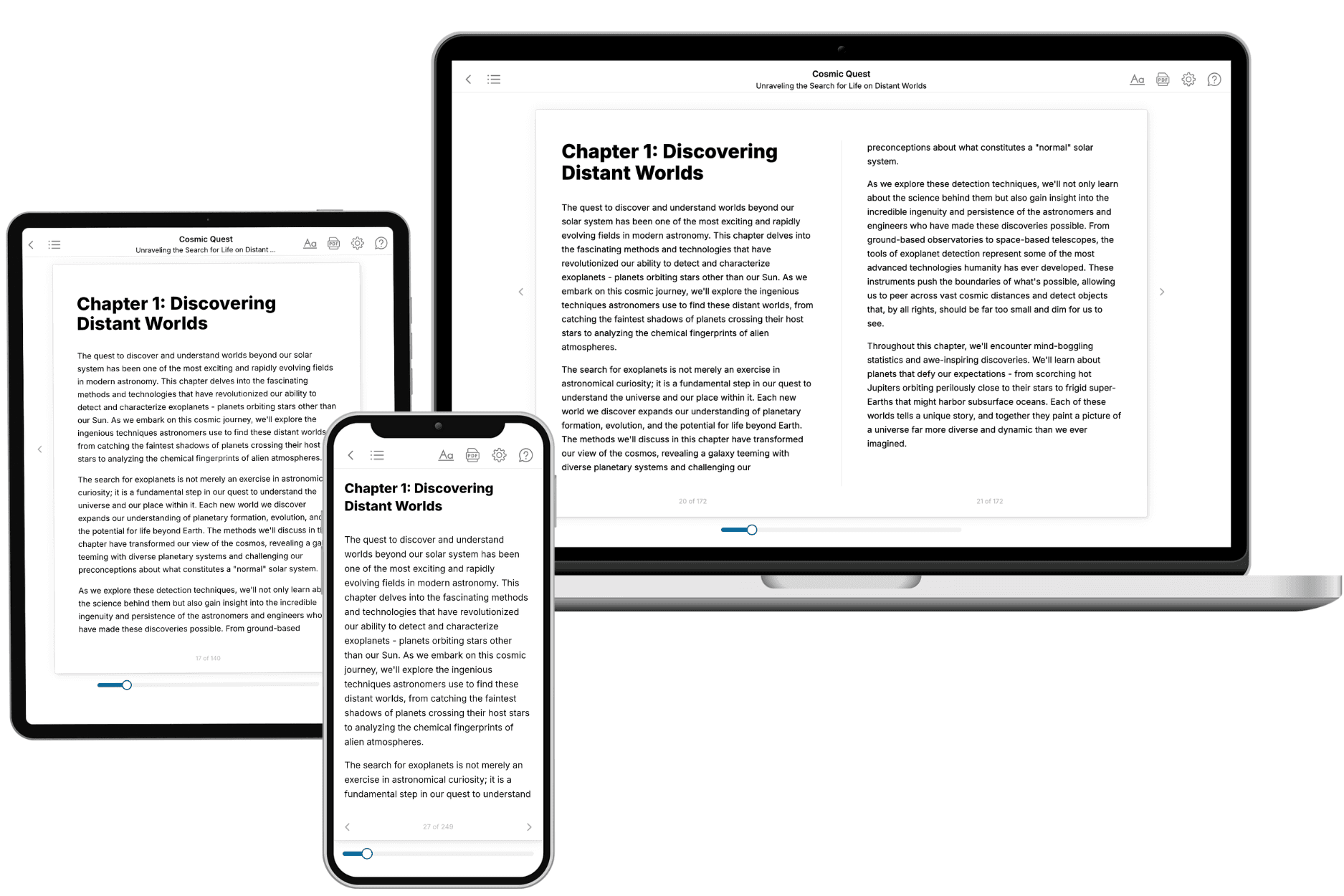
- 3. Get your tailored book
Your book is ready in 10 minutes. Read it online, download as EPUB or PDF, or send to Kindle.
Frequently asked questions
- What is TailoredRead?
TailoredRead creates complete, full-length nonfiction ebooks, written specifically for you. Tell us what you want to learn and why, and TailoredRead writes you a complete ebook on it, with charts, tables, and diagrams throughout. Read it online, on Kindle, or on any e-reader, or download it as a PDF or EPUB. Every book is written fresh the day you order it.
- How is the book tailored to me?
Before anything is written, you answer a few short questions about your goals, your background, and the topics you care about. Your book is then planned around your answers: written at your level, focused on your goals, and covering the topics you chose, instead of the one-size-fits-all book a store sells everyone.
- Will it read like generic AI content?
No. Your book isn't a chat transcript: it's planned chapter by chapter before a single word is written, told in a clear book voice, and explains ideas visually with charts, tables, and diagrams. After writing, every book goes through an editorial pass that polishes chapters so the book reads consistent from start to finish. Judge for yourself: browse thousands of sample books on our Explore Books page.
- How accurate is the content?
Our AI first checks whether your subject needs live research. Niche and fast-moving subjects are researched before writing, and the book plan and chapters are grounded in what it finds. After writing, every book goes through a quality pass that checks its facts and consistency, and researched books list their sources in a Notes section at the back.
- How long is the book?
You choose the length: Comprehensive (250-300 pages), Detailed (150-200 pages), Essential (70-100 pages), or Short (30-50 pages).
- Does the book include visuals?
Yes. Every book includes charts, tables, and diagrams: timelines, checklists, step-by-step guides, decision trees, comparison tables, matrices, and bar charts. A typical book includes dozens of these visual elements.
- Can I read it on Kindle? What formats can I download?
Yes. Every book can be read in our online reader or downloaded as a PDF or EPUB. The EPUB can be opened with Kindle, Apple Books, Kobo, and any e-reader. The Commercial and Author licenses also include an editable Word (DOCX) and Markdown download.
- How much does it cost?
About the price of a regular ebook. The exact price depends on your book's length and complexity, from $2 for the shortest books to $35 for the most comprehensive, and it's shown when you review your book, before you commit to anything. Each book is a one-time purchase, yours to keep, no subscription. Licenses that let you share, teach, or publish your book range from $35.99 to $49.99.
- Can I preview the book before purchasing?
Before you pay, you'll see what your book will cover: the title, a detailed description, the estimated length, and the complete chapter-by-chapter table of contents, so you know what you're getting before you decide. The full text itself is written after you purchase.
- How long does it take to create a book?
About 10 minutes. You can start reading the opening chapters while the rest is still being written.