Crossing the Delaware
How Washington's Daring Gamble Changed the Course of American Independence
Discover how a desperate midnight crossing and a surprise dawn attack transformed the American Revolution from a failing cause into a viable movement.
207 pages10 chaptersMar 9, 2026American Revolutionary War
About this book
The Battle of Trenton stands as one of history's most dramatic military operations—a moment when everything hung in the balance and one commander's audacious decision changed the course of a nation. You'll gain insight into Washington's strategic thinking, the brutal conditions faced by Continental soldiers, and the intricate planning that made victory possible against overwhelming odds. Through detailed accounts of the campaign, you'll understand how this single battle restored hope to a demoralized army, convinced foreign powers that American independence was achievable, and set the stage for ultimate victory. This account weaves together military strategy, personal narratives, and historical context to show why Trenton matters not just as a battle, but as the moment the American Revolution became real.
Table of contents
- IntroductionWhy Trenton Matters Today, The Revolution in Crisis, What You'll Discover in This BookRead below
- Chapter 1: The Road to DesperationEarly Battles and Defeats, The New York Campaign, Retreat Across New Jersey, An Army on the Brink of Collapse
- Chapter 2: Washington's Strategic VisionThe Commander-in-Chief, Washington's Military Philosophy, Conceiving the Bold Plan, Gathering Intelligence on Trenton
- Chapter 3: The Enemy PositionThe Hessian Garrison, Trenton's Geography and Defenses, British Strategic Assumptions
- Chapter 4: Preparation and PlanningAssembling the Strike Force, Logistics and Supply Challenges, Final Preparations and Orders, Soldier Morale and Readiness
- Chapter 5: The Delaware CrossingChristmas Night, 1776, Crossing in Brutal Conditions, The Soldiers' Experience, The Crossing Complete
- Chapter 6: The March to BattleThe Night March, Maintaining Discipline and Secrecy, As Dawn Approaches
- Chapter 7: The Battle UnfoldsInitial Contact and Surprise, Street Fighting in Trenton, The Hessian Response, American Victory Secured
- Chapter 8: Immediate ConsequencesCasualties and Prisoners, The Transformation of Morale, Washington's Decision to Stay Engaged
- Chapter 9: The Broader ImpactImpact on the American Public, Changing Foreign Perceptions, The British Response, Building Military Momentum
- Chapter 10: Legacy and LessonsHistorical Significance, Military Lessons and Principles, Leadership Insights from Trenton
- ConclusionTrenton as a Turning Point, The Enduring Relevance of Trenton
- Further Reading and Resources
Introduction
On the night of December 25, 1776, a ragged army of American soldiers climbed into wooden boats on the Pennsylvania side of the Delaware River. The temperature had dropped well below freezing. Chunks of ice ground against the hulls. Sleet and snow cut sideways through the darkness. These men had been retreating for weeks, their numbers shrinking with every mile. Many had no shoes. Some wrapped their feet in rags. And yet, under the command of General George Washington, they pushed off from the bank and began rowing toward the New Jersey shore. What happened in the hours that followed would change the course of American history.
The Battle of Trenton, fought on the morning of December 26, 1776, is one of the most dramatic episodes in the story of American independence. It was not the largest battle of the Revolutionary War. It did not involve the most troops or produce the most casualties. But in terms of its consequences, few engagements in American military history can match it. A single surprise attack on a Hessian garrison transformed a failing revolution into a viable cause, restored the confidence of a shattered army, and sent a message to the world that the United States of America intended to survive.
This book tells that story in full. It traces the desperate weeks that led Washington to conceive his bold plan, examines the meticulous preparation that made the crossing possible, and follows the soldiers through the ice and darkness to the streets of Trenton. It also looks beyond the battle itself, exploring how the victory rippled outward to change public opinion, influence foreign governments, and set the stage for the ultimate success of the Revolution. Understanding Trenton means understanding not just a single morning of combat, but the entire arc of a nation's birth.
History is often taught as a series of inevitable outcomes, as if the United States was always going to win its independence. The story of Trenton corrects that comfortable assumption. In December 1776, American independence was genuinely in doubt. The Continental Army was dissolving. Enlistments were expiring. Morale had collapsed. Washington himself wrote privately that the cause was nearly lost. The crossing of the Delaware and the attack on Trenton were not the actions of a confident army pressing its advantage. They were the desperate gamble of a commander who understood that without a dramatic reversal, the Revolution would simply fade away. That context is what makes the victory so remarkable, and so worth studying.
Why Trenton Matters Today
Nearly 250 years after Washington's soldiers crossed the Delaware, the Battle of Trenton continues to resonate. It appears in military academies as a case study in surprise, speed, and the effective use of unconventional tactics. It appears in leadership courses as an example of decision-making under extreme pressure. And it appears in the broader American cultural memory as a symbol of perseverance, of refusing to quit when circumstances seem hopeless. Emanuel Leutze's famous 1851 painting of Washington standing in the bow of a boat crossing the ice-choked Delaware has become one of the most recognizable images in American art, even if its historical details are somewhat romanticized.[1]
The battle matters today because it illustrates a principle that applies far beyond military history: bold action at the right moment can reverse a situation that appears irreversible. Washington did not wait for conditions to improve. He did not wait for reinforcements that might never come. He assessed the situation, identified a narrow window of opportunity, and acted decisively within it. That kind of thinking, the willingness to accept calculated risk when the alternative is certain failure, is as relevant in the twenty-first century as it was in the eighteenth.
Trenton also matters because it humanizes the Revolution. The men who crossed the Delaware were not mythological figures. They were farmers, tradesmen, and laborers. They were cold, hungry, and exhausted. Many of them had serious doubts about whether the cause was worth dying for. Their decision to keep going, to climb into those boats on Christmas night, was not made from a position of strength or certainty. It was made from a position of near-total desperation. Understanding that reality makes their achievement more impressive, not less.
For students of military history, Trenton offers a masterclass in operational planning. Washington coordinated multiple columns, managed complex logistics across a major river obstacle, maintained operational security in a region full of Loyalist informants, and timed his attack to achieve maximum surprise. The fact that he pulled it off with an army that was barely holding together makes the planning achievement even more striking. Each of these elements deserves careful examination, and this book provides it.
There is also a political dimension to Trenton that is easy to overlook. The battle did not just boost American morale. It changed how European powers, particularly France, assessed the viability of the American cause. France had been cautiously watching the Revolution, weighing whether to provide open support. A string of American defeats had made that support seem like a poor investment. Trenton, followed quickly by the victory at Princeton, began to shift that calculation. The French alliance that eventually proved decisive in the war had its roots, at least in part, in the events of that December morning.
Finally, Trenton matters because it demonstrates how geography, weather, timing, and human determination can intersect to create a historical turning point. None of those factors alone would have been sufficient. Washington needed all of them working together, and he needed his soldiers to endure conditions that would have broken lesser men. The story of how those elements combined is one of the most compelling narratives in American history, and it deserves to be told with the detail and care it has earned.
A note on perspective: The events of December 1776 looked very different depending on where you stood. For Washington and his officers, it was a moment of calculated desperation. For the ordinary Continental soldier, it was one more brutal night in a brutal campaign. For the Hessian garrison in Trenton, it was a catastrophic surprise. And for the watching world, it was an unexpected signal that the American experiment might actually survive. This book tries to honor all of those perspectives.
The Revolution in Crisis
To understand why Trenton mattered so much, you need to understand just how badly things had gone for the American cause in the months leading up to it. The Declaration of Independence had been signed in July 1776 with great ceremony and genuine optimism. But the military situation deteriorated almost immediately afterward. The British, under General William Howe, launched a massive campaign to capture New York City, deploying a force of roughly 32,000 professional soldiers and Hessian auxiliaries, the largest expeditionary force Britain had ever sent abroad.[2]
Washington's Continental Army, by contrast, was a patchwork force of short-term volunteers, state militia units, and a small core of more experienced soldiers. It lacked the training, equipment, and discipline of the British regulars it faced. The results were predictable. The Battle of Long Island in August 1776 was a near-disaster, with Washington barely managing to evacuate his army across the East River before it was destroyed. The fall of New York City followed. Then came defeats at White Plains, Fort Washington, and Fort Lee. By November, the Continental Army was in full retreat across New Jersey, shedding men with every passing day.
The numbers tell a stark story. When Washington crossed into New Jersey in mid-November 1776, he had roughly 5,000 men. By the time he crossed the Delaware into Pennsylvania in early December, that number had fallen to somewhere between 2,000 and 3,000 effective soldiers.[3] Enlistments for most of the army were set to expire on December 31. If Washington could not give his men a reason to re-enlist, the Continental Army would effectively cease to exist at the start of the new year. The British would then be free to finish the job in the spring.
The political situation was equally grim. Support for the Revolution was eroding in New Jersey and Pennsylvania. Many residents were signing loyalty oaths to the Crown, either out of genuine Loyalist sentiment or simple pragmatism. Thomas Paine, who had marched with the retreating army, captured the mood in his pamphlet The American Crisis, written in December 1776. His opening line, These are the times that try men's souls,
was not rhetorical flourish. It was an accurate description of the moment.[4] Washington had Paine's words read aloud to his troops before the crossing, understanding that his men needed to feel the weight of what they were fighting for.
The British, for their part, believed the campaign was essentially over. General Howe had established a chain of garrison posts across New Jersey, including a significant Hessian force at Trenton, and settled into winter quarters. European military convention held that armies did not conduct major operations in winter. The weather was too harsh, the roads too difficult, and the risks too great. Howe expected Washington to do what any sensible commander would do: go into winter quarters, wait for spring, and then negotiate a settlement. The idea that Washington would launch an offensive in the dead of winter, across an ice-choked river, on Christmas night, simply did not register as a serious possibility.
That assumption was the crack in the British position, and Washington saw it clearly. The very factors that made an attack seem impossible, the weather, the timing, the audacity required, were also the factors that made it potentially decisive. If he could achieve surprise, he could neutralize the Hessians' superior training and discipline. If he could move fast enough, he could strike and withdraw before the British could respond. The plan was dangerous. It required everything to go right. But Washington had concluded that doing nothing was more dangerous still. The Revolution needed a victory, and it needed one immediately.
- August 1776: Defeat at the Battle of Long Island; Washington barely escapes with his army
- September 1776: New York City falls to British forces
- October 1776: Defeat at White Plains; Washington retreats northward
- November 1776: Fort Washington falls; nearly 3,000 Americans captured in a single day
- November–December 1776: Retreat across New Jersey; army shrinks from 5,000 to fewer than 3,000
- December 1776: Washington crosses into Pennsylvania; British establish winter garrisons across New Jersey
This sequence of events is the essential backdrop for everything that follows. Without understanding how desperate the situation had become, it is impossible to fully appreciate the courage and calculation that went into the Trenton operation. Washington was not a general with options. He was a commander with one last card to play, and he played it with everything he had.
What You'll Discover in This Book
This book is organized to take you through the Trenton campaign in a logical sequence, from the crisis that made it necessary to the legacy that makes it worth studying today. Each chapter builds on the one before it, so that by the time you reach the battle itself, you have a full understanding of the context, the planning, and the people involved. The goal is not just to describe what happened, but to explain why it happened the way it did, and what it means.
The opening chapters examine the road to desperation. You will follow Washington's army through the defeats of 1776, understanding how a force that began the year with genuine hope was reduced to a shattered remnant clinging to the Pennsylvania bank of the Delaware. This section pays particular attention to the human dimension of the crisis: what it felt like to be a Continental soldier in December 1776, what kept men in the ranks when every rational calculation suggested leaving, and how Washington maintained any semblance of command authority over an army that was literally falling apart around him.
The middle chapters focus on Washington himself. You will examine his background, his military philosophy, and the specific thinking that led him to conceive the Trenton operation. Washington is often portrayed as a remote, almost mythological figure, but the historical record reveals a more complex and interesting man: a commander who made serious mistakes, learned from them, and developed a strategic approach that was genuinely innovative for its time. His decision to attack Trenton was not impulsive. It was the product of careful analysis, good intelligence, and a clear-eyed assessment of what the Revolution needed to survive.
You will also spend considerable time with the enemy. The Hessian garrison at Trenton is often caricatured in popular accounts, portrayed as complacent soldiers sleeping off a Christmas celebration. The reality is more nuanced and more interesting. The Hessians were professional soldiers with a strong military tradition. Understanding their actual situation, their strengths, their vulnerabilities, and the specific circumstances that made them susceptible to surprise, is essential to understanding why Washington's plan worked.
The chapters covering the crossing and the battle itself draw on firsthand accounts, military records, and the best available historical scholarship to reconstruct the events of December 25 and 26, 1776, in as much detail as the sources allow. You will experience the crossing through the eyes of the soldiers who made it, understanding the physical and psychological demands it placed on men who were already at the limits of their endurance. And you will follow the battle through the streets of Trenton, seeing how Washington's plan unfolded in real time and how his officers and soldiers adapted when things did not go exactly as planned.
The final chapters examine the consequences of the victory. The immediate aftermath, the prisoners taken, the morale transformed, the decision to stay and fight again at Princeton, is covered in detail. But the book also looks at the broader impact: how Trenton changed the political landscape in America, how it influenced foreign perceptions of the Revolution, and how it set the stage for the eventual American victory. These consequences were not automatic or inevitable. They required Washington to make additional bold decisions in the days following Trenton, and those decisions are part of the story too.
Throughout the book, you will encounter specific individuals whose stories illuminate the larger narrative. These include:
- Henry Knox, Washington's artillery chief, who organized the logistics of the Delaware crossing with remarkable skill
- Johann Rall, the Hessian commander at Trenton, whose decisions in the hours before the attack shaped the outcome
- James Monroe, a young officer who was seriously wounded in the battle and would later become the fifth President of the United States
- Thomas Paine, whose words helped sustain the army's will to fight through the darkest weeks of the campaign
- Ordinary Continental soldiers, men like John Greenwood and Henry Miller, whose diaries and letters provide ground-level accounts of what the crossing and battle actually felt like
One thing this book does not do is treat the outcome as inevitable. At every stage of the Trenton campaign, things could have gone differently. The crossing could have been aborted by the weather. The army could have been detected on its march to Trenton. The Hessians could have mounted a more effective defense. Washington could have decided that the risks were simply too great. The fact that none of these things happened was partly the result of good planning, partly the result of good fortune, and partly the result of the extraordinary determination of the men involved. Keeping that contingency in view is what makes the story genuinely dramatic rather than simply a recitation of known outcomes.
By the time you finish this book, you will have a thorough understanding of one of the most consequential military operations in American history. More than that, you will understand why it was consequential: not just because it produced a tactical victory, but because it demonstrated something about the nature of the American cause that no amount of political rhetoric could have conveyed. The men who crossed the Delaware on Christmas night 1776 proved, through action rather than words, that the Revolution was real, that it was serious, and that it was not going to give up. That proof changed everything. And that is why, nearly 250 years later, the story of Trenton is still worth telling.
A note on sources: The account in this book draws primarily on David Hackett Fischer's landmark study Washington's Crossing (2004), along with primary sources including Washington's correspondence, officer diaries, and contemporary newspaper accounts. Where sources conflict, the text notes the disagreement and explains the reasoning behind the interpretation adopted. The goal throughout is accuracy, not mythology. The real story of Trenton is dramatic enough without embellishment.
Notes
Introduction
- 1. Fischer, David Hackett. Washington's Crossing. Oxford University Press, 2004. pp. 367-368.
- 2. Ferling, John. Almost a Miracle: The American Victory in the War of Independence. Oxford University Press, 2007. p. 141.
- 3. Fischer, David Hackett. Washington's Crossing. Oxford University Press, 2004. p. 138.
- 4. Paine, "Thomas. The American Crisis," December 19, 1776
This is the end of the free sample. The full book has 10 chapters.
Want this book written for you?
Tell us your goals and background, and get your own version of this book, tailored by AI to you.


Benefits of AI-tailored books
- Read one book, not ten:
- all the American Revolutionary War knowledge you need, gathered into a single book.
- Save days of learning:
- tell us your goals, choose your topics, and the whole book is built around them.
- Learn effortlessly:
- American Revolutionary War book written for your specific background and expertise.
- Understand at a glance:
- includes charts, tables, timelines, checklists, decision trees, and more.
- Stay current:
- written the day you order it, not years ago.
- Trust what you read:
- every book is checked for accuracy, with real research when your subject needs it.
Create your unique book in 3 steps
- 1. Select your focus
Select the focus of your American Revolutionary War book and share your background
- 2. Personalize your book
Specify your goals and choose sub-topics to include
- 3. Get your tailored book
Your book is ready in 10 minutes. Read it online, download as EPUB or PDF, or send to Kindle.


Frequently asked questions
- What is TailoredRead?
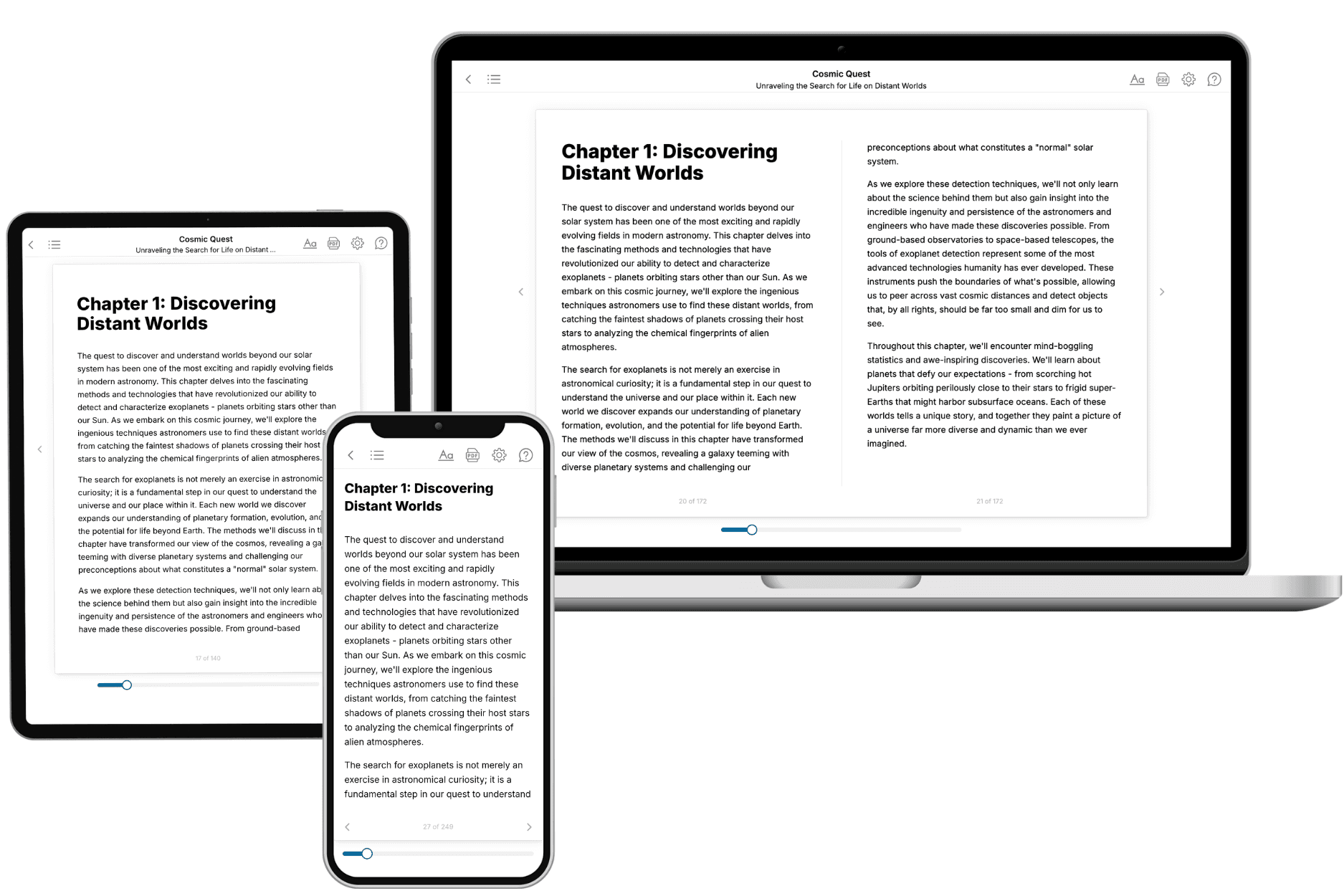
TailoredRead creates complete, full-length nonfiction ebooks, written specifically for you. Tell us what you want to learn and why, and TailoredRead writes you a complete ebook on it, with charts, tables, and diagrams throughout. Read it online, on Kindle, or on any e-reader, or download it as a PDF or EPUB. Every book is written fresh the day you order it.
- How is the book tailored to me?
Before anything is written, you answer a few short questions about your goals, your background, and the topics you care about. Your book is then planned around your answers: written at your level, focused on your goals, and covering the topics you chose, instead of the one-size-fits-all book a store sells everyone.
- Will it read like generic AI content?
No. Your book isn't a chat transcript: it's planned chapter by chapter before a single word is written, told in a clear book voice, and explains ideas visually with charts, tables, and diagrams. After writing, every book goes through an editorial pass that polishes chapters so the book reads consistent from start to finish. Judge for yourself: browse thousands of sample books on our Explore Books page.
- How accurate is the content?
Our AI first checks whether your subject needs live research. Niche and fast-moving subjects are researched before writing, and the book plan and chapters are grounded in what it finds. After writing, every book goes through a quality pass that checks its facts and consistency, and researched books list their sources in a Notes section at the back.
- How long is the book?
You choose the length: Comprehensive (250-300 pages), Detailed (150-200 pages), Essential (70-100 pages), or Short (30-50 pages).
- Does the book include visuals?
Yes. Every book includes charts, tables, and diagrams: timelines, checklists, step-by-step guides, decision trees, comparison tables, matrices, and bar charts. A typical book includes dozens of these visual elements.
- Can I read it on Kindle? What formats can I download?
Yes. Every book can be read in our online reader or downloaded as a PDF or EPUB. The EPUB can be opened with Kindle, Apple Books, Kobo, and any e-reader. The Commercial and Author licenses also include an editable Word (DOCX) and Markdown download.
- How much does it cost?
About the price of a regular ebook. The exact price depends on your book's length and complexity, from $2 for the shortest books to $35 for the most comprehensive, and it's shown when you review your book, before you commit to anything. Each book is a one-time purchase, yours to keep, no subscription. Licenses that let you share, teach, or publish your book range from $35.99 to $49.99.
- Can I preview the book before purchasing?
Before you pay, you'll see what your book will cover: the title, a detailed description, the estimated length, and the complete chapter-by-chapter table of contents, so you know what you're getting before you decide. The full text itself is written after you purchase.
- How long does it take to create a book?
About 10 minutes. You can start reading the opening chapters while the rest is still being written.