Cryptographic Protocols Demystified
Mastering XOF Functions and Modern Cryptography Algorithms
Imagine confidently designing and implementing cryptographic systems that protect sensitive data against both current and emerging threats.
238 pages11 chaptersApr 1, 2026Cryptography Algorithms
About this book
This comprehensive guide takes you beyond basic cryptography concepts to master the sophisticated world of cryptographic protocols, with special focus on XOF (Extendable Output Functions) and cutting-edge cryptographic algorithms. Whether you're building secure applications, evaluating cryptographic implementations, or advancing your technical expertise, this book provides the practical knowledge and theoretical understanding you need. You'll explore how modern protocols work, why XOF functions are revolutionizing cryptography, and how to select and implement the right algorithms for your specific security challenges. Through clear explanations, real-world examples, and practical guidance, you'll gain the confidence to work with advanced cryptographic systems and make informed decisions about protocol selection and implementation strategies.
Table of contents
- IntroductionWhy Cryptography Matters in Today's World, The Evolution of Cryptographic Protocols, What You'll Learn in This Book, How to Use This GuideRead below
- Chapter 1: Foundations of Cryptographic ProtocolsWhat Are Cryptographic Protocols?, Core Security Properties and Guarantees, Essential Components of Secure Protocols
- Chapter 2: Hash Functions and Their EvolutionUnderstanding Hash Function Fundamentals, Limitations of Fixed-Output Hash Functions, The SHA Family: From SHA-1 to SHA-3
- Chapter 3: Introduction to XOF FunctionsWhat Are Extendable Output Functions?, Advantages Over Traditional Hash Functions, Real-World Applications of XOF Functions
- Chapter 4: SHA-3 and the Keccak Sponge ConstructionThe Keccak Sponge Architecture, SHA-3 Variants and SHAKE Functions, Implementation Considerations and Performance
- Chapter 5: Modern Cryptographic AlgorithmsBLAKE and BLAKE3: Next-Generation Hashing, Other Contemporary Cryptographic Algorithms, Comparing Modern Algorithms: Performance and Security
- Chapter 6: Key Derivation and XOF FunctionsPrinciples of Cryptographic Key Derivation, Using XOF Functions for Key Derivation, Practical Key Derivation Patterns and Best Practices
- Chapter 7: Stream Ciphers and XOF-Based ConstructionsUnderstanding Stream Cipher Fundamentals, Building Stream Ciphers with XOF Functions, Security Analysis and Threat Models
- Chapter 8: Authenticated Encryption ProtocolsThe Concept of Authenticated Encryption, AEAD Modes and XOF Integration, Verifying Protocol Security and Correctness
- Chapter 9: Implementation Security and Side ChannelsUnderstanding Side-Channel Attacks, Constant-Time Implementation Techniques, Secure Coding Practices for Cryptographic Systems
- Chapter 10: Protocol Selection and EvaluationThreat Modeling and Security Requirements, Selecting the Right Algorithm for Your Use Case, A Framework for Evaluating Cryptographic Protocols
- Chapter 11: Future Trends and Post-Quantum CryptographyThe Quantum Computing Threat to Current Protocols, Post-Quantum Cryptographic Algorithms, Building Cryptographic Agility into Your Systems
- ConclusionKey Takeaways and Core Principles, Your Next Steps in Cryptographic Mastery
- Glossary of Cryptographic Terms
- Further Reading and Resources
Introduction
Every time you send a message, make a payment, or log into an account, cryptography is working silently in the background to keep that interaction secure. Most people never think about it, and that's exactly the point. Good cryptography is invisible. But for the engineers, developers, and security professionals who build and maintain these systems, cryptography is anything but invisible. It's a discipline that demands precision, deep understanding, and constant learning as threats evolve and new algorithms emerge to meet them.
This book is for those who already have a foothold in cryptography and want to go further. You understand what a hash function does. You've worked with encryption before. You know the difference between symmetric and asymmetric cryptography. But you've started to encounter terms like XOF, SHAKE128, sponge construction, or BLAKE3, and you want to understand not just what they are, but why they exist, how they work, and when to use them. That's exactly what this guide is designed to deliver.
The cryptographic landscape has changed dramatically over the past two decades. The algorithms that were considered state-of-the-art in the early 2000s have been broken, deprecated, or replaced. SHA-1 is no longer trusted for security-critical applications. MD5 is effectively obsolete for anything beyond checksums. In their place, a new generation of cryptographic primitives has emerged, built on stronger mathematical foundations and designed to solve problems that older algorithms couldn't handle efficiently. Among the most significant of these developments is the rise of Extendable Output Functions, or XOFs, which represent a genuine shift in how cryptographic designers think about hash-based constructions.
Understanding these modern tools requires more than reading a specification. It requires understanding the problems they were designed to solve, the trade-offs they make, and the contexts in which they perform best. This book walks through all of that, starting from the foundational principles and building toward practical implementation guidance. Along the way, you'll encounter real-world examples, concrete comparisons, and actionable frameworks that you can apply directly to your own work.
Whether you're evaluating cryptographic libraries for a new project, designing a key derivation scheme, building a secure messaging protocol, or simply trying to stay current with the field, this guide gives you the conceptual depth and practical grounding to make confident, well-informed decisions. Cryptography is too important to get wrong, and too fascinating to treat as a black box.
Why Cryptography Matters in Today's World
The scale of digital communication today is almost incomprehensible. By 2023, the world was generating roughly 120 zettabytes of data per year, and a significant portion of that data is sensitive in some way: financial records, medical histories, private communications, authentication credentials, and intellectual property.[1] Without cryptography, none of that data could be transmitted or stored with any meaningful expectation of privacy or integrity.
Cryptography solves three fundamental problems that arise whenever two parties want to communicate securely. First, it provides confidentiality, ensuring that only the intended recipient can read a message. Second, it provides integrity, ensuring that a message hasn't been altered in transit. Third, it provides authentication, ensuring that a message actually came from who it claims to have come from. Modern cryptographic protocols typically address all three of these properties simultaneously, often through carefully composed combinations of primitives.
The stakes of getting cryptography wrong are enormous. In 2011, a vulnerability in the way RSA SecurID tokens were implemented allowed attackers to compromise the authentication systems of defense contractors, including Lockheed Martin.[2] In 2014, the Heartbleed vulnerability in OpenSSL exposed private keys and sensitive data from millions of servers worldwide, not because the underlying cryptographic algorithm was broken, but because of a subtle implementation flaw.[3] These incidents illustrate a critical point: cryptographic failures rarely come from breaking the math. They come from misunderstanding protocols, misusing primitives, or making small implementation mistakes with large consequences.
This is why depth of understanding matters so much. A developer who knows that SHA-256 is a "secure hash function" but doesn't understand its properties might use it in a context where it's entirely inappropriate, such as directly hashing passwords without a proper password hashing scheme, or using it as a stream cipher by repeatedly hashing a counter. These mistakes are common, and they're almost always the result of treating cryptographic tools as black boxes rather than understanding what they actually do.
Modern applications also face threats that didn't exist a decade ago. The rise of quantum computing, while not yet an immediate practical threat to most deployed systems, is forcing the cryptographic community to rethink long-standing assumptions about the hardness of certain mathematical problems. Regulatory environments are tightening, with frameworks like GDPR and HIPAA imposing legal requirements around data protection that have direct implications for cryptographic design choices. And the attack surface for cryptographic systems has expanded dramatically as more computation moves to edge devices, mobile platforms, and embedded systems with constrained resources.
Understanding cryptography at a deep level isn't just an academic exercise. It's a practical necessity for anyone building systems that need to remain secure over time. The tools and protocols covered in this book are the ones that will define secure system design for the next decade, and knowing them well puts you in a position to build systems that are genuinely trustworthy rather than just superficially compliant.
There's also something intellectually rewarding about cryptography that's worth acknowledging. It sits at the intersection of mathematics, computer science, and engineering, drawing on number theory, probability, information theory, and systems design. When you understand why a particular construction works, it's not just useful knowledge. It's genuinely elegant, and that elegance is part of what makes the field so compelling to the people who work in it.
The Evolution of Cryptographic Protocols
Cryptographic protocols have a history that stretches back centuries, but the modern era of computational cryptography really begins in the 1970s. The publication of the Data Encryption Standard (DES) in 1977 and, more importantly, the introduction of public-key cryptography by Diffie and Hellman in 1976 fundamentally changed what was possible.[4] For the first time, two parties who had never met could establish a shared secret over an insecure channel. That insight underpins virtually every secure communication protocol in use today.
The 1990s brought the internet into mainstream use, and with it came an urgent need for practical cryptographic protocols. SSL (Secure Sockets Layer) was introduced by Netscape in 1995 to secure web traffic, and it became the foundation for what we now call TLS (Transport Layer Security). During this same period, the MD5 and SHA-1 hash functions became widely deployed, and RSA became the dominant public-key algorithm. These tools were adequate for their time, but they were designed under assumptions and constraints that no longer hold.
The 2000s were a decade of reckoning. Researchers began finding serious weaknesses in the algorithms that the internet had come to depend on. MD5 was shown to be vulnerable to collision attacks in 2004 by Xiaoyun Wang and colleagues, and SHA-1 followed with a theoretical break in 2005.[5] These weren't just academic results. They had real-world implications for digital signatures, certificate authorities, and software integrity verification. The cryptographic community responded by launching a competition to develop a new hash standard, which ultimately produced SHA-3 in 2015.
SHA-3 was a landmark development, not just because it provided a new secure hash function, but because of the architectural innovation it introduced. The Keccak sponge construction at its core was fundamentally different from the Merkle-Damgård construction used by MD5, SHA-1, and SHA-2. This new architecture naturally supported variable-length output, giving rise to the SHAKE functions and, more broadly, the concept of Extendable Output Functions. This was more than an incremental improvement. It was a new way of thinking about what a hash function could do.
Around the same time, the BLAKE family of hash functions was gaining recognition. BLAKE2 became widely adopted for its exceptional performance, and BLAKE3, released in 2020, pushed performance even further while incorporating tree-hashing and XOF capabilities.[6] These developments reflect a broader trend: modern cryptographic primitives are being designed not just for security, but for versatility and performance across a wide range of use cases and hardware platforms.
The evolution of protocols has also been shaped by the growing complexity of the systems they need to secure. Early cryptographic protocols were designed for relatively simple scenarios: encrypt a file, sign a document, authenticate a user. Modern applications require protocols that can handle continuous data streams, operate on constrained devices, support multiple parties, and remain secure even when some components are compromised. This has driven the development of more sophisticated constructions, including authenticated encryption schemes, multi-party computation protocols, and zero-knowledge proof systems.
Looking at this history, a clear pattern emerges. Each generation of cryptographic tools was designed to address the limitations of the previous generation, and each generation introduced new capabilities that enabled new applications. Understanding this evolutionary arc helps you appreciate why the tools covered in this book are designed the way they are, and it gives you a framework for evaluating the next generation of tools as they emerge.
The transition from fixed-output hash functions to XOFs is one of the most significant steps in this evolution. It's not just a technical improvement. It's a conceptual shift that opens up new design possibilities and makes certain classes of cryptographic constructions significantly cleaner and more efficient. The rest of this book explores that shift in depth.
What You'll Learn in This Book
This book is organized to build your understanding progressively, starting with foundational concepts and moving toward advanced applications and implementation guidance. Each chapter is designed to stand on its own as a reference, but reading them in order will give you the most coherent picture of how the pieces fit together. Here's a clear map of what each part of the journey covers.
The first two chapters establish the foundations. Chapter 1 covers the core concepts of cryptographic protocols: what they are, what security properties they need to provide, and what components they're built from. If you've worked with cryptography before, some of this will be familiar, but the framing and terminology established here will be used throughout the rest of the book. Chapter 2 dives into hash functions, tracing their development from early designs through the SHA family, and examining the limitations of fixed-output functions that motivated the development of XOFs.
Chapter 3 introduces XOF functions directly, explaining what they are, how they differ from traditional hash functions, and why they matter. This chapter establishes the conceptual foundation for everything that follows. Chapter 4 then goes deep on SHA-3 and the Keccak sponge construction, which is the most widely standardized XOF-capable design. You'll understand the architecture in detail, including the SHAKE128 and SHAKE256 functions that are SHA-3's XOF variants.
Chapter 5 broadens the view to cover other modern cryptographic algorithms, with particular focus on the BLAKE family. You'll see how BLAKE3's design compares to Keccak, where each performs better, and how to think about algorithm selection in practical terms. Chapter 6 applies XOF functions to one of their most important use cases: key derivation. You'll learn the principles of key derivation, see how XOFs simplify and strengthen key derivation schemes, and get practical patterns you can implement directly.
The next two chapters cover two more major application areas. Chapter 7 explores stream ciphers and how XOF functions can be used to construct them, along with the security analysis needed to evaluate such constructions. Chapter 8 covers authenticated encryption, including AEAD (Authenticated Encryption with Associated Data) modes and how XOF functions integrate into these schemes. Both chapters include concrete examples and security considerations.
Chapter 9 addresses implementation security, which is where many real-world cryptographic failures occur. You'll learn about side-channel attacks, constant-time implementation techniques, and secure coding practices that apply specifically to cryptographic systems. Chapter 10 provides a framework for protocol selection and evaluation, helping you match the right tools to your specific security requirements and threat model.
Finally, Chapter 11 looks ahead to post-quantum cryptography and the challenge of building systems that remain secure as computing capabilities evolve. You'll understand the quantum threat in concrete terms, survey the leading post-quantum algorithm candidates, and learn how to build cryptographic agility into your systems so they can adapt as standards evolve.
By the end of this book, you'll have a clear, practical understanding of the following key areas:
- How XOF functions work and why they represent a significant advance over fixed-output hash functions
- The design and security properties of SHA-3, SHAKE128, SHAKE256, BLAKE2, and BLAKE3
- How to use XOF functions for key derivation, stream cipher construction, and authenticated encryption
- How to evaluate cryptographic protocols against real-world threat models
- How to implement cryptographic systems securely, avoiding common pitfalls and side-channel vulnerabilities
- How to prepare your systems for the post-quantum transition
This is not a book about cryptographic theory for its own sake. Every concept is connected to practical application, and every chapter includes concrete examples and actionable guidance. The goal is to give you knowledge you can actually use, not just knowledge you can recite.
How to Use This Guide
This guide is designed to be flexible. You can read it cover to cover for a comprehensive understanding of the subject, or you can use it as a reference, jumping to specific chapters when you need to understand a particular concept or solve a specific problem. The structure is designed to support both approaches, with each chapter providing enough context to be understood independently while also building on the concepts introduced in earlier chapters.
If you're new to some of the foundational concepts, start with Chapters 1 and 2 before moving on. These chapters establish the vocabulary and conceptual framework that the rest of the book relies on. If you're already comfortable with hash functions and basic protocol design, you can move directly to Chapter 3 to start with XOF functions. The following quick-reference guide can help you navigate based on your current focus:
- Building a key derivation scheme: Start with Chapter 3 for XOF fundamentals, then go to Chapter 6 for key derivation patterns.
- Evaluating SHA-3 vs. BLAKE3 for a project: Read Chapters 4 and 5, then use the comparison framework in Chapter 5.
- Designing an authenticated encryption protocol: Chapters 7 and 8 cover stream ciphers and AEAD modes in sequence.
- Auditing an existing cryptographic implementation: Chapter 9 on implementation security and Chapter 10 on evaluation frameworks are your primary references.
- Planning for post-quantum migration: Chapter 11 addresses this directly, but Chapter 10 on cryptographic agility provides important context.
Throughout the book, you'll encounter several recurring elements designed to make the content more useful. Code examples illustrate how concepts translate into actual implementations, using pseudocode and real algorithm specifications where appropriate. Comparison tables help you quickly evaluate trade-offs between different algorithms and approaches. Security notes highlight common mistakes and the specific conditions under which a construction is or isn't secure. Pay particular attention to these, as they often capture lessons learned from real-world failures.
The mathematical content in this book is kept at a level that's accessible to someone with a technical background, but it doesn't require a graduate degree in mathematics. Where mathematical notation is used, it's explained in plain language alongside the formal expression. The goal is always to build intuition, not to demonstrate rigor for its own sake. If you want to go deeper into the formal proofs and security reductions behind these constructions, the footnotes and further reading section point you toward the primary literature.
One important note about implementation: the code examples and patterns in this book are intended to illustrate concepts and guide design decisions. They are not production-ready implementations. Cryptographic implementations require careful attention to platform-specific details, library versions, and security auditing that goes beyond what any book can fully address. Always use well-vetted, actively maintained cryptographic libraries for production systems, and consider professional security review for high-stakes applications.
A practical note on mindset: The most dangerous attitude in cryptography is overconfidence. The history of the field is full of constructions that seemed secure until they weren't, and implementations that looked correct until someone found the subtle flaw. Approach every cryptographic design decision with healthy skepticism, including the guidance in this book. Verify claims against primary sources, test implementations against known test vectors, and treat security as an ongoing process rather than a one-time achievement.
The glossary at the back of the book provides quick definitions for all the technical terms introduced throughout the text. If you encounter an unfamiliar term while reading, the glossary is your first stop. The further reading section provides curated references for each major topic, organized by chapter, so you can easily find the primary sources and deeper treatments for any area you want to explore further.
Finally, this field moves quickly. New research is published constantly, standards evolve, and new vulnerabilities are discovered. The concepts and principles in this book are designed to remain relevant even as specific algorithms and recommendations change, because they focus on understanding rather than memorization. A reader who understands why a construction works will be able to evaluate new constructions as they emerge. That's the kind of knowledge that compounds over time, and it's what this guide is ultimately trying to build.
With that foundation in place, it's time to start building. The next chapter begins with the fundamentals of cryptographic protocols, establishing the conceptual bedrock on which everything else rests. Let's get into it.
Notes
Introduction
- 1. Statista Research Department, Volume of data/information created, captured, copied, and consumed worldwide from 2010 to 2020, with forecasts from 2021 to 2025, Statista, 2023
- 2. Kim Zetter, "RSA Finally Admits SecurID Tokens Used in Lockheed Hack," Wired, 2011
- 3. Codenomicon, The Heartbleed Bug. heartbleed.com, 2014
- 4. W. Diffie and M. Hellman, "New Directions in Cryptography," IEEE Transactions on Information Theory, 1976
- 5. X. Wang and others, "Collisions for Hash Functions MD4, MD5, HAVAL-128 and RIPEMD," Cryptology ePrint Archive, Report 2004/199, 2004
- 6. J. O'Connor and others, "BLAKE3: One Function, Fast Everywhere," IACR Cryptology ePrint Archive, 2020
This is the end of the free sample. The full book has 11 chapters.
Want this book written for you?
Tell us your goals and background, and get your own version of this book, tailored by AI to you.


Benefits of AI-tailored books
- Read one book, not ten:
- all the Cryptography Algorithms knowledge you need, gathered into a single book.
- Save days of learning:
- tell us your goals, choose your topics, and the whole book is built around them.
- Learn effortlessly:
- Cryptography Algorithms book written for your specific background and expertise.
- Understand at a glance:
- includes charts, tables, timelines, checklists, decision trees, and more.
- Stay current:
- written the day you order it, not years ago.
- Trust what you read:
- every book is checked for accuracy, with real research when your subject needs it.
Create your unique book in 3 steps
- 1. Select your focus
Select the focus of your Cryptography Algorithms book and share your background
- 2. Personalize your book
Specify your goals and choose sub-topics to include
- 3. Get your tailored book
Your book is ready in 10 minutes. Read it online, download as EPUB or PDF, or send to Kindle.


Frequently asked questions
- What is TailoredRead?
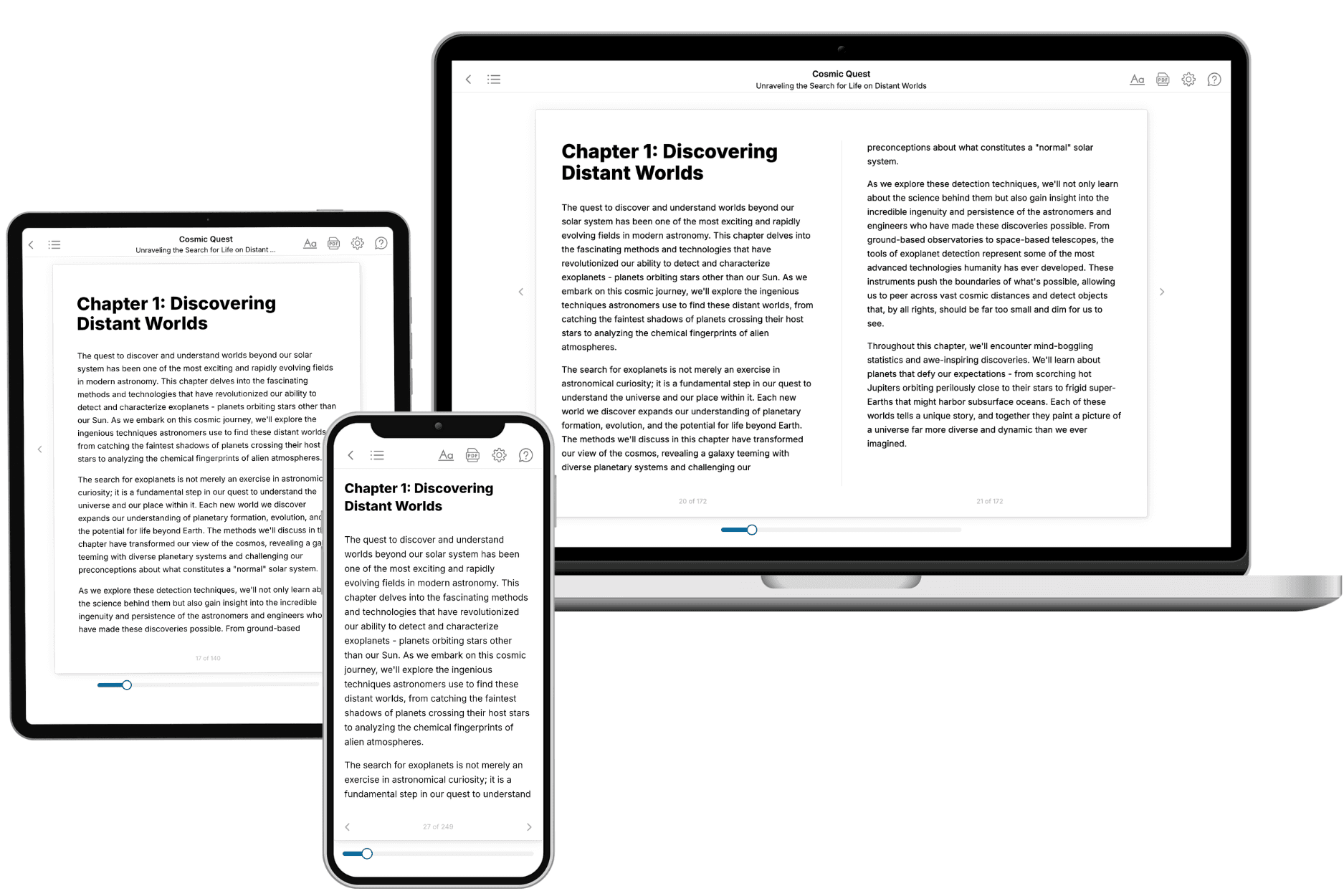
TailoredRead creates complete, full-length nonfiction ebooks, written specifically for you. Tell us what you want to learn and why, and TailoredRead writes you a complete ebook on it, with charts, tables, and diagrams throughout. Read it online, on Kindle, or on any e-reader, or download it as a PDF or EPUB. Every book is written fresh the day you order it.
- How is the book tailored to me?
Before anything is written, you answer a few short questions about your goals, your background, and the topics you care about. Your book is then planned around your answers: written at your level, focused on your goals, and covering the topics you chose, instead of the one-size-fits-all book a store sells everyone.
- Will it read like generic AI content?
No. Your book isn't a chat transcript: it's planned chapter by chapter before a single word is written, told in a clear book voice, and explains ideas visually with charts, tables, and diagrams. After writing, every book goes through an editorial pass that polishes chapters so the book reads consistent from start to finish. Judge for yourself: browse thousands of sample books on our Explore Books page.
- How accurate is the content?
Our AI first checks whether your subject needs live research. Niche and fast-moving subjects are researched before writing, and the book plan and chapters are grounded in what it finds. After writing, every book goes through a quality pass that checks its facts and consistency, and researched books list their sources in a Notes section at the back.
- How long is the book?
You choose the length: Comprehensive (250-300 pages), Detailed (150-200 pages), Essential (70-100 pages), or Short (30-50 pages).
- Does the book include visuals?
Yes. Every book includes charts, tables, and diagrams: timelines, checklists, step-by-step guides, decision trees, comparison tables, matrices, and bar charts. A typical book includes dozens of these visual elements.
- Can I read it on Kindle? What formats can I download?
Yes. Every book can be read in our online reader or downloaded as a PDF or EPUB. The EPUB can be opened with Kindle, Apple Books, Kobo, and any e-reader. The Commercial and Author licenses also include an editable Word (DOCX) and Markdown download.
- How much does it cost?
About the price of a regular ebook. The exact price depends on your book's length and complexity, from $2 for the shortest books to $35 for the most comprehensive, and it's shown when you review your book, before you commit to anything. Each book is a one-time purchase, yours to keep, no subscription. Licenses that let you share, teach, or publish your book range from $35.99 to $49.99.
- Can I preview the book before purchasing?
Before you pay, you'll see what your book will cover: the title, a detailed description, the estimated length, and the complete chapter-by-chapter table of contents, so you know what you're getting before you decide. The full text itself is written after you purchase.
- How long does it take to create a book?
About 10 minutes. You can start reading the opening chapters while the rest is still being written.