CUDA Mastery
Advanced Techniques for High-Performance GPU Computing
Dive into the world of high-performance GPU computing with CUDA Mastery.
253 pages13 chaptersEnglishApr 22, 2025Software DevelopmentCreated by Đạt
About this book
This comprehensive guide takes you beyond the basics, equipping you with advanced techniques to harness the full power of CUDA programming. You'll start by reinforcing your foundational knowledge, then quickly progress to mastering complex concepts such as CUDA streams, memory optimization, and kernel fusion. Through hands-on examples and real-world scenarios, you'll learn to fine-tune your GPU algorithms for maximum efficiency. Discover how to leverage unified memory, navigate the intricacies of the CUDA thread hierarchy, and implement advanced synchronization techniques. By the end of this journey, you'll have the skills to design, develop, and optimize cutting-edge CUDA applications that push the boundaries of GPU computing. Whether you're optimizing scientific simulations, accelerating machine learning algorithms, or developing high-performance graphics applications, CUDA Mastery provides the in-depth knowledge and practical insights you need to excel in the world of GPU programming.
Table of contents
- IntroductionCUDA Overview and Importance, Book Structure and Learning Path, Prerequisites and Setup, The GPU Computing RevolutionRead below
- Chapter 1: Understanding GPU ArchitectureEvolution of GPU Architecture, GPU Compute Capability, GPU Memory Hierarchy, Streaming Multiprocessor Architecture
- Chapter 2: CUDA Programming Fundamentals RevisitedCUDA Basics and Execution Model, CUDA Thread Hierarchy, CUDA Memory Types and Usage, Kernel Basics and Launch Parameters
- Chapter 3: Advanced Memory ManagementUnified Memory, Pinned Memory and Zero-Copy Memory, Texture Memory Usage, Memory Coalescing Techniques
- Chapter 4: CUDA Streams and Asynchronous ExecutionIntroduction to CUDA Streams, Asynchronous Memory Operations, Stream Scheduling and Priorities, CUDA Events and Synchronization
- Chapter 5: Kernel Optimization TechniquesUnderstanding and Optimizing Occupancy, Managing Register Pressure, Effective Shared Memory Usage, Minimizing Warp Divergence
- Chapter 6: Advanced CUDA FeaturesDynamic Parallelism, Cooperative Groups, CUDA Graph API, Tensor Core Operations
- Chapter 7: Parallel Algorithms and PatternsParallel Reduction Techniques, Scan and Prefix Sum Algorithms, GPU-Optimized Sorting Algorithms, Efficient Matrix Operations
- Chapter 8: CUDA Libraries and TemplatesThrust Library Usage, CUDA C++ Templates, cuBLAS and cuSPARSE Libraries, Creating Custom CUDA Libraries
- Chapter 9: Multi-GPU ProgrammingMulti-GPU Basics and Setup, Data Partitioning Strategies, Inter-GPU Communication, Load Balancing in Multi-GPU Systems
- Chapter 10: CUDA InteroperabilityCUDA-OpenGL Interoperability, CUDA-DirectX Interoperability, CUDA-aware MPI, CUDA with OpenMP and OpenACC
- Chapter 11: Profiling and Debugging CUDA ApplicationsUsing NVIDIA Nsight Compute, NVIDIA Visual Profiler, CUDA-memcheck and Debugging Tools, Interpreting Performance Metrics
- Chapter 12: Advanced Optimization StrategiesKernel Fusion Techniques, Persistent Threads Pattern, Warp Shuffle Functions, Efficient Use of Atomic Operations
- Chapter 13: CUDA Best Practices and Design PatternsGPU-Centric Algorithm Design, Memory Access Optimization Patterns, Efficient Synchronization Techniques, Robust Error Handling in CUDA, Writing Portable CUDA Code
- ConclusionFuture Trends in GPU Computing, Next Steps in Your CUDA Journey
- AppendixCUDA API Quick Reference, CUDA Compiler Options
Introduction
Welcome to the world of advanced CUDA programming and high-performance GPU computing. As you embark on this journey to master CUDA, you're taking a significant step towards harnessing the immense computational power of modern graphics processing units (GPUs). This introduction will set the stage for your learning adventure, providing you with a comprehensive overview of CUDA, its importance in today's computing landscape, and what you can expect to learn from this book.
In an era where computational demands are skyrocketing across various fields—from scientific simulations and artificial intelligence to computer graphics and big data analytics—GPUs have emerged as game-changers. Their ability to perform massive parallel computations has revolutionized the way we approach complex problems, enabling solutions that were once thought impossible or impractical. CUDA, NVIDIA's parallel computing platform and programming model, stands at the forefront of this revolution, providing developers with the tools to unleash the full potential of GPUs.
As an intermediate-level developer, you've already taken your first steps into the world of CUDA. You understand the basics of GPU programming and have likely implemented some fundamental CUDA kernels. However, you're now ready to dive deeper, to uncover the advanced techniques that will allow you to optimize your algorithms, squeeze every ounce of performance from the GPU, and tackle more complex computational challenges. This book is designed to be your guide on this journey, taking you from a competent CUDA programmer to a true master of GPU computing.
CUDA Overview and Importance
CUDA, which stands for Compute Unified Device Architecture, is more than just a programming model—it's a comprehensive ecosystem that enables developers to harness the parallel processing capabilities of NVIDIA GPUs. Since its introduction in 2007, CUDA has continuously evolved, offering increasingly sophisticated tools and features that push the boundaries of what's possible in GPU computing.
At its core, CUDA allows you to write C++ code that can be executed on the GPU, taking advantage of its massively parallel architecture. This parallelism is the key to CUDA's power. While traditional CPUs excel at sequential tasks, GPUs are designed to handle thousands of threads simultaneously. This makes them ideal for problems that can be broken down into many independent or semi-independent tasks, which is the case for a wide range of computational challenges in fields such as scientific computing, machine learning, computer vision, and more.
The importance of CUDA in modern computing cannot be overstated. It has become an essential tool in numerous industries and research fields. In scientific computing, CUDA has enabled researchers to run complex simulations that would have taken months on CPUs in just days or hours. In the field of artificial intelligence and machine learning, CUDA has been instrumental in the rapid advancements we've seen in recent years. Deep learning models that require massive amounts of data and computational power have become feasible thanks to GPU acceleration through CUDA.
In computer graphics and video processing, CUDA has opened up new possibilities for real-time rendering and video encoding. The financial sector uses CUDA for high-frequency trading and risk analysis. Even in fields like genomics and drug discovery, CUDA-accelerated computations are speeding up research and enabling breakthroughs.
As a CUDA programmer, you're not just learning a programming model—you're gaining the skills to solve some of the most challenging computational problems of our time. You're joining a community of developers who are pushing the boundaries of what's possible in computing, and you're equipping yourself with knowledge that is in high demand across various industries.
However, with great power comes great responsibility. While CUDA provides the tools to harness GPU power, it's up to you as the developer to use these tools effectively. Writing efficient CUDA code requires a deep understanding of the GPU architecture, memory hierarchy, and the principles of parallel programming. It's not just about offloading computations to the GPU—it's about structuring your algorithms and data in a way that maximizes the GPU's strengths while minimizing its weaknesses.
This is where the importance of advanced CUDA techniques comes into play. As you progress through this book, you'll learn not just how to write CUDA code, but how to optimize it, how to profile and debug it, and how to leverage advanced features to create truly high-performance applications. You'll gain insights into the intricacies of GPU architecture and learn how to write code that aligns with this architecture for maximum efficiency.
Moreover, you'll discover that CUDA is not an isolated technology. It interoperates with other important computing paradigms and libraries. You'll learn how to integrate CUDA with graphics APIs like OpenGL and DirectX, how to use CUDA in conjunction with MPI for distributed computing, and how to leverage libraries like cuBLAS and cuDNN for specialized tasks.
By the end of this journey, you'll have the skills to not just use CUDA, but to master it. You'll be able to look at complex computational problems and see opportunities for GPU acceleration. You'll have the knowledge to design, implement, and optimize CUDA solutions that can handle real-world challenges. In essence, you'll be equipped to be at the forefront of the GPU computing revolution.
Book Structure and Learning Path
This book is structured to take you on a comprehensive journey through advanced CUDA programming. Each chapter builds upon the knowledge from the previous ones, gradually introducing more complex concepts and techniques. The learning path is designed to be both challenging and rewarding, pushing you to expand your understanding while providing practical, applicable knowledge.
We begin by revisiting the fundamentals of GPU architecture and CUDA programming. This isn't just a review—it's a deeper dive into these concepts, providing insights that will form the foundation for the advanced techniques you'll learn later. You'll gain a more nuanced understanding of how GPUs work, which will inform every aspect of your CUDA programming moving forward.
From there, we delve into advanced memory management techniques. Memory is often the bottleneck in GPU computing, and mastering its intricacies can lead to significant performance improvements. You'll learn about unified memory, pinned memory, texture memory, and advanced techniques like memory coalescing. These concepts will enable you to optimize data transfer between CPU and GPU, and to structure your data for efficient GPU access.
The book then explores CUDA streams and asynchronous execution. These powerful features allow you to overlap computation with data transfer and to utilize the GPU more efficiently. You'll learn how to use streams to manage concurrent operations, how to prioritize tasks, and how to synchronize operations when necessary. This knowledge will be crucial for developing high-performance applications that can fully utilize the GPU's resources.
A significant portion of the book is dedicated to kernel optimization techniques. You'll learn how to fine-tune your CUDA kernels for maximum performance, exploring concepts like occupancy, register pressure, shared memory usage, and warp divergence. These techniques will enable you to write kernels that can efficiently process large amounts of data in parallel.
As you progress, you'll encounter advanced CUDA features such as dynamic parallelism, cooperative groups, and the CUDA Graph API. These features provide powerful tools for tackling complex computational problems and for fine-tuning the execution of your CUDA applications. You'll also learn about Tensor Core operations, which can dramatically accelerate certain types of computations, particularly in the field of machine learning.
The book doesn't just focus on individual features, but also on how to combine these features to implement efficient parallel algorithms. You'll explore parallel patterns like reduction, scan, and sorting, learning how to implement these fundamental operations efficiently on the GPU. You'll also delve into matrix operations, which are crucial for many scientific and machine learning applications.
To help you work more efficiently, we'll explore CUDA libraries and templates. You'll learn how to use the Thrust library for high-level parallel algorithms, how to leverage CUDA C++ templates for flexible, reusable code, and how to use specialized libraries like cuBLAS and cuSPARSE for linear algebra operations. You'll even learn how to create your own custom CUDA libraries.
As modern computing often requires the use of multiple GPUs, we dedicate a chapter to multi-GPU programming. You'll learn how to set up multi-GPU systems, how to partition data across multiple GPUs, how to manage inter-GPU communication, and how to balance load effectively. These skills will enable you to scale your applications to tackle even larger computational problems.
Interoperability is a key aspect of CUDA programming in real-world scenarios. You'll learn how to integrate CUDA with graphics APIs like OpenGL and DirectX, how to use CUDA with MPI for distributed computing, and how to combine CUDA with CPU-based parallel programming models like OpenMP and OpenACC. This knowledge will allow you to leverage CUDA in diverse computing environments and to integrate GPU acceleration into existing applications.
No advanced programming book would be complete without covering profiling and debugging. You'll learn how to use tools like NVIDIA Nsight Compute and the Visual Profiler to analyze your CUDA applications, identify performance bottlenecks, and validate your optimizations. You'll also learn about debugging tools and techniques specific to CUDA, enabling you to track down and fix issues in your GPU code.
The book concludes with chapters on advanced optimization strategies and best practices. You'll learn techniques like kernel fusion and the persistent threads pattern, how to use warp shuffle functions effectively, and how to optimize atomic operations. You'll also explore GPU-centric algorithm design, memory access optimization patterns, efficient synchronization techniques, and strategies for writing portable CUDA code.
Throughout the book, you'll find numerous code examples, case studies, and exercises to reinforce your learning. These practical elements will help you apply the concepts you're learning to real-world scenarios, giving you hands-on experience with advanced CUDA programming.
By the end of this learning path, you'll have a comprehensive understanding of advanced CUDA programming. You'll be equipped with the knowledge and skills to develop highly optimized GPU applications, to tackle complex computational problems, and to push the boundaries of what's possible with GPU computing. Whether you're working on scientific simulations, developing AI algorithms, or creating high-performance graphics applications, you'll have the expertise to leverage CUDA to its fullest potential.
Prerequisites and Setup
Before diving into the advanced topics covered in this book, it's important to ensure that you have the necessary prerequisites in place. This includes both the knowledge prerequisites and the technical setup required to follow along with the examples and exercises in the book.
In terms of knowledge prerequisites, this book assumes that you have a solid foundation in C++ programming. You should be comfortable with concepts such as pointers, references, templates, and object-oriented programming. If you need to brush up on these topics, there are many excellent C++ resources available online and in print.
Additionally, you should have a basic understanding of CUDA programming. You should be familiar with the concept of CUDA kernels, the CUDA thread hierarchy (grids, blocks, and threads), and basic memory management in CUDA (e.g., cudaMalloc, cudaMemcpy). If you're new to CUDA or need a refresher, the NVIDIA CUDA C++ Programming Guide is an excellent resource to start with.
A basic understanding of parallel programming concepts will also be beneficial. Familiarity with terms like parallelism, concurrency, race conditions, and synchronization will help you grasp the advanced concepts more easily. However, don't worry if you're not an expert in these areas—we'll review and expand upon these concepts throughout the book.
In terms of technical setup, you'll need a computer with an NVIDIA GPU that supports CUDA. Most NVIDIA GPUs released in the last decade support CUDA, but you can check the CUDA GPUs page on NVIDIA's website to confirm compatibility. For the best experience with the advanced techniques covered in this book, a GPU with compute capability 6.0 or higher is recommended.
You'll need to install the CUDA Toolkit on your system. The CUDA Toolkit includes the CUDA runtime, development tools, and libraries that you'll need for CUDA programming. Visit the NVIDIA CUDA Toolkit download page to get the latest version compatible with your system. Follow the installation instructions provided for your specific operating system (Windows, Linux, or macOS).
In addition to the CUDA Toolkit, you'll need a C++ compiler that's compatible with CUDA. On Windows, this is typically Microsoft Visual Studio. On Linux, you can use GCC. The specific versions supported depend on the version of the CUDA Toolkit you're using, so be sure to check the CUDA installation guide for compatibility information.
For development, you might want to use an Integrated Development Environment (IDE) that supports CUDA. While not strictly necessary (you can write CUDA code in any text editor), an IDE can greatly enhance your productivity. NVIDIA's Nsight Eclipse Edition is a popular choice for CUDA development on Linux and macOS. On Windows, you can use Visual Studio with the CUDA toolkit integration.
To follow along with the profiling and debugging chapters, you'll need to install additional tools. NVIDIA Nsight Compute and NVIDIA Nsight Systems are powerful profiling tools that come with the CUDA Toolkit. The NVIDIA Visual Profiler, while deprecated in recent CUDA versions, is still useful for certain types of analysis and is worth installing if you're using an older CUDA version.
For the chapters on CUDA interoperability, you might need to install additional SDKs or libraries. For example, to work with CUDA-OpenGL interoperability, you'll need to have OpenGL and related development libraries installed on your system. Similarly, for CUDA-aware MPI, you'll need an MPI implementation that supports CUDA integration.
It's a good idea to set up your development environment before starting the book. This will allow you to immediately start experimenting with the code examples and exercises as you encounter them. If you run into any issues during setup, the NVIDIA Developer Forums are an excellent resource for troubleshooting.
Remember, CUDA and GPU computing is a rapidly evolving field. While this book covers the most up-to-date techniques at the time of writing, it's always a good idea to keep an eye on the latest CUDA documentation and release notes. NVIDIA frequently releases new versions of CUDA with performance improvements and new features.
Lastly, don't be intimidated by the advanced nature of the material in this book. While the concepts can be challenging, they're presented in a way that builds gradually on your existing knowledge. Take your time with each chapter, experiment with the code examples, and don't hesitate to revisit earlier sections if you need to reinforce your understanding. With patience and practice, you'll soon be mastering these advanced CUDA techniques and applying them to your own projects.
The GPU Computing Revolution
The GPU computing revolution represents one of the most significant paradigm shifts in the history of computational technology. What began as specialized hardware for rendering graphics has evolved into a powerhouse for general-purpose computing, reshaping the landscape of high-performance computing across numerous fields. This revolution has not only accelerated existing computational tasks but has also enabled entirely new classes of problems to be solved, pushing the boundaries of what's possible in areas ranging from scientific research to artificial intelligence.
The journey of GPUs from graphics processors to general-purpose computing engines is a testament to the power of parallel processing. Traditional CPUs are designed to handle a wide variety of tasks, with complex control logic and large caches to minimize latency. They excel at sequential processing, handling one or a few complex tasks at a time. GPUs, on the other hand, were initially designed with a singular focus: to render graphics as quickly as possible. This specialized task naturally lends itself to parallel processing, as each pixel on a screen can be processed independently.
The architecture of GPUs, with their numerous simple processing cores, proved to be incredibly efficient for certain types of computations beyond graphics. Researchers and developers began to recognize that many computational problems in fields like physics simulations, financial modeling, and signal processing shared similar characteristics with graphics rendering – they involved performing the same operation on large sets of data in parallel.
This realization led to the development of general-purpose computing on GPUs (GPGPU). Early GPGPU programming was challenging, often requiring developers to frame their problems in terms of graphics operations. However, the potential for massive speedups in certain applications drove continued interest and development in this area.
The introduction of CUDA by NVIDIA in 2007 marked a pivotal moment in the GPU computing revolution. CUDA provided a more accessible way for developers to harness the power of GPUs for general-purpose computing. It allowed programmers to use a variant of C++ to write code that could run on the GPU, abstracting away much of the complexity of the underlying hardware. This accessibility, combined with the raw computational power of GPUs, catalyzed a boom in GPU computing across various fields.
One of the most prominent areas where GPU computing has made a significant impact is in the field of artificial intelligence, particularly in deep learning. The training of deep neural networks involves massive matrix operations that are perfectly suited for GPU parallelism. The advent of GPU-accelerated deep learning has been a key factor in the recent AI boom, enabling the training of larger, more complex models on bigger datasets. Breakthroughs in areas like computer vision, natural language processing, and reinforcement learning have been largely powered by GPU computing.
In scientific computing, GPUs have become indispensable tools for researchers across various disciplines. In physics, GPUs enable complex simulations of particle interactions, fluid dynamics, and astronomical phenomena. In chemistry and biology, they accelerate molecular dynamics simulations and protein folding calculations. Climate scientists use GPU-powered models to predict weather patterns and study climate change with unprecedented detail and speed.
The financial sector has also embraced GPU computing for tasks like risk analysis, options pricing, and high-frequency trading. The ability to perform complex financial calculations in real-time has transformed how financial institutions operate and make decisions.
In the realm of data analytics and big data, GPUs have proven invaluable for processing and analyzing massive datasets. Operations that would take hours or days on traditional CPU-based systems can often be completed in minutes using GPU acceleration.
The impact of the GPU computing revolution extends beyond just raw speed improvements. It has changed how developers think about algorithm design and optimization. Writing efficient GPU code requires a different mindset than traditional CPU programming. Developers must consider data parallelism, memory access patterns, and the unique characteristics of GPU architecture. This shift in thinking has led to new algorithmic approaches and has driven innovation in software design.
The GPU computing revolution has also influenced hardware development. The demand for more powerful GPUs for computing has driven rapid advancements in GPU technology. Modern GPUs are incredibly sophisticated pieces of hardware, with thousands of cores, complex memory hierarchies, and specialized units for tasks like tensor operations. The competition in the GPU market has led to continuous improvements in performance, energy efficiency, and features.
Looking to the future, the GPU computing revolution shows no signs of slowing down. Emerging technologies like quantum computing may complement GPU computing in certain areas, but the massive parallelism offered by GPUs remains unmatched for a wide range of computational tasks. As GPUs continue to evolve, we can expect to see even more powerful hardware, more sophisticated software tools, and new applications that leverage GPU computing in innovative ways.
As you embark on your journey to master advanced CUDA techniques, you're not just learning a programming model – you're becoming part of this ongoing revolution. The skills you'll develop will enable you to harness one of the most powerful computational tools available today, opening up possibilities to solve problems and create applications that were once thought impossible. Whether you're interested in pushing the boundaries of AI, accelerating scientific discoveries, or developing the next generation of high-performance applications, your mastery of CUDA will put you at the forefront of the GPU computing revolution.
This is the end of the free sample. The full book has 13 chapters.
Want this book written for you?
Tell us your goals and background, and get your own version of this book, tailored by AI to you.


Benefits of AI-tailored books
- Read one book, not ten:
- all the Software Development knowledge you need, gathered into a single book.
- Save days of learning:
- tell us your goals, choose your topics, and the whole book is built around them.
- Learn effortlessly:
- Software Development book written for your specific background and expertise.
- Understand at a glance:
- includes charts, tables, timelines, checklists, decision trees, and more.
- Stay current:
- written the day you order it, not years ago.
- Trust what you read:
- every book is checked for accuracy, with real research when your subject needs it.
Create your unique book in 3 steps
- 1. Select your focus
Select the focus of your Software Development book and share your background
- 2. Personalize your book
Specify your goals and choose sub-topics to include
- 3. Get your tailored book
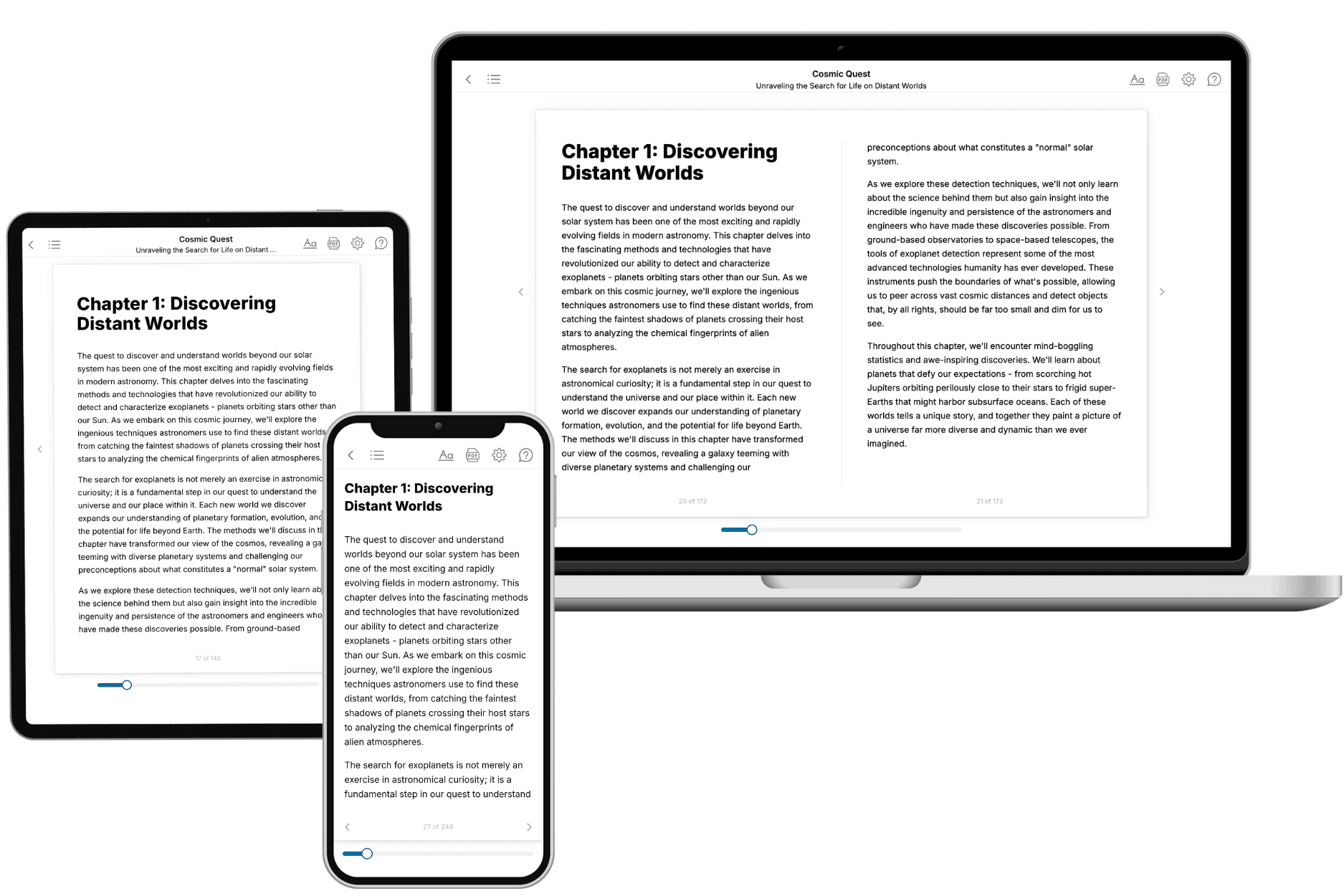
Your book is ready in 10 minutes. Read it online, download as EPUB or PDF, or send to Kindle.

Frequently asked questions
- What is TailoredRead?
TailoredRead creates complete, full-length nonfiction ebooks, written specifically for you. Tell us what you want to learn and why, and TailoredRead writes you a complete ebook on it, with charts, tables, and diagrams throughout. Read it online, on Kindle, or on any e-reader, or download it as a PDF or EPUB. Every book is written fresh the day you order it.
- How is the book tailored to me?
Before anything is written, you answer a few short questions about your goals, your background, and the topics you care about. Your book is then planned around your answers: written at your level, focused on your goals, and covering the topics you chose, instead of the one-size-fits-all book a store sells everyone.
- Will it read like generic AI content?
No. Your book isn't a chat transcript: it's planned chapter by chapter before a single word is written, told in a clear book voice, and explains ideas visually with charts, tables, and diagrams. After writing, every book goes through an editorial pass that polishes chapters so the book reads consistent from start to finish. Judge for yourself: browse thousands of sample books on our Explore Books page.
- How accurate is the content?
Our AI first checks whether your subject needs live research. Niche and fast-moving subjects are researched before writing, and the book plan and chapters are grounded in what it finds. After writing, every book goes through a quality pass that checks its facts and consistency, and researched books list their sources in a Notes section at the back.
- How long is the book?
You choose the length: Comprehensive (250-300 pages), Detailed (150-200 pages), Essential (70-100 pages), or Short (30-50 pages).
- Does the book include visuals?
Yes. Every book includes charts, tables, and diagrams: timelines, checklists, step-by-step guides, decision trees, comparison tables, matrices, and bar charts. A typical book includes dozens of these visual elements.
- Can I read it on Kindle? What formats can I download?
Yes. Every book can be read in our online reader or downloaded as a PDF or EPUB. The EPUB can be opened with Kindle, Apple Books, Kobo, and any e-reader. The Commercial and Author licenses also include an editable Word (DOCX) and Markdown download.
- How much does it cost?
About the price of a regular ebook. The exact price depends on your book's length and complexity, from $2 for the shortest books to $35 for the most comprehensive, and it's shown when you review your book, before you commit to anything. Each book is a one-time purchase, yours to keep, no subscription. Licenses that let you share, teach, or publish your book range from $35.99 to $49.99.
- Can I preview the book before purchasing?
Before you pay, you'll see what your book will cover: the title, a detailed description, the estimated length, and the complete chapter-by-chapter table of contents, so you know what you're getting before you decide. The full text itself is written after you purchase.
- How long does it take to create a book?
About 10 minutes. You can start reading the opening chapters while the rest is still being written.