Cyber Shield
Master the Art of Blue Team Defense: From Network Analysis to Threat Hunting
You're about to dive deep into the world of cyber defense, where every packet tells a story and every log entry could be the key to thwarting an attack.
315 pages16 chaptersJun 15, 2025Cyber SecurityCreated by Trung
About this book
This comprehensive guide will take you from understanding the basics of network protocols to becoming a master of advanced threat hunting techniques. As you progress through the pages, you'll gain hands-on experience with essential blue team tools like Wireshark, NMAP, and TCPDUMP. You'll learn to decipher complex network traffic patterns, implement robust security information and event management (SIEM) systems, and leverage the power of endpoint detection and response (EDR) solutions. By the end of this journey, you'll be equipped with the knowledge and skills to implement cutting-edge intrusion detection and prevention systems, correlate logs like a pro, and proactively hunt for threats using frameworks like MITRE ATT&CK and D3FEND. Whether you're analyzing network flows or optimizing SIEM tools, this book will be your trusted companion in becoming the cyber defender you've always aspired to be.
Table of contents
- IntroductionThe Role of Blue Team in Cybersecurity, How to Use This Book, Your Journey to Becoming a Cyber DefenderRead below
- Chapter 1: Network Fundamentals for Cyber DefendersUnderstanding the OSI Model, Common Network Protocols, Network Architecture Basics, Introduction to Network Traffic Flow
- Chapter 2: Mastering Wireshark for Network AnalysisNavigating the Wireshark Interface, Setting Up Capture Filters, Crafting Effective Display Filters, Basic Packet Analysis Techniques
- Chapter 3: Advanced Wireshark TechniquesDeep Dive into Protocol Dissection, Extending Wireshark with Lua Scripting, Leveraging Wireshark Statistics, Command-line Power with TShark
- Chapter 4: NMAP: Network Mapping and DiscoveryNMAP Basics and Syntax, Different Scan Techniques, OS Fingerprinting with NMAP, Introduction to NSE (NMAP Scripting Engine)
- Chapter 5: Advanced NMAP StrategiesEvasion Techniques and Timing Options, Interpreting and Customizing NMAP Output, Automating NMAP Scans, Defending Against NMAP Scans
- Chapter 6: TCPDUMP: Command-line Packet AnalysisTCPDUMP Syntax and Basic Usage, Capture Options and Filters, Understanding TCPDUMP Output Formats, Real-time Traffic Analysis with TCPDUMP
- Chapter 7: Advanced TCPDUMP TechniquesCrafting Complex TCPDUMP Filters, Scripting with TCPDUMP, Integrating TCPDUMP with Wireshark, Performance Tuning for Large-scale Captures
- Chapter 8: Log Management FundamentalsUnderstanding Different Log Sources, Common Log Formats and Structures, Log Collection and Aggregation Methods, Log Storage and Retention Strategies
- Chapter 9: Advanced Log Analysis TechniquesLog Normalization and Parsing, Log Correlation Techniques, Pattern Recognition in Logs, Anomaly Detection in Log Data
- Chapter 10: SIEM: Security Information and Event ManagementSIEM Architecture and Components, Integrating Data Sources with SIEM, Creating Effective SIEM Alerts, Building Informative SIEM Dashboards
- Chapter 11: Advanced SIEM TechniquesSIEM Performance Tuning and Optimization, Threat Modeling in SIEM, Automating SIEM Responses, Machine Learning in SIEM
- Chapter 12: Endpoint Detection and Response (EDR) and Extended Detection and Response (XDR)EDR Fundamentals, The Evolution to XDR, Implementing EDR and XDR Solutions, Analyzing EDR and XDR Data
- Chapter 13: Intrusion Detection and Prevention Systems (IDS/IPS)Types of IDS and IPS, Signature-based Detection, Anomaly-based Detection, Deploying and Configuring IDS/IPS
- Chapter 14: Leveraging MITRE ATT&CK and D3FEND FrameworksUnderstanding the MITRE ATT&CK Framework, Introduction to MITRE D3FEND, Mapping Attacks to Defenses, Integrating Frameworks into Security Operations
- Chapter 15: Threat Intelligence and Proactive DefenseSources of Threat Intelligence, Analyzing and Contextualizing Threat Data, Integrating Threat Intelligence into Security Operations, Threat Intelligence Sharing and Collaboration
- Chapter 16: Advanced Threat Hunting TechniquesDeveloping a Threat Hunting Methodology, Hypothesis-driven Hunting, Leveraging Data Analytics in Threat Hunting, Automating Threat Hunting Processes
- ConclusionFuture Trends in Cyber Defense, The Importance of Continuous Learning
- Glossary
- Appendix: Additional Resources
Introduction
Welcome to the world of cyber defense, where every byte of data can be the key to protecting critical systems and thwarting malicious attacks. As you embark on this journey to become a proficient cyber defender, you're about to delve into the intricate realm of blue team operations, where vigilance, analytical skills, and a deep understanding of network dynamics are paramount. This book is designed to be your comprehensive guide, taking you from the foundational concepts of network analysis to the advanced techniques of proactive threat hunting.
In today's digital landscape, the role of cyber defenders has never been more crucial. With the increasing sophistication of cyber threats and the expanding attack surface of modern networks, organizations rely heavily on skilled professionals who can detect, analyze, and respond to security incidents effectively. Whether you're safeguarding a small business network or protecting a large enterprise infrastructure, the skills and knowledge you'll gain from this book will be invaluable in your quest to become an expert cyber defender.
Throughout this book, you'll explore a wide array of tools, techniques, and frameworks that form the backbone of modern cyber defense strategies. From mastering the intricacies of Wireshark for deep packet inspection to leveraging the power of Security Information and Event Management (SIEM) systems for comprehensive threat detection, each chapter is designed to build upon your existing knowledge and push your skills to new heights. You'll learn how to think like both an attacker and a defender, understanding the tactics, techniques, and procedures (TTPs) used by threat actors while developing robust defensive measures to counter them.
As you progress through the chapters, you'll notice a strong emphasis on practical, hands-on learning. This approach ensures that you're not just absorbing theoretical concepts, but actively applying them in scenarios that mirror real-world challenges. By the time you reach the advanced sections on threat hunting and proactive defense, you'll have developed a holistic understanding of the cyber defense landscape and be well-equipped to tackle complex security challenges head-on.
Remember, the field of cybersecurity is ever-evolving, and staying ahead of threats requires continuous learning and adaptation. This book is designed to provide you with a solid foundation and the tools to continue your growth as a cyber defender long after you've turned the last page. So, let's begin this exciting journey into the heart of blue team operations and transform you into the cyber defender you've always aspired to be.
The Role of Blue Team in Cybersecurity
In the dynamic world of cybersecurity, the blue team plays a critical and multifaceted role in protecting an organization's digital assets. As the defensive counterpart to the offensive red team, blue team members are the guardians of the network, constantly vigilant and ready to respond to any security threats. The primary objective of the blue team is to maintain the integrity, confidentiality, and availability of an organization's information systems and data.
At its core, the blue team's responsibilities encompass a wide range of activities, all aimed at strengthening an organization's security posture. These activities can be broadly categorized into several key areas:
- Threat Detection and Analysis: Blue team members are at the forefront of identifying potential security threats. This involves monitoring network traffic, analyzing log files, and utilizing various security tools to detect anomalies or suspicious activities that could indicate a breach or an ongoing attack.
- Incident Response: When a security incident occurs, the blue team is responsible for coordinating and executing the response. This includes containing the threat, eradicating the attacker's presence, and recovering affected systems to their normal state.
- Vulnerability Assessment and Management: Regularly assessing the organization's systems for vulnerabilities and ensuring that these weaknesses are addressed is a crucial part of the blue team's proactive defense strategy.
- Security Architecture and Design: Blue team members often contribute to the design and implementation of secure network architectures, ensuring that security is built into the system from the ground up.
- Policy Development and Enforcement: Creating and enforcing security policies and procedures is essential for maintaining a consistent and robust security posture across the organization.
One of the most critical aspects of the blue team's role is its proactive nature. While reactive measures are necessary for incident response, the true strength of a blue team lies in its ability to anticipate and prevent attacks before they occur. This proactive approach involves continuous monitoring, threat intelligence gathering, and the implementation of preventive measures based on emerging threat landscapes.
The blue team's effectiveness is heavily reliant on its ability to leverage a diverse set of tools and technologies. From intrusion detection systems (IDS) and security information and event management (SIEM) platforms to advanced endpoint detection and response (EDR) solutions, blue team members must be proficient in a wide array of security technologies. Moreover, they need to possess a deep understanding of network protocols, operating systems, and application behaviors to effectively distinguish between normal operations and potential threats.
Collaboration is another key aspect of the blue team's role. Effective cyber defense requires seamless coordination not only within the security team but also with other departments across the organization. Blue team members often work closely with IT operations, development teams, and even business units to ensure that security measures are aligned with organizational goals and do not impede business operations.
As cyber threats continue to evolve in complexity and sophistication, the role of the blue team has become increasingly challenging. Advanced persistent threats (APTs), zero-day vulnerabilities, and sophisticated social engineering attacks require blue team members to constantly update their skills and knowledge. This necessitates a commitment to continuous learning and adaptation to new technologies and threat vectors.
Furthermore, the blue team plays a crucial role in fostering a culture of security within the organization. Through regular training sessions, awareness programs, and simulated exercises like tabletop scenarios or full-scale incident response drills, blue team members help to elevate the overall security consciousness of the entire organization. This holistic approach to security ensures that every employee, regardless of their role, becomes an active participant in the organization's defense strategy.
In the context of regulatory compliance, the blue team's role extends to ensuring that the organization adheres to various industry standards and legal requirements. Whether it's GDPR, HIPAA, PCI DSS, or any other relevant regulation, blue team members must be well-versed in these standards and implement controls to maintain compliance. This aspect of their role often involves working closely with legal and compliance teams to interpret and apply regulatory requirements effectively.
As you progress through this book, you'll gain a deeper understanding of these various facets of the blue team's role. You'll learn not just the technical skills required to perform these functions, but also the strategic thinking and analytical approach that characterizes successful blue team operations. By the end of your journey, you'll be well-equipped to take on the challenges of modern cyber defense and contribute effectively to your organization's security posture.
How to Use This Book
This book has been meticulously structured to provide you with a comprehensive and practical learning experience in the field of cyber defense. Whether you're a seasoned professional looking to enhance your skills or an aspiring cyber defender eager to dive into the world of blue team operations, this guide is designed to cater to your needs. To get the most out of this book, it's important to understand its structure and how to effectively navigate through its contents.
The book is divided into several key sections, each focusing on a crucial aspect of cyber defense:
- Foundational Knowledge: The initial chapters cover essential network fundamentals and protocols. This section is crucial for building a solid understanding of how networks operate, which is fundamental to effective cyber defense.
- Tool Mastery: A significant portion of the book is dedicated to mastering key tools used in cyber defense, including Wireshark, NMAP, and TCPDUMP. Each tool is covered in-depth, from basic usage to advanced techniques.
- Log Management and Analysis: These chapters focus on the critical skills of log management and analysis, essential for detecting and investigating security incidents.
- Advanced Defense Systems: Here, you'll explore SIEM, EDR/XDR, and IDS/IPS systems, learning how to implement and leverage these technologies for robust defense.
- Frameworks and Methodologies: The latter part of the book covers important frameworks like MITRE ATT&CK and D3FEND, as well as advanced threat hunting techniques.
To make the most of this book, consider the following approach:
- Sequential Reading: While it's possible to jump to specific sections based on your immediate needs, reading the book sequentially will provide you with a structured learning path that builds your knowledge progressively.
- Hands-On Practice: Throughout the book, you'll find practical exercises and examples. It's crucial to actually perform these exercises rather than just reading about them. Set up a lab environment where you can safely practice the techniques described.
- Note-Taking: Actively engage with the material by taking notes. This helps in retention and allows you to create quick reference guides for future use.
- Reflection and Application: After each chapter, take some time to reflect on how the concepts can be applied to your current or future role. Consider real-world scenarios where you might use these skills.
- Revisiting Content: Don't hesitate to revisit earlier chapters as you progress. Often, advanced concepts will make more sense when you review the basics with your newfound knowledge.
Each chapter in this book follows a consistent structure to facilitate learning:
- Introduction: An overview of the topic and its relevance to cyber defense.
- Core Concepts: Detailed explanations of key ideas and principles.
- Practical Examples: Real-world scenarios and step-by-step guides to apply the concepts.
- Advanced Techniques: For those looking to dive deeper into a particular area.
- Summary and Key Takeaways: A recap of the most important points to remember.
- Further Reading: Resources for additional learning on the topic.
As you work through the book, you'll notice an emphasis on practical, real-world applications. The examples and case studies provided are drawn from actual scenarios encountered in the field of cyber defense. This approach ensures that you're not just learning theory, but gaining insights into how these concepts and tools are applied in real-world situations.
It's important to note that the field of cybersecurity is vast and constantly evolving. While this book covers a wide range of topics, it's designed to be a springboard for your continued learning journey. Use the "Further Reading" sections at the end of each chapter to explore topics that particularly interest you or are most relevant to your work.
Additionally, the book includes various callout boxes and sidebars that provide extra information:
- Pro Tips: These offer insider knowledge and shortcuts learned from years of experience in the field.
- Caution Notes: These highlight common pitfalls or areas where extra care is needed.
- Deep Dives: For those interested in exploring a topic in more detail, these sections provide additional, more advanced information.
Remember, becoming a proficient cyber defender is not just about memorizing facts or following procedures. It's about developing a mindset that combines analytical thinking, creativity, and a constant curiosity about how systems work and how they can be protected. As you progress through this book, try to cultivate this mindset. Question why certain techniques are used, think about how you might improve upon the methods described, and always be on the lookout for new ways to apply what you've learned.
Lastly, don't underestimate the power of community in your learning journey. Engage with fellow cybersecurity professionals, participate in online forums, and attend conferences or webinars when possible. The collective knowledge and experience of the cybersecurity community are invaluable resources that can complement and enhance what you learn from this book.
By approaching this book with dedication, curiosity, and a hands-on attitude, you'll not only gain a wealth of knowledge and skills but also develop the confidence to tackle real-world cyber defense challenges. So, let's begin this exciting journey into the world of blue team operations, and transform you into the cyber defender you aspire to be.
Your Journey to Becoming a Cyber Defender
Embarking on the path to becoming a proficient cyber defender is an exciting and challenging journey. This book is designed to guide you through this process, providing a structured learning path that will transform you from someone with a foundational understanding of cybersecurity to a skilled practitioner capable of defending against sophisticated cyber threats. Let's outline the journey ahead and what you can expect as you progress through this book and beyond.
Your journey begins with solidifying your understanding of network fundamentals. This foundational knowledge is crucial because effective cyber defense requires a deep understanding of how networks operate. You'll start by revisiting key concepts such as the OSI model, common network protocols, and basic network architecture. This section will ensure that you have a robust foundation upon which to build more advanced skills.
From there, you'll dive into the world of network analysis tools, starting with Wireshark. Mastering Wireshark is a critical step in your journey, as it will give you the ability to inspect and analyze network traffic at a granular level. You'll learn how to capture packets, apply filters, and interpret the data you see. As you progress, you'll move on to more advanced Wireshark techniques, including protocol dissection and using Lua scripts to extend Wireshark's capabilities.
Next, you'll explore NMAP and TCPDUMP, two powerful command-line tools essential for network mapping and packet analysis. These tools will enhance your ability to understand network topologies and analyze traffic from a different perspective. You'll start with basic usage and gradually move to advanced techniques, including evasion methods and performance tuning for large-scale captures.
As you become proficient with these tools, your journey will shift focus to log management and analysis. This critical skill set forms the backbone of many cyber defense operations. You'll learn about various log sources, formats, and collection methods. More importantly, you'll develop the analytical skills needed to correlate logs, recognize patterns, and detect anomalies that could indicate a security threat.
Building on your log analysis skills, you'll then explore Security Information and Event Management (SIEM) systems. This section of your journey will teach you how to aggregate and analyze security data from multiple sources across your network. You'll learn how to set up effective alerts, create informative dashboards, and even delve into advanced topics like SIEM performance tuning and integrating machine learning capabilities.
As your skills grow, you'll move into more advanced territory with Endpoint Detection and Response (EDR) and Extended Detection and Response (XDR) systems. This part of your journey will teach you how to monitor endpoints for suspicious activities and respond to threats in real-time. You'll gain insights into the evolution from EDR to XDR and learn how to implement and analyze data from these sophisticated defense systems.
Your path will then lead you to Intrusion Detection and Prevention Systems (IDS/IPS). Here, you'll learn about different types of IDS/IPS, understand signature-based and anomaly-based detection methods, and learn how to deploy and configure these systems effectively. This knowledge will be crucial in your ability to detect and prevent network intrusions.
As you near the advanced stages of your journey, you'll explore the MITRE ATT&CK and D3FEND frameworks. These powerful tools will provide you with structured approaches to understand attack techniques and develop corresponding defense strategies. You'll learn how to map attacks to defenses and integrate these frameworks into your security operations.
The final stages of your journey focus on threat intelligence and advanced threat hunting techniques. You'll learn how to gather, analyze, and apply threat intelligence to enhance your defensive capabilities. You'll also develop skills in proactive threat hunting, learning how to hypothesize about potential threats and use data analytics to uncover hidden adversaries in your network.
Throughout this journey, you'll notice several themes that recur and evolve:
- Analytical Thinking: As you progress, you'll develop increasingly sophisticated analytical skills, learning to interpret complex data and draw meaningful conclusions.
- Tool Proficiency: You'll become adept at using a wide range of cybersecurity tools, understanding not just how to use them, but when and why to apply them.
- Defensive Strategy: Your understanding of defensive strategies will evolve from basic concepts to complex, multi-layered approaches that can protect against advanced persistent threats.
- Threat Actor Mindset: You'll learn to think like an attacker, understanding their tactics and techniques, which is crucial for effective defense.
- Continuous Adaptation: Throughout the book, you'll be encouraged to stay current with evolving threats and technologies, instilling a mindset of continuous learning.
It's important to understand that this journey doesn't end with the conclusion of this book. The field of cybersecurity is constantly evolving, and so too must your skills and knowledge. This book will provide you with a solid foundation and the tools to continue your growth, but your journey as a cyber defender will be ongoing.
To truly excel in this field, you should complement your learning from this book with:
- Practical Experience: Seek opportunities to apply what you've learned in real-world scenarios. This could be through your current job, internships, or personal projects.
- Certifications: Consider pursuing relevant certifications like CISSP, CEH, or OSCP to validate your skills and knowledge.
- Continuous Learning: Stay updated with the latest trends, tools, and threats in cybersecurity through blogs, webinars, and conferences.
- Networking: Engage with the cybersecurity community through forums, local meetups, or online groups. The insights and experiences of others in the field can be invaluable.
- Specialization: As you progress, you may find areas of cyber defense that particularly interest you. Don't hesitate to dive deeper into these specializations.
Remember, becoming a skilled cyber defender is not just about acquiring technical knowledge. It's about developing a security-focused mindset, honing your problem-solving skills, and cultivating the ability to think creatively in the face of new and evolving threats. As you progress through this book and beyond, you'll not only gain technical proficiency but also develop these crucial soft skills that distinguish great cyber defenders.
Your journey to becoming a cyber defender is one of continuous growth and learning. It will be challenging at times, but also incredibly rewarding. As you face each new concept or technique in this book, approach it with curiosity and determination. Each skill you master is another tool in your arsenal against cyber threats.
So, as you stand at the beginning of this journey, take a moment to appreciate the path ahead. You're about to dive into a world where your skills and knowledge can make a real difference in protecting digital assets, preserving privacy, and securing the digital landscape. Embrace the challenges, celebrate your progress, and remember that every step you take brings you closer to becoming the cyber defender you aspire to be. Let's begin this exciting journey together!
This is the end of the free sample. The full book has 16 chapters.
Want this book written for you?
Tell us your goals and background, and get your own version of this book, tailored by AI to you.


Benefits of AI-tailored books
- Read one book, not ten:
- all the Cyber Security knowledge you need, gathered into a single book.
- Save days of learning:
- tell us your goals, choose your topics, and the whole book is built around them.
- Learn effortlessly:
- Cyber Security book written for your specific background and expertise.
- Understand at a glance:
- includes charts, tables, timelines, checklists, decision trees, and more.
- Stay current:
- written the day you order it, not years ago.
- Trust what you read:
- every book is checked for accuracy, with real research when your subject needs it.
Create your unique book in 3 steps
- 1. Select your focus
Select the focus of your Cyber Security book and share your background
- 2. Personalize your book
Specify your goals and choose sub-topics to include
- 3. Get your tailored book
Your book is ready in 10 minutes. Read it online, download as EPUB or PDF, or send to Kindle.


Frequently asked questions
- What is TailoredRead?
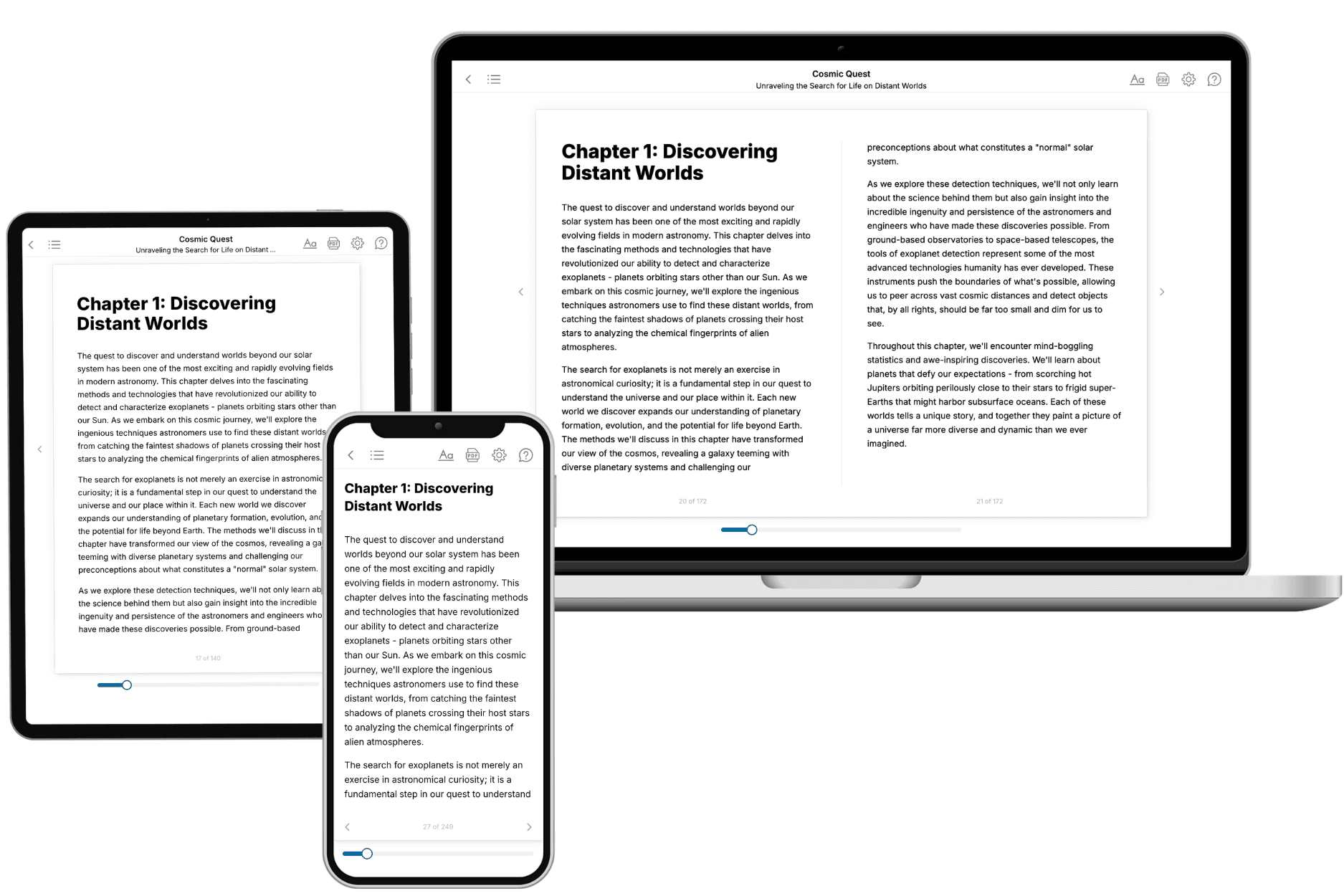
TailoredRead creates complete, full-length nonfiction ebooks, written specifically for you. Tell us what you want to learn and why, and TailoredRead writes you a complete ebook on it, with charts, tables, and diagrams throughout. Read it online, on Kindle, or on any e-reader, or download it as a PDF or EPUB. Every book is written fresh the day you order it.
- How is the book tailored to me?
Before anything is written, you answer a few short questions about your goals, your background, and the topics you care about. Your book is then planned around your answers: written at your level, focused on your goals, and covering the topics you chose, instead of the one-size-fits-all book a store sells everyone.
- Will it read like generic AI content?
No. Your book isn't a chat transcript: it's planned chapter by chapter before a single word is written, told in a clear book voice, and explains ideas visually with charts, tables, and diagrams. After writing, every book goes through an editorial pass that polishes chapters so the book reads consistent from start to finish. Judge for yourself: browse thousands of sample books on our Explore Books page.
- How accurate is the content?
Our AI first checks whether your subject needs live research. Niche and fast-moving subjects are researched before writing, and the book plan and chapters are grounded in what it finds. After writing, every book goes through a quality pass that checks its facts and consistency, and researched books list their sources in a Notes section at the back.
- How long is the book?
You choose the length: Comprehensive (250-300 pages), Detailed (150-200 pages), Essential (70-100 pages), or Short (30-50 pages).
- Does the book include visuals?
Yes. Every book includes charts, tables, and diagrams: timelines, checklists, step-by-step guides, decision trees, comparison tables, matrices, and bar charts. A typical book includes dozens of these visual elements.
- Can I read it on Kindle? What formats can I download?
Yes. Every book can be read in our online reader or downloaded as a PDF or EPUB. The EPUB can be opened with Kindle, Apple Books, Kobo, and any e-reader. The Commercial and Author licenses also include an editable Word (DOCX) and Markdown download.
- How much does it cost?
About the price of a regular ebook. The exact price depends on your book's length and complexity, from $2 for the shortest books to $35 for the most comprehensive, and it's shown when you review your book, before you commit to anything. Each book is a one-time purchase, yours to keep, no subscription. Licenses that let you share, teach, or publish your book range from $35.99 to $49.99.
- Can I preview the book before purchasing?
Before you pay, you'll see what your book will cover: the title, a detailed description, the estimated length, and the complete chapter-by-chapter table of contents, so you know what you're getting before you decide. The full text itself is written after you purchase.
- How long does it take to create a book?
About 10 minutes. You can start reading the opening chapters while the rest is still being written.