Decision Trees Decoded
Master the Algorithm That Powers Machine Learning's Most Interpretable Models
You'll gain the expertise to design, implement, and optimize decision tree algorithms that solve real-world problems with clarity and precision.
222 pages12 chaptersOct 21, 2025Machine Learning
About this book
This book bridges the gap between theoretical computer science and practical machine learning, giving you a deep understanding of how recursive partitioning creates powerful predictive models. You'll explore the mathematical foundations of impurity measures, learn why certain splits outperform others, and discover how to prevent overfitting through intelligent pruning strategies. Beyond single trees, you'll master ensemble techniques that combine multiple trees into robust, high-performance systems. Each concept builds naturally on the previous one, moving from basic binary splits to advanced topics like handling missing data, feature importance analysis, and computational optimization. With clear explanations of algorithms, complexity analysis, and decision-making frameworks, you'll develop the confidence to choose the right tree-based approach for your specific use case. Whether you're building classification systems, regression models, or interpretable AI solutions, this book equips you with the knowledge to leverage decision trees effectively and understand exactly why your models make the predictions they do.
Table of contents
- IntroductionWhy Decision Trees Matter in Modern Computing, The Interpretability Advantage, How This Book Approaches Tree AlgorithmsRead below
- Chapter 1: Foundations of Decision TreesUnderstanding Tree Structure and Terminology, The Recursive Partitioning Paradigm, Classification Trees Versus Regression Trees, Historical Development and Key Algorithms
- Chapter 2: Splitting Criteria and Impurity MeasuresThe Concept of Node Impurity, Gini Index: Measuring Classification Purity, Entropy and Information Gain, Variance Reduction for Regression Problems
- Chapter 3: Tree Construction AlgorithmsThe Greedy Splitting Approach, ID3: The Foundational Algorithm, C4.5 and Its Improvements, CART: Classification and Regression Trees
- Chapter 4: Handling Different Data TypesSplitting on Categorical Features, Optimal Splits for Numerical Features, Strategies for Missing Data, Working with Mixed Data Types
- Chapter 5: Controlling OverfittingUnderstanding the Overfitting Problem, Pre-Pruning: Early Stopping Strategies, Post-Pruning: Cost-Complexity Pruning, Hyperparameter Tuning for Optimal Generalization
- Chapter 6: Performance Evaluation and MetricsClassification and Regression Metrics, Cross-Validation Strategies, The Bias-Variance Tradeoff in Trees
- Chapter 7: Feature Importance and InterpretationCalculating Feature Importance Scores, Visualizing and Interpreting Tree Structures, Analyzing Decision Paths and Rules, Extracting Actionable Insights from Trees
- Chapter 8: Ensemble Methods: Beyond Single TreesThe Power of Ensemble Learning, Bagging and Bootstrap Aggregation, Random Forests: Randomized Tree Ensembles, Introduction to Boosting Algorithms
- Chapter 9: Gradient Boosting Decision TreesGradient Boosting Theory and Mechanics, Implementing Gradient Boosting Machines, Modern Implementations: XGBoost and LightGBM
- Chapter 10: Computational Complexity and OptimizationTime Complexity of Tree Construction, Memory Requirements and Space Complexity, Optimization Techniques for Large Datasets, Parallel and Distributed Tree Building
- Chapter 11: Advanced Topics and ExtensionsMulti-Output Decision Trees, Oblique Decision Trees and Linear Combinations, Incremental and Online Tree Learning, Hybrid Approaches: Trees and Neural Networks
- Chapter 12: Practical Applications and Case StudiesCommon Application Domains, Choosing the Right Tree-Based Approach, Implementation Best Practices, Debugging and Troubleshooting Tree Models
- ConclusionKey Takeaways and Core Principles, Future Directions in Tree-Based Learning, Your Path Forward with Decision Trees
Introduction
Decision trees stand among the most elegant and powerful algorithms in machine learning, offering a rare combination of predictive accuracy and human interpretability. Unlike black-box models that obscure their reasoning behind layers of mathematical abstraction, decision trees make their logic transparent through a structure that mirrors human decision-making processes. This transparency has made them indispensable across industries where understanding why a prediction was made matters as much as the prediction itself. From credit approval systems that must explain rejections to medical diagnosis tools that guide treatment decisions, decision trees provide both answers and reasoning.
The fundamental appeal of decision trees lies in their intuitive approach to problem-solving. They partition data through a series of yes-or-no questions, creating a flowchart-like structure that anyone can follow from input to output. This recursive partitioning process—splitting data into increasingly homogeneous subsets—forms the conceptual foundation for understanding not just single trees, but entire families of ensemble methods that dominate modern machine learning competitions. When you grasp how a single tree makes decisions, you unlock the door to understanding Random Forests, Gradient Boosting Machines, and the sophisticated variants that power today's most successful predictive systems.
This book takes you on a comprehensive journey through the world of tree-based algorithms, from foundational concepts to advanced implementations. You'll explore the mathematical principles that govern split selection, discover why certain impurity measures outperform others in specific contexts, and learn practical techniques for preventing overfitting while maintaining predictive power. Each chapter builds systematically on previous concepts, ensuring you develop both theoretical understanding and practical implementation skills. Whether you're working with classification problems, regression tasks, or complex multi-output scenarios, you'll gain the expertise to choose appropriate algorithms, tune them effectively, and interpret their results with confidence.
The approach here emphasizes depth over breadth, focusing on genuine understanding rather than superficial coverage. You won't find cookbook recipes that work without comprehension. Instead, you'll develop the analytical framework to reason about algorithm behavior, predict performance characteristics, and troubleshoot problems when they arise. This foundation proves invaluable when facing real-world challenges that don't match textbook examples. By understanding the underlying mechanics of recursive partitioning, impurity reduction, and ensemble aggregation, you'll be equipped to adapt these algorithms to novel situations and make informed decisions about model architecture and hyperparameter selection.
Why Decision Trees Matter in Modern Computing
Decision trees occupy a unique position in the machine learning landscape, serving as both standalone algorithms and foundational components of more complex systems. Their importance extends far beyond their original conception in the 1960s and 1970s. Today, tree-based methods consistently rank among the top-performing algorithms in machine learning competitions, particularly when working with structured tabular data. The Kaggle platform, which hosts thousands of data science competitions, reveals that ensemble tree methods like XGBoost and LightGBM dominate winning solutions across diverse problem domains[1]. This practical success stems from several key advantages that make trees particularly well-suited to real-world data challenges.
The versatility of decision trees manifests in their ability to handle heterogeneous data without extensive preprocessing. Unlike many algorithms that require careful feature scaling, normalization, or transformation, trees work naturally with both categorical and numerical variables. They remain robust to outliers because split decisions depend on rank ordering rather than absolute values. This characteristic dramatically reduces the data preparation burden that often consumes the majority of time in machine learning projects. When you're working with messy real-world datasets containing mixed data types, missing values, and non-linear relationships, decision trees provide a practical starting point that often yields surprisingly competitive results with minimal feature engineering.
The computational efficiency of tree-based methods deserves particular attention in an era of increasingly large datasets. Modern implementations leverage sophisticated optimization techniques that enable training on millions of examples with thousands of features. The greedy nature of tree construction—making locally optimal decisions at each split—allows for efficient algorithms that scale well with data size. Consider these performance characteristics that make trees practical for production systems:
- Training efficiency: Tree construction typically exhibits O(n × m × log n) time complexity for n samples and m features, making it feasible for large datasets
- Prediction speed: Once trained, trees make predictions in O(log n) time by traversing from root to leaf, enabling real-time inference
- Memory footprint: Trees store only split conditions and leaf values, resulting in compact models compared to instance-based methods
- Parallelization potential: Both training and prediction can be parallelized across features, samples, or trees in ensemble methods
Beyond raw performance metrics, decision trees excel at capturing non-linear relationships and complex interactions between features without explicit feature engineering. While linear models require you to manually specify interaction terms, trees automatically discover these patterns through their hierarchical splitting structure. A tree might first split on customer age, then within the older age group, split on income level—effectively learning an age-income interaction without being explicitly told to look for it. This automatic interaction detection proves particularly valuable in exploratory analysis and when domain knowledge about feature relationships remains incomplete or uncertain.
The interpretability advantage of decision trees extends beyond simple visualization to practical business value. In regulated industries like banking and healthcare, model transparency isn't merely desirable—it's often legally required. The European Union's General Data Protection Regulation (GDPR) includes provisions for the "right to explanation" regarding automated decisions[2]. Decision trees naturally satisfy these requirements by providing clear decision paths that can be communicated to stakeholders without technical backgrounds. When a loan application gets rejected, the tree can explain exactly which factors led to that decision, enabling both regulatory compliance and customer communication.
The educational value of decision trees for understanding machine learning concepts cannot be overstated. They provide concrete, visual representations of abstract concepts like overfitting, bias-variance tradeoff, and model complexity. When you see a tree grow deeper and deeper, perfectly memorizing training data while failing on test data, the concept of overfitting becomes tangible rather than theoretical. This pedagogical clarity makes trees an ideal entry point for learning machine learning, while their continued relevance in advanced applications ensures that time invested in understanding them pays dividends throughout your career. The principles you learn from studying single decision trees—recursive partitioning, impurity reduction, regularization through pruning—transfer directly to understanding ensemble methods and even inform thinking about other algorithm families.
Modern variants of decision trees have addressed many limitations of classical implementations while preserving their core advantages. Gradient boosting frameworks like XGBoost, LightGBM, and CatBoost incorporate sophisticated techniques for handling categorical variables, missing data, and imbalanced classes. These implementations achieve state-of-the-art performance on structured data while maintaining reasonable training times and model interpretability. The continued innovation in tree-based methods—from histogram-based splitting to leaf-wise growth strategies—demonstrates that this algorithm family remains vibrant and relevant. Understanding the foundational principles of decision trees positions you to leverage these modern implementations effectively and appreciate the engineering innovations that make them practical for large-scale applications.
The ecosystem surrounding decision trees has matured significantly, with robust implementations available in every major programming language and machine learning framework. Libraries like scikit-learn, XGBoost, LightGBM, and CatBoost provide production-ready implementations with extensive documentation and active communities. This mature tooling ecosystem means you can move quickly from understanding concepts to implementing solutions. However, the availability of these tools makes deep understanding even more critical—knowing which hyperparameters to tune, how to diagnose poor performance, and when to choose one variant over another requires comprehension of the underlying algorithms rather than just familiarity with API calls.
The Interpretability Advantage
Interpretability represents perhaps the most distinctive advantage of decision trees in an era increasingly dominated by complex neural networks and ensemble methods. While deep learning models might achieve marginally better accuracy on certain tasks, they operate as black boxes that provide predictions without explanations. Decision trees, by contrast, encode their logic in a structure that humans can inspect, understand, and validate against domain knowledge. This transparency proves invaluable when model predictions inform high-stakes decisions affecting people's lives, livelihoods, or safety. The ability to trace any prediction back through a clear sequence of logical conditions transforms machine learning from an opaque oracle into an understandable decision support system.
The visual representation of decision trees as flowcharts provides immediate intuition about model behavior. Each internal node represents a question about a feature, each branch represents a possible answer, and each leaf represents a final prediction. This structure maps naturally onto how humans explain their own reasoning: "If the customer has good credit history, and their income exceeds $50,000, and they've been employed for more than two years, then approve the loan." Stakeholders without technical backgrounds can follow this logic, identify potential issues, and provide feedback based on domain expertise. Consider a medical diagnosis tree that recommends treatment based on patient symptoms—doctors can validate whether the decision path aligns with medical knowledge and identify cases where the model might be learning spurious correlations rather than causal relationships.
The interpretability of decision trees manifests at multiple levels, each providing different insights into model behavior. At the global level, you can examine the entire tree structure to understand overall decision-making patterns. Which features appear near the root, indicating high importance? What combinations of conditions lead to different predictions? At the local level, you can trace the specific path taken for any individual prediction, seeing exactly which feature values triggered which decisions. This dual perspective—both forest and trees—enables comprehensive model understanding. Here are the key interpretability dimensions that decision trees provide:
- Feature importance rankings: Quantify which variables most influence predictions across the entire dataset
- Decision rules: Extract human-readable if-then rules that capture model logic
- Prediction paths: Trace the exact sequence of decisions leading to any specific prediction
- Split thresholds: Identify the specific cutoff values that separate different outcomes
- Leaf statistics: Examine the distribution of training samples and predictions at terminal nodes
- Interaction detection: Discover which features interact by observing hierarchical split patterns
The practical implications of interpretability extend to model debugging and improvement. When a decision tree makes incorrect predictions, you can inspect the relevant decision paths to diagnose the problem. Perhaps the tree splits on a feature that shouldn't be predictive, suggesting data leakage or spurious correlation. Maybe certain leaf nodes contain very few training samples, indicating overfitting to noise. Or you might discover that the tree fails to split on an important feature because it's correlated with another feature that was selected first. These insights guide targeted improvements—collecting more data for underrepresented scenarios, engineering better features, or adjusting regularization parameters. The transparency of trees transforms model development from trial-and-error into informed iteration.
Regulatory compliance and ethical AI considerations increasingly demand model interpretability. Financial institutions must explain credit decisions to applicants. Healthcare providers need to justify treatment recommendations. Hiring systems must demonstrate fairness and avoid discriminatory patterns. Decision trees naturally support these requirements by providing auditable decision logic. Regulators, auditors, and affected individuals can examine the rules that govern predictions and verify they align with legal and ethical standards. This auditability proves particularly valuable when investigating potential bias—you can directly inspect whether protected attributes like race or gender influence decisions, either directly through splits on those features or indirectly through correlated proxies.
The interpretability advantage extends to building trust with end users and stakeholders. When people understand how a system makes decisions, they're more likely to trust and adopt it. A doctor might be hesitant to follow recommendations from an opaque neural network but willing to consider suggestions from a decision tree whose logic they can validate. Similarly, business stakeholders are more comfortable deploying models they understand, knowing they can explain the system's behavior to customers, regulators, or executives. This trust factor often outweighs small differences in predictive accuracy, making interpretable models the pragmatic choice for many real-world applications. The ability to explain model behavior in plain language—without resorting to mathematical formulas or technical jargon—bridges the gap between data science teams and business stakeholders.
However, interpretability comes with important caveats that deserve acknowledgment. While individual decision trees remain highly interpretable, ensemble methods that combine hundreds or thousands of trees sacrifice much of this transparency. A Random Forest with 500 trees doesn't provide a single clear decision path—it aggregates predictions from 500 different paths. Gradient boosting models build trees sequentially, each correcting errors from previous trees, creating complex interdependencies that obscure simple interpretation. Modern techniques like SHAP (SHapley Additive exPlanations) values and partial dependence plots help recover some interpretability for ensemble methods, but they add complexity and computational cost. Understanding this tradeoff—between the perfect interpretability of single trees and the superior accuracy of ensembles—helps you make informed decisions about which approach suits your specific requirements.
The depth and complexity of a decision tree directly impact its interpretability. A shallow tree with five or six leaf nodes can be fully comprehended at a glance. A deep tree with hundreds of nodes becomes difficult to visualize and understand holistically, even though any individual prediction path remains traceable. This creates a tension between model capacity and interpretability—deeper trees can capture more complex patterns but become harder to interpret. Practical interpretability often requires constraining tree depth, even at the cost of some predictive accuracy. The optimal balance depends on your specific use case: a model for exploratory data analysis might prioritize interpretability with very shallow trees, while a production prediction system might accept deeper trees where interpretability matters less than accuracy.
The interpretability of decision trees also facilitates knowledge discovery and hypothesis generation. By examining which features the tree selects and how it combines them, you can uncover patterns and relationships in your data that might not be obvious from summary statistics or correlation matrices. A tree might reveal that customer churn depends primarily on support ticket frequency, but only for customers in certain geographic regions—suggesting a localized service quality issue. These insights can inform business strategy, guide further investigation, or generate hypotheses for causal analysis. The tree serves not just as a predictive model but as an analytical tool that helps you understand your data and domain more deeply. This dual role—prediction and insight—makes decision trees particularly valuable in exploratory phases of data science projects.
How This Book Approaches Tree Algorithms
This book adopts a principled approach that builds understanding from foundational concepts to advanced implementations. Rather than presenting algorithms as recipes to be followed blindly, each chapter develops the reasoning behind design decisions and explores the tradeoffs inherent in different approaches. You'll learn not just how decision trees work, but why they work the way they do, and when alternative approaches might be more appropriate. This emphasis on understanding over memorization equips you to adapt techniques to novel situations and make informed decisions when facing real-world challenges that don't match textbook examples. The goal is to develop your intuition and analytical capabilities alongside your technical knowledge.
The progression through topics follows a carefully designed learning path that introduces concepts in logical order, with each chapter building on previous material. You'll start with the fundamental structure of decision trees and the recursive partitioning paradigm that underlies all tree-based methods. From this foundation, you'll explore the mathematical measures that quantify split quality—Gini index, entropy, and variance reduction—understanding both their theoretical justification and practical implications. The book then examines specific algorithms like ID3, C4.5, and CART, showing how different design choices lead to different algorithm characteristics. This systematic progression ensures you're never confronted with concepts that depend on material you haven't yet encountered, while also revealing how ideas connect and build upon each other.
Each chapter balances theoretical understanding with practical implementation considerations. You'll encounter the mathematical formulations that define algorithms precisely, but always accompanied by intuitive explanations and concrete examples that ground abstract concepts in tangible scenarios. When discussing impurity measures, for instance, you'll see both the mathematical definitions and worked examples showing how these measures behave with different data distributions. When exploring pruning techniques, you'll learn the algorithmic procedures alongside discussions of when and why pruning improves generalization. This dual perspective—theory and practice—ensures you can both implement algorithms correctly and reason about their behavior in different contexts.
The book emphasizes actionable knowledge through specific implementation guidance and troubleshooting advice. You'll find detailed explanations of hyperparameters and their effects, helping you understand what to tune and why. Common pitfalls and their solutions receive explicit attention—for example, how to recognize when a tree is overfitting, what strategies can address the problem, and how to evaluate whether your interventions succeeded. The content includes specific steps you can take immediately, such as:
- Diagnostic procedures for identifying overfitting, underfitting, and data quality issues
- Systematic approaches to hyperparameter tuning that go beyond random search
- Strategies for handling imbalanced classes, missing data, and high-cardinality categorical variables
- Methods for extracting and validating feature importance rankings
- Techniques for visualizing tree structures and decision boundaries effectively
- Guidelines for choosing between single trees, Random Forests, and gradient boosting methods
Concrete examples and case studies appear throughout the book to illustrate concepts and demonstrate practical applications. Rather than relying solely on abstract descriptions, you'll see how algorithms behave with specific datasets and scenarios. For instance, when discussing the bias-variance tradeoff, you'll examine how tree depth affects both training and test performance with actual data, observing the characteristic patterns that indicate overfitting. When exploring ensemble methods, you'll see quantitative comparisons showing how Random Forests reduce variance and how gradient boosting reduces bias. These examples use realistic scenarios that mirror the challenges you'll encounter in practice, helping you recognize similar situations in your own work and apply appropriate solutions.
The treatment of computational complexity and algorithmic efficiency receives substantial attention, reflecting the practical reality that algorithms must scale to real-world data volumes. You'll learn the time and space complexity of different tree construction approaches, understanding which operations dominate computational cost and where optimization efforts yield the greatest returns. The book explores modern implementation techniques like histogram-based splitting, parallel tree construction, and efficient handling of categorical variables. This performance-oriented perspective helps you make informed decisions about algorithm selection and implementation when working with large datasets or resource-constrained environments. Understanding complexity also enables you to predict how algorithm runtime will scale as your data grows, informing infrastructure planning and system design.
Advanced topics receive thorough coverage while remaining accessible to readers with intermediate backgrounds. The book doesn't shy away from sophisticated concepts like gradient boosting, oblique trees, or hybrid neural-tree architectures, but introduces them systematically with appropriate context and motivation. Each advanced topic builds on foundational material covered earlier, ensuring you have the necessary background to understand more complex ideas. The presentation style maintains consistency throughout—clear explanations, concrete examples, and practical guidance—whether discussing basic binary splits or advanced ensemble techniques. This approach makes advanced material approachable without oversimplifying or omitting important details that affect practical implementation.
The book acknowledges the ecosystem of tools and libraries that support tree-based machine learning while maintaining focus on algorithmic understanding rather than specific software packages. You'll develop knowledge that transfers across implementations and programming languages, understanding the underlying concepts that remain constant even as specific APIs and tools evolve. When discussing implementation details, the book highlights key considerations that apply regardless of which library you use—how to specify stopping criteria, what hyperparameters control model complexity, how to extract feature importance scores. This tool-agnostic approach ensures the knowledge you gain remains valuable even as the software landscape changes, while still providing practical guidance for working with real implementations.
Throughout the book, connections between different concepts and algorithms receive explicit attention. You'll see how the greedy splitting approach in single trees relates to the sequential nature of gradient boosting. You'll understand how the bias-variance tradeoff manifests differently in single trees versus Random Forests. You'll recognize how the interpretability advantages of simple trees partially carry over to ensemble methods through feature importance measures. These connections help you build a coherent mental model of tree-based machine learning rather than a collection of isolated facts. This integrated understanding proves invaluable when facing novel problems—you can reason by analogy, transfer insights from one context to another, and combine techniques in creative ways to address specific challenges.
The ultimate goal of this book is to transform you from someone who can use decision tree libraries into someone who deeply understands tree-based algorithms and can leverage that understanding to solve real problems effectively. You'll develop the confidence to choose appropriate algorithms for specific tasks, tune them intelligently, diagnose problems when they arise, and explain your models to technical and non-technical audiences. You'll understand the strengths and limitations of different approaches, enabling realistic expectations and informed tradeoffs. Most importantly, you'll gain the analytical framework to continue learning as the field evolves, able to evaluate new techniques and implementations based on solid foundational knowledge. This depth of understanding—not just knowing what works, but understanding why it works—represents the difference between merely using machine learning tools and truly mastering them.
Notes
Introduction
- 1. Chen, Tianqi, and Carlos Guestrin. 'XGBoost: A Scalable Tree Boosting System.' Proceedings of the 22nd ACM SIGKDD International Conference on Knowledge Discovery and Data Mining (2016): 785-794.
- 2. Goodman, Bryce, and Seth Flaxman. 'European Union Regulations on Algorithmic Decision-Making and a Right to Explanation.' AI Magazine 38.3 (2017): 50-57.
This is the end of the free sample. The full book has 12 chapters.
Want this book written for you?
Tell us your goals and background, and get your own version of this book, tailored by AI to you.


Benefits of AI-tailored books
- Read one book, not ten:
- all the Machine Learning knowledge you need, gathered into a single book.
- Save days of learning:
- tell us your goals, choose your topics, and the whole book is built around them.
- Learn effortlessly:
- Machine Learning book written for your specific background and expertise.
- Understand at a glance:
- includes charts, tables, timelines, checklists, decision trees, and more.
- Stay current:
- written the day you order it, not years ago.
- Trust what you read:
- every book is checked for accuracy, with real research when your subject needs it.
Create your unique book in 3 steps
- 1. Select your focus
Select the focus of your Machine Learning book and share your background
- 2. Personalize your book
Specify your goals and choose sub-topics to include
- 3. Get your tailored book
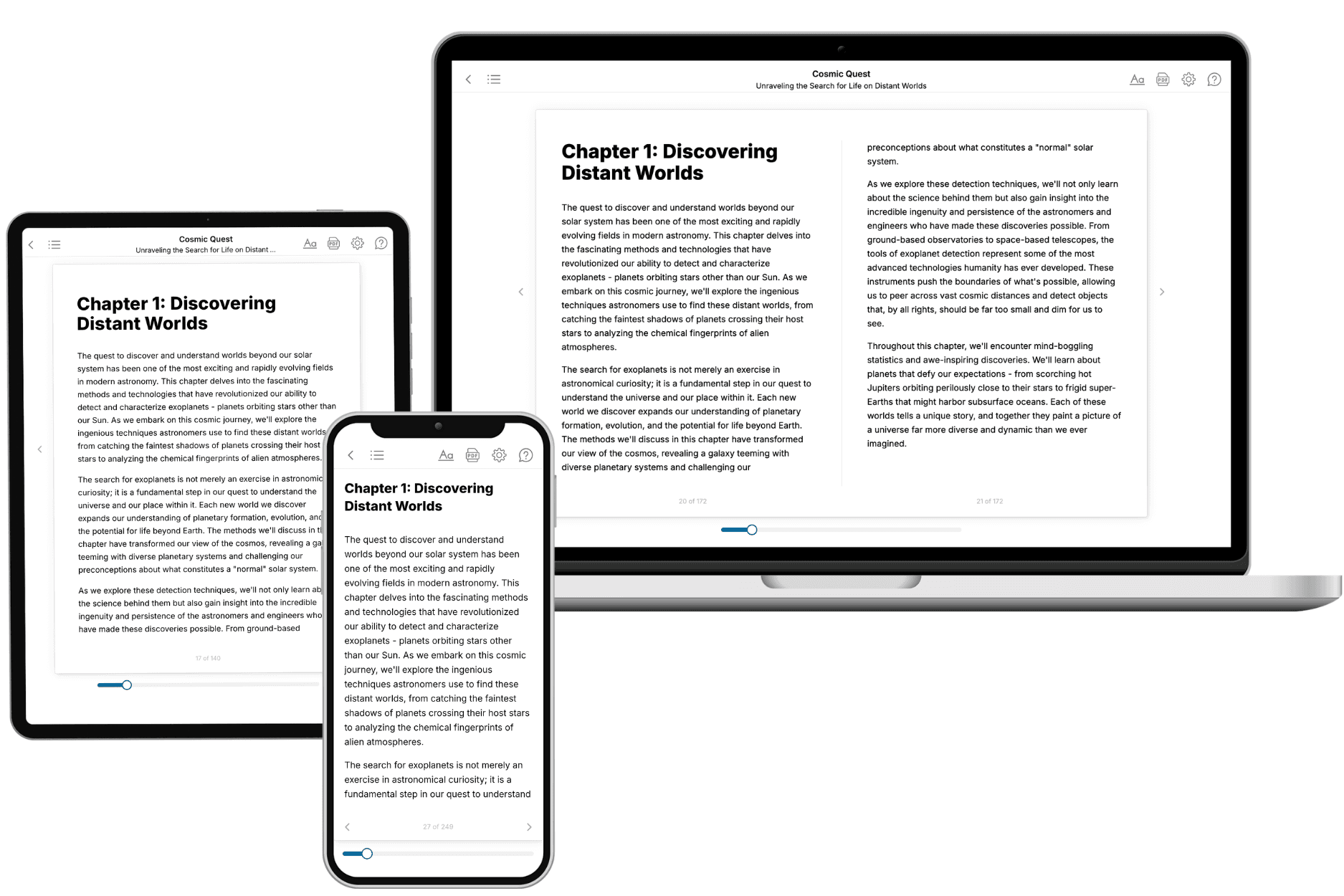
Your book is ready in 10 minutes. Read it online, download as EPUB or PDF, or send to Kindle.

Frequently asked questions
- What is TailoredRead?
TailoredRead creates complete, full-length nonfiction ebooks, written specifically for you. Tell us what you want to learn and why, and TailoredRead writes you a complete ebook on it, with charts, tables, and diagrams throughout. Read it online, on Kindle, or on any e-reader, or download it as a PDF or EPUB. Every book is written fresh the day you order it.
- How is the book tailored to me?
Before anything is written, you answer a few short questions about your goals, your background, and the topics you care about. Your book is then planned around your answers: written at your level, focused on your goals, and covering the topics you chose, instead of the one-size-fits-all book a store sells everyone.
- Will it read like generic AI content?
No. Your book isn't a chat transcript: it's planned chapter by chapter before a single word is written, told in a clear book voice, and explains ideas visually with charts, tables, and diagrams. After writing, every book goes through an editorial pass that polishes chapters so the book reads consistent from start to finish. Judge for yourself: browse thousands of sample books on our Explore Books page.
- How accurate is the content?
Our AI first checks whether your subject needs live research. Niche and fast-moving subjects are researched before writing, and the book plan and chapters are grounded in what it finds. After writing, every book goes through a quality pass that checks its facts and consistency, and researched books list their sources in a Notes section at the back.
- How long is the book?
You choose the length: Comprehensive (250-300 pages), Detailed (150-200 pages), Essential (70-100 pages), or Short (30-50 pages).
- Does the book include visuals?
Yes. Every book includes charts, tables, and diagrams: timelines, checklists, step-by-step guides, decision trees, comparison tables, matrices, and bar charts. A typical book includes dozens of these visual elements.
- Can I read it on Kindle? What formats can I download?
Yes. Every book can be read in our online reader or downloaded as a PDF or EPUB. The EPUB can be opened with Kindle, Apple Books, Kobo, and any e-reader. The Commercial and Author licenses also include an editable Word (DOCX) and Markdown download.
- How much does it cost?
About the price of a regular ebook. The exact price depends on your book's length and complexity, from $2 for the shortest books to $35 for the most comprehensive, and it's shown when you review your book, before you commit to anything. Each book is a one-time purchase, yours to keep, no subscription. Licenses that let you share, teach, or publish your book range from $35.99 to $49.99.
- Can I preview the book before purchasing?
Before you pay, you'll see what your book will cover: the title, a detailed description, the estimated length, and the complete chapter-by-chapter table of contents, so you know what you're getting before you decide. The full text itself is written after you purchase.
- How long does it take to create a book?
About 10 minutes. You can start reading the opening chapters while the rest is still being written.