Deep Time and Nuclear Waste
Understanding Geological Time Scales for Safe Energy Storage
You'll gain a comprehensive understanding of how geological time scales fundamentally reshape our approach to nuclear waste management and energy storage.
207 pages9 chaptersJun 27, 2026Nuclear Energy
About this book
This book bridges the gap between abstract geological concepts and practical energy policy, showing you why storing radioactive materials safely requires thinking in terms of millions of years rather than decades. You'll explore how scientists assess geological stability, evaluate repository sites, and predict the behavior of rock formations across incomprehensible timescales. Learn the science behind deep geological repositories, understand radioisotope decay and its timeline implications, and discover how natural geological processes provide the ultimate containment strategy. Whether you're evaluating energy policy, working in environmental management, or simply seeking to understand one of modern civilization's greatest challenges, this book provides the knowledge to grasp why geological time is not just relevant—it's essential to our energy future.
Table of contents
- IntroductionWhy Geological Time Matters Today, The Nuclear Waste Challenge, How to Use This BookRead below
- Chapter 1: Understanding Geological Time ScalesHuman Time Versus Geological Time, Eons, Eras, and Periods: The Geological Calendar, Measuring Deep Time: Radiometric Dating, Visualizing the Timescale
- Chapter 2: Radioactivity and Decay: The Science of Hazard DurationWhat Is Radioactivity?, Half-Lives and Decay Rates, Calculating Hazard Timelines, Key Isotopes in Nuclear Waste
- Chapter 3: Nuclear Waste: Types, Characteristics, and HazardsCategories of Nuclear Waste, High-Level Waste Properties, Intermediate and Low-Level Waste, Hazard Assessment Methods
- Chapter 4: Geological Stability and Site SelectionAssessing Geological Stability, Tectonic Activity and Risk, Groundwater Flow and Migration, Site Selection Criteria
- Chapter 5: Deep Geological Repositories: Design and FunctionRepository Concept Overview, Engineered Barriers and Containment, Natural Barriers: Rock as Protection, The Multi-Barrier Approach
- Chapter 6: Case Studies: Global Repository ProgramsYucca Mountain: The U.S. Experience, Onkalo: Finland's Deep Repository, Other International Programs
- Chapter 7: Predicting the Future: Modeling Across Millions of YearsChallenges of Long-Term Prediction, Computer Modeling and Simulation, Uncertainty and Safety Margins, Scenario Analysis and Contingencies
- Chapter 8: Institutional Control and Human TimescalesLimits of Human Institutions, Passive Safety Design, Intergenerational Responsibility
- Chapter 9: Energy Policy and Geological ConsiderationsNuclear Energy in the Energy Mix, Waste Management as Policy Driver, Comparing Storage Solutions, Future Technologies and Approaches
- ConclusionKey Takeaways, Your Role Moving Forward
- Glossary
- Further Reading and Resources
Introduction
Somewhere beneath the bedrock of northern Finland, workers are carving tunnels into ancient granite that has sat undisturbed for nearly two billion years. They are not mining for ore or drilling for oil. They are building a vault designed to outlast every human institution that has ever existed, a permanent home for some of the most hazardous material our civilization has ever produced. The project is called Onkalo, which means "hiding place" in Finnish, and it represents one of the most ambitious engineering undertakings in human history. Its purpose is straightforward: keep radioactive waste isolated from the living world for at least 100,000 years.
That number deserves a moment of reflection. One hundred thousand years ago, modern humans had not yet reached Europe. The last ice age had not yet peaked. The oldest known cave paintings were still tens of thousands of years in the future. Every language, every nation, every religion, every technology that defines human civilization fits inside a fraction of the time that nuclear waste must remain safely contained. This is not a problem that engineers or politicians can solve with a 50-year plan. It is a problem that demands geological thinking, and that is precisely what this book is about.
The challenge of nuclear waste storage sits at the intersection of two fields that rarely speak to each other clearly: energy policy and deep-time geology. Energy professionals understand reactor cycles, waste volumes, and regulatory frameworks. Geologists understand rock formations, tectonic processes, and the slow rhythms of a planet that has been reshaping itself for 4.5 billion years. Bridging those two worlds is not just intellectually interesting. It is practically essential for anyone who wants to understand how modern societies can responsibly manage the byproducts of nuclear power generation. This book builds that bridge, step by step, in language that respects your intelligence without assuming a PhD in either field.
What follows is a structured journey through the science, the policy, and the practical realities of long-term nuclear waste management. You will encounter concepts that may initially feel abstract, like radioisotope half-lives measured in millions of years or geological formations stable since before the dinosaurs. But each concept connects directly to real decisions being made right now by governments, scientists, and energy planners around the world. By the end, you will have the conceptual tools to evaluate those decisions critically and to understand why geological time is not just a background detail in this story. It is the central fact that shapes everything else.
Why Geological Time Matters Today
Most of the problems that occupy human attention operate on human timescales. Election cycles run four to five years. Corporate planning horizons rarely exceed a decade. Infrastructure projects like bridges or highways are designed to last 50 to 100 years. Even the most ambitious climate projections typically look out to 2100, roughly 75 years from now. These are the timescales that feel real and manageable to us, because they fit within the span of a human life or the memory of a living institution. Geological time operates on an entirely different order of magnitude, and that difference is not just quantitative. It is qualitative.
Consider what geologists mean when they talk about "recent" events. The extinction of the dinosaurs, which wiped out roughly 75% of all species on Earth, happened about 66 million years ago. In geological terms, that is relatively recent. The formation of the Appalachian Mountains began around 480 million years ago. The oldest exposed surface rocks on Earth, found in Canada's Nuvvuagittuq Belt, are estimated to be up to 4.28 billion years old.[1] These numbers are not just trivia. They tell us something profound about the stability and predictability of geological systems over timescales that dwarf anything human civilization has experienced.
This matters for nuclear waste because the hazard does not disappear on a human schedule. Plutonium-239, one of the most significant isotopes in spent nuclear fuel, has a half-life of approximately 24,100 years. That means it takes 24,100 years for half of a given quantity to decay into a less hazardous form. To reduce it to roughly one-thousandth of its original activity, you need about ten half-lives, or around 241,000 years. No government, no company, no institution in human history has maintained continuous operation for even a fraction of that time. The Roman Empire lasted roughly 500 years in the West. The oldest continuously operating institution in the world, the Catholic Church, is about 2,000 years old. Neither comes close.
The practical implication is stark. If human institutions cannot reliably maintain oversight of nuclear waste for the full duration of its hazard, then the containment strategy must rely on something more durable. That something is geology. Rock formations that have remained chemically stable and physically intact for hundreds of millions of years offer a kind of reliability that no human-built structure can match. Understanding why requires understanding how geologists assess stability, what processes threaten it, and how those processes operate across deep time. That understanding is the foundation of everything else in this book.
Geological time also matters because it reframes how we think about risk. In conventional engineering, a structure that performs reliably for 100 years is considered a success. In nuclear waste management, 100 years is barely the opening act. Risk assessments for deep geological repositories must account for events that are vanishingly unlikely in any given century but become near-certainties over 100,000 years. These include shifts in groundwater flow patterns, slow tectonic movements, future ice ages, and even the possibility that future human societies might inadvertently drill into a repository while searching for resources. Each of these scenarios requires a different kind of analysis than conventional engineering risk assessment provides.
There is also a philosophical dimension worth acknowledging. Thinking seriously about geological time forces a kind of humility about human civilization's place in the larger story of this planet. The decisions being made today about where and how to store nuclear waste will have consequences that extend far beyond any living person's lifetime, far beyond the lifetimes of their grandchildren, and far beyond the likely lifespan of any current nation-state. That is an unusual kind of responsibility, and it deserves an unusual kind of seriousness. This book aims to provide the intellectual grounding for that seriousness.
A useful perspective: If the entire history of Earth were compressed into a single calendar year, modern humans would appear in the last 37 minutes of December 31st. All of recorded human history would fit into the final 10 seconds. The hazard lifetime of high-level nuclear waste would span roughly the last 3 to 4 minutes of that year. Geological formations used for repositories have been stable for weeks or months in that same compressed calendar.
Understanding geological time is not an academic exercise for the purposes of this book. It is a practical prerequisite for evaluating any serious proposal for nuclear waste management. When a government agency claims that a particular rock formation will safely contain radioactive material for 100,000 years, you need a framework for assessing that claim. When an engineer describes a multi-barrier containment system designed to function without human maintenance, you need to understand what geological processes might challenge it. The chapters that follow build that framework systematically, starting from first principles and moving toward real-world applications.
The Nuclear Waste Challenge
Nuclear power currently generates about 10% of the world's electricity, and in some countries the share is much higher.[2] France, for example, generates roughly 70% of its electricity from nuclear plants. The United States operates 93 commercial reactors, more than any other country. Each of these reactors produces spent nuclear fuel as a byproduct, and that fuel remains intensely radioactive for timescales that, as already noted, dwarf human civilization. The global inventory of spent nuclear fuel is already substantial, and it continues to grow every year that reactors operate.
The scale of the challenge is worth making concrete. As of the early 2020s, the world has accumulated approximately 400,000 metric tons of heavy metal in the form of spent nuclear fuel, with roughly 10,000 additional metric tons generated each year.[3] Most of this material is currently stored in temporary facilities, either in water-filled cooling pools at reactor sites or in dry cask storage containers on the surface. These are interim solutions, not permanent ones. They require ongoing human maintenance, monitoring, and institutional oversight. They are not designed to function for 100,000 years. They are designed to buy time while permanent solutions are developed and implemented.
The problem is not simply one of volume. It is one of hazard duration combined with the physical and chemical properties of the waste itself. Nuclear waste is not uniformly dangerous. It spans a wide spectrum, from low-level waste like contaminated protective clothing that loses most of its hazard within decades, to high-level waste like spent fuel rods that remain dangerous for hundreds of thousands of years. The management strategy for each category differs significantly, and understanding those differences requires understanding the underlying science of radioactive decay. That science is covered in detail in Chapter 2, but the key point for now is that the most challenging waste is also the most long-lived.
High-level nuclear waste presents a unique combination of properties that makes it extraordinarily difficult to manage safely over geological timescales. It generates significant heat as it decays, which affects the behavior of surrounding rock and engineered barriers. It emits multiple types of radiation that can damage biological tissue and degrade containment materials. It contains a complex mixture of isotopes with different decay rates and chemical behaviors. And it must be isolated not just from direct human contact but from groundwater systems that could carry dissolved radioactive material into the broader environment over thousands of years. No single engineering solution addresses all of these challenges simultaneously.
The political and social dimensions of nuclear waste management add another layer of complexity. Virtually every country that operates nuclear power plants has struggled to site a permanent repository. The phenomenon known informally as NIMBY (Not In My Backyard) is particularly acute for nuclear waste, where public concern about radiation hazards is high and trust in government and industry assurances is often low. In the United States, the proposed Yucca Mountain repository in Nevada spent decades in regulatory and political limbo before being effectively shelved, leaving the country without a permanent disposal pathway for its high-level waste. Similar political obstacles have delayed repository programs in Germany, Canada, and elsewhere.
Finland's Onkalo project stands as a notable exception, a case where scientific rigor, transparent public engagement, and sustained political commitment have combined to produce a functioning repository program. Understanding what Finland did differently, and why it worked, is one of the most instructive case studies in this entire field. Chapter 6 examines Onkalo in detail, alongside other international programs, to draw out lessons that apply broadly to the challenge of nuclear waste governance.
It is also worth being clear about what this book does not claim. It does not argue that nuclear power is inherently good or bad as an energy source. That is a policy question that involves trade-offs well beyond the scope of geological science, including economics, climate impacts, proliferation risks, and energy security. What this book does argue is that if nuclear power is used, the waste it generates must be managed with a level of scientific rigor and long-term thinking that matches the actual duration of the hazard. Currently, in most countries, that standard is not being fully met. Understanding why, and what it would take to meet it, is the practical purpose of this book.
The nuclear waste challenge is ultimately a test of whether modern civilization can think and act on timescales longer than its own institutional memory. It requires integrating knowledge from geology, chemistry, physics, engineering, ecology, and political science into a coherent long-term strategy. It requires making decisions today whose consequences will unfold over thousands of generations. And it requires doing all of this in a way that is transparent, scientifically defensible, and socially legitimate. That is a tall order, but it is not an impossible one. The science exists. The engineering concepts are well-developed. What is often missing is the conceptual framework that connects geological reality to policy action. This book provides that framework.
How to Use This Book
This book is designed for professionals and informed citizens who bring intermediate knowledge of either geology or energy policy to the table, but who may not have deep expertise in both. If you work in energy regulation, environmental management, nuclear engineering, or related policy fields, you will find that the geological concepts are explained with enough rigor to be genuinely useful without requiring a geology degree. If you come from a geoscience background, the nuclear waste and energy policy material is presented with enough technical grounding to connect meaningfully to what you already know. The goal throughout is to build a shared conceptual language that bridges these two domains.
The book is organized to move from foundational concepts toward applied analysis. The early chapters establish the scientific bedrock: what geological time actually means and how it is measured (Chapter 1), how radioactivity works and why decay rates determine hazard timelines (Chapter 2), and what the different categories of nuclear waste look like in terms of their physical and chemical properties (Chapter 3). These chapters are deliberately thorough because the later material depends on them. If you already have a strong background in one of these areas, you can move through the relevant chapter more quickly, but it is worth at least skimming to ensure the terminology used later in the book is familiar.
The middle section of the book moves into the core applied challenge: how geological stability is assessed and what it means for site selection (Chapter 4), how deep geological repositories are designed to function across geological timescales (Chapter 5), and what real-world repository programs look like in practice (Chapter 6). These chapters are where the foundational science connects directly to engineering and policy decisions. They include specific examples, real site data, and concrete assessments of what has worked and what has not in existing programs around the world.
The later chapters address the harder, more speculative questions that any serious treatment of this topic must confront. How do scientists model the behavior of geological systems millions of years into the future, and how much confidence can those models justify (Chapter 7)? What happens when human institutional control eventually fails, as it inevitably will, and how should repository design account for that (Chapter 8)? And how does all of this connect to the broader landscape of energy policy, including the role of nuclear power in a low-carbon energy transition (Chapter 9)? These chapters are more analytical and less purely technical, and they are where the book's broader implications for policy and decision-making come into focus.
Throughout the book, you will find several recurring features designed to make the material more accessible and actionable:
- Concrete examples and case studies that ground abstract concepts in real situations, from specific repository sites to particular isotopes and their decay characteristics.
- Numerical benchmarks that give you a sense of scale, whether that is the half-life of a specific isotope, the depth of a repository tunnel, or the age of a geological formation.
- Conceptual frameworks that you can apply when evaluating claims made by governments, industry, or advocacy groups about nuclear waste management.
- Footnotes and citations pointing to primary sources and further reading for topics where you want to go deeper.
One important note about scope: this book focuses primarily on the geological and scientific dimensions of nuclear waste management, with policy analysis as a secondary lens. It does not attempt to be a comprehensive guide to nuclear reactor technology, radiation health physics, or the full regulatory landscape of any particular country. Those are important topics, but they are covered well elsewhere. The specific contribution of this book is the geological time perspective, and that is where the depth of analysis is concentrated.
You do not need to read this book cover to cover in sequence, though that approach will give you the most coherent understanding. If you have a specific professional need, the structure allows for targeted reading. For example, if you are working on site selection for a waste facility, Chapters 4 and 5 are your primary destination, but they will make more sense with the background from Chapters 1 through 3. If you are focused on energy policy, Chapter 9 is the most directly relevant, but its arguments rest on the scientific foundation built in the earlier chapters. The table of contents and chapter summaries are designed to help you navigate efficiently.
A word about uncertainty: this book does not pretend that all the questions surrounding nuclear waste management have been answered. They have not. There are genuine scientific debates about the long-term behavior of certain geological formations, genuine engineering uncertainties about how containment materials will perform over millennia, and genuine policy disagreements about the right balance between current energy needs and long-term waste obligations. Where those uncertainties exist, this book acknowledges them honestly rather than papering over them with false confidence. The goal is not to give you a false sense of certainty but to give you the tools to think clearly about a genuinely complex and consequential set of problems.
Finally, it is worth saying something about why this subject matters beyond the technical. The decisions being made right now about nuclear waste storage are among the most consequential long-term decisions that any generation of humans has ever faced. They will affect people who have not yet been born, in societies that do not yet exist, speaking languages that may not yet have developed. The ethical weight of that responsibility is real, and it deserves to be taken seriously. Understanding the geological science is not just a technical exercise. It is a prerequisite for making those decisions with the care and rigor they demand. That is the spirit in which this book is written, and the spirit in which it is best read.
This is the end of the free sample. The full book has 9 chapters.
Want this book written for you?
Tell us your goals and background, and get your own version of this book, tailored by AI to you.


Benefits of AI-tailored books
- Read one book, not ten:
- all the Nuclear Energy knowledge you need, gathered into a single book.
- Save days of learning:
- tell us your goals, choose your topics, and the whole book is built around them.
- Learn effortlessly:
- Nuclear Energy book written for your specific background and expertise.
- Understand at a glance:
- includes charts, tables, timelines, checklists, decision trees, and more.
- Stay current:
- written the day you order it, not years ago.
- Trust what you read:
- every book is checked for accuracy, with real research when your subject needs it.
Create your unique book in 3 steps
- 1. Select your focus
Select the focus of your Nuclear Energy book and share your background
- 2. Personalize your book
Specify your goals and choose sub-topics to include
- 3. Get your tailored book
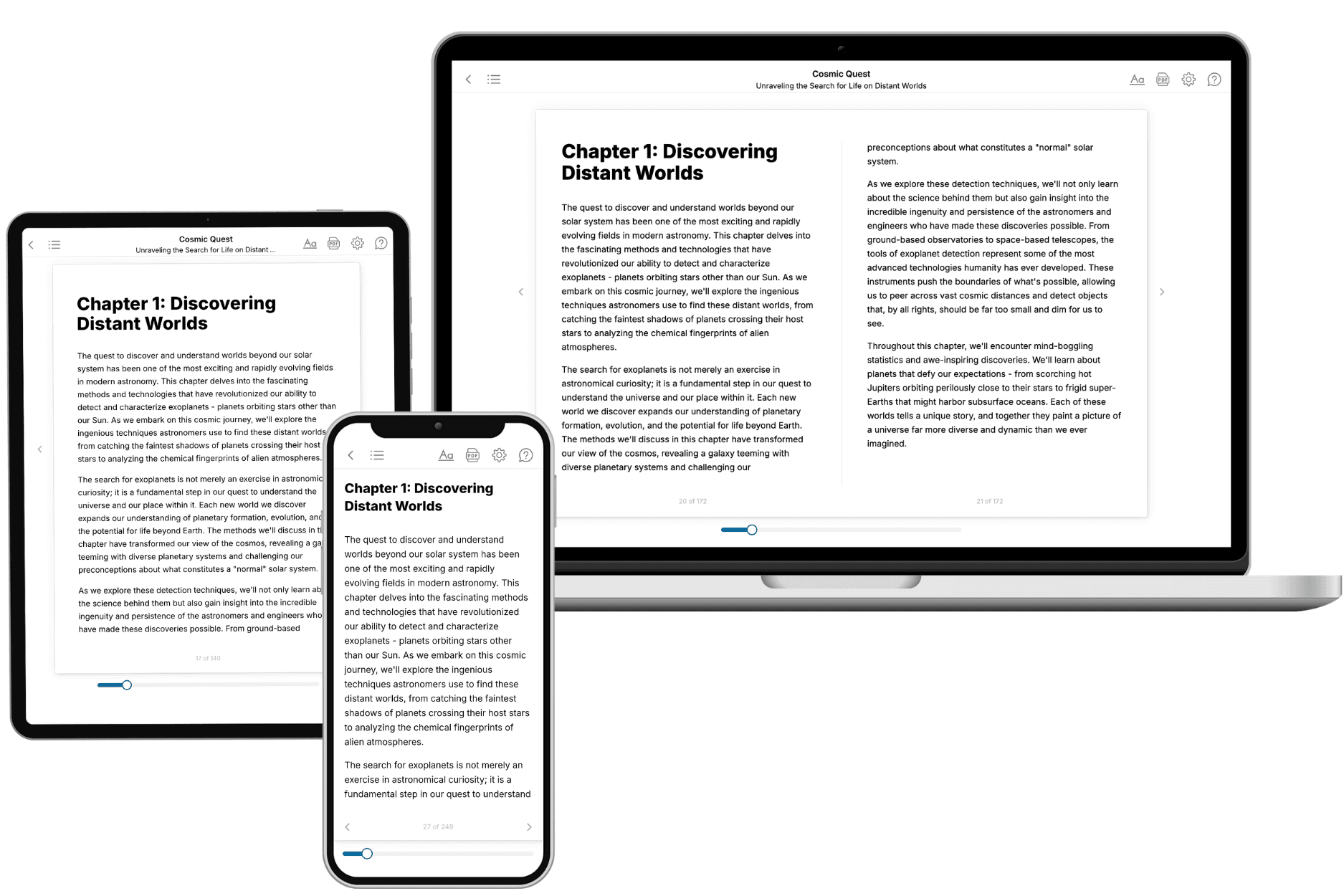
Your book is ready in 10 minutes. Read it online, download as EPUB or PDF, or send to Kindle.
Frequently asked questions
- What is TailoredRead?
TailoredRead creates complete, full-length nonfiction ebooks, written specifically for you. Tell us what you want to learn and why, and TailoredRead writes you a complete ebook on it, with charts, tables, and diagrams throughout. Read it online, on Kindle, or on any e-reader, or download it as a PDF or EPUB. Every book is written fresh the day you order it.
- How is the book tailored to me?
Before anything is written, you answer a few short questions about your goals, your background, and the topics you care about. Your book is then planned around your answers: written at your level, focused on your goals, and covering the topics you chose, instead of the one-size-fits-all book a store sells everyone.
- Will it read like generic AI content?
No. Your book isn't a chat transcript: it's planned chapter by chapter before a single word is written, told in a clear book voice, and explains ideas visually with charts, tables, and diagrams. After writing, every book goes through an editorial pass that polishes chapters so the book reads consistent from start to finish. Judge for yourself: browse thousands of sample books on our Explore Books page.
- How accurate is the content?
Our AI first checks whether your subject needs live research. Niche and fast-moving subjects are researched before writing, and the book plan and chapters are grounded in what it finds. After writing, every book goes through a quality pass that checks its facts and consistency, and researched books list their sources in a Notes section at the back.
- How long is the book?
You choose the length: Comprehensive (250-300 pages), Detailed (150-200 pages), Essential (70-100 pages), or Short (30-50 pages).
- Does the book include visuals?
Yes. Every book includes charts, tables, and diagrams: timelines, checklists, step-by-step guides, decision trees, comparison tables, matrices, and bar charts. A typical book includes dozens of these visual elements.
- Can I read it on Kindle? What formats can I download?
Yes. Every book can be read in our online reader or downloaded as a PDF or EPUB. The EPUB can be opened with Kindle, Apple Books, Kobo, and any e-reader. The Commercial and Author licenses also include an editable Word (DOCX) and Markdown download.
- How much does it cost?
About the price of a regular ebook. The exact price depends on your book's length and complexity, from $2 for the shortest books to $35 for the most comprehensive, and it's shown when you review your book, before you commit to anything. Each book is a one-time purchase, yours to keep, no subscription. Licenses that let you share, teach, or publish your book range from $35.99 to $49.99.
- Can I preview the book before purchasing?
Before you pay, you'll see what your book will cover: the title, a detailed description, the estimated length, and the complete chapter-by-chapter table of contents, so you know what you're getting before you decide. The full text itself is written after you purchase.
- How long does it take to create a book?
About 10 minutes. You can start reading the opening chapters while the rest is still being written.