Diagenesis Decoded
Unraveling the Chemical Transformations of Sedimentary Rocks
Many geologists and chemists underestimate the complexity and far-reaching impacts of diagenesis in sedimentary rocks.
284 pages14 chaptersDec 27, 2024Geology
About this book
This oversight can lead to misinterpretations of geological history and inaccurate predictions in resource exploration. Diagenesis Decoded shatters these misconceptions, offering you a deep dive into the intricate world of post-depositional changes in sedimentary rocks. This comprehensive guide takes you on a journey through the chemical and physical processes that shape our planet's sedimentary record. You'll explore the factors influencing diagenetic reactions, from burial depth and temperature to pore fluid composition and microbial activity. Through real-world case studies and cutting-edge research, you'll gain the tools to recognize diagenetic signatures in the rock record and understand their implications for paleoenvironmental reconstructions and reservoir characterization. Whether you're a geochemist, petrologist, or sedimentologist, Diagenesis Decoded will enhance your ability to unravel the complex history of sedimentary rocks. By mastering the principles and applications of diagenesis, you'll be better equipped to tackle challenges in fields ranging from petroleum geology to climate change studies. Don't let diagenetic processes remain a mystery – arm yourself with the knowledge to decode the hidden messages in Earth's sedimentary archive.
Table of contents
- IntroductionWhat is Diagenesis?, The Importance of Diagenesis in Geosciences, Structure of the BookRead below
- Chapter 1: Fundamentals of DiagenesisFrom Sediment to Rock: The Diagenetic Journey, Physical Processes in Diagenesis, Chemical Processes in Diagenesis, Biological Processes in Diagenesis
- Chapter 2: Controlling Factors of DiagenesisTemperature Effects on Diagenetic Reactions, Pressure and Its Impacts on Diagenesis, Pore Fluid Composition and Chemistry, The Time Factor in Diagenetic Processes
- Chapter 3: Early Diagenesis: Near-Surface ProcessesBioturbation and Its Effects, Microbial Activity in Early Diagenesis, Early Cementation Processes, Mechanical Compaction of Sediments
- Chapter 4: Burial Diagenesis: Deep TransformationsChemical Compaction and Pressure Solution, Mineral Transformations During Burial, Diagenesis of Organic Matter, Fluid Flow and Its Role in Burial Diagenesis
- Chapter 5: Diagenetic EnvironmentsMarine Diagenetic Environments, Meteoric Diagenetic Environments, Evaporitic Diagenetic Environments, Deep Burial Diagenetic Environments
- Chapter 6: Carbonate DiagenesisCarbonate Mineralogy and Stability, Dissolution and Cementation in Carbonates, Dolomitization Processes and Models, Karst Development in Carbonate Rocks
- Chapter 7: Siliciclastic DiagenesisQuartz Cementation and Overgrowths, Clay Mineral Transformations, Feldspar Diagenesis and Albitization, Porosity Evolution in Siliciclastic Rocks
- Chapter 8: Organic Matter DiagenesisKerogen Formation and Maturation, Hydrocarbon Generation and Migration, Coal Diagenesis and Coalification, Biomarkers and Their Diagenetic Alterations
- Chapter 9: Diagenetic Minerals and Their SignificanceAuthigenic Clay Minerals, Carbonate Cements and Their Varieties, Silica Cements and Chert Formation, Evaporite Minerals in Diagenetic Settings
- Chapter 10: Analytical Techniques in Diagenesis StudiesOptical and Electron Microscopy Techniques, Geochemical Analysis Methods, Stable and Radiogenic Isotope Studies, Fluid Inclusion Analysis
- Chapter 11: Diagenesis and Paleoenvironmental ReconstructionDiagenetic Indicators of Paleoclimate, Diagenetic Signatures of Sea Level Changes, Reconstructing Burial History from Diagenetic Features, Tracing Paleofluid Flow Through Diagenetic Alterations
- Chapter 12: Diagenesis and Natural ResourcesImpact on Reservoir Quality and Characterization, Diagenetic Processes in Ore Deposit Formation, Diagenesis in Unconventional Resource Systems, Diagenetic Alterations in Geothermal Systems
- Chapter 13: Modeling Diagenetic ProcessesConceptual Models of Diagenetic Systems, Numerical Simulations of Diagenetic Reactions, Integrating Diagenesis in Basin Modeling, Machine Learning Approaches in Diagenesis Prediction
- Chapter 14: Future Directions in Diagenesis ResearchEmerging Analytical Techniques, Climate Change Impacts on Modern Diagenetic Processes, Diagenesis in Extraterrestrial Environments, Diagenetic Considerations in Carbon Sequestration
- ConclusionKey Takeaways, Future Challenges and Opportunities
- Glossary
- Further Reading
Introduction
The world beneath our feet is in constant flux, undergoing a myriad of transformations that shape the very foundation of our planet. At the heart of these changes lies a complex and fascinating process known as diagenesis. This introduction aims to unravel the intricacies of diagenesis, shedding light on its fundamental concepts, its profound importance in the geosciences, and providing a roadmap for the journey that lies ahead in this comprehensive exploration of sedimentary rock transformations.
As you embark on this intellectual voyage through the pages of "Diagenesis Decoded: Unraveling the Chemical Transformations of Sedimentary Rocks," you will discover a world where chemistry, physics, and biology converge to tell the story of Earth's dynamic past and present. This book is designed to equip you with the knowledge and tools necessary to interpret the subtle clues left behind by diagenetic processes, enabling you to unlock the secrets hidden within the rock record.
Whether you are a seasoned geochemist looking to deepen your understanding of diagenetic phenomena or an advanced student eager to apply these concepts in your research, this introduction will set the stage for a comprehensive exploration of the subject. By the end of this chapter, you will have a solid foundation upon which to build your expertise in diagenesis, preparing you for the in-depth discussions and analyses that follow in subsequent chapters.
What is Diagenesis?
Diagenesis, derived from the Greek words "dia" (meaning through) and "genesis" (meaning origin or mode of formation), encompasses the vast array of physical, chemical, and biological processes that alter sediments or sedimentary rocks after their initial deposition but before their transformation into metamorphic rocks. This complex interplay of processes begins the moment sediments settle and continues throughout burial, potentially spanning millions of years. The scope of diagenesis is broad, ranging from subtle changes in mineral composition to dramatic alterations in rock texture and structure.
At its core, diagenesis is a response to the changing environmental conditions experienced by sedimentary materials as they are buried deeper within the Earth's crust. As depth increases, so do temperature and pressure, while the chemistry of pore fluids evolves. These changing conditions trigger a cascade of reactions and transformations that can profoundly impact the properties of the sedimentary rock. Understanding these processes is crucial for accurately interpreting the geological record and unraveling the Earth's history.
The realm of diagenesis can be broadly divided into three main stages: eogenesis, mesogenesis, and telogenesis. Eogenesis refers to the early diagenetic processes that occur near the surface, where sediments interact with depositional fluids and are influenced by surface conditions. Mesogenesis encompasses the changes that take place during deeper burial, where increased temperature and pressure drive further alterations. Telogenesis involves the modifications that occur when deeply buried rocks are uplifted and exposed to near-surface conditions once again.
Throughout these stages, a multitude of processes are at work. Compaction, both mechanical and chemical, reduces porosity and expels pore fluids. Cementation binds grains together, altering the rock's strength and permeability. Dissolution of unstable minerals and precipitation of new, stable phases reshape the rock's mineralogy. Recrystallization and neomorphism modify crystal structures and sizes. Organic matter undergoes maturation, potentially generating hydrocarbons. Each of these processes leaves its mark on the sedimentary rock, creating a complex tapestry of features that geologists must learn to decipher.
The products of diagenesis are as varied as the processes themselves. New minerals form, pore spaces are modified, fossils are preserved or altered, and the overall character of the rock evolves. These changes can have profound implications for the rock's properties, affecting its porosity, permeability, strength, and geochemical signature. For instance, diagenetic processes can create or destroy reservoir potential in hydrocarbon-bearing formations, highlighting the practical importance of understanding these transformations.
It's important to note that diagenesis is not a linear process with a predetermined outcome. The specific diagenetic history of a rock depends on a complex interplay of factors, including its initial composition, burial history, tectonic setting, and the chemistry of fluids it encounters. This variability means that two sedimentary units deposited under similar conditions can evolve quite differently over geological time, underscoring the need for careful analysis and interpretation.
As you delve deeper into the subject of diagenesis, you'll discover that it serves as a bridge between sedimentology and metamorphic petrology. It represents a continuum of processes that transform loose sediments into coherent rocks and eventually, under extreme conditions, into metamorphic rocks. This continuity challenges us to think holistically about rock formation and alteration, considering the entire life cycle of sedimentary materials from deposition to deep burial and potential uplift.
The study of diagenesis draws upon a wide range of scientific disciplines. Geochemistry provides tools to analyze mineral compositions and fluid interactions. Petrophysics helps us understand how diagenetic changes affect rock properties. Microbiology illuminates the role of organisms in early diagenetic processes. Advanced imaging techniques allow us to visualize diagenetic features at multiple scales. This interdisciplinary nature of diagenesis research offers exciting opportunities for collaboration and innovation.
As we progress through this book, you'll gain a deeper appreciation for the complexity and significance of diagenetic processes. You'll learn to recognize diagenetic signatures in the rock record, understand their implications for paleoenvironmental reconstructions, and apply this knowledge to practical challenges in fields such as petroleum geology, hydrogeology, and climate change studies. The journey through diagenesis is one of constant discovery, where each rock tells a unique story of transformation and adaptation to changing Earth conditions.
The Importance of Diagenesis in Geosciences
The study of diagenesis holds a pivotal position in the geosciences, serving as a crucial link between the initial deposition of sediments and the final rock product we observe in outcrops or core samples. Its importance extends far beyond academic interest, influencing our understanding of Earth's history and shaping our approach to resource exploration and environmental management. As you delve deeper into this field, you'll discover that a thorough grasp of diagenetic processes is indispensable for any geoscientist seeking to unravel the complexities of sedimentary systems and their evolution through time.
One of the primary reasons diagenesis is so critical in geosciences is its role in altering the original depositional characteristics of sedimentary rocks. These alterations can significantly impact our interpretation of past environments and climates. For instance, the presence of certain diagenetic minerals or textures can provide valuable clues about ancient water chemistry, burial depths, and temperature histories. However, diagenetic overprinting can also obscure primary sedimentary features, potentially leading to misinterpretations if not properly accounted for. By understanding diagenetic processes, geoscientists can more accurately reconstruct paleoenvironments and decipher the Earth's past climatic conditions, which is crucial for predicting future climate trends[1].
In the realm of petroleum geology and reservoir characterization, diagenesis plays a paramount role. The porosity and permeability of sedimentary rocks, which are critical factors in determining their potential as hydrocarbon reservoirs, are profoundly influenced by diagenetic processes. Cementation can occlude pore spaces, reducing reservoir quality, while dissolution can create secondary porosity, enhancing it. Understanding these processes allows geologists to predict reservoir quality in unexplored areas and develop more effective strategies for hydrocarbon extraction. Moreover, diagenetic studies can reveal the timing of hydrocarbon generation relative to the formation of traps, a crucial factor in assessing the likelihood of successful accumulations[2].
The field of hydrogeology also benefits immensely from a deep understanding of diagenesis. Diagenetic processes can significantly alter the hydraulic properties of aquifers, affecting groundwater flow patterns and storage capacity. For example, the dissolution of carbonate minerals can create karst systems with complex flow regimes, while clay mineral transformations can impact the ability of aquitards to act as barriers to fluid flow. These insights are crucial for managing groundwater resources, predicting contaminant transport, and designing effective remediation strategies for polluted aquifers.
In the context of global carbon cycling and climate change mitigation, diagenesis takes on new significance. The diagenetic fate of organic matter in sedimentary basins plays a crucial role in the long-term storage of carbon. Understanding these processes is essential for accurately modeling carbon sequestration potential in geological formations and predicting the stability of stored carbon over geological timescales. Furthermore, the study of diagenetic carbonates can provide insights into past ocean chemistry and atmospheric CO2 levels, contributing to our understanding of long-term climate variability[3].
The importance of diagenesis extends to the field of paleontology as well. Diagenetic processes play a crucial role in the preservation or alteration of fossils, influencing our ability to study ancient life forms. Understanding these processes helps paleontologists distinguish between original biological features and post-depositional alterations, leading to more accurate reconstructions of extinct organisms and paleoecosystems. Moreover, certain diagenetic environments can create exceptional fossil preservation, such as the formation of lagerstätten, providing unique windows into past biodiversity and ecological relationships.
In the realm of economic geology, diagenesis is key to understanding the formation of various mineral deposits. Many economically important ore deposits, such as Mississippi Valley-type lead-zinc deposits, are the result of diagenetic and related low-temperature hydrothermal processes. The precipitation of minerals during diagenesis can concentrate valuable elements, creating exploitable resources. Conversely, diagenetic processes can also remobilize and disperse elements, potentially destroying pre-existing concentrations. A thorough understanding of these processes is therefore essential for effective mineral exploration and resource assessment.
The study of diagenesis also has significant implications for civil engineering and construction. The diagenetic history of sedimentary rocks influences their geotechnical properties, such as strength, durability, and susceptibility to weathering. This knowledge is crucial for assessing the suitability of building materials, predicting the behavior of foundations, and evaluating the stability of natural and man-made slopes. In the context of underground construction, understanding diagenetic features can help in predicting zones of weakness or fluid flow that could impact tunnel stability or dam integrity.
Furthermore, diagenesis plays a role in the field of environmental forensics and pollution studies. Diagenetic processes can affect the fate and transport of contaminants in sedimentary environments. For instance, the adsorption and incorporation of heavy metals or organic pollutants into diagenetic minerals can influence their bioavailability and long-term environmental impact. Understanding these interactions is crucial for assessing environmental risks and designing effective remediation strategies for contaminated sediments and soils.
In the emerging field of astrobiology and planetary science, the study of diagenesis on Earth provides valuable insights for interpreting sedimentary deposits on other planets, particularly Mars. The recognition of diagenetic features in Martian sedimentary rocks can provide clues about past environmental conditions and the potential for preserving biosignatures. This terrestrial analog approach is crucial for planning and interpreting data from current and future Mars exploration missions.
As we continue to push the boundaries of geoscience research, new applications of diagenetic studies are constantly emerging. For example, the growing interest in geothermal energy has highlighted the importance of understanding diagenetic processes in predicting and managing the behavior of geothermal reservoirs. Similarly, the potential for geological storage of nuclear waste necessitates a deep understanding of long-term diagenetic processes that could affect the integrity of storage sites.
In conclusion, the study of diagenesis is fundamental to numerous aspects of the geosciences, bridging the gap between surface processes and deep Earth dynamics. Its importance spans from academic research to practical applications in resource exploration, environmental management, and engineering. As you progress through this book, you'll gain a deeper appreciation for how diagenesis underpins our understanding of Earth's history and shapes our approach to many of the challenges facing modern geoscientists. The knowledge you acquire will not only enhance your ability to interpret geological data but also equip you with valuable insights applicable to a wide range of geoscience disciplines and related fields.
Structure of the Book
"Diagenesis Decoded: Unraveling the Chemical Transformations of Sedimentary Rocks" is structured to provide you with a comprehensive and logical progression through the complex world of diagenesis. The book is designed to build your understanding from fundamental concepts to advanced applications, ensuring that you develop a robust foundation before delving into more specialized topics. This structure allows you to gradually assimilate the multifaceted nature of diagenetic processes and their implications across various geological settings and timescales.
The journey begins with Chapter 1, "Fundamentals of Diagenesis," which lays the groundwork for your exploration. This chapter introduces the basic principles and definitions essential for understanding diagenesis. You'll learn about the transition from sediment to rock, exploring the physical, chemical, and biological processes that drive this transformation. This foundational knowledge will serve as a cornerstone for the more detailed discussions in subsequent chapters.
Chapter 2, "Controlling Factors of Diagenesis," delves into the key variables that influence diagenetic processes. You'll examine how temperature, pressure, pore fluid composition, and time interact to shape the diagenetic evolution of sedimentary rocks. Understanding these controlling factors is crucial for predicting and interpreting diagenetic features in various geological contexts.
The book then progresses to explore diagenesis at different stages and in various environments. Chapter 3, "Early Diagenesis: Near-Surface Processes," focuses on the initial stages of sediment alteration, including bioturbation, microbial activity, and early cementation. Chapter 4, "Burial Diagenesis: Deep Transformations," takes you deeper into the Earth's crust, examining the processes that occur as sediments are buried and subjected to increasing temperature and pressure.
Chapter 5, "Diagenetic Environments," provides a comprehensive overview of the different settings in which diagenesis occurs, from marine and meteoric environments to evaporitic and deep burial settings. This chapter will help you understand how the environmental context influences diagenetic pathways and outcomes.
The next two chapters focus on specific rock types. Chapter 6, "Carbonate Diagenesis," explores the unique processes that affect carbonate sediments and rocks, including dissolution, cementation, and dolomitization. Chapter 7, "Siliciclastic Diagenesis," covers the diagenetic processes specific to sand and mud-rich sedimentary rocks, such as quartz cementation and clay mineral transformations.
Chapter 8, "Organic Matter Diagenesis," addresses the fate of organic material during burial and its implications for hydrocarbon generation and biomarker preservation. This chapter bridges the gap between inorganic and organic aspects of diagenesis, providing a holistic view of sedimentary rock evolution.
Chapter 9, "Diagenetic Minerals and Their Significance," offers an in-depth look at the various minerals formed or altered during diagenesis and their importance as indicators of past environmental conditions and burial history.
The book then shifts focus to the practical aspects of studying diagenesis. Chapter 10, "Analytical Techniques in Diagenesis Studies," introduces you to the wide array of tools and methods used to investigate diagenetic features, from traditional petrography to cutting-edge geochemical and isotopic analyses.
Chapter 11, "Diagenesis and Paleoenvironmental Reconstruction," demonstrates how diagenetic signatures can be used to infer past environmental conditions, climate changes, and burial histories. This chapter showcases the application of diagenetic knowledge to broader geological questions.
The practical implications of diagenesis are further explored in Chapter 12, "Diagenesis and Natural Resources," which examines how diagenetic processes impact the formation, distribution, and quality of economically important resources such as hydrocarbons, ore deposits, and geothermal systems.
Chapter 13, "Modeling Diagenetic Processes," introduces you to the world of conceptual and numerical modeling in diagenesis studies. You'll learn how these models are constructed, their applications, and their limitations in predicting diagenetic outcomes.
The book concludes with Chapter 14, "Future Directions in Diagenesis Research," which provides an exciting glimpse into emerging techniques and frontier areas of research in the field of diagenesis. This chapter will inspire you to think about the future challenges and opportunities in diagenesis studies, from the impacts of climate change on modern diagenetic processes to the exploration of diagenesis in extraterrestrial environments.
Throughout the book, you'll find numerous case studies, practical examples, and thought-provoking questions that will help you apply the concepts to real-world geological scenarios. Each chapter is designed to build upon the knowledge gained in previous sections, creating a cohesive and comprehensive understanding of diagenesis.
The book also includes a detailed glossary to help you navigate the specialized terminology used in diagenesis studies, as well as an extensive list of further reading materials for those who wish to delve deeper into specific topics.
By structuring the book in this manner, we aim to provide you with a logical and engaging journey through the world of diagenesis. Whether you're reading cover-to-cover or focusing on specific chapters relevant to your research or professional needs, this structure ensures that you'll gain a thorough and practical understanding of diagenetic processes and their implications across the geosciences.
As you progress through the chapters, you'll develop not only a deep understanding of diagenetic concepts but also the critical thinking skills necessary to apply this knowledge to complex geological problems. By the end of the book, you'll be well-equipped to interpret diagenetic features in the rock record, understand their significance in various geological contexts, and contribute to the ongoing research and practical applications of diagenesis in the geosciences.
Notes
Introduction
- 1. R. H. Worden and S. D. Burley, Sandstone diagenesis: the evolution of sand to stone, Sandstone Diagenesis: Recent and Ancient, 2003
- 2. S. Morad and others, Spatial and temporal distribution of diagenetic alterations in siliciclastic rocks: implications for mass transfer in sedimentary basins, Sedimentology, 47(s1), 2000
- 3. D. P. Schrag and others, "Authigenic carbonate and the history of the global carbon cycle," Science, 2013
This is the end of the free sample. The full book has 14 chapters.
Want this book written for you?
Tell us your goals and background, and get your own version of this book, tailored by AI to you.


Benefits of AI-tailored books
- Read one book, not ten:
- all the Geology knowledge you need, gathered into a single book.
- Save days of learning:
- tell us your goals, choose your topics, and the whole book is built around them.
- Learn effortlessly:
- Geology book written for your specific background and expertise.
- Understand at a glance:
- includes charts, tables, timelines, checklists, decision trees, and more.
- Stay current:
- written the day you order it, not years ago.
- Trust what you read:
- every book is checked for accuracy, with real research when your subject needs it.
Create your unique book in 3 steps
- 1. Select your focus
Select the focus of your Geology book and share your background
- 2. Personalize your book
Specify your goals and choose sub-topics to include
- 3. Get your tailored book
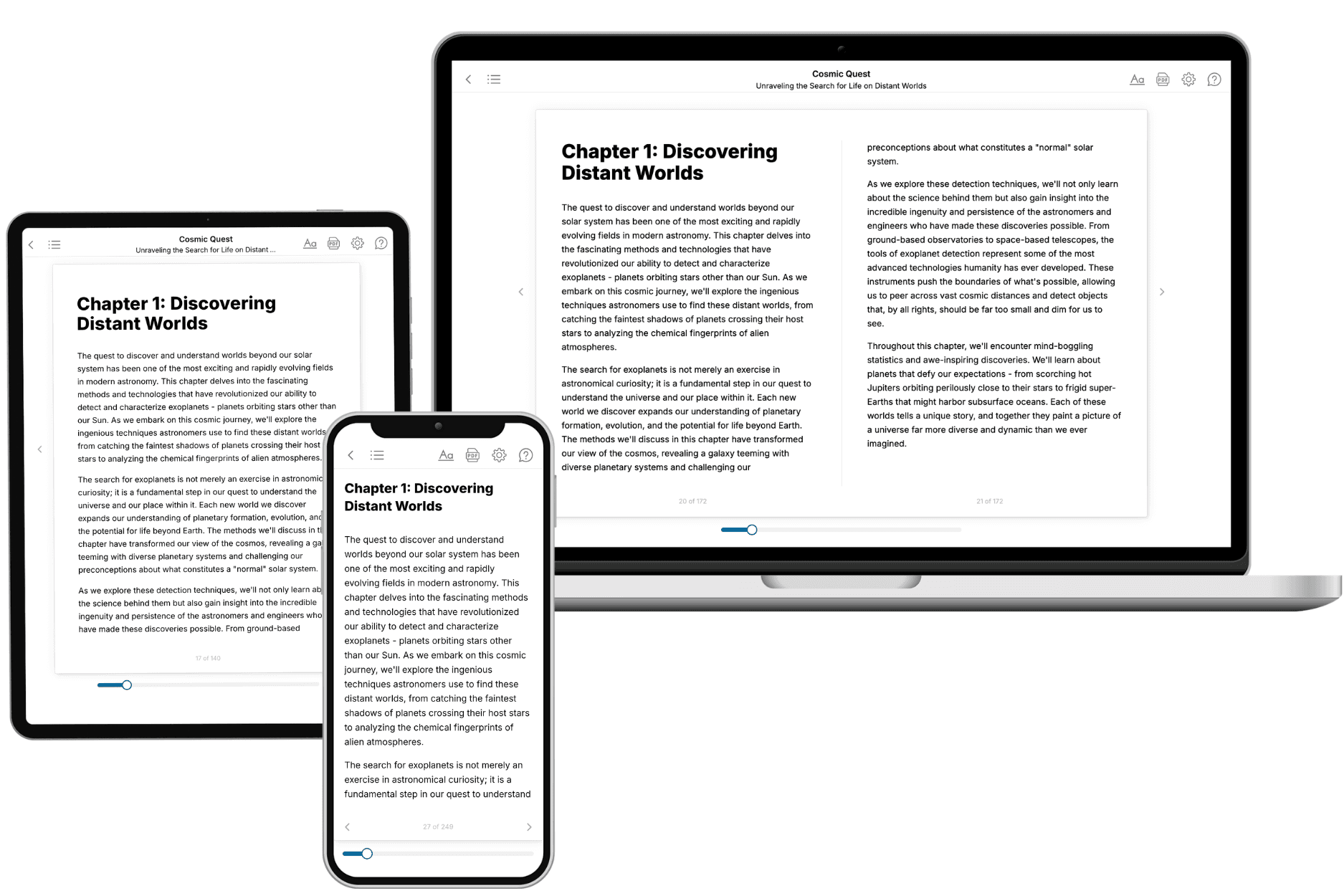
Your book is ready in 10 minutes. Read it online, download as EPUB or PDF, or send to Kindle.

Frequently asked questions
- What is TailoredRead?
TailoredRead creates complete, full-length nonfiction ebooks, written specifically for you. Tell us what you want to learn and why, and TailoredRead writes you a complete ebook on it, with charts, tables, and diagrams throughout. Read it online, on Kindle, or on any e-reader, or download it as a PDF or EPUB. Every book is written fresh the day you order it.
- How is the book tailored to me?
Before anything is written, you answer a few short questions about your goals, your background, and the topics you care about. Your book is then planned around your answers: written at your level, focused on your goals, and covering the topics you chose, instead of the one-size-fits-all book a store sells everyone.
- Will it read like generic AI content?
No. Your book isn't a chat transcript: it's planned chapter by chapter before a single word is written, told in a clear book voice, and explains ideas visually with charts, tables, and diagrams. After writing, every book goes through an editorial pass that polishes chapters so the book reads consistent from start to finish. Judge for yourself: browse thousands of sample books on our Explore Books page.
- How accurate is the content?
Our AI first checks whether your subject needs live research. Niche and fast-moving subjects are researched before writing, and the book plan and chapters are grounded in what it finds. After writing, every book goes through a quality pass that checks its facts and consistency, and researched books list their sources in a Notes section at the back.
- How long is the book?
You choose the length: Comprehensive (250-300 pages), Detailed (150-200 pages), Essential (70-100 pages), or Short (30-50 pages).
- Does the book include visuals?
Yes. Every book includes charts, tables, and diagrams: timelines, checklists, step-by-step guides, decision trees, comparison tables, matrices, and bar charts. A typical book includes dozens of these visual elements.
- Can I read it on Kindle? What formats can I download?
Yes. Every book can be read in our online reader or downloaded as a PDF or EPUB. The EPUB can be opened with Kindle, Apple Books, Kobo, and any e-reader. The Commercial and Author licenses also include an editable Word (DOCX) and Markdown download.
- How much does it cost?
About the price of a regular ebook. The exact price depends on your book's length and complexity, from $2 for the shortest books to $35 for the most comprehensive, and it's shown when you review your book, before you commit to anything. Each book is a one-time purchase, yours to keep, no subscription. Licenses that let you share, teach, or publish your book range from $35.99 to $49.99.
- Can I preview the book before purchasing?
Before you pay, you'll see what your book will cover: the title, a detailed description, the estimated length, and the complete chapter-by-chapter table of contents, so you know what you're getting before you decide. The full text itself is written after you purchase.
- How long does it take to create a book?
About 10 minutes. You can start reading the opening chapters while the rest is still being written.