Differential Geometry and General Relativity
A Comprehensive Guide to Tensor Calculus, Spacetime Curvature, and Einstein's Field Equations
Imagine confidently working through the mathematical framework that describes gravity not as a force, but as the geometry of spacetime itself.
269 pages14 chaptersMay 16, 2026Tensor Calculus
About this book
This comprehensive guide takes you from foundational tensor calculus through the sophisticated mathematics of black holes, gravitational waves, and cosmological models. Whether you're exploring the elegant Schwarzschild solution, mastering Einstein's field equations, or developing geometric intuition for curved spacetime, this book provides the rigorous yet accessible treatment you need. Each chapter builds systematically on previous concepts, combining theoretical foundations with practical problem-solving techniques. You'll work with Riemann geometry, differential forms, and advanced tensor methods while gaining deep insight into how mathematics reveals the universe's structure. Perfect for someone with strong mathematical background seeking to understand general relativity at the level of research and advanced applications, this book transforms abstract concepts into concrete understanding.
Table of contents
- IntroductionWhy Differential Geometry Matters for General Relativity, How This Book Is Organized, What You Need to Know Before Starting, The Learning Approach: Theory and PracticeRead below
- Chapter 1: Tensor Calculus FundamentalsIndex Notation and Einstein Summation Convention, Defining Tensors: Transformation Properties and Rank, Tensor Operations: Contraction, Outer Product, and Symmetries
- Chapter 2: Manifolds and Topology BasicsWhat Is a Manifold? Topological and Smooth Structures, Tangent Spaces and Vector Fields, Coordinate Systems and Coordinate Transformations
- Chapter 3: Metric Tensor and Spacetime GeometryThe Metric Tensor: Measuring Distances and Angles, Signature, Causality, and Lorentzian Geometry, Raising and Lowering Indices with the Metric
- Chapter 4: Covariant Derivatives and ConnectionsChristoffel Symbols: Computing Connection Coefficients, The Covariant Derivative: Parallel Transport and Geodesics, Torsion and Curvature: Measuring Spacetime Deformation
- Chapter 5: Riemann Geometry and Curvature TensorsThe Riemann Curvature Tensor: Definition and Properties, The Ricci Tensor and Ricci Scalar: Contractions of Curvature, The Weyl Tensor: Traceless Curvature and Gravitational Radiation
- Chapter 6: Geodesic Equations and Particle MotionDeriving Geodesic Equations from Variational Principles, Solving Geodesic Equations in Simple Spacetimes, Geodesic Deviation and Tidal Forces
- Chapter 7: Einstein Field EquationsThe Stress-Energy Tensor: Matter and Energy Distribution, Deriving Einstein's Field Equations from the Action Principle, Properties and Implications of Einstein's Equations
- Chapter 8: The Schwarzschild SolutionDeriving the Schwarzschild Metric from Einstein's Equations, Properties of the Schwarzschild Spacetime, Event Horizons and Black Hole Thermodynamics
- Chapter 9: Rotating Black Holes and the Kerr MetricThe Kerr Metric: Geometry of Rotating Black Holes, Ergosphere, Cauchy Horizons, and Extremal Kerr Black Holes, Charged Black Holes: The Reissner-Nordström Solution
- Chapter 10: Differential Forms and Exterior CalculusDifferential Forms: An Alternative Language for Geometry, The Exterior Derivative and Stokes' Theorem, Applying Differential Forms to Einstein's Equations
- Chapter 11: Gravitational Waves and Perturbation TheoryLinearized Gravity and the Gravitational Wave Equation, Properties of Gravitational Waves: Polarization and Detection, Sources of Gravitational Waves and Observational Confirmation
- Chapter 12: Cosmological Models and the Friedmann EquationsDeriving the Friedmann Equations from Einstein's Equations, Solutions to the Friedmann Equations: Expanding Universes, Dark Energy, Inflation, and the Cosmological Constant
- Chapter 13: Advanced Topics: Conformal Geometry and Penrose DiagramsConformal Transformations and Conformal Geometry, Penrose Diagrams: Visualizing Causal Structure, Bianchi Identities and Conservation Laws
- Chapter 14: Problem-Solving Strategies and ApplicationsComputational Techniques for Tensor Calculations, Gravitational Lensing: Theory and Calculations, Gravitational Collapse and Black Hole Formation
- ConclusionSynthesizing Geometry and Physics, Future Directions in Differential Geometry and Relativity
- Appendix: Essential Mathematical ReferenceNotation and Conventions, Useful Formulas and Identities, Further Reading and Resources
Introduction
There is a particular moment that many physicists and mathematicians describe when they first truly understand general relativity. It is not the moment they memorize Einstein's field equations, nor when they can reproduce the Schwarzschild metric from scratch. It is the moment they realize that gravity is not a force at all. It is the shape of spacetime itself. That shift in perspective, from force to geometry, is one of the most profound conceptual leaps in the history of science, and it rests entirely on the machinery of differential geometry.
This book is built for someone who already has serious mathematical training and wants to go deeper. With a background in mathematics and physics at the graduate level, you are not starting from zero. You understand calculus, linear algebra, and classical mechanics. You have likely encountered tensors before, perhaps in the context of continuum mechanics or electromagnetism. What this book offers is a systematic, rigorous, and geometrically motivated path through the full mathematical framework of general relativity, from the foundations of tensor calculus all the way to black hole physics, gravitational waves, and cosmological models.
The approach here is deliberately dual-track. Every major concept is developed both abstractly, with full mathematical precision, and concretely, with explicit calculations and worked examples. Geometric intuition and computational skill are treated as equally important. You will not find one without the other. The goal is not just to understand what the Riemann tensor is, but to know how to compute it, how to interpret it physically, and how to use it to solve real problems. That combination of depth and practicality is what distinguishes a working knowledge of general relativity from a superficial familiarity with its vocabulary.
The chapters ahead cover a carefully sequenced progression. Tensor calculus and manifold theory come first, building the language you will use throughout. The metric tensor, covariant derivatives, and curvature tensors follow, each chapter deepening the geometric picture. Einstein's field equations emerge naturally from this foundation, and their solutions, including the Schwarzschild and Kerr metrics, are derived and analyzed in detail. Later chapters address differential forms, gravitational waves, cosmology, and advanced topics in conformal geometry. Each step is designed to feel inevitable rather than arbitrary, because in this subject, the mathematics genuinely does lead you forward.
Why Differential Geometry Matters for General Relativity
Einstein's great insight was that gravity could be understood as the curvature of a four-dimensional spacetime manifold. But that insight only becomes precise and computable when you have the right mathematical tools. Differential geometry provides exactly those tools. Without it, statements like "spacetime is curved" remain poetic metaphors. With it, they become quantitative, testable, and extraordinarily powerful.
The central objects of differential geometry, manifolds, tensors, connections, and curvature tensors, are not abstract luxuries. They are the minimum necessary vocabulary for writing down the laws of gravity in a form that is independent of any particular coordinate system. This coordinate independence is not a stylistic preference. It is a physical requirement. The laws of nature should not depend on the labels you choose to attach to points in spacetime.
Consider a concrete example. In flat Euclidean space, the distance between two nearby points is given by the familiar Pythagorean formula ds² = dx² + dy² + dz². In curved spacetime, this generalizes to ds² = gμν dxμ dxν, where gμν is the metric tensor. That single object encodes everything about the geometry of spacetime: distances, angles, volumes, and the paths that freely falling particles follow. Without the concept of a tensor, you cannot even write this expression in a meaningful way.
Differential geometry also provides the concept of a connection, which tells you how to compare vectors at different points on a curved manifold. This is not trivial. On a curved surface, there is no canonical way to say that a vector at one point is "the same" as a vector at another point. The Levi-Civita connection, derived from the metric tensor, gives a precise and physically natural answer to this question. It is the foundation for defining covariant derivatives, parallel transport, and geodesics, all of which are essential for describing how objects move in curved spacetime.
The payoff becomes clear when you reach the Riemann curvature tensor. This object, built from the connection and its derivatives, captures the intrinsic curvature of spacetime in a way that no coordinate transformation can remove. Its contractions, the Ricci tensor and Ricci scalar, appear directly in Einstein's field equations. The Weyl tensor, the traceless part of the Riemann tensor, describes the part of curvature that propagates freely through empty space and is responsible for gravitational waves and tidal distortions. None of these distinctions are accessible without the full apparatus of differential geometry.[1]
There is also a deeper reason why differential geometry matters here. General relativity is not just a theory of gravity. It is a theory about the nature of space, time, and causality. The mathematical structures of differential geometry, particularly the distinction between timelike, spacelike, and null vectors in a Lorentzian manifold, are what give precise meaning to concepts like simultaneity, causality, and the speed of light. Understanding these structures geometrically, rather than just algebraically, transforms your ability to reason about the theory.
Finally, differential geometry connects general relativity to the broader landscape of modern mathematics and physics. The same tools used here appear in gauge field theories, string theory, and the geometry of fiber bundles. Mastering this material does not just deepen your understanding of gravity. It opens a door to a much wider mathematical world.
How This Book Is Organized
The book is organized into fourteen chapters plus appendices, following a logical progression from foundational mathematics to advanced physical applications. The structure is cumulative: each chapter builds directly on the concepts established in the previous ones. Skipping ahead is possible for readers who are already comfortable with certain material, but the sequencing is deliberate and worth following in order if you want the full geometric picture to develop naturally.
Chapters 1 through 3 establish the mathematical foundations. Chapter 1 covers tensor calculus, including index notation, the Einstein summation convention, and the transformation properties that define tensors. Chapter 2 introduces manifolds and their topological and smooth structures, tangent spaces, vector fields, and coordinate transformations. Chapter 3 develops the metric tensor in depth, covering how it measures distances and angles, the distinction between Riemannian and Lorentzian signatures, and the essential operations of raising and lowering indices.
Chapters 4 through 6 develop the geometry of curved spaces. Chapter 4 introduces connections and covariant derivatives, with careful attention to Christoffel symbols and their computation. Chapter 5 builds the full theory of curvature, deriving the Riemann tensor and its contractions. Chapter 6 applies this machinery to geodesics, deriving the geodesic equation from variational principles and analyzing geodesic deviation as the geometric description of tidal forces.
Chapters 7 through 9 are the physical heart of the book. Chapter 7 derives Einstein's field equations from the action principle, introduces the stress-energy tensor, and analyzes the equations' properties and implications. Chapter 8 derives and analyzes the Schwarzschild solution in full detail, including event horizons and an introduction to black hole thermodynamics. Chapter 9 extends this to rotating black holes via the Kerr metric, covering the ergosphere, Cauchy horizons, and the Reissner-Nordström solution for charged black holes.
Chapters 10 through 13 cover more advanced topics. Chapter 10 introduces differential forms and exterior calculus as an elegant coordinate-independent framework. Chapter 11 develops linearized gravity and gravitational wave theory, connecting to modern observational results. Chapter 12 derives the Friedmann equations and analyzes cosmological models, including dark energy and inflation. Chapter 13 covers conformal geometry, Penrose diagrams, and Bianchi identities.
Chapter 14 is dedicated to problem-solving strategies and applications, including computational techniques for tensor calculations, gravitational lensing, and gravitational collapse. The appendices provide a compact reference for notation conventions, useful formulas and identities, and a curated guide to further reading. These are designed to be consulted throughout your work with the book, not just at the end.
Throughout the book, worked examples appear within the text rather than being isolated in separate boxes. This is intentional. The calculations are part of the argument, not illustrations of it. You will see how each formula is derived, what assumptions go into it, and what it means geometrically. Where a calculation is long, it is broken into clearly labeled steps so you can follow the logic without losing the thread.
What You Need to Know Before Starting
This book assumes a solid foundation in several areas of mathematics and physics. The prerequisites are not listed here to be discouraging. They are listed so you can honestly assess where you stand and identify any gaps worth addressing before diving in. The material builds on these foundations continuously, so a weakness in any of them will compound as you progress.
In mathematics, the essential prerequisites are:
- Multivariable calculus: partial derivatives, multiple integrals, the chain rule in several variables, and the gradient, divergence, and curl operators.
- Linear algebra: vector spaces, linear maps, matrices, eigenvalues, inner products, and the concept of a dual space. The notion of a tensor as a multilinear map on a vector space is central to Chapter 1.
- Real analysis: a working understanding of continuity, differentiability, and the topology of metric spaces. You do not need measure theory, but you should be comfortable with epsilon-delta arguments.
- Ordinary and partial differential equations: you will encounter both throughout the book, particularly when solving geodesic equations and Einstein's field equations in symmetric spacetimes.
In physics, the essential prerequisites are:
- Classical mechanics: Lagrangian and Hamiltonian formulations, the principle of least action, and variational calculus. The geodesic equation is derived using exactly these methods in Chapter 6.
- Special relativity: Minkowski spacetime, four-vectors, the Lorentz transformation, and the invariant interval. Chapter 3 generalizes these concepts to curved spacetime, so familiarity with the flat case is essential.
- Electromagnetism: Maxwell's equations in both three-vector and four-vector form. Chapter 10 reformulates electromagnetism using differential forms, which requires knowing what you are reformulating.
Some exposure to differential geometry at the undergraduate level is helpful but not strictly required. If you have seen the concept of a manifold, a tangent space, or a Riemannian metric before, even briefly, Chapter 2 will feel like a natural extension. If these are entirely new concepts, Chapter 2 is written to be self-contained, but you may want to spend extra time there before moving forward.
One area that is often underestimated as a prerequisite is index notation fluency. Working with tensors requires comfort with upper and lower indices, the Einstein summation convention, and the manipulation of multi-index expressions. Chapter 1 develops this systematically, but the pace assumes you can work with matrix equations and summation notation without difficulty. If you find yourself struggling with the notation in Chapter 1, it is worth pausing and working through additional exercises before continuing.
There is no prerequisite knowledge of general relativity itself. The theory is developed from scratch, with every major result derived rather than stated. If you have read an introductory text on general relativity before, such as Hartle's Gravity or Carroll's Spacetime and Geometry, you will find that this book goes significantly deeper into the mathematical structure.[2] If this is your first encounter with the subject, the book is still accessible, but you should expect to work carefully through the early chapters.
A practical note on computation: some of the tensor calculations in this book are lengthy. Having access to a computer algebra system such as Mathematica, Maple, or the free Python library SageMath is genuinely useful for checking your work, especially in Chapters 8 and 9 where the Christoffel symbols and curvature components involve many terms. Chapter 14 includes guidance on using these tools effectively. That said, the book is written so that every calculation can be followed and reproduced by hand, and doing so at least once for each major result is strongly recommended.
The Learning Approach: Theory and Practice
The philosophy behind this book is that deep understanding in mathematical physics requires two things working together: geometric intuition and computational fluency. Neither is sufficient on its own. A reader who can visualize curved spacetime but cannot compute the Riemann tensor is limited in what they can actually do with the theory. A reader who can grind through index calculations but has no geometric picture of what they are computing will struggle to set up problems correctly or recognize when a result is physically meaningful.
To develop geometric intuition, the book consistently connects abstract definitions to visual and physical interpretations. For example, the covariant derivative is introduced not just as a formula involving Christoffel symbols, but as the answer to a specific geometric question: how do you differentiate a vector field on a curved surface in a way that respects the surface's geometry? The Riemann tensor is introduced through the concept of parallel transport around a closed loop, which gives an immediate visual sense of what curvature means before any index calculation begins.
To develop computational fluency, the book includes detailed worked calculations at every major step. These are not abbreviated. When the Christoffel symbols for the Schwarzschild metric are computed in Chapter 8, every nonzero component is derived explicitly. When the geodesic equations are solved for radial free-fall in Chapter 6, the integration is carried through to a closed-form result. The reason for this level of detail is simple: you cannot develop computational skill by reading abbreviated calculations. You need to see every step, and then reproduce it yourself.
A recommended approach for working through each chapter is the following:
- Read the chapter once through without stopping to verify every calculation. Get the overall structure and the main ideas clear in your mind first.
- Go back and work through every calculation with pen and paper, verifying each step independently. Do not just check that the answer matches. Understand why each manipulation is valid.
- Attempt the exercises at the end of each chapter before looking at any solutions. The exercises are designed to test both conceptual understanding and computational skill.
- Revisit the geometric interpretation of each major result after completing the calculations. Ask yourself: what does this formula mean physically? What would change if the spacetime were different?
The exercises in this book are not optional extras. They are an integral part of the learning process. Some exercises ask you to verify claims made in the text. Others extend the theory to new cases. A few are genuinely challenging and require combining ideas from multiple chapters. The difficulty level is indicated for each exercise, and hints are provided for the harder ones. Working through them systematically is the single most effective way to consolidate your understanding.
One common pitfall in learning general relativity is getting lost in index manipulation without maintaining a clear sense of what the indices represent. A useful habit is to always ask, before beginning any calculation: what kind of object am I computing? Is it a scalar, a vector, a covector, or a higher-rank tensor? How many free indices does it have? What are its symmetry properties? Keeping these questions in mind prevents many algebraic errors and helps you catch mistakes quickly when they occur.
Another common difficulty is the transition from special relativity to general relativity. In special relativity, the metric is fixed and flat, and the Lorentz group provides a global symmetry. In general relativity, the metric is dynamical, there is no global symmetry group, and the only symmetries are those of specific solutions. This transition requires a genuine conceptual shift, not just a generalization of formulas. Chapter 3 addresses this transition carefully, and it is worth spending extra time there to make sure the shift has genuinely occurred before moving on.
The book also emphasizes the importance of dimensional analysis and limiting cases as tools for checking results. Every formula in general relativity should reduce to the correct Newtonian or special-relativistic limit in the appropriate regime. When the Schwarzschild metric is derived in Chapter 8, for example, it is immediately verified that it reduces to flat Minkowski spacetime far from the source and that the Newtonian gravitational potential appears in the correct limit. These checks are not just reassuring. They are part of understanding what the formula means.
Finally, a word about notation. General relativity has a reputation for notational complexity, and that reputation is not entirely undeserved. Different textbooks use different conventions for the signature of the metric, the definition of the Riemann tensor, and the placement of factors of 8πG/c⁴ in Einstein's equations. This book uses the (-, +, +, +) signature convention and the sign conventions of Misner, Thorne, and Wheeler, which are among the most widely used in the research literature.[3] A complete summary of all notation and conventions is provided in the appendix, and you are encouraged to consult it whenever you encounter an unfamiliar symbol or an apparent inconsistency with another source.
The goal of this book is not to make general relativity seem easy. It is to make it genuinely understandable. Those are very different things. The mathematics is deep, the calculations are demanding, and the conceptual shifts required are real. But every step is within reach if you approach it systematically, maintain your geometric intuition alongside your computational work, and resist the temptation to move forward before the current material is solid. The reward for that patience is a level of understanding that transforms how you see the universe.
What follows is a subject that took Einstein a decade to develop, that required the invention of new mathematics, and that continues to generate active research more than a century after its publication. The fact that it can now be learned systematically from a single book is itself a testament to how well the mathematical community has organized and clarified the theory. The path is well-marked. The work is yours to do.
This is the end of the free sample. The full book has 14 chapters.
Want this book written for you?
Tell us your goals and background, and get your own version of this book, tailored by AI to you.


Benefits of AI-tailored books
- Read one book, not ten:
- all the Tensor Calculus knowledge you need, gathered into a single book.
- Save days of learning:
- tell us your goals, choose your topics, and the whole book is built around them.
- Learn effortlessly:
- Tensor Calculus book written for your specific background and expertise.
- Understand at a glance:
- includes charts, tables, timelines, checklists, decision trees, and more.
- Stay current:
- written the day you order it, not years ago.
- Trust what you read:
- every book is checked for accuracy, with real research when your subject needs it.
Create your unique book in 3 steps
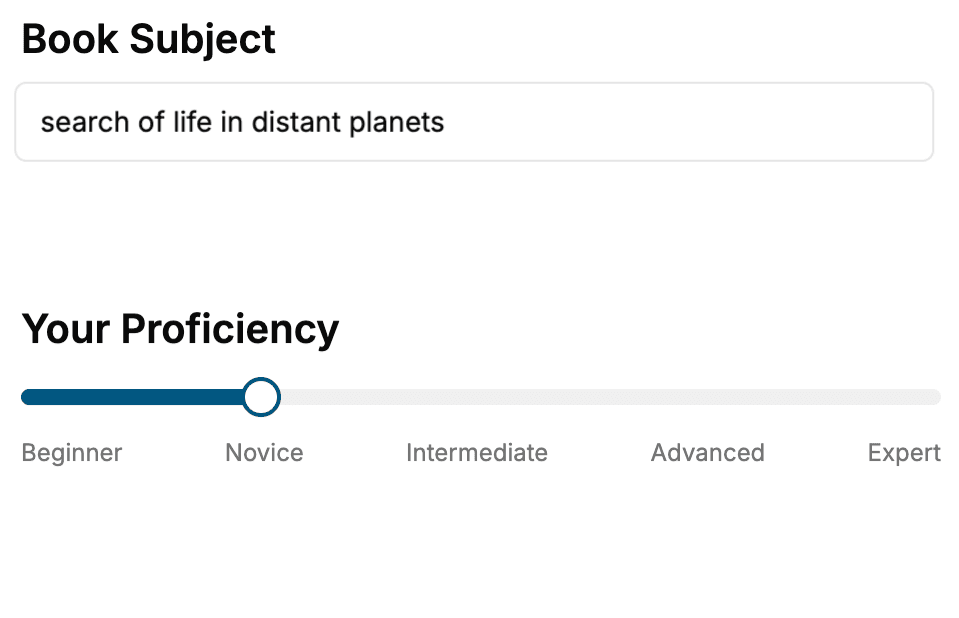
- 1. Select your focus
Select the focus of your Tensor Calculus book and share your background
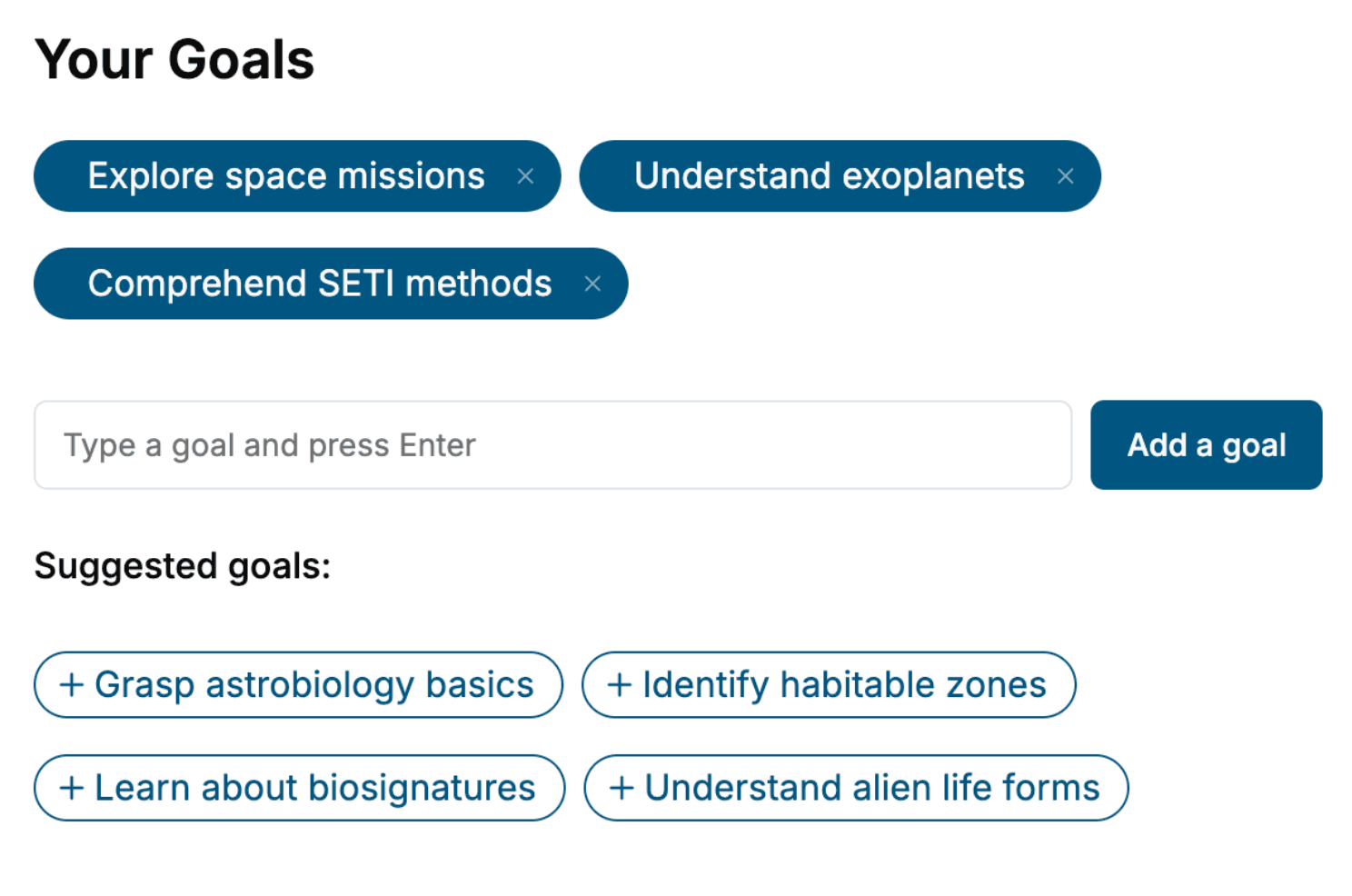
- 2. Personalize your book
Specify your goals and choose sub-topics to include
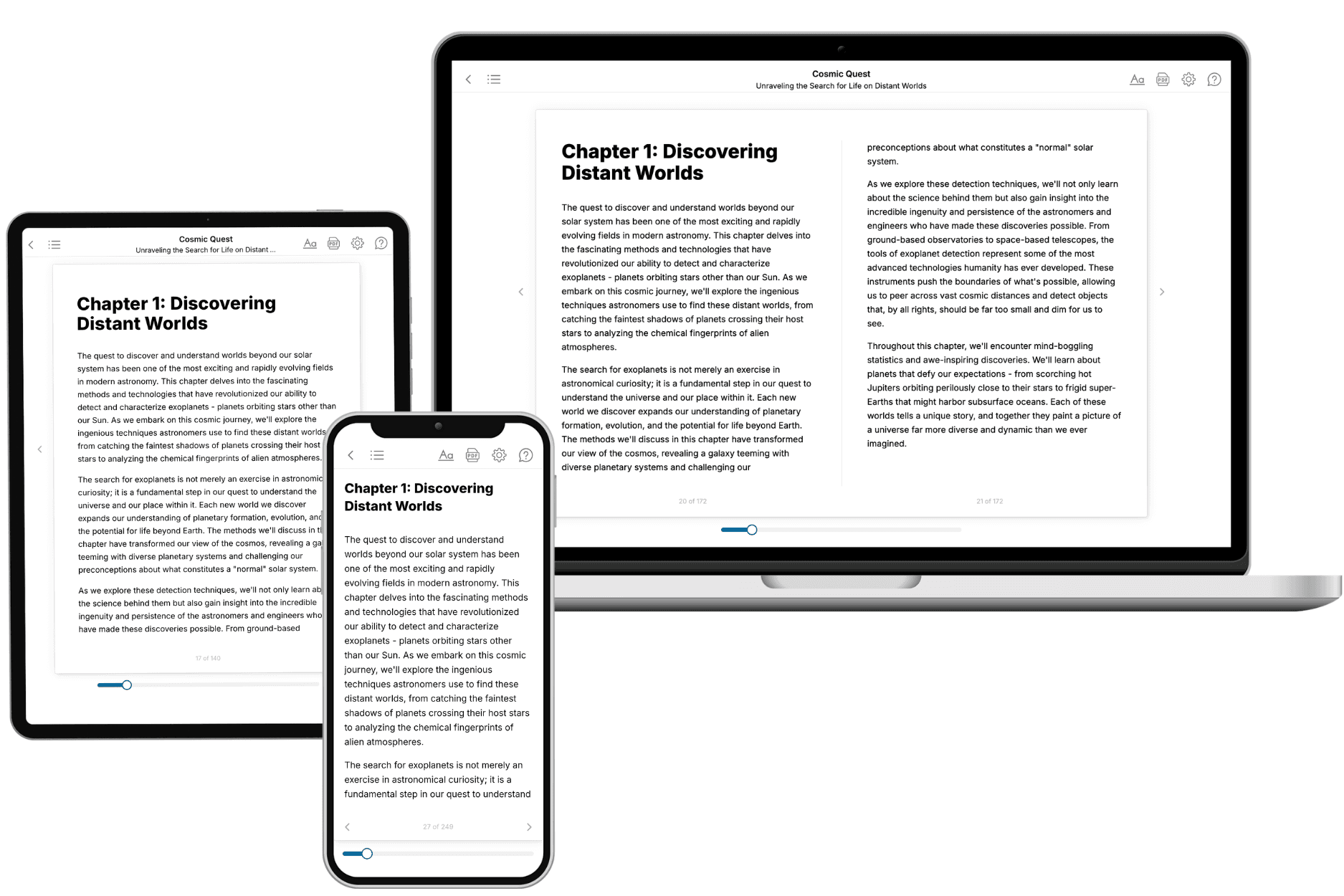
- 3. Get your tailored book
Your book is ready in 10 minutes. Read it online, download as EPUB or PDF, or send to Kindle.
Frequently asked questions
- What is TailoredRead?
TailoredRead creates complete, full-length nonfiction ebooks, written specifically for you. Tell us what you want to learn and why, and TailoredRead writes you a complete ebook on it, with charts, tables, and diagrams throughout. Read it online, on Kindle, or on any e-reader, or download it as a PDF or EPUB. Every book is written fresh the day you order it.
- How is the book tailored to me?
Before anything is written, you answer a few short questions about your goals, your background, and the topics you care about. Your book is then planned around your answers: written at your level, focused on your goals, and covering the topics you chose, instead of the one-size-fits-all book a store sells everyone.
- Will it read like generic AI content?
No. Your book isn't a chat transcript: it's planned chapter by chapter before a single word is written, told in a clear book voice, and explains ideas visually with charts, tables, and diagrams. After writing, every book goes through an editorial pass that polishes chapters so the book reads consistent from start to finish. Judge for yourself: browse thousands of sample books on our Explore Books page.
- How accurate is the content?
Our AI first checks whether your subject needs live research. Niche and fast-moving subjects are researched before writing, and the book plan and chapters are grounded in what it finds. After writing, every book goes through a quality pass that checks its facts and consistency, and researched books list their sources in a Notes section at the back.
- How long is the book?
You choose the length: Comprehensive (250-300 pages), Detailed (150-200 pages), Essential (70-100 pages), or Short (30-50 pages).
- Does the book include visuals?
Yes. Every book includes visual elements such as timelines, checklists, step-by-step guides, decision trees, comparison tables, and matrices, and many include bar charts. A typical book includes dozens of these visual elements.
- Can I read it on Kindle? What formats can I download?
Yes. Every book can be read in our online reader or downloaded as a PDF or EPUB. The EPUB can be opened with Kindle, Apple Books, Kobo, and any e-reader. The Commercial and Author licenses also include an editable Word (DOCX) and Markdown download.
- How much does it cost?
About the price of a regular ebook. The exact price depends on your book's length and complexity, from $2 for the shortest books to $35 for the most comprehensive, and it's shown when you review your book, before you commit to anything. Each book is a one-time purchase, yours to keep, no subscription. Licenses that let you share, teach, or publish your book range from $35.99 to $49.99.
- Can I preview the book before purchasing?
Before you pay, you'll see what your book will cover: the title, a detailed description, the estimated length, and the complete chapter-by-chapter table of contents, so you know what you're getting before you decide. The full text itself is written after you purchase.
- How long does it take to create a book?
About 10 minutes. You can start reading the opening chapters while the rest is still being written.