Digital Twins in Healthcare Food Service
Building Smart Supply Chains for Value-Based Patient Nutrition
Your hospital's transition to value-based food service requires more than operational tweaks—it demands visibility into every aspect of your supply chain.
222 pages10 chaptersOct 4, 2026Internet of Things
About this book
This book guides you through designing and implementing digital twin technology integrated with IoT networks to transform how your organization manages patient nutrition. You'll learn to build virtual replicas of your food service operations that continuously sync with real-time sensor data, revealing inefficiencies invisible to traditional management. Discover how to deploy RFID tracking systems, establish cold chain monitoring networks, and leverage AI-driven predictive analytics to reduce waste, ensure food safety compliance, and optimize costs. Using your quality management expertise, you'll apply systems thinking to create healthcare-specific digital twins that balance multiple competing objectives. This practical guide connects emerging technologies to measurable outcomes—quantifying sustainability improvements, cost reductions, and patient satisfaction gains. Move beyond pilot projects to enterprise-scale implementation using cloud infrastructure and data-driven decision-making frameworks that align with value-based care principles.
Table of contents
- IntroductionWhy Digital Twins Matter for Healthcare Food Service, The Value-Based Transition Challenge, How This Book Will Guide Your ImplementationRead below
- Chapter 1: Foundations of Digital Twin TechnologyUnderstanding Digital Twins: Core Concepts and Architecture, Food Digital Twins: Monitoring Quality and Shelf-Life, Enterprise Digital Twins for Supply Chain Optimization, Cyber-Physical Systems Integration in Healthcare Operations
- Chapter 2: Building Your IoT Sensor NetworkThe Perception Layer: Multi-Source Data Acquisition, Selecting and Deploying Sensors for Cold Chain Monitoring, Wireless Sensor Networks and RFID Implementation, Data Communication: Connectivity and Edge Computing
- Chapter 3: Data Architecture and Cloud InfrastructureStorage and Processing: From Edge to Cloud, Leveraging AWS IoT Core for Healthcare Applications, Security, Privacy, and Healthcare Compliance, Addressing Interoperability Across Vendor Systems
- Chapter 4: Analytics, AI, and Real-Time InsightsBuilding AI-Driven Quality Prediction Models, Demand Forecasting and Inventory Optimization, Visualization and Decision Support Systems, Ensuring Explainability in AI Decision-Making
- Chapter 5: Food Safety, Traceability, and ComplianceDigital Traceability: From Farm to Patient Bedside, Blockchain for Supply Chain Transparency, Real-Time Compliance Monitoring and Audit Trails, Quality Assurance Through Continuous Monitoring
- Chapter 6: Reducing Waste and Optimizing ResourcesAnalyzing Waste Patterns with Digital Twin Data, Optimizing Shelf-Life and Inventory Turnover, Measuring Sustainability Outcomes Quantitatively, Cost Reduction Through Automation and Efficiency
- Chapter 7: Applying Total Quality Management to Digital SystemsSystems Thinking and Process Optimization, Continuous Improvement Cycles with Real-Time Data, Balancing Multiple Objectives in Value-Based Operations, TQM Metrics and Performance Measurement
- Chapter 8: Implementation Strategy and DeploymentPhased Implementation: From Pilot to Enterprise Scale, Change Management and Organizational Alignment, Staff Training and Capability Building, Vendor Selection and Technology Integration
- Chapter 9: Measuring Value and Patient OutcomesDefining Value Metrics for Healthcare Food Service, Patient Satisfaction and Meal Quality Outcomes, Building Resilience and Service Continuity, Return on Investment and Financial Impact Analysis
- Chapter 10: Emerging Implementations and Lessons LearnedCommon Deployment Patterns and Configurations, Challenges, Failures, and Solutions, Future Trends: Biosensors, Advanced AI, and Integration
- ConclusionDigital Twins as a Strategic Imperative for Value-Based Care, Your Next Steps: From Knowledge to Action
- Glossary of Key Terms
- Further Reading and Resources
Introduction
Picture a tray line in a hospital kitchen at six in the morning. A refrigerated truck has just unloaded crates of produce, a cooler holds dairy nearing its use-by window, and a dietitian is finalizing menus for patients on sodium-restricted diets. None of these three activities talk to each other in most hospitals today. The produce manager does not know the cooler is close to a temperature excursion. The dietitian has no visibility into which lots are aging fastest. This disconnect, repeated across thousands of healthcare food service operations, is the exact gap that digital twin technology is built to close.
A Digital Twin is a virtual replica of a physical operation that stays synchronized with real-world conditions through continuous data feeds. Applied to food service, it means the cooler, the delivery truck, the inventory shelf, and the tray assembly line all have digital counterparts that update as conditions change. Instead of discovering a spoiled batch of yogurt after it has already been served or discarded, a digital twin can flag the degradation hours earlier, based on temperature history and time-in-transit data. This shift from reacting to events to anticipating them is the central promise running through this book.
Healthcare food service sits at an unusual intersection. It is a logistics operation, a clinical support function, and a hospitality service all at once. A missed delivery affects patient meals the same day. A temperature excursion in a cold chain can become a food safety incident with direct clinical consequences for immunocompromised patients. A poorly forecasted demand pattern leads to waste that erodes margins already under pressure from value-based reimbursement models. Few other industries combine this density of operational, safety, and financial stakes in a single supply chain, which is exactly why digital twins have moved from manufacturing floors into hospital kitchens.
This introduction sets up three things. First, it explains why digital twins matter specifically for healthcare food service, beyond the generic case made for digital twins in other industries. Second, it frames the value-based transition as the organizational pressure that makes this technology investment timely rather than optional. Third, it lays out how the rest of the book builds, chapter by chapter, from technical foundations through to measurable outcomes, so a reader with quality management expertise can map prior knowledge onto new technical terrain.
Why Digital Twins Matter for Healthcare Food Service
Traditional food service management relies on periodic checks: a manual temperature log every few hours, a visual inspection of produce on delivery, a monthly waste audit. These checks tell a story after the fact. By the time a log shows three consecutive out-of-range readings, the product may already be compromised. A Digital Twin replaces this intermittent snapshot with a continuous stream, turning a cooler from a static asset into a monitored system that reports its own condition in near real time. The difference is not just frequency of data, it is the shift from a single point-in-time judgment to a running history that can be analyzed for patterns.
Consider a cold storage unit holding dairy products for a 400-bed hospital. Under a manual regime, staff might record temperature three times per shift. If a compressor begins to fail gradually, those three readings might still look acceptable individually while the overall trend is clearly degrading. A continuous sensor feed captures that slow drift, and a digital twin model trained on historical failure patterns can raise an alert well before the readings cross a hard threshold. This is Cold Chain Monitoring done predictively rather than retrospectively, and it is one of the clearest, most concrete payoffs of the technology for food safety.
The value extends past safety into cost control. Food waste in institutional settings is often invisible until it shows up as a budget line at the end of the month. A digital twin that tracks inventory age, usage rates, and spoilage patterns in real time turns that invisible waste into a visible, addressable pattern. A kitchen manager can see, for example, that a particular produce category consistently arrives with less shelf life than expected from a specific supplier, and can act on that insight within days rather than discovering it in a quarterly review.
Digital twins also change the nature of decision-making authority within food service operations. Decisions that once required waiting for a supervisor's periodic walkthrough can now be flagged automatically and routed to whoever is positioned to act fastest. This does not remove human judgment from the process. It relocates that judgment to the moments where it adds the most value, freeing staff from constant manual checking so they can focus on exceptions and root-cause investigation. That reallocation of attention is a recurring theme across the operational chapters of this book.
A useful way to think about the architecture underlying these capabilities is the Four-Tier Architecture that recurs throughout food supply chain digital twin implementations: a perception layer of sensors and data capture devices, a model layer that structures that data into a coherent virtual representation, a simulation layer that tests scenarios against that model, and an application layer that surfaces insights and recommendations to staff. Each tier depends on the one below it, and weaknesses at the perception layer propagate upward, which is why so much early implementation effort focuses on getting sensor data right before building analytics on top of it.
None of this works without the underlying Cyber-Physical System concept, the tight coupling between physical equipment (coolers, delivery vehicles, tray assembly lines) and the computational systems that model and respond to them. A cyber-physical lens treats the kitchen not as a collection of separate rooms and equipment but as a single interconnected system whose state can be observed, modeled, and in some cases automatically adjusted. For a quality management professional, this framing should feel familiar: it is systems thinking applied to a domain that has historically been managed piecemeal, room by room, shift by shift.
The stakes of getting this right in healthcare are higher than in general retail food service. A grocery store losing a case of yogurt to spoilage is a financial loss. A hospital serving spoiled food to a patient recovering from chemotherapy is a clinical incident with regulatory, reputational, and human consequences. This asymmetry is why healthcare food service cannot simply borrow digital twin frameworks wholesale from general agri-food supply chains. It requires adaptations for regulatory compliance, patient safety documentation, and the kind of audit trails that clinical operations already expect from medication administration and infection control, a theme explored in depth in the chapter on food safety, traceability, and compliance.
It also matters that healthcare food service operates inside a larger hospital ecosystem with its own data systems, procurement platforms, and clinical records. A digital twin that cannot exchange data with the hospital's existing enterprise resource planning platform or electronic health record system creates a new silo rather than closing an old one. This is why ERP Integration and broader Vendor Interoperability questions appear early in the technical chapters rather than as an afterthought. A technically elegant sensor network that cannot feed its data into procurement and dietary systems delivers a fraction of its potential value.
Beyond the operational and safety case, there is a strategic dimension specific to this historical moment. The broader food supply chain industry has moved from simple monitoring dashboards toward systems capable of autonomous recommendations and, in some configurations, autonomous control, a shift documented across recent digital twin deployments in agri-food contexts[1]. Healthcare food service leaders who wait for this technology to mature elsewhere before adopting it risk falling behind peer institutions that are already building the data infrastructure and staff capability needed to use these tools well.
It is also worth distinguishing between a Food Digital Twin, which models a specific product category's quality and shelf-life trajectory, and an Enterprise Digital Twin, which models the broader supply chain and operational flow across a facility or network of facilities. Both matter for healthcare food service, and conflating them leads to scoping mistakes during implementation. A pilot project that tries to build an enterprise-wide twin before validating a single food digital twin for one product category is taking on far more risk than necessary, a point the implementation chapter returns to in detail.
There is a temptation, especially among operations leaders already skilled in quality management frameworks, to treat digital twins as simply a more sophisticated dashboard. That framing undersells what the technology enables. A dashboard displays data that a person must interpret and act on. A digital twin, paired with predictive models, can simulate the downstream consequences of a decision before it is made, such as testing whether a proposed menu substitution will strain a particular supplier's shelf-life margins. This simulation capability, covered in later chapters under agent-based and optimization-based modeling approaches, is what separates a digital twin from conventional monitoring software.
Smaller or resource-constrained hospital systems sometimes assume this technology is reserved for large academic medical centers with dedicated informatics teams. Scaled-down implementations exist, starting with a single cold storage unit or a single high-risk product category, and the phased implementation approach covered later in this book is designed specifically to let an organization start small and expand as capability and confidence grow. The goal is not to replicate a full enterprise architecture on day one, but to build the perception layer and basic model layer well enough that expansion becomes additive rather than a rebuild.
What ties all of these threads together is a single operating principle: visibility precedes control. An organization cannot optimize what it cannot see, and most healthcare food service operations today have far less real-time visibility into their supply chains than their clinical counterparts have into patient vitals. Digital twins exist to close that visibility gap, and everything else this book covers, from sensor selection to AI-driven forecasting to value measurement, depends on getting that foundational visibility layer right first.
The Value-Based Transition Challenge
Hospitals moving from volume-based to value-based care face a fundamental measurement problem in food service: the metrics that mattered under volume-based models, meals served per day, cost per tray, labor hours per meal, say almost nothing about patient outcomes. Value-based care asks a different question entirely. Did the meal support the patient's clinical recovery? Did it arrive at the right time, at the right temperature, meeting the right dietary restriction, without contributing to readmission risk through poor nutrition? Answering that question requires data that traditional food service operations were never built to capture.
This is where the tension becomes concrete. A food service director under volume-based incentives was rewarded for minimizing cost per meal and maximizing throughput. Under value-based incentives, the same director is now accountable for outcomes that unfold after the patient leaves the hospital, outcomes that are harder to attribute directly to food service decisions and much harder to measure in real time. Digital twins do not solve the attribution problem by themselves, but they provide the granular, timestamped operational data that makes outcome-linked analysis possible in the first place. Without that data layer, value-based food service remains an aspiration rather than a measurable practice.
Consider the specific challenge of balancing competing objectives. Reducing waste by ordering smaller, more frequent deliveries might save money and reduce spoilage, but it increases delivery frequency and transportation emissions, and it raises the risk of stockouts that compromise patient meal continuity. Each objective (cost, sustainability, safety, continuity) pulls in a slightly different direction, and quality management professionals will recognize this immediately as a Multi-Objective Balancing problem rather than a simple optimization task with a single correct answer. Digital twins make these trade-offs visible and quantifiable instead of leaving them to intuition, because simulation layers can model the downstream effect of a delivery frequency change across cost, waste, and continuity metrics simultaneously.
A concrete illustration helps here. Imagine a hospital dietary department considering a shift from twice-weekly to daily produce deliveries, aiming to reduce spoilage-driven waste. Without a digital twin, this decision would be tested through a manual trial, likely over several months, with waste tracked by hand and compared imprecisely against a baseline. With a digital twin fed by real sensor and inventory data, the same question can be simulated against historical delivery and consumption patterns before a single additional truck is scheduled, surfacing likely waste reduction alongside the added transportation cost and labor burden. That shift from trial-and-error to simulated decision-making is a recurring pattern value-based transitions depend on.
The decision tree below illustrates how a food service leader might reason through exactly this kind of trade-off when evaluating a proposed operational change under value-based pressures.
Evaluating an Operational Change Under Value-Based Pressure
- Proposed change (e.g., delivery frequency shift)
- Run digital twin simulation across cost, waste, safety
- Net improvement across objectives Pilot the change in one unit or product category
- Mixed results Adjust parameters and re-simulate
- Net harm to safety or cost Shelve the change and document the finding
- Run digital twin simulation across cost, waste, safety
Patient satisfaction adds another layer of complexity to this transition. Under volume-based models, satisfaction surveys about food were often treated as a soft metric, nice to track but rarely tied to reimbursement. Under value-based arrangements, patient experience metrics carry real financial weight, and food quality is consistently one of the most frequently cited drivers of dissatisfaction in inpatient surveys. A digital twin that links meal quality data, including temperature history and time from preparation to delivery, with satisfaction scores gives food service leaders an evidence base for exactly which operational variables move the satisfaction needle, rather than relying on anecdote.
Supply chain resilience is a second pressure point unique to the value-based era. A disruption, whether a supplier failure, a weather event affecting transportation, or a regional shortage, used to be managed through improvisation and institutional memory. Under value-based contracts that increasingly include service continuity expectations, an unmanaged disruption carries financial penalties as well as reputational and clinical risk. Digital twins paired with disruption simulation capabilities let operations leaders stress-test their supply chains against hypothetical scenarios well before those scenarios occur, identifying which suppliers or product categories carry the highest concentration risk.
None of this is free, and the financial case for digital twin investment has to be made in terms the organization's leadership already understands: return on investment, payback period, and risk reduction. A quality management professional accustomed to building the case for process improvement initiatives will recognize the pattern, but the specific inputs differ. Instead of defect rates and rework costs, the inputs here include spoilage-driven waste reduction, labor hours saved through automated monitoring, and avoided cost from fewer food safety incidents. The chapter on measuring value and patient outcomes develops this financial case in detail, including how to structure an ROI analysis that executive leadership will find credible.
One mistake worth flagging early is treating the value-based transition as a reason to delay technology investment until metrics and incentive structures are fully settled. Waiting for complete clarity on reimbursement formulas before building the data infrastructure needed to measure outcomes is backwards. The data layer needs to exist before the organization can respond intelligently to whatever specific value-based metrics eventually get codified into contracts. Early movers on digital twin infrastructure are positioning themselves to adapt quickly once those metrics stabilize, while late movers will be starting their data infrastructure build from zero at a moment when competitors already have years of historical data to analyze.
The organizational dimension of this transition deserves equal attention to the technical one. Moving to value-based food service is not simply a matter of installing sensors and building models. It requires staff throughout the department, from dietary aides to kitchen managers to supply chain coordinators, to trust and act on data-driven recommendations rather than relying solely on experience and habit. This is a change management challenge as much as a technology challenge, and it is why this book treats staff training and organizational alignment as core chapters rather than a brief afterthought appended to the technical material.
A further complication is that value-based metrics rarely map cleanly onto a single department's control. Patient nutrition outcomes depend on clinical decisions, dietary restrictions, patient preferences, and food service execution all at once. A digital twin of the food service operation alone cannot capture the full causal chain to a readmission outcome, but it can isolate the food service variables within that chain and demonstrate, with evidence, where food service execution met or fell short of its contribution to the outcome. This partial but rigorous attribution is more useful to a value-based contract negotiation than no attribution at all.
The transition also changes what counts as a successful pilot project. Under a volume-based mindset, a pilot succeeds if it reduces cost per meal. Under a value-based mindset, the same pilot needs to demonstrate it did not compromise safety, satisfaction, or continuity while achieving that cost reduction, and ideally improved at least one of those dimensions alongside cost. This higher bar for pilot success is one reason digital twin simulation capabilities matter so much during the evaluation phase, since they let a team estimate multi-dimensional impact before committing resources to a live trial.
Ultimately, the value-based transition is less a single event than an ongoing recalibration of what food service operations are accountable for. Digital twins do not remove the difficulty of that recalibration, but they provide the continuous, granular evidence base that makes the recalibration possible to manage rigorously rather than by instinct. Every subsequent chapter in this book, whether it covers sensor deployment, AI forecasting, or compliance monitoring, ultimately feeds back into this same question: how does this capability help demonstrate and improve value, not just reduce cost or increase throughput.
How This Book Will Guide Your Implementation
The chapters ahead follow the logic of building a system from the ground up, starting with concepts and architecture, moving through the physical and data infrastructure, then into analytics, compliance, and finally organizational execution and measurement. This sequencing is deliberate. A reader who skips to the analytics chapters without first understanding the Four-Tier Architecture and the perception layer beneath it will struggle to evaluate whether a vendor's predictive model is built on a sound data foundation or on gaps and assumptions.
The foundations chapter establishes the vocabulary and conceptual architecture used throughout the rest of the book, distinguishing Food Digital Twin from Enterprise Digital Twin, and explaining how cyber-physical systems integrate with healthcare-specific operational constraints. This is the chapter to return to whenever a later chapter's terminology feels unfamiliar, since every subsequent technical discussion builds directly on the definitions established there.
From there, the book moves into the physical build-out of the Perception Layer: how to select and deploy sensors for cold chain monitoring, how wireless sensor networks and RFID tagging create the traceability backbone, and how data moves from edge devices toward cloud storage. This is the most hands-on material in the book, covering concrete equipment and deployment decisions rather than abstract architecture.
The data architecture chapter then addresses what happens once sensor data exists: how it flows through an edge-to-cloud pipeline, how platforms like AWS IoT Core support that flow at scale, and how healthcare-specific security, privacy, and vendor interoperability requirements shape every infrastructure decision made along the way. Operations leaders who skip this chapter often discover interoperability problems only after a vendor contract has already been signed, which is a far more expensive place to discover them.
Analytics and AI follow, covering how raw sensor streams become predictive quality scores and demand forecasts, and crucially, how to ensure those AI-driven recommendations remain explainable to staff and auditors rather than functioning as an opaque black box. For a healthcare setting where decisions must be defensible to regulators and clinical leadership, explainability is not an optional nicety but a practical requirement covered in detail in that chapter.
Food safety, traceability, and compliance follow next, addressing how digital traceability and blockchain-based supply chain transparency create an unbroken chain of custody from farm to patient bedside, and how real-time compliance monitoring and audit trails support the regulatory obligations unique to healthcare food service. This chapter connects directly back to the cold chain monitoring concepts introduced earlier, showing how raw sensor data becomes a defensible compliance record.
Waste reduction and sustainability measurement form the next major section, translating the perception and analytics layers into concrete waste pattern analysis, shelf-life optimization, and quantified sustainability outcomes. This is where the cost case for digital twin investment becomes most tangible, since waste reduction tends to be one of the fastest and most visible returns an organization sees after implementation.
The TQM integration chapter speaks most directly to the quality management background already assumed throughout this book. It maps systems thinking, continuous improvement cycles, and multi-objective balancing, concepts likely already familiar from other quality frameworks, onto the specific context of real-time digital twin data. This chapter functions as a bridge between prior expertise and the new technical material, showing how established quality principles translate into this new operational context rather than being replaced by it.
Implementation strategy comes next, covering the practical sequence of a phased rollout from pilot to enterprise scale, along with the change management, staff training, and vendor selection decisions that determine whether a technically sound system actually gets adopted and used. Many promising pilot projects fail not because the technology underperforms, but because the organizational groundwork around training and vendor fit was never properly laid. This chapter is built to prevent that failure mode.
Measuring value and patient outcomes follows, directly addressing the value-based transition challenge introduced earlier in this introduction. It covers how to define value metrics specific to healthcare food service, how patient satisfaction and meal quality outcomes connect to those metrics, how to build supply chain resilience and service continuity into operational planning, and how to construct a credible return on investment analysis for leadership.
The book closes with a chapter surveying deployment patterns and lessons learned across emerging implementations, covering common configurations, documented failures and their corrective lessons, and forward-looking trends including biosensors and advanced AI integration. This chapter is designed to temper expectations with realism, showing that implementation rarely proceeds exactly as planned and that learning from others' documented missteps is often more valuable than studying only the success stories.
Two reference sections close out the book: a glossary of key terms for quick lookup when a chapter's vocabulary needs clarification, and a further reading section pointing toward additional resources for readers who want to go deeper on any single topic. Neither section re-teaches material covered in the main chapters, they exist purely as navigation aids for ongoing reference after a first full read.
Throughout, the book assumes familiarity with quality management principles and operational leadership, but not with the technical specifics of IoT architecture, cloud infrastructure, or machine learning. Wherever a technical concept is introduced, it is tied back to an operational or quality management parallel already familiar from prior professional experience. The goal is not to turn a food service operations leader into a data engineer, but to build enough technical fluency to make sound architecture decisions, ask vendors the right questions, and lead an implementation team with confidence.
A practical suggestion for using this book: read the foundations and IoT architecture chapters in full before moving to the chapters most relevant to an immediate project. The analytics, compliance, and waste reduction chapters are written to be referenced somewhat independently once the foundational vocabulary is established, so a reader facing an urgent compliance question, for instance, can jump directly to that chapter without losing context, provided the foundational material has already been absorbed.
The chapters ahead move from concept to construction to measurement, mirroring the actual sequence a hospital food service department follows when building this capability in practice. By the final chapter, the goal is not just technical literacy but a concrete, phased plan that can be brought back to an organization's leadership team, translating the promise of digital twins into a project with defined scope, measurable milestones, and a clear connection to the value-based outcomes the institution is already being held accountable for.
Notes
Introduction
- 1. Current state synthesis on digital twin and IoT integration trends in food supply chains, 2024
This is the end of the free sample. The full book has 10 chapters.
Want this book written for you?
Tell us your goals and background, and get your own version of this book, tailored by AI to you.


Benefits of AI-tailored books
- Read one book, not ten:
- all the Internet of Things knowledge you need, gathered into a single book.
- Save days of learning:
- tell us your goals, choose your topics, and the whole book is built around them.
- Learn effortlessly:
- Internet of Things book written for your specific background and expertise.
- Understand at a glance:
- includes charts, tables, timelines, checklists, decision trees, and more.
- Stay current:
- written the day you order it, not years ago.
- Trust what you read:
- every book is checked for accuracy, with real research when your subject needs it.
Create your unique book in 3 steps
- 1. Select your focus
Select the focus of your Internet of Things book and share your background
- 2. Personalize your book
Specify your goals and choose sub-topics to include
- 3. Get your tailored book
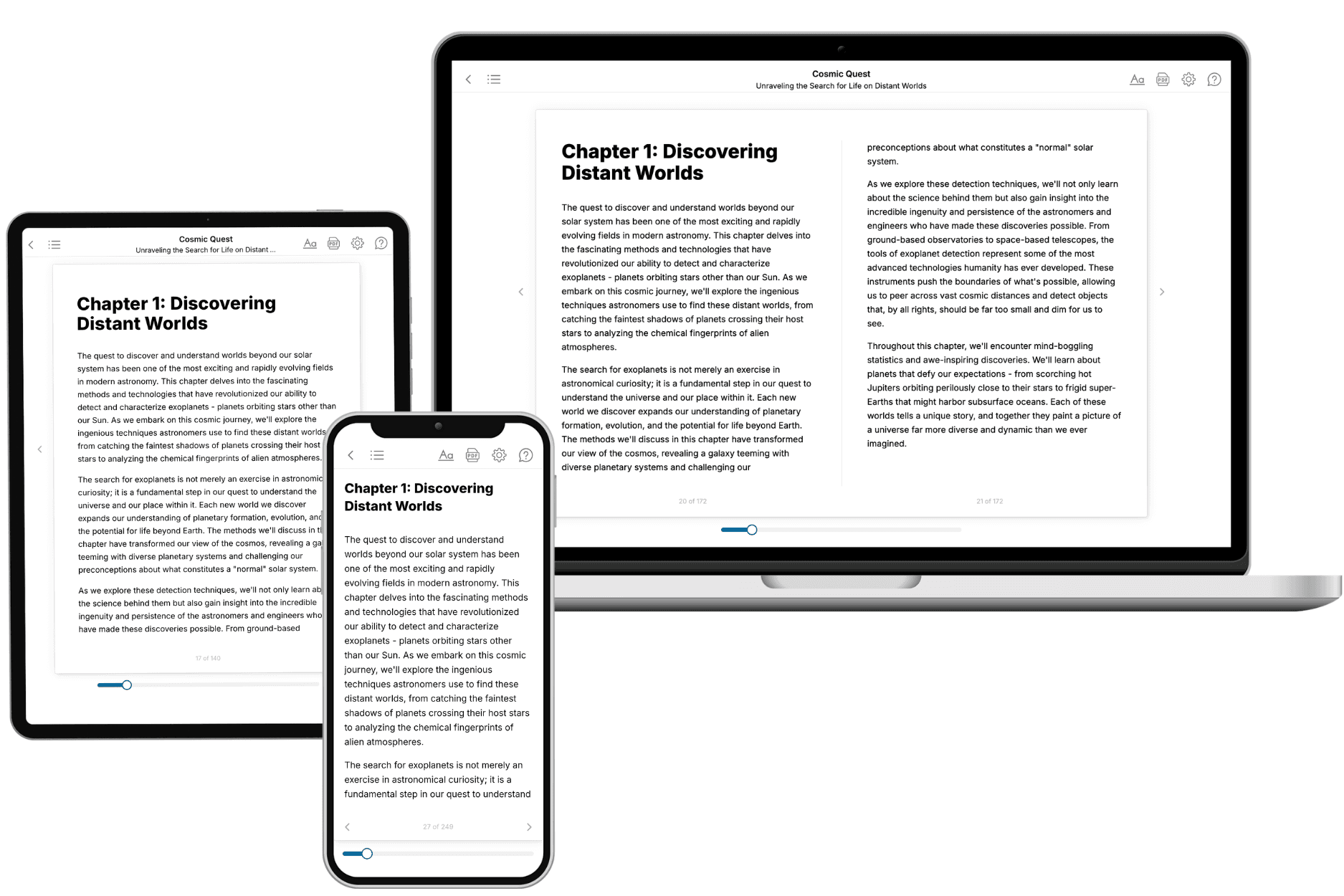
Your book is ready in 10 minutes. Read it online, download as EPUB or PDF, or send to Kindle.

Frequently asked questions
- What is TailoredRead?
TailoredRead creates complete, full-length nonfiction ebooks, written specifically for you. Tell us what you want to learn and why, and TailoredRead writes you a complete ebook on it, with charts, tables, and diagrams throughout. Read it online, on Kindle, or on any e-reader, or download it as a PDF or EPUB. Every book is written fresh the day you order it.
- How is the book tailored to me?
Before anything is written, you answer a few short questions about your goals, your background, and the topics you care about. Your book is then planned around your answers: written at your level, focused on your goals, and covering the topics you chose, instead of the one-size-fits-all book a store sells everyone.
- Will it read like generic AI content?
No. Your book isn't a chat transcript: it's planned chapter by chapter before a single word is written, told in a clear book voice, and explains ideas visually with charts, tables, and diagrams. After writing, every book goes through an editorial pass that polishes chapters so the book reads consistent from start to finish. Judge for yourself: browse thousands of sample books on our Explore Books page.
- How accurate is the content?
Our AI first checks whether your subject needs live research. Niche and fast-moving subjects are researched before writing, and the book plan and chapters are grounded in what it finds. After writing, every book goes through a quality pass that checks its facts and consistency, and researched books list their sources in a Notes section at the back.
- How long is the book?
You choose the length: Comprehensive (250-300 pages), Detailed (150-200 pages), Essential (70-100 pages), or Short (30-50 pages).
- Does the book include visuals?
Yes. Every book includes visual elements such as timelines, checklists, step-by-step guides, decision trees, comparison tables, and matrices, and many include bar charts. A typical book includes dozens of these visual elements.
- Can I read it on Kindle? What formats can I download?
Yes. Every book can be read in our online reader or downloaded as a PDF or EPUB. The EPUB can be opened with Kindle, Apple Books, Kobo, and any e-reader. The Commercial and Author licenses also include an editable Word (DOCX) and Markdown download.
- How much does it cost?
About the price of a regular ebook. The exact price depends on your book's length and complexity, from $2 for the shortest books to $35 for the most comprehensive, and it's shown when you review your book, before you commit to anything. Each book is a one-time purchase, yours to keep, no subscription. Licenses that let you share, teach, or publish your book range from $35.99 to $49.99.
- Can I preview the book before purchasing?
Before you pay, you'll see what your book will cover: the title, a detailed description, the estimated length, and the complete chapter-by-chapter table of contents, so you know what you're getting before you decide. The full text itself is written after you purchase.
- How long does it take to create a book?
About 10 minutes. You can start reading the opening chapters while the rest is still being written.