The DNA Repair Blueprint
How Your Cells Fix Damage and What Epigenetics Reveals About Healing
Imagine understanding the intricate machinery that keeps your cells healthy and functioning optimally.
238 pages11 chaptersJun 24, 2026Molecular Biology
About this book
Your cells face constant threats from radiation, chemicals, and metabolic byproducts, yet they possess remarkable systems to detect and repair damage before it becomes dangerous. This book reveals how DNA repair mechanisms work at the molecular level and how epigenetics—the study of how genes are regulated—connects these cellular processes to your everyday choices. You'll discover why some people seem to age more gracefully, how environmental factors influence your genetic expression, and what science says about optimizing your cellular health. Whether you're curious about the biology behind longevity, interested in cancer prevention, or seeking to understand how lifestyle impacts your genes, this comprehensive guide translates cutting-edge research into accessible insights. Learn the mechanisms that protect your genome, explore the epigenetic switches controlling your health, and understand how modern science is harnessing these discoveries to develop transformative treatments.
Table of contents
- IntroductionWhy Cellular Health Matters More Than You Think, A Quick Primer on DNA and Genetic Information, What You'll Learn in This BookRead below
- Chapter 1: The Constant Threat: Understanding DNA DamageWhere DNA Damage Comes From, Types of DNA Lesions and Their Consequences, How Damage Accumulates Over Time
- Chapter 2: The Detection System: How Cells Recognize DamageSensor Proteins That Detect Damage, Cell Cycle Checkpoints and Damage Response, How Cells Sound the Alarm
- Chapter 3: Base Excision Repair: Fixing Small MistakesHow Base Excision Repair Works, Oxidative Stress and Cellular Damage, Why This Pathway Matters for Daily Cellular Health
- Chapter 4: Nucleotide Excision Repair: Handling Major DamageThe Nucleotide Excision Repair Pathway, UV Radiation and Skin Cancer Prevention, What Happens When NER Fails
- Chapter 5: Mismatch Repair and Double-Strand Break RepairCatching Replication Errors with Mismatch Repair, Repairing the Most Dangerous Breaks, The Balance Between Speed and Accuracy
- Chapter 6: Epigenetics Fundamentals: Beyond the DNA SequenceWhat Epigenetics Really Means, DNA Methylation: Silencing and Activating Genes, Histone Modifications and Chromatin Structure
- Chapter 7: The Epigenetic Landscape: How Genes Get Turned On and OffChromatin Remodeling and Gene Accessibility, Transcription Factors and Gene Regulation, Epigenetic Memory and Cellular Identity
- Chapter 8: The DNA Repair-Epigenetics ConnectionHow DNA Repair Influences Gene Expression, Epigenetic Changes in Response to Damage, The Integrated Cellular Response System
- Chapter 9: Lifestyle Factors That Influence DNA Repair and EpigeneticsNutrition and Antioxidant Support for Repair, Exercise and Its Epigenetic Effects, Sleep, Stress, and Cellular Recovery, Environmental Exposures and Epigenetic Modifications
- Chapter 10: Disease and Dysfunction: When Repair Systems FailCancer: The Consequence of Accumulated Damage, Neurological Diseases and DNA Repair Defects, Aging, Senescence, and Declining Repair Capacity
- Chapter 11: Emerging Therapies and Future DirectionsDrugs That Enhance DNA Repair, Epigenetic Therapies and Gene Reactivation, Personalized Medicine Based on Repair Capacity
- ConclusionKey Takeaways and What Comes Next, Empowering Your Cellular Health
- Glossary
- Further Reading and Resources
Introduction
Right now, inside every cell of your body, something extraordinary is happening. Molecular machines are scanning your DNA, hunting for damage, patching errors, and restoring the genetic code that keeps you alive. This is not a metaphor or a simplification. Your cells are genuinely running a continuous quality-control operation, one that handles tens of thousands of DNA damage events every single day.[1] Most of the time, this system works so well that you never notice it. But when it starts to slip, the consequences can be profound.
The story of DNA repair is one of the most compelling in all of biology. It connects the invisible world of molecules to the very visible realities of aging, cancer, and disease. It also connects to something more hopeful: the growing understanding that your lifestyle choices, your diet, your sleep habits, your stress levels, and your exposure to environmental factors all influence how well your cells maintain their genetic integrity. This is not wishful thinking. It is the science of epigenetics, and it is reshaping how researchers and clinicians think about health and disease.
This book was written for people who want to understand these processes at a meaningful level, not just in broad strokes, but with enough detail to appreciate the elegance of the machinery involved. You do not need a graduate degree in molecular biology to follow along. What you do need is curiosity and a willingness to engage with ideas that are genuinely fascinating. Whether you work in healthcare, research, or wellness, or whether you are simply someone who wants to understand what is happening inside your own body, this book is designed to meet you where you are and take you somewhere more informed.
The field of DNA repair and epigenetics has exploded in recent decades. Discoveries that once seemed purely academic are now driving the development of cancer therapies, anti-aging interventions, and personalized medicine strategies. Understanding the basics of these fields is no longer just for specialists. It is increasingly relevant to anyone who wants to make sense of modern health science and the choices that influence long-term wellbeing. This introduction will give you the foundation you need to get the most out of everything that follows.
Why Cellular Health Matters More Than You Think
Most conversations about health focus on the body at a scale you can see and feel: weight, blood pressure, energy levels, sleep quality. These things matter enormously. But underneath all of them is a cellular reality that drives everything else. Your body is made up of roughly 37 trillion cells, and the health of those cells determines the health of every tissue, organ, and system they compose.[2] When cells function well, the body tends to function well. When cells accumulate damage and lose their ability to repair it, problems follow.
Consider what a single cell has to manage. It must copy its entire genome accurately every time it divides, a process involving roughly 3 billion base pairs of DNA. It must respond to signals from neighboring cells and from the environment. It must produce thousands of different proteins at the right times and in the right amounts. And it must do all of this while constantly defending its genetic material against damage from radiation, reactive chemicals, and its own metabolic processes. The fact that this works as reliably as it does is a testament to the sophistication of cellular biology.
When cellular health declines, the effects are not always immediate or obvious. Damage accumulates gradually. A cell that has lost some repair capacity may still function for years before problems become apparent. This is why many age-related diseases, including cancer, cardiovascular disease, and neurodegeneration, tend to emerge later in life. They are often the downstream result of decades of slowly accumulating cellular damage that the body's repair systems could no longer fully address.
This gradual accumulation is also why prevention matters so much. Choices made in your twenties and thirties influence the cellular landscape of your fifties and sixties. Research consistently shows that lifestyle factors can either accelerate or slow the rate at which DNA damage accumulates and repair capacity declines.[3] Understanding the mechanisms behind this relationship gives you a much clearer picture of why those choices matter at a biological level.
There is also a practical dimension to understanding cellular health that goes beyond personal lifestyle. For healthcare professionals, knowing how DNA repair pathways work helps explain why certain cancers respond to specific treatments and why others do not. For researchers, understanding epigenetic regulation opens doors to entirely new therapeutic strategies. For anyone working in wellness or preventive medicine, the science of cellular maintenance provides a rigorous foundation for recommendations that might otherwise seem speculative.
The key insight is this: cellular health is not a fixed trait you are born with and stuck with. It is a dynamic state that responds to your environment, your habits, and increasingly, to medical interventions designed to support or restore repair capacity. That makes it one of the most actionable areas of biology available to us right now.
A concrete example: Xeroderma pigmentosum is a rare genetic disorder in which one of the key DNA repair pathways is defective. People with this condition are extraordinarily sensitive to UV radiation and have a dramatically elevated risk of skin cancer, sometimes developing tumors in childhood. This extreme case illustrates what happens when repair systems fail completely. But it also highlights, by contrast, how much protection a functioning repair system provides to everyone else every single day.
Understanding cellular health at this level is not about becoming anxious about invisible damage happening inside your body. It is about developing an accurate mental model of how your biology works, so that the choices you make and the information you encounter can be evaluated with greater clarity and confidence.
A Quick Primer on DNA and Genetic Information
Before diving into repair mechanisms and epigenetics, it helps to have a clear picture of what DNA actually is and how it carries information. DNA, or deoxyribonucleic acid, is a long molecule made up of four chemical building blocks called nucleotide bases: adenine (A), thymine (T), guanine (G), and cytosine (C). These bases pair up in a specific way (A with T, G with C) to form the famous double helix structure. The sequence of these bases along the DNA strand encodes the instructions for building and operating a living organism.
The human genome contains approximately 3 billion of these base pairs, organized into 23 pairs of chromosomes housed in the nucleus of nearly every cell. If you stretched out all the DNA from a single human cell, it would measure about two meters in length.[4] Fitting that much material into a nucleus that is only about 6 micrometers across requires extraordinary packaging. This is where histones come in: proteins around which DNA is wound tightly, like thread around a spool. The combination of DNA and its associated proteins is called chromatin.
Genes are specific segments of DNA that encode instructions for making proteins. But here is something that surprises many people: only about 1.5 to 2 percent of the human genome actually codes for proteins.[5] The rest was once dismissed as "junk DNA," but researchers now know that much of it plays important regulatory roles, controlling when and how genes are expressed. This regulatory landscape is central to epigenetics, which you will explore in depth later in this book.
When a gene is expressed, the information in its DNA sequence is first copied into a related molecule called messenger RNA (mRNA) through a process called transcription. The mRNA then travels out of the nucleus to the cell's protein-making machinery, where it is translated into a specific protein. This flow of information, from DNA to RNA to protein, is often called the central dogma of molecular biology. It is the fundamental logic of how genetic information becomes biological function.
DNA damage disrupts this flow. When the sequence of bases is altered, deleted, or chemically modified, the instructions encoded in the DNA can become garbled. A protein built from corrupted instructions may not fold correctly, may not function properly, or may not be produced at all. In some cases, damaged DNA can lead to proteins that actively cause harm, as happens with certain cancer-driving mutations. This is why maintaining the integrity of the DNA sequence is so critical to cellular function.
Epigenetics adds another layer of complexity to this picture. Even when the DNA sequence itself is intact, the way that DNA is packaged and chemically marked can determine whether a gene is accessible for transcription or effectively silenced. These epigenetic marks can be influenced by environmental signals and can even be passed from one cell generation to the next. Understanding both the sequence-level integrity of DNA and its epigenetic regulation is essential for a complete picture of how cells maintain their identity and function.
Here is a simple way to think about the relationship between DNA, genes, and epigenetics:
- DNA sequence: The text of the instruction manual, written in a four-letter alphabet.
- Genes: Specific chapters or sections of that manual, each encoding a particular protein or functional RNA.
- Epigenetic marks: Sticky notes and highlighters on the pages, indicating which sections should be read now, which should be skipped, and which should be read loudly or quietly.
- DNA repair: The proofreading and editing process that corrects typos and damage before they cause lasting problems.
This framework will serve you well as you work through the chapters ahead. The details will become richer and more nuanced, but the core logic remains the same: genetic information is stored in DNA, expressed through a regulated process, and protected by a sophisticated repair system that is itself subject to regulation.
What You'll Learn in This Book
This book is organized to take you on a logical journey through the science of DNA repair and epigenetics, starting with the threats that cells face and moving through the mechanisms they use to respond, the broader regulatory landscape of epigenetics, and finally the practical and clinical implications of all of it. Each chapter builds on the ones before it, so by the time you reach the later sections on disease and emerging therapies, you will have the conceptual tools to understand them fully.
Chapters 1 and 2 set the stage by examining DNA damage itself. You will learn where damage comes from, including UV radiation, oxidative stress, environmental chemicals, and errors in DNA replication. You will also learn how cells detect damage in the first place, which turns out to be a fascinating story involving specialized sensor proteins and a network of signaling pathways that can halt cell division, trigger repair, or in extreme cases, initiate programmed cell death.
Chapters 3 through 5 cover the major DNA repair pathways in detail:
- Base excision repair (BER) handles small, chemically altered bases, the kind of damage that happens constantly as a byproduct of normal metabolism.
- Nucleotide excision repair (NER) deals with bulkier damage that distorts the DNA helix, including the lesions caused by UV radiation.
- Mismatch repair (MMR) catches errors that slip through during DNA replication, correcting mismatched base pairs before they become permanent mutations.
- Double-strand break repair addresses the most dangerous type of damage, where both strands of the DNA helix are severed, using two distinct strategies depending on the cellular context.
Each of these pathways involves a cast of specialized proteins working in a coordinated sequence. Understanding how they work, and what happens when they fail, provides a molecular explanation for many of the diseases and conditions that affect human health.
Chapters 6 and 7 shift the focus to epigenetics. You will learn what epigenetic regulation actually means at the molecular level, covering DNA methylation, histone modifications, and chromatin remodeling. These chapters explain how the same DNA sequence can give rise to hundreds of different cell types, each with a distinct identity and function, through differences in epigenetic patterning rather than differences in the underlying genetic code.
Chapter 8 brings the two halves of the book together by exploring the connections between DNA repair and epigenetic regulation. These systems are not independent. Damage to DNA triggers epigenetic changes that help coordinate the repair response, and epigenetic marks influence which regions of the genome are most accessible to repair machinery. Understanding this integration gives you a much more complete picture of how cells respond to stress and maintain stability.
Chapter 9 is where the science becomes most directly relevant to everyday life. You will explore how nutrition, exercise, sleep, stress, and environmental exposures influence both DNA repair efficiency and epigenetic patterns. This chapter is grounded in research, not speculation, and it will give you a clear sense of which lifestyle factors have the strongest evidence behind them and why they matter at a cellular level.
Chapter 10 examines what happens when repair systems fail or epigenetic regulation goes wrong. Cancer, neurological diseases, and the biology of aging are all examined through the lens of DNA damage and repair capacity. This chapter is not meant to be alarming. Rather, it provides a mechanistic understanding of disease that makes the preventive and therapeutic strategies discussed in the final chapter much more meaningful.
Chapter 11 looks at the frontier of research and clinical application. Drugs that enhance DNA repair, epigenetic therapies that reactivate silenced genes, and personalized medicine approaches based on individual repair capacity are all areas of active development. Some of these are already in clinical use; others are on the horizon. Understanding the science behind them puts you in a much better position to follow and evaluate this rapidly evolving field.
Throughout the book, you will find concrete examples, real-world scenarios, and connections to clinical outcomes that make the science tangible. The goal is not just to inform but to give you a framework for thinking about cellular health that you can apply to new information as it emerges. Science in this area is moving fast, and the most valuable thing this book can give you is not just a snapshot of current knowledge but a way of understanding the underlying logic that will help you make sense of future discoveries.
A note on complexity: DNA repair and epigenetics are genuinely complex fields. Some of the mechanisms described in this book involve dozens of proteins interacting in precisely coordinated sequences. The goal here is not to oversimplify but to present the essential logic of each process clearly enough that the complexity becomes comprehensible rather than overwhelming. Technical terms are introduced carefully and explained in context, and a glossary at the back of the book provides quick reference definitions for key terms.
By the time you finish this book, you will have a working understanding of how your cells protect their genetic material, how environmental and lifestyle factors influence that protection, and how modern medicine is beginning to harness these mechanisms for therapeutic purposes. That understanding is genuinely useful, whether you apply it in a clinical setting, a research context, a wellness practice, or simply in making more informed decisions about your own health. The biology of DNA repair and epigenetics is not just an academic subject. It is the story of how life maintains itself, and it is happening inside you right now.
Notes
Introduction
- 1. T. Lindahl, "Instability and decay of the primary structure of DNA," Nature, 1993
- 2. E. Bianconi and others, "An estimation of the number of cells in the human body," Annals of Human Biology, 2013
- 3. T. E. Seeman and others, "Cumulative biological risk and socio-economic differences in mortality," Social Science & Medicine, 2010
- 4. B. Alberts and others, "Molecular Biology of the Cell (6th ed.)," Garland Science, 2014
- 5. ENCODE Project Consortium, "An integrated encyclopedia of DNA elements in the human genome," Nature, 2012
This is the end of the free sample. The full book has 11 chapters.
Want this book written for you?
Tell us your goals and background, and get your own version of this book, tailored by AI to you.


Benefits of AI-tailored books
- Read one book, not ten:
- all the Molecular Biology knowledge you need, gathered into a single book.
- Save days of learning:
- tell us your goals, choose your topics, and the whole book is built around them.
- Learn effortlessly:
- Molecular Biology book written for your specific background and expertise.
- Understand at a glance:
- includes charts, tables, timelines, checklists, decision trees, and more.
- Stay current:
- written the day you order it, not years ago.
- Trust what you read:
- every book is checked for accuracy, with real research when your subject needs it.
Create your unique book in 3 steps
- 1. Select your focus
Select the focus of your Molecular Biology book and share your background
- 2. Personalize your book
Specify your goals and choose sub-topics to include
- 3. Get your tailored book
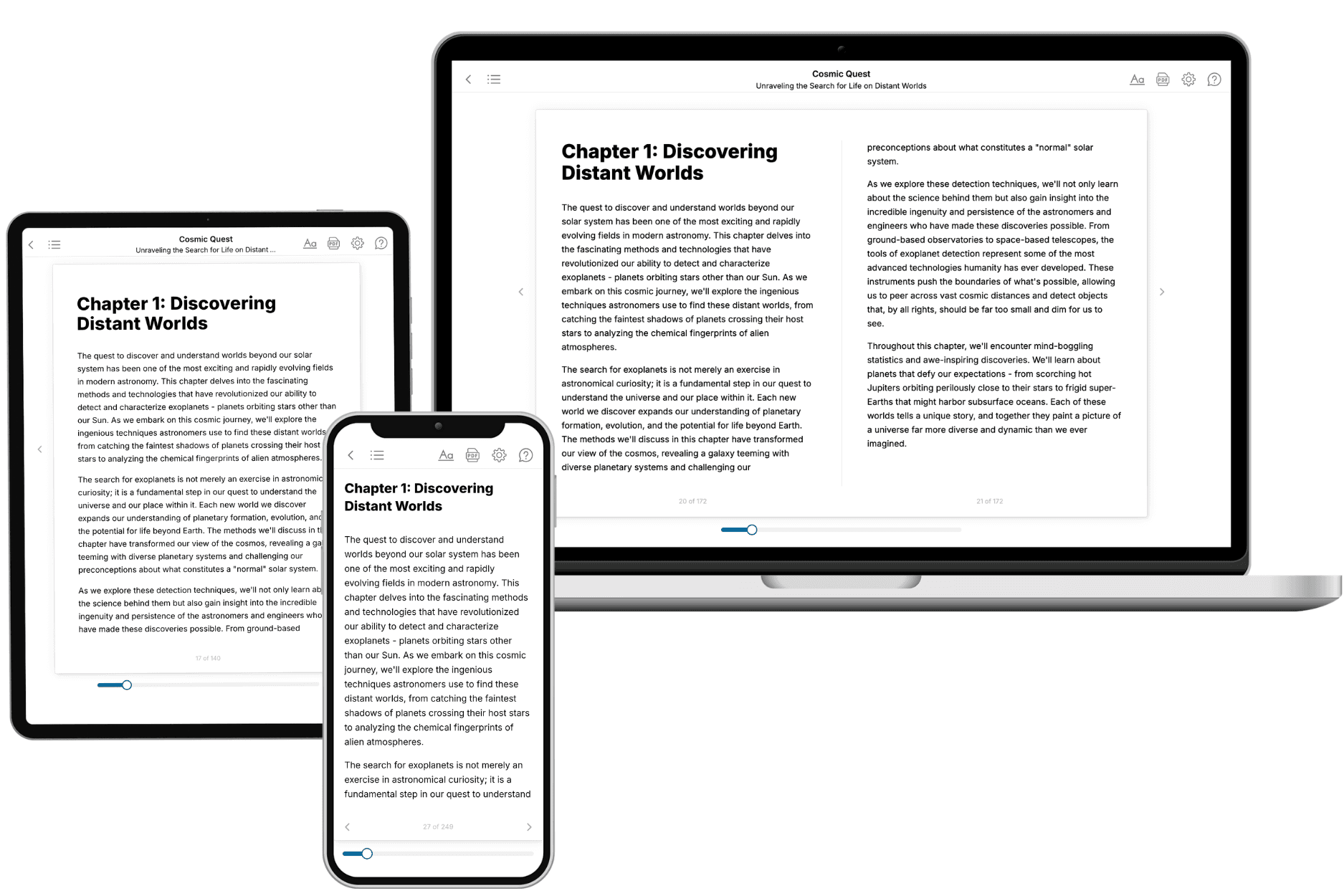
Your book is ready in 10 minutes. Read it online, download as EPUB or PDF, or send to Kindle.
Frequently asked questions
- What is TailoredRead?
TailoredRead creates complete, full-length nonfiction ebooks, written specifically for you. Tell us what you want to learn and why, and TailoredRead writes you a complete ebook on it, with charts, tables, and diagrams throughout. Read it online, on Kindle, or on any e-reader, or download it as a PDF or EPUB. Every book is written fresh the day you order it.
- How is the book tailored to me?
Before anything is written, you answer a few short questions about your goals, your background, and the topics you care about. Your book is then planned around your answers: written at your level, focused on your goals, and covering the topics you chose, instead of the one-size-fits-all book a store sells everyone.
- Will it read like generic AI content?
No. Your book isn't a chat transcript: it's planned chapter by chapter before a single word is written, told in a clear book voice, and explains ideas visually with charts, tables, and diagrams. After writing, every book goes through an editorial pass that polishes chapters so the book reads consistent from start to finish. Judge for yourself: browse thousands of sample books on our Explore Books page.
- How accurate is the content?
Our AI first checks whether your subject needs live research. Niche and fast-moving subjects are researched before writing, and the book plan and chapters are grounded in what it finds. After writing, every book goes through a quality pass that checks its facts and consistency, and researched books list their sources in a Notes section at the back.
- How long is the book?
You choose the length: Comprehensive (250-300 pages), Detailed (150-200 pages), Essential (70-100 pages), or Short (30-50 pages).
- Does the book include visuals?
Yes. Every book includes visual elements such as timelines, checklists, step-by-step guides, decision trees, comparison tables, and matrices, and many include bar charts. A typical book includes dozens of these visual elements.
- Can I read it on Kindle? What formats can I download?
Yes. Every book can be read in our online reader or downloaded as a PDF or EPUB. The EPUB can be opened with Kindle, Apple Books, Kobo, and any e-reader. The Commercial and Author licenses also include an editable Word (DOCX) and Markdown download.
- How much does it cost?
About the price of a regular ebook. The exact price depends on your book's length and complexity, from $2 for the shortest books to $35 for the most comprehensive, and it's shown when you review your book, before you commit to anything. Each book is a one-time purchase, yours to keep, no subscription. Licenses that let you share, teach, or publish your book range from $35.99 to $49.99.
- Can I preview the book before purchasing?
Before you pay, you'll see what your book will cover: the title, a detailed description, the estimated length, and the complete chapter-by-chapter table of contents, so you know what you're getting before you decide. The full text itself is written after you purchase.
- How long does it take to create a book?
About 10 minutes. You can start reading the opening chapters while the rest is still being written.