The Economics Educator's Guide to NLP
Master Neuro-Linguistic Programming to Transform Student Engagement, Influence, and Learning Outcomes
Become a more influential, engaging economics educator by mastering the neurolinguistic principles that shape how students learn, decide, and grow.
129 pages6 chaptersAug 17, 2026Neuro-Linguistic Programming
About this book
This practical guide bridges NLP and economics education, showing you how to use sensory language, strategic anchoring, and advanced communication patterns to transform student motivation and comprehension. You'll discover how to build authentic rapport, recognize and interrupt limiting beliefs about economics, and model the communication excellence of master educators. Whether you're teaching supply and demand or behavioral economics, you'll learn to chunk complex concepts into memorable pieces, use reframing to shift perspective, and manage your own state to create psychological safety in the classroom. Grounded in neuroscience and behavioral economics, this book equips you with evidence-based techniques to enhance student engagement, deepen understanding, and develop the cognitive flexibility that modern economics demands. Move beyond traditional teaching methods and step into a new level of professional mastery.
Table of contents
- IntroductionWhy NLP Matters for Economics Educators, How to Use This Book, What You'll Learn and MasterRead below
- Chapter 1: NLP Foundations and Representational SystemsCore NLP Principles and How They Apply to Teaching, Understanding Visual, Auditory, and Kinesthetic Learners, Developing Sensory Acuity to Read Your Students
- Chapter 2: Building Rapport and Authentic ConnectionThe Science of Rapport Building in the Classroom, Congruence and Authenticity: Aligning Your Words and Presence, Mirroring and Pacing Techniques for Student Engagement
- Chapter 3: Linguistic Mastery: Meta-Model and Milton ModelThe Meta-Model: Precision Language for Clarity and Critical Thinking, The Milton Model: Hypnotic Language for Influence and Engagement, Recognizing and Responding to Linguistic Patterns in Student Communication
- Chapter 4: State Management, Anchoring, and MotivationManaging Your State and Your Students' Emotional States, Anchoring Techniques to Condition Positive Learning States, Using Anchoring and State Management to Boost Student Motivation
- Chapter 5: Reframing, Logical Levels, and Belief SystemsReframing and Perspective Shifts for Deeper Understanding, The Logical Levels Framework: From Behavior to Identity and Values, Shifting Neurolinguistic Belief Systems About Economics and Learning
- Chapter 6: NLP in Economics: Behavioral Economics and Market InfluenceBehavioral Economics Through the Lens of NLP, Sensory Language and Linguistic Influence in Economic Markets, Modeling Excellence: Learning from Master Economists and Educators
- ConclusionIntegrating NLP Into Your Teaching Practice
Introduction
A tenth-grade economics teacher stands in front of a class trying to explain opportunity cost for the third time this week. Half the room nods along when she draws a graph on the board. The other half only lights up when she tells a story about choosing between a part-time job and extra study time. Same concept, same teacher, two completely different responses. That gap between what a teacher intends to communicate and what a student actually absorbs is the entire subject of this book. Neuro-Linguistic Programming, often shortened to NLP, gives a structured way to close that gap by paying attention to how people internally represent information, not just what information they receive.
Economics is an unusually demanding subject to teach well. It mixes abstract models like supply and demand curves with deeply personal decisions about money, risk, and trade-offs that students already have opinions about from their own households. A student who watched a parent struggle to pay rent does not experience scarcity
as a diagram. A student who has never worried about money might treat the same concept as a purely academic exercise. NLP matters here because it was built, from its origins in the 1970s, around modeling how skilled communicators adjust their language and delivery to match the internal experience of the person in front of them[1]. Economics teaching benefits directly from that adjustment.
This book treats NLP not as a motivational gimmick but as a communication technology with specific, learnable components. Representational systems, rapport techniques, precision language patterns, state management, reframing, and modeling are treated as discrete skills, each with its own chapter, each building on the last. The intermediate NLP knowledge already held is assumed and extended rather than re-explained from zero. Where earlier general NLP training might have introduced a concept like anchoring in the abstract, this book asks a sharper question: what does anchoring look like in the seven minutes before a quiz on elasticity, and how does a teacher use it without turning the classroom into a performance.
The chapters ahead move in a deliberate sequence. Foundational perception comes first, then connection, then language, then emotional state, then belief and identity, and finally the applied synthesis where all of it meets real economic content and market behavior. Each stage depends on the one before it. Trying to reframe a student's limiting belief about their own math ability, for instance, without first having built rapport, tends to land as criticism rather than help. This introduction sets out why the framework matters specifically for economics classrooms, how the book expects to be used, and what mastery looks like by the final page.
Why NLP Matters for Economics Educators
Economics carries a reputation problem before a lesson even begins. Many students arrive believing it is either too mathematical for them or too abstract to matter, and that belief shapes how they listen long before any content is delivered. NLP treats this as a solvable communication problem rather than a fixed trait of the student. The discipline's founding assumptions, sometimes called the NLP Presuppositions, include the idea that the map is not the territory, meaning each student's internal model of the economy
is a personal construction, not a direct copy of economic reality. A teacher who understands this stops arguing with a student's model and starts working with it.
Consider two students learning about inflation. One pictures rising numbers on a grocery receipt, a visual and concrete image. Another recalls a parent complaining about prices at dinner, an experience tied to sound and emotion. A lecture built entirely around graphs will land cleanly with the first student and only partially with the second. This is the practical payoff of attending to Representational Systems, a concept developed at length in a later chapter, but its relevance starts here: economics has more abstract, model-based content than most subjects, which means the risk of losing students who process information differently is higher than average.
Behavioral economics itself, now a mainstream branch of the field, quietly validates much of what NLP has argued for decades: that people do not process information the way classical models assume, that framing changes decisions, and that emotional state shapes judgment as much as raw data does. Daniel Kahneman's work on cognitive biases and dual-process thinking demonstrated that decisions are frequently driven by fast, intuitive, emotionally-loaded processing rather than the slow deliberate calculation textbooks describe[2]. An economics teacher who understands NLP is, in effect, applying the same insight about human cognition to the act of teaching that behavioral economists apply to the act of choosing.
There is also a credibility dimension specific to this subject. Economics teachers are often asked, implicitly or explicitly, to justify why the subject matters at all. A teacher whose words, tone, and body language are not aligned, someone preaching the importance of rational long-term thinking while visibly stressed and short-tempered, undermines the lesson without saying a single contradictory word. This is the concept of Congruence, covered in depth when rapport is discussed, and it explains why some technically excellent economics teachers still struggle to engage a room: the mismatch between message and manner is picked up by students even when they cannot articulate it.
NLP also offers economics educators a way to handle the subject's built-in controversy. Topics like minimum wage, taxation, or free trade provoke strong opinions, and students often arrive with inherited political positions rather than economic reasoning. The Meta-Model, a tool for identifying vague or distorted language patterns, gives a teacher a neutral, repeatable way to question a claim like taxes always hurt the economy
without turning the exchange into a political argument. The student is asked to specify, clarify, and support their own claim, which builds critical thinking skills that outlast any single debate.
A further reason NLP fits economics specifically is the subject's reliance on models that compress reality into simplified relationships. A supply curve is already an act of chunking, taking countless individual decisions and representing them as a single line. NLP's attention to how people naturally chunk information, moving between big-picture and granular detail, mirrors exactly what economics instruction requires. A teacher fluent in this skill can sense when a class needs to zoom out to the big idea of trade-offs or zoom in to a specific numerical example, and can make that shift deliberately rather than by accident.
None of this replaces subject-matter expertise or curriculum design. NLP does not decide what economics content to teach. It shapes how that content reaches a room of individual minds, each with a different sensory bias, a different emotional history with the subject, and a different set of beliefs about their own capability. A teacher who has mastered the economics but not the delivery risks producing technically accurate lessons that fail to move anyone. This book exists to close that specific gap, one chapter and one skill at a time, always tying the technique back to a recognizable moment in an economics classroom.
Skepticism about NLP as a field is worth acknowledging directly rather than avoiding. Some of its specific claims, particularly early claims about eye movements reliably indicating internal processing, have not held up well under later scrutiny[3]. This book treats such claims with appropriate caution, framing techniques like Eye-Accessing Cues as one input among several rather than a reliable diagnostic on their own, and it favors techniques with broader support in communication research and behavioral science. The value of NLP here lies less in any single mechanism and more in the disciplined attention it demands: watch closely, adjust deliberately, and test whether the adjustment actually improves understanding.
Framed this way, NLP becomes less a separate system to learn and more a lens that sharpens skills a good economics teacher already has. Every experienced teacher already adjusts pacing when a room looks confused, already tells a different story to different classes, already senses when energy has dropped before a quiz. NLP names these instincts, breaks them into repeatable steps, and gives them enough structure to be taught, practiced, and improved deliberately rather than left to chance.
The result, when applied consistently, is not a dramatic transformation overnight but a steady compounding effect. A teacher who reads sensory language cues slightly better, builds rapport slightly faster, and reframes a limiting belief slightly more skillfully will, across a semester, produce measurably more engaged and confident students. Small adjustments to communication, repeated across hundreds of classroom interactions, accumulate into the kind of teaching reputation that students remember years later, the teacher who made economics finally make sense.
It also matters that these techniques are learnable rather than innate. Some educators are naturally gifted communicators who build rapport and read a room without ever studying why it works. NLP takes what those natural communicators do intuitively and turns it into an explicit skill set, closing the gap between naturally gifted teachers and technically skilled ones who want to become equally engaging. That democratizing effect, making excellent communication trainable rather than a fixed trait, is one of the strongest arguments for including it in a teacher's ongoing professional development.
Finally, economics as a discipline is unusually well suited to modeling its own teaching improvements. Economists already think in terms of incentives, feedback loops, and marginal changes. Applying that same analytical mindset to one's own classroom communication, treating rapport, language precision, and state management as variables that can be measured and improved, is a natural extension of the economic way of thinking rather than a departure from it. This book asks economics teachers to turn their professional lens on themselves as communicators, not only on the subject matter they deliver.
How to Use This Book
This book is built to be used two ways at once: as a sequential course and as a reference to return to before a specific lesson. Reading front to back the first time is recommended, because later chapters assume familiarity with terms introduced earlier. Anchoring, for example, is easier to apply once Rapport and Sensory Acuity have already been practiced, since reading a student's state accurately is a prerequisite for anchoring it effectively. After the first full read, individual chapters can be revisited on their own whenever a specific classroom challenge arises, such as a unit on behavioral economics or a difficult week of low student motivation.
Each chapter follows a consistent internal logic: a concept is introduced, connected explicitly to an economics teaching scenario, and then broken into practical steps or examples. The steps below outline the recommended path through the book for someone using it as a structured course over a term.
Recommended Path Through This Book
- Build the perceptual foundation - Work through the chapter on representational systems and sensory acuity before anything else, since every later skill depends on accurately reading students first.
- Establish connection skills - Practice the rapport and congruence techniques in real classes for at least two weeks before introducing new language patterns, so trust is in place before precision language begins.
- Layer in language precision - Introduce Meta-Model questions gradually in class discussions, starting with one or two vague student claims per week rather than overhauling every conversation at once.
- Add state and motivation tools - Once language patterns feel natural, begin experimenting with anchoring and state management around specific high-stakes moments like exams or difficult topics.
- Work on beliefs and identity - Apply reframing and the Logical Levels model only after rapport and state work are established, since belief-level conversations require a foundation of trust.
- Synthesize with economic content - Return to the applied chapter on behavioral economics and market language once the core NLP skills feel comfortable, to see how they combine directly with subject matter.
Every chapter includes concrete classroom examples rather than abstract descriptions alone. Where a technique like Stacking Anchors is introduced, expect a walked-through scenario, such as conditioning a calm, confident state before a unit test by pairing a specific gesture with three separate moments of genuine student success earlier in the term. These examples are meant to be adapted, not copied word for word, since every classroom has its own rhythm, age group, and cultural context that changes how a technique should be delivered.
Terminology is kept consistent throughout the book so that a concept introduced in one chapter can be referenced later without redefinition. Terms such as Meta-Model, Milton Model, Logical Levels (Dilts), and Sleight of Mouth always refer to the same specific frameworks wherever they appear. Keeping a simple personal glossary while reading, even a single page listing each term and one classroom example tied to it, makes the material far easier to apply later when planning an actual lesson rather than only reading about it in the abstract.
Practice is treated as non-negotiable throughout this book, not optional supplementary advice. Reading about mirroring body language or pacing a student's breathing pattern before matching it does very little on its own. The techniques described only become reliable through repeated, deliberate application in real classroom moments, followed by honest reflection on what worked and what did not. A useful habit is keeping a short weekly log noting one NLP technique attempted, the situation it was used in, and the observed result, whether positive, neutral, or unclear.
Some chapters will feel more immediately useful than others depending on which classroom challenges are most pressing right now. A teacher struggling mainly with low motivation might be tempted to skip ahead to the chapter on state management and anchoring. This is reasonable as an emergency measure, but the foundational chapters on representational systems and rapport should still be reviewed soon after, since anchoring techniques applied without accurate rapport tend to feel manipulative to students rather than supportive, undermining the very trust the technique depends on.
Where a technique touches on emotionally sensitive territory, such as a student's anxiety around math-heavy economics content or a limiting belief tied to family financial stress, this book stays within the bounds of general classroom practice. Nothing here is intended as therapy or clinical intervention. Reframing a student's belief that I am bad at economics
is squarely within an educator's role; addressing deeper anxiety or family trauma that surfaces during such a conversation is not, and should be referred to appropriate school counseling resources.
The checklist below can be used as a quick readiness check before starting the main chapters, particularly for a teacher who wants to confirm the basics are already in place before layering on more advanced material.
Before Starting Chapter One
- A specific class or unit in mind to apply techniques to as they are introduced
- Willingness to observe and log student reactions honestly, including when a technique does not work
- Basic comfort with core NLP vocabulary such as rapport, anchoring, and reframing
- An openness to adjusting personal teaching habits, including tone, pacing, and body language
- A note-taking method in place for tracking which techniques get tried and their outcomes
Cross-referencing is used deliberately throughout the book rather than repeating full explanations of a concept every time it reappears. When behavioral economics is discussed later in relation to market framing, it draws directly on the language precision skills introduced earlier without re-explaining every Meta-Model distinction from scratch. Reading in order the first time avoids the friction of encountering a term without its original context.
This book also assumes an intermediate starting point rather than complete beginner status, meaning foundational NLP vocabulary such as basic rapport concepts is used with only brief reminders rather than full re-teaching. If a specific term feels unfamiliar or half-remembered while reading, it is worth pausing to look it up rather than pushing forward with a shaky foundation, since later applied techniques build directly on precise understanding of earlier terms rather than a general impression of them.
Time investment matters more than speed. A single technique practiced consistently across several weeks of actual teaching will produce more durable improvement than five techniques skimmed in a single weekend and never applied. Economics teachers already juggling grading, lesson planning, and administrative demands should treat this book as a slow-release professional development resource, picked up in short sessions between other responsibilities, rather than something to be finished and shelved in a single sitting.
Finally, this book works best alongside ordinary classroom observation, whether that comes from a trusted colleague sitting in on a lesson, informal student feedback, or simple self-recording where permitted by school policy. NLP techniques are ultimately judged by their effect on real students in a real room, not by how elegant they sound on paper. The techniques ahead are offered as tested starting points, not fixed scripts, and the most effective economics educators will end up adapting each one to fit their own voice, their own students, and their own particular corner of economic content.
What You'll Learn and Master
By the end of this book, the goal is a working, integrated skill set rather than a collection of isolated facts about NLP theory. Mastery here means being able to walk into an economics classroom, read the room accurately within the first few minutes, adjust language and pacing to match what is observed, and shift a student's stuck belief about their own capability, all without needing to consciously think through each individual technique step by step. That level of fluency develops gradually, through the same layered progression the chapters themselves follow.
The foundational skill is perceptual: learning to notice, in real time, whether a student is processing information visually, auditorily, or kinesthetically, and adjusting explanations of concepts like marginal utility or GDP calculation accordingly. This is not about labeling students permanently into one category, since most people use a mix of all three depending on context, but about building the moment-to-moment sensitivity to notice when a current explanation is not landing and having a ready alternative in a different sensory register.
Connected closely to that perceptual skill is the ability to build genuine rapport quickly, including with students who arrive resistant or disengaged from the subject. This includes practical mirroring and pacing techniques, but more importantly it includes the deeper skill of Congruence, ensuring that enthusiasm expressed about a topic like international trade is genuinely felt and not just performed, since students detect the difference and respond accordingly. By the end of the relevant chapter, expect to be able to establish a working sense of trust with a new class within the first week rather than the first month.
Linguistic mastery forms the next major skill area, covering both the Meta-Model and the Milton Model as complementary tools rather than competing ones. The Meta-Model sharpens critical thinking by challenging vague or distorted claims, useful when a student asserts something like the government always makes things worse
without evidence. The Milton Model, by contrast, uses deliberately artful vagueness and Embedded Commands to guide attention and motivation, useful when introducing a challenging new topic and wanting to presuppose success rather than invite doubt. Mastery means knowing which tool fits which classroom moment.
State management and anchoring form a third pillar, covering the ability to notice and shift both a teacher's own emotional state and a student's, and to condition useful states like curiosity or calm confidence so they become available on demand before a difficult topic or a high-stakes assessment. By the end of this section, expect to have at least one reliable, tested anchor built with a specific class, tied to a specific resource state, that can be triggered deliberately before a moment that typically produces stress or disengagement.
Reframing and the Logical Levels (Dilts) model make up the belief-level work of the book, addressing not just what a student thinks about a specific economic concept but what they believe about their own identity as a learner of economics. A student who says I'm just not a numbers person
is making an identity-level statement, not a behavior-level one, and mastery here means recognizing that distinction and knowing which level of intervention actually addresses it rather than treating a deep belief with a surface-level fix.
The final applied layer brings all of this directly into economic content itself, covering behavioral economics through an NLP lens, sensory language in market description, and modeling the communication patterns of respected economists and educators. This is where the book closes the loop between communication technique and subject matter, showing for instance how the framing of a price increase as a loss
versus a foregone gain
changes student and market reactions alike, directly connecting classroom language choices to concepts students will later study formally as framing effects.
Beyond individual techniques, a broader outcome to expect is increased flexibility as a communicator, the ability to hold several different explanations of the same concept ready and to switch between them fluidly based on what a room actually needs in the moment. This flexibility is one of the most transferable outcomes of NLP training generally, and it shows up not only in formal lessons but in office hours, parent conversations, and staff meetings as well.
Another outcome worth naming directly is increased comfort with classroom disagreement and controversy, particularly around economic policy topics that carry political weight. Rather than avoiding these topics or shutting down debate, the linguistic precision tools in this book equip a teacher to guide such conversations productively, extracting the underlying economic reasoning from a politically loaded claim without needing to declare a side.
A quiz can help check understanding of these foundational goals before moving into the full chapters ahead.
Quiz: Introduction Check
What is the primary role of NLP in this book's approach to economics teaching?
NLP here is a lens on delivery and connection, not a substitute for subject expertise or a rigid labeling system.
Why does the book recommend building rapport before introducing anchoring techniques?
Anchoring depends on accurate reading of a student's state, which itself depends on the trust rapport establishes first.
Ultimately, the measure of success with this material will not be how fluently the vocabulary of NLP can be recited, but how differently a classroom feels by the middle of a school year, whether students who once dismissed economics as irrelevant or too difficult begin engaging with genuine curiosity, and whether concepts that once required repeated re-teaching start landing the first time they are introduced. That shift in classroom atmosphere, built one deliberate technique at a time, is the real outcome this book is aiming toward, starting with the foundational work of representational systems and sensory acuity in the chapter that follows.
This is the end of the free sample. The full book has 6 chapters.
Want this book written for you?
Tell us your goals and background, and get your own version of this book, tailored by AI to you.


Benefits of AI-tailored books
- Read one book, not ten:
- all the Neuro-Linguistic Programming knowledge you need, gathered into a single book.
- Save days of learning:
- tell us your goals, choose your topics, and the whole book is built around them.
- Learn effortlessly:
- Neuro-Linguistic Programming book written for your specific background and expertise.
- Understand at a glance:
- includes charts, tables, timelines, checklists, decision trees, and more.
- Stay current:
- written the day you order it, not years ago.
- Trust what you read:
- every book is checked for accuracy, with real research when your subject needs it.
Create your unique book in 3 steps
- 1. Select your focus
Select the focus of your Neuro-Linguistic Programming book and share your background
- 2. Personalize your book
Specify your goals and choose sub-topics to include
- 3. Get your tailored book
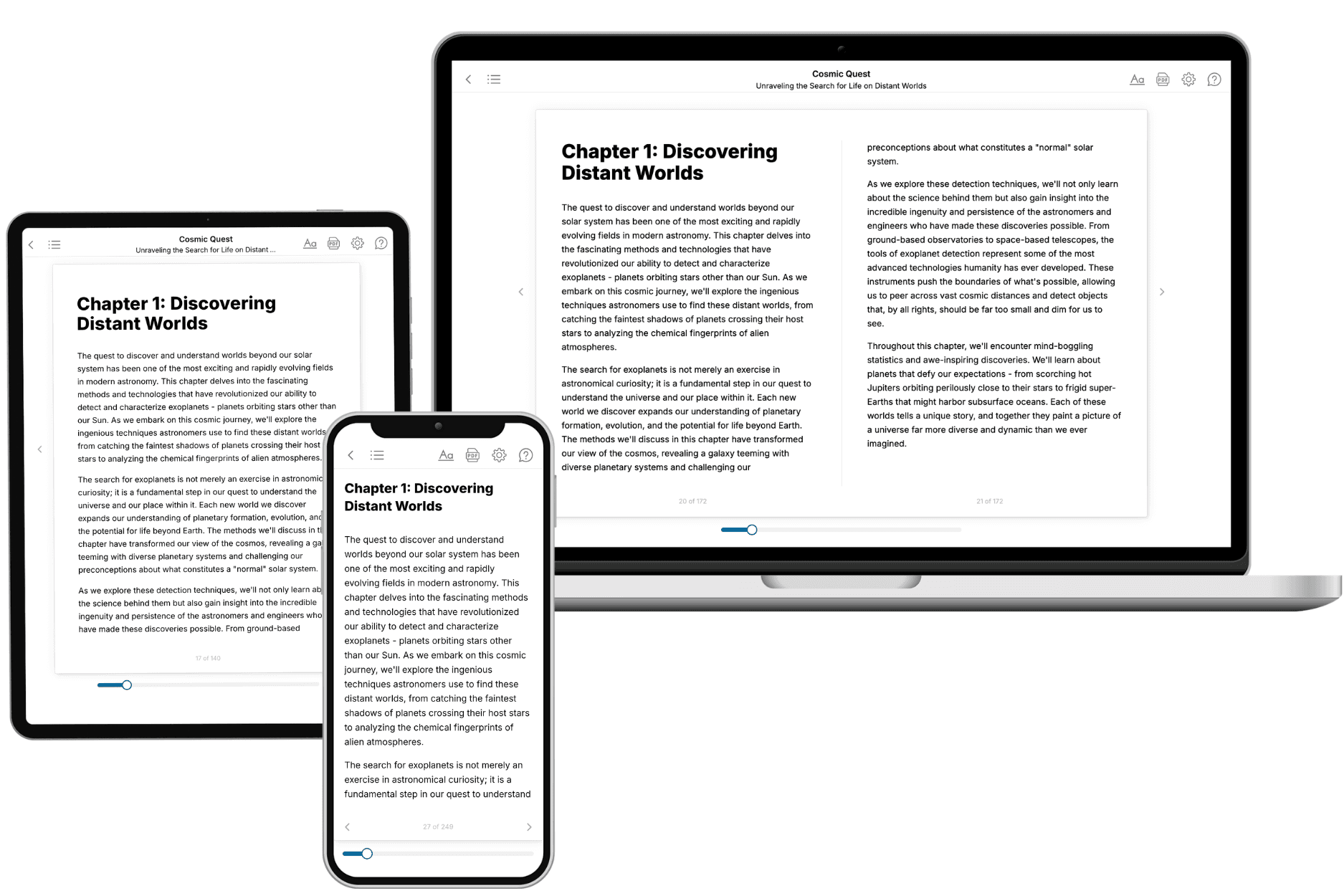
Your book is ready in 10 minutes. Read it online, download as EPUB or PDF, or send to Kindle.
Frequently asked questions
- What is TailoredRead?
TailoredRead creates complete, full-length nonfiction ebooks, written specifically for you. Tell us what you want to learn and why, and TailoredRead writes you a complete ebook on it, with charts, tables, and diagrams throughout. Read it online, on Kindle, or on any e-reader, or download it as a PDF or EPUB. Every book is written fresh the day you order it.
- How is the book tailored to me?
Before anything is written, you answer a few short questions about your goals, your background, and the topics you care about. Your book is then planned around your answers: written at your level, focused on your goals, and covering the topics you chose, instead of the one-size-fits-all book a store sells everyone.
- Will it read like generic AI content?
No. Your book isn't a chat transcript: it's planned chapter by chapter before a single word is written, told in a clear book voice, and explains ideas visually with charts, tables, and diagrams. After writing, every book goes through an editorial pass that polishes chapters so the book reads consistent from start to finish. Judge for yourself: browse thousands of sample books on our Explore Books page.
- How accurate is the content?
Our AI first checks whether your subject needs live research. Niche and fast-moving subjects are researched before writing, and the book plan and chapters are grounded in what it finds. After writing, every book goes through a quality pass that checks its facts and consistency, and researched books list their sources in a Notes section at the back.
- How long is the book?
You choose the length: Comprehensive (250-300 pages), Detailed (150-200 pages), Essential (70-100 pages), or Short (30-50 pages).
- Does the book include visuals?
Yes. Every book includes charts, tables, and diagrams: timelines, checklists, step-by-step guides, decision trees, comparison tables, matrices, and bar charts. A typical book includes dozens of these visual elements.
- Can I read it on Kindle? What formats can I download?
Yes. Every book can be read in our online reader or downloaded as a PDF or EPUB. The EPUB can be opened with Kindle, Apple Books, Kobo, and any e-reader. The Commercial and Author licenses also include an editable Word (DOCX) and Markdown download.
- How much does it cost?
About the price of a regular ebook. The exact price depends on your book's length and complexity, from $2 for the shortest books to $35 for the most comprehensive, and it's shown when you review your book, before you commit to anything. Each book is a one-time purchase, yours to keep, no subscription. Licenses that let you share, teach, or publish your book range from $35.99 to $49.99.
- Can I preview the book before purchasing?
Before you pay, you'll see what your book will cover: the title, a detailed description, the estimated length, and the complete chapter-by-chapter table of contents, so you know what you're getting before you decide. The full text itself is written after you purchase.
- How long does it take to create a book?
About 10 minutes. You can start reading the opening chapters while the rest is still being written.