Eigenvalues and Eigenvectors in Physics
From Linear Algebra Fundamentals to Angular Momentum Dynamics
Elevate your mastery of linear algebra by connecting abstract eigenvalue theory directly to angular momentum dynamics—the cornerstone of quantum mechanics and rotational physics.
222 pages10 chaptersAug 17, 2026Quantum Mechanics
About this book
This guide bridges the mathematical foundations with physical intuition, showing you how eigenvalues represent quantized angular momentum values and eigenvectors describe physical states. You'll discover why the spectral theorem guarantees measurable results, how diagonalization simplifies coupled systems into interpretable components, and how rotation matrices encode angular momentum transformations. Through rigorous yet accessible explanations, you'll learn to apply perturbation theory, exploit commuting observables, and leverage symmetry principles in your research. Whether you're analyzing quantum spin systems, classical rotational dynamics, or complex coupled oscillators, this book equips you with the conceptual clarity and practical techniques to transform eigenvalue analysis from a computational tool into a powerful lens for understanding physical reality.
Table of contents
- IntroductionWhy Eigenvalues Matter in Physics, The Angular Momentum Connection, How to Use This BookRead below
- Chapter 1: Foundations of Linear AlgebraVectors, Matrices, and Linear Transformations, Essential Matrix Operations and Properties, Hermitian and Unitary Operators in Physics
- Chapter 2: Eigenvalues and Eigenvectors FundamentalsThe Characteristic Equation and Eigenvalue Problem, Computing Eigenvalues: Methods and Algorithms, Interpreting Eigenvectors as Physical States
- Chapter 3: The Spectral Theorem and DiagonalizationThe Spectral Theorem: Statement and Proof, Diagonalization and Similarity Transformations, Physical Implications of Diagonalization
- Chapter 4: Angular Momentum Operators and Their EigenstructureClassical and Quantum Angular Momentum, Commutation Relations and Simultaneous Eigenstates, Eigenvalues and Eigenvectors of Angular Momentum Operators
- Chapter 5: Rotation Matrices and Angular MomentumRotation Matrices as Unitary Transformations, Eigenstructure of Rotation Matrices, Angular Momentum as Generators of Rotations
- Chapter 6: Coupled Systems and DecouplingCoupled Oscillators and Normal Modes, Using Eigendecomposition to Decouple Systems, Physical Interpretation of Normal Modes
- Chapter 7: Perturbation Theory and Eigenvalue ShiftsIntroduction to Perturbation Theory, First-Order Eigenvalue and Eigenvector Corrections, Applications to Angular Momentum Systems
- Chapter 8: Commuting Observables and Simultaneous MeasurementCommutation Relations and Measurability, Complete Sets of Commuting Observables, Simultaneous Measurement of Angular Momentum Components
- Chapter 9: Symmetry and Eigenvalue StructureSymmetry Principles in Physics, Degeneracy and Symmetry Breaking, Group Theory and Eigenvalue Multiplicity
- Chapter 10: Advanced Applications in Quantum MechanicsSpin Systems and Pauli Matrices, Angular Momentum in the Hydrogen Atom, Coupling Angular Momenta: Clebsch-Gordan Coefficients
- ConclusionSynthesizing Key Concepts, Future Directions in Your Research
- Appendix: Computational Tools and ResourcesNumerical Methods for Eigenvalue Computation, Software Libraries and Implementation
- Further Reading and References
Introduction
A spectroscopist measuring the energy levels of an atom placed in a weak magnetic field sees a single spectral line split into several closely spaced lines. Behind that split sits a Hamiltonian matrix whose diagonalization produces exactly the observed frequencies as its Eigenvalue set, while its Eigenvector set tells the experimenter which physical state corresponds to each line. Nothing about the underlying mathematics is exotic. It is the same eigenvalue problem taught in a first linear algebra course, applied to an operator built from physical quantities instead of an arbitrary numerical array.
That gap, between an abstract eigenvalue problem and a concrete measurable spectrum, is the subject of this book. Intermediate linear algebra courses teach how to find eigenvalues and eigenvectors of a matrix as a computational exercise. Graduate physics courses then use those same objects to describe spin, orbital angular momentum, and rotational symmetry, often assuming the connection is obvious. It rarely is on first exposure. This book treats that connection as something to build deliberately, one operator and one physical system at a time.
The angular momentum operators are used throughout as the central worked example, not because they are the only application of eigenvalue theory in physics, but because they are the richest one available at this level. They are Hermitian, so their eigenvalues are guaranteed real. They obey a specific commutation structure that determines which of them can be measured together. Their eigenvectors organize the state space of every rotationally symmetric quantum system, from a single electron's spin to the coupled momenta of a multi-electron atom.
Later chapters build outward from linear algebra fundamentals toward increasingly specific physical machinery, covering the Spectral Theorem, rotation matrices, coupled oscillator normal modes, perturbation theory, compatible observables, and symmetry-driven degeneracy, before closing with a synthesis of spin systems, the hydrogen atom, and angular momentum coupling. The three sections ahead in this introduction set up why that path matters, preview where angular momentum fits into it, and lay out how to read the book depending on your background and goals.
Why Eigenvalues Matter in Physics
An eigenvalue equation states that an operator acting on a particular vector returns that same vector scaled by a number. Written abstractly as A|v⟩ = λ|v⟩, this looks like a narrow algebraic curiosity. In physics it is something stronger: a statement that the vector |v⟩ represents a state of a system that does not change its character under the operation A, only its scale. When A represents a measurable quantity, that scale factor λ is the value you actually read off an instrument. The eigenvector is the state the system must be in for that reading to come out sharp and definite rather than smeared across a range of possibilities.
Quantum mechanics makes this literal rather than metaphorical. The energy levels of a bound system, the allowed values of angular momentum, and the two outcomes of a spin measurement are all eigenvalues of Hermitian operators representing those quantities. The states the system occupies when it produces one of those definite outcomes are the corresponding eigenvectors. This is not an analogy borrowed from linear algebra to help visualize physics. The eigenvalue problem is the physics, expressed in the only language precise enough to state it without ambiguity.
The requirement that measured quantities come out as real numbers is what forces physical observables to be represented by Hermitian Operator objects in the first place. A general matrix can have complex eigenvalues, which would correspond to an instrument reading out a complex number, a result with no physical meaning. The Spectral Theorem, developed later, proves that Hermitian operators avoid this problem automatically. Their eigenvalues are always real, and their eigenvectors always form an Orthonormal Eigenbasis, meaning distinct outcomes correspond to distinct, non-overlapping physical states.
The callout below summarizes the eigenvalue equation in the form used throughout the book, alongside the physical reading attached to each symbol.
Definition: The eigenvalue equation, read physically
A|v⟩ = λ|v⟩
A: an operator representing a measurable quantity
|v⟩: an Eigenvector, a physical state with a definite value of that quantity
λ: an Eigenvalue, the definite value an instrument would measure in state |v⟩
Degeneracy, where more than one linearly independent eigenvector shares the same eigenvalue, is not a mathematical inconvenience to be brushed aside. It is a direct signal of underlying symmetry. A hydrogen atom's energy levels each admit multiple angular momentum states because rotating the atom in space does not change its energy, only its orientation. Later chapters connect this pattern precisely, showing how a system's symmetry group determines the possible sizes of its degenerate eigenspaces through the structure of Irreducible Representation theory.
Diagonalization, the process of rewriting an operator in the basis of its own eigenvectors, earns its central place in physics for a practical reason beyond elegance. A coupled system described in an arbitrary basis mixes its physical quantities together in the equations of motion, making the behavior of any one component depend on all the others. Diagonalizing the operator that governs the system separates it into independent pieces, each evolving on its own. Coupled oscillators reduce to independent normal modes. Coupled spins reduce to independent total angular momentum states. The physics does not become simpler through diagonalization. It becomes visible.
Consider a concrete case: two identical masses connected by three springs, one to each wall and one between them. Writing Newton's second law for both masses gives two coupled differential equations, each containing both position variables. Diagonalizing the stiffness matrix that governs this system produces two eigenvectors, one where both masses move together and one where they move in opposition. Each eigenvector defines a mode that oscillates at its own eigenvalue-determined frequency, completely independent of the other. The coupled description and the diagonalized description contain identical physical information, but only the second one lets you read off the answer directly.
This same pattern, an operator built from a physical law, diagonalized to reveal independent structure, recurs across every major topic ahead. It appears in perturbation theory, where a Hamiltonian split into an unperturbed piece and a small correction is analyzed through how the correction shifts known eigenvalues. It appears in the classification of compatible observables, where operators sharing a common eigenbasis can be measured simultaneously without disturbing each other. Once this pattern is recognized in one setting, it becomes far easier to spot in every subsequent one, which is the central skill this book is built to develop.
The Angular Momentum Connection
Angular momentum earns its place as the book's recurring example because it sits at an unusually rich intersection of algebra and geometry. Classically, angular momentum is a vector built from position and momentum, describing how much rotational motion a system carries. Quantum mechanically, the same quantity becomes an operator, and that operator's Eigenvalue spectrum turns out to be discrete rather than continuous. A spinning top can rotate at any rate you like. An electron's intrinsic angular momentum cannot. It is restricted to a small, fixed set of allowed values, and eigenvalue theory is precisely the tool that explains why.
Later chapters derive this quantization from the algebraic properties of the angular momentum operators themselves, using only their Commutator relations as a starting point, without needing to solve a differential equation first. That derivation produces two labels for every angular momentum eigenstate: the Quantum Number ℓ, which sets the total magnitude of angular momentum, and the Quantum Number m, which sets its projection along a chosen axis. Both numbers emerge directly as indices on eigenvalues, not as quantities inserted by hand to match experiment.
The operators L² and Lz are singled out for a specific algebraic reason worth previewing here. They commute with each other, meaning applying one and then the other gives the same result regardless of order. That property, examined in general later under Compatible Observables, guarantees that they share a common set of eigenvectors and can therefore be measured on the same system simultaneously without one measurement disturbing the other. This is why a physicist can meaningfully state both the total angular momentum and its component along one axis for a single quantum state at the same time.
Two other operators, the raising and lowering Ladder Operators, do not commute with Lz and are not themselves observables in the usual sense. Their role is structural rather than measurable: they shift an eigenstate from one value of m to an adjacent one while leaving ℓ unchanged, generating the entire tower of states for a given total angular momentum from a single starting eigenvector. This construction, covered in depth alongside the derivation of the angular momentum eigenvalue spectrum, is one of the cleanest illustrations available of how far pure operator algebra can go without ever writing down a wavefunction.
Geometrically, the same angular momentum operators reappear as the Generator of Rotation for the group of rotations in three-dimensional space. A finite rotation of a quantum state is produced by exponentiating an angular momentum operator, and the resulting Rotation Matrix is unitary precisely because the generator is Hermitian. This is not a coincidence bridging two separate subjects. It is the same mathematical object viewed from two directions: once as a measurable physical quantity with a discrete eigenvalue spectrum, and once as the infinitesimal engine driving how quantum states transform under spatial rotation.
The practical payoff of this dual role shows up whenever two or more angular momenta must be combined into one, such as adding an electron's orbital angular momentum to its spin. The combined system's allowed total angular momentum values, indexed by the Total Angular Momentum Quantum Number j, are found using Clebsch-Gordan Coefficients, a bookkeeping device built entirely from the eigenvector structure of the individual angular momenta. Without a solid grip on what an angular momentum eigenvector represents physically, this coupling procedure reads as an opaque table of numbers. With that grip, it becomes a direct extension of everything established earlier.
The bar chart below sketches, for illustration only, how the number of independent magnetic sublevels grows with the total angular momentum quantum number, since each allowed ℓ carries 2ℓ+1 distinct values of m.
| Quantum Number ℓ | Sublevels | |
|---|---|---|
| 0 | 1 | |
| 1 | 3 | |
| 2 | 5 | |
| 3 | 7 |
Every one of these threads, quantization, compatible measurement, rotation, and coupling, depends on treating angular momentum operators as matrices with a definite eigenstructure rather than as abstract symbols manipulated by rule. That is the habit this book is designed to instill. Once angular momentum is seen clearly as an eigenvalue problem dressed in physical notation, the same lens applies readily to spin systems, to the hydrogen atom's degenerate energy levels, and to any other rotationally symmetric system encountered afterward.
How to Use This Book
The material ahead is organized to move from general linear algebra toward increasingly specific physical applications, and the chapters are built to be read in sequence at least once, even for someone who already knows quantum mechanics well. The foundational vocabulary covering vector spaces, matrix operations, and the Hermitian and unitary operator classes comes first, because every later argument leans on precise use of those terms. The eigenvalue problem itself, its characteristic equation, and the physical reading of eigenvectors follow immediately, before any physics beyond simple examples is introduced.
From there, the Spectral Theorem is established as the result that guarantees diagonalizability for Hermitian operators, which is the mathematical fact underwriting every claim made afterward about real eigenvalues and orthogonal eigenbases. Angular momentum enters once that guarantee is in hand, first through its commutation structure and quantized spectrum, then through its role generating rotation matrices. Coupled oscillators, perturbation theory, compatible observables, and symmetry-driven degeneracy each take the eigenvalue machinery into a distinct physical setting, and the final chapter on advanced quantum applications draws all of it together through spin, the hydrogen atom, and angular momentum coupling.
Someone arriving with strong linear algebra but a rusty grip on quantum mechanics should not skip the early chapters on the assumption that they are review. The matrix theory is presented there specifically in the physical language used throughout the rest of the book, including notational conventions like Bra-Ket Notation that later chapters use without re-explaining. Someone arriving with strong quantum mechanics but a shakier grip on the underlying linear algebra should slow down deliberately in the early chapters instead of rushing to the angular momentum material, since every later argument about eigenvalues rests on definitions introduced there.
Each chapter is written to stand on the eigenvalue framework built before it rather than repeating derivations from scratch, so a claim about angular momentum degeneracy in a later chapter will point back to the symmetry argument that explains it rather than re-deriving it. Reading out of order is possible for targeted reference, but a claim in one chapter is often stated once and used freely afterward. The checklist below outlines a practical approach for working through the material rather than simply reading it.
Working through this book effectively
- Rework every characteristic equation by hand at least once rather than trusting the printed result
- Keep a running notation sheet as new operators and quantum numbers are introduced
- Before each new physical application, restate what the eigenvalues and eigenvectors represent physically in that specific system
- Check commutation relations directly when a claim of simultaneous measurability is made
- Revisit the Spectral Theorem's statement whenever a later chapter invokes diagonalizability as a guarantee
- Attempt the angular momentum coupling calculations by hand before consulting a reference table of Clebsch-Gordan coefficients
Notation is kept consistent throughout, following conventions standard in graduate quantum mechanics texts.[1] Operators are written as capital letters, their eigenvalues as the corresponding lowercase Greek or Roman letter, and quantum states are expressed in Bra-Ket Notation once that notation is introduced formally. Where a term has more than one common name in the literature, such as an operator's Adjoint also being called its Hermitian conjugate, the canonical term is used consistently after its first appearance to avoid ambiguity across chapters.
The appendix at the end of the book is meant for a different kind of reading than the main chapters. It covers numerical methods for eigenvalue computation and the software libraries commonly used to carry them out, and it is written as a reference to consult when a specific computational question arises, not as material to work through sequentially. Treat it the way you would treat a lab manual, returning to the relevant section only when a particular calculation demands it rather than reading it cover to cover in advance.
Worked examples throughout favor small, explicit matrices, typically no larger than three by three or four by four, over abstract symbolic manipulation. This is a deliberate choice rather than a simplification for its own sake. A three by three angular momentum matrix for a specific value of ℓ can be diagonalized by hand, its eigenvalues checked against the known quantization formula, and its eigenvectors compared directly against the spherical harmonics they represent. That concrete check, repeated across each new topic, is what turns eigenvalue theory from a memorized formalism into a working intuition applicable to any new Hermitian operator encountered in future research.
Notes
Introduction
- 1. J. J. Sakurai and Jim Napolitano, Modern Quantum Mechanics, Cambridge University Press, 2017
This is the end of the free sample. The full book has 10 chapters.
Want this book written for you?
Tell us your goals and background, and get your own version of this book, tailored by AI to you.


Benefits of AI-tailored books
- Read one book, not ten:
- all the Quantum Mechanics knowledge you need, gathered into a single book.
- Save days of learning:
- tell us your goals, choose your topics, and the whole book is built around them.
- Learn effortlessly:
- Quantum Mechanics book written for your specific background and expertise.
- Understand at a glance:
- includes charts, tables, timelines, checklists, decision trees, and more.
- Stay current:
- written the day you order it, not years ago.
- Trust what you read:
- every book is checked for accuracy, with real research when your subject needs it.
Create your unique book in 3 steps
- 1. Select your focus
Select the focus of your Quantum Mechanics book and share your background
- 2. Personalize your book
Specify your goals and choose sub-topics to include
- 3. Get your tailored book
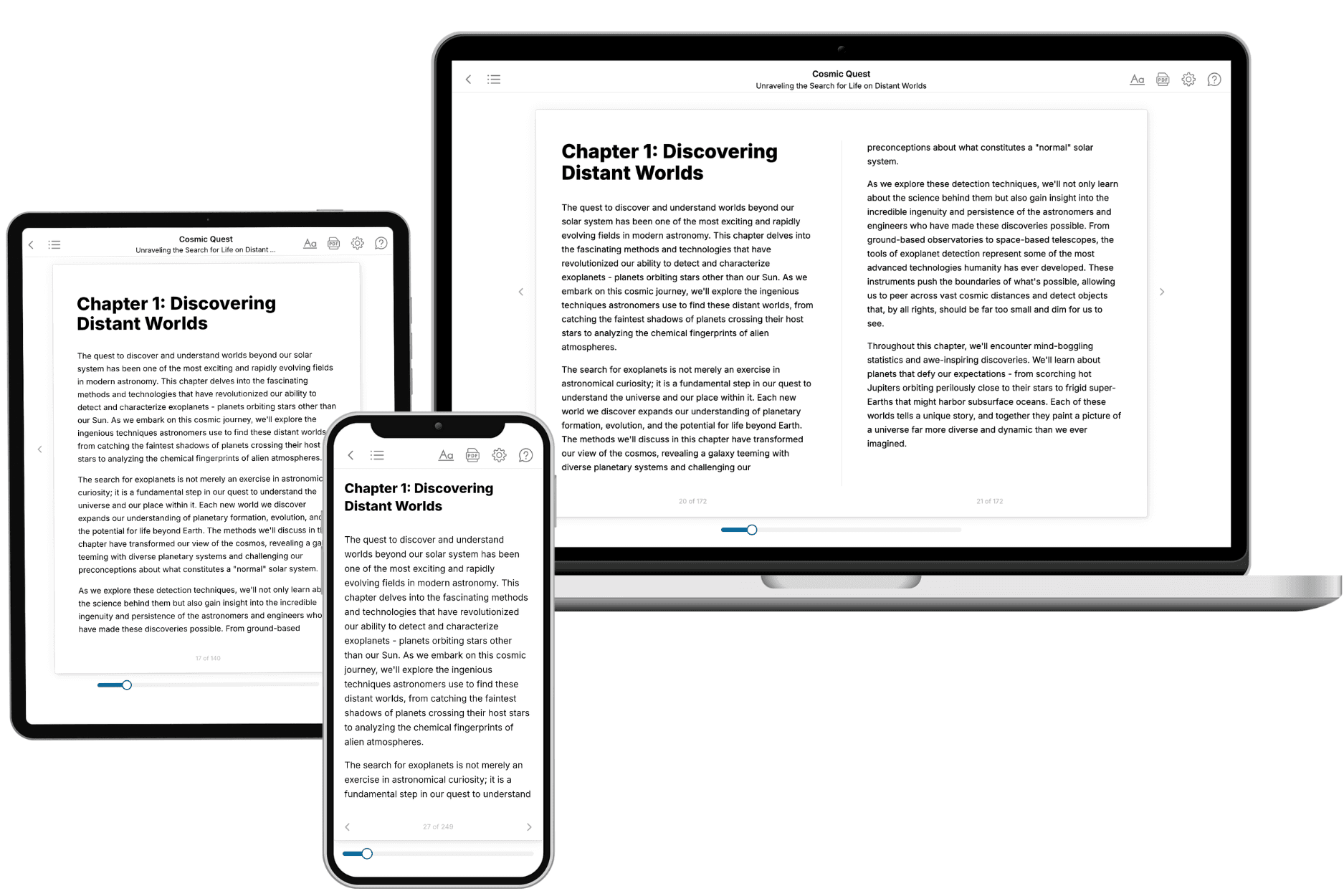
Your book is ready in 10 minutes. Read it online, download as EPUB or PDF, or send to Kindle.


Frequently asked questions
- What is TailoredRead?
TailoredRead creates complete, full-length nonfiction ebooks, written specifically for you. Tell us what you want to learn and why, and TailoredRead writes you a complete ebook on it, with charts, tables, and diagrams throughout. Read it online, on Kindle, or on any e-reader, or download it as a PDF or EPUB. Every book is written fresh the day you order it.
- How is the book tailored to me?
Before anything is written, you answer a few short questions about your goals, your background, and the topics you care about. Your book is then planned around your answers: written at your level, focused on your goals, and covering the topics you chose, instead of the one-size-fits-all book a store sells everyone.
- Will it read like generic AI content?
No. Your book isn't a chat transcript: it's planned chapter by chapter before a single word is written, told in a clear book voice, and explains ideas visually with charts, tables, and diagrams. After writing, every book goes through an editorial pass that polishes chapters so the book reads consistent from start to finish. Judge for yourself: browse thousands of sample books on our Explore Books page.
- How accurate is the content?
Our AI first checks whether your subject needs live research. Niche and fast-moving subjects are researched before writing, and the book plan and chapters are grounded in what it finds. After writing, every book goes through a quality pass that checks its facts and consistency, and researched books list their sources in a Notes section at the back.
- How long is the book?
You choose the length: Comprehensive (250-300 pages), Detailed (150-200 pages), Essential (70-100 pages), or Short (30-50 pages).
- Does the book include visuals?
Yes. Every book includes charts, tables, and diagrams: timelines, checklists, step-by-step guides, decision trees, comparison tables, matrices, and bar charts. A typical book includes dozens of these visual elements.
- Can I read it on Kindle? What formats can I download?
Yes. Every book can be read in our online reader or downloaded as a PDF or EPUB. The EPUB can be opened with Kindle, Apple Books, Kobo, and any e-reader. The Commercial and Author licenses also include an editable Word (DOCX) and Markdown download.
- How much does it cost?
About the price of a regular ebook. The exact price depends on your book's length and complexity, from $2 for the shortest books to $35 for the most comprehensive, and it's shown when you review your book, before you commit to anything. Each book is a one-time purchase, yours to keep, no subscription. Licenses that let you share, teach, or publish your book range from $35.99 to $49.99.
- Can I preview the book before purchasing?
Before you pay, you'll see what your book will cover: the title, a detailed description, the estimated length, and the complete chapter-by-chapter table of contents, so you know what you're getting before you decide. The full text itself is written after you purchase.
- How long does it take to create a book?
About 10 minutes. You can start reading the opening chapters while the rest is still being written.