Electromagnetic Pulse Attacks
Understanding EMP Threats, Vulnerabilities, and Defense Strategies in the Digital Age
What would happen to your critical systems if an electromagnetic pulse suddenly disabled all electronics in your area?
238 pages11 chaptersMar 26, 2026Cyber Security
About this book
This book explores the real threat of electromagnetic pulse attacks—from natural phenomena like solar storms to deliberate human-made weapons—and their potential impact on modern infrastructure. You'll discover how EMP attacks work at a technical level, why our increasingly digital world is vulnerable, and most importantly, what practical steps you can take to protect your systems and data. Whether you're responsible for organizational infrastructure, managing sensitive equipment, or simply concerned about resilience, this guide provides evidence-based defense strategies, from electromagnetic shielding techniques to system redundancy planning. Learn how leading organizations are hardening their defenses and what regulatory standards are emerging to address these threats. This is essential reading for anyone who needs to understand and mitigate one of the most significant yet underappreciated risks to modern technology.
Table of contents
- IntroductionWhy Electromagnetic Pulse Threats Matter Today, What This Book Covers, How to Use This GuideRead below
- Chapter 1: The Physics of Electromagnetic PulsesElectromagnetic Fields and Waves: The Basics, How Electromagnetic Pulses Are Generated, Characteristics and Propagation of EMP Waves
- Chapter 2: Sources of Electromagnetic Pulse ThreatsNatural EMP Sources: Solar Storms and Geomagnetic Events, Human-Made EMP Weapons and Devices, Accidental and Industrial EMP Generation
- Chapter 3: Understanding System VulnerabilitiesWhy Electronics Are Susceptible to EMP, Critical Infrastructure at Risk, Cascade Failures and Systemic Impact
- Chapter 4: Electromagnetic Shielding and Protection MethodsFaraday Cages: Principles and Construction, Materials and Techniques for Effective Shielding, Implementing Shielding in Real-World Environments
- Chapter 5: Hardening Systems Against EMP AttacksSelecting EMP-Resistant Equipment and Components, Designing System Redundancy and Failover Mechanisms, Network Isolation and Air-Gapped Systems
- Chapter 6: Organizational Defense StrategiesConducting EMP Risk Assessments, Developing Comprehensive Defense Plans, Testing and Validating Protection Measures
- Chapter 7: Regulatory Frameworks and Industry StandardsCurrent Regulatory Requirements and Standards, Emerging Standards and Best Practices, Implementing Compliance in Your Organization
- Chapter 8: Integrating EMP Defense with CybersecurityThe Convergence of EMP and Cyber Threats, Building a Holistic Security Strategy, Incident Response Planning for EMP Events
- Chapter 9: Real-World Case Studies and Lessons LearnedHistorical EMP Events and Their Impacts, How Organizations Responded to EMP Threats, Key Lessons and Takeaways
- Chapter 10: Personal and Small-Scale PreparednessProtecting Your Personal Devices and Data, Building Home Resilience Against EMP, Emergency Planning and Response Strategies
- Chapter 11: The Future of EMP Threats and DefenseEmerging EMP Technologies and Threat Evolution, Advancing Defense Technologies, Strategic Outlook and Recommendations
- ConclusionKey Takeaways and Action Items, Your Next Steps Forward
- Glossary of Terms
- Further Reading and Resources
Introduction
On March 13, 1989, a geomagnetic storm triggered by a solar eruption knocked out the entire power grid of the Canadian province of Quebec in under 90 seconds. More than six million people lost electricity for up to nine hours. Transformers failed across the northeastern United States. Satellites experienced navigation errors. The event caused hundreds of millions of dollars in damage, and it happened without any warning, without any human adversary, and without a single line of malicious code.[1] It was simply the sun doing what the sun occasionally does. And yet, the consequences were severe enough to reshape how engineers and policymakers think about grid resilience to this day.
That event was not an isolated curiosity. It was a preview. The same physical phenomenon that caused the Quebec blackout, a sudden surge of electromagnetic energy interacting with conductive infrastructure, is also the underlying principle behind a class of deliberate weapons and accidental industrial hazards that pose a growing risk to modern society. We call the broader category of these events electromagnetic pulse threats, or EMP threats. They range from natural solar activity to purpose-built military devices, and they share one defining characteristic: the ability to damage or destroy electronics without any physical contact, often across large geographic areas.
The reason this matters more today than it did in 1989 is straightforward. Modern infrastructure is dramatically more dependent on electronics than it was three decades ago. Power grids, water treatment systems, financial networks, hospital equipment, transportation control systems, and communications infrastructure all rely on dense layers of digital technology. The more interconnected and digitally dependent a system becomes, the more surface area it presents to electromagnetic threats. In a very real sense, the progress that has made modern life more efficient and capable has also made it more fragile in specific and underappreciated ways.
This book exists because that fragility deserves serious, practical attention. There is a lot of noise around EMP threats, ranging from sensationalized doomsday scenarios on one end to dismissive skepticism on the other. Neither extreme is useful. The goal here is to cut through both and give you a grounded, evidence-based understanding of what EMP threats actually are, how they work, what they can realistically do, and what you can do about them. Whether you manage infrastructure for an organization, work in cybersecurity, or simply want to make informed decisions about your own preparedness, this guide is built to be actionable.
Why Electromagnetic Pulse Threats Matter Today
The digital transformation of the past two decades has been extraordinary. By 2023, there were an estimated 15 billion connected devices worldwide, a number projected to exceed 29 billion by 2030.[2] Every one of those devices contains semiconductor components that are, by their physical nature, susceptible to electromagnetic interference. The miniaturization of electronics, which has driven so much of the performance gains in computing, has also made individual components more sensitive to voltage spikes and induced currents. Older, bulkier electronics were often more tolerant of electromagnetic disturbances simply because their components operated at higher voltages and had more physical margin for error. Modern microchips do not have that luxury.
Critical infrastructure is the area of greatest concern. The electrical grid, in particular, represents a single point of systemic vulnerability. Large high-voltage transformers, which are the backbone of long-distance power transmission, are custom-built, expensive, and have lead times of 12 to 18 months or longer for replacement.[3] A significant EMP event that damaged multiple transformers simultaneously could leave affected regions without power for months, not days. The downstream effects on water treatment, food supply chains, medical care, and communications would compound rapidly. This is not speculation; it is the conclusion of multiple government studies and independent analyses conducted over the past two decades.
Beyond the grid, consider the systems that modern organizations depend on daily. Financial transaction networks, hospital patient monitoring systems, air traffic control, industrial control systems for manufacturing and chemical processing, and emergency communications infrastructure all sit within the potential impact zone of a significant EMP event. Many of these systems were designed with cybersecurity in mind but were not specifically hardened against electromagnetic threats. The two disciplines have historically operated in separate silos, and that gap represents a real vulnerability.
The threat landscape has also evolved on the human-made side. Directed energy weapons capable of generating localized electromagnetic pulses have moved from theoretical military concepts to documented development programs in multiple countries. Non-nuclear EMP devices, sometimes called high-power microwave (HPM) weapons, can be built at scales ranging from vehicle-mounted military systems to smaller, more portable configurations. The barrier to entry for creating low-level EMP-generating devices has also decreased as electronic components have become more accessible. This does not mean that sophisticated EMP weapons are easy to build or widely available, but it does mean that the threat is not limited to nation-state actors with nuclear arsenals.
Natural threats have not diminished either. Solar activity follows an approximately 11-year cycle, and scientists track periods of heightened solar activity called solar maximum with increasing precision. The most powerful geomagnetic storm on record, the Carrington Event of 1859, occurred during a period of intense solar activity and was so powerful that telegraph operators reported receiving electric shocks and telegraph paper catching fire.[4] A Carrington-scale event today would interact with a global electrical infrastructure that did not exist in 1859. The potential consequences are difficult to overstate.
The regulatory and policy environment is beginning to catch up with these realities. In the United States, executive orders and congressional reports have specifically addressed EMP preparedness for critical infrastructure. NATO and allied defense organizations have incorporated EMP hardening into military equipment standards for decades, and those standards are now influencing civilian infrastructure policy. Understanding this regulatory landscape is increasingly important for organizations that operate critical systems, because compliance requirements are evolving and the cost of non-compliance, both financial and operational, is rising.
Perhaps most importantly, EMP threats matter because they are preventable in their impact, if not always in their occurrence. The physics of electromagnetic shielding are well understood. The engineering principles behind surge protection, system redundancy, and hardened equipment design are mature and proven. The gap between the threat and the defense is not primarily a technical one. It is a gap in awareness, prioritization, and implementation. That is the gap this book is designed to help close.
What This Book Covers
This book is organized to take you from foundational understanding through to practical implementation. It does not assume you have a background in electrical engineering or physics, but it does assume you are comfortable with technical concepts and are looking for substance rather than surface-level coverage. Each chapter builds on the previous one, but the structure also allows you to navigate directly to the topics most relevant to your situation.
The first section of the book establishes the technical foundation. Chapter 1 covers the physics of electromagnetic pulses, explaining how electromagnetic fields and waves behave, how pulses are generated, and what characteristics determine their destructive potential. This is not a physics textbook, but understanding the underlying mechanics is essential for making sense of why certain defenses work and others do not. Without this foundation, protection strategies can feel arbitrary. With it, they become logical and intuitive.
Chapter 2 maps the threat landscape by examining the different sources of EMP threats in detail. This includes natural sources like solar coronal mass ejections and geomagnetic storms, human-made sources including nuclear and non-nuclear EMP weapons, and accidental sources such as industrial equipment and lightning-induced surges. Each source type has different characteristics, different geographic reach, and different implications for how you should prioritize your defenses.
Chapter 3 shifts focus to vulnerability assessment, examining why modern electronics are susceptible to EMP effects at a component level, which categories of critical infrastructure face the greatest risk, and how cascade failures can amplify the initial impact of an EMP event. This chapter is particularly relevant for anyone responsible for infrastructure planning or risk management, because it provides a framework for identifying where your systems are most exposed.
The middle section of the book moves into defense strategies. The chapters here cover the full spectrum of protective measures available, organized as follows:
- Chapter 4 covers electromagnetic shielding, including the principles behind Faraday cages, the materials and construction techniques that provide effective protection, and how to implement shielding in practical environments ranging from server rooms to portable equipment cases.
- Chapter 5 addresses system hardening, including how to select EMP-resistant components, how to design redundancy and failover mechanisms, and how network isolation and air-gapped systems can limit the propagation of EMP damage.
- Chapter 6 focuses on organizational defense strategies, walking through how to conduct a structured EMP risk assessment, how to develop a comprehensive defense plan, and how to test and validate your protection measures so you know they will actually work when needed.
Chapter 7 examines the regulatory and standards landscape, covering current requirements from bodies like the Federal Energy Regulatory Commission (FERC), military standards such as MIL-STD-461, and emerging frameworks that are shaping how organizations are expected to address EMP vulnerabilities. This chapter also provides practical guidance on implementing compliance within your organization without creating unnecessary operational friction.
Chapter 8 addresses the intersection of EMP defense and cybersecurity, which is an area that is often treated as two separate disciplines but increasingly needs to be approached as one integrated challenge. A sophisticated adversary might combine an EMP attack with a simultaneous cyber intrusion, exploiting the confusion and system disruption caused by the electromagnetic event. This chapter explores that convergence and provides guidance on building a holistic security strategy that addresses both vectors.
Chapter 9 grounds the discussion in real-world events through case studies of historical EMP incidents and organizational responses. These include the Quebec blackout, documented military EMP testing programs, and industrial incidents that produced EMP-like effects. The lessons extracted from these events are concrete and directly applicable to your own planning.
Chapter 10 addresses personal and small-scale preparedness, recognizing that not every reader is managing enterprise infrastructure. This chapter covers practical steps for protecting personal devices and data, building home resilience, and developing emergency response plans that account for extended power and communications outages.
Finally, Chapter 11 looks ahead at the evolving threat landscape, including emerging EMP technologies, advances in defense capabilities, and the strategic outlook for how EMP threats are likely to develop over the coming decade. The book closes with a conclusion that synthesizes the key takeaways and provides a prioritized action framework you can begin applying immediately.
How to Use This Guide
This guide is designed to serve multiple types of readers, and the most effective way to use it depends on your role and your starting point. Before diving into the chapters, it is worth taking a moment to identify where you are coming from and what you most need to get out of this material. That will help you prioritize your reading and apply the content more effectively.
If you are a cybersecurity professional or IT manager who is new to EMP threats specifically, the recommended path is to read Chapters 1 through 3 carefully to build your technical foundation, then move directly to Chapters 5, 6, and 8. These chapters will connect EMP defense to the security frameworks and risk management processes you already work with. Chapter 7 on regulatory standards will also be directly relevant if your organization operates in a regulated sector.
If you are an infrastructure or facilities manager responsible for physical systems, Chapter 3 on vulnerability assessment and Chapter 4 on shielding will be your most immediately practical resources. Chapter 6 on organizational defense planning provides a structured process you can adapt to your specific environment. The case studies in Chapter 9 will give you concrete reference points for understanding what real-world EMP impacts look like and how organizations have responded.
If you are an executive or decision-maker who needs to understand EMP risks at a strategic level without necessarily diving into technical details, the introduction and Chapter 2 will give you a solid threat overview. Chapter 6 on organizational defense and Chapter 7 on regulatory compliance are the most directly relevant to your responsibilities. Chapter 11 on the future outlook will help you frame EMP preparedness within your longer-term strategic planning.
If you are an individual reader focused on personal preparedness, you can read the book sequentially or jump directly to Chapter 10, which is written specifically for personal and small-scale contexts. Chapters 1 and 2 will give you the background to understand why the recommendations in Chapter 10 are grounded in real physics rather than speculation. The glossary at the back of the book is a useful reference whenever you encounter an unfamiliar term.
Regardless of your background, there are a few practices that will help you get the most out of this material. First, treat the examples and case studies as more than illustrations. They are the places where abstract concepts become concrete, and they often contain the most transferable insights. Second, pay attention to the footnotes. The claims in this book are grounded in documented research, government reports, and engineering standards, and the footnotes point you toward primary sources you can explore further. Third, use the action items and frameworks as starting points, not finished products. Every organization and individual situation is different, and the value of a framework is in how you adapt it to your specific context.
A note on scope: this book focuses on understanding EMP threats and implementing defensive measures. It does not cover the design or construction of EMP-generating devices, and it does not address offensive applications. The goal throughout is protection, resilience, and informed decision-making.
One more thing worth saying at the outset: EMP preparedness does not require a worst-case-scenario mindset to be worthwhile. The same measures that protect against a large-scale EMP event also protect against more common electromagnetic hazards like lightning strikes, power surges, and industrial interference. Many of the hardening techniques covered in this book have direct, near-term benefits that justify the investment regardless of whether a major EMP event ever occurs. Think of EMP preparedness less as preparing for a catastrophe and more as building the kind of robust, resilient infrastructure that performs reliably under a wide range of conditions. That framing tends to make the investment easier to justify and the implementation easier to sustain over time.
The threat is real. The defenses are available. The knowledge to connect the two is what this book provides. Let's get started.
Notes
Introduction
- 1. L. Bolduc, "GIC observations and studies in the Hydro-Québec power system," Journal of Atmospheric and Solar-Terrestrial Physics, 2002
- 2. Statista Research Department, Number of Internet of Things (IoT) connected devices worldwide from 2019 to 2030, Statista, 2023
- 3. United States Department of Energy, Large Power Transformers and the U.S. Electric Grid, Office of Electricity Delivery and Energy Reliability, 2014
- 4. B. T. Tsurutani and others, "The extreme magnetic storm of 1-2 September 1859," Journal of Geophysical Research: Space Physics, 108(A7), 2003
This is the end of the free sample. The full book has 11 chapters.
Want this book written for you?
Tell us your goals and background, and get your own version of this book, tailored by AI to you.


Benefits of AI-tailored books
- Read one book, not ten:
- all the Cyber Security knowledge you need, gathered into a single book.
- Save days of learning:
- tell us your goals, choose your topics, and the whole book is built around them.
- Learn effortlessly:
- Cyber Security book written for your specific background and expertise.
- Understand at a glance:
- includes charts, tables, timelines, checklists, decision trees, and more.
- Stay current:
- written the day you order it, not years ago.
- Trust what you read:
- every book is checked for accuracy, with real research when your subject needs it.
Create your unique book in 3 steps
- 1. Select your focus
Select the focus of your Cyber Security book and share your background
- 2. Personalize your book
Specify your goals and choose sub-topics to include
- 3. Get your tailored book
Your book is ready in 10 minutes. Read it online, download as EPUB or PDF, or send to Kindle.


Frequently asked questions
- What is TailoredRead?
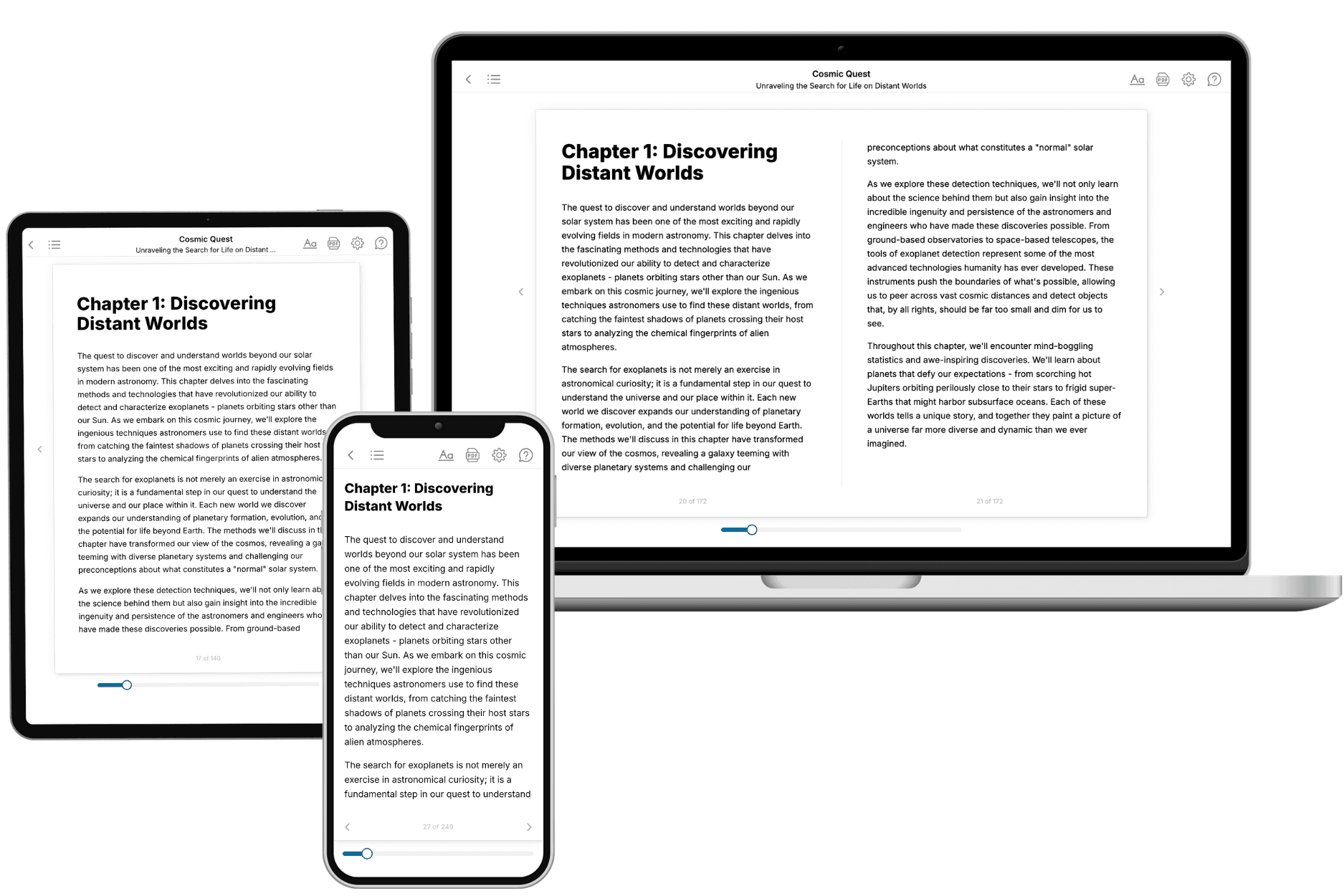
TailoredRead creates complete, full-length nonfiction ebooks, written specifically for you. Tell us what you want to learn and why, and TailoredRead writes you a complete ebook on it, with charts, tables, and diagrams throughout. Read it online, on Kindle, or on any e-reader, or download it as a PDF or EPUB. Every book is written fresh the day you order it.
- How is the book tailored to me?
Before anything is written, you answer a few short questions about your goals, your background, and the topics you care about. Your book is then planned around your answers: written at your level, focused on your goals, and covering the topics you chose, instead of the one-size-fits-all book a store sells everyone.
- Will it read like generic AI content?
No. Your book isn't a chat transcript: it's planned chapter by chapter before a single word is written, told in a clear book voice, and explains ideas visually with charts, tables, and diagrams. After writing, every book goes through an editorial pass that polishes chapters so the book reads consistent from start to finish. Judge for yourself: browse thousands of sample books on our Explore Books page.
- How accurate is the content?
Our AI first checks whether your subject needs live research. Niche and fast-moving subjects are researched before writing, and the book plan and chapters are grounded in what it finds. After writing, every book goes through a quality pass that checks its facts and consistency, and researched books list their sources in a Notes section at the back.
- How long is the book?
You choose the length: Comprehensive (250-300 pages), Detailed (150-200 pages), Essential (70-100 pages), or Short (30-50 pages).
- Does the book include visuals?
Yes. Every book includes charts, tables, and diagrams: timelines, checklists, step-by-step guides, decision trees, comparison tables, matrices, and bar charts. A typical book includes dozens of these visual elements.
- Can I read it on Kindle? What formats can I download?
Yes. Every book can be read in our online reader or downloaded as a PDF or EPUB. The EPUB can be opened with Kindle, Apple Books, Kobo, and any e-reader. The Commercial and Author licenses also include an editable Word (DOCX) and Markdown download.
- How much does it cost?
About the price of a regular ebook. The exact price depends on your book's length and complexity, from $2 for the shortest books to $35 for the most comprehensive, and it's shown when you review your book, before you commit to anything. Each book is a one-time purchase, yours to keep, no subscription. Licenses that let you share, teach, or publish your book range from $35.99 to $49.99.
- Can I preview the book before purchasing?
Before you pay, you'll see what your book will cover: the title, a detailed description, the estimated length, and the complete chapter-by-chapter table of contents, so you know what you're getting before you decide. The full text itself is written after you purchase.
- How long does it take to create a book?
About 10 minutes. You can start reading the opening chapters while the rest is still being written.