Electron Paramagnetic Resonance Essentials
A Practical Guide to Understanding and Applying EPR in Modern Chemistry
Navigate the world of Electron Paramagnetic Resonance with confidence and clarity.
238 pages11 chaptersNov 24, 2025Spectroscopy
About this book
This guide takes you from fundamental principles through advanced applications, providing the knowledge you need to master EPR spectroscopy in your laboratory. You'll discover how EPR detects unpaired electrons and reveals molecular secrets that other techniques cannot access. Learn the physics behind resonance conditions, explore practical instrument operation and optimization, and develop skills in spectrum interpretation and data analysis. Whether you're designing new experiments, troubleshooting unexpected results, or exploring specialized applications, this book equips you with both theoretical understanding and hands-on strategies. Real-world examples and systematic approaches help you avoid common pitfalls and maximize the value of your EPR measurements. By the end, you'll understand not just how EPR works, but how to use it effectively to advance your research and solve complex chemical problems.
Table of contents
- IntroductionWhy EPR Matters in Modern Chemistry, What You'll Learn in This Book, How to Use This GuideRead below
- Chapter 1: Fundamentals of Electron Spin and MagnetismElectron Spin: The Foundation, Magnetic Moments and Spin States, The Zeeman Effect and Energy Levels, Identifying Unpaired Electrons in Molecules
- Chapter 2: Resonance Conditions and Microwave InteractionsThe Resonance Principle, Microwave Absorption and Energy Transitions, Understanding the g-Factor, Calculating Resonance Frequency
- Chapter 3: EPR Instrumentation and SetupKey Instrument Components, The Microwave Bridge and Detection System, Resonator Cavities and Sample Holders, Magnetic Field Modulation and Lock-In Detection
- Chapter 4: Sample Preparation and Experimental DesignSample Requirements and Considerations, Proper Sample Handling and Storage, Selecting Experimental Parameters, Temperature Control and Cryogenic Techniques
- Chapter 5: Spectrum Interpretation and AnalysisReading EPR Spectra: Key Features, Line Shapes and Linewidths, Hyperfine Coupling and Splitting Patterns, Quantitative Analysis and Spin Concentration
- Chapter 6: Calibration, Optimization, and Quality ControlCalibrating Your EPR Instrument, Optimizing Experimental Parameters, Quality Assurance and Validation, Maintaining Performance Standards
- Chapter 7: Troubleshooting Common ChallengesAddressing Weak or Missing Signals, Identifying and Eliminating Artifacts and Noise, Baseline Issues and Corrections, Diagnosing Instrumental Problems
- Chapter 8: Advanced Techniques: Pulse EPR and ENDORIntroduction to Pulse EPR, Spin Echo and Relaxation Measurements, ENDOR: Electron-Nuclear Double Resonance, Advanced Applications and Combinations
- Chapter 9: Applications in Materials Science and CatalysisCharacterizing Defects and Impurities, Studying Catalytic Intermediates, Semiconductors, Oxides, and Polymers, Case Studies in Materials Analysis
- Chapter 10: Biochemical and Environmental ApplicationsStudying Proteins and Metalloproteins, Detecting Free Radicals and Reactive Species, Environmental and Soil Analysis, Biomedical and Pharmaceutical Applications
- Chapter 11: Data Processing and Software ToolsData Acquisition and File Formats, Processing Techniques and Corrections, Common Software Platforms and Tools, Visualization and Reporting Results
- ConclusionKey Takeaways and Next Steps, Future Directions in EPR Research
- Glossary of Terms
- Further Reading and Resources
Introduction
Electron Paramagnetic Resonance spectroscopy stands as one of the most powerful yet underutilized analytical techniques in modern chemistry. While methods like NMR and mass spectrometry have become routine in most laboratories, EPR remains a specialized tool that offers unique insights unavailable through any other technique. This specialization creates both an opportunity and a challenge. The opportunity lies in EPR's ability to detect and characterize unpaired electrons with extraordinary sensitivity, revealing information about molecular structure, dynamics, and reactivity that would otherwise remain hidden. The challenge is that many chemists lack the practical knowledge needed to harness this power effectively in their research.
The gap between EPR's potential and its practical application in laboratories worldwide stems from several factors. Traditional EPR education often emphasizes theoretical physics at the expense of hands-on guidance, leaving researchers uncertain about experimental design and troubleshooting. Instrument manuals provide technical specifications but rarely explain the reasoning behind parameter choices or how to adapt methods to new systems. Research papers showcase polished results without revealing the iterative process of optimization and problem-solving that produced them. This book bridges that gap by combining fundamental principles with actionable strategies you can implement immediately in your laboratory work.
Whether you're investigating radical intermediates in organic reactions, characterizing defects in semiconductor materials, studying metalloproteins in biological systems, or exploring catalytic mechanisms, EPR provides information that complements and extends what other techniques can tell you. Understanding how to design EPR experiments properly, interpret spectra accurately, and troubleshoot common challenges will expand your analytical capabilities and open new research directions. This introduction sets the stage for your journey from understanding basic concepts to confidently applying EPR spectroscopy to solve real chemical problems.
Why EPR Matters in Modern Chemistry
EPR spectroscopy occupies a unique position in the analytical toolkit because it detects something fundamentally different from most other techniques: unpaired electrons. While NMR observes nuclear spins and UV-Vis spectroscopy measures electronic transitions, EPR specifically targets molecules and materials with unpaired electron spins. This specificity makes EPR extraordinarily sensitive to paramagnetic species, including free radicals, transition metal complexes, defects in solid materials, and triplet states. In many cases, EPR can detect these species at concentrations as low as nanomolar levels, providing information when other methods remain silent.
The information content of EPR spectra extends far beyond simple detection. The g-factor reveals details about the electronic environment and orbital occupancy of unpaired electrons. Hyperfine coupling patterns map out the distribution of spin density across molecular frameworks, showing which atoms interact with the unpaired electron and how strongly. Linewidths and relaxation times provide insights into molecular dynamics, including rotation rates, exchange processes, and interactions with surrounding molecules. Temperature-dependent measurements reveal activation energies and thermodynamic parameters. This rich information content makes EPR invaluable for mechanistic studies where understanding electronic structure and reactivity is essential.
Consider the practical impact across different research areas. In catalysis research, EPR identifies paramagnetic intermediates that represent key steps in reaction mechanisms, helping researchers understand how catalysts work and how to improve them. A study of copper-based oxidation catalysts might reveal Cu(II) species with distinct g-factors corresponding to different coordination geometries, showing how the catalyst structure changes during the reaction cycle[1]. In materials science, EPR characterizes defects, dopants, and charge carriers that control electronic and optical properties. Silicon wafer manufacturers use EPR to detect and quantify dangling bonds and impurities that affect semiconductor performance, with detection limits far below what other techniques can achieve.
Biological applications demonstrate EPR's versatility in complex systems. Metalloproteins containing iron, copper, manganese, or other transition metals are often EPR-active in their functional states. Researchers studying cytochrome P450 enzymes use EPR to observe how substrate binding changes the iron coordination environment, revealing conformational changes that activate the enzyme for catalysis. Spin labeling techniques extend EPR to diamagnetic proteins by attaching stable nitroxide radicals at specific sites, then measuring distances between labels through dipolar coupling. This approach has revealed protein conformational changes, binding interactions, and membrane protein topology in native-like environments where crystallization is impossible.
Environmental chemistry benefits from EPR's ability to detect and characterize reactive oxygen species, organic radicals in atmospheric particles, and transition metal complexes in natural waters and soils. Researchers investigating soil organic matter use EPR to quantify stable free radicals associated with humic substances, providing insights into carbon cycling and pollutant binding. The technique's sensitivity to paramagnetic species makes it ideal for studying oxidative stress, photochemical processes, and redox reactions in environmental systems. Unlike many analytical methods that require extensive sample preparation, EPR can often examine environmental samples with minimal processing, preserving the chemical states present in the original system.
The pharmaceutical industry employs EPR for quality control, formulation stability studies, and drug mechanism investigations. Solid dosage forms can develop free radicals during manufacturing or storage, potentially affecting drug stability and efficacy. EPR monitors these radicals quantitatively, helping formulators optimize processing conditions and packaging. In drug discovery, EPR characterizes how candidate molecules interact with target enzymes, particularly those containing metal centers. Researchers developing antibiotics that target bacterial metalloenzymes use EPR to verify binding modes and measure binding affinities, information that guides medicinal chemistry optimization.
What makes EPR particularly valuable is not just what it measures, but what it reveals that other techniques cannot. When you observe a complex hyperfine splitting pattern, you're seeing a direct map of spin density distribution that would require sophisticated quantum chemical calculations to predict from structure alone. When you measure g-factor anisotropy, you're probing orbital contributions to the magnetic moment that reflect the detailed electronic structure around the paramagnetic center. When you detect a weak signal from a transient radical intermediate, you're capturing evidence of a reactive species that exists only briefly during a reaction. This unique information makes EPR not just another analytical technique, but often the only technique that can answer specific research questions about paramagnetic systems.
What You'll Learn in This Book
This book takes you on a structured journey from fundamental concepts through advanced applications, building your understanding systematically while maintaining focus on practical implementation. The early chapters establish the theoretical foundation you need to understand how EPR works and why spectra look the way they do. You'll learn about electron spin, magnetic moments, and the quantum mechanical basis for resonance conditions. Rather than drowning you in mathematical derivations, these chapters emphasize physical intuition and conceptual understanding, providing just enough theory to make informed experimental decisions without getting lost in formalism.
The middle chapters shift focus to practical laboratory work, covering instrumentation, experimental design, and spectrum interpretation. You'll discover how EPR spectrometers work, from the microwave bridge that generates and detects signals to the resonator cavity that holds your sample. More importantly, you'll learn how to set up experiments properly, choosing appropriate parameters for different sample types and research questions. These chapters include specific guidance on:
- Selecting microwave power to avoid saturation while maximizing signal-to-noise ratio
- Optimizing modulation amplitude to enhance resolution without distorting lineshapes
- Choosing appropriate time constants and sweep rates for your signal characteristics
- Preparing samples in proper tubes with correct filling heights and concentrations
- Implementing temperature control for variable-temperature studies
- Calibrating g-factors using standard reference materials
Spectrum interpretation receives detailed attention because extracting meaningful information from EPR data requires systematic analysis skills. You'll learn to identify key spectral features including g-factors, hyperfine coupling constants, and linewidths, then understand what these parameters reveal about molecular structure and dynamics. The book provides frameworks for analyzing different types of spectra, from simple single-line signals to complex multi-component systems with overlapping features. Worked examples demonstrate the interpretation process step-by-step, showing how to move from raw spectral data to chemical conclusions. You'll also learn quantitative analysis methods for determining spin concentrations, essential for kinetic studies and comparing samples.
Troubleshooting receives dedicated coverage because experimental challenges are inevitable in EPR work. You'll learn to diagnose and resolve common problems including weak signals, baseline distortions, unexpected artifacts, and instrumental issues. The troubleshooting chapter provides decision trees and systematic approaches for identifying problem sources, whether they originate from sample preparation, instrumental settings, or environmental factors. This practical guidance helps you avoid frustration and wasted time when experiments don't produce expected results. Understanding what can go wrong and how to fix it transforms you from someone who follows protocols to someone who can adapt methods to new situations.
Advanced techniques including pulse EPR and ENDOR (Electron-Nuclear Double Resonance) are introduced with emphasis on when and why you might use them. While continuous-wave EPR remains the workhorse technique for most applications, pulse methods provide additional capabilities for measuring relaxation times, resolving overlapping signals, and determining distances between paramagnetic centers. The book explains these techniques conceptually, helping you understand their advantages and limitations so you can decide whether they're appropriate for your research questions. You'll learn what types of information pulse EPR provides that continuous-wave methods cannot, and what experimental requirements these techniques impose.
Application-focused chapters demonstrate how EPR addresses real research problems across different fields. Rather than simply listing applications, these chapters walk through case studies showing experimental design, data collection, interpretation, and how EPR results integrate with information from complementary techniques. You'll see how materials scientists use EPR to characterize defects in semiconductors, how biochemists study metalloprotein active sites, how environmental chemists track radical species in atmospheric particles, and how catalysis researchers identify reaction intermediates. These examples provide templates you can adapt to your own research, showing not just what's possible but how to actually do it.
Throughout the book, you'll find practical tools and resources including:
- Parameter selection guidelines for different sample types and research goals
- Checklists for experimental setup and quality control
- Troubleshooting flowcharts for diagnosing common problems
- Interpretation frameworks for analyzing different spectral features
- Software recommendations for data processing and simulation
- References to key literature for deeper exploration of specific topics
By the end of this book, you'll possess both conceptual understanding and practical skills. You'll know not just how EPR works, but how to use it effectively to answer research questions. You'll be able to design experiments that generate high-quality data, interpret spectra to extract meaningful chemical information, troubleshoot problems when they arise, and integrate EPR results with other analytical techniques. Most importantly, you'll understand when EPR is the right tool for a particular problem and when other methods might be more appropriate. This combination of knowledge and judgment enables you to use EPR confidently and productively in your research.
How to Use This Guide
This book is designed to serve multiple purposes depending on your current needs and experience level. If you're new to EPR or need to refresh fundamental concepts, reading sequentially from beginning to end provides a structured learning path. Each chapter builds on previous material, developing your understanding progressively from basic principles through advanced applications. The early chapters establish theoretical foundations, middle chapters cover practical implementation, and later chapters explore specialized techniques and applications. This sequential approach ensures you have the background needed to understand each new concept as it's introduced.
For experienced practitioners seeking guidance on specific topics, the book functions as a reference resource you can consult selectively. The detailed table of contents and chapter organization make it easy to locate information about particular techniques, applications, or problems. Need to optimize parameters for a new sample type? Jump to the experimental design chapter. Encountering unexpected artifacts in your spectra? Go directly to the troubleshooting chapter. Want to understand whether pulse EPR would benefit your research? Read the advanced techniques chapter. Each chapter is written to be largely self-contained, with cross-references directing you to related material in other sections when deeper background would be helpful.
The book's structure supports different reading strategies:
- Comprehensive learning: Read chapters 1-7 sequentially to build complete understanding from fundamentals through routine applications
- Quick start: Read chapters 3-5 to get started with practical EPR work, then return to chapters 1-2 for theoretical depth as needed
- Problem-solving: Use chapter 7 (troubleshooting) as your first stop when experiments aren't working, then consult relevant sections in other chapters for deeper understanding
- Application-focused: Start with chapters 9-10 to see how EPR addresses problems in your field, then work backward through earlier chapters to understand the techniques being applied
- Advanced techniques: If you're already comfortable with continuous-wave EPR, jump to chapter 8 to explore pulse methods and ENDOR
Pay special attention to the examples and case studies throughout the book. These aren't just illustrations of concepts—they're templates you can adapt to your own research. When you encounter an example similar to your work, study it carefully. Note the experimental parameters chosen, the reasoning behind those choices, how the data was analyzed, and what conclusions were drawn. Consider how you might modify the approach for your specific system. Many examples include explicit parameter values, sample preparation details, and interpretation steps precisely so you can use them as starting points for your own experiments.
The book uses several conventions to help you navigate and extract information efficiently. Key terms appear in bold when first introduced or when particularly important. Emphasis highlights subtle but important points that are easy to overlook. Technical terms and parameters appear in code formatting to distinguish them from surrounding text. Blockquotes set off important principles, warnings, or summary statements:
These formatting choices help you quickly identify different types of information and locate key points when scanning for specific content.Always calibrate your g-factor measurements using a standard reference sample before making quantitative comparisons between different samples or experiments.
Footnotes provide citations to primary literature, additional resources, and technical details that would interrupt the main text flow. When you see a footnote reference, the citation information appears in the footnote itself, allowing you to locate the source without consulting a separate bibliography. These references serve multiple purposes: they document claims made in the text, point you toward deeper treatments of specific topics, and identify key papers that have shaped current understanding. If a particular topic interests you, the footnoted references provide excellent starting points for further exploration.
As you work through the book, consider keeping a laboratory notebook or digital document where you record insights, questions, and ideas for applying concepts to your research. When you encounter a troubleshooting tip, note whether you've experienced that problem and how you might prevent it in future experiments. When you read about a new technique, jot down research questions where it might be useful. When you study an example, sketch out how you'd adapt the approach to your system. This active engagement transforms passive reading into active learning, helping you internalize concepts and develop the judgment needed for independent EPR work.
Don't expect to master everything on first reading. EPR spectroscopy encompasses substantial breadth and depth, and developing true expertise requires both study and hands-on experience. Use this book as a companion to your laboratory work, returning to relevant sections as you encounter new situations and challenges. The first time you read about parameter optimization, you'll gain general understanding. The second time, when you're actually optimizing parameters for a difficult sample, the material will resonate differently and you'll notice details you missed initially. The third time, when troubleshooting an unexpected problem, you'll see connections to other concepts that weren't apparent before. This iterative engagement deepens understanding progressively.
Finally, remember that this book aims to make you an effective EPR practitioner, not just a knowledgeable reader. The ultimate test of understanding is whether you can design good experiments, collect quality data, interpret results correctly, and solve problems independently. As you read, continually ask yourself: "How would I apply this to my research? What would I do differently in my next experiment based on this information? How does this connect to challenges I've encountered?" This application-oriented mindset ensures that knowledge translates into practical capability, which is the book's fundamental goal.
Notes
Introduction
- 1. R. A. Sheldon and others, Green Chemistry and Catalysis, Wiley-VCH, 2007
This is the end of the free sample. The full book has 11 chapters.
Want this book written for you?
Tell us your goals and background, and get your own version of this book, tailored by AI to you.


Benefits of AI-tailored books
- Read one book, not ten:
- all the Spectroscopy knowledge you need, gathered into a single book.
- Save days of learning:
- tell us your goals, choose your topics, and the whole book is built around them.
- Learn effortlessly:
- Spectroscopy book written for your specific background and expertise.
- Understand at a glance:
- includes charts, tables, timelines, checklists, decision trees, and more.
- Stay current:
- written the day you order it, not years ago.
- Trust what you read:
- every book is checked for accuracy, with real research when your subject needs it.
Create your unique book in 3 steps
- 1. Select your focus
Select the focus of your Spectroscopy book and share your background
- 2. Personalize your book
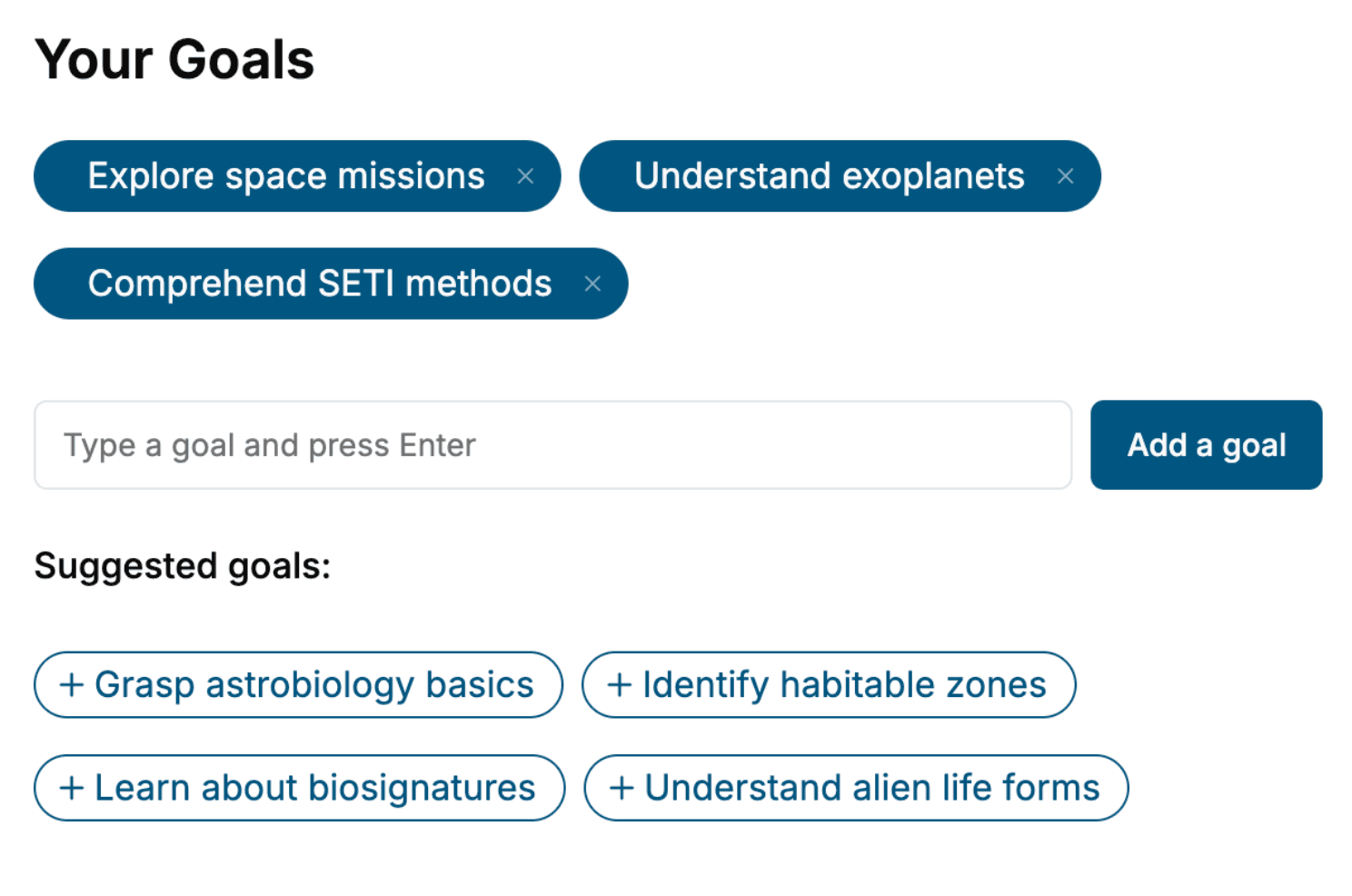
Specify your goals and choose sub-topics to include
- 3. Get your tailored book
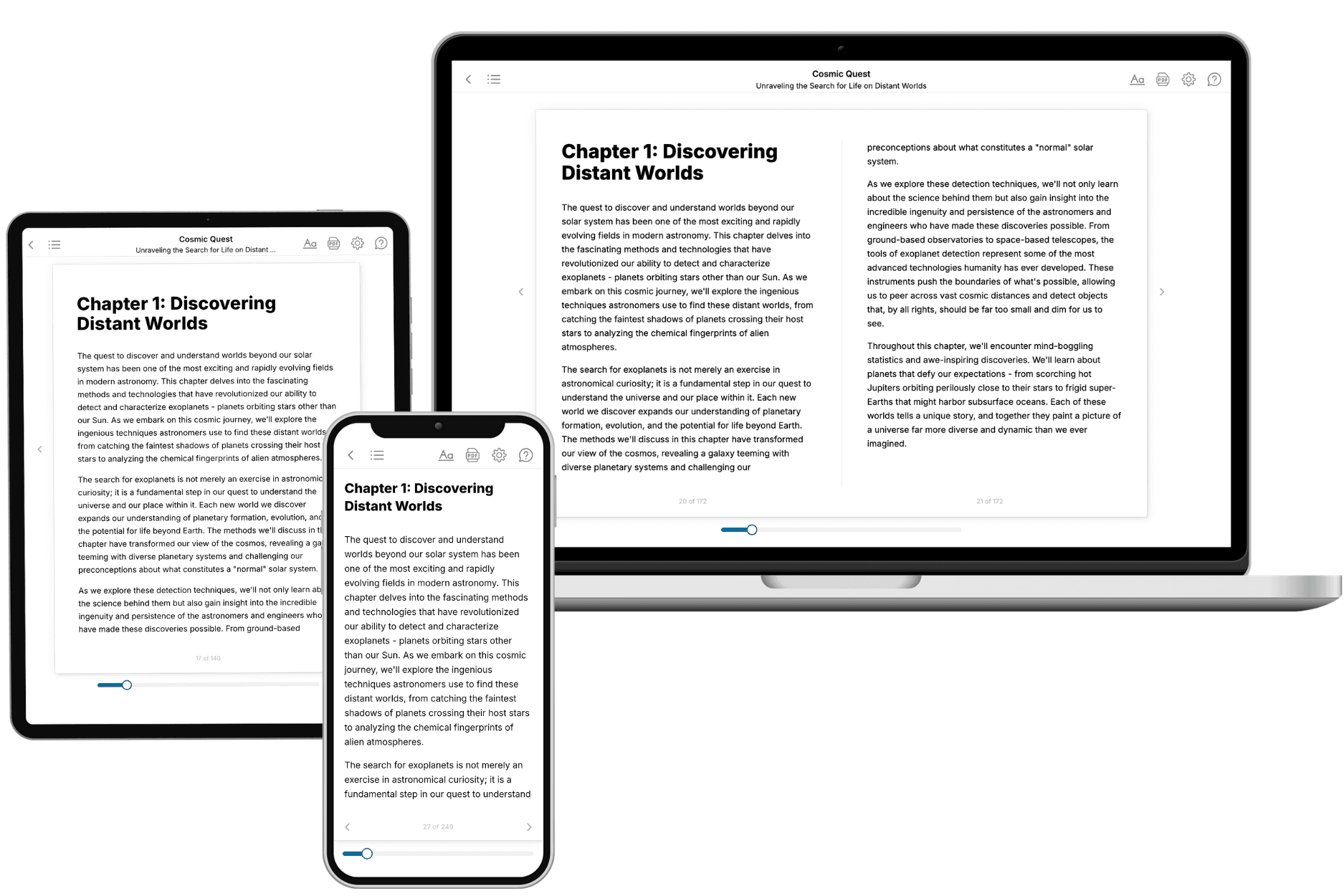
Your book is ready in 10 minutes. Read it online, download as EPUB or PDF, or send to Kindle.

Frequently asked questions
- What is TailoredRead?
TailoredRead creates complete, full-length nonfiction ebooks, written specifically for you. Tell us what you want to learn and why, and TailoredRead writes you a complete ebook on it, with charts, tables, and diagrams throughout. Read it online, on Kindle, or on any e-reader, or download it as a PDF or EPUB. Every book is written fresh the day you order it.
- How is the book tailored to me?
Before anything is written, you answer a few short questions about your goals, your background, and the topics you care about. Your book is then planned around your answers: written at your level, focused on your goals, and covering the topics you chose, instead of the one-size-fits-all book a store sells everyone.
- Will it read like generic AI content?
No. Your book isn't a chat transcript: it's planned chapter by chapter before a single word is written, told in a clear book voice, and explains ideas visually with charts, tables, and diagrams. After writing, every book goes through an editorial pass that polishes chapters so the book reads consistent from start to finish. Judge for yourself: browse thousands of sample books on our Explore Books page.
- How accurate is the content?
Our AI first checks whether your subject needs live research. Niche and fast-moving subjects are researched before writing, and the book plan and chapters are grounded in what it finds. After writing, every book goes through a quality pass that checks its facts and consistency, and researched books list their sources in a Notes section at the back.
- How long is the book?
You choose the length: Comprehensive (250-300 pages), Detailed (150-200 pages), Essential (70-100 pages), or Short (30-50 pages).
- Does the book include visuals?
Yes. Every book includes charts, tables, and diagrams: timelines, checklists, step-by-step guides, decision trees, comparison tables, matrices, and bar charts. A typical book includes dozens of these visual elements.
- Can I read it on Kindle? What formats can I download?
Yes. Every book can be read in our online reader or downloaded as a PDF or EPUB. The EPUB can be opened with Kindle, Apple Books, Kobo, and any e-reader. The Commercial and Author licenses also include an editable Word (DOCX) and Markdown download.
- How much does it cost?
About the price of a regular ebook. The exact price depends on your book's length and complexity, from $2 for the shortest books to $35 for the most comprehensive, and it's shown when you review your book, before you commit to anything. Each book is a one-time purchase, yours to keep, no subscription. Licenses that let you share, teach, or publish your book range from $35.99 to $49.99.
- Can I preview the book before purchasing?
Before you pay, you'll see what your book will cover: the title, a detailed description, the estimated length, and the complete chapter-by-chapter table of contents, so you know what you're getting before you decide. The full text itself is written after you purchase.
- How long does it take to create a book?
About 10 minutes. You can start reading the opening chapters while the rest is still being written.