Elliptic Curves and Digital Signatures
Mastering ECDSA and One-Way Functions in Modern Cryptography
Discover how elliptic curve cryptography secures the digital world.
238 pages11 chaptersApr 19, 2026Cryptography
About this book
This book takes you from foundational concepts to practical mastery of ECDSA and one-way functions, the mathematical engines behind modern digital signatures. You'll understand why elliptic curves are more efficient than traditional cryptographic methods, how one-way functions create mathematical asymmetry that protects your data, and exactly how ECDSA authenticates digital messages. Through clear explanations, real-world examples, and algorithmic insights, you'll gain the knowledge to implement, evaluate, and deploy elliptic curve cryptography in your projects. Whether you're building secure systems, working with blockchain technology, or simply want to understand the mathematics protecting your digital life, this book provides the comprehensive foundation you need to think critically about cryptographic security.
Table of contents
- IntroductionWhy Cryptography Matters in the Digital Age, The Evolution of Digital Signatures, What You'll Learn in This Book, How to Use This BookRead below
- Chapter 1: Foundations of One-Way FunctionsDefining One-Way Functions, Essential Properties and Characteristics, Real-World Examples of One-Way Functions, Understanding Computational Hardness
- Chapter 2: Mathematical Foundations of Elliptic CurvesWhat Are Elliptic Curves?, Curve Equations and Parameters, Points on Curves and Group Structure, Finite Fields and Modular Arithmetic
- Chapter 3: Point Operations and Elliptic Curve ArithmeticPoint Addition on Elliptic Curves, Point Doubling and Scalar Multiplication, Efficient Computation Algorithms, Geometric Intuition Behind Operations
- Chapter 4: The Discrete Logarithm ProblemDefining the Discrete Logarithm Problem, The Elliptic Curve Discrete Logarithm Problem, Computational Complexity and Security, Known Attacks and Resistance
- Chapter 5: Introduction to Digital SignaturesCore Concepts of Digital Signatures, Requirements for Secure Signatures, Signatures Versus Encryption, Real-World Applications of Digital Signatures
- Chapter 6: ECDSA: The Algorithm ExplainedOverview of ECDSA, Key Generation Process, Signature Generation Step-by-Step, Signature Verification Process
- Chapter 7: Hash Functions and Message DigestsHash Function Fundamentals, Properties of Cryptographic Hash Functions, Common Hash Algorithms in ECDSA, Security Considerations and Best Practices
- Chapter 8: Implementation Considerations and SecurityRandom Number Generation and Nonce Selection, Choosing Secure Curve Parameters, Protecting Against Side-Channel Attacks, Common Implementation Pitfalls
- Chapter 9: ECDSA in Practice: Real-World ApplicationsECDSA in Blockchain and Cryptocurrency, TLS/SSL Certificates and Web Security, Code Signing and Software Authentication, IoT and Embedded System Applications
- Chapter 10: Comparing Elliptic Curve Cryptography with Other MethodsECDSA Versus RSA: Strengths and Trade-offs, Key Size and Computational Efficiency, Performance Analysis and Benchmarks, Choosing the Right Algorithm for Your Needs
- Chapter 11: Advanced Topics and Future DirectionsPost-Quantum Cryptography Considerations, Curve Variants and Emerging Standards, Deterministic ECDSA and RFC 6979, Future Research Directions
- ConclusionKey Takeaways, Your Next Steps
- Glossary
- Further Reading and Resources
Introduction
Every time you send a message, make a payment online, or push code to a repository, something invisible is working hard to protect you. That something is cryptography, and at the heart of modern cryptographic security sits a surprisingly elegant piece of mathematics: the elliptic curve. This book is about understanding that mathematics deeply enough to use it confidently, whether you're building secure systems, auditing existing ones, or simply trying to make sense of how digital trust actually works.
The Elliptic Curve Digital Signature Algorithm, known as ECDSA, is one of the most widely deployed cryptographic tools in existence today. It secures Bitcoin transactions, authenticates TLS certificates that protect web traffic, signs software packages before they reach your machine, and underpins the identity systems of billions of connected devices. Despite its ubiquity, ECDSA is often treated as a black box, something developers use through a library without fully understanding what's happening underneath. This book opens that box.
Understanding ECDSA means understanding several interconnected ideas: one-way functions, the algebraic structure of elliptic curves, the hardness of the discrete logarithm problem, and the mechanics of signature generation and verification. None of these topics require a PhD in mathematics, but they do reward careful, patient study. This book is designed to give you exactly that kind of structured, progressive understanding, building each concept on the last until the full picture comes into focus.
This introduction sets the stage. It explains why cryptography matters more than ever in today's digital environment, traces the historical path that led from handwritten signatures to ECDSA, outlines what you'll learn across the chapters ahead, and offers practical guidance on how to get the most from this book. By the time you finish this introduction, you'll have a clear map of the journey ahead and a strong sense of why it's worth taking.
Why Cryptography Matters in the Digital Age
The digital world runs on trust. When your browser connects to your bank's website, it needs to trust that the server it's talking to is actually your bank and not an impersonator. When a software update arrives on your phone, your operating system needs to trust that the update came from the legitimate developer and hasn't been tampered with. When a Bitcoin transaction is broadcast to the network, every node needs to trust that the person spending the funds actually owns them. In every one of these cases, cryptography is the mechanism that makes trust possible without requiring the parties to know each other personally.
The scale of this problem is staggering. As of 2024, there are over 5 billion internet users worldwide, and global internet traffic exceeds 400 exabytes per month.[1] Every secure connection, every signed transaction, every authenticated login depends on cryptographic primitives functioning correctly. The failure of any one of those primitives, whether through mathematical weakness or implementation error, can expose millions of users to fraud, surveillance, or data theft.
Cryptography is not just a technical concern. It has profound social and economic implications. End-to-end encrypted messaging protects journalists communicating with sources in authoritarian environments. Digital signatures on legal documents enable contracts to be executed across borders without physical presence. Certificate authorities and public key infrastructure form the backbone of e-commerce, enabling trillions of dollars in transactions annually. When cryptographic systems fail, the consequences are real and often severe.
Consider the 2010 discovery that the PlayStation 3's ECDSA implementation reused the same random nonce across multiple signatures. This single implementation flaw allowed attackers to extract Sony's private signing key, completely breaking the console's security model and enabling the installation of unauthorized software.[2] The mathematics of ECDSA was sound. The implementation was not. This example illustrates a theme that runs throughout this book: understanding the theory is essential to getting the practice right.
The threat landscape is also evolving rapidly. Quantum computing, while not yet a practical threat to ECDSA, represents a long-term challenge that the cryptographic community is actively preparing for. Nation-state actors invest heavily in cryptanalysis. Supply chain attacks target the libraries and tools that developers use to implement cryptography. In this environment, a surface-level understanding of cryptographic tools is no longer sufficient for anyone building or maintaining secure systems.
The good news is that the mathematics underlying modern cryptography is genuinely beautiful and accessible. Elliptic curves, in particular, have a visual and algebraic elegance that makes them rewarding to study. The goal of this book is not just to teach you how ECDSA works, but to give you the kind of deep understanding that lets you reason about security, evaluate trade-offs, and recognize when something has gone wrong. That kind of understanding starts with appreciating why cryptography matters in the first place.
Strong cryptography is one of the few tools that genuinely levels the playing field between individuals and powerful adversaries. A well-implemented ECDSA signature is just as hard to forge whether the attacker is a lone hacker or a well-funded intelligence agency. That mathematical equality is remarkable, and it's worth understanding deeply.
The Evolution of Digital Signatures
The concept of a signature is ancient. For thousands of years, humans have used marks, seals, and handwritten signatures to authenticate documents and bind agreements. A signature serves two fundamental purposes: it identifies the signer, and it signals the signer's intent to be bound by the document's contents. These two properties, authentication and non-repudiation, are just as important in the digital world as they were on papyrus scrolls.
The challenge of translating signatures into the digital domain is not trivial. A handwritten signature is tied to the physical characteristics of a person's hand. A digital signature, by contrast, is just a string of bits. Any string of bits can be copied perfectly and infinitely. This means a naive approach, such as simply appending a fixed string to every document you sign, would be completely insecure. Anyone who saw one of your signed documents could copy your "signature" and attach it to a forged document.
The breakthrough came in 1976, when Whitfield Diffie and Martin Hellman published their landmark paper New Directions in Cryptography.[3] They introduced the concept of public-key cryptography, in which each party holds two mathematically related keys: a private key known only to them, and a public key that can be shared freely. A message signed with the private key can be verified by anyone holding the corresponding public key, but the private key cannot be derived from the public key in any practical amount of time. This asymmetry is the foundation of all modern digital signature schemes.
The first practical public-key signature scheme was RSA, developed in 1977 by Ron Rivest, Adi Shamir, and Leonard Adleman.[4] RSA's security rests on the difficulty of factoring large integers, a problem that has been studied for centuries without a known efficient solution. RSA became the dominant signature algorithm for decades and remains widely used today. However, RSA has a significant drawback: achieving strong security requires very large key sizes, which translates to slower computation and larger data overhead.
The search for more efficient alternatives led researchers to explore other mathematical structures. In 1985, Neal Koblitz and Victor Miller independently proposed using elliptic curves as the basis for public-key cryptography.[5] Elliptic curves offer a mathematical group structure in which the discrete logarithm problem is believed to be significantly harder than its counterpart in the integers. This hardness advantage means that elliptic curve cryptography can achieve equivalent security to RSA with much smaller keys.
The specific algorithm that became the standard for elliptic curve digital signatures, ECDSA, was proposed by Scott Vanstone in 1992 and standardized by NIST in 2000 as part of the Digital Signature Standard (DSS).[6] Since then, ECDSA has been adopted across an enormous range of applications. The secp256k1 curve used in Bitcoin, the P-256 curve used in TLS, and the Ed25519 curve used in modern SSH implementations all trace their lineage to this foundational work.
The evolution from handwritten signatures to ECDSA spans millennia of human ingenuity. Each step in that evolution addressed a specific limitation of the previous approach. Understanding that history helps clarify what ECDSA is actually trying to achieve and why its mathematical design choices were made the way they were. The rest of this book builds on that foundation.
It's also worth noting that the story isn't finished. Post-quantum cryptography is actively developing new signature schemes designed to resist attacks from quantum computers. Understanding ECDSA deeply, including its strengths and its potential vulnerabilities, is essential context for evaluating and eventually transitioning to whatever comes next.
What You'll Learn in This Book
This book is organized as a progressive journey from mathematical foundations to practical applications. Each chapter builds on the previous ones, so concepts introduced early are reinforced and extended as you move forward. Here is a clear picture of what each part of the book covers and what you'll be able to do after reading it.
Chapters 1 through 4 cover the mathematical foundations. You'll start with one-way functions, the core concept that makes asymmetric cryptography possible. You'll learn what makes a function "one-way" in a formal sense, why this property is so valuable, and how it connects to real-world cryptographic constructions. From there, you'll move into the mathematics of elliptic curves: what they are, how points on a curve form an algebraic group, and how arithmetic works in finite fields. Chapter 3 dives into the specific operations that make elliptic curve cryptography work, including point addition, point doubling, and scalar multiplication. Chapter 4 introduces the discrete logarithm problem on elliptic curves, the computational hardness assumption that underpins ECDSA's security.
Chapters 5 through 7 cover the core cryptographic machinery. Chapter 5 introduces digital signatures as a concept, covering what properties a secure signature scheme must have and how signatures differ from encryption. Chapter 6 is the heart of the book: a detailed, step-by-step explanation of ECDSA itself, including key generation, signature generation, and signature verification. Chapter 7 covers hash functions, which are an essential component of ECDSA and deserve careful treatment in their own right.
Chapters 8 through 10 move from theory to practice. Chapter 8 addresses implementation security, covering the critical importance of random number generation, the dangers of nonce reuse, side-channel attacks, and common pitfalls that have caused real-world security failures. Chapter 9 surveys the major real-world applications of ECDSA, from Bitcoin and Ethereum to TLS certificates and code signing. Chapter 10 compares ECDSA with RSA and other signature schemes, giving you the analytical tools to choose the right algorithm for a given context.
Chapter 11 looks ahead. It covers post-quantum cryptography and why quantum computers pose a long-term threat to ECDSA. It introduces curve variants and emerging standards, including EdDSA and the Curve25519 family. It explains deterministic ECDSA as defined in RFC 6979, a critical improvement that eliminates the risks associated with random nonce generation. And it surveys active research directions that may shape the next generation of digital signature schemes.
By the end of this book, you will be able to:
- Explain what one-way functions are and why they are the foundation of public-key cryptography
- Describe the algebraic structure of elliptic curves and perform point arithmetic
- Explain the discrete logarithm problem and why it is hard on elliptic curves
- Walk through the complete ECDSA algorithm, including key generation, signing, and verification
- Identify common implementation vulnerabilities and explain how to avoid them
- Evaluate the trade-offs between ECDSA, RSA, and other signature schemes
- Understand how ECDSA is used in blockchain, TLS, code signing, and IoT systems
- Assess the long-term security implications of quantum computing for elliptic curve cryptography
These are not abstract learning objectives. They represent the kind of practical, transferable knowledge that makes a real difference when you're designing a system, reviewing a codebase, or evaluating a cryptographic library. The goal is not just to know that ECDSA exists, but to understand it well enough to use it wisely.
Throughout the book, mathematical concepts are introduced with concrete examples and visual intuition wherever possible. Where formulas appear, they are explained in plain language alongside the notation. No prior knowledge of abstract algebra or number theory is assumed, though familiarity with basic modular arithmetic will be helpful. If you've worked with hash functions or public-key cryptography at a surface level before, you already have enough background to follow along comfortably.
How to Use This Book
This book is designed to be read sequentially, from Chapter 1 through Chapter 11. The concepts build on each other in a deliberate order, and skipping ahead can leave gaps that make later material harder to follow. That said, different readers come to this book with different backgrounds and goals, so here is some guidance on how to approach it based on where you're starting from.
If you're new to cryptography and are reading this book to build a solid foundation, read every chapter in order and take your time with Chapters 1 through 4. These chapters contain the mathematical core of the book, and the rest of the material depends on them. Don't rush past the examples. Work through the arithmetic by hand at least once, even if it feels slow. The effort pays off when you reach Chapter 6 and the ECDSA algorithm suddenly makes intuitive sense rather than feeling like a sequence of arbitrary steps.
If you already have a working knowledge of public-key cryptography and are reading primarily to understand ECDSA specifically, you may be able to move through Chapters 1 and 5 more quickly, treating them as review. Pay close attention to Chapters 3 and 4, which cover the elliptic curve arithmetic and discrete logarithm problem that distinguish ECDSA from RSA-based schemes. Chapter 6 is essential reading regardless of your background.
If you're a practitioner who needs to implement or evaluate ECDSA in a real system, Chapters 6, 7, 8, and 9 are your most immediately relevant material. Chapter 8 in particular, which covers implementation security, is critical reading before you write or deploy any ECDSA code. The Sony PlayStation 3 example mentioned earlier, and others like it, illustrate that even mathematically sound algorithms can be broken by implementation errors. Chapter 10 will help you make informed decisions about algorithm selection.
Throughout the book, you'll encounter several recurring features designed to reinforce learning:
- Worked examples that walk through calculations step by step, showing both the process and the result
- Concrete scenarios that ground abstract concepts in real-world contexts, such as how a Bitcoin wallet signs a transaction or how a TLS handshake uses ECDSA
- Common mistakes sections that highlight the errors most frequently made in practice, with explanations of why they matter
- Footnotes and citations pointing to primary sources, standards documents, and further reading for topics you want to explore in greater depth
A note on the mathematics: this book uses standard mathematical notation where necessary, but every formula is accompanied by a plain-language explanation. If you encounter a symbol or concept that feels unfamiliar, the glossary at the back of the book provides definitions for all key terms. The goal is always clarity, not formalism for its own sake. When a concept can be explained with a diagram or an analogy instead of a formula, that approach is preferred.
You'll also notice that the book returns to certain themes repeatedly. The importance of random number generation, for example, comes up in the context of one-way functions, again in the ECDSA signing algorithm, and again in the chapter on implementation security. This repetition is intentional. Cryptographic security depends on a small number of principles applied consistently, and seeing those principles in multiple contexts helps them stick.
The code examples in this book are written for clarity rather than production use. They illustrate algorithmic concepts and are not intended to be copied directly into security-critical applications. For production implementations, always use a well-audited cryptographic library such as OpenSSL, libsodium, or the cryptographic modules provided by your language's standard library. The purpose of the code in this book is to help you understand what those libraries are doing under the hood, not to replace them.
Finally, approach this material with patience and curiosity. Elliptic curve cryptography has a reputation for being difficult, and some of that reputation is deserved. The mathematics is genuinely subtle in places. But it is also genuinely beautiful, and the effort of understanding it deeply is its own reward. Every concept in this book was discovered by real people solving real problems, and that history gives the mathematics a human dimension that makes it more engaging to learn. The goal is not just to understand ECDSA, but to appreciate why it works the way it does and to carry that understanding into everything you build.
Notes
Introduction
- 1. Cisco Annual Internet Report, "Cisco Systems," 2018
- 2. G. Hotz and others, "PS3 Epic Fail," 27th Chaos Communication Congress (27C3), 2010
- 3. W. Diffie and M. Hellman, "New Directions in Cryptography," IEEE Transactions on Information Theory, 1976
- 4. R. Rivest and others, "A Method for Obtaining Digital Signatures and Public-Key Cryptosystems," Communications of the ACM, 1978
- 5. N. Koblitz, "Elliptic Curve Cryptosystems," Mathematics of Computation, 1987
- 6. NIST FIPS PUB 186-4: Digital Signature Standard (DSS). National Institute of Standards and Technology, 2013
This is the end of the free sample. The full book has 11 chapters.
Want this book written for you?
Tell us your goals and background, and get your own version of this book, tailored by AI to you.


Benefits of AI-tailored books
- Read one book, not ten:
- all the Cryptography knowledge you need, gathered into a single book.
- Save days of learning:
- tell us your goals, choose your topics, and the whole book is built around them.
- Learn effortlessly:
- Cryptography book written for your specific background and expertise.
- Understand at a glance:
- includes charts, tables, timelines, checklists, decision trees, and more.
- Stay current:
- written the day you order it, not years ago.
- Trust what you read:
- every book is checked for accuracy, with real research when your subject needs it.
Create your unique book in 3 steps
- 1. Select your focus
Select the focus of your Cryptography book and share your background
- 2. Personalize your book
Specify your goals and choose sub-topics to include
- 3. Get your tailored book
Your book is ready in 10 minutes. Read it online, download as EPUB or PDF, or send to Kindle.


Frequently asked questions
- What is TailoredRead?
TailoredRead creates complete, full-length nonfiction ebooks, written specifically for you. Tell us what you want to learn and why, and TailoredRead writes you a complete ebook on it, with charts, tables, and diagrams throughout. Read it online, on Kindle, or on any e-reader, or download it as a PDF or EPUB. Every book is written fresh the day you order it.
- How is the book tailored to me?
Before anything is written, you answer a few short questions about your goals, your background, and the topics you care about. Your book is then planned around your answers: written at your level, focused on your goals, and covering the topics you chose, instead of the one-size-fits-all book a store sells everyone.
- Will it read like generic AI content?
No. Your book isn't a chat transcript: it's planned chapter by chapter before a single word is written, told in a clear book voice, and explains ideas visually with charts, tables, and diagrams. After writing, every book goes through an editorial pass that polishes chapters so the book reads consistent from start to finish. Judge for yourself: browse thousands of sample books on our Explore Books page.
- How accurate is the content?
Our AI first checks whether your subject needs live research. Niche and fast-moving subjects are researched before writing, and the book plan and chapters are grounded in what it finds. After writing, every book goes through a quality pass that checks its facts and consistency, and researched books list their sources in a Notes section at the back.
- How long is the book?
You choose the length: Comprehensive (250-300 pages), Detailed (150-200 pages), Essential (70-100 pages), or Short (30-50 pages).
- Does the book include visuals?
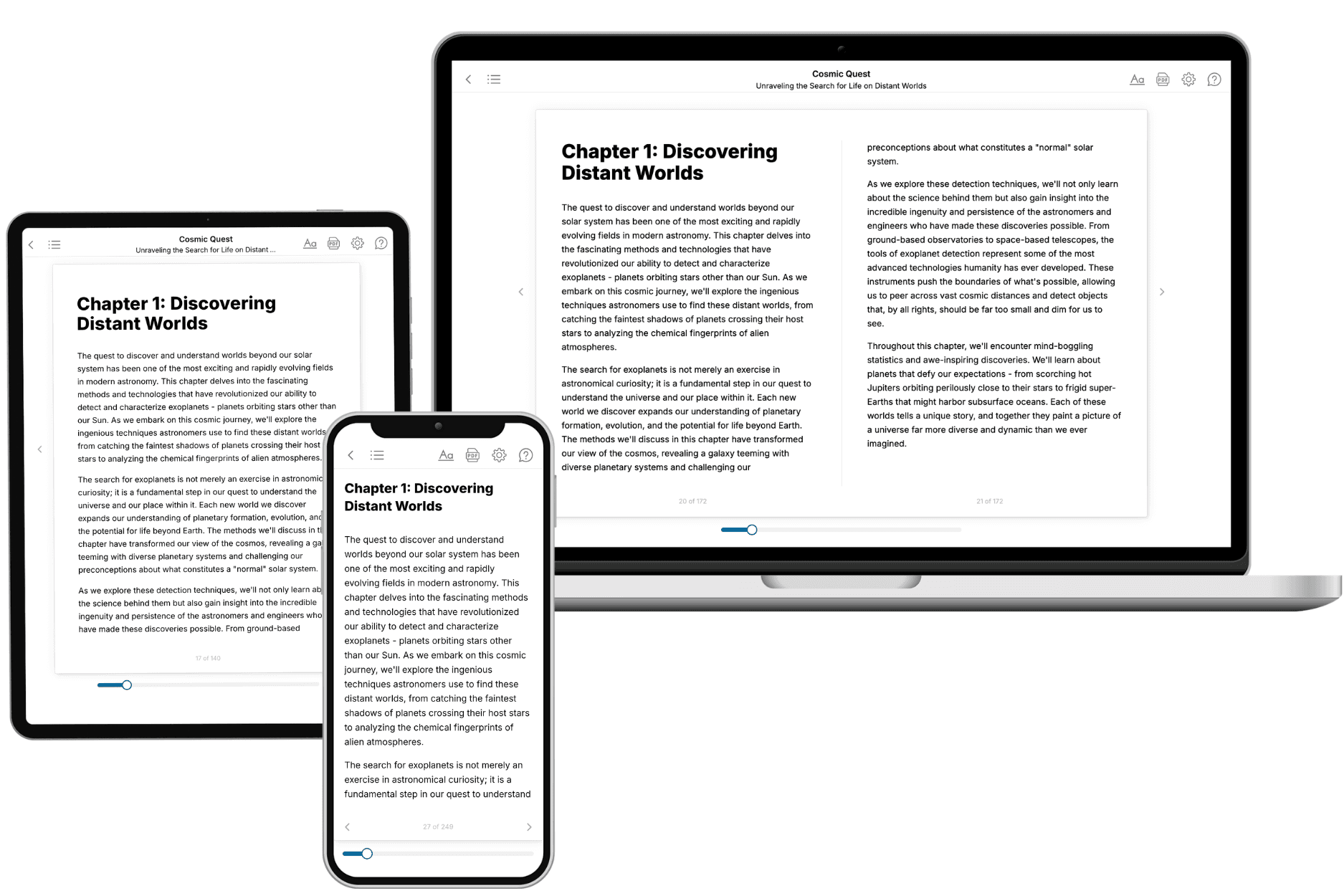
Yes. Every book includes charts, tables, and diagrams: timelines, checklists, step-by-step guides, decision trees, comparison tables, matrices, and bar charts. A typical book includes dozens of these visual elements.
- Can I read it on Kindle? What formats can I download?
Yes. Every book can be read in our online reader or downloaded as a PDF or EPUB. The EPUB can be opened with Kindle, Apple Books, Kobo, and any e-reader. The Commercial and Author licenses also include an editable Word (DOCX) and Markdown download.
- How much does it cost?
About the price of a regular ebook. The exact price depends on your book's length and complexity, from $2 for the shortest books to $35 for the most comprehensive, and it's shown when you review your book, before you commit to anything. Each book is a one-time purchase, yours to keep, no subscription. Licenses that let you share, teach, or publish your book range from $35.99 to $49.99.
- Can I preview the book before purchasing?
Before you pay, you'll see what your book will cover: the title, a detailed description, the estimated length, and the complete chapter-by-chapter table of contents, so you know what you're getting before you decide. The full text itself is written after you purchase.
- How long does it take to create a book?
About 10 minutes. You can start reading the opening chapters while the rest is still being written.