Encoder-Decoder Architectures Explained
Master the Fundamentals of Sequence-to-Sequence Learning with Convolutional Neural Networks
Encoder-decoder architectures are everywhere in modern AI—from language translation to image captioning—yet many practitioners struggle to understand how these systems actually work beneath the surface.
222 pages10 chaptersNov 10, 2025AI and Machine Learning
About this book
You might know that encoders compress information and decoders generate output, but do you truly grasp the mechanics of how information flows through these networks, or how to implement them effectively for your specific problems? This book bridges that gap. Starting with the fundamental concepts of neural network building blocks, you'll progress through the complete architecture of encoder-decoder systems, explore how convolutional networks enhance these models, and discover the attention mechanisms that make them powerful. Each concept is explained with clear examples, practical code insights, and real-world applications. Whether you're building machine translation systems, working with image-to-text models, or exploring sequence-to-sequence learning, this guide equips you with both the theoretical understanding and practical knowledge needed to implement, optimize, and innovate with encoder-decoder architectures.
Table of contents
- IntroductionWhy Encoder-Decoder Architectures Matter, What You'll Learn in This Book, How to Use This Guide, Prerequisites and Background KnowledgeRead below
- Chapter 1: Neural Network FundamentalsFrom Perceptrons to Deep Networks, Activation Functions and Non-linearity, Forward and Backward Propagation, Loss Functions and Optimization Algorithms
- Chapter 2: Convolutional Neural Networks EssentialsUnderstanding the Convolution Operation, Filters, Kernels, and Feature Maps, Pooling and Batch Normalization, Building Complete CNN Architectures
- Chapter 3: Introduction to Encoder-Decoder ArchitecturesSequence-to-Sequence Learning Fundamentals, The Encoder: Compressing Information, The Decoder: Generating Output, The Information Bottleneck and Context Vector
- Chapter 4: Building Encoder ComponentsDesigning Effective Encoders, CNN-Based Encoders for Visual Data, Recurrent Encoders for Sequential Data, Practical Encoder Implementation
- Chapter 5: Building Decoder ComponentsDesigning Effective Decoders, Teacher Forcing and Training Strategies, Inference and Decoding Strategies, Practical Decoder Implementation
- Chapter 6: Attention MechanismsWhy Attention Solves the Bottleneck Problem, How Attention Mechanisms Work, Different Types of Attention, Implementing Attention in Your Models
- Chapter 7: Convolutional Encoder-Decoder ModelsCombining CNNs with Encoder-Decoder Frameworks, Image Captioning: Vision to Language, Image-to-Image Translation Models, Attention in Convolutional Encoder-Decoders
- Chapter 8: Training and OptimizationData Preparation and Preprocessing, Training Strategies and Techniques, Hyperparameter Tuning and Validation, Regularization and Preventing Overfitting
- Chapter 9: Real-World ApplicationsMachine Translation Systems, Speech Recognition and Audio Processing, Text Summarization and Generation, Other Emerging Applications
- Chapter 10: Advanced Topics and Modern VariantsTransformers: Evolution of Encoder-Decoders, Multi-Task Learning with Shared Encoders, Transfer Learning and Pre-trained Models, Future Directions and Research Frontiers
- ConclusionKey Takeaways and Next Steps, Your Path Forward in Deep Learning
- Glossary
- Further Reading and Resources
Introduction
Artificial intelligence has transformed from a distant dream into an everyday reality, powering the translation apps on your phone, the voice assistants in your home, and the image recognition systems that organize your photos. Behind many of these remarkable capabilities lies a powerful architectural pattern that has revolutionized how machines process and transform information: the encoder-decoder architecture. This elegant framework has become the foundation for some of the most impressive achievements in modern AI, yet its inner workings remain mysterious to many practitioners who use these systems daily. Understanding encoder-decoder architectures isn't just about grasping another technical concept—it's about unlocking the fundamental pattern that enables machines to transform one type of information into another, whether that's converting speech to text, images to descriptions, or one language to another.
The encoder-decoder pattern represents a profound insight into how intelligent systems can process information. Rather than attempting to solve complex transformation problems in a single step, these architectures break the challenge into two distinct phases: first, compress the input into a rich, meaningful representation; second, use that representation to generate the desired output. This two-stage approach mirrors how humans often tackle complex problems—we first understand and internalize information, then express it in a new form. The beauty of encoder-decoder systems lies in their versatility and generality. The same fundamental architecture can be adapted to translate languages, caption images, recognize speech, summarize documents, and countless other tasks. By mastering this architectural pattern, you gain access to a powerful toolkit that applies across diverse domains and problem types.
This book takes you on a comprehensive journey through encoder-decoder architectures, with particular emphasis on how convolutional neural networks enhance these systems. You'll start with the foundational building blocks—understanding neural networks and convolutional operations—before progressing to the complete encoder-decoder framework. Along the way, you'll discover attention mechanisms that dramatically improve performance, explore practical implementation strategies, and examine real-world applications that demonstrate these concepts in action. Whether you're building your first sequence-to-sequence model or seeking to deepen your understanding of systems you already use, this guide provides both the theoretical foundation and practical knowledge you need. The goal isn't just to teach you what encoder-decoder architectures are, but to help you truly understand how they work, why they're designed the way they are, and how you can apply them effectively to solve meaningful problems.
Why Encoder-Decoder Architectures Matter
The rise of encoder-decoder architectures represents one of the most significant breakthroughs in machine learning over the past decade. Before these systems emerged, many AI tasks required highly specialized, task-specific approaches that couldn't easily transfer to other problems. Machine translation systems relied on complex rule-based methods and phrase tables. Image captioning seemed impossibly difficult, requiring separate systems for vision and language that were challenging to integrate. The encoder-decoder framework changed everything by providing a unified approach to sequence-to-sequence learning—the general problem of transforming one sequence of data into another. This architectural pattern proved so powerful and flexible that it quickly became the foundation for breakthrough systems across multiple domains, from natural language processing to computer vision to speech recognition.
What makes encoder-decoder architectures particularly valuable is their ability to handle variable-length inputs and outputs. Traditional neural networks required fixed-size inputs and produced fixed-size outputs, severely limiting their applicability to real-world problems. Consider machine translation: a sentence in English might be five words long, while its French translation could be seven words. An image caption might be a short phrase or a detailed description. Encoder-decoder systems elegantly solve this challenge by separating the input processing from output generation. The encoder can process inputs of any length, compressing them into a fixed-size representation. The decoder then generates outputs of whatever length is appropriate, one element at a time. This flexibility opened up entirely new categories of problems that neural networks could tackle effectively.
The practical impact of encoder-decoder architectures extends far beyond academic research. These systems power the translation features in Google Translate, enabling real-time communication across language barriers for millions of users daily. They drive the automatic captioning systems that make images accessible to visually impaired users and help organize vast photo libraries. Voice assistants like Siri and Alexa rely on encoder-decoder models to convert your spoken words into text and generate appropriate responses. In healthcare, these architectures help analyze medical images and generate diagnostic reports. In creative industries, they enable automatic video captioning and content summarization. The list of applications continues to grow as researchers discover new ways to apply this versatile framework to emerging challenges.
Understanding encoder-decoder architectures also provides crucial insight into more advanced systems that have emerged in recent years. The Transformer architecture, which powers breakthrough models like BERT and GPT, represents an evolution of encoder-decoder thinking. While Transformers introduce significant innovations—particularly in how they handle attention—they still embody the core principle of encoding information into representations and decoding those representations into outputs. By mastering the fundamentals of encoder-decoder systems, you build the foundation needed to understand these more sophisticated architectures. You'll recognize the design patterns, understand the motivations behind architectural choices, and grasp why certain modifications improve performance. This foundational knowledge remains relevant even as the field continues to evolve.
The mathematical elegance of encoder-decoder architectures makes them particularly appealing for both research and practical applications. The clear separation between encoding and decoding phases allows for modular design and experimentation. You can swap different encoder types—convolutional, recurrent, or attention-based—while keeping the decoder constant, or vice versa. This modularity accelerates research and makes it easier to adapt systems to new domains. The architecture also provides natural points for analysis and interpretation. By examining the encoded representations, researchers can understand what information the model considers important. By studying decoder attention patterns, they can see which parts of the input influence each output element. This interpretability proves invaluable for debugging, improving, and trusting these systems in critical applications.
Perhaps most importantly, encoder-decoder architectures represent a way of thinking about AI problems that extends beyond any specific implementation. The core insight—that complex transformations can be decomposed into compression and generation phases—applies broadly across machine learning. Even when working with architectures that don't explicitly use encoder-decoder terminology, you'll find this pattern recurring. Autoencoders compress and reconstruct data. Generative adversarial networks encode images into latent spaces and decode them back. Variational autoencoders learn compressed representations for generation. By understanding encoder-decoder architectures deeply, you develop intuition about information flow, representation learning, and generation that applies throughout deep learning. This conceptual framework helps you approach new problems more effectively and design better solutions.
What You'll Learn in This Book
This book provides a comprehensive, structured path through encoder-decoder architectures, starting from fundamental concepts and progressing to advanced applications. You'll begin by building a solid foundation in neural network basics and convolutional operations, ensuring you understand the building blocks before tackling complete architectures. The early chapters cover essential topics including activation functions, backpropagation, loss functions, and optimization algorithms. You'll learn how convolutional neural networks extract hierarchical features from data through convolution operations, pooling layers, and normalization techniques. These foundational chapters ensure that when you encounter these concepts within encoder-decoder systems, you'll understand not just what they do, but why they work and how to use them effectively.
The core chapters dive deep into encoder-decoder architectures themselves, examining each component in detail. You'll discover how encoders compress input information into dense representations, exploring different encoder designs for various data types. The book covers CNN-based encoders for visual data, recurrent encoders for sequential information, and hybrid approaches that combine multiple techniques. You'll learn about the information bottleneck—the context vector that connects encoder and decoder—and understand both its power and limitations. The decoder chapters explain how these components generate output sequences, covering training strategies like teacher forcing, inference techniques including greedy decoding and beam search, and practical implementation considerations. Each concept is illustrated with concrete examples and code-level insights that bridge theory and practice.
Attention mechanisms receive extensive coverage, as they represent one of the most important innovations in encoder-decoder systems. You'll understand why the fixed-size context vector creates a bottleneck that limits performance, and how attention solves this problem by allowing the decoder to focus on relevant parts of the input. The book explains different attention types, including:
- Additive attention (Bahdanau attention) that computes alignment scores through learned transformations
- Multiplicative attention (Luong attention) that uses dot products for efficient computation
- Self-attention that allows elements to attend to other elements in the same sequence
- Multi-head attention that captures different types of relationships simultaneously
The book dedicates substantial attention to convolutional encoder-decoder models, which combine the spatial feature extraction capabilities of CNNs with the sequence transformation power of encoder-decoder frameworks. You'll explore image captioning systems that convert visual information into natural language descriptions, understanding how CNN encoders extract image features and recurrent decoders generate coherent captions. Image-to-image translation models receive detailed treatment, showing how encoder-decoder architectures can transform images from one domain to another—converting sketches to photos, day scenes to night, or satellite imagery to maps. These chapters include architectural diagrams, implementation guidance, and analysis of what makes these models effective for visual tasks.
Practical training and optimization techniques form another crucial component of the book. You'll learn how to prepare and preprocess data for encoder-decoder models, including tokenization strategies, vocabulary construction, and data augmentation techniques. The training chapters cover essential topics like batch construction, gradient clipping, learning rate scheduling, and early stopping. You'll discover how to tune hyperparameters effectively, including encoder and decoder sizes, attention dimensions, dropout rates, and optimization algorithm parameters. The book provides concrete guidance on regularization techniques that prevent overfitting, from dropout and weight decay to more sophisticated approaches like label smoothing and scheduled sampling. These practical insights help you move from understanding architectures to successfully training them.
Real-world applications demonstrate encoder-decoder architectures in action across diverse domains. The machine translation chapter examines how these systems convert text between languages, covering challenges like handling rare words, maintaining grammatical structure, and dealing with language-specific phenomena. Speech recognition applications show how encoder-decoder models transform audio signals into text, addressing issues like speaker variation, background noise, and real-time processing requirements. Text summarization examples illustrate how these architectures can compress long documents into concise summaries while preserving key information. Each application chapter includes specific examples, performance metrics, and discussion of domain-specific challenges and solutions. You'll see not just that encoder-decoder architectures work for these tasks, but understand why they're well-suited to each problem.
The final chapters explore advanced topics and modern variants that extend encoder-decoder thinking. You'll learn about Transformers and how they evolved from traditional encoder-decoder architectures, understanding the innovations that made them so successful. Multi-task learning approaches show how shared encoders can improve efficiency and performance across related tasks. Transfer learning and pre-trained models demonstrate how you can leverage existing encoder-decoder systems for new applications with limited data. The book concludes by examining emerging research directions and future possibilities, helping you understand where the field is heading and how you might contribute to its evolution. Throughout these advanced chapters, connections back to fundamental encoder-decoder concepts reinforce your understanding and show how innovations build on established principles.
How to Use This Guide
This book is designed to be read sequentially, with each chapter building on concepts introduced in previous ones. The early chapters establish foundational knowledge that later chapters assume you understand. If you're new to neural networks or convolutional operations, starting from Chapter 1 ensures you have the necessary background. However, if you already have solid grounding in neural network fundamentals and CNNs, you might choose to skim the first two chapters as review before diving into the encoder-decoder content beginning in Chapter 3. The book's structure allows for this flexibility while ensuring that all necessary concepts are covered. Each chapter begins with a brief overview of what you'll learn and how it connects to previous material, helping you navigate the content effectively.
The book balances theoretical understanding with practical implementation throughout. Conceptual explanations describe what components do and why they're designed that way, while code examples and implementation discussions show how to build these systems in practice. You'll find mathematical formulations presented clearly with accompanying intuitive explanations—the goal is understanding, not just memorization of equations. When encountering mathematical notation, take time to work through the examples and ensure you grasp what each symbol represents. The book uses consistent notation throughout, with key terms defined when first introduced. A glossary at the end provides quick reference for terminology and symbols. Don't hesitate to revisit earlier sections if you need to refresh your understanding of a concept.
To get the most from this book, consider implementing the concepts as you learn them. While the book includes code examples and implementation guidance, actually writing and running code dramatically deepens understanding. Start with simple implementations of basic components—a single-layer encoder, a basic decoder, a simple attention mechanism. Gradually build up to more complex systems as your understanding grows. Experiment with different architectural choices and observe how they affect performance. Try applying encoder-decoder models to small datasets before tackling larger problems. This hands-on practice transforms abstract concepts into concrete skills. The book's examples use common deep learning frameworks, but the concepts apply regardless of your preferred tools. Focus on understanding the underlying principles, which remain constant across implementations.
Each chapter includes examples and case studies that illustrate concepts in context. Pay close attention to these examples, as they demonstrate how theoretical ideas apply to real problems. When you encounter an example, consider:
- What problem is being solved and why is an encoder-decoder approach appropriate?
- How do the encoder and decoder components handle the specific characteristics of the input and output?
- What design choices were made and what alternatives might work?
- How would you modify the approach for a related but different problem?
The book includes footnotes and references to important papers and resources throughout. These citations serve multiple purposes: they acknowledge the original sources of ideas, provide paths for deeper exploration, and help you understand the historical development of concepts. When you encounter a particularly interesting topic, follow the references to read the original papers and gain additional perspective. The "Further Reading and Resources" section at the end of the book provides curated recommendations for continuing your learning journey. Don't feel obligated to read every reference immediately—instead, note interesting ones and return to them as your understanding deepens. Building a personal library of key papers and resources helps you stay current as the field evolves.
As you progress through the book, you'll encounter increasingly complex concepts and architectures. If you find yourself struggling with a particular topic, that's completely normal—encoder-decoder architectures involve many interconnected ideas that take time to fully absorb. When you hit a challenging section, try these strategies:
- Slow down and reread the section carefully, ensuring you understand each sentence
- Review earlier chapters that cover prerequisite concepts
- Draw diagrams showing information flow through the architecture
- Implement a simple version of the concept to see it in action
- Take a break and return to the material with fresh perspective
Finally, remember that this book is a starting point, not an ending point. Encoder-decoder architectures continue to evolve, with new variants and applications emerging regularly. Use this book to build a strong foundation, then stay engaged with the research community through papers, conferences, and online resources. Experiment with new ideas, contribute to open-source projects, and apply these techniques to problems you care about. The field of deep learning rewards curiosity, creativity, and persistence. By mastering encoder-decoder architectures, you're equipping yourself with powerful tools and fundamental insights that will serve you well as the field continues to advance. Your journey through this book is just the beginning of a longer exploration into the fascinating world of sequence-to-sequence learning and neural architecture design.
Prerequisites and Background Knowledge
This book assumes you have intermediate-level knowledge of machine learning and neural networks. You should be comfortable with basic neural network concepts including feedforward networks, activation functions, and gradient descent optimization. Familiarity with how neural networks learn through backpropagation is important, though the book reviews these concepts in Chapter 1. You don't need to be an expert, but you should have some hands-on experience training simple neural networks and understand the general workflow of machine learning projects: preparing data, defining models, training with optimization algorithms, and evaluating performance. If you're completely new to neural networks, consider working through an introductory machine learning course or textbook before tackling this material. The book builds on foundational concepts rather than teaching them from scratch.
Mathematical prerequisites include comfort with linear algebra, calculus, and probability. You should understand matrix operations including multiplication, transpose, and basic manipulations. Calculus knowledge should include derivatives, partial derivatives, and the chain rule—essential for understanding backpropagation. Basic probability concepts like probability distributions, expectation, and conditional probability appear throughout the book, particularly in discussions of loss functions and training objectives. The book doesn't require advanced mathematics, but you should be able to follow mathematical notation and work through equations with guidance. When mathematical concepts are introduced, they're explained with intuitive descriptions alongside formal definitions. If you encounter unfamiliar mathematical notation, take time to understand it before proceeding, as later chapters build on these foundations.
Programming proficiency is essential for getting the most from this book. You should be comfortable programming in Python, as it's the dominant language for deep learning and the book's examples use Python-based frameworks. Familiarity with at least one deep learning framework—PyTorch, TensorFlow, or Keras—helps you understand implementation examples and experiment with concepts. The book focuses on concepts rather than framework-specific details, but seeing how ideas translate to code deepens understanding significantly. You should know how to:
- Define neural network layers and connect them into models
- Load and preprocess data using standard libraries
- Implement training loops with forward passes, loss computation, and backpropagation
- Save and load trained models
- Visualize training progress and model outputs
Some exposure to convolutional neural networks is beneficial but not strictly required. Chapter 2 provides a comprehensive review of CNN concepts, but prior experience with CNNs for image classification or similar tasks gives you a head start. Understanding how convolution operations extract features, how pooling reduces spatial dimensions, and how CNN architectures stack layers to build hierarchical representations helps you grasp how CNNs integrate into encoder-decoder frameworks. If you've worked with popular CNN architectures like VGG, ResNet, or Inception, you'll recognize patterns and design principles that appear in encoder-decoder systems. However, the book explains CNN concepts thoroughly enough that motivated readers without prior CNN experience can follow along successfully.
Familiarity with sequence modeling and recurrent neural networks (RNNs) provides helpful context, though it's not essential. Many encoder-decoder architectures use recurrent components, and understanding RNN fundamentals—including how they process sequences, maintain hidden states, and handle variable-length inputs—makes these architectures more intuitive. If you've worked with LSTMs (Long Short-Term Memory networks) or GRUs (Gated Recurrent Units), you'll recognize these components when they appear in encoder-decoder systems. The book explains recurrent concepts when they're introduced, but prior exposure means you can focus on how they're used rather than what they are. That said, the book's emphasis on convolutional encoder-decoder models means you can understand substantial material even without deep RNN knowledge.
Beyond technical prerequisites, approaching this book with the right mindset matters. Encoder-decoder architectures involve many interconnected concepts that take time to fully internalize. Be prepared to:
- Read sections multiple times to fully grasp complex ideas
- Pause and work through examples carefully rather than rushing ahead
- Implement concepts yourself to solidify understanding
- Accept that confusion is part of the learning process
- Connect new concepts to your existing knowledge actively
Finally, having access to appropriate computational resources enhances your learning experience, though it's not absolutely necessary for understanding the concepts. Training encoder-decoder models, especially on realistic datasets, requires significant computational power. Access to a GPU dramatically accelerates training and allows you to experiment more freely. Cloud platforms like Google Colab, AWS, or Azure provide GPU access if you don't have local hardware. However, you can understand the concepts and work through small-scale examples on CPU-only systems. The book's focus is on understanding architectures and principles rather than training state-of-the-art models, so limited computational resources shouldn't prevent you from learning effectively. Start with small datasets and simple models, scaling up as your understanding and resources allow. The conceptual knowledge you gain applies regardless of the scale at which you can currently experiment.
This is the end of the free sample. The full book has 10 chapters.
Want this book written for you?
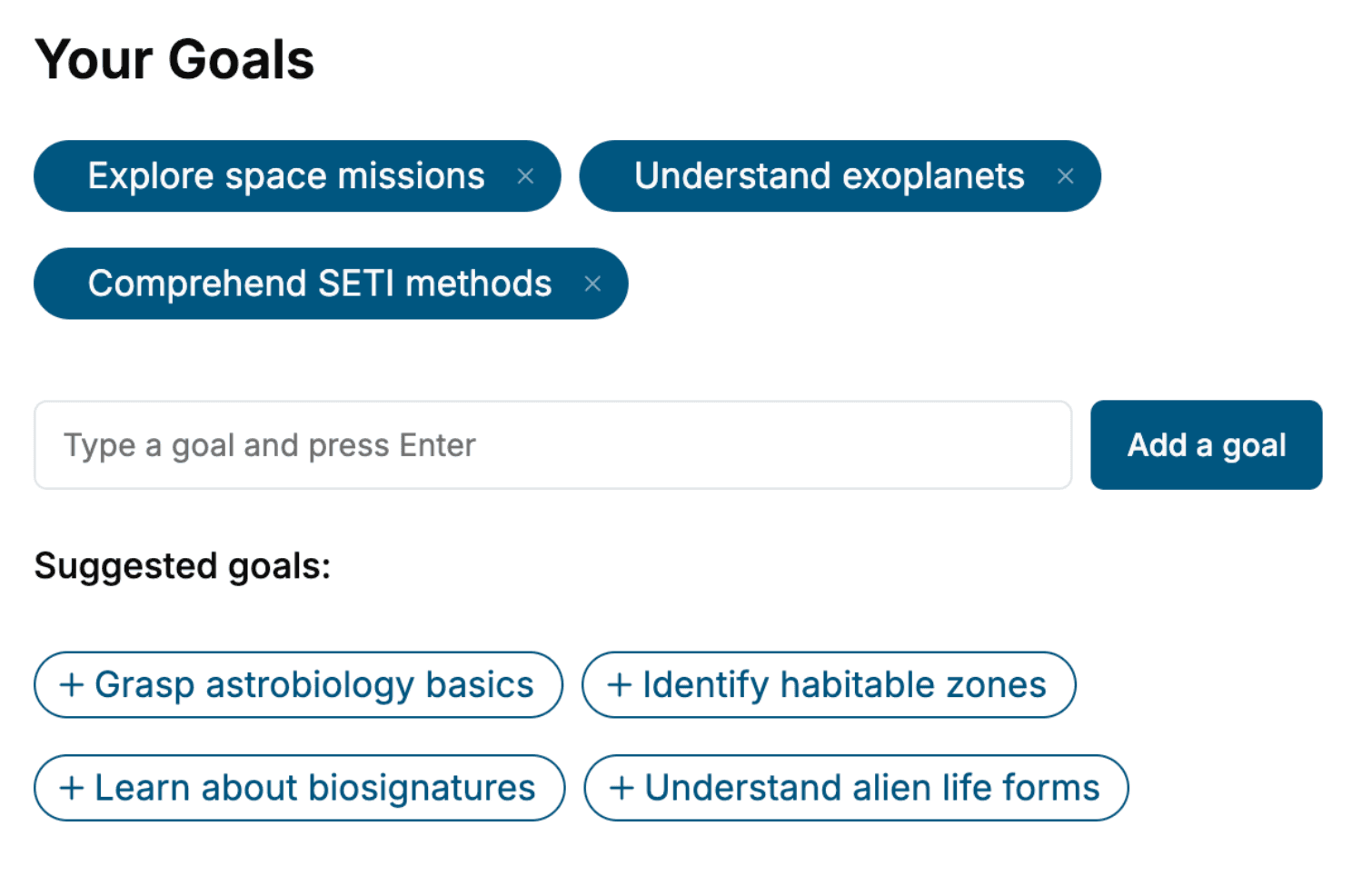
Tell us your goals and background, and get your own version of this book, tailored by AI to you.


Benefits of AI-tailored books
- Read one book, not ten:
- all the AI and Machine Learning knowledge you need, gathered into a single book.
- Save days of learning:
- tell us your goals, choose your topics, and the whole book is built around them.
- Learn effortlessly:
- AI and Machine Learning book written for your specific background and expertise.
- Understand at a glance:
- includes charts, tables, timelines, checklists, decision trees, and more.
- Stay current:
- written the day you order it, not years ago.
- Trust what you read:
- every book is checked for accuracy, with real research when your subject needs it.
Create your unique book in 3 steps
- 1. Select your focus
Select the focus of your AI and Machine Learning book and share your background
- 2. Personalize your book
Specify your goals and choose sub-topics to include
- 3. Get your tailored book
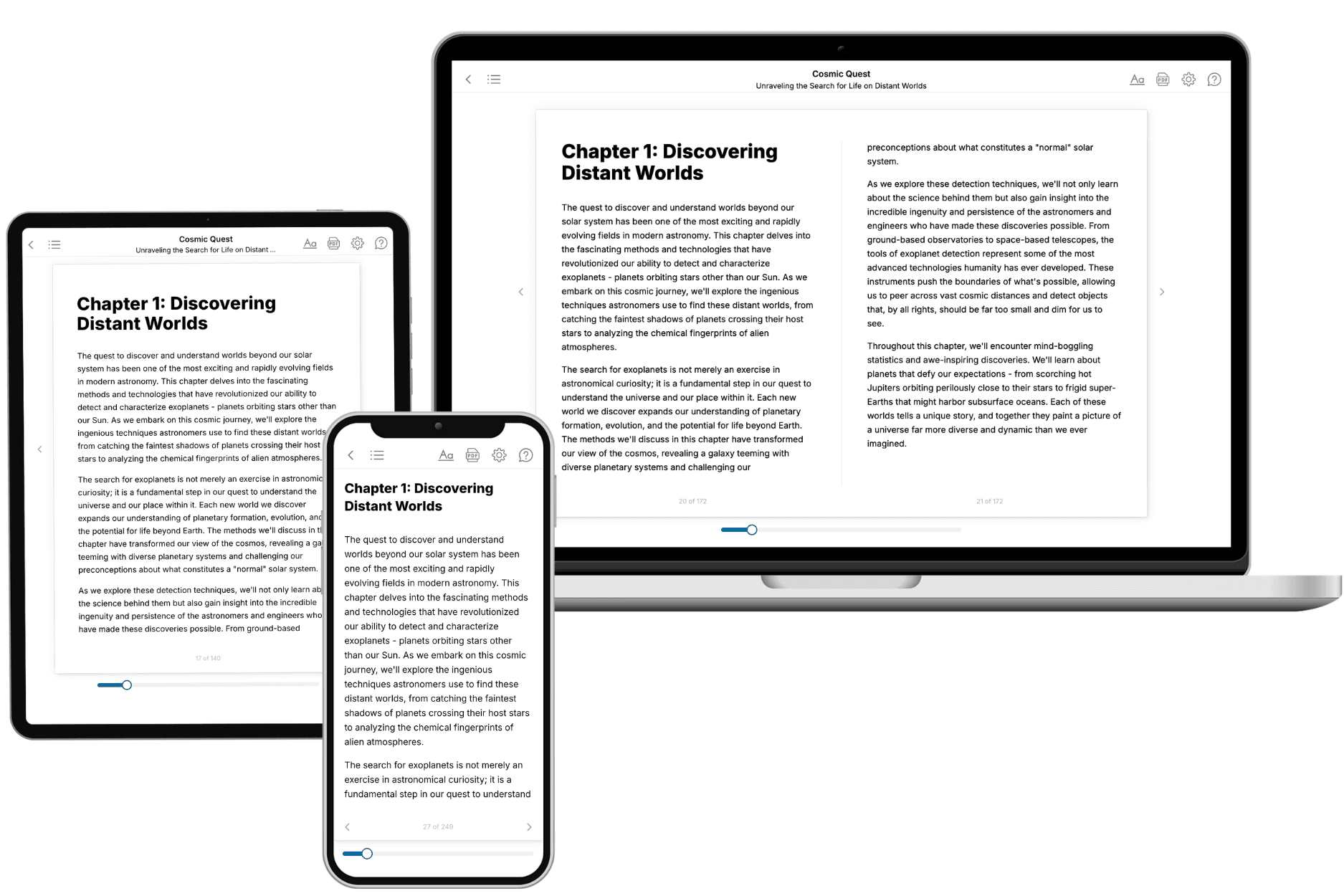
Your book is ready in 10 minutes. Read it online, download as EPUB or PDF, or send to Kindle.

Frequently asked questions
- What is TailoredRead?
TailoredRead creates complete, full-length nonfiction ebooks, written specifically for you. Tell us what you want to learn and why, and TailoredRead writes you a complete ebook on it, with charts, tables, and diagrams throughout. Read it online, on Kindle, or on any e-reader, or download it as a PDF or EPUB. Every book is written fresh the day you order it.
- How is the book tailored to me?
Before anything is written, you answer a few short questions about your goals, your background, and the topics you care about. Your book is then planned around your answers: written at your level, focused on your goals, and covering the topics you chose, instead of the one-size-fits-all book a store sells everyone.
- Will it read like generic AI content?
No. Your book isn't a chat transcript: it's planned chapter by chapter before a single word is written, told in a clear book voice, and explains ideas visually with charts, tables, and diagrams. After writing, every book goes through an editorial pass that polishes chapters so the book reads consistent from start to finish. Judge for yourself: browse thousands of sample books on our Explore Books page.
- How accurate is the content?
Our AI first checks whether your subject needs live research. Niche and fast-moving subjects are researched before writing, and the book plan and chapters are grounded in what it finds. After writing, every book goes through a quality pass that checks its facts and consistency, and researched books list their sources in a Notes section at the back.
- How long is the book?
You choose the length: Comprehensive (250-300 pages), Detailed (150-200 pages), Essential (70-100 pages), or Short (30-50 pages).
- Does the book include visuals?
Yes. Every book includes charts, tables, and diagrams: timelines, checklists, step-by-step guides, decision trees, comparison tables, matrices, and bar charts. A typical book includes dozens of these visual elements.
- Can I read it on Kindle? What formats can I download?
Yes. Every book can be read in our online reader or downloaded as a PDF or EPUB. The EPUB can be opened with Kindle, Apple Books, Kobo, and any e-reader. The Commercial and Author licenses also include an editable Word (DOCX) and Markdown download.
- How much does it cost?
About the price of a regular ebook. The exact price depends on your book's length and complexity, from $2 for the shortest books to $35 for the most comprehensive, and it's shown when you review your book, before you commit to anything. Each book is a one-time purchase, yours to keep, no subscription. Licenses that let you share, teach, or publish your book range from $35.99 to $49.99.
- Can I preview the book before purchasing?
Before you pay, you'll see what your book will cover: the title, a detailed description, the estimated length, and the complete chapter-by-chapter table of contents, so you know what you're getting before you decide. The full text itself is written after you purchase.
- How long does it take to create a book?
About 10 minutes. You can start reading the opening chapters while the rest is still being written.