Encoder-Decoder Architectures Explained
Master Sequence-to-Sequence Learning from RNNs to Transformers for Robotics and Vision
Build production-ready encoder-decoder systems that power real-time robotics and vision applications.
269 pages15 chaptersJan 24, 2026Deep LearningCreated by MirageParody
About this book
This comprehensive guide takes you from fundamental RNN concepts through modern Transformer alternatives, providing the architectural knowledge and optimization techniques you need to implement sequence-to-sequence learning in your robotics and ML research. You'll master attention mechanisms that enable your vision translation systems to focus on critical features, understand how gradient flow shapes network performance, and learn practical strategies for deploying efficient models on edge devices. Each concept is grounded in concrete robotics applications—from robot perception pipelines to navigation systems—with detailed explanations of how architectural choices affect real-world performance. Discover how to optimize CNN encoders for your specific hardware constraints, implement custom decoder strategies for your use cases, and debug complex multi-modal fusion architectures. Whether you're building image captioning systems, enhancing robot perception, or deploying models in production, this book provides the technical depth and practical insights needed to make informed architectural decisions and achieve optimal performance.
Table of contents
- IntroductionWhy Encoder-Decoder Architectures Matter for Robotics, How This Book Is Structured, What You Need to Know Before StartingRead below
- Chapter 1: Recurrent Neural Network FundamentalsUnderstanding RNN Architecture and Information Flow, Why Standard RNNs Struggle with Long Sequences, RNNs in Robotics: Temporal Perception and Control
- Chapter 2: LSTM and GRU Architecture ComparisonLSTM Gates and Memory Cells Explained, GRU Simplification and Computational Efficiency, When to Choose LSTM vs GRU for Your Application
- Chapter 3: Gradient Flow in Deep NetworksThe Vanishing Gradient Problem and Its Solutions, Analyzing Gradient Flow Through Your Network, Techniques for Maintaining Healthy Gradient Propagation
- Chapter 4: Attention Mechanism FundamentalsHow Attention Transforms Sequence Processing, Scaled Dot-Product and Multi-Head Attention, Cross-Modal Attention for Multi-Sensor Fusion
- Chapter 5: Sequence-to-Sequence Learning BasicsThe Encoder-Decoder Framework, Context Vectors and Information Bottlenecks, Seq2Seq Applications in Vision and Robotics
- Chapter 6: CNN Encoder Architecture OptimizationDesigning Efficient CNN Encoders for Vision Tasks, Transfer Learning for Vision Encoders, Optimizing Encoder Output for Decoder Input
- Chapter 7: Temporal Convolution NetworksTemporal Convolution Networks vs RNNs, Dilated Convolutions for Extended Receptive Fields, TCNs for Sequence Prediction in Robotics
- Chapter 8: RNN Evolution to TransformersTransformer Architecture and Self-Attention, Why Transformers Outperform RNNs for Sequences, Transformer Alternatives and Hybrid Approaches
- Chapter 9: Decoder Strategy ImplementationBeam Search Decoding Strategies, Sequence Masking and Padding Techniques, Building Custom Decoders for Specialized Tasks
- Chapter 10: Encoder-Decoder Loss FunctionsChoosing the Right Loss Function for Your Task, Sequence-Level Loss and Optimization Strategies, Multi-Task Loss for End-to-End Learning Systems
- Chapter 11: Real-World Applications and IntegrationImage Captioning with Encoders and Decoders, Real-Time Vision Translation Systems, Robot Perception Pipeline Design, Robot Navigation with Seq2Seq Models
- Chapter 12: Optimization and DeploymentInference Latency Optimization for Edge Devices, Robotics-Specific Model Compression Techniques, Mobile Architecture Efficiency and Constraints
- Chapter 13: Debugging and ValidationEncoder-Decoder Debugging Methods, Visualizing Attention and Gradient Flow, Validation Strategies for End-to-End Systems
- Chapter 14: Advanced Topics and TechniquesMulti-Modal Fusion Architectures, Bidirectional Encoder Design, Data Augmentation for Sequences
- Chapter 15: Production Deployment and ScalingProduction Deployment Strategies, Real-Time Inference on Edge Devices, Monitoring and Maintaining Deployed Models
- ConclusionKey Takeaways and Next Steps, Future Directions in Encoder-Decoder Research
Introduction
Encoder-decoder architectures have become the backbone of modern robotics and machine vision systems, transforming how machines perceive, interpret, and act upon visual and sequential data. These architectures enable robots to translate raw sensor inputs into meaningful actions, convert images into descriptive language, and fuse multi-modal information into coherent representations. From autonomous navigation systems that process camera feeds into trajectory plans to perception pipelines that transform visual scenes into semantic understanding, encoder-decoder models power the most sophisticated robotics applications in research and production today. Understanding these architectures is no longer optional for robotics researchers—it's essential for building systems that perform reliably in real-world environments.
The evolution from recurrent neural networks through attention mechanisms to modern Transformers represents more than just architectural innovation. Each development solved specific problems that directly impact your ability to deploy robust robotics systems. Vanishing gradients limited how far back in time RNNs could remember critical information. Attention mechanisms enabled models to focus on relevant features without processing entire sequences uniformly. Transformers parallelized sequence processing, dramatically reducing training time while improving performance. These aren't just theoretical improvements—they determine whether your robot can navigate reliably, whether your vision system can process frames in real-time, and whether your multi-modal fusion architecture can integrate sensor data effectively enough for production deployment.
This book bridges the gap between architectural theory and practical implementation for robotics applications. You'll learn not just how encoder-decoder systems work, but why specific design choices matter for your hardware constraints, latency requirements, and accuracy targets. Every concept is grounded in concrete robotics scenarios, from optimizing CNN encoders for edge devices to implementing custom decoder strategies for specialized tasks. You'll discover how to debug gradient flow issues that prevent your models from learning, visualize attention patterns to understand what your network focuses on, and compress models for real-time inference without sacrificing critical performance. Whether you're building perception pipelines, enhancing robot navigation, or deploying multi-modal fusion systems, this book provides the technical depth and practical guidance needed to make informed architectural decisions.
The robotics and machine vision landscape demands more than understanding individual components. You need to know how encoders transform high-dimensional inputs into compact representations, how decoders generate structured outputs from those representations, and how attention mechanisms enable selective information flow between them. You need practical strategies for managing computational budgets on resource-constrained hardware, techniques for maintaining gradient flow through deep networks, and methods for validating end-to-end system performance. This introduction sets the foundation for that comprehensive understanding, explaining why encoder-decoder architectures matter specifically for robotics, how this book is organized to maximize your learning efficiency, and what background knowledge you'll need to get the most from each chapter.
Why Encoder-Decoder Architectures Matter for Robotics
Robotics systems face a fundamental challenge that encoder-decoder architectures are uniquely positioned to solve: transforming high-dimensional, noisy sensor data into structured, actionable outputs. Consider a mobile robot navigating an indoor environment. Its cameras capture millions of pixels per frame, LiDAR sensors generate thousands of distance measurements, and IMUs provide continuous motion data. The robot must compress this overwhelming information stream into a compact representation that captures spatial relationships, identifies obstacles, and predicts safe trajectories. An encoder performs this compression, learning to extract relevant features while discarding noise and redundancy. The decoder then transforms this compressed representation into specific outputs—navigation commands, object labels, or natural language descriptions—depending on the task at hand.
The separation between encoding and decoding provides architectural flexibility that's critical for robotics research and deployment. You can train a single powerful encoder on massive vision datasets, then attach different decoders for various downstream tasks without retraining the entire system. This transfer learning approach dramatically reduces the data requirements for specialized robotics applications. For example, a CNN encoder pre-trained on ImageNet can extract robust visual features that work well for robot grasping, scene understanding, and visual odometry. You only need to train task-specific decoders on your robotics dataset, which might contain just thousands of examples rather than millions. This modularity also enables rapid prototyping—you can experiment with different decoder architectures and loss functions while keeping the encoder fixed, accelerating your research iteration cycles.
Attention mechanisms within encoder-decoder architectures solve a critical problem for robotics perception: selective information processing. Not all parts of a visual scene are equally important for a given task. When a robot reaches for an object, it needs to focus on the target object's pose and nearby obstacles, not on distant background elements. Traditional fixed-length context vectors force encoders to compress all information uniformly, creating bottlenecks that lose critical details. Attention allows decoders to dynamically query different parts of the encoded representation, focusing computational resources where they matter most. This selective processing improves both accuracy and efficiency—your model learns what to pay attention to rather than processing everything equally, reducing unnecessary computation while improving task performance.
Real-time performance requirements make encoder-decoder architectures particularly relevant for robotics applications. Unlike offline analysis tasks, robots must process sensor data and generate outputs within strict latency budgets. A navigation system might need to process camera frames and output steering commands at 30 Hz or faster. Encoder-decoder separation enables targeted optimization strategies. You can quantize encoder weights for faster inference, prune unnecessary connections, or even deploy encoders and decoders on different hardware—running heavy encoders on edge GPUs while executing lightweight decoders on microcontrollers. This flexibility is essential when you're balancing accuracy requirements against power consumption, thermal constraints, and cost limitations of embedded robotics hardware.
Multi-modal fusion represents another area where encoder-decoder architectures excel in robotics contexts. Modern robots integrate diverse sensor modalities—RGB cameras, depth sensors, thermal imaging, audio, and proprioceptive feedback. Each modality provides complementary information, but fusing them effectively requires architectures that can handle different input types and temporal resolutions. Encoder-decoder frameworks naturally accommodate multi-modal inputs through specialized encoders for each modality. A vision encoder processes camera frames, a temporal encoder handles IMU sequences, and a point cloud encoder processes LiDAR data. These separate encoders can use architectures optimized for their specific input types—CNNs for images, RNNs or Transformers for sequences, PointNet for point clouds—before fusing their outputs through cross-modal attention mechanisms in the decoder.
The sequence-to-sequence learning paradigm that encoder-decoder architectures enable is fundamental to many robotics tasks. Robot navigation requires mapping sequences of sensor observations to sequences of control commands. Visual servoing transforms sequences of images into sequences of joint velocities. Human-robot interaction systems convert sequences of gestures or speech into sequences of robot actions. These tasks don't fit naturally into standard classification or regression frameworks—they require models that can handle variable-length inputs and outputs while maintaining temporal coherence. Encoder-decoder architectures provide this capability through recurrent connections, temporal convolutions, or self-attention mechanisms that model sequential dependencies explicitly.
Production deployment considerations make understanding encoder-decoder architectures essential for moving robotics research from lab prototypes to real-world systems. You need to know how architectural choices affect model size, inference latency, and memory consumption. Should you use LSTM or GRU cells in your encoder? How many attention heads provide the best accuracy-efficiency trade-off? Can you replace your Transformer decoder with a more efficient temporal convolution network? These decisions directly impact whether your model can run on your target hardware within your latency budget. This book provides the knowledge needed to make these trade-offs intelligently, understanding not just what different architectures do, but when and why to choose each one for your specific robotics application.
Debugging and validation challenges in robotics systems require deep understanding of encoder-decoder internals. When your robot navigation system fails, you need to diagnose whether the problem lies in the encoder's feature extraction, the decoder's output generation, or the attention mechanism's information routing. Is the encoder learning meaningful representations from your sensor data? Are gradients flowing properly through your recurrent connections? Is the attention mechanism focusing on relevant features or getting distracted by spurious correlations? Without understanding how information flows through encoder-decoder architectures, you're limited to black-box debugging approaches that waste time and provide limited insight. This book equips you with systematic debugging strategies, visualization techniques, and validation methods that enable you to identify and fix problems efficiently.
The rapid evolution of encoder-decoder architectures means that staying current with best practices is crucial for competitive robotics research. Transformers have largely replaced RNNs for many sequence modeling tasks, but understanding why this transition happened—and when RNNs or temporal convolutions might still be preferable—requires deep architectural knowledge. New attention mechanisms, efficient Transformer variants, and hybrid architectures emerge regularly, each claiming performance improvements. You need the foundational understanding to evaluate these claims critically, assess whether new architectures fit your robotics constraints, and adapt promising techniques to your specific applications. This book provides that foundation, explaining not just current best practices but the principles underlying them, enabling you to evaluate and adopt new developments as the field evolves.
How This Book Is Structured
This book follows a carefully designed progression from fundamental concepts through advanced techniques to production deployment strategies. The structure reflects how encoder-decoder architectures actually evolved—starting with recurrent neural networks, progressing through attention mechanisms, and culminating in modern Transformer-based approaches. This historical progression isn't just pedagogically sound; it helps you understand why each architectural innovation emerged and what problems it solved. You'll see how limitations in RNNs motivated LSTM and GRU designs, how fixed-length context vectors created bottlenecks that attention mechanisms resolved, and how sequential processing constraints led to the development of Transformers. Understanding this evolution enables you to make informed architectural choices rather than blindly following current trends.
The first section (Chapters 1-3) establishes the foundational concepts you need for all encoder-decoder work. Chapter 1 covers recurrent neural network fundamentals, explaining how RNNs process sequential information and why they struggle with long sequences. You'll learn about information flow through recurrent connections, backpropagation through time, and the specific challenges RNNs face in robotics applications with long temporal dependencies. Chapter 2 compares LSTM and GRU architectures in detail, showing how gating mechanisms solve the vanishing gradient problem and when to choose each architecture for your applications. Chapter 3 dives deep into gradient flow analysis, providing practical techniques for diagnosing and fixing gradient-related training problems that commonly plague deep encoder-decoder networks. These chapters build the foundation for understanding more complex architectures introduced later.
The middle section (Chapters 4-8) introduces the key mechanisms that make modern encoder-decoder architectures powerful. Chapter 4 explains attention mechanisms from first principles, showing how scaled dot-product attention and multi-head attention transform sequence processing. You'll learn to implement attention layers, understand their computational costs, and apply them to robotics perception tasks. Chapter 5 covers sequence-to-sequence learning basics, explaining the encoder-decoder framework, context vectors, and information bottlenecks. Chapter 6 focuses specifically on CNN encoder optimization for vision tasks, covering transfer learning, architecture search, and techniques for preparing encoder outputs for decoder consumption. Chapter 7 introduces temporal convolution networks as efficient alternatives to RNNs for certain sequence modeling tasks. Chapter 8 completes this section by explaining the evolution from RNNs to Transformers, showing why self-attention enables better performance and parallelization for many robotics applications.
The application-focused section (Chapters 9-11) connects architectural concepts to concrete robotics implementations. Chapter 9 covers decoder strategy implementation, including beam search algorithms, sequence masking techniques, and custom decoder designs for specialized tasks. You'll learn how different decoding strategies affect output quality and computational cost, with specific examples from robotics applications. Chapter 10 examines loss functions for encoder-decoder training, explaining how to choose appropriate losses for different tasks, implement sequence-level optimization, and design multi-task losses for end-to-end learning systems. Chapter 11 provides detailed case studies of real-world applications: image captioning systems, vision translation pipelines, robot perception architectures, and navigation systems. Each case study includes architectural diagrams, implementation considerations, and performance analysis relevant to production robotics systems.
The optimization and deployment section (Chapters 12-13) addresses the practical challenges of moving encoder-decoder models from research prototypes to production systems. Chapter 12 covers inference latency optimization, model compression techniques specific to robotics constraints, and mobile architecture efficiency considerations. You'll learn quantization strategies, pruning methods, and knowledge distillation approaches that maintain accuracy while reducing computational requirements. Chapter 13 focuses on debugging and validation, providing systematic methods for diagnosing encoder-decoder problems, visualizing attention patterns and gradient flow, and validating end-to-end system performance. These chapters include specific tools, code examples, and troubleshooting workflows you can apply directly to your robotics projects.
The advanced topics section (Chapter 14) explores sophisticated techniques for complex robotics scenarios. You'll learn about multi-modal fusion architectures that combine vision, temporal sequences, and other sensor modalities through specialized encoders and cross-modal attention. Bidirectional encoder designs enable your models to process sequences in both forward and backward directions, capturing richer contextual information. Data augmentation strategies for sequences help improve model robustness without architectural changes. These advanced techniques build on the foundations established in earlier chapters, showing how to combine multiple concepts to solve challenging robotics problems that require sophisticated information processing.
The final section (Chapter 15 and Conclusion) addresses production deployment at scale. Chapter 15 covers deployment strategies for different robotics platforms, real-time inference optimization for edge devices, and monitoring approaches for deployed models. You'll learn how to set up continuous validation pipelines, detect model degradation in production, and update deployed systems safely. The conclusion synthesizes key takeaways from throughout the book, provides guidance on next steps for deepening your expertise, and discusses future directions in encoder-decoder research relevant to robotics applications. This forward-looking perspective helps you anticipate upcoming developments and position your research to take advantage of emerging techniques.
Each chapter follows a consistent structure designed to maximize learning efficiency and practical applicability. Concepts are introduced with clear explanations of what they are and why they matter for robotics. Detailed technical descriptions show how mechanisms work internally, with mathematical formulations where necessary but always accompanied by intuitive explanations. Concrete examples demonstrate concepts in action, using realistic robotics scenarios rather than toy problems. Implementation considerations address practical challenges you'll face when building real systems—computational costs, memory requirements, numerical stability issues, and hardware constraints. Code examples and pseudocode illustrate key algorithms, while architectural diagrams visualize information flow through complex systems.
The book is designed to support multiple reading strategies depending on your needs and background. If you're new to encoder-decoder architectures, reading sequentially from Chapter 1 provides the most comprehensive learning path, building concepts progressively. If you have strong RNN and attention mechanism background, you might start with Chapter 5 and refer back to earlier chapters as needed. If you're focused on specific applications, you can jump directly to relevant chapters in the application section, though you'll get more value if you've covered the foundational material first. Each chapter includes references to related concepts in other chapters, enabling you to navigate efficiently to prerequisite material or advanced extensions. This flexibility ensures the book serves as both a learning resource and a reference guide throughout your robotics research and development work.
What You Need to Know Before Starting
This book assumes you have a PhD-level background in machine vision and practical experience with deep learning frameworks. You should be comfortable with fundamental neural network concepts including feedforward architectures, backpropagation, gradient descent optimization, and common activation functions. You don't need to be an expert in recurrent networks or attention mechanisms—those topics are covered in depth—but you should understand how convolutional neural networks process images, how training loops work, and how to implement basic models in PyTorch or TensorFlow. If you've trained image classification models, implemented object detection systems, or worked with semantic segmentation architectures, you have sufficient background to engage with this material effectively.
Mathematical prerequisites include linear algebra, calculus, and probability theory at the undergraduate level. You should be comfortable with matrix operations, vector spaces, and eigenvalue decomposition. Calculus knowledge should include partial derivatives, chain rule, and gradient computation—the mathematical foundations of backpropagation. Probability concepts including conditional probability, expectation, and basic statistical inference appear throughout the book, particularly in chapters on loss functions and validation strategies. You don't need advanced mathematical sophistication, but you should be able to follow mathematical notation and understand how equations translate to computational operations. When complex mathematical concepts are necessary, they're explained with both formal notation and intuitive interpretations.
Programming proficiency in Python is essential, as all code examples and implementation discussions use Python-based deep learning frameworks. You should be comfortable reading and writing Python code, understanding object-oriented programming concepts, and working with NumPy for numerical operations. Familiarity with either PyTorch or TensorFlow is strongly recommended—you should know how to define models, implement custom layers, write training loops, and debug common issues. The book doesn't assume expertise in any specific framework, and concepts are explained in framework-agnostic terms where possible, but you'll get the most value if you can implement examples in your preferred framework as you read. Experience with GPU computing and CUDA is helpful but not required.
Computer vision background is crucial given the book's focus on robotics and vision applications. You should understand how images are represented digitally, how convolutional operations extract features, and how pooling layers reduce spatial dimensions. Familiarity with common vision architectures like ResNet, VGG, or EfficientNet provides helpful context, though specific architectures are explained when relevant. You should know basic image preprocessing techniques including normalization, resizing, and color space conversions. Understanding of vision tasks like classification, detection, and segmentation helps you connect encoder-decoder concepts to practical applications. If you've worked with vision datasets like ImageNet, COCO, or domain-specific robotics datasets, you'll find the examples and case studies more immediately applicable.
Robotics domain knowledge enhances your ability to apply concepts from this book, though it's not strictly required. Understanding robot perception pipelines, sensor modalities common in robotics (cameras, LiDAR, IMUs), and basic control concepts helps you appreciate why certain architectural choices matter for robotics applications. Familiarity with robotics challenges like real-time processing requirements, sensor noise, and deployment constraints provides context for optimization and deployment discussions. However, robotics-specific concepts are explained when introduced, so machine learning researchers without robotics background can still benefit from the material. The book bridges ML and robotics perspectives, making concepts accessible to readers from either background.
Hardware and systems knowledge becomes increasingly important in later chapters focused on optimization and deployment. You should understand basic concepts of computational complexity, memory hierarchies, and the difference between training and inference workloads. Familiarity with GPU architecture and parallel computing concepts helps you understand why certain operations are efficient while others create bottlenecks. Knowledge of edge computing platforms, embedded systems, and hardware accelerators is valuable for deployment chapters, though specific platforms are introduced as needed. Understanding trade-offs between computational cost, memory usage, and latency helps you make informed architectural decisions throughout the book.
Experience with model training and debugging is perhaps the most valuable prerequisite. You should have encountered common training problems like overfitting, underfitting, vanishing gradients, and exploding gradients. Familiarity with regularization techniques, learning rate scheduling, and optimization algorithms beyond basic SGD provides helpful context. Experience debugging why models fail to train, investigating loss curves, and diagnosing performance problems prepares you for the systematic debugging approaches presented in later chapters. If you've struggled with getting complex models to converge, you'll particularly appreciate the gradient flow analysis and debugging techniques covered throughout the book.
Research methodology and experimental design skills help you apply concepts from this book to your own projects. You should understand how to design experiments that isolate variables, interpret performance metrics beyond simple accuracy, and validate that improvements are statistically significant rather than random variation. Familiarity with cross-validation, train-test splits, and evaluation protocols for your specific robotics tasks enables you to properly assess encoder-decoder architectures. Experience reading research papers and implementing techniques from literature prepares you to extend concepts from this book with cutting-edge developments. The book references seminal papers and recent research throughout, assuming you can locate and read academic publications when you want to dive deeper into specific topics.
If you find gaps in your background as you read, don't be discouraged. The book provides references to foundational resources where you can fill in missing knowledge. Key concepts are explained from first principles even when they're considered prerequisites, ensuring you can follow the material even if your background is stronger in some areas than others. The important thing is having enough foundation to engage with the material actively—implementing examples, experimenting with variations, and applying concepts to your own robotics problems. Learning is most effective when you're building on existing knowledge and connecting new concepts to practical applications, which is exactly how this book is designed to be used.
This is the end of the free sample. The full book has 15 chapters.
Want this book written for you?
Tell us your goals and background, and get your own version of this book, tailored by AI to you.


Benefits of AI-tailored books
- Read one book, not ten:
- all the Deep Learning knowledge you need, gathered into a single book.
- Save days of learning:
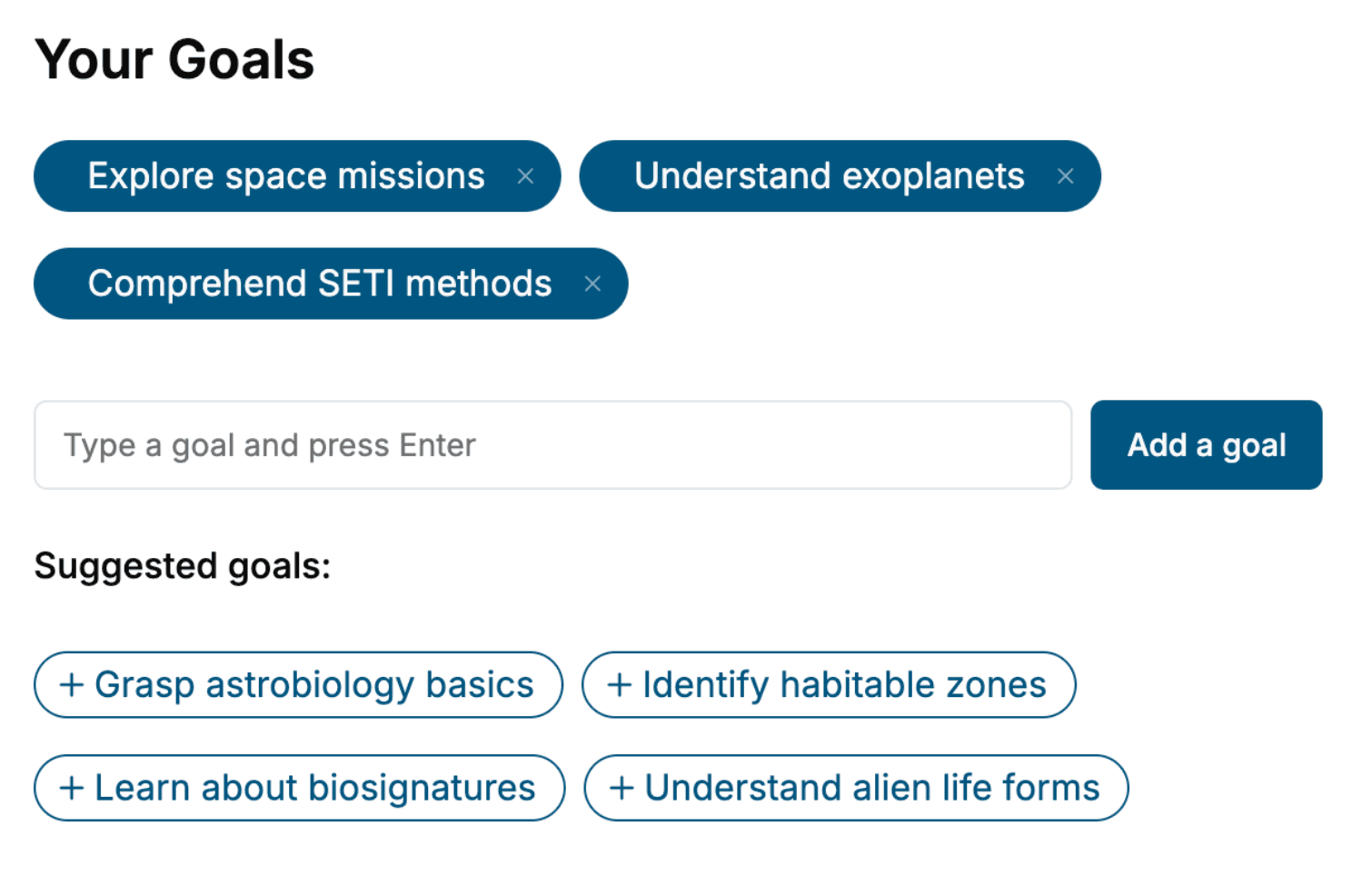
- tell us your goals, choose your topics, and the whole book is built around them.
- Learn effortlessly:
- Deep Learning book written for your specific background and expertise.
- Understand at a glance:
- includes charts, tables, timelines, checklists, decision trees, and more.
- Stay current:
- written the day you order it, not years ago.
- Trust what you read:
- every book is checked for accuracy, with real research when your subject needs it.
Create your unique book in 3 steps
- 1. Select your focus
Select the focus of your Deep Learning book and share your background
- 2. Personalize your book
Specify your goals and choose sub-topics to include
- 3. Get your tailored book
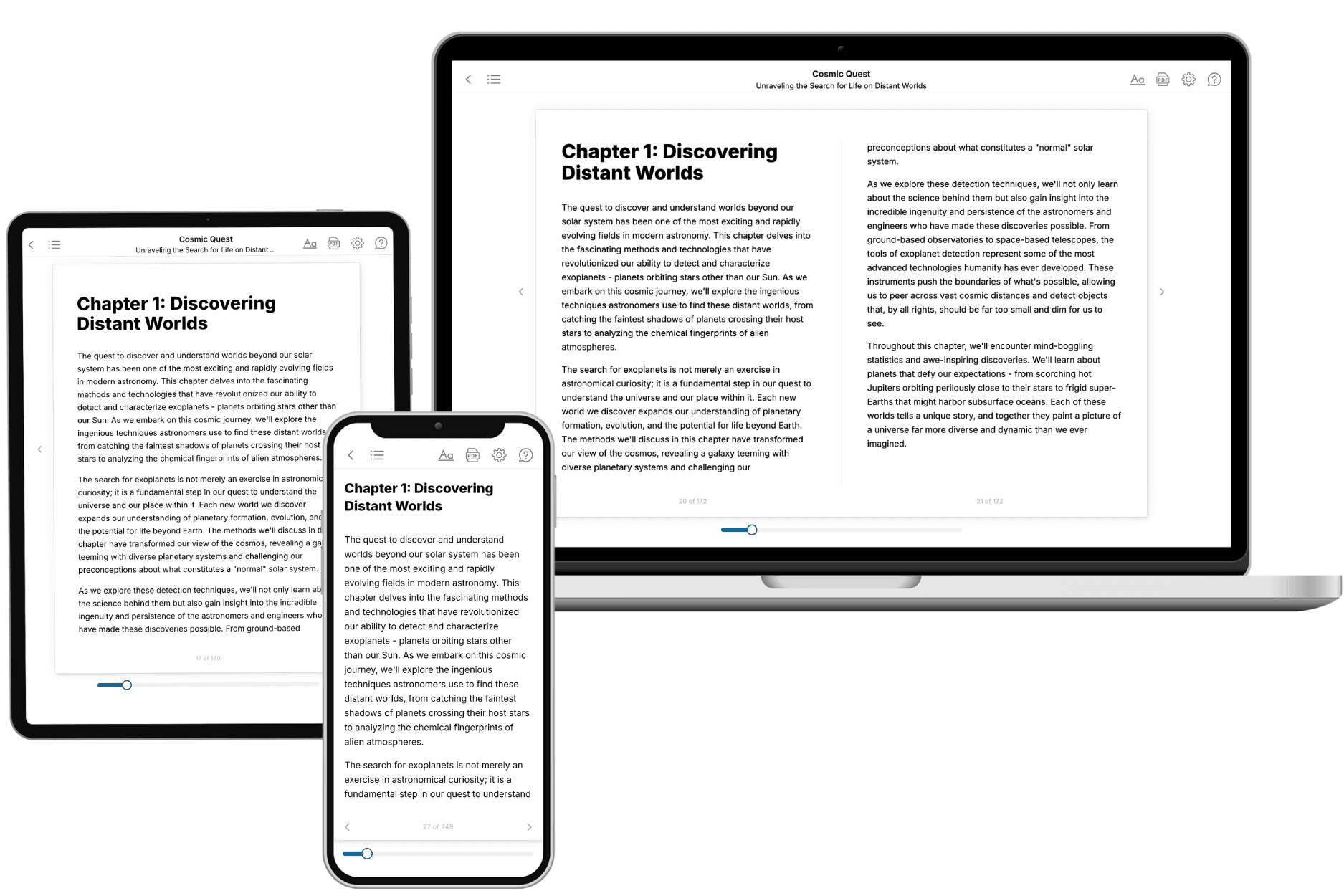
Your book is ready in 10 minutes. Read it online, download as EPUB or PDF, or send to Kindle.

Frequently asked questions
- What is TailoredRead?
TailoredRead creates complete, full-length nonfiction ebooks, written specifically for you. Tell us what you want to learn and why, and TailoredRead writes you a complete ebook on it, with charts, tables, and diagrams throughout. Read it online, on Kindle, or on any e-reader, or download it as a PDF or EPUB. Every book is written fresh the day you order it.
- How is the book tailored to me?
Before anything is written, you answer a few short questions about your goals, your background, and the topics you care about. Your book is then planned around your answers: written at your level, focused on your goals, and covering the topics you chose, instead of the one-size-fits-all book a store sells everyone.
- Will it read like generic AI content?
No. Your book isn't a chat transcript: it's planned chapter by chapter before a single word is written, told in a clear book voice, and explains ideas visually with charts, tables, and diagrams. After writing, every book goes through an editorial pass that polishes chapters so the book reads consistent from start to finish. Judge for yourself: browse thousands of sample books on our Explore Books page.
- How accurate is the content?
Our AI first checks whether your subject needs live research. Niche and fast-moving subjects are researched before writing, and the book plan and chapters are grounded in what it finds. After writing, every book goes through a quality pass that checks its facts and consistency, and researched books list their sources in a Notes section at the back.
- How long is the book?
You choose the length: Comprehensive (250-300 pages), Detailed (150-200 pages), Essential (70-100 pages), or Short (30-50 pages).
- Does the book include visuals?
Yes. Every book includes charts, tables, and diagrams: timelines, checklists, step-by-step guides, decision trees, comparison tables, matrices, and bar charts. A typical book includes dozens of these visual elements.
- Can I read it on Kindle? What formats can I download?
Yes. Every book can be read in our online reader or downloaded as a PDF or EPUB. The EPUB can be opened with Kindle, Apple Books, Kobo, and any e-reader. The Commercial and Author licenses also include an editable Word (DOCX) and Markdown download.
- How much does it cost?
About the price of a regular ebook. The exact price depends on your book's length and complexity, from $2 for the shortest books to $35 for the most comprehensive, and it's shown when you review your book, before you commit to anything. Each book is a one-time purchase, yours to keep, no subscription. Licenses that let you share, teach, or publish your book range from $35.99 to $49.99.
- Can I preview the book before purchasing?
Before you pay, you'll see what your book will cover: the title, a detailed description, the estimated length, and the complete chapter-by-chapter table of contents, so you know what you're getting before you decide. The full text itself is written after you purchase.
- How long does it take to create a book?
About 10 minutes. You can start reading the opening chapters while the rest is still being written.