Encoder-Decoder Architectures
Mastering Representation Learning for Modern AI Applications
Imagine building AI systems that can translate languages, generate captions for images, or summarize complex documents with remarkable accuracy.
238 pages11 chaptersAug 24, 2026Deep Learning
About this book
These capabilities rely on encoder-decoder architectures—one of the most influential innovations in modern machine learning. This book demystifies these powerful systems, taking you from foundational concepts to practical implementation. You'll discover how encoders compress information into meaningful representations while decoders reconstruct or transform that information into useful outputs. Through clear explanations, real-world examples, and hands-on guidance, you'll learn to design and optimize encoder-decoder models for your specific challenges. Whether you're working on natural language processing, computer vision, or multimodal AI, this book equips you with the knowledge and skills to leverage these architectures effectively. By the end, you'll understand not just how these systems work, but why they work—and how to adapt them for tomorrow's AI challenges.
Table of contents
- IntroductionWhy Encoder-Decoder Architectures Matter, What You'll Learn in This Book, How to Use This BookRead below
- Chapter 1: Foundations of Neural Networks and Representation LearningNeural Network Fundamentals, Understanding Representation Learning, Feature Extraction and Dimensionality, Learning Objectives and Loss Functions
- Chapter 2: The Encoder-Decoder FrameworkArchitecture Overview and Components, The Encoder: Compression and Abstraction, The Decoder: Reconstruction and Generation, The Latent Space: Where Meaning Lives
- Chapter 3: Sequence-to-Sequence Models and RNNsRecurrent Neural Networks Explained, Sequence-to-Sequence Architecture, LSTMs and GRUs: Handling Long-Term Dependencies, Real-World Seq2Seq Applications
- Chapter 4: Attention Mechanisms: Focusing on What MattersThe Problem Attention Solves, How Attention Mechanisms Work, Self-Attention and Multi-Head Attention, Attention in Practice
- Chapter 5: Transformers: The Modern Encoder-DecoderTransformer Architecture Fundamentals, Positional Encoding and Sequence Order, The Transformer Encoder Stack, The Transformer Decoder Stack
- Chapter 6: Training Encoder-Decoder ModelsTraining Fundamentals and Optimization, Loss Functions for Different Tasks, Regularization and Preventing Overfitting, Advanced Training Strategies
- Chapter 7: Applications: Machine Translation and NLPMachine Translation Systems, Text Summarization and Abstractive Models, Question Answering and Dialogue Systems, Best Practices for NLP Applications
- Chapter 8: Multimodal Applications: Vision and LanguageImage Captioning and Visual Understanding, Visual Question Answering Systems, Cross-Modal Representation Learning, Challenges in Multimodal Architectures
- Chapter 9: Optimization and Scaling Encoder-Decoder ModelsComputational Efficiency and Memory Management, Model Compression and Distillation, Distributed Training and Parallelization, Inference Optimization and Deployment
- Chapter 10: Debugging, Evaluation, and ImprovementEvaluation Metrics and Benchmarking, Debugging Common Issues, Hyperparameter Tuning and Experimentation, Strategies for Performance Improvement
- Chapter 11: Advanced Topics and Future DirectionsTransfer Learning and Pre-trained Models, Few-Shot and Zero-Shot Learning, Emerging Architectures and Innovations, Future Trends in Encoder-Decoder Research
- ConclusionKey Takeaways, Your Next Steps
- Glossary
- Further Reading and Resources
Introduction
A translation service that turns a sentence in Japanese into fluent English in under a second. A photo app that writes a caption describing a dog catching a frisbee. A chatbot that answers a question buried in a hundred-page manual. These three systems look nothing alike on the surface, yet they share a common blueprint. Each one takes something complicated, squeezes it down into a compact internal form, and then expands that form back out into something new and useful. That blueprint is the encoder-decoder framework, and it sits behind a surprising share of the AI tools now used every day.
This book exists because the framework is easy to sketch on a whiteboard but genuinely hard to master in practice. Drawing two boxes labeled "encoder" and "decoder" with an arrow between them takes ten seconds. Understanding why that arrow works, what breaks when it doesn't, and how to redesign it for a new problem takes considerably longer. The gap between the sketch and a working system is where most practitioners get stuck, and it's exactly the gap this book aims to close.
The approach taken here is deliberately layered. Early chapters build the vocabulary and intuition needed to talk precisely about compression, reconstruction, and meaning inside a neural network. Middle chapters trace the historical path from recurrent networks through attention mechanisms to the Transformer, showing why each innovation was a direct response to a specific limitation of what came before. Later chapters turn toward application, training, scaling, and debugging, treating the architecture not as an abstract diagram but as a system you will actually build, break, and fix.
None of this requires starting from zero. The assumption throughout is that concepts like a neuron, an activation function, and gradient descent are already familiar, even if a little rusty. What this book adds is the layer above that foundation: how individual neural network components combine into an encoder and a decoder, how those two halves communicate through a latent space, and how that communication has been reengineered again and again to handle longer sequences, richer modalities, and larger scales.
By the final page, the goal is not just recognition, being able to name a Transformer when it appears in a paper, but working fluency: knowing which architecture fits a given problem, how to train it without wasting a week of compute on a broken configuration, and how to read its failures well enough to fix them.
Why Encoder-Decoder Architectures Matter
Consider the task of summarizing a news article. The input might be eight hundred words long, while a good summary is perhaps thirty. Somewhere in between, a system has to decide which facts matter, which can be dropped, and how to phrase what remains in a coherent sentence. This is not a task that can be solved by memorizing rules, because every article is different. It requires a system that can learn, from thousands of examples, what "important" tends to look like and how to express it concisely. That learning problem is precisely what an encoder-decoder framework is built to solve.
The architecture earns its name from a simple division of labor. An encoder reads the input, whether that input is a sentence, an image, or an audio clip, and compresses it into a dense internal representation. A decoder then takes that representation and produces an output, which might be a translated sentence, a caption, or an answer to a question. The compressed representation in between is often called the latent space, and it acts as a kind of universal currency that lets the system convert one kind of data into another.
This design solves a problem that simpler approaches cannot. A rule-based translation system, for instance, needs a rule for every grammatical quirk in every language pair, an approach that collapses under the sheer variety of human language. An encoder-decoder system instead learns statistical patterns directly from paired examples, such as millions of English sentences aligned with their French translations. The encoder figures out what a sentence means in a language-agnostic way, and the decoder figures out how to express that meaning in the target language. Neither half needs to be told the rules explicitly.
The framework's reach extends well past text. In image captioning, the encoder is typically a convolutional or Transformer-based vision model that turns a photograph into a feature representation, while the decoder is a language model that turns that representation into a sentence. In speech recognition, the encoder processes an audio waveform and the decoder produces text. In each case, the specific components change, but the underlying contract stays the same: compress meaning, then reconstruct it in a different form.
What makes this contract so valuable is the forced abstraction it creates. Because the latent space is smaller than the raw input, the encoder cannot simply copy every detail forward. It has to decide what matters, which is another way of saying it has to learn a genuine representation of the input rather than a superficial copy. This forced compression is sometimes called a bottleneck, and later chapters will show both how it helps and how it can hurt performance when the input is long and complex[1].
The commercial and scientific stakes here are hard to overstate. Google's neural machine translation system, introduced in the mid-2010s, replaced a decade of hand-tuned statistical translation rules with a single encoder-decoder network and produced a substantial jump in translation quality almost overnight[2]. That same architectural pattern, refined through attention mechanisms and then reinvented as the Transformer, now underlies large language models, code generation tools, and multimodal assistants that combine vision and text. Learning this framework is not a niche technical detour. It is close to a prerequisite for understanding how modern AI systems are built at all.
It also matters because the framework is a lens, not just a tool. Once the encoder-decoder split becomes second nature, a huge range of AI problems start to look structurally similar. A recommendation engine that encodes a user's history and decodes a ranked list of products, a code assistant that encodes a bug report and decodes a patch, a voice assistant that encodes spoken audio and decodes an action to take: all of these fit the same mold. Recognizing that mold quickly is one of the most transferable skills a practitioner can develop.
There is also a practical career dimension worth naming directly. Job postings for machine learning engineers and applied researchers increasingly list familiarity with sequence-to-sequence models, attention, and Transformer-based systems as baseline requirements rather than specialized extras. Understanding the encoder-decoder framework at a mechanical level, not just as a buzzword, is what separates someone who can fine-tune a pre-trained model competently from someone who can diagnose why that fine-tuning failed and fix the underlying cause.
Finally, the framework matters because it keeps evolving without abandoning its core logic. The jump from recurrent networks to attention-augmented sequence-to-sequence models, and then to the fully attention-based Transformer, each preserved the encoder-decoder split while replacing the machinery inside it. That continuity means the effort spent understanding the framework's fundamentals pays off across architectural generations. A solid grasp of what the latent space represents and why the bottleneck exists will still be relevant when the next architectural shift arrives, because the underlying representation learning problem does not change even as the tools for solving it do.
What You'll Learn in This Book
The chapters ahead follow a deliberate arc rather than a loose collection of topics. The arc starts with foundations, moves through the historical development of the architecture, dives into the mechanics of modern systems, and ends with practical guidance on building, scaling, and troubleshooting real models. Each stage builds directly on the one before it, so a concept introduced early, such as a loss function, reappears later in a more specialized form, such as a translation-specific evaluation metric.
The opening chapters revisit neural network fundamentals through the specific lens of representation learning. Rather than re-deriving backpropagation from scratch, the focus is on what a network actually learns to represent, how feature extraction reduces raw data into something more compact and meaningful, and why dimensionality reduction is not a side effect but often the entire point of a well-designed system. This groundwork sets up the central claim that runs through the whole book: an encoder-decoder network is, at heart, a representation learning machine wearing two different hats.
From there, the encoder-decoder framework itself gets a full chapter of dedicated treatment. This section works through the role of the encoder as a compressor of meaning, the role of the decoder as a reconstructor or generator, and the nature of the latent space that connects them. Concrete examples illustrate what happens when the bottleneck is too small, causing important details to be lost, and what happens when it is too large, causing the model to memorize rather than generalize.
A substantial stretch of the book traces the architecture's evolution chronologically. Recurrent neural networks and the original sequence-to-sequence design come first, including the practical problem of the vanishing gradient and how LSTM and GRU cells were built specifically to address it. Attention mechanisms follow, explained as a direct fix for the fixed-length bottleneck that limited early sequence-to-sequence models on long inputs. The Transformer then arrives as the natural next step, replacing recurrence entirely with self-attention and multi-head attention, and the book spends real time unpacking the query, key, and value vectors that make scaled dot-product attention work.
Once the architectural story is complete, attention turns to training. This includes the optimizers and loss functions used for different tasks, regularization techniques like dropout and label smoothing that keep models from overfitting, and training tricks such as teacher forcing, scheduled sampling, gradient clipping, and warm-up steps that make large models converge reliably instead of diverging or stalling.
Application chapters then ground all of this theory in specific, familiar tasks. Machine translation, abstractive summarization, and dialogue systems get dedicated treatment on the language side, complete with discussion of evaluation tools like the BLEU score and ROUGE score. A separate chapter extends the same ideas into multimodal territory, covering image captioning, visual question answering, and the harder problem of building a shared cross-modal representation when the two input types, pixels and words, don't naturally speak the same language.
Because a working model that cannot run in production is of limited use, later chapters address the engineering side directly. Topics include knowledge distillation, quantization, and pruning as ways to shrink a model without gutting its performance, along with the KV cache, mixed-precision training, data parallelism, and model parallelism as tools for handling scale. These are not abstract mentions. Each technique is explained with the specific trade-off it makes, so the choice between, say, quantization and distillation becomes a reasoned decision rather than a guess.
The book closes its technical arc with a chapter dedicated to evaluation and debugging, treating this as a distinct skill separate from initial model building. Learning curves, ablation studies, and systematic hyperparameter tuning are presented as a workflow, not a bag of disconnected tricks, so that when a model underperforms, there is a clear sequence of checks to run rather than a scramble of random changes.
A final substantive chapter looks toward the frontier: transfer learning and fine-tuning of pre-trained models, few-shot learning and zero-shot learning, retrieval-augmented generation, and the mixture of experts pattern that has started reshaping how large models are scaled efficiently. These topics are presented as extensions of the same encoder-decoder logic established earlier, not as an entirely separate subject, because they largely are extensions rather than replacements.
Throughout, the emphasis stays on connecting mechanism to outcome. It is not enough to know that multi-head attention exists; the goal is to understand why splitting attention into multiple heads lets a model attend to different types of relationships simultaneously, such as syntactic structure in one head and coreference in another. That kind of mechanistic clarity is what turns a black-box architecture into a tool you can actually reason about and adjust.
Worked examples appear throughout rather than being confined to a single tutorial chapter. A translation example walks through what the encoder's hidden state looks like for a short sentence, a summarization example shows how cross-attention lets the decoder pull relevant phrases from a long article, and a captioning example demonstrates how a vision encoder's output feeds into a language decoder. These examples are chosen for concreteness over comprehensiveness, aiming to build intuition that transfers to problems not explicitly covered here.
By design, the book does not treat any single architecture as the final answer. The Transformer receives the most attention because it currently dominates practice, but the historical chapters on recurrent approaches are not filler. Understanding why recurrence was eventually set aside, and under what conditions it might still make sense today, such as for extremely long streaming inputs where full self-attention becomes computationally expensive, gives a more durable understanding than simply learning "use a Transformer" as a rule of thumb.
The cumulative result, followed chapter by chapter, is a working mental model of the entire encoder-decoder landscape: where it came from, how its major variants differ, what each design choice costs and buys, and how to translate that understanding into a model that actually ships.
How to Use This Book
The chapters are written to be read in order, at least on a first pass, because later material leans on vocabulary and intuition built earlier. Someone who skips straight to the Transformer chapter without first working through attention mechanisms will likely find terms like query, key, and value introduced without the buildup that makes them intuitive. That said, once a first full pass is complete, the book works well as a reference. Returning to the training chapter to look up label smoothing, or the optimization chapter to check the trade-offs of pruning, requires no re-reading of earlier material.
For readers who already have hands-on experience with recurrent networks or basic Transformers, the early chapters can be skimmed rather than studied closely. The subsections on neural network fundamentals and representation learning are written to refresh rather than teach from scratch, so a quick pass to confirm the terminology matches expectations should be enough before moving into the encoder-decoder framework chapter proper.
A practical suggestion: keep a code editor open while reading the chapters on training and applications. Concepts like teacher forcing or beam search are far easier to internalize by implementing a small version, even a toy translation model with a vocabulary of a few hundred words, than by reading about them alone. The book explains mechanisms in enough depth to support this kind of hands-on experimentation, but it deliberately avoids padding every subsection with full code listings, since the goal is conceptual mastery that then transfers to whatever framework or codebase is in front of you.
Each application chapter, whether on machine translation or visual question answering, is structured so that the underlying architecture is explained first and the task-specific details follow. This means it is possible to read only the sections relevant to a current project, such as summarization, without missing prerequisite material, as long as the architecture chapters have already been covered once.
Footnoted references throughout point to the original papers and foundational sources behind major ideas, from the original sequence-to-sequence paper to the paper that introduced the Transformer[3]. These are worth pursuing directly for anyone planning to work at the research end of this field, since the original papers often contain design reasoning and ablation results that a summary cannot fully capture.
The glossary near the end of the book is meant for quick lookups rather than sequential reading. Given how densely this field uses precise terminology, terms like cross-attention versus masked self-attention can blur together after a long reading session, and a thirty-second glossary check is often faster than flipping back through a chapter.
Readers primarily interested in a specific modality, such as computer vision practitioners exploring multimodal work, may be tempted to jump straight to the multimodal applications chapter. This is workable, but the chapter assumes familiarity with cross-attention and the encoder stack and decoder stack from the Transformer chapter, so a brief backward glance at those sections is recommended before diving in.
Practitioners under time pressure, needing to ship a working model quickly, might prioritize the chapters on the encoder-decoder framework, Transformers, training, and the relevant application chapter, treating the recurrent network history and the frontier chapter on emerging architectures as optional background to return to later. This is a reasonable shortcut, though the historical chapter does contain intuitions about why certain design choices exist that make later material easier to reason about, not just easier to memorize.
For those using this book alongside a formal course or a self-directed study plan, each chapter's subsections map reasonably well onto a single study session of an hour or two. The four subsections per chapter are written to stand as coherent units, so pacing one subsection per sitting, with a short implementation exercise afterward, tends to work better than attempting an entire chapter in one sitting.
The optimization and scaling chapter deserves a particular note: its content on quantization, pruning, and distributed training is most useful once a working model already exists. Reading it too early, before any model has been built and trained, tends to produce abstract knowledge that is hard to apply. Revisiting it once a first model is running and needs to be made faster or cheaper will make the trade-offs discussed there far more concrete.
Similarly, the chapter on debugging, evaluation, and improvement is best read twice: once early, to understand what good evaluation practice looks like before bad habits form, and once again after a first real project has produced confusing or disappointing results, when the specific debugging strategies will map directly onto a concrete problem rather than a hypothetical one.
None of these suggestions are strict requirements. The book is structured to reward linear reading but does not punish a more selective approach, provided the dependencies noted above are respected. What matters most is treating the encoder-decoder framework not as a topic to memorize but as a set of design trade-offs to internalize, since the specific architectures in use today will keep changing while the underlying logic of compression, latent representation, and reconstruction is likely to persist for a long time to come.
Notes
Introduction
- 1. Ilya Sutskever and others, "Sequence to Sequence Learning with Neural Networks," Advances in Neural Information Processing Systems, 2014
- 2. Yonghui Wu and others, "Google's Neural Machine Translation System," arXiv, 2016
- 3. Ashish Vaswani and others, "Attention Is All You Need," Advances in Neural Information Processing Systems, 2017
This is the end of the free sample. The full book has 11 chapters.
Want this book written for you?
Tell us your goals and background, and get your own version of this book, tailored by AI to you.


Benefits of AI-tailored books
- Read one book, not ten:
- all the Deep Learning knowledge you need, gathered into a single book.
- Save days of learning:
- tell us your goals, choose your topics, and the whole book is built around them.
- Learn effortlessly:
- Deep Learning book written for your specific background and expertise.
- Understand at a glance:
- includes charts, tables, timelines, checklists, decision trees, and more.
- Stay current:
- written the day you order it, not years ago.
- Trust what you read:
- every book is checked for accuracy, with real research when your subject needs it.
Create your unique book in 3 steps
- 1. Select your focus
Select the focus of your Deep Learning book and share your background
- 2. Personalize your book
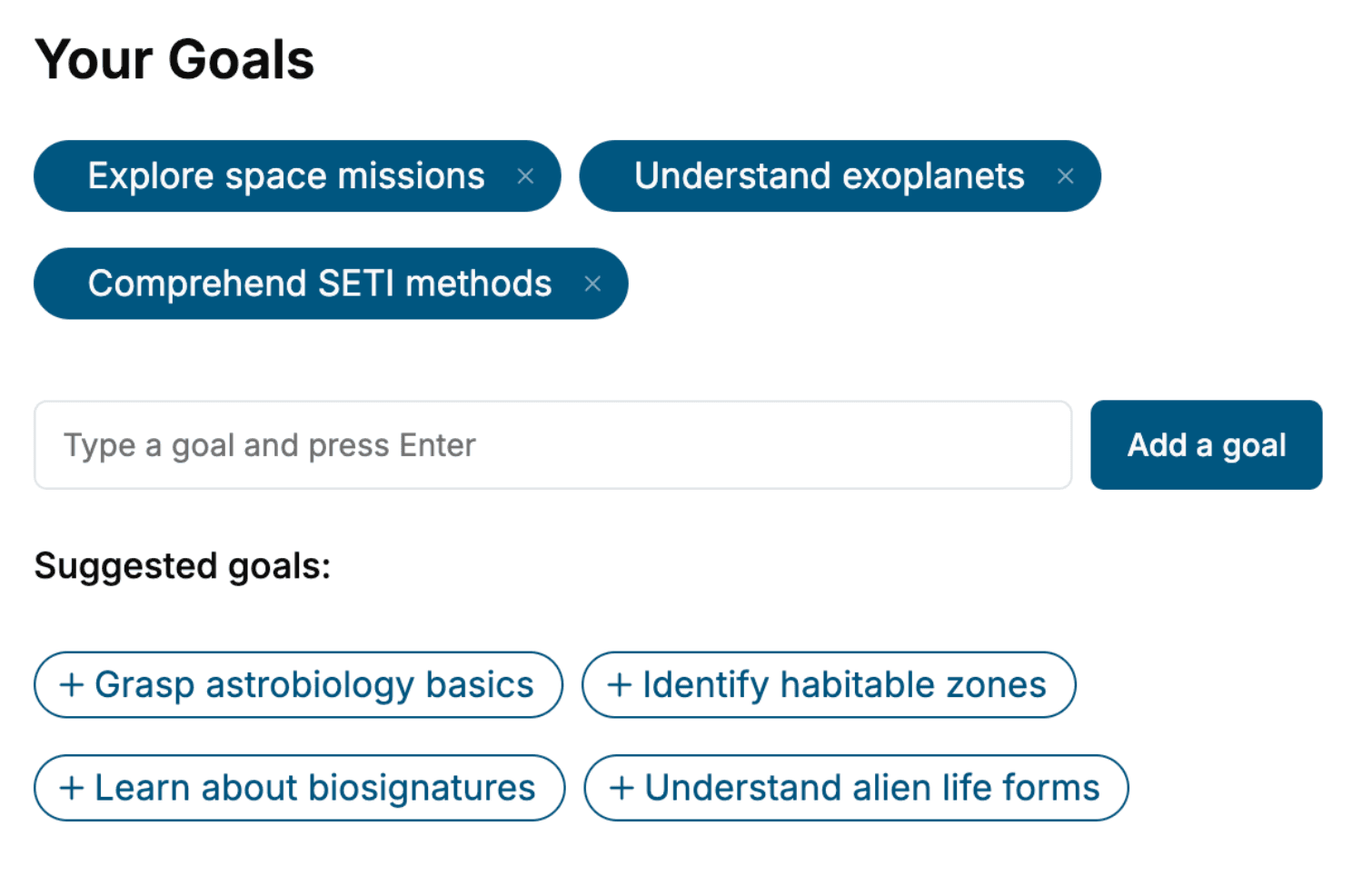
Specify your goals and choose sub-topics to include
- 3. Get your tailored book
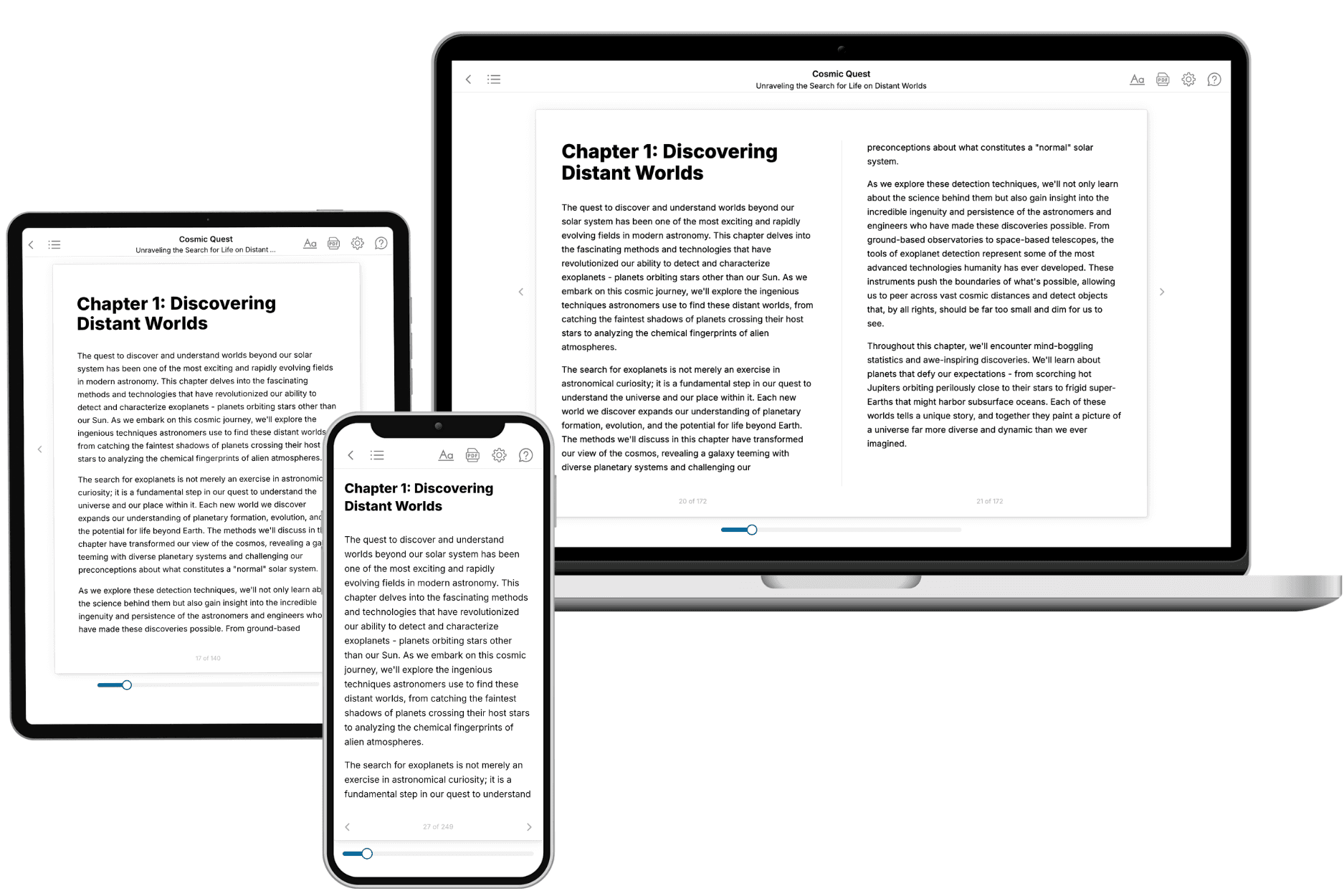
Your book is ready in 10 minutes. Read it online, download as EPUB or PDF, or send to Kindle.

Frequently asked questions
- What is TailoredRead?
TailoredRead creates complete, full-length nonfiction ebooks, written specifically for you. Tell us what you want to learn and why, and TailoredRead writes you a complete ebook on it, with charts, tables, and diagrams throughout. Read it online, on Kindle, or on any e-reader, or download it as a PDF or EPUB. Every book is written fresh the day you order it.
- How is the book tailored to me?
Before anything is written, you answer a few short questions about your goals, your background, and the topics you care about. Your book is then planned around your answers: written at your level, focused on your goals, and covering the topics you chose, instead of the one-size-fits-all book a store sells everyone.
- Will it read like generic AI content?
No. Your book isn't a chat transcript: it's planned chapter by chapter before a single word is written, told in a clear book voice, and explains ideas visually with charts, tables, and diagrams. After writing, every book goes through an editorial pass that polishes chapters so the book reads consistent from start to finish. Judge for yourself: browse thousands of sample books on our Explore Books page.
- How accurate is the content?
Our AI first checks whether your subject needs live research. Niche and fast-moving subjects are researched before writing, and the book plan and chapters are grounded in what it finds. After writing, every book goes through a quality pass that checks its facts and consistency, and researched books list their sources in a Notes section at the back.
- How long is the book?
You choose the length: Comprehensive (250-300 pages), Detailed (150-200 pages), Essential (70-100 pages), or Short (30-50 pages).
- Does the book include visuals?
Yes. Every book includes charts, tables, and diagrams: timelines, checklists, step-by-step guides, decision trees, comparison tables, matrices, and bar charts. A typical book includes dozens of these visual elements.
- Can I read it on Kindle? What formats can I download?
Yes. Every book can be read in our online reader or downloaded as a PDF or EPUB. The EPUB can be opened with Kindle, Apple Books, Kobo, and any e-reader. The Commercial and Author licenses also include an editable Word (DOCX) and Markdown download.
- How much does it cost?
About the price of a regular ebook. The exact price depends on your book's length and complexity, from $2 for the shortest books to $35 for the most comprehensive, and it's shown when you review your book, before you commit to anything. Each book is a one-time purchase, yours to keep, no subscription. Licenses that let you share, teach, or publish your book range from $35.99 to $49.99.
- Can I preview the book before purchasing?
Before you pay, you'll see what your book will cover: the title, a detailed description, the estimated length, and the complete chapter-by-chapter table of contents, so you know what you're getting before you decide. The full text itself is written after you purchase.
- How long does it take to create a book?
About 10 minutes. You can start reading the opening chapters while the rest is still being written.