The Ethnobotanist's Guide
Understanding Plants, Cultures, and the Wisdom of Traditional Knowledge
Many people assume ethnobotany is simply about identifying wild plants or using herbs for home remedies.
207 pages9 chaptersNov 12, 2025Botany
About this book
In reality, it's a sophisticated science that reveals how human cultures have developed profound relationships with the plant world over millennia. This book explores the fascinating intersection of botany, anthropology, chemistry, and ecology—showing how indigenous communities have created sustainable systems of plant use that continue to inform modern medicine, agriculture, and conservation efforts. You'll discover how traditional knowledge systems work, why certain plants became central to specific cultures, and how ethnobotanists conduct research ethically and responsibly. From the rainforests of South America to the deserts of Africa, from ancient healing practices to cutting-edge pharmaceutical discoveries, this guide illuminates the remarkable ways plants and people have co-evolved. Whether you're interested in ethnobotany as an academic pursuit, a conservation concern, or simply a deeper appreciation for human ingenuity, you'll gain practical knowledge and analytical frameworks that transform how you understand the natural world and cultural diversity.
Table of contents
- IntroductionWhat Is Ethnobotany?, Why Ethnobotany Matters Today, How to Use This BookRead below
- Chapter 1: Foundations of EthnobotanyDefining the Discipline: History and Evolution, An Interdisciplinary Approach, Key Concepts and Terminology, Ethnobotany Versus Related Fields
- Chapter 2: Traditional Knowledge SystemsHow Indigenous Cultures Classify Plants, Oral Transmission and Knowledge Preservation, Sustainable Ecological Management Practices, Spiritual and Cultural Significance of Plants
- Chapter 3: Plants as MedicineTraditional Healing Systems Across Cultures, From Traditional Use to Pharmacological Validation, Modern Drug Discovery from Ethnobotanical Leads, Challenges and Opportunities in Medicinal Plant Research
- Chapter 4: Food, Agriculture, and DomesticationThe History of Crop Domestication, Traditional Agricultural Systems and Biodiversity, Staple Crops and Cultural Identity, Food Security and Ethnobotanical Knowledge
- Chapter 5: Materials, Fibers, and DyesPlant-Based Materials in Human Culture, Textiles, Fibers, and Traditional Crafts, Natural Dyes, Pigments, and Colorants, Sustainable Alternatives to Synthetic Materials
- Chapter 6: Biodiversity Hotspots and Cultural DiversityMapping Biodiversity and Cultural Centers, Rainforest Ethnobotany: Tropical Megadiversity, Arid Region Adaptations and Plant Use, Temperate Forest Traditions and Knowledge
- Chapter 7: Research Methods and EthicsDesigning Ethnobotanical Research, Fieldwork Techniques and Data Collection, Ethical Frameworks and Community Engagement, Intellectual Property Rights and Benefit Sharing
- Chapter 8: Conservation and ThreatsBiodiversity Loss and Extinction Risk, Cultural Erosion and Knowledge Loss, Climate Change Impacts on Plant Distributions, Conservation Strategies and Community-Based Solutions
- Chapter 9: Case Studies in EthnobotanyAyurveda: The Medical Tradition of India, Traditional Chinese Medicine and Plant Use, Amazonian Indigenous Plant Knowledge Systems
- ConclusionSynthesizing Key Insights, The Future of Ethnobotany
- Glossary
- Further Reading and Resources
Introduction
When you walk through a forest, garden, or even a city park, you're surrounded by relationships that stretch back thousands of years. Every plant around you tells a story—not just of botanical evolution, but of human ingenuity, cultural adaptation, and survival. The tomatoes in your kitchen originated in the Americas and were transformed through centuries of indigenous cultivation. The aspirin in your medicine cabinet traces its lineage to traditional uses of willow bark. The cotton in your clothing represents millennia of plant domestication and textile innovation across multiple continents. These connections between plants and people form the foundation of ethnobotany, a discipline that reveals how deeply intertwined human civilization is with the botanical world.
Ethnobotany challenges the artificial boundaries we often draw between nature and culture, science and tradition, past and present. It demonstrates that indigenous communities aren't simply living in their environments—they've actively shaped those landscapes through sophisticated management practices developed over countless generations. When a Kayapó farmer in Brazil creates a forest garden with over 250 plant species, or when a traditional healer in Nepal identifies the precise mountain elevation where a medicinal herb grows most potent, they're applying knowledge systems as rigorous and empirically grounded as any modern scientific discipline. Understanding these systems doesn't just enrich our appreciation of human diversity; it provides practical solutions to contemporary challenges in medicine, agriculture, and conservation.
This book invites you into a world where botany meets anthropology, where chemistry intersects with cultural practice, and where ancient wisdom informs cutting-edge research. You'll discover why certain plants became sacred to specific cultures, how traditional knowledge has led to life-saving pharmaceuticals, and why the loss of indigenous languages represents not just a cultural tragedy but a scientific crisis. Whether you're a student considering ethnobotany as a field of study, a healthcare professional interested in medicinal plants, a conservationist seeking sustainable solutions, or simply someone curious about the remarkable ways humans have learned to thrive alongside plants, this guide offers frameworks for understanding one of humanity's most fundamental relationships. The journey begins with a simple question: what exactly is ethnobotany, and why does it matter more now than ever before?
What Is Ethnobotany?
Ethnobotany is the scientific study of the relationships between people and plants. The term itself combines ethno, referring to people or culture, with botany, the study of plants. But this simple definition barely scratches the surface of what ethnobotanists actually do. The field encompasses how different cultures identify, classify, manage, and use plants for food, medicine, shelter, clothing, ritual, and countless other purposes. It examines both the practical applications of plants in daily life and the symbolic meanings they carry within cultural systems. An ethnobotanist might spend months documenting how an Amazonian community uses over 300 plant species for different purposes, or years analyzing the chemical compounds in a traditional remedy to understand why it works.
The discipline emerged formally in the late 19th century, though humans have been practicing ethnobotany informally since the dawn of our species. The term was coined by botanist John William Harshberger in 1895, but the systematic study of plant-people relationships gained momentum throughout the 20th century[1]. Early ethnobotanists often accompanied anthropological expeditions, documenting plant uses among indigenous communities. However, the field has evolved dramatically from its colonial-era origins. Modern ethnobotany emphasizes collaborative research, ethical engagement with communities, and recognition that traditional knowledge holders are experts in their own right, not merely informants providing data for outside researchers.
What makes ethnobotany unique is its fundamentally interdisciplinary nature. To practice ethnobotany effectively, you need to draw on multiple fields:
- Botany and plant taxonomy to accurately identify and classify plant species
- Anthropology and linguistics to understand cultural contexts and communication systems
- Chemistry and pharmacology to analyze plant compounds and their effects
- Ecology and environmental science to comprehend plant distributions and ecosystem relationships
- History and archaeology to trace how plant-human relationships evolved over time
- Ethics and law to navigate intellectual property rights and community consent
Ethnobotany operates at multiple scales of inquiry. At the individual level, it examines how specific people acquire and transmit plant knowledge throughout their lives. At the community level, it explores how groups develop shared understandings of their botanical environment and create systems for managing plant resources. At the regional level, it investigates how geography, climate, and biodiversity shape the possibilities for plant use. At the global level, it traces how plants, seeds, and knowledge have moved across continents, transforming cuisines, economies, and ecosystems. Each scale reveals different patterns and raises different questions about how humans and plants have co-evolved.
Consider a concrete example: the relationship between the Quechua people of Peru and the potato. An ethnobotanist studying this relationship wouldn't simply catalog potato varieties. They would investigate how Quechua farmers recognize and name hundreds of distinct potato cultivars, often using characteristics invisible to outsiders. They would document the sophisticated agricultural techniques developed for growing potatoes at extreme altitudes, including the creation of raised fields that moderate temperature fluctuations. They would explore how potatoes feature in Quechua cosmology and ritual life, not just as food but as beings with spiritual significance. They would trace how Spanish colonizers carried potatoes to Europe, where they eventually became a staple crop that transformed European agriculture and demographics. This single plant-culture relationship encompasses botany, agriculture, linguistics, religion, history, and global economics.
The scope of ethnobotany extends far beyond what many people initially imagine. It's not limited to remote indigenous communities or exotic tropical plants. Ethnobotanists study urban gardens in Detroit, traditional apple orchards in Kazakhstan, seaweed harvesting in coastal Scotland, and medicinal plant markets in Morocco. They investigate how immigrant communities maintain connections to their heritage through cultivating specific crops, how prison gardens affect rehabilitation outcomes, and how climate change is forcing communities to adapt their traditional plant management practices. Any situation where humans interact meaningfully with plants falls within ethnobotany's purview. The field recognizes that everyone, regardless of their cultural background, has ethnobotanical knowledge—even if it's just knowing which herbs to add to pasta sauce or which houseplants tolerate low light.
Modern ethnobotany also grapples with urgent contemporary questions. How can traditional agricultural knowledge help develop climate-resilient food systems? What happens to medicinal plant knowledge when younger generations migrate to cities? How should pharmaceutical companies compensate indigenous communities when traditional remedies lead to profitable drugs? Can ethnobotanical research help restore degraded ecosystems using traditional ecological management techniques? These questions demonstrate that ethnobotany isn't merely an academic exercise in documenting the past. It's a vital tool for addressing present challenges and shaping sustainable futures. The field sits at the intersection of cultural preservation, scientific innovation, environmental conservation, and social justice.
Understanding ethnobotany requires recognizing that plant knowledge isn't static or uniform. Different individuals within the same community often possess different expertise—elders might know medicinal applications, while farmers specialize in crop management, and ritual specialists understand ceremonial uses. Gender frequently shapes plant knowledge, with women and men often having distinct but complementary expertise. Knowledge also changes over time as communities encounter new plants, adopt new technologies, or face environmental changes. An ethnobotanist must be attentive to this diversity and dynamism, avoiding the trap of treating cultures as frozen in time or assuming that any single person can speak for an entire community's botanical knowledge.
Why Ethnobotany Matters Today
The relevance of ethnobotany has never been more critical than in our current era of rapid environmental and social change. As biodiversity declines at unprecedented rates, we're simultaneously losing the cultural knowledge systems that have sustained human communities for millennia. When a language goes extinct—which happens approximately every two weeks—we lose not just words but entire frameworks for understanding the natural world[2]. Many plant names, uses, and management techniques exist only in oral traditions. Once the last speaker of a language dies, that knowledge often disappears forever. Ethnobotany provides methods for documenting this knowledge before it's lost, creating records that can benefit both the communities themselves and humanity more broadly.
The pharmaceutical industry offers perhaps the most tangible demonstration of ethnobotany's practical value. Approximately 25% of modern medicines derive from plants, and many of these were first identified through ethnobotanical research into traditional remedies[3]. Consider these examples:
- Aspirin originated from traditional uses of willow bark for pain and fever
- Quinine, the first effective malaria treatment, came from indigenous Peruvian use of cinchona bark
- Vincristine and vinblastine, crucial chemotherapy drugs, were developed from the Madagascar periwinkle after ethnobotanical leads
- Artemisinin, the most effective antimalarial drug, was discovered through research into traditional Chinese medicine
- Digoxin, used for heart conditions, derives from foxglove, long used in European folk medicine
Climate change makes ethnobotanical knowledge increasingly valuable for developing resilient agricultural systems. Traditional farmers have spent generations observing how plants respond to environmental variations, developing crop varieties adapted to specific microclimates, and creating agricultural techniques that work with rather than against ecological processes. In Peru's Potato Park, Quechua communities maintain over 1,300 potato varieties, representing a genetic reservoir that could prove crucial as climate change forces agriculture to adapt[4]. These varieties include potatoes resistant to frost, drought, pests, and diseases—traits that industrial agriculture is now desperately trying to breed into commercial crops. Traditional knowledge about intercropping, water management, and soil conservation offers proven strategies for sustainable food production that modern agriculture is only beginning to appreciate.
Ethnobotany also illuminates the deep connections between biological and cultural diversity. Research consistently shows that areas of high biodiversity overlap significantly with regions of high linguistic and cultural diversity. Indigenous territories, which cover about 22% of Earth's land surface, contain approximately 80% of the planet's remaining biodiversity[5]. This isn't coincidental. Many indigenous communities have actively managed their landscapes for thousands of years using practices that maintain or even enhance biodiversity. The Amazon rainforest, often imagined as pristine wilderness, actually bears the fingerprints of millennia of indigenous management, with useful plant species concentrated in patterns that reflect human cultivation and selection. Understanding these traditional management systems is essential for effective conservation strategies.
The field addresses critical questions of justice and equity in how we value different knowledge systems. For centuries, Western science dismissed traditional knowledge as superstition or folklore, only to later "discover" principles that indigenous communities had understood for generations. Ethnobotany, when practiced ethically, challenges this hierarchy by recognizing traditional knowledge as legitimate, empirically grounded, and valuable in its own right. It advocates for indigenous peoples' rights to control their knowledge and benefit from its applications. The Nagoya Protocol, an international agreement on access to genetic resources and benefit-sharing, emerged partly from ethnobotanists' advocacy for fair treatment of indigenous communities. This represents a fundamental shift toward recognizing that knowledge has value regardless of whether it's written in scientific journals or transmitted through oral traditions.
Urban populations, increasingly disconnected from plant-based livelihoods, benefit from ethnobotanical perspectives that reveal the botanical foundations of daily life. Your morning coffee, afternoon chocolate, and evening glass of wine all represent complex ethnobotanical histories involving domestication, trade, cultural adoption, and agricultural innovation. The spices in your kitchen traveled along ancient trade routes that shaped world history. The wood in your furniture, the cotton in your clothes, the paper in your books—all reflect specific relationships between humans and plants. Ethnobotany makes these invisible connections visible, fostering appreciation for the botanical world and the diverse cultures that have shaped our relationships with it. This awareness can inspire more sustainable consumption choices and greater respect for the knowledge systems that developed these resources.
The discipline also offers frameworks for addressing biocultural conservation—the recognition that preserving biodiversity and cultural diversity are inseparable goals. When a forest is cleared, we lose not just species but also the accumulated knowledge about those species. When indigenous youth migrate to cities and abandon traditional livelihoods, plant knowledge disappears even if the plants themselves survive. Effective conservation requires supporting the communities who have successfully managed ecosystems for generations, respecting their land rights, and ensuring they can continue their traditional practices. Ethnobotany provides the research methods and ethical frameworks needed to document knowledge, demonstrate its value, and advocate for policies that protect both biological and cultural heritage.
Finally, ethnobotany cultivates critical thinking about sustainability and human-environment relationships. It demonstrates that humans aren't inherently destructive to nature—many cultures have developed sustainable relationships with their environments that persisted for thousands of years. It shows that "traditional" doesn't mean primitive or unchanging; traditional knowledge systems are dynamic, adaptive, and sophisticated. It reveals that there are multiple valid ways of knowing and understanding the world, each with its own strengths and limitations. These insights are essential for developing the kind of nuanced, culturally informed approaches needed to address complex challenges like climate change, food security, and biodiversity loss. Ethnobotany doesn't just teach you about plants and cultures—it transforms how you think about knowledge, sustainability, and the possibilities for human societies to thrive in balance with the natural world.
How to Use This Book
This book is designed to build your understanding of ethnobotany systematically, moving from foundational concepts to specific applications and case studies. Each chapter addresses a distinct aspect of the field while connecting to broader themes that run throughout the discipline. You don't necessarily need to read the chapters in order, but the sequence is structured to introduce concepts progressively, with later chapters building on frameworks established earlier. If you're new to ethnobotany, reading sequentially will provide the most coherent learning experience. If you already have background knowledge, you might choose to focus on chapters addressing your specific interests or gaps in your understanding.
The book is organized into several thematic sections:
- Foundations (Chapter 1) establishes the historical development of ethnobotany, its interdisciplinary nature, and core concepts you'll encounter throughout the field
- Knowledge Systems (Chapter 2) explores how different cultures understand, classify, and transmit plant knowledge across generations
- Applications (Chapters 3-5) examine specific domains where plants intersect with human life—medicine, food and agriculture, and materials
- Geography and Diversity (Chapter 6) investigates how different ecosystems and regions have shaped distinct ethnobotanical traditions
- Practice and Ethics (Chapter 7) provides practical guidance on conducting ethnobotanical research responsibly and ethically
- Conservation (Chapter 8) addresses threats to both plant diversity and traditional knowledge, along with strategies for preservation
- Case Studies (Chapter 9) offers in-depth examinations of specific ethnobotanical systems, illustrating how concepts from earlier chapters manifest in real-world contexts
Throughout the book, you'll encounter several types of content designed to enhance your learning. Concrete examples and case studies illustrate abstract concepts, showing how ethnobotanical principles operate in specific cultural and ecological contexts. These aren't just decorative anecdotes—they're essential for understanding how theory translates into practice. When you read about a particular plant-culture relationship, consider what broader patterns it exemplifies and how similar dynamics might operate in different contexts. The examples are chosen to represent diverse geographic regions, cultural groups, and types of plant use, giving you a global perspective on ethnobotanical diversity.
Key terms and concepts are highlighted when first introduced, and you'll find a comprehensive glossary at the end of the book for quick reference. Ethnobotany draws vocabulary from multiple disciplines, and some terms have specific technical meanings that differ from everyday usage. When you encounter an unfamiliar term, take time to understand it fully before proceeding—these concepts form the building blocks for more complex ideas introduced later. The glossary also includes pronunciation guides for terms from indigenous languages, helping you engage respectfully with the cultural contexts where these concepts originated.
The book emphasizes actionable knowledge alongside theoretical understanding. You'll find frameworks for analyzing plant-culture relationships, questions to guide your thinking about ethnobotanical issues, and considerations for ethical engagement with traditional knowledge. If you're interested in pursuing ethnobotanical research, Chapter 7 provides detailed guidance on research design, fieldwork methods, and ethical protocols. Even if you don't plan to conduct formal research, these frameworks will help you think critically about ethnobotanical claims you encounter in media, evaluate the sustainability of plant-based products, and appreciate the complexity of traditional knowledge systems.
Several themes recur throughout the book, and recognizing these connections will deepen your understanding:
- Interdependence: Plants and humans have shaped each other through domestication, cultivation, and ecosystem management
- Diversity: Both biological and cultural diversity are essential for resilience and adaptation
- Ethics: Engaging with traditional knowledge requires respect, reciprocity, and recognition of intellectual property rights
- Change: Traditional knowledge systems are dynamic and adaptive, not frozen in time
- Integration: Effective solutions to contemporary challenges require combining traditional knowledge with modern science
- Justice: Ethnobotany intersects with issues of indigenous rights, environmental justice, and equitable benefit-sharing
To get the most from this book, engage actively with the material rather than passively absorbing information. When you encounter a plant-culture relationship, ask yourself: What environmental factors made this plant available and useful? What knowledge and skills would be required to use this plant effectively? How might this knowledge have been discovered and refined over time? What would be lost if this knowledge disappeared? How does this example challenge or confirm your assumptions about traditional knowledge? This kind of critical engagement transforms reading from information consumption into genuine learning that changes how you see the world around you.
Consider keeping a notebook as you read, recording observations, questions, and connections you notice. You might document plants in your own environment and research their ethnobotanical histories. You could explore the origins of foods in your diet or investigate traditional plant uses in your own cultural heritage. Many readers find that ethnobotany transforms everyday experiences—a walk through a park becomes an opportunity to notice plant diversity, a trip to the grocery store reveals global networks of plant domestication and trade, a conversation with an elder uncovers forgotten knowledge about local plants. The book provides frameworks and information, but the real learning happens when you apply these concepts to your own observations and experiences.
The "Further Reading and Resources" section at the end of the book directs you toward additional materials for deepening your knowledge. These include foundational texts in ethnobotany, specialized works on particular regions or topics, journals where current research is published, and organizations working on ethnobotanical conservation and research. If particular chapters or topics especially interest you, these resources provide pathways for continued exploration. Ethnobotany is a vast field, and this book serves as an introduction and guide rather than an exhaustive treatment. Consider it a starting point for a lifelong engagement with the fascinating relationships between plants and people.
Finally, approach this book with both intellectual curiosity and cultural humility. Ethnobotany reveals the sophistication and value of knowledge systems that dominant cultures have often dismissed or exploited. It challenges us to recognize that there are multiple valid ways of understanding the world, each offering unique insights. As you learn about different cultures' relationships with plants, resist the temptation to romanticize or exoticize these practices. Traditional knowledge holders are neither mystical sages with perfect ecological wisdom nor primitive peoples trapped in the past—they're people navigating complex realities, adapting to changing circumstances, and making decisions based on their values and circumstances. Approach their knowledge with the same respect and critical engagement you would bring to any other expert domain. This balance of appreciation and analysis is essential for ethical, effective engagement with ethnobotany.
Notes
Introduction
- 1. J. W. Harshberger, "The Purposes of Ethno-Botany," Botanical Gazette, 1896
- 2. L. Maffi, "Linguistic, Cultural, and Biological Diversity," Annual Review of Anthropology, 2005
- 3. D. S. Fabricant and N. R. Farnsworth, "The Value of Plants Used in Traditional Medicine for Drug Discovery," Environmental Health Perspectives, 2001
- 4. A. Argumedo and T. Stenner, Association ANDES: Conserving Indigenous Biocultural Heritage in Peru, Gatekeeper Series, 137a, 2008
- 5. S. T. Garnett and others, "A Spatial Overview of the Global Importance of Indigenous Lands for Conservation," Nature Sustainability, 2018
This is the end of the free sample. The full book has 9 chapters.
Want this book written for you?
Tell us your goals and background, and get your own version of this book, tailored by AI to you.


Benefits of AI-tailored books
- Read one book, not ten:
- all the Botany knowledge you need, gathered into a single book.
- Save days of learning:
- tell us your goals, choose your topics, and the whole book is built around them.
- Learn effortlessly:
- Botany book written for your specific background and expertise.
- Understand at a glance:
- includes charts, tables, timelines, checklists, decision trees, and more.
- Stay current:
- written the day you order it, not years ago.
- Trust what you read:
- every book is checked for accuracy, with real research when your subject needs it.
Create your unique book in 3 steps
- 1. Select your focus
Select the focus of your Botany book and share your background
- 2. Personalize your book
Specify your goals and choose sub-topics to include
- 3. Get your tailored book
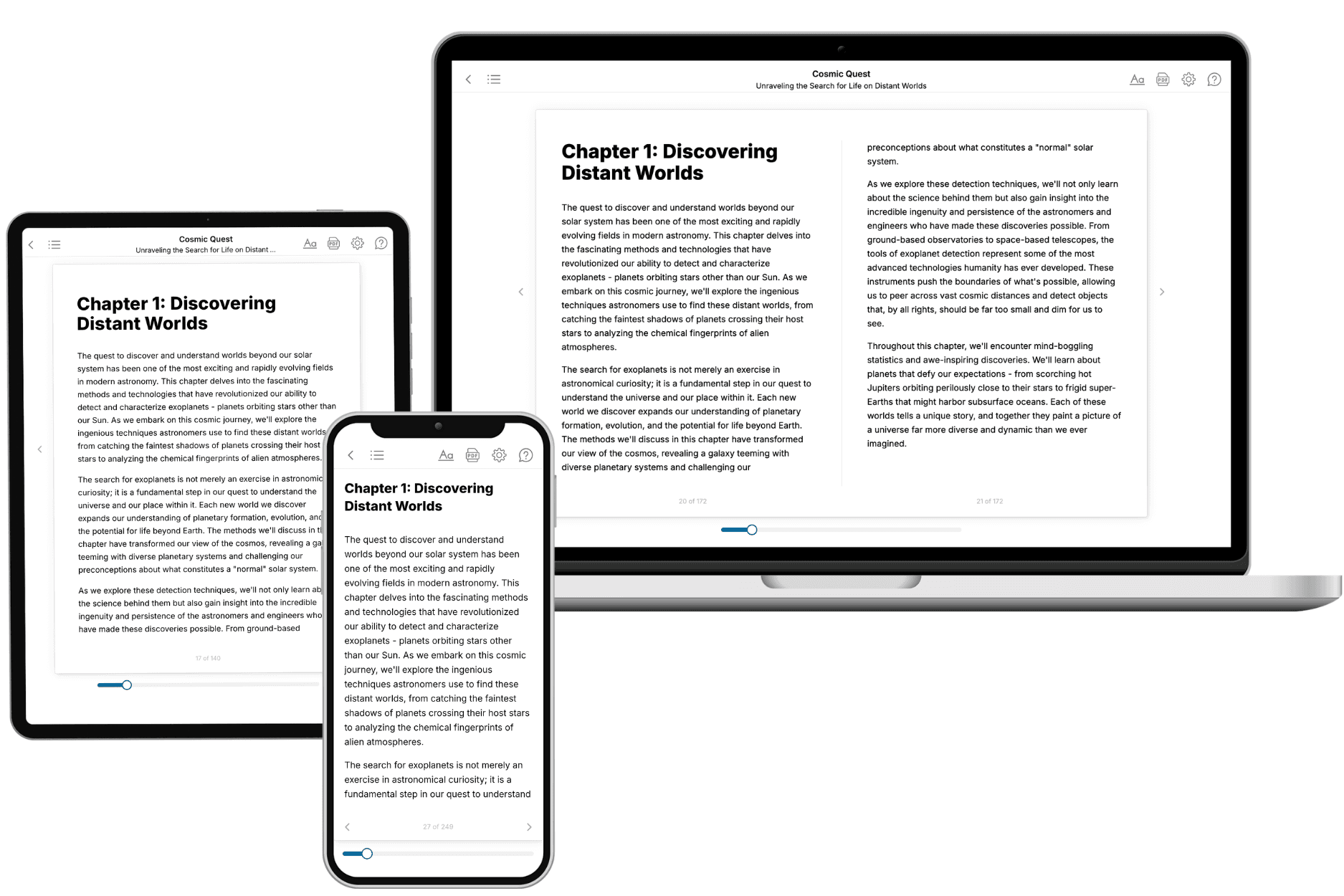
Your book is ready in 10 minutes. Read it online, download as EPUB or PDF, or send to Kindle.

Frequently asked questions
- What is TailoredRead?
TailoredRead creates complete, full-length nonfiction ebooks, written specifically for you. Tell us what you want to learn and why, and TailoredRead writes you a complete ebook on it, with charts, tables, and diagrams throughout. Read it online, on Kindle, or on any e-reader, or download it as a PDF or EPUB. Every book is written fresh the day you order it.
- How is the book tailored to me?
Before anything is written, you answer a few short questions about your goals, your background, and the topics you care about. Your book is then planned around your answers: written at your level, focused on your goals, and covering the topics you chose, instead of the one-size-fits-all book a store sells everyone.
- Will it read like generic AI content?
No. Your book isn't a chat transcript: it's planned chapter by chapter before a single word is written, told in a clear book voice, and explains ideas visually with charts, tables, and diagrams. After writing, every book goes through an editorial pass that polishes chapters so the book reads consistent from start to finish. Judge for yourself: browse thousands of sample books on our Explore Books page.
- How accurate is the content?
Our AI first checks whether your subject needs live research. Niche and fast-moving subjects are researched before writing, and the book plan and chapters are grounded in what it finds. After writing, every book goes through a quality pass that checks its facts and consistency, and researched books list their sources in a Notes section at the back.
- How long is the book?
You choose the length: Comprehensive (250-300 pages), Detailed (150-200 pages), Essential (70-100 pages), or Short (30-50 pages).
- Does the book include visuals?
Yes. Every book includes charts, tables, and diagrams: timelines, checklists, step-by-step guides, decision trees, comparison tables, matrices, and bar charts. A typical book includes dozens of these visual elements.
- Can I read it on Kindle? What formats can I download?
Yes. Every book can be read in our online reader or downloaded as a PDF or EPUB. The EPUB can be opened with Kindle, Apple Books, Kobo, and any e-reader. The Commercial and Author licenses also include an editable Word (DOCX) and Markdown download.
- How much does it cost?
About the price of a regular ebook. The exact price depends on your book's length and complexity, from $2 for the shortest books to $35 for the most comprehensive, and it's shown when you review your book, before you commit to anything. Each book is a one-time purchase, yours to keep, no subscription. Licenses that let you share, teach, or publish your book range from $35.99 to $49.99.
- Can I preview the book before purchasing?
Before you pay, you'll see what your book will cover: the title, a detailed description, the estimated length, and the complete chapter-by-chapter table of contents, so you know what you're getting before you decide. The full text itself is written after you purchase.
- How long does it take to create a book?
About 10 minutes. You can start reading the opening chapters while the rest is still being written.