The European Union: From Vision to Reality
Understanding the History, Structure, and Future of Europe's Greatest Political Project
What if the most ambitious political experiment in modern history could be explained in a way that actually makes sense?
207 pages11 chaptersMay 27, 2026International Relations
About this book
The European Union is often portrayed as either a bureaucratic nightmare or a visionary achievement—but the reality is far more nuanced and fascinating. This book cuts through the complexity to show you how a continent devastated by war transformed itself into an unprecedented union of 27 democracies. You'll discover the historical forces that drove integration, the ingenious (and sometimes frustrating) institutions that make it work, and the real tensions that threaten its future. From the Coal and Steel Community's modest beginnings to today's debates over sovereignty and identity, this book reveals why the EU matters—not just for Europeans, but for understanding how nations can choose cooperation over conflict. Whether you're curious about how Brussels actually functions, puzzled by Brexit, or wondering what Europe's future holds, you'll find clear answers grounded in history and contemporary reality.
Table of contents
- IntroductionWhy the European Union Matters Today, How to Use This Book, Essential Concepts You'll EncounterRead below
- Chapter 1: The Ruins of War: Europe Before the UnionA Continent in Crisis, The Cold War and European Division, First Visions of European Unity
- Chapter 2: Building the Foundation: The Coal and Steel CommunityThe Schuman Plan: A Radical Idea, Creating the European Coal and Steel Community, Early Successes and Lessons Learned
- Chapter 3: Expansion and Crisis: The Road to the Common MarketThe Treaty of Rome and the EEC, Navigating Early Conflicts and Disagreements, The First Wave of Enlargement
- Chapter 4: The Institutional Framework: How the EU Actually WorksThe European Commission: The Executive Branch, The European Parliament: Democratic Representation, The Council and Court of Justice: Coordination and Law
- Chapter 5: The Single Market: Breaking Down BarriersThe Vision of a Borderless Europe, The Four Freedoms: Movement of People, Goods, Services, and Capital, Economic Impact and Ongoing Challenges
- Chapter 6: Monetary Union: The Euro and BeyondThe Path to a Common Currency, Creating the Eurozone, The Eurozone Crisis and Its Aftermath
- Chapter 7: Deepening Integration: The Maastricht and Lisbon TreatiesThe Maastricht Treaty: Creating the European Union, The Lisbon Treaty: Modernizing Institutions, Testing the Limits of Integration
- Chapter 8: Enlargement and Diversity: From Six to Twenty-SevenSouthern Enlargement: Spain, Portugal, and Greece, Eastern Expansion: The Post-Cold War Transformation, Managing Diversity and Cohesion
- Chapter 9: Sovereignty and Democracy: The Legitimacy QuestionThe Democratic Deficit Debate, Balancing National Sovereignty and EU Authority, Building Citizen Engagement and Trust
- Chapter 10: The Brexit Shock: When Integration ReversesUnderstanding the Causes of Brexit, The Withdrawal Process and Negotiations, Lessons for the Future of European Integration
- Chapter 11: Contemporary Challenges: Migration, Populism, and IdentityThe Migration and Refugee Crisis, The Rise of Eurosceptic and Populist Movements, Questions of European Identity and Values
- Conclusion: The Future of EuropeReflecting on the EU's Achievements, Possible Futures for European Integration
Introduction
Imagine a continent where, within living memory, neighbors were bombing each other's cities into rubble, where borders were drawn and redrawn in blood, and where the idea of peaceful cooperation between France and Germany seemed not just unlikely but almost absurd. Now imagine that same continent, just a few decades later, sharing a common currency, open borders, a single market, and a shared legal framework governing everything from food safety to human rights. That transformation is the story of the European Union, and it is one of the most remarkable political achievements in modern history.
The EU is often misunderstood. In popular debate, it gets reduced to caricature: a faceless bureaucracy in Brussels churning out regulations about the curvature of bananas, or alternatively, a noble peace project that holds civilization together. Neither picture is accurate. The reality is a complex, evolving institution that has genuinely changed how hundreds of millions of people live, work, and move across a continent. Understanding it properly requires looking at where it came from, how it actually functions, and what pressures it faces today.
This book is designed to give you that understanding. It does not assume you have a background in political science or European history, though it does assume you are curious and willing to engage with ideas that are sometimes genuinely complicated. The goal is to make the EU accessible without making it simplistic. Europe's integration project is full of fascinating tensions, surprising compromises, and moments where history could easily have gone a different way. Those tensions and turning points are what make the story worth telling.
What you will find in these pages is a journey through time and institutions. The book moves from the devastation of World War II through the careful construction of early European institutions, the expansion of the single market, the creation of the euro, and the crises and controversies that have tested the project in recent decades. Along the way, it pauses to explain how the EU's institutions actually work, what the key treaties changed, and why debates over sovereignty and democracy matter so much to the project's future. By the end, you should have a clear, grounded picture of both what the EU has achieved and what challenges it still faces.
Why the European Union Matters Today
The European Union is not just a regional organization. It is the world's largest single market, with a combined GDP of roughly $17 trillion, making it comparable in economic weight to the United States.[1] Its regulatory standards shape global industries. When the EU sets rules on data privacy, chemical safety, or automobile emissions, companies around the world adjust their practices to comply, because access to the European market is simply too valuable to ignore. This phenomenon, sometimes called the Brussels Effect, means that EU decisions ripple far beyond Europe's borders.
Beyond economics, the EU represents a political experiment with no real precedent. Twenty-seven sovereign nations have voluntarily pooled significant portions of their decision-making authority into shared institutions. They have agreed to be bound by a common legal order that, in many areas, takes precedence over their own national laws. They have opened their borders to each other's citizens and, in nineteen cases, abandoned their national currencies entirely. No other group of independent states has ever gone this far in voluntary integration, which is precisely why the EU attracts so much scholarly attention and political controversy.
The EU also matters because it is a living test of a fundamental question in international relations: can nations choose sustained cooperation over competition? The 20th century offered a brutal answer to what happens when they do not. Two world wars, fought largely on European soil, killed tens of millions of people and destroyed the continent's economies and cities. The EU was built, in large part, as a deliberate answer to that catastrophe. Whether that answer holds under pressure from nationalism, economic stress, and geopolitical competition is one of the defining questions of our time.
Recent events have made these questions more urgent. The 2008 financial crisis exposed deep fault lines in the Eurozone's design. The 2015 refugee crisis strained solidarity between member states and fueled the rise of populist and Eurosceptic political movements across the continent. In 2016, the United Kingdom voted to leave the EU entirely, an event that would have seemed almost unthinkable to the architects of European integration. And since 2022, Russia's full-scale invasion of Ukraine has forced the EU to confront its role as a security actor in ways it had long avoided.
Understanding these events requires more than reading today's headlines. It requires knowing the history that shaped the EU's institutions, the logic behind its design choices, and the tensions that were built into the project from the very beginning. That is what this book provides. The EU's current challenges are not random crises. They are, in many ways, the predictable consequences of choices made decades ago, and understanding those choices is the key to understanding what is happening now.
There is also a more personal reason why the EU matters. If you live in Europe, its decisions affect your daily life in ways that are often invisible precisely because they work so smoothly. The ability to travel across borders without showing a passport, to work in another member state, to buy products that meet consistent safety standards, to appeal to a court that sits above your national government: these are not small things. They represent a fundamentally different kind of political life than existed in Europe just a few generations ago. And if you live outside Europe, the EU's choices on trade, climate, technology regulation, and foreign policy affect your world too.
A note on scale: The EU's 27 member states together are home to roughly 450 million people, spanning from Portugal in the west to Bulgaria in the east, and from Finland in the north to Cyprus in the south. They speak 24 official languages and represent an extraordinary diversity of cultures, histories, and political traditions. Holding that diversity together within a single institutional framework is, by any measure, an extraordinary undertaking.
The EU also matters as a model, or a warning, depending on your perspective. Advocates of regional integration in Africa, Southeast Asia, and Latin America have looked to the EU as a template for what is possible. Critics have pointed to its democratic deficits, its bureaucratic complexity, and its struggles with internal solidarity as reasons to be cautious about deep integration. Either way, the EU's experience offers lessons that extend well beyond Europe's borders, making it a subject of genuine global relevance.
How to Use This Book
This book is organized chronologically and thematically. It begins with the historical context that made European integration both necessary and possible, moves through the key institutional and treaty developments that shaped the EU's structure, and then turns to the contemporary challenges that define its current situation. Each chapter is designed to stand on its own, so if you already have a solid grasp of, say, post-war European history, you can move more quickly through the early chapters and spend more time on the institutional and contemporary sections.
That said, reading the book from beginning to end will give you the richest understanding. The EU's current institutional design makes much more sense when you understand the historical compromises that produced it. The debates over sovereignty and democratic legitimacy are far more meaningful when you know how much authority member states have actually transferred to Brussels over the decades. The Brexit story is more comprehensible when you understand the UK's always-ambivalent relationship with European integration going back to the 1950s. History is not just background here. It is the explanation.
Here is a brief map of what each part of the book covers:
- Chapters 1 and 2 cover the post-war context and the creation of the European Coal and Steel Community, the EU's earliest institutional ancestor.
- Chapter 3 traces the path from the Coal and Steel Community to the Treaty of Rome and the creation of the European Economic Community in 1957.
- Chapter 4 steps back from the historical narrative to explain how the EU's main institutions actually work today, including the Commission, Parliament, Council, and Court of Justice.
- Chapters 5 and 6 focus on the two most ambitious economic achievements of integration: the single market and the euro.
- Chapter 7 examines the Maastricht and Lisbon treaties, the two most transformative moments in the EU's constitutional development.
- Chapter 8 covers the successive waves of enlargement that took the EU from six founding members to twenty-seven.
- Chapters 9, 10, and 11 address the EU's most pressing contemporary challenges: democratic legitimacy, Brexit, migration, and the rise of Euroscepticism.
- The Conclusion reflects on the EU's achievements and considers possible futures for the integration project.
Throughout the book, key terms are introduced in italics when they first appear and explained in plain language. You do not need a dictionary of political science jargon to follow the argument. Where technical concepts are unavoidable, they are explained clearly and connected to concrete examples. The goal is always to make the complex understandable, not to impress with terminology.
You will also find, throughout the text, specific examples and case studies that ground abstract institutional descriptions in real events. It is one thing to explain how the EU's legislative process works in theory. It is more useful to walk through a specific piece of legislation and show how it actually moved through the system, where it got stuck, and what compromises were required to pass it. That kind of concrete illustration is woven throughout the book.
A word about what this book does not do. It does not attempt to be a comprehensive academic reference covering every aspect of EU law, policy, and politics. That would require multiple volumes and a very different kind of writing. Instead, it aims to give you a clear, accurate, and engaging overview that equips you to understand the EU's major features and debates. If it sparks a desire to go deeper on particular topics, the footnotes and references throughout the text will point you toward more specialized sources.
Finally, this book tries to be fair. The EU is a subject that generates strong opinions, and those opinions often reflect genuine values and legitimate concerns. Supporters of deeper integration and critics of the EU project both have arguments worth taking seriously. The aim here is not to advocate for a particular position on European integration but to give you the knowledge and analytical tools to form your own informed view. Where the evidence clearly points in one direction, that is stated plainly. Where reasonable people disagree, that disagreement is presented honestly.
Essential Concepts You'll Encounter
Before diving into the history and institutions, it helps to have a clear grasp of a few foundational concepts that appear throughout the book. These are not obscure academic terms. They are the basic vocabulary needed to understand how the EU works and why it is designed the way it is. Think of this section as a brief orientation before the main journey begins.
The first and most important concept is the distinction between supranational and intergovernmental governance. These two words describe fundamentally different ways of organizing cooperation between countries.
- Supranational governance means that member states transfer authority to a shared institution that can make decisions binding on all members, even those that voted against a particular decision. The EU's Court of Justice and the European Commission operate largely on supranational principles. When the Court rules that a national law violates EU law, that ruling applies regardless of what the national government thinks.
- Intergovernmental governance means that decisions require the agreement of national governments, and each government retains a veto. The EU's foreign policy and many security decisions work this way. No country can be forced into a foreign policy position it has not agreed to.
The EU is a hybrid of both approaches, and understanding which areas are governed supranationally and which are intergovernmental is essential to understanding why the EU can act decisively in some areas (like trade policy) and seems paralyzed in others (like foreign policy). This tension between the two models runs through the entire history of European integration and is still very much alive today.
The second key concept is subsidiarity. This principle, formally enshrined in the Maastricht Treaty of 1992, holds that decisions should be made at the lowest level of government capable of handling them effectively.[2] In other words, the EU should only act when individual member states cannot achieve the same objective on their own. Subsidiarity is meant to prevent Brussels from accumulating power unnecessarily and to keep decision-making as close to citizens as possible. In practice, debates about whether a particular issue truly requires EU-level action are constant and often politically charged.
Third, you will encounter the concept of integration itself, used in two related but distinct senses. Widening refers to expanding the EU's membership to include more countries. Deepening refers to expanding the scope and intensity of integration among existing members, moving into new policy areas or strengthening existing ones. Much of the EU's history can be understood as a running debate about the right balance between widening and deepening. Some argue that expanding membership too quickly makes it harder to deepen integration, because a larger and more diverse group of countries finds it harder to agree on ambitious shared policies. Others argue that widening and deepening can and should proceed together.
The fourth concept is the democratic deficit. This term refers to the concern that the EU's decision-making processes are insufficiently accountable to ordinary citizens. Because many key EU decisions are made by appointed officials (like the European Commission) or by national ministers meeting in the Council rather than by directly elected representatives, critics argue that the EU lacks the democratic legitimacy that national governments derive from direct elections. This is one of the most persistent and serious criticisms of the EU, and it has driven multiple rounds of institutional reform. Understanding the democratic deficit debate is essential to understanding both the EU's institutional design and the political discontent that has fueled Eurosceptic movements.
Key concepts at a glance:
- Supranational: Authority shared above the national level; decisions can bind member states even without unanimous consent.
- Intergovernmental: Decisions require agreement of national governments; each retains significant control.
- Subsidiarity: The EU acts only where member states cannot act as effectively alone.
- Widening: Expanding EU membership to new countries.
- Deepening: Expanding the scope or intensity of integration among existing members.
- Democratic deficit: The gap between EU decision-making power and direct democratic accountability to citizens.
A fifth concept worth introducing early is sovereignty, specifically the tension between national sovereignty and EU membership. Sovereignty, in its traditional sense, means that a state has supreme authority over its own territory and people, with no higher power above it. EU membership requires member states to accept that, in certain areas, EU law takes precedence over national law. This is a genuine and significant constraint on traditional sovereignty, and it is the source of enormous political controversy. The question of how much sovereignty member states have given up, and whether that trade-off is worth it, is at the heart of virtually every major EU debate, from Brexit to the Eurozone crisis to disputes over the rule of law.
Finally, it is worth understanding the concept of conditionality, particularly in the context of EU enlargement. When countries apply to join the EU, they must meet a demanding set of criteria covering democracy, the rule of law, human rights, and economic standards. These are known as the Copenhagen Criteria, established in 1993.[3] The requirement to meet these standards before joining has been one of the EU's most powerful tools for promoting political and economic reform in neighboring countries. It has also been a source of frustration and controversy when the process moves slowly or when existing members appear to backslide on the same standards they required of newcomers.
With these concepts in hand, you are well equipped to follow the story that unfolds in the chapters ahead. The history of European integration is, at its core, a story about how nations navigate the tension between their desire for independence and their need for cooperation. It is a story full of idealism and pragmatism, of visionary leaders and stubborn national interests, of remarkable successes and genuine failures. It is, in short, a story very much worth understanding. Let us begin.
Notes
Introduction
- 1. World Bank, GDP data (2023). The EU's combined GDP fluctuates with exchange rates but consistently ranks among the top two or three global economies.
- 2. Treaty on European Union (Maastricht Treaty), Article 5, 1992. The subsidiarity principle was formally incorporated to address concerns about excessive centralization of power in Brussels.
- 3. European Council, Copenhagen Criteria, June 1993. The criteria established that candidate countries must have stable institutions guaranteeing democracy, the rule of law, human rights, and a functioning market economy.
This is the end of the free sample. The full book has 11 chapters.
Want this book written for you?
Tell us your goals and background, and get your own version of this book, tailored by AI to you.


Benefits of AI-tailored books
- Read one book, not ten:
- all the International Relations knowledge you need, gathered into a single book.
- Save days of learning:
- tell us your goals, choose your topics, and the whole book is built around them.
- Learn effortlessly:
- International Relations book written for your specific background and expertise.
- Understand at a glance:
- includes charts, tables, timelines, checklists, decision trees, and more.
- Stay current:
- written the day you order it, not years ago.
- Trust what you read:
- every book is checked for accuracy, with real research when your subject needs it.
Create your unique book in 3 steps
- 1. Select your focus
Select the focus of your International Relations book and share your background
- 2. Personalize your book
Specify your goals and choose sub-topics to include
- 3. Get your tailored book
Your book is ready in 10 minutes. Read it online, download as EPUB or PDF, or send to Kindle.


Frequently asked questions
- What is TailoredRead?
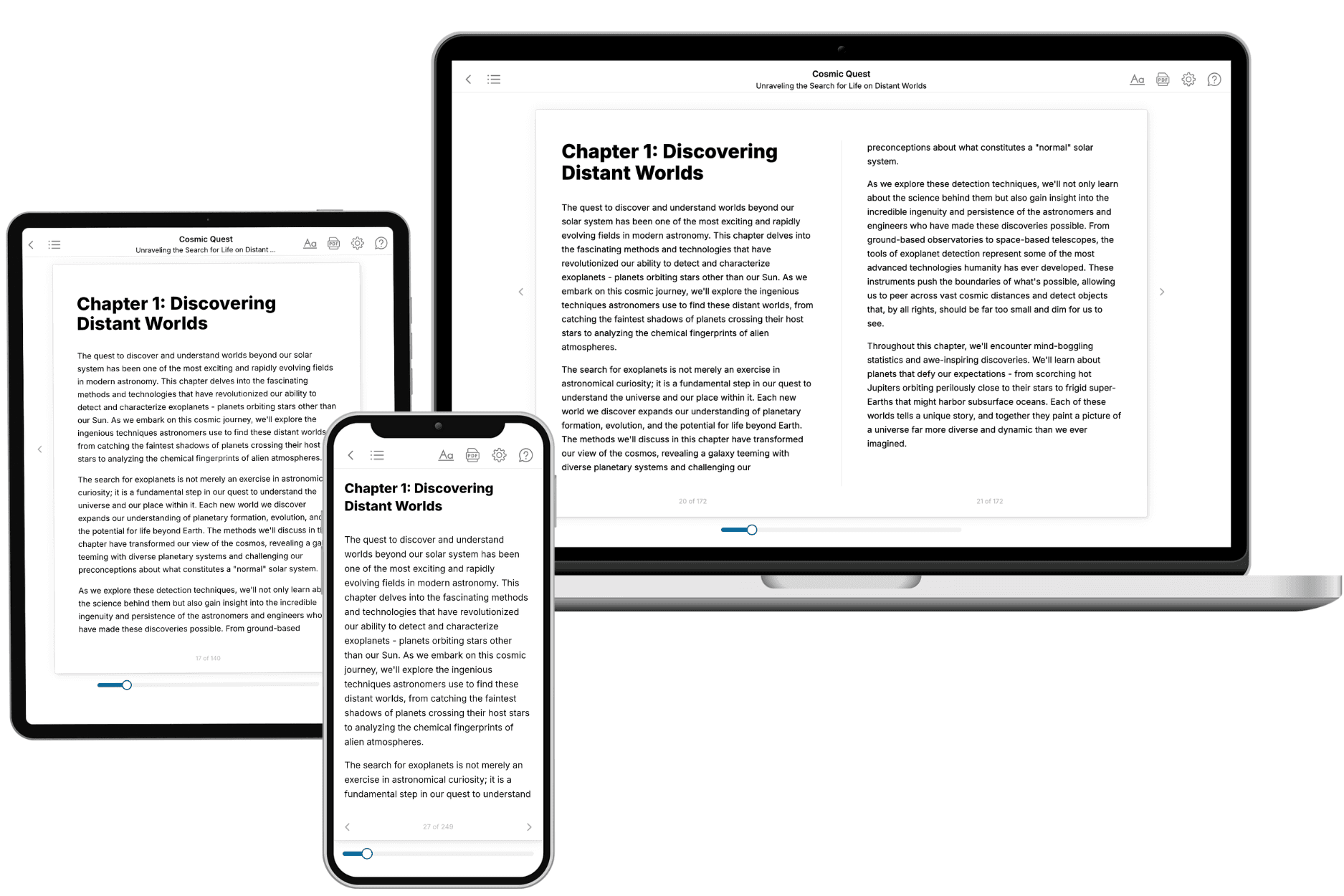
TailoredRead creates complete, full-length nonfiction ebooks, written specifically for you. Tell us what you want to learn and why, and TailoredRead writes you a complete ebook on it, with charts, tables, and diagrams throughout. Read it online, on Kindle, or on any e-reader, or download it as a PDF or EPUB. Every book is written fresh the day you order it.
- How is the book tailored to me?
Before anything is written, you answer a few short questions about your goals, your background, and the topics you care about. Your book is then planned around your answers: written at your level, focused on your goals, and covering the topics you chose, instead of the one-size-fits-all book a store sells everyone.
- Will it read like generic AI content?
No. Your book isn't a chat transcript: it's planned chapter by chapter before a single word is written, told in a clear book voice, and explains ideas visually with charts, tables, and diagrams. After writing, every book goes through an editorial pass that polishes chapters so the book reads consistent from start to finish. Judge for yourself: browse thousands of sample books on our Explore Books page.
- How accurate is the content?
Our AI first checks whether your subject needs live research. Niche and fast-moving subjects are researched before writing, and the book plan and chapters are grounded in what it finds. After writing, every book goes through a quality pass that checks its facts and consistency, and researched books list their sources in a Notes section at the back.
- How long is the book?
You choose the length: Comprehensive (250-300 pages), Detailed (150-200 pages), Essential (70-100 pages), or Short (30-50 pages).
- Does the book include visuals?
Yes. Every book includes charts, tables, and diagrams: timelines, checklists, step-by-step guides, decision trees, comparison tables, matrices, and bar charts. A typical book includes dozens of these visual elements.
- Can I read it on Kindle? What formats can I download?
Yes. Every book can be read in our online reader or downloaded as a PDF or EPUB. The EPUB can be opened with Kindle, Apple Books, Kobo, and any e-reader. The Commercial and Author licenses also include an editable Word (DOCX) and Markdown download.
- How much does it cost?
About the price of a regular ebook. The exact price depends on your book's length and complexity, from $2 for the shortest books to $35 for the most comprehensive, and it's shown when you review your book, before you commit to anything. Each book is a one-time purchase, yours to keep, no subscription. Licenses that let you share, teach, or publish your book range from $35.99 to $49.99.
- Can I preview the book before purchasing?
Before you pay, you'll see what your book will cover: the title, a detailed description, the estimated length, and the complete chapter-by-chapter table of contents, so you know what you're getting before you decide. The full text itself is written after you purchase.
- How long does it take to create a book?
About 10 minutes. You can start reading the opening chapters while the rest is still being written.