The Factorization Blueprint
Master Algebraic Factoring and Unlock the Mathematics Behind Modern Cryptography
What if the algebra skill you learned in high school is actually protecting your bank account, emails, and private messages right now?
191 pages8 chaptersEnglishJul 4, 2026Algebra
About this book
Factorization isn't just about breaking down polynomials on a worksheet—it's the mathematical principle that secures billions of digital transactions daily. This book reveals the hidden connection between algebraic factorization and cryptographic algorithms, showing you how the same techniques used to factor trinomials underpin the encryption protecting sensitive data worldwide. You'll progress from mastering fundamental factorization methods to understanding how prime factorization creates the mathematical "one-way door" that makes RSA encryption virtually unbreakable. Whether you're a student seeking deeper mathematical understanding, a professional exploring cybersecurity foundations, or simply curious about the math behind digital security, this guide transforms factorization from an abstract concept into a powerful tool with tangible real-world applications. Discover why mathematicians and cryptographers consider factorization one of the most important problems in modern science.
Table of contents
- IntroductionWhy Factorization Matters in the Modern World, Where Algebra Meets Cryptography, What You'll Learn and How to Use This BookRead below
- Chapter 1: Foundations of FactorizationWhat Is Factorization and Why Does It Matter?, Understanding Factors, Multiples, and Prime Numbers, Finding the Greatest Common Factor
- Chapter 2: Basic Polynomial FactorizationFactoring Out Common Monomials, Factoring Binomials and Difference of Squares, Factoring Trinomials: The Core Technique
- Chapter 3: Advanced Factorization TechniquesFactoring by Grouping, Sum and Difference of Cubes, Recognizing and Using Special Patterns
- Chapter 4: Prime Numbers and Number TheoryWhat Makes a Number Prime?, The Fundamental Theorem of Arithmetic, Testing for Primality and Finding Prime Factors
- Chapter 5: The Mathematics of CryptographyIntroduction to Cryptographic Concepts, How Public Key Cryptography Works, One-Way Functions and Computational Difficulty
- Chapter 6: RSA Encryption and FactorizationUnderstanding RSA: The Algorithm Explained, How RSA Keys Are Generated Using Large Primes, Why Breaking RSA Requires Factoring Large Numbers
- Chapter 7: Factorization Algorithms and Computational ComplexityTrial Division and Basic Factorization Methods, Advanced Algorithms: Pollard's Rho and Quadratic Sieve, Understanding Computational Limits and Time Complexity
- Chapter 8: Real-World Applications and Security ImplicationsDigital Signatures and Authentication, Securing Your Digital Communications, Quantum Computing and the Future of Factorization-Based Security
- ConclusionKey Takeaways and Your Next Steps, Continuing Your Mathematical Journey
- Glossary of Terms
- Further Reading and Resources
Introduction
Right now, as you read this sentence, your device is performing a mathematical operation rooted in factorization. Every time you log into your bank account, send an encrypted email, or make an online purchase, a cryptographic system built on the properties of prime numbers and integer factorization is working silently in the background to keep your data safe. Most people never think about the mathematics protecting their digital lives. This book is about making that invisible math visible, understandable, and genuinely fascinating.
Factorization has a reputation problem. For many people, it conjures memories of tedious algebra worksheets, rows of trinomials to be broken down into parenthetical pairs, with no clear reason why any of it mattered. That framing does factorization a serious disservice. The ability to decompose numbers and expressions into their fundamental components is one of the most powerful ideas in all of mathematics. It connects elementary arithmetic to abstract algebra, and it connects both of those to the systems that protect modern civilization's digital infrastructure.
This book was written for people who want more than mechanical skill. Whether you're a student who wants to genuinely understand what you're doing when you factor a polynomial, a professional curious about the mathematical foundations of cybersecurity, or simply someone who finds the intersection of pure math and real-world application compelling, this guide is designed for you. The goal is not just to teach you how to factor. The goal is to show you why factorization is one of the most consequential mathematical ideas of the modern era, and to give you the tools to understand it deeply.
The journey through this book moves in a deliberate arc. It begins with the fundamentals of factorization, building solid technique through polynomial methods and prime number theory. Then it pivots to cryptography, showing how the mathematical properties you've learned translate directly into the algorithms that secure digital communication. By the end, you won't just know how to factor expressions. You'll understand why certain numbers are computationally hard to break apart, why that hardness is a feature rather than a bug, and how mathematicians and engineers have turned that difficulty into one of the most elegant security systems ever devised.
Why Factorization Matters in the Modern World
It's worth pausing to appreciate just how central factorization is to everyday life in the digital age. When you visit a website secured with HTTPS, your browser and the server exchange cryptographic keys using a protocol that depends on the difficulty of factoring very large numbers. The same mathematical principle protects your credit card number when you shop online, secures the messages you send through encrypted apps, and authenticates the software updates your devices download. Factorization isn't a relic of high school math. It's an active, load-bearing pillar of modern security infrastructure.
The reason factorization plays this role comes down to a fundamental asymmetry in mathematics. Multiplying two large prime numbers together is computationally easy. A modern computer can multiply two 300-digit prime numbers in a fraction of a second. But reversing that process, starting with the product and finding the two original primes, is extraordinarily difficult. No efficient general algorithm for this exists, and the best known methods would take longer than the age of the universe to factor sufficiently large numbers.[1] This asymmetry is the mathematical foundation of RSA encryption, one of the most widely used cryptographic systems in the world.
Beyond cryptography, factorization matters in pure mathematics, computer science, and engineering. In algebra, factoring is the key technique for solving polynomial equations, simplifying rational expressions, and analyzing the behavior of functions. In number theory, the study of how integers factor into primes reveals deep structural truths about the nature of numbers themselves. In computer science, factorization algorithms are benchmarks for computational complexity, helping researchers understand the boundaries of what computers can and cannot do efficiently.
Consider a concrete example from everyday life. When you use a messaging app that advertises end-to-end encryption, the security of that system ultimately rests on mathematical problems that include integer factorization. If someone could factor large numbers quickly, they could potentially break the encryption protecting those messages. The fact that your private conversations remain private is, in a very real sense, a consequence of the mathematical difficulty of factorization. That's not an abstraction. That's a practical reality affecting billions of people every day.
Factorization also matters because it trains a particular kind of mathematical thinking. When you learn to factor, you learn to look for structure inside complexity. You learn to ask: what are the building blocks of this expression? How can I decompose this into simpler parts? That habit of mind transfers across mathematics and into problem-solving more broadly. Factorization is, in this sense, both a specific technique and a general intellectual discipline. Developing fluency with it sharpens your ability to analyze and simplify complex problems in any domain.
The stakes around factorization are also growing. As quantum computing advances, some of the cryptographic systems that currently rely on factorization difficulty may become vulnerable. This is not a distant theoretical concern. Governments, technology companies, and standards bodies are actively working on post-quantum cryptography, developing new systems that don't depend on factorization in the same way. Understanding factorization deeply gives you the context to follow and evaluate these developments as they unfold. The math you'll learn in this book is directly relevant to one of the most important technological transitions of the coming decades.
None of this requires you to be a professional mathematician or a cryptographer. The concepts in this book are accessible to anyone with a solid foundation in basic algebra. What it does require is a willingness to engage with ideas carefully and to follow the logic from one step to the next. If you bring that willingness, the payoff is substantial: a genuine understanding of one of mathematics' most powerful and practically important ideas.
Key insight: Factorization is the mathematical principle that makes it easy to lock a door but hard to pick the lock. That asymmetry is what makes modern encryption work.
Where Algebra Meets Cryptography
The connection between algebra and cryptography might seem surprising at first. Algebra, as most people encounter it, is about manipulating symbols and solving equations. Cryptography is about securing information. But these two fields share a deep mathematical foundation, and factorization is one of the most important bridges between them. Understanding how they connect transforms both subjects from isolated topics into parts of a coherent, powerful framework.
Algebraic factorization and integer factorization are related but distinct ideas. Algebraic factorization involves breaking down polynomial expressions into simpler factors, for example, writing x² - 9 as (x + 3)(x - 3). Integer factorization involves breaking down whole numbers into their prime components, for example, writing 84 as 2 × 2 × 3 × 7. The techniques differ, but the underlying logic is the same: find the fundamental components that, when combined, produce the original object. Cryptography draws primarily on integer factorization, but the algebraic thinking you develop through polynomial factorization builds exactly the intuition you need to understand why integer factorization is hard.
The story of how algebra entered cryptography is worth knowing. For most of human history, cryptographic systems relied on substitution and transposition, rearranging or replacing letters according to a secret key. These systems were clever but ultimately breakable with enough effort. The revolution came in the 1970s, when mathematicians began applying number theory and abstract algebra to cryptography. The result was public-key cryptography, a system so mathematically elegant that it changed the nature of secure communication forever.[2]
Public-key cryptography works by exploiting mathematical operations that are easy to perform in one direction but computationally infeasible to reverse. These are called one-way functions. The multiplication of two large primes is the classic example. Given the primes p and q, computing their product n = p × q is trivial. But given only n, recovering p and q is, for sufficiently large numbers, effectively impossible with current technology. This one-way property is what makes RSA encryption secure, and it's rooted entirely in the mathematics of factorization.
The algebraic structures underlying cryptography go deeper than just multiplication and factorization. Modular arithmetic, which is arithmetic performed within a fixed range of numbers (like clock arithmetic, where 11 + 3 = 2 rather than 14), plays a central role. The properties of numbers under modular arithmetic, including concepts like Euler's totient function and modular inverses, are what allow RSA to encrypt and decrypt messages reliably. These concepts build directly on the number theory that factorization introduces. As you work through this book, you'll see these ideas emerge naturally from the factorization techniques you're developing.
A useful way to think about the algebra-cryptography connection is through the metaphor of a combination lock. Algebraic factorization teaches you how combination locks are built: what the components are, how they fit together, and what makes the mechanism work. Integer factorization and number theory show you why certain combinations are harder to guess than others. Cryptography then uses that hardness deliberately, designing systems where the "combination" is a mathematical problem that would take an attacker an impractical amount of time to solve. Understanding the lock's construction is the first step to understanding why it's secure.
This connection also runs in the other direction. Studying cryptography gives you a powerful motivation for understanding algebra and number theory more deeply. When you know that the factorization techniques you're learning have direct applications in systems that protect real data, the abstract exercises take on new meaning. The question "why does this matter?" has a concrete, compelling answer. That motivation makes the mathematics easier to engage with and easier to retain.
Throughout this book, the algebraic and cryptographic threads are woven together deliberately. Each chapter on factorization technique is paired with context about how that technique or the thinking it develops connects to cryptographic applications. By the time you reach the chapters on RSA and computational complexity, the connection will feel natural rather than forced, because you'll have built the mathematical foundation that makes it make sense.
Example connection: The same reasoning that lets you factor
x² - 1into(x+1)(x-1)by recognizing a difference of squares is the reasoning that helps you understand whyn = p × qhas exactly two prime factors and why finding them fromnalone is so difficult.
What You'll Learn and How to Use This Book
This book is organized as a progressive journey. It starts with the mathematical foundations you need and builds systematically toward the cryptographic applications that give those foundations their real-world significance. Each chapter is designed to be self-contained enough to be useful on its own, but the full picture emerges when you follow the arc from beginning to end. Here's a clear map of what each part of the book covers and what you'll be able to do after working through it.
Chapters 1 through 3 cover the core techniques of algebraic factorization. You'll start with the fundamentals: what factorization means, how to identify factors and multiples, and how to find the greatest common factor of expressions. From there, you'll move into polynomial factorization, learning to factor monomials, binomials, and trinomials with confidence. Chapter 3 introduces advanced techniques including factoring by grouping, sum and difference of cubes, and special patterns that appear repeatedly in algebra. By the end of Chapter 3, you'll have a complete toolkit for factoring algebraic expressions of any standard form.
Chapter 4 makes the pivot from algebraic to integer factorization through the lens of prime number theory. You'll learn what makes a number prime, why primes are the "atoms" of the integers, and how the Fundamental Theorem of Arithmetic guarantees that every integer has a unique prime factorization. You'll also learn practical methods for testing whether a number is prime and for finding its prime factors. This chapter is the mathematical bridge between the algebra of the first three chapters and the cryptography of the chapters that follow.
Chapters 5 and 6 introduce cryptography and show how factorization underlies it. Chapter 5 covers the conceptual foundations of cryptographic systems, including the idea of public and private keys, one-way functions, and why computational difficulty is a security feature rather than a flaw. Chapter 6 goes deep on RSA encryption specifically, walking through how the algorithm works, how keys are generated using large prime numbers, and why breaking RSA requires solving the integer factorization problem. These chapters are where the mathematical work of the earlier chapters pays off most visibly.
Chapter 7 examines factorization from a computational perspective. You'll learn about the algorithms mathematicians and computer scientists use to factor large numbers, from simple trial division to sophisticated methods like Pollard's Rho algorithm and the Quadratic Sieve. You'll also learn about computational complexity, the branch of computer science that studies how the difficulty of problems scales with their size. This chapter explains, in precise terms, why factoring large numbers is hard and what "hard" actually means in a mathematical context.
Chapter 8 brings everything together through real-world applications. You'll see how factorization-based cryptography enables digital signatures, secure communication protocols, and authentication systems. You'll also look at the emerging challenge of quantum computing, which threatens to undermine factorization-based security, and learn about the mathematical responses being developed to address that threat. This chapter connects the mathematics you've learned to the technological landscape you live in.
Here's a practical guide to getting the most out of this book:
- Work through the examples actively. Don't just read the worked examples. Pause, cover the solution, and try to work through the problem yourself before checking. Active engagement with examples is far more effective than passive reading for building mathematical skill.
- Don't skip the number theory. Chapter 4 can feel like a detour if you're eager to get to the cryptography. It isn't. The prime number concepts in that chapter are essential for understanding why RSA works and why it's secure. Give it the attention it deserves.
- Connect the algebra to the applications as you go. Each time you learn a new factorization technique, ask yourself: how does this kind of thinking connect to the cryptographic ideas I've read about? Making those connections actively will deepen your understanding of both.
- Use the glossary. Technical terms are defined when they're introduced, but the glossary at the back of the book provides quick reference definitions for all key terms. Use it freely when you need a reminder.
- Return to earlier chapters when needed. The book is designed so that later chapters build on earlier ones. If something in Chapter 6 feels unclear, it's worth revisiting the relevant sections of Chapters 4 and 5 before moving forward.
This book assumes you have a working knowledge of basic algebra: variables, expressions, equations, and the standard rules of arithmetic. You don't need to have studied number theory or cryptography before. You don't need advanced calculus or linear algebra. What you need is comfort with algebraic manipulation and a genuine curiosity about where the mathematics leads. If you have those two things, everything else in this book is within reach.
One thing worth setting as an expectation: some of the ideas in this book, particularly in the chapters on computational complexity and RSA, are genuinely subtle. They've occupied some of the best mathematical minds of the past century. The goal here is not to make those ideas seem simpler than they are, but to make them accessible without sacrificing accuracy. That means some sections will require careful, patient reading. The payoff for that patience is a real understanding of ideas that most people never encounter, even in formal mathematics education.
The mathematics of factorization has been described by the number theorist Carl Pomerance as one of the most important problems in all of mathematics
, not because it's unsolved in the way that some famous conjectures are, but because its difficulty has such profound practical consequences.[3] By the time you finish this book, you'll understand exactly what he meant, and you'll have the mathematical tools to appreciate why that difficulty is, paradoxically, one of the most valuable properties in modern science.
The journey starts with the basics, as all good mathematical journeys do. But the destination is something genuinely remarkable: a clear-eyed understanding of how a concept from elementary algebra became one of the cornerstones of digital civilization. Let's begin.
Notes
Introduction
- 1. R. L. Rivest and others, "A method for obtaining digital signatures and public-key cryptosystems," Communications of the ACM, 1978
- 2. W. Diffie and M. Hellman, "New directions in cryptography," IEEE Transactions on Information Theory, 1976
- 3. C. Pomerance, "A tale of two sieves," Notices of the American Mathematical Society, 1996
This is the end of the free sample. The full book has 8 chapters.
Want this book written for you?
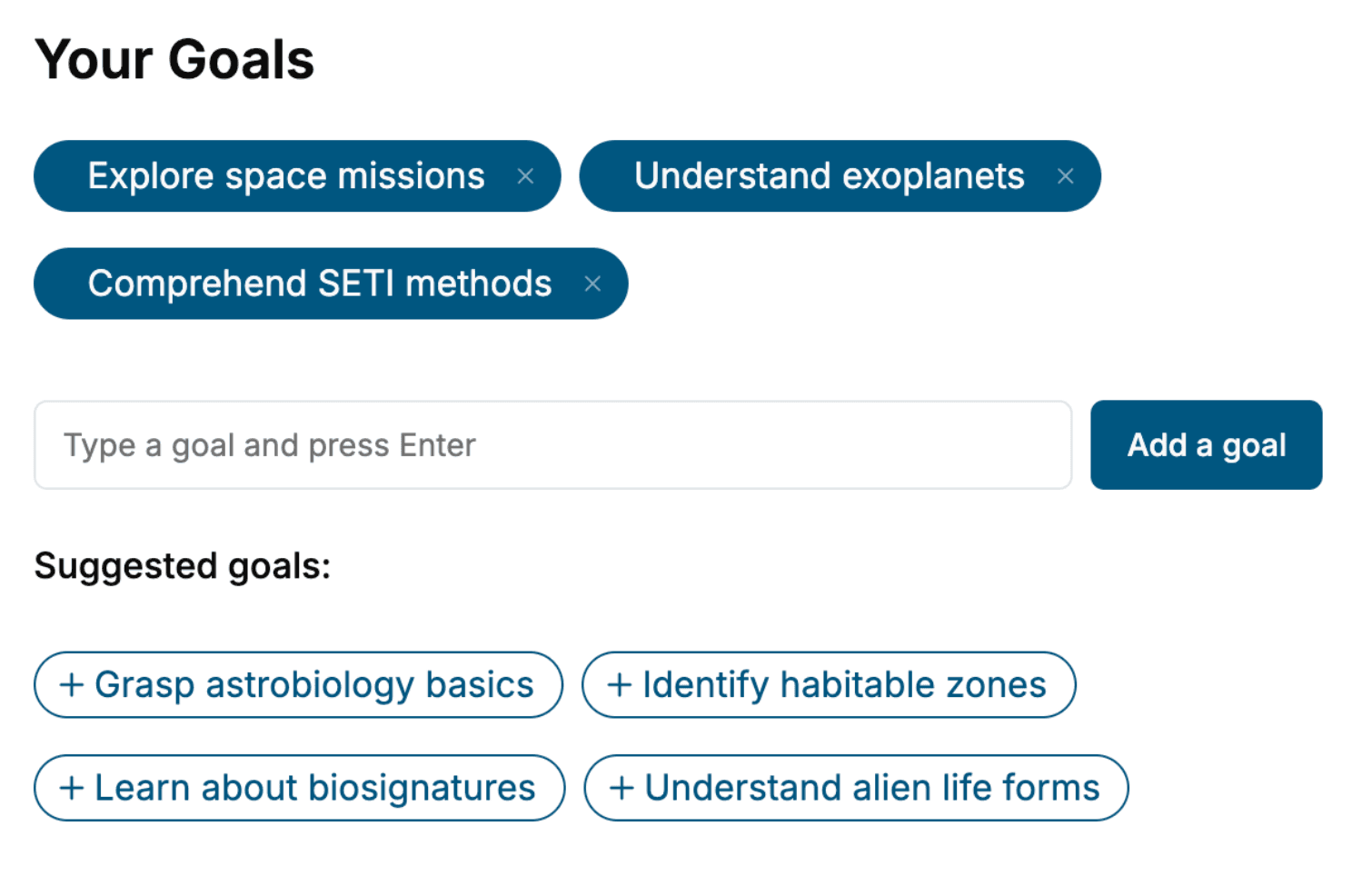
Tell us your goals and background, and get your own version of this book, tailored by AI to you.


Benefits of AI-tailored books
- Read one book, not ten:
- all the Algebra knowledge you need, gathered into a single book.
- Save days of learning:
- tell us your goals, choose your topics, and the whole book is built around them.
- Learn effortlessly:
- Algebra book written for your specific background and expertise.
- Understand at a glance:
- includes charts, tables, timelines, checklists, decision trees, and more.
- Stay current:
- written the day you order it, not years ago.
- Trust what you read:
- every book is checked for accuracy, with real research when your subject needs it.
Create your unique book in 3 steps
- 1. Select your focus
Select the focus of your Algebra book and share your background
- 2. Personalize your book
Specify your goals and choose sub-topics to include
- 3. Get your tailored book
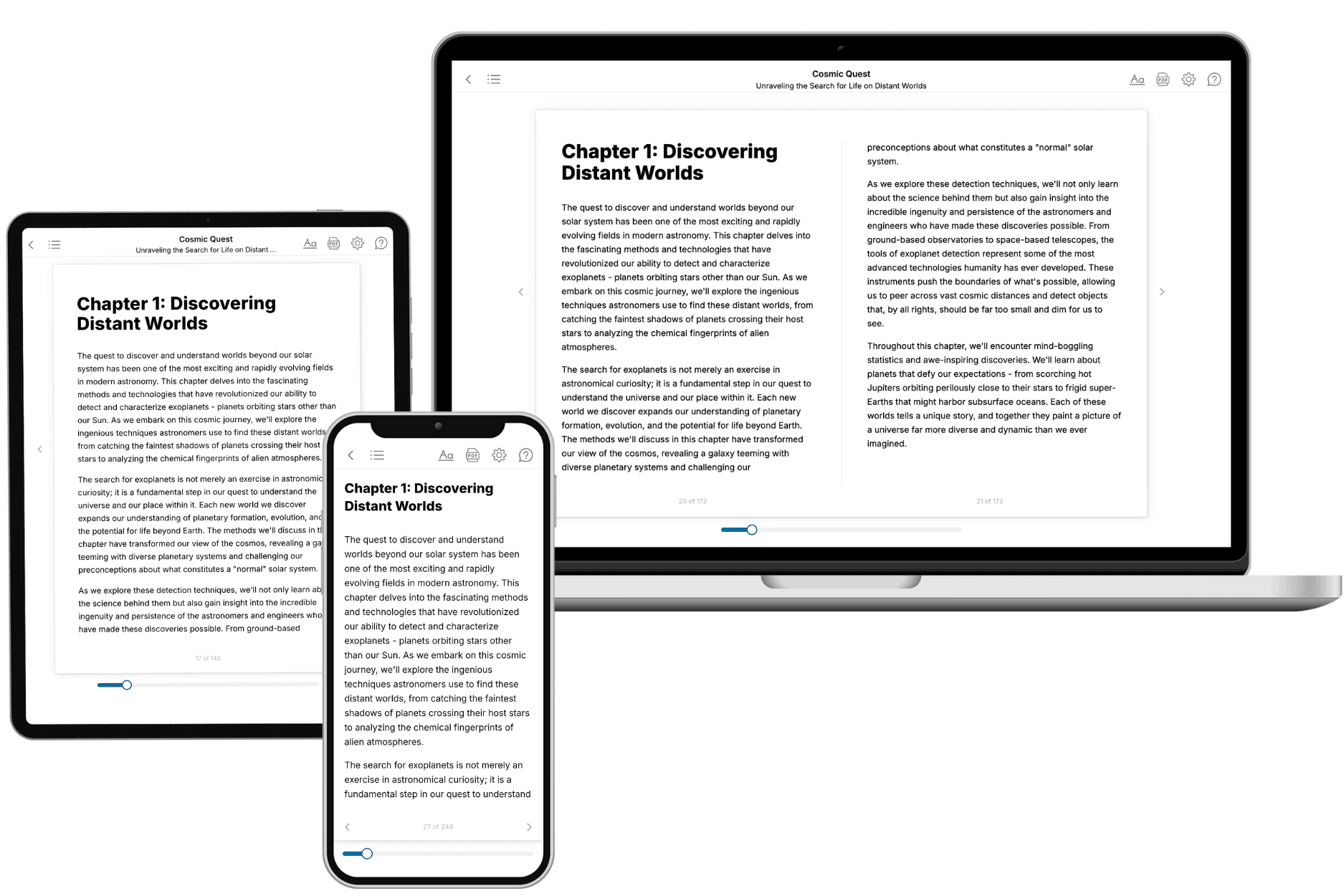
Your book is ready in 10 minutes. Read it online, download as EPUB or PDF, or send to Kindle.

Frequently asked questions
- What is TailoredRead?
TailoredRead creates complete, full-length nonfiction ebooks, written specifically for you. Tell us what you want to learn and why, and TailoredRead writes you a complete ebook on it, with charts, tables, and diagrams throughout. Read it online, on Kindle, or on any e-reader, or download it as a PDF or EPUB. Every book is written fresh the day you order it.
- How is the book tailored to me?
Before anything is written, you answer a few short questions about your goals, your background, and the topics you care about. Your book is then planned around your answers: written at your level, focused on your goals, and covering the topics you chose, instead of the one-size-fits-all book a store sells everyone.
- Will it read like generic AI content?
No. Your book isn't a chat transcript: it's planned chapter by chapter before a single word is written, told in a clear book voice, and explains ideas visually with charts, tables, and diagrams. After writing, every book goes through an editorial pass that polishes chapters so the book reads consistent from start to finish. Judge for yourself: browse thousands of sample books on our Explore Books page.
- How accurate is the content?
Our AI first checks whether your subject needs live research. Niche and fast-moving subjects are researched before writing, and the book plan and chapters are grounded in what it finds. After writing, every book goes through a quality pass that checks its facts and consistency, and researched books list their sources in a Notes section at the back.
- How long is the book?
You choose the length: Comprehensive (250-300 pages), Detailed (150-200 pages), Essential (70-100 pages), or Short (30-50 pages).
- Does the book include visuals?
Yes. Every book includes charts, tables, and diagrams: timelines, checklists, step-by-step guides, decision trees, comparison tables, matrices, and bar charts. A typical book includes dozens of these visual elements.
- Can I read it on Kindle? What formats can I download?
Yes. Every book can be read in our online reader or downloaded as a PDF or EPUB. The EPUB can be opened with Kindle, Apple Books, Kobo, and any e-reader. The Commercial and Author licenses also include an editable Word (DOCX) and Markdown download.
- How much does it cost?
About the price of a regular ebook. The exact price depends on your book's length and complexity, from $2 for the shortest books to $35 for the most comprehensive, and it's shown when you review your book, before you commit to anything. Each book is a one-time purchase, yours to keep, no subscription. Licenses that let you share, teach, or publish your book range from $35.99 to $49.99.
- Can I preview the book before purchasing?
Before you pay, you'll see what your book will cover: the title, a detailed description, the estimated length, and the complete chapter-by-chapter table of contents, so you know what you're getting before you decide. The full text itself is written after you purchase.
- How long does it take to create a book?
About 10 minutes. You can start reading the opening chapters while the rest is still being written.