Feature Engineering Fundamentals
Master the Art of Transforming Raw Data into Powerful Machine Learning Features
Elevate your machine learning models by mastering the critical skill that separates good predictions from exceptional ones.
191 pages9 chaptersMar 17, 2026Machine Learning
About this book
Feature engineering is where data science meets domain expertise—the process of transforming raw data into meaningful inputs that help algorithms learn effectively. This book guides you through proven techniques for numerical and categorical feature transformation, handling missing data and outliers, and discovering feature interactions that reveal hidden patterns. You'll learn when to apply scaling, encoding, and binning strategies, how to leverage domain knowledge alongside statistical methods, and when to use automated tools versus manual engineering. With practical examples and clear explanations, you'll understand why certain features work better than others and how to systematically improve your models. Whether you're building predictive systems, classification models, or regression solutions, these skills will directly enhance your results and deepen your understanding of how data becomes intelligence.
Table of contents
- IntroductionWhy Features Matter More Than You Think, What Is Feature Engineering?, Your Roadmap Through This BookRead below
- Chapter 1: Foundations of Feature EngineeringExploratory Data Analysis: Understanding Your Raw Material, Identifying Feature Types and Their Characteristics, Assessing Data Quality and Identifying Problems
- Chapter 2: Engineering Numerical FeaturesScaling and Normalization Techniques, Power Transformations and Distribution Adjustments, Binning and Discretization Strategies, Creating Polynomial and Interaction Features
- Chapter 3: Engineering Categorical FeaturesEncoding Methods: One-Hot, Label, and Target Encoding, Handling Ordinal and Hierarchical Categories, Managing Rare and High-Cardinality Categories
- Chapter 4: Handling Missing Data StrategicallyUnderstanding Missing Data Patterns and Mechanisms, Imputation Techniques and When to Use Them, Creating Features from Missing Data Itself
- Chapter 5: Managing Outliers and Imbalanced DataDetecting and Understanding Outliers, Treatment Strategies: Removal, Transformation, and Capping, Addressing Class Imbalance Through Feature Engineering
- Chapter 6: Leveraging Domain KnowledgeExtracting Insights from Subject Matter Experts, Translating Business Context into Features, Validating Features Against Domain Expectations
- Chapter 7: Feature Selection and Dimensionality ReductionStatistical and Model-Based Selection Methods, Dimensionality Reduction Techniques, Preventing Overfitting Through Feature Pruning
- Chapter 8: Automating Feature EngineeringAutomated Feature Engineering Tools and Frameworks, When to Automate and When to Engineer Manually, Combining Automation with Human Expertise
- Chapter 9: Building Effective Feature Engineering WorkflowsA Systematic Approach to Feature Development, Testing and Validating Your Features, Documenting and Tracking Feature Changes
- ConclusionKey Takeaways and Core Principles, Your Path Forward in Feature Engineering
- Glossary of Key Terms
Introduction
There is a moment that almost every machine learning practitioner experiences at some point. You have a clean dataset, a well-tuned algorithm, and a reasonable training setup. You run the model, check the results, and feel a quiet disappointment. The accuracy is decent, but not great. The predictions are plausible, but not reliable. You tweak the hyperparameters, try a different algorithm, and still the results plateau. What you may not realize yet is that the bottleneck is not the model. It is the features you fed into it.
Feature engineering is the practice of transforming raw data into meaningful inputs that machine learning models can actually learn from. It sits at the heart of every successful data science project, yet it is often the least discussed part of the pipeline. Most introductory courses spend hours on algorithms and almost no time on the data preparation work that makes those algorithms perform well. This book exists to close that gap. It treats feature engineering not as a preprocessing chore, but as a core skill that deserves serious attention and deliberate practice.
The goal here is practical and direct. By the time you finish this book, you will have a clear, structured understanding of how to look at raw data and see the features hiding inside it. You will know which transformation techniques apply to which data types, how to handle messy real-world problems like missing values and outliers, and how to use domain knowledge to build features that carry genuine predictive power. You will also understand when to reach for automated tools and when human judgment is irreplaceable. These are the skills that separate practitioners who get good results from those who get exceptional ones.
This book is written for intermediate learners who already have a working understanding of machine learning fundamentals. You do not need to be an expert, but familiarity with concepts like training and test sets, model evaluation metrics, and basic supervised learning will help you get the most from the material. The focus throughout is on building intuition alongside technique, so that you understand not just what to do, but why it works and when to apply it.
Why Features Matter More Than You Think
In 2009, the Netflix Prize competition offered one million dollars to any team that could improve Netflix's movie recommendation algorithm by at least 10 percent. Hundreds of teams competed over three years, trying every advanced algorithm available. The winning solution was not a single breakthrough model. It was an ensemble of many models, and a significant portion of its performance gains came from careful feature construction, including temporal features that captured how user ratings changed over time.[1] The lesson was clear: thoughtful feature design can unlock performance that no algorithm alone can achieve.
This pattern repeats across industries and problem types. In medical diagnosis, a raw blood test value might be less predictive than the ratio of two values, or the rate of change over multiple visits. In fraud detection, the raw transaction amount matters less than whether it deviates significantly from a customer's historical average. In natural language processing, raw word counts are far less useful than carefully constructed features like term frequency-inverse document frequency scores or sentiment indicators. The algorithm sees only the numbers you give it. If those numbers do not capture the right signal, no amount of model tuning will compensate.
Research consistently supports this view. A widely cited analysis of Kaggle competition winners found that feature engineering was mentioned as a key factor in winning solutions far more often than algorithm selection.[2] Pedro Domingos, a prominent machine learning researcher, put it plainly: the most important factor in a learning algorithm's success is the features it is given. The algorithm is almost secondary. This is a strong claim, but the evidence behind it is substantial.
Consider a concrete example. Suppose you are building a model to predict whether a customer will churn from a subscription service. Your raw data includes account creation date and last login date. Feeding those two dates directly into a model gives it very little to work with. But if you engineer a feature called days since last login, suddenly the model has a direct signal about customer engagement. Add a feature for login frequency over the past 30 days, and you have captured behavioral trend. Add a binary flag for whether the customer has contacted support in the last week, and you have introduced a known churn predictor. None of these features existed in the raw data. You created them by thinking carefully about what drives the outcome you are trying to predict.
The flip side is also true. Poor features can actively hurt model performance. Irrelevant features add noise that confuses the learning process. Redundant features can inflate the apparent importance of certain signals. Poorly scaled features can cause gradient-based algorithms to converge slowly or not at all. Leaky features, those that inadvertently encode information about the target variable, can produce models that look excellent during training but fail completely in production. Understanding what makes a feature good or bad is just as important as knowing how to create features in the first place.
Feature engineering also has a direct impact on model interpretability. Simpler, well-constructed features tend to produce models that are easier to explain to stakeholders. When a feature like customer_lifetime_value_tier appears in a model, a business analyst can understand its meaning immediately. When a raw, untransformed timestamp appears, the connection to business outcomes is much harder to communicate. In many real-world applications, the ability to explain a model's decisions is not optional. It is a requirement. Good feature engineering supports that goal from the ground up.
Finally, features matter because they encode your understanding of the problem. Every feature you create is a hypothesis about what drives the outcome you are predicting. The process of building features forces you to think deeply about the data, the domain, and the relationships between variables. That thinking process itself is valuable. It surfaces assumptions, reveals gaps in your data, and often leads to insights that improve not just the model but the broader understanding of the problem you are solving.
What Is Feature Engineering?
Feature engineering is the process of using domain knowledge and statistical techniques to create, transform, and select input variables that improve the performance of machine learning models. It sits between raw data collection and model training, and it encompasses a wide range of activities. At its core, it is about making data more useful for learning algorithms by representing information in a form those algorithms can interpret effectively.
It helps to break the concept down into its main components. Feature engineering is not a single technique. It is a collection of related practices, each addressing a different aspect of the data preparation challenge.
- Feature creation: Building new variables from existing ones, such as computing ratios, differences, or aggregations.
- Feature transformation: Changing the scale or distribution of existing variables, such as applying logarithms or standardization.
- Feature encoding: Converting non-numeric data types, like categories or text, into numeric representations that models can process.
- Feature selection: Identifying and keeping only the most informative variables, removing noise and redundancy.
- Feature extraction: Deriving compact representations from high-dimensional data, such as using principal component analysis on image pixel values.
It is worth distinguishing feature engineering from related concepts that sometimes get conflated with it. Data cleaning refers to fixing errors, inconsistencies, and formatting problems in raw data. It is a prerequisite for feature engineering, but it is not the same thing. Data preprocessing is a broader term that includes both cleaning and transformation steps. Feature engineering specifically refers to the creative and analytical work of constructing meaningful variables, not just preparing data for ingestion. The distinction matters because feature engineering requires domain thinking, not just technical execution.
A useful analogy is cooking. Raw ingredients are your data. Data cleaning is washing and trimming those ingredients. Feature engineering is the actual cooking: deciding how to cut, combine, season, and prepare the ingredients so that the final dish is as good as it can be. Two chefs working with identical ingredients can produce very different results depending on their technique and judgment. The same is true for two data scientists working with identical datasets. The quality of the features they engineer will largely determine the quality of their models.
Feature engineering also exists on a spectrum from fully manual to fully automated. At the manual end, a domain expert carefully crafts each feature based on deep knowledge of the problem. At the automated end, tools like Featuretools or AutoML platforms generate large numbers of candidate features algorithmically. In practice, the most effective approaches combine both. Automated tools can explore a large feature space quickly, but human judgment is needed to evaluate which features are meaningful, which are spurious, and which might cause problems like data leakage.
One important concept to understand early is data leakage. Leakage occurs when a feature inadvertently contains information about the target variable that would not be available at prediction time. For example, if you are predicting hospital readmission and you include a feature derived from discharge notes written after the readmission decision was made, your model will appear to perform well in training but will fail in deployment. Leakage is one of the most common and damaging mistakes in feature engineering, and recognizing it requires careful thinking about the timeline of your data and the real-world prediction scenario.
Another foundational concept is the difference between raw features and derived features. Raw features are the variables that come directly from your data source, such as a customer's age, a transaction amount, or a product category. Derived features are computed from raw features, such as a customer's age group, the log of a transaction amount, or a binary flag indicating whether a product belongs to a high-margin category. Most of the interesting work in feature engineering happens at the derived feature level, where your analytical judgment shapes what the model learns.
Understanding what feature engineering is also means understanding what it is not. It is not a magic fix for bad data. If your data collection process is flawed, if important variables are missing entirely, or if your labels are unreliable, feature engineering cannot fully compensate. It works best when the raw data contains genuine signal about the outcome you are trying to predict, and your job is to surface and amplify that signal. Thinking of feature engineering as a tool for extracting value from good data, rather than rescuing bad data, will help you set realistic expectations and focus your efforts where they matter most.
Your Roadmap Through This Book
This book is organized to build your knowledge progressively, starting with foundational concepts and moving toward more advanced and specialized techniques. Each chapter addresses a distinct aspect of feature engineering, and the chapters are designed to be read in order on a first pass. Once you are familiar with the material, individual chapters also work well as standalone references when you encounter specific challenges in your own projects.
Chapter 1: Foundations of Feature Engineering sets the stage by covering exploratory data analysis, feature type identification, and data quality assessment. Before you can engineer good features, you need to understand your raw material deeply. This chapter gives you the tools to do that systematically, including how to spot distributions, relationships, and quality issues that will shape your engineering decisions later.
Chapter 2: Engineering Numerical Features dives into the techniques that apply specifically to continuous and discrete numeric variables. You will learn when and how to apply scaling and normalization, how to use power transformations to handle skewed distributions, how to bin continuous variables into meaningful categories, and how to create polynomial and interaction features that capture nonlinear relationships.
Chapter 3: Engineering Categorical Features covers the distinct challenges that arise with non-numeric data. Categories require encoding before most algorithms can use them, and the choice of encoding method has significant consequences for model performance. This chapter walks through one-hot encoding, label encoding, target encoding, and strategies for handling ordinal categories and high-cardinality variables.
Chapter 4: Handling Missing Data Strategically addresses one of the most common real-world data problems. Missing values are not just an inconvenience. They carry information about why data is absent, and handling them thoughtlessly can introduce bias or destroy signal. This chapter covers the three main patterns of missingness, a range of imputation techniques, and the counterintuitive idea that missing data itself can become a useful feature.
Chapter 5: Managing Outliers and Imbalanced Data tackles two related challenges that can distort model learning. Outliers can skew distributions and mislead algorithms, but they can also represent the most important cases in your dataset. Class imbalance, where one outcome is far more common than another, creates its own set of feature engineering considerations. This chapter provides detection methods, treatment strategies, and techniques for building features that help models handle these situations gracefully.
Chapter 6: Leveraging Domain Knowledge makes the case that the best features often come not from statistical analysis alone, but from deep understanding of the problem domain. This chapter shows how to extract insights from subject matter experts, translate business context into concrete features, and validate your engineered features against domain expectations. It includes practical guidance on working with domain experts even when you are not one yourself.
Chapter 7: Feature Selection and Dimensionality Reduction addresses the problem of having too many features. More features are not always better. This chapter covers statistical selection methods, model-based importance ranking, and dimensionality reduction techniques like principal component analysis. You will learn how to identify and remove features that add noise rather than signal, and how to prevent the overfitting that comes from an overly large feature space.
Chapter 8: Automating Feature Engineering introduces the tools and frameworks that can accelerate your workflow. Platforms like Featuretools, AutoML systems, and feature store technologies can generate and manage features at scale. This chapter explains how these tools work, when they are most useful, and how to combine them with manual engineering to get the best of both approaches.
Chapter 9: Building Effective Feature Engineering Workflows brings everything together into a practical, repeatable process. Good feature engineering is not just about knowing individual techniques. It is about applying them systematically, testing their impact rigorously, and documenting your decisions so that your work is reproducible and maintainable. This chapter provides a structured workflow, testing strategies, and documentation practices that will serve you across many different projects.
Throughout the book, you will find concrete examples drawn from realistic scenarios in areas like customer analytics, financial modeling, healthcare prediction, and e-commerce. Each technique is illustrated with specific, practical cases so that you can see not just how it works in theory, but how to apply it in practice. Key terms are highlighted when they are first introduced, and a glossary at the end of the book provides quick reference definitions for all major concepts.
A few practical notes before you begin. The code examples and frameworks in this book are presented in a way that is accessible regardless of whether you work primarily in Python or R, though Python-based tools are referenced most frequently given their dominance in the field. The focus is always on the concept and the decision-making process, not on any specific library's syntax. You should be able to apply the ideas here using whatever tools you are most comfortable with.
Feature engineering is not a step you complete once and move on from. It is an iterative process that runs in parallel with model development. As you learn more about your data and your model's behavior, you will return to your features, refine them, and create new ones. The best practitioners treat feature engineering as an ongoing conversation between the data, the model, and the problem they are trying to solve.
The skills in this book will not just improve your model metrics. They will change how you think about data. You will start seeing features in raw variables that you previously overlooked. You will develop instincts for which transformations are likely to help and which are likely to hurt. You will become more systematic in your approach to data problems and more confident in your ability to extract value from complex, messy, real-world datasets. That shift in perspective is the real goal of this book, and it starts on the very next page.
This is the end of the free sample. The full book has 9 chapters.
Want this book written for you?
Tell us your goals and background, and get your own version of this book, tailored by AI to you.


Benefits of AI-tailored books
- Read one book, not ten:
- all the Machine Learning knowledge you need, gathered into a single book.
- Save days of learning:
- tell us your goals, choose your topics, and the whole book is built around them.
- Learn effortlessly:
- Machine Learning book written for your specific background and expertise.
- Understand at a glance:
- includes charts, tables, timelines, checklists, decision trees, and more.
- Stay current:
- written the day you order it, not years ago.
- Trust what you read:
- every book is checked for accuracy, with real research when your subject needs it.
Create your unique book in 3 steps
- 1. Select your focus
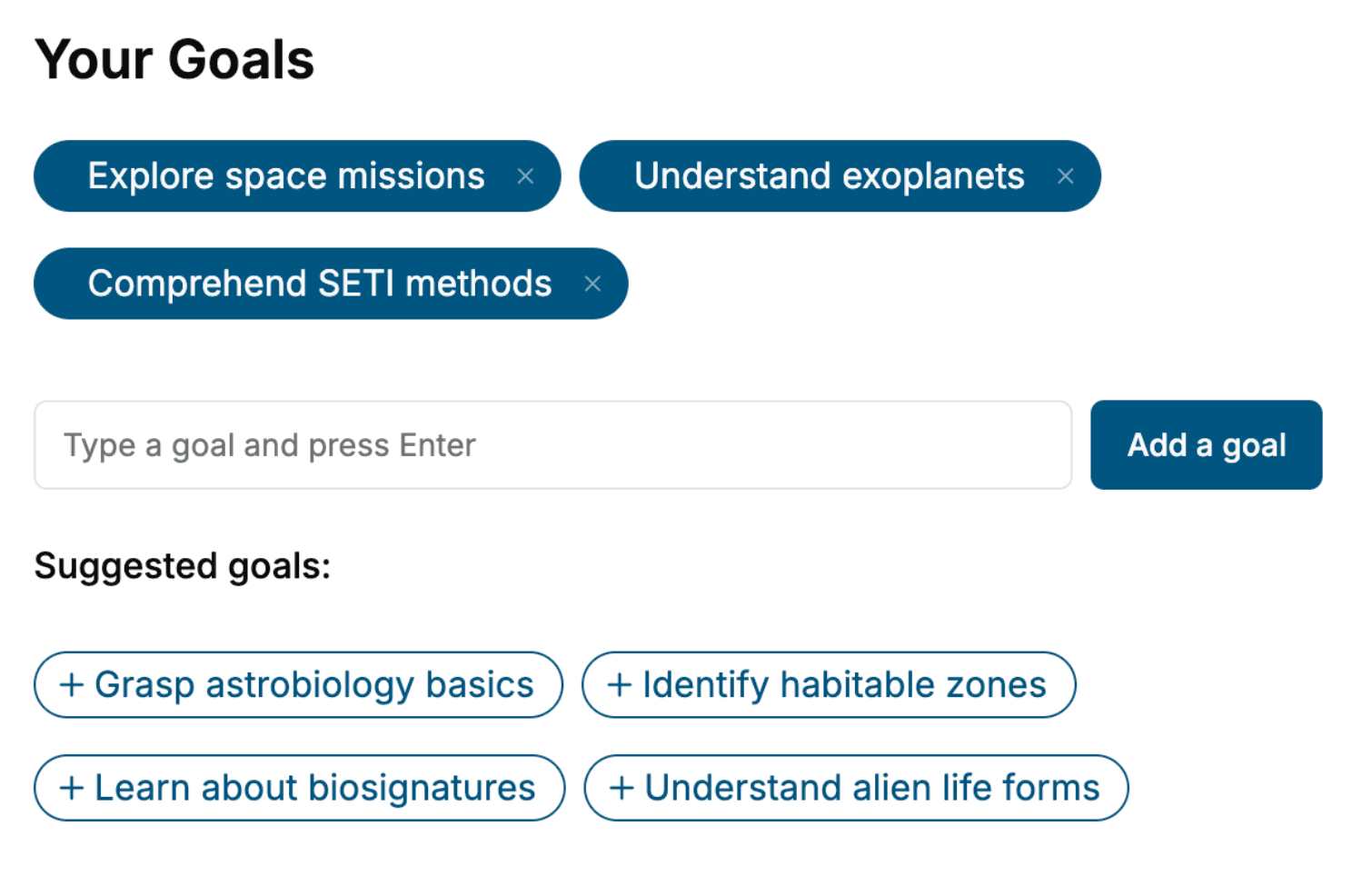
Select the focus of your Machine Learning book and share your background
- 2. Personalize your book
Specify your goals and choose sub-topics to include
- 3. Get your tailored book
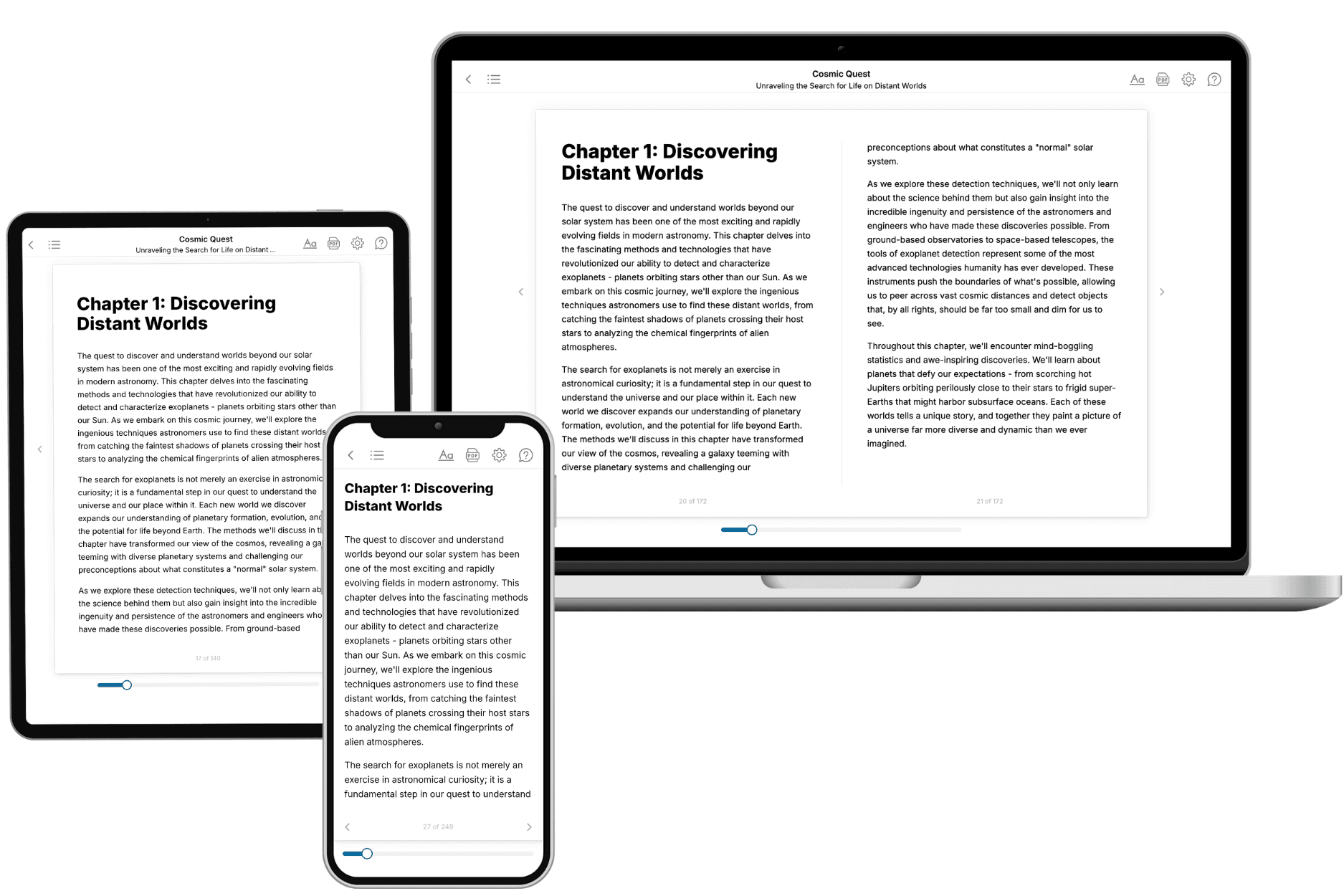
Your book is ready in 10 minutes. Read it online, download as EPUB or PDF, or send to Kindle.

Frequently asked questions
- What is TailoredRead?
TailoredRead creates complete, full-length nonfiction ebooks, written specifically for you. Tell us what you want to learn and why, and TailoredRead writes you a complete ebook on it, with charts, tables, and diagrams throughout. Read it online, on Kindle, or on any e-reader, or download it as a PDF or EPUB. Every book is written fresh the day you order it.
- How is the book tailored to me?
Before anything is written, you answer a few short questions about your goals, your background, and the topics you care about. Your book is then planned around your answers: written at your level, focused on your goals, and covering the topics you chose, instead of the one-size-fits-all book a store sells everyone.
- Will it read like generic AI content?
No. Your book isn't a chat transcript: it's planned chapter by chapter before a single word is written, told in a clear book voice, and explains ideas visually with charts, tables, and diagrams. After writing, every book goes through an editorial pass that polishes chapters so the book reads consistent from start to finish. Judge for yourself: browse thousands of sample books on our Explore Books page.
- How accurate is the content?
Our AI first checks whether your subject needs live research. Niche and fast-moving subjects are researched before writing, and the book plan and chapters are grounded in what it finds. After writing, every book goes through a quality pass that checks its facts and consistency, and researched books list their sources in a Notes section at the back.
- How long is the book?
You choose the length: Comprehensive (250-300 pages), Detailed (150-200 pages), Essential (70-100 pages), or Short (30-50 pages).
- Does the book include visuals?
Yes. Every book includes charts, tables, and diagrams: timelines, checklists, step-by-step guides, decision trees, comparison tables, matrices, and bar charts. A typical book includes dozens of these visual elements.
- Can I read it on Kindle? What formats can I download?
Yes. Every book can be read in our online reader or downloaded as a PDF or EPUB. The EPUB can be opened with Kindle, Apple Books, Kobo, and any e-reader. The Commercial and Author licenses also include an editable Word (DOCX) and Markdown download.
- How much does it cost?
About the price of a regular ebook. The exact price depends on your book's length and complexity, from $2 for the shortest books to $35 for the most comprehensive, and it's shown when you review your book, before you commit to anything. Each book is a one-time purchase, yours to keep, no subscription. Licenses that let you share, teach, or publish your book range from $35.99 to $49.99.
- Can I preview the book before purchasing?
Before you pay, you'll see what your book will cover: the title, a detailed description, the estimated length, and the complete chapter-by-chapter table of contents, so you know what you're getting before you decide. The full text itself is written after you purchase.
- How long does it take to create a book?
About 10 minutes. You can start reading the opening chapters while the rest is still being written.