Fiduciary Duty: The Complete Paralegal's Guide to Trust, Estate, and POA Breaches
Master Fiduciary Standards, Identify Breaches, and Build Winning Trust Dispute Cases
Navigate the complex landscape of fiduciary duty breaches with the precision and confidence your cases demand.
238 pages11 chaptersMay 1, 2026Law
About this book
This comprehensive guide equips you with the knowledge to identify when trustees, executors, and power of attorney holders have violated their legal obligations—and how to build compelling cases that protect beneficiary interests. You'll master the fiduciary duty standards that vary across jurisdictions, learn to recognize breach scenarios from self-dealing to accounting failures, and understand the full spectrum of liability exposure. Through practical frameworks for trust accounting analysis, discovery strategy, and damages calculation, you'll develop the litigation support capabilities that make you invaluable to your legal team. Whether you're analyzing trust documents, deposing fiduciaries, or negotiating settlements, this guide provides the authoritative foundation and actionable strategies you need to excel in trust dispute cases.
Table of contents
- IntroductionWhy Fiduciary Duty Matters in Trust Disputes, What This Guide Covers, How to Use This Guide for Maximum ImpactRead below
- Chapter 1: Fiduciary Duty FundamentalsDefining the Fiduciary Relationship, The Core Fiduciary Duties: Loyalty, Prudence, and Disclosure, How Duties Vary by Role and Jurisdiction
- Chapter 2: Trustee Fiduciary Duties and StandardsThe Duty of Loyalty and Self-Dealing Prohibitions, The Prudence Standard and Investment Obligations, Accounting and Disclosure Obligations
- Chapter 3: Executor and Administrator DutiesScope of Executor Authority and Limitations, Executor Liability Exposure and Common Breaches, Estate Accounting and Distribution Requirements
- Chapter 4: Power of Attorney and Guardian DutiesPower of Attorney Authority and Fiduciary Obligations, Detecting POA Misuse and Unauthorized Transactions, Guardian Fiduciary Standards and Duty Variations
- Chapter 5: Identifying Breach ScenariosSelf-Dealing and Conflicted Transactions, Improper Distributions and Unauthorized Payments, Failure to Account and Concealment of Assets
- Chapter 6: Trust Accounting Principles and AnalysisIncome Versus Principal: Proper Allocation Standards, Evaluating Accounting Records and Documentation, Identifying Accounting Breaches and Discrepancies
- Chapter 7: State Trust Law Variations and Jurisdiction-Specific StandardsUniform Trust Code and State Adoptions, Key Variations in State Fiduciary Duty Standards, Statutes of Limitation and Jurisdiction-Specific Procedures
- Chapter 8: Legal Document Analysis and InterpretationAnalyzing Trust Documents for Duty Modifications, Will and Estate Planning Document Interpretation, Power of Attorney Document Scope and Limitations
- Chapter 9: Discovery Strategy in Trust DisputesStrategic Document Requests and Production Analysis, Interrogatories Targeting Fiduciary Conduct, Deposition Strategy and Fiduciary Examination
- Chapter 10: Damages Calculation and RemediesCalculating Actual Losses and Lost Profits, Surcharge Actions and Constructive Trusts, Punitive Damages and Prejudgment Interest
- Chapter 11: Settlement Negotiation and Case StrategyAnalyzing Leverage Points and Fiduciary Exposure, Valuing Claims and Structuring Settlement Offers, Negotiation Tactics and Dispute Resolution
- ConclusionKey Takeaways for Fiduciary Duty Practice, Building Your Fiduciary Duty Expertise
- Glossary of Fiduciary Duty Terms
- Further Reading and Resources
Introduction
Trust disputes are among the most emotionally charged and legally complex matters that pass through a law office. At their center is almost always the same fundamental question: did the person entrusted with managing someone else's assets actually honor that trust? Answering that question requires more than a general sense of fairness. It requires a precise, working knowledge of fiduciary duty, the legal framework that defines what trustees, executors, and power of attorney holders are obligated to do, and what happens when they fall short. For paralegals working in trust and estate law, that knowledge is not optional. It is the foundation of every case you support.
The stakes in these cases are real and often significant. A trustee who quietly diverts trust assets into a personal account. An executor who delays estate administration for years while collecting fees. A power of attorney agent who transfers an elderly parent's savings to themselves under the guise of "helping." These are not hypothetical scenarios. They happen regularly, and the beneficiaries harmed by these actions depend on legal professionals who can identify what went wrong, document it thoroughly, and build a case that holds the fiduciary accountable. That work falls heavily on paralegals, who are often the first to review financial records, flag discrepancies, and organize the evidentiary foundation that attorneys rely on in court.
This guide was written specifically for paralegals who already have a solid grounding in trust and estate law and are ready to go deeper. You understand the basic vocabulary. You know what a trust instrument is, you have worked with probate filings, and you are familiar with the general concept of a fiduciary. What this guide provides is the next level: a structured, comprehensive framework for analyzing fiduciary conduct, identifying breaches, understanding liability exposure, and supporting litigation from discovery through settlement. Each chapter builds on the last, moving from foundational legal standards to practical litigation tools you can apply immediately in your casework.
The legal landscape for fiduciary duty is not uniform. State law variations, the adoption of the Uniform Trust Code in different forms across jurisdictions, and the specific language of individual trust documents all shape what a fiduciary is required to do in any given case. This guide addresses those variations directly, giving you the analytical tools to work effectively regardless of which state's law governs your matter. Where general principles apply broadly, they are presented as such. Where jurisdiction-specific differences are significant, they are flagged clearly so you know where to dig deeper in your own research.
Why Fiduciary Duty Matters in Trust Disputes
Fiduciary duty is not just a legal concept. It is the mechanism through which the law enforces trust. When a person accepts a fiduciary role, whether as a trustee managing a family trust, an executor administering an estate, or an agent acting under a power of attorney, they accept a legally binding obligation to act in someone else's interest rather than their own. That obligation is enforceable in court, and when it is violated, the law provides remedies designed to make the harmed party whole. Understanding this framework is what separates a paralegal who can process paperwork from one who can actually drive a case forward.
The practical importance of fiduciary duty in trust disputes becomes clear when you consider how often breaches go undetected for years. A trustee who makes self-interested investment decisions may not trigger obvious red flags in the first year. An executor who delays distributing estate assets while quietly paying themselves inflated fees may not face scrutiny until a beneficiary finally asks questions. A POA agent who begins making small unauthorized transfers may escalate over time before anyone notices the pattern. In each of these scenarios, the breach is identifiable only if someone knows what standards apply and what deviation from those standards looks like in financial records and conduct.
Consider a concrete example. In a 2019 California probate court matter, a successor trustee of a family trust was found to have invested the majority of trust assets in a private business he personally owned, generating fees for himself while the trust's value declined significantly. The breach was not immediately obvious from the trust accountings he provided, which were technically formatted but strategically incomplete. It was a paralegal's detailed review of the underlying investment records, cross-referenced against the trustee's personal business filings, that first identified the conflict of interest. That kind of analytical work requires knowing exactly what the duty of loyalty prohibits and what documentation to look for when you suspect a violation.[1]
Fiduciary duty also matters because it defines the scope of available remedies. Not every financial loss in a trust context is a breach. A trustee who makes a reasonable investment that declines in value has not necessarily violated the prudence standard. An executor who misses a minor procedural deadline without causing harm may not face surcharge liability. The distinction between a breach and a mistake, between actionable conduct and an unfortunate outcome, turns entirely on whether the fiduciary's conduct measured up to the applicable legal standard. Knowing that standard with precision is what allows you to assess a case accurately and avoid both over-claiming and under-claiming on behalf of your client.
Beyond individual cases, fiduciary duty law reflects a broader social policy: that people who accept positions of trust over others' assets must be held to a higher standard than ordinary contracting parties. Courts have consistently reinforced this principle, describing the fiduciary relationship as one of the most demanding in law.[2] For paralegals, internalizing that principle shapes how you approach every document review, every financial analysis, and every deposition outline you prepare. You are not just looking for errors. You are measuring conduct against a demanding legal standard that exists specifically to protect vulnerable beneficiaries.
The volume of trust and estate litigation has grown steadily over the past two decades, driven in part by the aging of the baby boomer generation and the corresponding transfer of significant wealth through trusts and estates.[3] As more assets move through fiduciary structures, the opportunities for breach multiply, and the demand for skilled trust litigation support grows with them. Paralegals who develop deep expertise in fiduciary duty standards are not just better at their current jobs. They are positioning themselves at the center of one of the most active and consequential areas of civil litigation.
Finally, fiduciary duty matters because the people harmed by breaches are often among the most vulnerable. Elderly principals whose POA agents exploit their diminished capacity. Minor beneficiaries whose trust assets are depleted before they reach adulthood. Surviving spouses who depend on estate distributions that an executor delays or diverts. These are not abstract legal parties. They are real people whose financial security depends on the legal system functioning as it should, and on legal professionals who know how to make it function that way. That context gives the technical work of fiduciary duty analysis a weight and purpose that goes beyond the mechanics of litigation.
What This Guide Covers
This guide is organized to take you from foundational principles through advanced litigation strategy in a logical, building sequence. Each chapter addresses a distinct component of fiduciary duty practice, and together they form a complete reference for trust dispute casework. Here is a clear map of what you will find and why each section matters to your work.
Chapters 1 through 4 establish the legal framework. Chapter 1 defines the fiduciary relationship itself, covering the core duties of loyalty, prudence, and disclosure that apply across all fiduciary roles. Chapters 2, 3, and 4 then drill down into the specific standards that apply to trustees, executors and administrators, and power of attorney agents and guardians respectively. These chapters are not just background reading. They are the analytical baseline you return to every time you evaluate a fiduciary's conduct. Knowing the standard is the prerequisite for identifying a breach.
Chapters 5 and 6 move from standards to identification. Chapter 5 catalogs the most common breach scenarios you will encounter in practice, including self-dealing, improper distributions, and concealment of assets, with specific indicators to look for in each category. Chapter 6 covers trust accounting principles in depth, because financial records are almost always the primary evidence in breach cases. Understanding how income and principal should be allocated, what proper accounting documentation looks like, and how to spot discrepancies is a core paralegal skill in this practice area.
Chapter 7 addresses the jurisdictional dimension of fiduciary duty law. The Uniform Trust Code has been adopted in some form by a majority of states, but the variations in how states have adopted, modified, or rejected its provisions are significant. This chapter gives you a framework for analyzing state-specific standards and identifying the procedural and substantive differences that affect your case strategy.
Chapter 8 focuses on document analysis, specifically how to read trust instruments, wills, and POA documents to understand what duties they create, modify, or limit. Trust documents can expand or restrict default fiduciary duties in important ways, and missing those provisions can lead to fundamental errors in case analysis. This chapter gives you a systematic approach to document review that ensures you capture every relevant provision.
Chapters 9 through 11 cover the litigation support work that paralegals perform most directly. Chapter 9 addresses discovery strategy, including how to structure document requests, draft interrogatories targeting fiduciary conduct, and prepare for depositions of fiduciaries. Chapter 10 covers damages calculation and the full range of available remedies, from surcharge actions to constructive trusts to punitive damages. Chapter 11 addresses settlement negotiation, including how to analyze leverage, value claims, and support your attorney in achieving favorable outcomes for beneficiaries.
Throughout the guide, you will find concrete examples drawn from common trust dispute patterns, practical frameworks for analysis, and specific action steps you can apply in your casework. The goal is not to give you a theoretical overview of fiduciary law. It is to give you the working knowledge and practical tools to perform at a high level in trust dispute cases from day one.
One important note on scope: this guide addresses fiduciary duty in the context of trusts, estates, and powers of attorney. It does not cover corporate fiduciary duties, investment adviser obligations under securities law, or ERISA fiduciary standards, which are distinct bodies of law with their own frameworks. Where those areas intersect with trust law, the relevant connections are noted, but the primary focus throughout is on the private trust and estate context where most trust litigation paralegals work.
This guide also does not provide legal advice for specific cases. It provides legal education and analytical frameworks. Every case involves specific facts, specific documents, and specific state law that must be analyzed by a licensed attorney. Your role as a paralegal is to support that analysis with thorough research, careful document review, and well-organized case preparation. This guide equips you to do that work at the highest level.
How to Use This Guide for Maximum Impact
Getting the most out of this guide depends on how you approach it, both as a learning resource and as a working reference. There are two distinct modes of use, and understanding both will help you extract maximum value from the material. The first is sequential reading, working through the chapters in order to build a complete, integrated understanding of fiduciary duty practice. The second is targeted reference, returning to specific chapters when a particular issue arises in a case. Both modes are valuable, and the guide is structured to support both.
If you are new to trust dispute litigation or are looking to systematically strengthen your foundation, start at the beginning and work through the chapters in sequence. The early chapters on fiduciary duty fundamentals and role-specific standards are prerequisites for the later chapters on breach identification, discovery, and damages. Reading them in order ensures that when you reach the practical litigation chapters, you have the legal framework to understand why each strategy works and what it is designed to prove. Skipping ahead to the discovery or damages chapters without that foundation is like trying to read a map without knowing what the symbols mean.
For experienced practitioners who already have a strong foundation in trust law, a more targeted approach may be appropriate. Use the table of contents and the chapter summaries to identify the areas where you want to deepen your knowledge or refresh your understanding. If you are currently working on a case involving POA misuse, Chapter 4 and Chapter 5 are your immediate priorities. If you are preparing for a deposition of a trustee, Chapter 9 is where you want to focus. The guide is designed so that each chapter is substantively complete and can be read independently when you need it.
Regardless of how you approach the reading, the most important habit to develop is connecting the material to your actual casework. As you read each chapter, ask yourself:
- What cases am I currently working on where this standard applies?
- What documents do I need to review in light of this framework?
- What questions should I be asking the supervising attorney about this issue?
- What red flags in my current files might I have missed before reading this?
That active, applied reading approach will accelerate your learning far more than passive reading alone. The goal is not to memorize the material. It is to internalize the analytical frameworks so that they become second nature in your daily work.
The examples and case scenarios throughout the guide are particularly valuable for building pattern recognition. Fiduciary breach cases often follow recognizable patterns, and the more familiar you are with those patterns, the faster you will spot them in new matters. When you encounter an example in the text, take a moment to think about whether you have seen anything similar in your own experience. If you have, consider how the framework presented would apply to that situation. If you have not, file the pattern away as something to watch for in future cases.
The footnotes and citations throughout the guide serve two purposes. First, they provide the legal authority behind the principles discussed, which is important for understanding that these are not just general guidelines but enforceable legal standards with specific sources. Second, they give you a starting point for deeper research when a particular issue requires jurisdiction-specific analysis. When a case turns on a specific point of state trust law, the cited authorities can point you toward the relevant statutes and case law to research further.
Practical tip: Keep a running case analysis worksheet as you work through this guide. For each chapter, note the key standards, the red flags to watch for, and the specific documents or records that would evidence a breach in that category. By the time you finish the guide, you will have a personalized reference document that reflects both the material and your own case experience. That kind of active synthesis is what transforms reading into expertise.
It is also worth being intentional about how you use this guide in your relationship with supervising attorneys. The frameworks and analytical tools here are designed to make you a more effective litigation support professional, not to replace attorney judgment on legal questions. When your review of financial records surfaces a potential breach, your role is to document the discrepancy clearly, organize the supporting evidence, and present your findings to the attorney in a structured way. The attorney then makes the legal judgment about how to proceed. This guide helps you do the first part exceptionally well, which in turn makes the attorney's work more effective.
Finally, treat this guide as a living resource rather than a one-time read. Trust law evolves. State legislatures amend their trust codes. Courts issue new decisions that refine fiduciary duty standards. The Uniform Law Commission periodically updates its model acts. The frameworks in this guide reflect current law and practice, but staying current requires ongoing attention to developments in your jurisdiction. Use this guide as your foundation, and build on it with regular review of state-specific updates, continuing legal education in trust and estate law, and engagement with professional resources in the paralegal and trust law communities.
The work of supporting trust dispute litigation is demanding, detail-intensive, and genuinely consequential. The beneficiaries whose interests you help protect are depending on the quality of your analysis and preparation. This guide is designed to give you every tool you need to meet that responsibility with confidence and precision. The chapters that follow will take you through the full landscape of fiduciary duty law, from the foundational principles that define the standard to the practical strategies that win cases. Let's get started.
Notes
Introduction
- 1. See generally Uniform Trust Code § 802 (duty of loyalty); California Probate Code § 16002 (trustee's duty of loyalty). Case details are illustrative of common breach patterns documented in trust litigation.
- 2. Meinhard v. Salmon, 249 N.Y. 458, 164 N.E. 545 (1928) (Cardozo, C.J.) ('Many forms of conduct permissible in a workaday world for those acting at arm's length are forbidden to those bound by fiduciary ties.').
- 3. American Bar Association, Section of Real Property, Trust and Estate Law, 'Trends in Trust and Estate Litigation' (2022). The ABA has documented increased fiduciary litigation volume correlating with intergenerational wealth transfer patterns.
This is the end of the free sample. The full book has 11 chapters.
Want this book written for you?
Tell us your goals and background, and get your own version of this book, tailored by AI to you.


Benefits of AI-tailored books
- Read one book, not ten:
- all the Law knowledge you need, gathered into a single book.
- Save days of learning:
- tell us your goals, choose your topics, and the whole book is built around them.
- Learn effortlessly:
- Law book written for your specific background and expertise.
- Understand at a glance:
- includes charts, tables, timelines, checklists, decision trees, and more.
- Stay current:
- written the day you order it, not years ago.
- Trust what you read:
- every book is checked for accuracy, with real research when your subject needs it.
Create your unique book in 3 steps
- 1. Select your focus
Select the focus of your Law book and share your background
- 2. Personalize your book
Specify your goals and choose sub-topics to include
- 3. Get your tailored book
Your book is ready in 10 minutes. Read it online, download as EPUB or PDF, or send to Kindle.


Frequently asked questions
- What is TailoredRead?
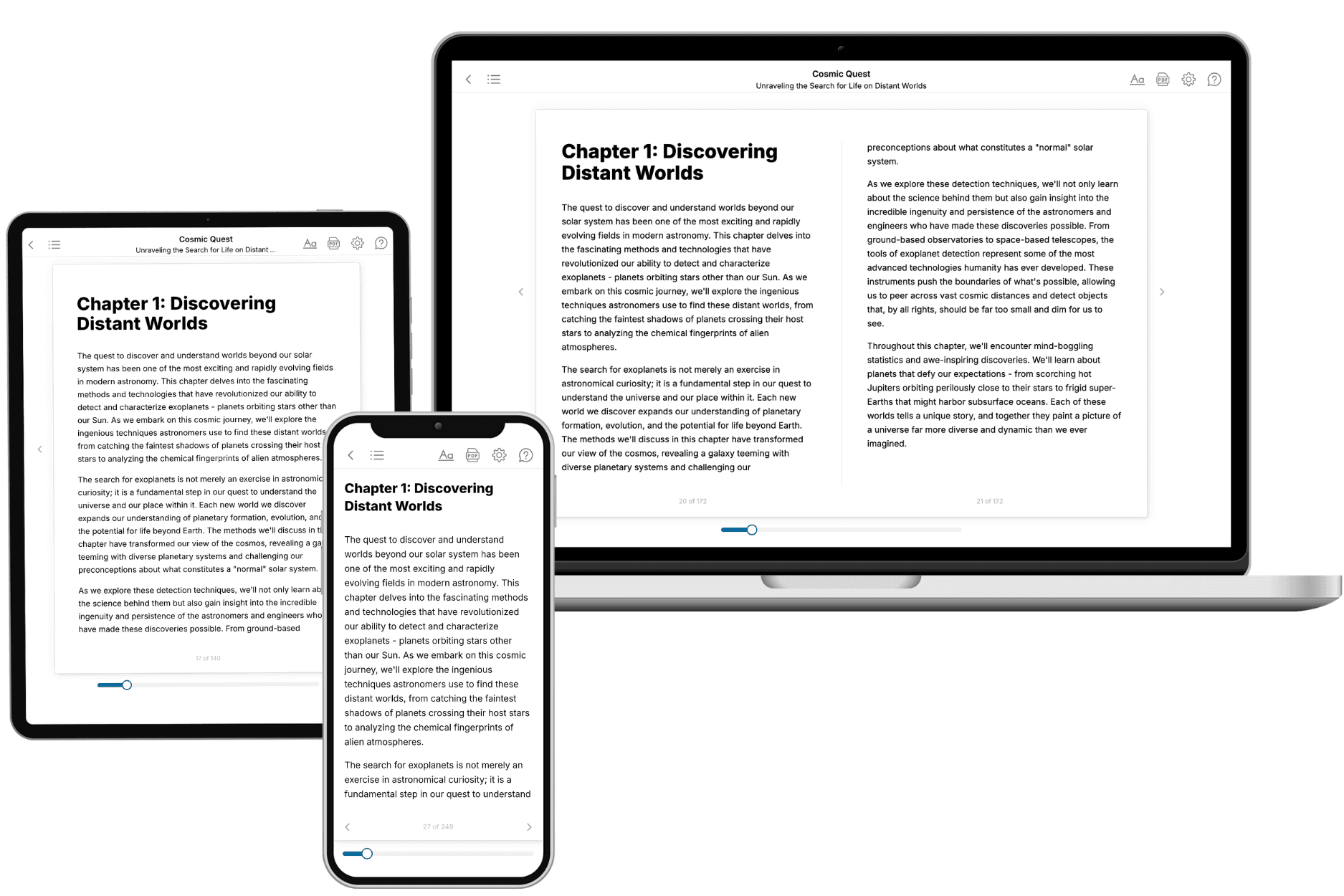
TailoredRead creates complete, full-length nonfiction ebooks, written specifically for you. Tell us what you want to learn and why, and TailoredRead writes you a complete ebook on it, with charts, tables, and diagrams throughout. Read it online, on Kindle, or on any e-reader, or download it as a PDF or EPUB. Every book is written fresh the day you order it.
- How is the book tailored to me?
Before anything is written, you answer a few short questions about your goals, your background, and the topics you care about. Your book is then planned around your answers: written at your level, focused on your goals, and covering the topics you chose, instead of the one-size-fits-all book a store sells everyone.
- Will it read like generic AI content?
No. Your book isn't a chat transcript: it's planned chapter by chapter before a single word is written, told in a clear book voice, and explains ideas visually with charts, tables, and diagrams. After writing, every book goes through an editorial pass that polishes chapters so the book reads consistent from start to finish. Judge for yourself: browse thousands of sample books on our Explore Books page.
- How accurate is the content?
Our AI first checks whether your subject needs live research. Niche and fast-moving subjects are researched before writing, and the book plan and chapters are grounded in what it finds. After writing, every book goes through a quality pass that checks its facts and consistency, and researched books list their sources in a Notes section at the back.
- How long is the book?
You choose the length: Comprehensive (250-300 pages), Detailed (150-200 pages), Essential (70-100 pages), or Short (30-50 pages).
- Does the book include visuals?
Yes. Every book includes charts, tables, and diagrams: timelines, checklists, step-by-step guides, decision trees, comparison tables, matrices, and bar charts. A typical book includes dozens of these visual elements.
- Can I read it on Kindle? What formats can I download?
Yes. Every book can be read in our online reader or downloaded as a PDF or EPUB. The EPUB can be opened with Kindle, Apple Books, Kobo, and any e-reader. The Commercial and Author licenses also include an editable Word (DOCX) and Markdown download.
- How much does it cost?
About the price of a regular ebook. The exact price depends on your book's length and complexity, from $2 for the shortest books to $35 for the most comprehensive, and it's shown when you review your book, before you commit to anything. Each book is a one-time purchase, yours to keep, no subscription. Licenses that let you share, teach, or publish your book range from $35.99 to $49.99.
- Can I preview the book before purchasing?
Before you pay, you'll see what your book will cover: the title, a detailed description, the estimated length, and the complete chapter-by-chapter table of contents, so you know what you're getting before you decide. The full text itself is written after you purchase.
- How long does it take to create a book?
About 10 minutes. You can start reading the opening chapters while the rest is still being written.