Flexible Electronics
The Complete Guide to Materials, Design, and Real-World Applications
Flexible electronics promises to revolutionize technology, yet most professionals struggle to understand how to design, manufacture, and implement these devices effectively.
238 pages11 chaptersJun 5, 2026Electronics Engineering
About this book
The challenge isn't just learning the theory—it's knowing which materials to choose, how to process them without damaging their flexibility, and how to ensure your devices actually perform reliably in real-world conditions. This comprehensive guide bridges the gap between fundamental materials science and practical engineering. You'll discover how to select appropriate substrates and active materials, master the deposition and patterning techniques that preserve mechanical properties, and navigate the critical issues of stress management and environmental protection. Whether you're developing wearable sensors, flexible displays, or innovative bioelectronic devices, this book provides the technical depth and practical insights you need to succeed. Learn from real-world case studies, understand the current limitations and future possibilities, and gain the knowledge to contribute meaningfully to this rapidly evolving field.
Table of contents
- IntroductionWhy Flexible Electronics Matter, What This Book Covers, How to Use This BookRead below
- Chapter 1: Fundamentals of Flexible ElectronicsDefining Flexible Electronics, History and Evolution of the Field, Key Differences from Rigid Electronics, Current Market and Applications
- Chapter 2: Substrate Materials and SelectionPolymer Substrates: Properties and Characteristics, Alternative Substrates: Paper, Fabric, and Elastomers, Selecting the Right Substrate for Your Application, Thermal and Chemical Limitations of Flexible Substrates
- Chapter 3: Active Materials and SemiconductorsOrganic Semiconductors and Polymers, Inorganic Thin Films on Flexible Substrates, Hybrid and Composite Materials, Comparing Material Performance and Trade-offs
- Chapter 4: Deposition and Patterning TechniquesThermal Evaporation and Sputtering, Printing Methods: Inkjet, Screen, and Flexography, Lithography and Patterning on Flexible Substrates, Optimizing Processes for Flexible Materials
- Chapter 5: Mechanical Properties and Stress AnalysisUnderstanding Stress and Strain in Flexible Devices, Mechanical Testing and Characterization Methods, Common Failure Modes and Fatigue Analysis, Design Optimization for Mechanical Reliability
- Chapter 6: Encapsulation and Environmental ProtectionBarrier Layers and Encapsulation Materials, Protection Against Moisture and Oxygen Ingress, Encapsulation Techniques and Implementation, Reliability Testing and Lifetime Prediction
- Chapter 7: Flexible Displays and OptoelectronicsDisplay Technologies: OLEDs, E-ink, and LCDs, Light-Emitting Devices and Photovoltaics, Challenges in Flexible Display Manufacturing, Case Studies: Commercial Flexible Display Products
- Chapter 8: Wearable Sensors and BioelectronicsTypes of Wearable Sensors and Their Principles, Biocompatibility and Skin-Contact Considerations, Signal Processing and Data Integration, Real-World Wearable Applications and Examples
- Chapter 9: Energy Storage and Power ManagementFlexible Batteries and Energy Storage Devices, Supercapacitors and Hybrid Energy Systems, Power Management and Energy Efficiency, Integration Challenges in Flexible Power Systems
- Chapter 10: Manufacturing and ScalabilityProduction Methods and Equipment, Quality Control and Yield Optimization, Cost Analysis and Economic Viability, Challenges in Scaling to Mass Production
- Chapter 11: Emerging Applications and Future DirectionsSmart Textiles and Fabric-Integrated Electronics, Implantable and Biomedical Devices, Future Materials and Technologies, Research Frontiers and Open Challenges
- ConclusionKey Takeaways and Practical Insights, Your Next Steps in Flexible Electronics
- Glossary of Terms
- Further Reading and Resources
Introduction
Electronics have always been defined by their rigidity. For decades, the silicon wafer sitting flat inside a computer, the glass panel of a smartphone screen, and the printed circuit board inside nearly every consumer device shared one fundamental characteristic: they were stiff, brittle, and unforgiving of any mechanical stress. That rigidity was not a design choice so much as a physical constraint. The materials that made electronics work simply could not bend without breaking. That constraint is now being dismantled, and the consequences for technology are profound.
Flexible electronics is the field that replaces rigid substrates with materials that can bend, fold, stretch, and conform to curved or irregular surfaces without losing their electrical function. This is not a minor refinement of existing technology. It represents a fundamental rethinking of what an electronic device can look like, where it can be placed, and what it can do. A sensor that wraps around a human wrist and monitors heart rhythm continuously, a display that folds in half like a piece of paper, a solar cell printed onto a fabric jacket: these are not science fiction concepts. They are products and prototypes that exist today, built on the principles this book explores.
The field draws from materials science, solid-state physics, mechanical engineering, and manufacturing technology simultaneously. That breadth is part of what makes flexible electronics both exciting and challenging to learn. Understanding why a particular polymer substrate works for one application but fails in another requires knowledge of thermal properties, chemical compatibility, and mechanical behavior all at once. Knowing how to deposit a thin film of semiconductor material onto a plastic sheet without cracking it or degrading its electrical properties requires mastery of process engineering under constraints that simply do not exist in conventional semiconductor fabrication. This book is designed to give you that integrated understanding, built from the ground up and applied to real problems.
Whether you are an engineer working on a wearable device project, a researcher exploring new materials for bioelectronic applications, or an advanced student trying to build a solid foundation in this field, the goal here is the same: to give you the technical depth and practical clarity you need to work confidently with flexible electronics. The chapters that follow move from fundamental materials science through design principles, manufacturing techniques, and specific application domains, always connecting theory to practice with concrete examples and real-world context.
Why Flexible Electronics Matter
The most immediate reason flexible electronics matter is that they make possible devices that rigid electronics simply cannot produce. Consider the challenge of building a health monitoring system that stays in continuous contact with human skin during exercise, sleep, and daily movement. A rigid device can be strapped to the body, but it will shift, create pressure points, and fail to maintain consistent sensor contact across the curved, moving surface of skin. A flexible device can conform to the body's contours, move with it, and maintain reliable contact without discomfort. That difference is not cosmetic. It determines whether the device actually works.
The medical and health technology sector has been one of the strongest drivers of flexible electronics development for exactly this reason. Researchers at institutions including Stanford University and the University of Tokyo have demonstrated flexible sensor arrays capable of measuring electrophysiological signals, temperature, sweat composition, and mechanical strain simultaneously, all from a patch worn on the skin.[1] These capabilities open pathways to continuous, non-invasive health monitoring that could transform how chronic conditions like diabetes, cardiovascular disease, and neurological disorders are managed.
Beyond healthcare, flexible electronics matter because they change the economics and logistics of manufacturing. Conventional semiconductor fabrication requires expensive, highly controlled cleanroom environments and rigid wafer-based processes. Flexible electronics, particularly those made using printing techniques, can be manufactured using roll-to-roll processes similar to newspaper printing. This approach dramatically reduces the cost per unit area and enables production at scales that are simply not achievable with wafer-based methods. For applications like large-area sensor networks, agricultural monitoring systems, or disposable diagnostic devices, that cost reduction is the difference between a viable product and an impractical one.
The display industry provides perhaps the most visible example of flexible electronics reaching commercial maturity. Foldable smartphones from Samsung, Huawei, and other manufacturers use flexible organic light-emitting diode (OLED) displays that can bend around a hinge thousands of times without failure. These products represent billions of dollars in engineering investment and demonstrate that flexible electronics can meet the reliability standards required for mass-market consumer devices. The global flexible display market was valued at approximately $15 billion in 2022 and is projected to exceed $50 billion by 2030, reflecting the scale of commercial interest in this technology.[2]
Energy harvesting and storage represent another domain where flexibility creates entirely new possibilities. Flexible photovoltaic cells can be integrated into building facades, vehicle surfaces, and clothing, capturing solar energy from surfaces that would be unusable with rigid panels. Flexible batteries and supercapacitors can be embedded directly into the structures they power, eliminating the need for separate, rigid power compartments. As the Internet of Things continues to expand the number of connected devices in the world, the ability to power those devices from flexible, integrated energy sources becomes increasingly important.
There is also a sustainability dimension worth acknowledging. Many flexible electronics applications use significantly less material than their rigid counterparts, and some are designed to be biodegradable or recyclable. Paper-based electronics, for example, have been demonstrated for disposable diagnostic applications where the device is used once and discarded. Designing electronics that can decompose safely addresses a growing concern about electronic waste, which currently amounts to over 50 million metric tons per year globally.[3] Flexible electronics will not solve the e-waste problem on their own, but they offer design pathways that conventional electronics do not.
Finally, flexible electronics matter because they are still early in their development. The field is advancing rapidly, and many of the most significant applications have not yet been fully realized. Implantable neural interfaces that conform to brain tissue, smart textiles that monitor structural health in buildings and bridges, and fully printed, disposable electronic systems for remote diagnostics are all active research areas with enormous potential. Understanding the fundamentals of flexible electronics now positions you to contribute to and benefit from those developments as they mature.
Flexible electronics does not simply make existing devices thinner or lighter. It enables entirely new categories of devices that interact with the physical world in ways that rigid electronics cannot. That is the core reason the field matters.
What This Book Covers
This book is organized to take you from foundational concepts through to advanced applications and future directions, with each chapter building on the knowledge established before it. The structure reflects the way flexible electronics problems actually present themselves in practice: you need to understand materials before you can make good substrate choices, you need to understand deposition processes before you can design reliable devices, and you need to understand mechanical behavior before you can predict how a device will perform under real-world conditions.
Chapter 1 establishes the fundamentals of the field. It defines what flexible electronics actually means (the term covers a wider range of technologies than many people initially assume), traces the history of the field from early organic semiconductor research through to today's commercial products, and clearly identifies the key differences between flexible and rigid electronics that drive all the design and manufacturing decisions that follow. It also surveys the current market landscape so you have a clear picture of where the technology stands commercially.
Chapters 2 and 3 cover materials in depth. Chapter 2 focuses on substrates: the base materials onto which electronic components are built. You will learn the properties of the most important polymer substrates, including polyethylene terephthalate (PET), polyimide (PI), and polyethylene naphthalate (PEN), as well as alternative substrates like paper, fabric, and elastomers. Chapter 3 covers active materials, the semiconductors and conductors that actually perform electronic functions. This includes organic semiconductors, inorganic thin films adapted for flexible use, and the hybrid composite materials that are increasingly important in high-performance applications.
Chapter 4 addresses deposition and patterning techniques. This is where materials science meets process engineering. The chapter covers thermal evaporation, sputtering, and the full range of printing methods from inkjet to screen printing to flexography. It also covers lithography and patterning approaches adapted for flexible substrates, and provides guidance on optimizing processes to preserve the mechanical and electrical properties of flexible materials during fabrication.
Chapters 5 and 6 deal with two of the most critical practical challenges in flexible electronics: mechanical reliability and environmental protection. Chapter 5 provides a thorough treatment of stress and strain analysis in flexible devices, covering testing methods, common failure modes, fatigue behavior, and design strategies for improving mechanical reliability. Chapter 6 covers encapsulation and barrier layers, explaining how to protect flexible devices from moisture and oxygen ingress without compromising their flexibility, and how to test and predict device lifetime.
The application chapters, Chapters 7 through 9, cover the three most developed application domains in detail:
- Chapter 7 covers flexible displays and optoelectronics, including OLED technology, e-ink displays, flexible photovoltaics, and the manufacturing challenges specific to display applications.
- Chapter 8 covers wearable sensors and bioelectronics, addressing sensor types, biocompatibility requirements, signal processing, and real-world wearable applications.
- Chapter 9 covers energy storage and power management, including flexible batteries, supercapacitors, and the integration challenges involved in building complete flexible power systems.
Chapter 10 addresses manufacturing and scalability, which is where many promising flexible electronics technologies have historically struggled. The chapter covers production methods and equipment, quality control and yield optimization, cost analysis, and the specific challenges involved in scaling laboratory processes to mass production. This is practical, engineering-focused content aimed at helping you understand what it actually takes to move a flexible electronics concept from prototype to product.
Chapter 11 looks at emerging applications and future directions. Smart textiles, implantable biomedical devices, next-generation materials like two-dimensional semiconductors and biodegradable electronics, and the open research challenges that define the frontier of the field are all covered here. This chapter is deliberately forward-looking, designed to give you a clear sense of where the field is heading and what problems remain to be solved.
Throughout the book, real-world case studies, specific material examples, and practical design considerations are woven into the technical content. The goal is not just to explain how flexible electronics work in theory, but to give you the knowledge and judgment to make good decisions when working with these technologies in practice. Each chapter includes concrete examples of both successful approaches and common pitfalls, so you can learn from the experience of the field rather than repeating its mistakes.
What this book does not cover is equally worth stating clearly. It is not a comprehensive textbook on semiconductor physics or materials science in general. It assumes you already have a working knowledge of basic electronics, solid-state physics, and materials science at an intermediate level. It also does not attempt to cover every flexible electronics technology that has ever been demonstrated in a laboratory. The field is vast and moves quickly. Instead, the focus is on the principles, techniques, and applications that are most relevant to professional practice and that provide the strongest foundation for understanding new developments as they emerge.
How to Use This Book
The chapters of this book are designed to be read in sequence, particularly for readers who are new to flexible electronics or who want a comprehensive understanding of the field. The early chapters on materials and processes provide context that makes the later chapters on applications and manufacturing much easier to understand. If you read Chapter 7 on flexible displays without the substrate and deposition knowledge from Chapters 2 and 4, you will understand what the displays do but not why specific design choices were made or how to evaluate alternatives.
That said, the book is also structured to support targeted reading for those who come to it with specific questions or existing knowledge. Each chapter is self-contained enough to be useful on its own, and cross-references throughout the text point you to related content in other chapters when deeper background would be helpful. If you are an engineer already working on wearable sensor development, for example, you might start with Chapter 8 and follow the cross-references back to the materials and mechanical reliability chapters as specific questions arise.
Here is a suggested reading approach based on your background and goals:
- If you are new to flexible electronics but have a solid electronics background: read the book sequentially from Chapter 1 through Chapter 11. Pay particular attention to Chapters 2, 3, and 5, which cover the material and mechanical concepts that are most different from conventional electronics.
- If you are a materials scientist or chemist moving into flexible electronics: Chapters 2 and 3 will be familiar territory. Focus your attention on Chapters 4, 5, and 6, which address the process and reliability challenges that are specific to flexible device fabrication.
- If you are a device engineer or product developer working on a specific application: start with the relevant application chapter (7, 8, or 9), then work through Chapters 5, 6, and 10 for the reliability, protection, and manufacturing content most relevant to bringing a device to production.
- If you are a researcher exploring new materials or applications: Chapter 11 provides the forward-looking context, but Chapters 3 and 5 contain the most technically dense material on active materials and mechanical behavior that will be most relevant to research work.
Throughout the book, several recurring features are designed to make the content more immediately useful. Worked examples walk through specific calculations or design decisions step by step, using realistic parameters drawn from published research and commercial practice. These are not simplified toy problems. They reflect the actual numbers and trade-offs you will encounter when working with real flexible electronics systems.
Comparison tables appear throughout the materials and process chapters to help you quickly evaluate options against each other. Choosing between PET and polyimide as a substrate, or between inkjet printing and sputtering for a particular deposition task, involves weighing multiple properties simultaneously. The tables make those comparisons concrete and scannable, so you can use them as reference tools when making real decisions.
Case studies drawn from commercial products and published research appear in most chapters. These are not generic success stories. They include specific technical details about what worked, what failed, and why. The Samsung Galaxy Z Fold series, for example, appears in the display chapter not just as an example of a successful foldable product but as a case study in how the engineering team addressed specific failure modes in the flexible OLED panel and hinge mechanism. That level of specificity is what makes case studies genuinely useful rather than merely illustrative.
Footnotes throughout the text point to primary sources, review articles, and technical standards that provide deeper coverage of specific topics. These are not decorative citations. They are curated pointers to the most useful resources for going deeper on a given subject. If a particular topic is central to your work, following those references will give you access to the detailed technical literature that underlies the summary presented here.
The glossary at the end of the book defines all key technical terms used throughout the text. Flexible electronics draws vocabulary from multiple disciplines, and the same concept sometimes goes by different names in different communities. The glossary resolves those ambiguities and provides a quick reference when you encounter an unfamiliar term. The further reading section provides a curated list of textbooks, review articles, and online resources organized by topic, giving you a clear path for continuing your education beyond what this book covers.
One practical note on the technical content: materials properties, process parameters, and performance benchmarks in this field change as research advances. The specific numbers cited throughout this book reflect the state of the field at the time of writing and are drawn from peer-reviewed sources. When you apply this knowledge in practice, always verify critical parameters against current literature and supplier specifications. The principles and frameworks presented here will remain valid even as specific numbers evolve, and understanding those principles is what will allow you to interpret and apply new data as it becomes available.
Flexible electronics is a field where the gap between knowing the theory and being able to apply it effectively is still quite large. The research literature is rich but often highly specialized, and the practical knowledge needed to actually fabricate and test flexible devices is frequently held within specific research groups or companies rather than written down in accessible form. This book is an attempt to close that gap, to take the distributed knowledge of the field and organize it into a form that is genuinely useful for working professionals and serious students. The goal is not just that you understand flexible electronics after reading it, but that you can do something with that understanding.
The most important thing you can bring to this material is a willingness to think across disciplines. Flexible electronics does not respect the boundaries between materials science, mechanical engineering, and electrical engineering. Neither should you.
Notes
Introduction
- 1. T. Someya and others, "The rise of plastic bioelectronics," Nature, 2016
- 2. Grand View Research, Flexible Display Market Size, Share & Trends Analysis Report, Grand View Research, 2023
- 3. V. Forti and others, The Global E-waste Monitor 2020, United Nations University / United Nations Institute for Training and Research, 2020
This is the end of the free sample. The full book has 11 chapters.
Want this book written for you?
Tell us your goals and background, and get your own version of this book, tailored by AI to you.


Benefits of AI-tailored books
- Read one book, not ten:
- all the Electronics Engineering knowledge you need, gathered into a single book.
- Save days of learning:
- tell us your goals, choose your topics, and the whole book is built around them.
- Learn effortlessly:
- Electronics Engineering book written for your specific background and expertise.
- Understand at a glance:
- includes charts, tables, timelines, checklists, decision trees, and more.
- Stay current:
- written the day you order it, not years ago.
- Trust what you read:
- every book is checked for accuracy, with real research when your subject needs it.
Create your unique book in 3 steps
- 1. Select your focus
Select the focus of your Electronics Engineering book and share your background
- 2. Personalize your book
Specify your goals and choose sub-topics to include
- 3. Get your tailored book
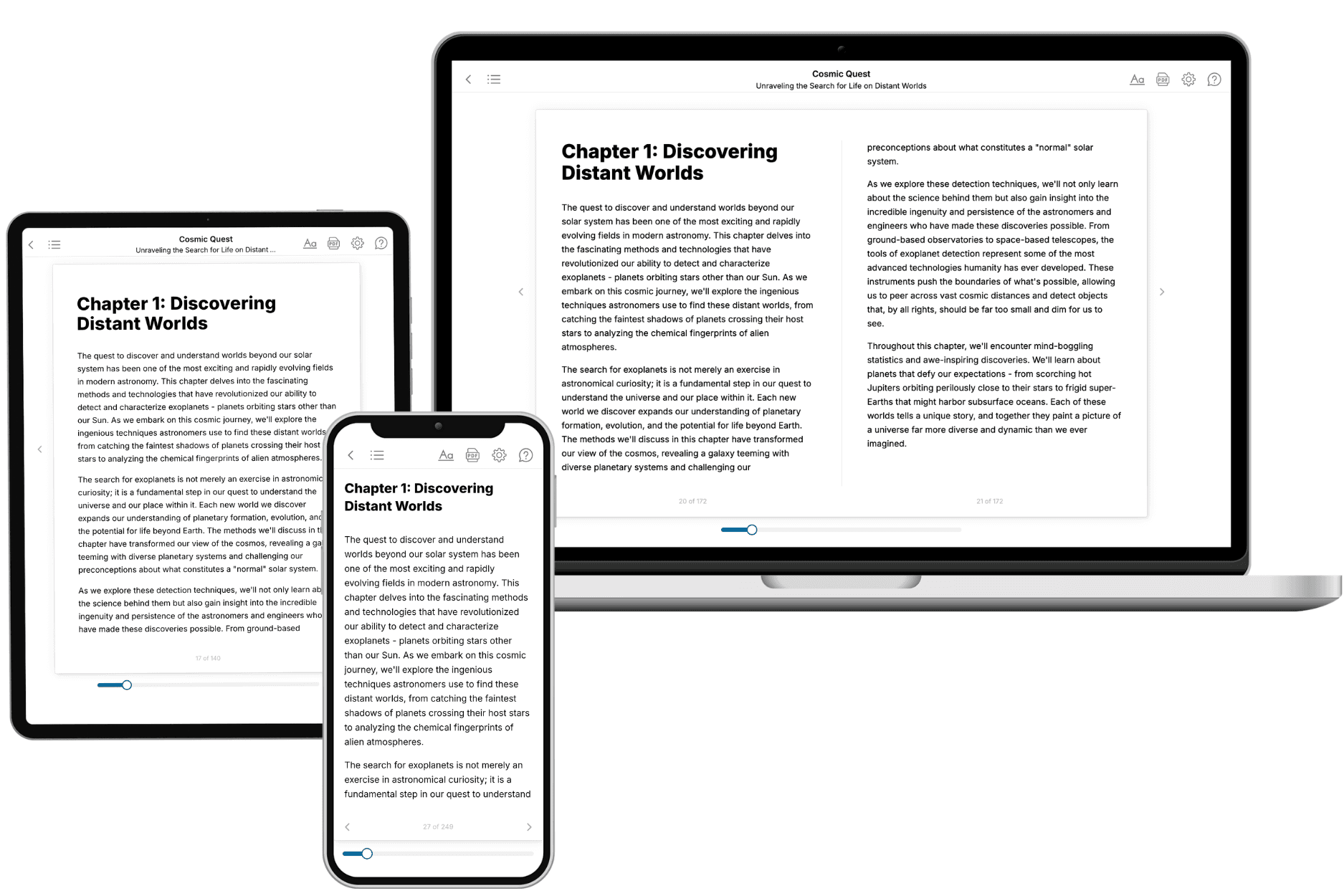
Your book is ready in 10 minutes. Read it online, download as EPUB or PDF, or send to Kindle.

Frequently asked questions
- What is TailoredRead?
TailoredRead creates complete, full-length nonfiction ebooks, written specifically for you. Tell us what you want to learn and why, and TailoredRead writes you a complete ebook on it, with charts, tables, and diagrams throughout. Read it online, on Kindle, or on any e-reader, or download it as a PDF or EPUB. Every book is written fresh the day you order it.
- How is the book tailored to me?
Before anything is written, you answer a few short questions about your goals, your background, and the topics you care about. Your book is then planned around your answers: written at your level, focused on your goals, and covering the topics you chose, instead of the one-size-fits-all book a store sells everyone.
- Will it read like generic AI content?
No. Your book isn't a chat transcript: it's planned chapter by chapter before a single word is written, told in a clear book voice, and explains ideas visually with charts, tables, and diagrams. After writing, every book goes through an editorial pass that polishes chapters so the book reads consistent from start to finish. Judge for yourself: browse thousands of sample books on our Explore Books page.
- How accurate is the content?
Our AI first checks whether your subject needs live research. Niche and fast-moving subjects are researched before writing, and the book plan and chapters are grounded in what it finds. After writing, every book goes through a quality pass that checks its facts and consistency, and researched books list their sources in a Notes section at the back.
- How long is the book?
You choose the length: Comprehensive (250-300 pages), Detailed (150-200 pages), Essential (70-100 pages), or Short (30-50 pages).
- Does the book include visuals?
Yes. Every book includes visual elements such as timelines, checklists, step-by-step guides, decision trees, comparison tables, and matrices, and many include bar charts. A typical book includes dozens of these visual elements.
- Can I read it on Kindle? What formats can I download?
Yes. Every book can be read in our online reader or downloaded as a PDF or EPUB. The EPUB can be opened with Kindle, Apple Books, Kobo, and any e-reader. The Commercial and Author licenses also include an editable Word (DOCX) and Markdown download.
- How much does it cost?
About the price of a regular ebook. The exact price depends on your book's length and complexity, from $2 for the shortest books to $35 for the most comprehensive, and it's shown when you review your book, before you commit to anything. Each book is a one-time purchase, yours to keep, no subscription. Licenses that let you share, teach, or publish your book range from $35.99 to $49.99.
- Can I preview the book before purchasing?
Before you pay, you'll see what your book will cover: the title, a detailed description, the estimated length, and the complete chapter-by-chapter table of contents, so you know what you're getting before you decide. The full text itself is written after you purchase.
- How long does it take to create a book?
About 10 minutes. You can start reading the opening chapters while the rest is still being written.