Fourier Analysis Unveiled
Mastering the Mathematics of Waves and Signals
Dive into the fascinating world of Fourier Analysis, where mathematics meets the intricate patterns of waves and signals.
269 pages13 chaptersDec 25, 2024Mathematics
About this book
As you progress through this illuminating journey, you'll unravel the complexities of periodic functions, explore the power of Fourier series, and discover how these concepts apply to derivatives and differentiation. Your adventure begins with the fundamentals, gradually building to more advanced concepts. You'll learn to decompose complex functions into simpler sinusoidal components, understand the significance of frequency domains, and apply these principles to real-world problems. Along the way, you'll develop a deeper appreciation for the elegance and utility of Fourier Analysis in various fields of mathematics and science. By the time you complete this book, you'll have gained a solid grasp of Fourier Analysis techniques, their applications in calculus, and their relevance in modern mathematics. You'll be equipped with the tools to analyze complex waveforms, solve differential equations with ease, and approach mathematical problems from a fresh perspective. This newfound knowledge will not only enhance your mathematical prowess but also open doors to further exploration in advanced mathematics, physics, and engineering.
Table of contents
- IntroductionOverview of Fourier Analysis, Historical Context and Importance, Structure of the Book, Mathematical PrerequisitesRead below
- Chapter 1: Foundations of Fourier AnalysisPeriodic Functions and Their Properties, Trigonometric Functions and Identities, Complex Exponentials and Euler's Formula, Orthogonality and Inner Products
- Chapter 2: Fourier SeriesDefinition and Convergence, Calculating Fourier Coefficients, Even and Odd Functions, Half-Range Expansions
- Chapter 3: Convergence of Fourier SeriesPointwise Convergence, Uniform Convergence, Gibbs Phenomenon, Parseval's Theorem
- Chapter 4: Complex Fourier SeriesComplex Exponential Form, Relation to Trigonometric Form, Complex Fourier Coefficients, Symmetry Properties
- Chapter 5: Fourier TransformsDefinition and Properties, Inverse Fourier Transform, Convolution Theorem, Parseval-Plancherel Theorem
- Chapter 6: Discrete Fourier TransformDefinition and Properties, Fast Fourier Transform (FFT), Sampling Theorem, Aliasing and Nyquist Frequency
- Chapter 7: Derivatives and Fourier AnalysisDifferentiation of Fourier Series, Integration of Fourier Series, Derivative Properties in Frequency Domain, Smoothness and Decay of Fourier Coefficients
- Chapter 8: Fourier Analysis in Differential EquationsSolving ODEs with Fourier Series, Solving PDEs with Fourier Transforms, Boundary Value Problems, The Heat Equation, The Wave Equation
- Chapter 9: Applications in Signal ProcessingFiltering and Convolution, Modulation and Demodulation, Sampling and Reconstruction, Spectral Analysis
- Chapter 10: Introduction to WaveletsWavelet Transforms, Multiresolution Analysis, Applications of Wavelets, Comparison with Fourier Analysis
- Chapter 11: Numerical Methods in Fourier AnalysisFFT Implementation, Numerical Integration Techniques, Error Analysis and Stability, Computational Efficiency Considerations
- Chapter 12: Advanced Topics in Fourier AnalysisDistributions and Generalized Functions, Multidimensional Fourier Analysis, Fractional Fourier Transforms, The Uncertainty Principle
- Chapter 13: Real-World ApplicationsImage Processing and Compression, Audio Analysis and Synthesis, Quantum Mechanics, Communications Systems, Medical Imaging Techniques
- ConclusionSummary of Key Concepts, Future Directions in Fourier Analysis
- AppendixMathematical Proofs, Tables of Fourier Transforms
- Glossary
Introduction
Welcome to the captivating world of Fourier Analysis, a mathematical realm where complex patterns of waves and signals are unraveled into their fundamental components. This introduction serves as your gateway to understanding the power and elegance of Fourier Analysis, setting the stage for a journey that will transform your perspective on mathematics and its applications. As you embark on this exploration, you'll discover how this branch of mathematics bridges the gap between abstract concepts and real-world phenomena, offering insights that span across various scientific and engineering disciplines.
Fourier Analysis, named after the brilliant French mathematician Joseph Fourier, is a cornerstone of modern mathematics and physics. It provides a unique lens through which we can view and analyze complex functions, breaking them down into simpler, more manageable parts. This decomposition not only aids in understanding the nature of these functions but also facilitates solving a wide array of mathematical and physical problems. From signal processing to quantum mechanics, from heat conduction to image compression, Fourier Analysis has left an indelible mark on our understanding of the natural world and our ability to manipulate it.
Throughout this book, you'll be guided through the intricacies of Fourier Analysis, starting from its foundational concepts and progressing to its advanced applications. You'll learn how to harness the power of Fourier series to represent periodic functions, explore the far-reaching implications of Fourier transforms, and discover how these tools can be applied to solve differential equations and analyze complex systems. By the end of this journey, you'll possess a robust toolkit for tackling a wide range of mathematical challenges and a deep appreciation for the underlying unity of mathematics that Fourier Analysis reveals.
Overview of Fourier Analysis
Fourier Analysis is a branch of mathematics that focuses on the study of functions or signals in terms of sinusoidal components. At its core, it is based on the remarkable idea that any periodic function, no matter how complex, can be expressed as a sum of simple sine and cosine waves of different frequencies. This concept, revolutionary in its simplicity and power, forms the foundation of Fourier series. The beauty of this approach lies in its ability to transform complex, seemingly intractable problems into more manageable forms, often revealing hidden patterns and relationships in the process.
The fundamental principle of Fourier Analysis can be traced back to the observation that many natural phenomena exhibit periodic behavior. From the oscillations of a pendulum to the electromagnetic waves that carry radio signals, periodicity is a ubiquitous feature of our universe. Fourier's insight was to recognize that these periodic behaviors could be described mathematically as combinations of simple sinusoidal functions. This realization opened up new avenues for analyzing and understanding a wide range of physical systems and mathematical problems.
One of the key strengths of Fourier Analysis is its ability to bridge the gap between the time domain and the frequency domain. In the time domain, we observe how a function or signal changes over time. However, by applying Fourier Analysis, we can transform this information into the frequency domain, revealing the spectrum of frequencies that make up the original function. This transformation provides a different perspective on the data, often uncovering insights that were not apparent in the original time-domain representation. For instance, in signal processing, this allows engineers to identify and filter out unwanted frequencies, leading to cleaner, more precise signals.
The applications of Fourier Analysis extend far beyond simple periodic functions. Through the development of Fourier transforms, these techniques can be applied to non-periodic functions as well, vastly expanding their utility. This generalization allows for the analysis of transient phenomena, such as the response of a system to a sudden impulse, or the study of signals that change over time, like speech or music. The discrete Fourier transform (DFT) and its efficient implementation, the fast Fourier transform (FFT), have revolutionized digital signal processing, enabling real-time analysis and manipulation of complex signals in fields ranging from telecommunications to medical imaging.
In the realm of differential equations, Fourier Analysis provides powerful tools for finding solutions to both ordinary and partial differential equations. Many physical laws are expressed in terms of differential equations, and Fourier techniques often offer elegant and efficient methods for solving these equations. For example, the heat equation, which describes how temperature varies over time in a physical object, can be solved using Fourier series, providing insights into heat conduction and diffusion processes. Similarly, the wave equation, fundamental to our understanding of electromagnetic waves and quantum mechanics, yields to Fourier analysis, revealing the behavior of waves in various media.
As you delve deeper into Fourier Analysis, you'll encounter concepts such as orthogonality, which underlies the independence of different frequency components, and Parseval's theorem, which relates the energy of a signal in the time domain to its energy in the frequency domain. These principles not only have mathematical elegance but also practical implications in fields like signal compression and spectral analysis. You'll also explore the fascinating connections between the smoothness of a function and the decay rate of its Fourier coefficients, a relationship that has profound implications for both pure mathematics and applied sciences.
The power of Fourier Analysis extends to multidimensional spaces as well. Two-dimensional Fourier transforms, for instance, are crucial in image processing and computer vision. They allow for the manipulation of images in the frequency domain, enabling operations like filtering, edge detection, and compression. In higher dimensions, Fourier techniques find applications in crystallography, helping scientists understand the structure of materials at the atomic level.
As we progress through this book, you'll see how Fourier Analysis interacts with other branches of mathematics. Its connections to complex analysis, functional analysis, and harmonic analysis enrich our understanding of these fields and provide new tools for tackling challenging problems. The interplay between Fourier Analysis and probability theory, for example, leads to powerful techniques in statistical signal processing and data analysis.
It's important to note that while Fourier Analysis is incredibly powerful, it's not without limitations. The assumption of periodicity or the infinite extent of functions in Fourier transforms can sometimes lead to artifacts or inaccuracies when dealing with finite, real-world data. This has led to the development of related techniques, such as wavelet analysis, which can better handle localized features and non-stationary signals. Understanding these limitations and the appropriate contexts for applying Fourier techniques is crucial for their effective use.
As you embark on this journey through Fourier Analysis, you'll develop not just technical skills but also a new way of thinking about functions, signals, and systems. You'll learn to see the hidden periodicities in complex data, to move fluidly between time and frequency domains, and to apply these insights to solve real-world problems. Whether your interests lie in pure mathematics, physics, engineering, or data science, the principles of Fourier Analysis you'll learn in this book will provide you with powerful tools and a deeper understanding of the mathematical structures that underlie our world.
Historical Context and Importance
The development of Fourier Analysis is a testament to the interplay between pure mathematics and practical problem-solving that has driven scientific progress throughout history. Its origins can be traced back to the early 19th century, when Joseph Fourier (1768-1830) was grappling with the problem of heat conduction. Fourier's work on this seemingly specific problem led to insights that would revolutionize mathematics and physics for centuries to come. His seminal work, "Théorie analytique de la chaleur" (The Analytical Theory of Heat), published in 1822, introduced the concept of expressing functions as infinite series of trigonometric functions, now known as Fourier series[1].
Fourier's ideas were initially met with skepticism from the mathematical community. Prominent mathematicians of the time, including Lagrange, raised objections to Fourier's claim that any arbitrary function could be represented as a sum of simple sine waves. This controversy sparked a flurry of research and debate that would ultimately lead to a deeper understanding of functions and their properties. The rigorous foundation for Fourier's work was laid in the late 19th and early 20th centuries by mathematicians such as Dirichlet, Riemann, and Lebesgue, who developed the theory of integration and measure that was necessary to fully justify Fourier's methods.
The importance of Fourier Analysis quickly became apparent as it found applications far beyond the study of heat conduction. In physics, it became an indispensable tool for understanding wave phenomena, from the behavior of sound waves to the nature of light. The development of quantum mechanics in the early 20th century relied heavily on Fourier techniques, with the wave functions of particles being expressed in terms of their frequency components. In electrical engineering, Fourier Analysis formed the basis for understanding signal processing and communication systems, leading to advancements in technologies ranging from radio and television to modern digital communications.
The advent of digital computing in the mid-20th century marked a new era for Fourier Analysis. The development of the Fast Fourier Transform (FFT) algorithm by Cooley and Tukey in 1965 dramatically reduced the computational complexity of Fourier transforms, making it feasible to apply these techniques to large datasets in real-time[2]. This breakthrough had far-reaching consequences, enabling new applications in fields such as medical imaging (e.g., MRI and CT scans), audio processing, and computer graphics. The FFT algorithm is often cited as one of the most important numerical algorithms of the 20th century, highlighting the practical impact of Fourier Analysis on modern technology.
In mathematics, Fourier Analysis has had a profound influence on the development of several branches of the field. It played a crucial role in the evolution of functional analysis, providing concrete examples of function spaces and operators that drove the development of abstract theories. The study of convergence of Fourier series led to important advances in real analysis and the theory of functions. In number theory, Fourier analytic techniques have been applied to problems in areas such as the distribution of prime numbers, leading to deep insights and powerful results.
The historical development of Fourier Analysis also illustrates the often unexpected ways in which mathematical ideas can evolve and find applications. What began as a method for solving a specific problem in heat conduction became a universal tool for analyzing periodic phenomena, and then expanded to encompass non-periodic functions and discrete data. This evolution continues today, with ongoing research in areas such as compressed sensing, which combines ideas from Fourier Analysis with optimization theory to recover signals from incomplete data.
Understanding the historical context of Fourier Analysis not only provides a deeper appreciation of its significance but also offers valuable lessons for aspiring mathematicians and scientists. It demonstrates how tackling specific, concrete problems can lead to general theories with wide-ranging applications. It also illustrates the importance of persistence and open-mindedness in the face of initial skepticism, as well as the value of rigorous mathematical foundations in validating and extending intuitive ideas.
As you delve into the details of Fourier Analysis in the following chapters, it's worth keeping this rich historical background in mind. The techniques you'll learn are the result of centuries of mathematical thought and refinement, and they continue to be at the forefront of scientific and technological innovation. From the analysis of climate data to the development of machine learning algorithms, from the design of musical instruments to the exploration of distant galaxies, Fourier Analysis remains a fundamental tool for understanding and manipulating the world around us.
Moreover, the story of Fourier Analysis serves as a reminder of the interconnectedness of different branches of mathematics and science. What began as a study of heat has become a unifying principle that bridges disciplines as diverse as quantum physics, signal processing, and data compression. As you progress through this book, you'll see how ideas from calculus, linear algebra, complex analysis, and other areas of mathematics come together in the framework of Fourier Analysis, providing a powerful example of the unity and coherence of mathematical thought.
In conclusion, the historical context of Fourier Analysis reveals its central importance in the development of modern mathematics and its applications. From its controversial beginnings to its current status as an indispensable tool across science and engineering, Fourier Analysis exemplifies the power of mathematical ideas to transform our understanding of the world. As you embark on your journey through this field, you are following in the footsteps of some of the greatest minds in mathematical history and participating in an ongoing intellectual adventure that continues to yield new insights and applications.
Structure of the Book
This book is designed to guide you through the fascinating world of Fourier Analysis, starting from its foundational concepts and progressing to advanced applications. The structure is carefully crafted to build your understanding step by step, ensuring that each new concept is grounded in previously established knowledge. As you progress through the chapters, you'll find that the material becomes increasingly sophisticated, allowing you to tackle more complex problems and gain deeper insights into the nature of Fourier Analysis and its wide-ranging applications.
We begin with the Foundations of Fourier Analysis, where you'll revisit and deepen your understanding of periodic functions, trigonometric identities, and complex exponentials. This chapter lays the groundwork for everything that follows, introducing key concepts such as orthogonality and inner products. These fundamental ideas are crucial for understanding the mechanics of Fourier series and transforms, and you'll find yourself referring back to this chapter as you encounter more advanced topics.
The next several chapters focus on the core elements of Fourier Analysis. You'll start with Fourier Series, learning how to represent periodic functions as sums of sines and cosines. This chapter covers the definition and convergence of Fourier series, methods for calculating Fourier coefficients, and special cases such as even and odd functions. Following this, you'll delve into the Convergence of Fourier Series, exploring concepts like pointwise and uniform convergence, and encountering phenomena such as the Gibbs effect. This deeper look at convergence properties will enhance your understanding of the strengths and limitations of Fourier series representations.
Building on your knowledge of trigonometric Fourier series, you'll then explore Complex Fourier Series. This chapter bridges the gap between the real and complex domains, showing how the exponential form of Fourier series relates to the trigonometric form and introducing the powerful concept of complex Fourier coefficients. This transition to the complex domain paves the way for the subsequent chapter on Fourier Transforms, where you'll learn how to extend Fourier analysis to non-periodic functions. The Fourier transform is a cornerstone of modern signal processing and analysis, and you'll explore its properties, inverse transforms, and important theorems such as the convolution theorem.
As the book progresses, you'll encounter more specialized topics that build on the core concepts. The chapter on Discrete Fourier Transforms introduces you to the digital world, where continuous functions are sampled and analyzed. Here, you'll learn about the Fast Fourier Transform (FFT) algorithm, a computational breakthrough that has made Fourier analysis practical for a wide range of applications. You'll also explore the critical concepts of sampling theory and the Nyquist frequency, which are fundamental to understanding how continuous signals can be accurately represented and processed in digital systems.
A key focus of this book is the relationship between Fourier Analysis and calculus, particularly in the realm of derivatives and differentiation. The chapter on Derivatives and Fourier Analysis explores how Fourier techniques can be used to analyze and manipulate derivatives of functions. You'll learn about the differentiation and integration of Fourier series, and how the smoothness of a function relates to the decay of its Fourier coefficients. This chapter provides crucial insights into the behavior of functions and their derivatives in both the time and frequency domains.
Building on this foundation, you'll explore the application of Fourier Analysis to Differential Equations. This chapter demonstrates the power of Fourier techniques in solving both ordinary and partial differential equations, including famous examples like the heat equation and the wave equation. You'll see how Fourier methods can simplify complex boundary value problems and provide elegant solutions to equations that describe physical phenomena.
The book then turns to practical applications, with chapters on Signal Processing and Real-World Applications. In these sections, you'll see how the theoretical concepts you've learned are applied to solve real-world problems in fields such as communications, image and audio processing, medical imaging, and quantum mechanics. These chapters will help you appreciate the broad impact of Fourier Analysis across various disciplines and inspire you to think about how you might apply these techniques in your own field of interest.
For those interested in more advanced topics, the book includes chapters on Wavelets and Advanced Topics in Fourier Analysis. The Wavelets chapter introduces you to this more recent development in signal analysis, which addresses some of the limitations of traditional Fourier analysis. In the Advanced Topics chapter, you'll encounter sophisticated concepts such as distributions, multidimensional Fourier analysis, and the uncertainty principle, pushing the boundaries of your understanding and preparing you for further study in this rich field.
Throughout the book, you'll find numerous examples, exercises, and applications that illustrate the concepts being discussed. These practical elements are designed to reinforce your understanding and help you develop intuition for how Fourier Analysis works in various contexts. The book also includes historical notes and biographical sketches of key figures in the development of Fourier Analysis, providing context and bringing the subject to life.
To support your learning, each chapter concludes with a summary of key points and a set of challenging problems that encourage you to apply and extend your knowledge. The book also includes an extensive appendix with mathematical proofs, tables of common Fourier transforms, and a comprehensive glossary of terms. These resources will be invaluable as you work through the material and refer back to it in your future studies or applications of Fourier Analysis.
By structuring the book in this way, the aim is to provide you with a comprehensive and coherent journey through Fourier Analysis. Whether you're a student encountering these concepts for the first time, a professional looking to apply Fourier techniques in your work, or simply a mathematics enthusiast eager to explore this beautiful and powerful area of mathematics, this book is designed to meet your needs and inspire your curiosity. As you progress through the chapters, you'll not only gain technical proficiency but also develop a deep appreciation for the elegance and utility of Fourier Analysis in unraveling the complexities of our mathematical universe.
Mathematical Prerequisites
Before diving into the intricacies of Fourier Analysis, it's important to ensure that you have a solid foundation in certain mathematical concepts. While this book is designed to be as self-contained as possible, familiarity with specific areas of mathematics will greatly enhance your understanding and appreciation of the material presented. This section outlines the key prerequisites that will serve as building blocks for your journey into Fourier Analysis, along with suggestions for review if you find any areas challenging.
First and foremost, a strong grasp of calculus is essential. You should be comfortable with both differential and integral calculus, including concepts such as limits, continuity, differentiation, and integration of single-variable functions. Familiarity with multivariable calculus, particularly partial derivatives and multiple integrals, will also be beneficial, especially when we explore multidimensional Fourier transforms and partial differential equations. If you need to refresh your calculus skills, consider reviewing a standard calculus textbook or online resources that cover these topics in depth[3].
Linear algebra forms another crucial foundation for understanding Fourier Analysis. You should be familiar with vector spaces, linear transformations, matrices, and eigenvalues. The concepts of inner products and orthogonality, which are fundamental to linear algebra, play a central role in Fourier Analysis. If your linear algebra skills need brushing up, there are many excellent resources available, including textbooks and online courses that cover these topics comprehensively[4].
A solid understanding of complex numbers and complex analysis is also crucial. You should be comfortable working with complex numbers, including their representation in both Cartesian and polar forms, and operations such as complex multiplication and exponentiation. Familiarity with complex functions, including Euler's formula (e^(ix) = cos(x) + i*sin(x)), is particularly important as it forms the basis for many Fourier techniques. If you need to review complex numbers and functions, consider consulting a complex analysis textbook or online resources dedicated to this topic[5].
Basic knowledge of differential equations, both ordinary and partial, will be helpful, especially when we explore the applications of Fourier Analysis in solving these equations. While we will review the necessary concepts as we encounter them, prior exposure to solving simple differential equations will give you a head start. If you haven't studied differential equations before, don't worry – the book will provide the necessary background, but you might find it helpful to familiarize yourself with the basic ideas beforehand.
Probability theory and statistics, while not strictly necessary for understanding the core concepts of Fourier Analysis, become increasingly relevant as we explore applications in signal processing and data analysis. A basic understanding of concepts such as random variables, probability distributions, and expected values will be beneficial. If you're not familiar with these concepts, a brief review of introductory probability and statistics materials could be helpful.
In addition to these specific areas of mathematics, certain mathematical skills and ways of thinking will be invaluable as you work through this book. These include:
- Analytical thinking: The ability to break down complex problems into simpler components and recognize patterns.
- Abstract reasoning: Comfort with abstract mathematical concepts and the ability to generalize from specific examples to broader principles.
- Mathematical rigor: An appreciation for precise definitions and logical arguments, including the ability to follow and construct mathematical proofs.
- Visualization skills: The capacity to visualize mathematical concepts, particularly in relation to waves, signals, and geometric representations of complex functions.
- Computational proficiency: While not strictly necessary, familiarity with mathematical software (such as MATLAB, Python with NumPy/SciPy, or similar tools) can be helpful for exploring Fourier Analysis concepts and visualizing results.
It's important to note that while these prerequisites provide a strong foundation, Fourier Analysis is a rich and multifaceted field that draws connections between many areas of mathematics. As you progress through the book, you'll find that concepts from various mathematical disciplines come together in fascinating ways. This interconnectedness is part of what makes Fourier Analysis so powerful and widely applicable.
If you find that your background in any of these areas is not as strong as you'd like, don't be discouraged. The book is designed to build your understanding gradually, and each chapter includes reviews of relevant concepts as needed. Additionally, the exercises and examples provided throughout the text will help reinforce your understanding and develop your skills.
Remember that learning mathematics is an active process. As you read through the book, take the time to work through examples, solve problems, and explore the concepts on your own. Don't hesitate to consult additional resources or seek help if you encounter difficulties. The journey through Fourier Analysis can be challenging at times, but it's also immensely rewarding, offering insights that will enrich your mathematical understanding and equip you with powerful tools for analyzing a wide range of phenomena.
Lastly, approach this material with curiosity and patience. Fourier Analysis reveals deep and sometimes surprising connections in mathematics, and developing a true understanding of these concepts takes time and practice. As you progress through the book, you'll find your mathematical intuition growing stronger, and you'll begin to see the world around you through the lens of frequency and periodicity. Embrace this journey of discovery, and let the elegance and power of Fourier Analysis inspire your mathematical explorations.
Notes
Introduction
- 1. J. Fourier, Théorie analytique de la chaleur, Firmin Didot, père et fils, 1822
- 2. J. W. Cooley and J. W. Tukey, "An algorithm for the machine calculation of complex Fourier series," Mathematics of computation, 1965
- 3. J. Stewart, Calculus: Early Transcendentals (8th ed.), Cengage Learning, 2015
- 4. G. Strang, Introduction to Linear Algebra (5th ed.), Wellesley-Cambridge Press, 2016
- 5. J. W. Brown and R. V. Churchill, Complex Variables and Applications (9th ed.), McGraw-Hill Education, 2013
This is the end of the free sample. The full book has 13 chapters.
Want this book written for you?
Tell us your goals and background, and get your own version of this book, tailored by AI to you.


Benefits of AI-tailored books
- Read one book, not ten:
- all the Mathematics knowledge you need, gathered into a single book.
- Save days of learning:
- tell us your goals, choose your topics, and the whole book is built around them.
- Learn effortlessly:
- Mathematics book written for your specific background and expertise.
- Understand at a glance:
- includes charts, tables, timelines, checklists, decision trees, and more.
- Stay current:
- written the day you order it, not years ago.
- Trust what you read:
- every book is checked for accuracy, with real research when your subject needs it.
Create your unique book in 3 steps
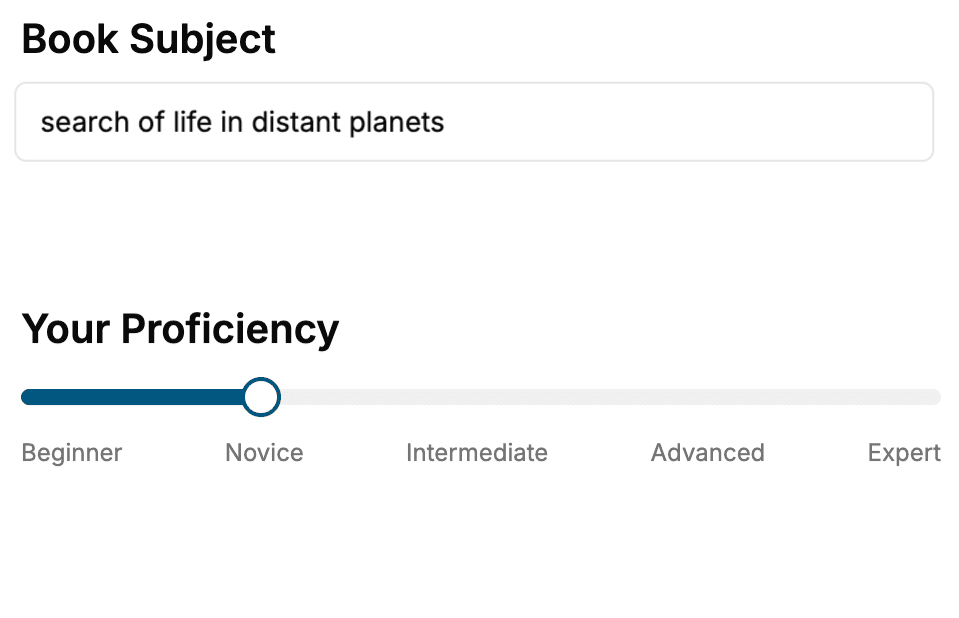
- 1. Select your focus
Select the focus of your Mathematics book and share your background
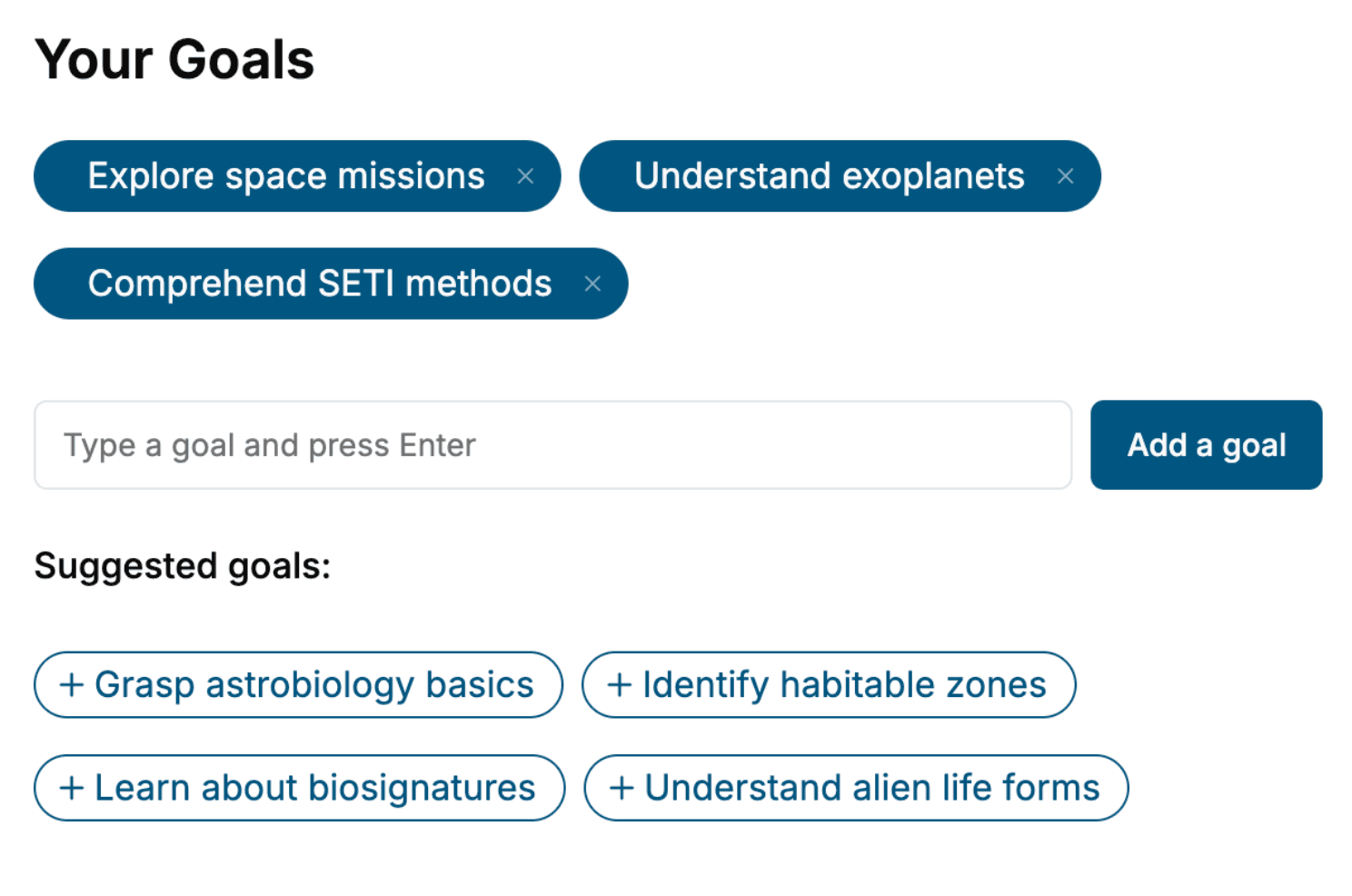
- 2. Personalize your book
Specify your goals and choose sub-topics to include
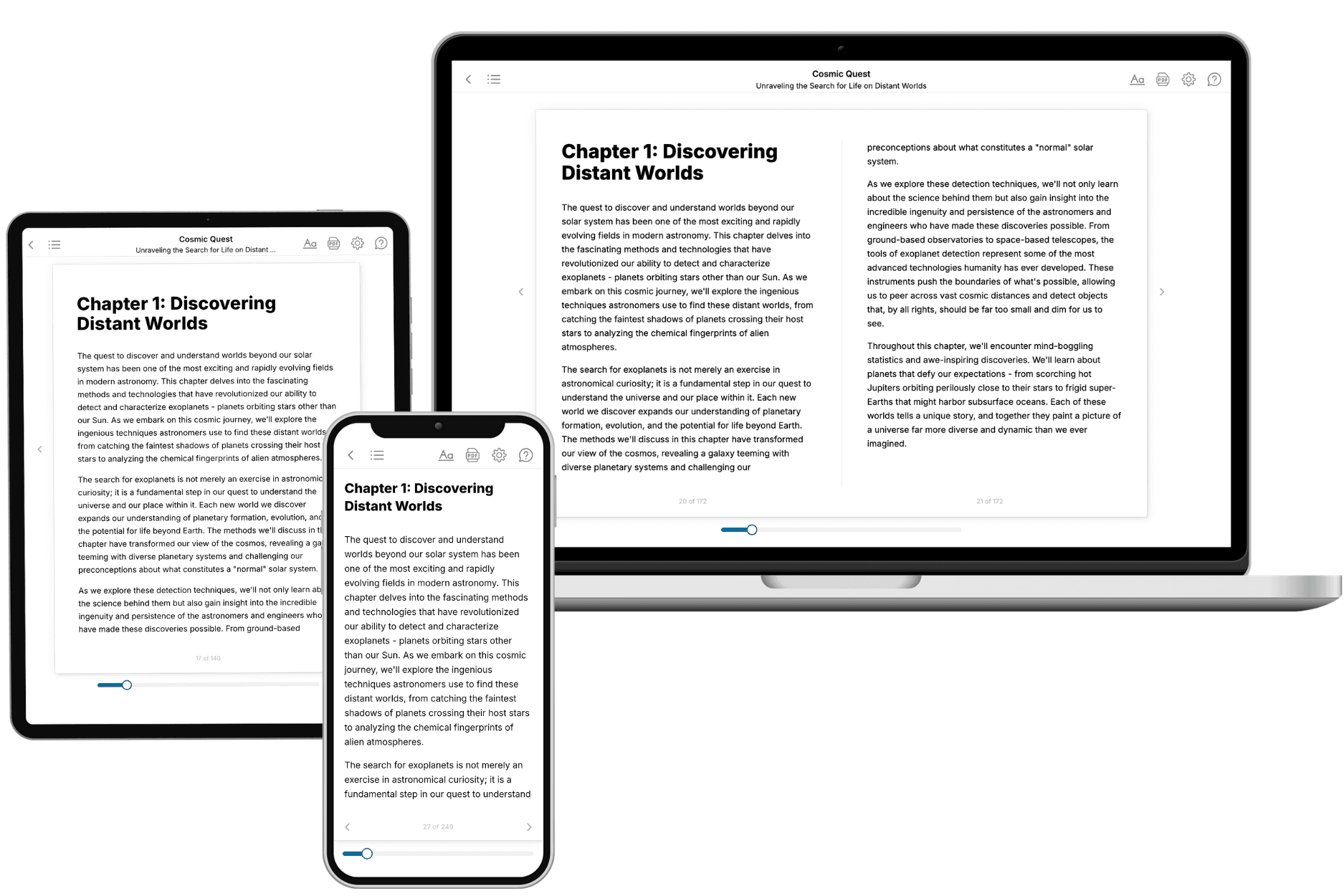
- 3. Get your tailored book
Your book is ready in 10 minutes. Read it online, download as EPUB or PDF, or send to Kindle.
Frequently asked questions
- What is TailoredRead?
TailoredRead creates complete, full-length nonfiction ebooks, written specifically for you. Tell us what you want to learn and why, and TailoredRead writes you a complete ebook on it, with charts, tables, and diagrams throughout. Read it online, on Kindle, or on any e-reader, or download it as a PDF or EPUB. Every book is written fresh the day you order it.
- How is the book tailored to me?
Before anything is written, you answer a few short questions about your goals, your background, and the topics you care about. Your book is then planned around your answers: written at your level, focused on your goals, and covering the topics you chose, instead of the one-size-fits-all book a store sells everyone.
- Will it read like generic AI content?
No. Your book isn't a chat transcript: it's planned chapter by chapter before a single word is written, told in a clear book voice, and explains ideas visually with charts, tables, and diagrams. After writing, every book goes through an editorial pass that polishes chapters so the book reads consistent from start to finish. Judge for yourself: browse thousands of sample books on our Explore Books page.
- How accurate is the content?
Our AI first checks whether your subject needs live research. Niche and fast-moving subjects are researched before writing, and the book plan and chapters are grounded in what it finds. After writing, every book goes through a quality pass that checks its facts and consistency, and researched books list their sources in a Notes section at the back.
- How long is the book?
You choose the length: Comprehensive (250-300 pages), Detailed (150-200 pages), Essential (70-100 pages), or Short (30-50 pages).
- Does the book include visuals?
Yes. Every book includes charts, tables, and diagrams: timelines, checklists, step-by-step guides, decision trees, comparison tables, matrices, and bar charts. A typical book includes dozens of these visual elements.
- Can I read it on Kindle? What formats can I download?
Yes. Every book can be read in our online reader or downloaded as a PDF or EPUB. The EPUB can be opened with Kindle, Apple Books, Kobo, and any e-reader. The Commercial and Author licenses also include an editable Word (DOCX) and Markdown download.
- How much does it cost?
About the price of a regular ebook. The exact price depends on your book's length and complexity, from $2 for the shortest books to $35 for the most comprehensive, and it's shown when you review your book, before you commit to anything. Each book is a one-time purchase, yours to keep, no subscription. Licenses that let you share, teach, or publish your book range from $35.99 to $49.99.
- Can I preview the book before purchasing?
Before you pay, you'll see what your book will cover: the title, a detailed description, the estimated length, and the complete chapter-by-chapter table of contents, so you know what you're getting before you decide. The full text itself is written after you purchase.
- How long does it take to create a book?
About 10 minutes. You can start reading the opening chapters while the rest is still being written.