The French Health Advantage
Master the Language of Wellness While Learning French
Imagine confidently discussing your health concerns with a French doctor, understanding pharmacy recommendations without hesitation, or engaging in meaningful conversations about wellness with French friends.
238 pages11 chaptersJun 9, 2026Learning French
About this book
This book bridges the gap between textbook French and real-world health communication. You'll discover how the French language uniquely expresses medical concepts, learn the vocabulary that matters most in healthcare settings, and gain insight into French wellness culture that shapes how people talk about their bodies and minds. Whether you're preparing for a trip to France, working in a healthcare environment, or simply want to communicate more authentically, this guide provides practical, immediately applicable language skills. Each chapter builds your confidence through authentic scenarios, cultural context, and clear explanations of how French speakers actually discuss health in their daily lives.
Table of contents
- IntroductionWhy Health French Matters, How to Use This Book, Understanding French Wellness CultureRead below
- Chapter 1: The Body and Its PartsMajor Body Systems and Organs, Essential Body Parts Vocabulary, Describing Physical Sensations and Pain
- Chapter 2: Common Illnesses and SymptomsAcute Illnesses and Infections, Chronic Conditions and Long-term Health, How to Express Symptoms Naturally
- Chapter 3: At the Doctor's OfficeScheduling and Preparing for Appointments, During the Medical Consultation, Understanding Diagnosis and Treatment Plans
- Chapter 4: Medications and PharmacyTypes of Medications and Their Names, Communicating at the Pharmacy, Understanding Dosage and Instructions
- Chapter 5: Mental Health and WellnessMental Health Terminology, Discussing Stress, Anxiety, and Depression, French Approaches to Mental Wellness
- Chapter 6: Nutrition and DietFood Groups and Nutritional Concepts, Discussing Dietary Needs and Restrictions, French Food Culture and Health
- Chapter 7: Exercise and Physical ActivityExercise Types and Fitness Vocabulary, Popular French Sports and Activities, Discussing Fitness Goals and Progress
- Chapter 8: Women's and Men's HealthReproductive Health Topics, Gender-Specific Health Conditions, Health Across Different Life Stages
- Chapter 9: Emergency and Urgent CareEmergency Situations and Critical Vocabulary, Hospital Procedures and Terminology, First Aid and Emergency Expressions
- Chapter 10: French Healthcare System and CultureHow the French Healthcare System Works, Insurance, Documentation, and Prescriptions, Cultural Attitudes Toward Health and Prevention
- Chapter 11: Practical Conversations and ScenariosReal-World Health Dialogues, Common Questions and Natural Responses, Cultural Nuances in Health Conversations
- ConclusionContinuing Your French Health Language Journey
- Glossary of Health Terms
- Further Reading and Resources
Introduction
Picture this: you're sitting in a waiting room in Lyon, your stomach is bothering you, and the receptionist asks you a question you only half understand. You know enough French to order coffee and ask for directions, but suddenly the words you need most are nowhere to be found. This is the gap that so many intermediate French learners discover the hard way. Everyday French and health French are two very different things, and the second one tends to matter a great deal more when you actually need it.
Health is one of the most personal and high-stakes areas of human life. When something goes wrong with your body, or when you're trying to understand a doctor's instructions, or when a pharmacist is explaining how to take a medication, there is very little room for misunderstanding. Yet most French language courses treat health vocabulary as an afterthought, tucking a few body parts into a chapter and calling it done. This book takes a completely different approach. It treats health French as a rich, layered subject that connects language, culture, and real-world communication in ways that are genuinely fascinating.
This is not a medical textbook, and it is not a dry vocabulary list. It is a practical guide designed for learners at the A2 to B1 level who want to move beyond tourist French and into the kind of confident, authentic communication that makes a real difference. You will find vocabulary, yes, but also cultural context, natural expressions, dialogue examples, and insight into how French people actually think and talk about their health. By the time you finish, you will have a toolkit that works in real situations, not just on paper.
The French approach to health and wellness is genuinely distinctive. It reflects a broader philosophy about food, pleasure, balance, and the relationship between the individual and the state. Understanding that philosophy does not just make you a better French speaker. It gives you a window into a way of life that millions of people find deeply appealing. The language and the culture are inseparable here, and this book honors that connection throughout every chapter.
Why Health French Matters
Language learners often focus on the vocabulary they think they will use most often: greetings, travel phrases, restaurant orders, and small talk. These are genuinely useful, but they represent only a fraction of real-world communication. Health conversations, by contrast, come up constantly and unexpectedly. A headache on a trip, a friend describing a chronic condition, a news story about a public health issue, a label on a medication bought at a French pharmacy. Health French is everywhere once you start looking for it.
The stakes in health communication are uniquely high. A misunderstood dosage instruction, a symptom you cannot describe clearly, or a diagnosis you only partially understand can have real consequences. This is not meant to be alarming. It is simply a reason to take this area of vocabulary seriously. When you invest time in health French, you are building a skill that protects you and the people around you in situations that genuinely matter.
Beyond emergencies and medical appointments, health French opens up enormous amounts of everyday conversation. French people talk about food, exercise, stress, sleep, and well-being constantly. These topics come up at dinner tables, in workplaces, and among friends. If you can participate in those conversations, your French relationships become richer and more authentic. You stop being the person who nods politely and starts being someone who actually engages.
There is also a professional dimension worth considering. Many people who study French are working in fields where health topics arise regularly. Teachers, social workers, healthcare professionals, researchers, and business people who work with French-speaking populations all benefit from strong health vocabulary. Even if your work does not directly involve medicine, understanding health-related French makes you a more capable and culturally aware professional.
Learning health French also accelerates your overall language development in surprising ways. Medical and wellness vocabulary tends to be precise, which trains you to think carefully about word choice. Health conversations often involve complex grammar structures like conditional tenses (si j'avais su, meaning "if I had known") and subjunctive moods (il faut que vous preniez, meaning "you must take"). Practicing these structures in a meaningful context makes them stick far better than abstract grammar exercises.
Finally, health French gives you access to a huge body of French media and culture. French films, novels, news programs, and podcasts frequently deal with health themes. Understanding the vocabulary and cultural attitudes around wellness lets you engage with French content at a much deeper level. You move from decoding words to actually understanding what is being communicated, which is the real goal of language learning.
A note on confidence: Many intermediate learners report that health situations are among the most anxiety-inducing in a second language. The good news is that preparation dramatically reduces that anxiety. Knowing the right words before you need them transforms a stressful situation into a manageable one. That is exactly what this book is designed to do.
Research in second language acquisition consistently shows that vocabulary learned in emotionally meaningful contexts is retained far more effectively than vocabulary learned in isolation.[1] Health topics are inherently meaningful. They connect to your body, your safety, and your relationships. That emotional weight is actually an advantage when it comes to remembering what you learn.
How to Use This Book
This book is organized to take you from foundational vocabulary to complex, culturally nuanced communication. Each chapter builds on the previous one, but the chapters are also designed to stand alone. If you have a specific and immediate need, such as preparing for a doctor's appointment or understanding pharmacy interactions, you can jump directly to the relevant chapter without losing much context.
Here is a quick overview of how the chapters are structured and what you will find in each one:
- Chapters 1 and 2 cover the body and common illnesses. These are your foundation. You need to know how to name body parts and describe symptoms before you can do anything else in a health context.
- Chapters 3 and 4 take you into healthcare settings: the doctor's office and the pharmacy. These chapters are especially practical for anyone planning to spend time in a French-speaking country.
- Chapters 5, 6, and 7 explore wellness in a broader sense, covering mental health, nutrition, and physical activity. These chapters reflect the French philosophy of health as a lifestyle rather than just the absence of illness.
- Chapter 8 addresses gender-specific health topics across different life stages, using clinical and respectful language throughout.
- Chapter 9 prepares you for emergency situations, which require fast, clear communication under pressure.
- Chapters 10 and 11 zoom out to give you a full picture of the French healthcare system and bring everything together through real-world dialogues and scenarios.
Within each chapter, you will find vocabulary presented in context rather than as isolated lists. Words are introduced through sentences, dialogues, and explanations that show how they are actually used. This approach reflects how language acquisition research suggests vocabulary is best learned: in meaningful, connected contexts rather than as abstract items to memorize.[2]
To get the most out of this book, consider using it in the following ways:
- Read actively. Do not just skim the vocabulary. Say the words out loud. French pronunciation of medical terms can be tricky, and practicing aloud helps you internalize the sounds as well as the meanings.
- Use the dialogues as scripts. The conversation examples in each chapter are designed to be practiced. Read them with a language partner, record yourself, or simply rehearse them mentally before situations where you might need them.
- Connect vocabulary to your own life. When you learn a new word, try to think of a personal connection. Do you have a family member with that condition? Have you experienced that symptom? Personal associations dramatically improve retention.
- Return to chapters as needed. This book is meant to be a reference as well as a course. Keep it accessible and come back to specific sections when real-life situations call for them.
- Notice the cultural notes. Throughout the book, cultural context is woven into the language explanations. Pay attention to these notes. They often explain why French speakers use certain expressions and what those expressions reveal about French attitudes toward health.
One important note about level: this book assumes you are at an A2 to B1 level in French. That means you can handle basic conversations, understand simple written texts, and have a working knowledge of core grammar. You do not need to be fluent. In fact, this book is specifically designed to push you from functional to genuinely confident in one important domain. If you encounter grammar structures that feel unfamiliar, do not let that stop you. Focus on the vocabulary and the communication patterns, and the grammar will become clearer with exposure.
Throughout the book, French terms are presented in bold when introduced for the first time, followed by their English translation in parentheses. Pronunciation guidance is provided for terms that are commonly mispronounced or that follow unexpected patterns. A full glossary at the back of the book gives you a quick reference for all key terms covered across every chapter.
Finally, approach this material with curiosity rather than anxiety. Health French can feel intimidating because the stakes feel high. But learning it is also genuinely interesting. The French language has a rich and sometimes surprising way of expressing ideas about the body, illness, and well-being. Some of those expressions will make you laugh. Some will make you think differently about your own assumptions. All of them will make you a more capable and culturally aware French speaker.
Understanding French Wellness Culture
To understand health French, you need to understand something about how French people think about health in the first place. The French approach to wellness is not simply a set of habits. It is a philosophy, and that philosophy is embedded in the language itself. Words carry cultural assumptions, and if you understand those assumptions, the vocabulary becomes much easier to learn and use naturally.
One of the most fundamental differences between French wellness culture and, say, American wellness culture is the emphasis on l'équilibre (balance). French health discourse tends to focus on maintaining balance across all areas of life: food, rest, work, pleasure, and social connection. This is quite different from the more goal-oriented, optimization-focused approach common in English-speaking countries, where wellness is often framed as something to achieve or maximize. In France, wellness is more often framed as something to maintain and protect.
This philosophy shows up in concrete and sometimes surprising ways. French people are statistically among the highest consumers of wine in the world, yet France has relatively low rates of cardiovascular disease compared to other wealthy nations, a phenomenon researchers have studied extensively and sometimes called the "French Paradox."[3] Whether or not wine is the explanation, the broader point is that French wellness culture does not treat pleasure as the enemy of health. Quite the opposite: pleasure, especially at the table, is considered part of a healthy life.
The French relationship with food is central to understanding French health culture. Meals in France are not just about nutrition. They are social rituals with their own rules, rhythms, and vocabulary. The French tend to eat at set times, sit down for meals, and take their time. Snacking between meals is far less common than in many other cultures. This structured approach to eating is reflected in the language: there are specific words and expressions for meal-related concepts that do not have direct English equivalents, and understanding them helps you participate in conversations about food and health more naturally.
French attitudes toward the medical system are also distinctive. France has one of the most comprehensive public healthcare systems in the world, consistently ranked among the best by international health organizations.[4] This shapes how French people talk about healthcare. There is a general expectation that healthcare is a right, not a privilege, and that the system will be there when needed. At the same time, French people tend to have a strong relationship with their médecin traitant (primary care physician), a designated doctor who coordinates their care and serves as the first point of contact for most health concerns.
The French pharmacy, or pharmacie, deserves special mention because it plays a role in French health culture that goes well beyond what pharmacies do in many other countries. French pharmacists are highly trained healthcare professionals who are expected to provide medical advice, recommend treatments for minor ailments, and serve as a first line of care before a doctor visit. The green cross sign outside every French pharmacy is one of the most recognizable symbols in French daily life. Understanding how to interact with a pharmacist in French is a genuinely practical skill, and it is covered in depth in Chapter 4.
Mental health is an area where French culture has historically been more reserved than some other Western cultures. Discussing psychological struggles openly has traditionally been less common in France than in, say, the United States. However, this is changing, particularly among younger generations. The vocabulary around mental health in French is evolving rapidly, and this book reflects current usage rather than outdated assumptions. Chapter 5 addresses this topic with the nuance and respect it deserves.
French wellness culture also places significant value on la prévention (prevention). Regular check-ups, screenings, and vaccinations are taken seriously, and the healthcare system is structured to encourage preventive care. This preventive mindset is reflected in the language: French has a rich vocabulary for describing health maintenance, risk factors, and lifestyle choices that support long-term well-being. Learning this vocabulary gives you access to conversations that go well beyond treating illness and into the broader territory of living well.
One more cultural element worth highlighting is the French concept of la médecine douce (gentle medicine or alternative medicine). Homeopathy, herbal remedies, and other complementary approaches have a significant following in France, far more so than in many other developed countries. French pharmacies stock homeopathic products alongside conventional medications, and many French people use both without seeing any contradiction. This cultural reality means that health conversations in French sometimes include vocabulary and concepts that might seem unfamiliar or unexpected to learners from other backgrounds.
Understanding these cultural dimensions does not mean you need to adopt French health attitudes as your own. It means you will be better equipped to understand what French speakers are actually communicating when they talk about their health. Language is never culturally neutral, and health language least of all. The words French people use to describe their bodies, their illnesses, and their well-being carry centuries of cultural history. This book helps you access that history in a way that makes you a more effective and more empathetic communicator.
Cultural insight: The French expression avoir le cafard literally translates as "to have the cockroach," but it means to feel down or blue. This kind of idiomatic expression, where the literal meaning and the actual meaning are completely different, is common in French health and emotional vocabulary. Throughout this book, you will encounter many such expressions, each one offering a small window into how French speakers experience and describe their inner lives.
As you move through the chapters ahead, keep this cultural backdrop in mind. The vocabulary you are learning is not just a set of labels for medical concepts. It is a way of participating in a rich, complex, and genuinely fascinating culture. Every word you learn brings you one step closer to that participation, and that is what makes this kind of language learning so rewarding. The chapters that follow are designed to make that journey as clear, practical, and enjoyable as possible.
Notes
Introduction
- 1. I. S. P. Nation, Learning Vocabulary in Another Language, Cambridge University Press, 2001
- 2. S. D. Krashen, Principles and Practice in Second Language Acquisition, Pergamon Press, 1982
- 3. S. Renaud and M. de Lorgeril, "Wine, alcohol, platelets, and the French paradox for coronary heart disease," The Lancet, 1992
- 4. World Health Organization, The World Health Report 2000, WHO Press, 2000
This is the end of the free sample. The full book has 11 chapters.
Want this book written for you?
Tell us your goals and background, and get your own version of this book, tailored by AI to you.


Benefits of AI-tailored books
- Read one book, not ten:
- all the Learning French knowledge you need, gathered into a single book.
- Save days of learning:
- tell us your goals, choose your topics, and the whole book is built around them.
- Learn effortlessly:
- Learning French book written for your specific background and expertise.
- Understand at a glance:
- includes charts, tables, timelines, checklists, decision trees, and more.
- Stay current:
- written the day you order it, not years ago.
- Trust what you read:
- every book is checked for accuracy, with real research when your subject needs it.
Create your unique book in 3 steps
- 1. Select your focus
Select the focus of your Learning French book and share your background
- 2. Personalize your book
Specify your goals and choose sub-topics to include
- 3. Get your tailored book
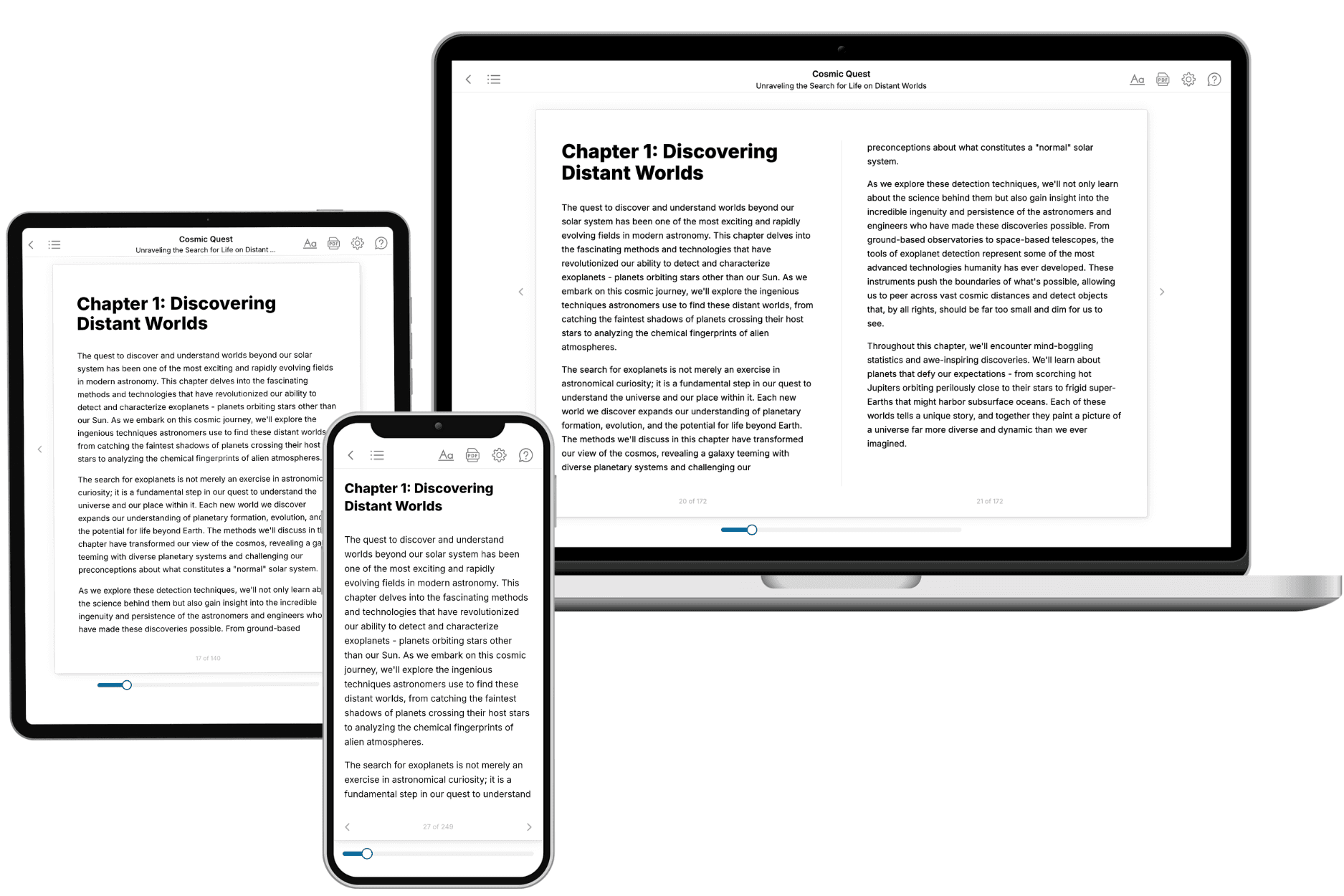
Your book is ready in 10 minutes. Read it online, download as EPUB or PDF, or send to Kindle.
Frequently asked questions
- What is TailoredRead?
TailoredRead creates complete, full-length nonfiction ebooks, written specifically for you. Tell us what you want to learn and why, and TailoredRead writes you a complete ebook on it, with charts, tables, and diagrams throughout. Read it online, on Kindle, or on any e-reader, or download it as a PDF or EPUB. Every book is written fresh the day you order it.
- How is the book tailored to me?
Before anything is written, you answer a few short questions about your goals, your background, and the topics you care about. Your book is then planned around your answers: written at your level, focused on your goals, and covering the topics you chose, instead of the one-size-fits-all book a store sells everyone.
- Will it read like generic AI content?
No. Your book isn't a chat transcript: it's planned chapter by chapter before a single word is written, told in a clear book voice, and explains ideas visually with charts, tables, and diagrams. After writing, every book goes through an editorial pass that polishes chapters so the book reads consistent from start to finish. Judge for yourself: browse thousands of sample books on our Explore Books page.
- How accurate is the content?
Our AI first checks whether your subject needs live research. Niche and fast-moving subjects are researched before writing, and the book plan and chapters are grounded in what it finds. After writing, every book goes through a quality pass that checks its facts and consistency, and researched books list their sources in a Notes section at the back.
- How long is the book?
You choose the length: Comprehensive (250-300 pages), Detailed (150-200 pages), Essential (70-100 pages), or Short (30-50 pages).
- Does the book include visuals?
Yes. Every book includes charts, tables, and diagrams: timelines, checklists, step-by-step guides, decision trees, comparison tables, matrices, and bar charts. A typical book includes dozens of these visual elements.
- Can I read it on Kindle? What formats can I download?
Yes. Every book can be read in our online reader or downloaded as a PDF or EPUB. The EPUB can be opened with Kindle, Apple Books, Kobo, and any e-reader. The Commercial and Author licenses also include an editable Word (DOCX) and Markdown download.
- How much does it cost?
About the price of a regular ebook. The exact price depends on your book's length and complexity, from $2 for the shortest books to $35 for the most comprehensive, and it's shown when you review your book, before you commit to anything. Each book is a one-time purchase, yours to keep, no subscription. Licenses that let you share, teach, or publish your book range from $35.99 to $49.99.
- Can I preview the book before purchasing?
Before you pay, you'll see what your book will cover: the title, a detailed description, the estimated length, and the complete chapter-by-chapter table of contents, so you know what you're getting before you decide. The full text itself is written after you purchase.
- How long does it take to create a book?
About 10 minutes. You can start reading the opening chapters while the rest is still being written.