Fuzzy Logic Control Essentials
Master the Art of Imprecise Reasoning in Modern Control Systems
Discover how fuzzy logic transforms the way control systems handle uncertainty and complexity.
222 pages10 chaptersMar 15, 2026Fuzzy Logic
About this book
Rather than forcing real-world problems into rigid mathematical frameworks, fuzzy logic embraces the imprecision inherent in human decision-making and applies it to electronics and automation. This guide walks you through the complete journey from understanding fuzzy sets and membership functions to designing, implementing, and optimizing fuzzy control systems. You'll learn how fuzzy inference engines process information using intuitive rules, how to convert fuzzy outputs into precise control signals, and how to apply these techniques to practical problems like temperature control, motor regulation, and adaptive systems. Whether you're working with industrial automation, robotics, or consumer electronics, you'll gain the knowledge and confidence to design fuzzy systems that outperform traditional approaches in handling non-linear, uncertain environments.
Table of contents
- IntroductionWhy Fuzzy Logic Matters in Modern Control, Limitations of Traditional Control Methods, Your Roadmap Through This Book, How to Get the Most from This GuideRead below
- Chapter 1: Foundations of Fuzzy LogicClassical Logic vs. Fuzzy Logic, Understanding Fuzzy Sets, Truth Values Beyond True and False
- Chapter 2: Membership Functions and Fuzzy SetsWhat Are Membership Functions?, Common Membership Function Shapes, Designing Membership Functions for Your Application, Tuning and Optimizing Membership Functions
- Chapter 3: Fuzzy Operations and LogicFuzzy AND, OR, and NOT Operations, T-norms and S-norms: The Mathematics Behind Operations, Fuzzy Logical Reasoning and Inference
- Chapter 4: Fuzzy Inference SystemsHow Fuzzy Inference Engines Work, Mamdani Inference Method, Sugeno Inference Method, Choosing the Right Inference Method
- Chapter 5: Rule Bases and Knowledge RepresentationCreating Effective Fuzzy Rules, Rule Structure and Syntax, Ensuring Rule Base Completeness and Consistency
- Chapter 6: Defuzzification TechniquesConverting Fuzzy Outputs to Crisp Values, Centroid and Center of Gravity Methods, Maximum, Weighted Average, and Other Defuzzification Methods, Selecting the Right Defuzzification Approach
- Chapter 7: Practical Applications in Control SystemsTemperature Control and HVAC Systems, Motor Speed and Power Control, Robotics and Industrial Automation
- Chapter 8: Designing and Implementing Fuzzy ControllersThe Fuzzy Controller Design Process, Hardware Implementation Considerations, Software Tools and Platforms for Fuzzy Logic, Testing, Validation, and Debugging
- Chapter 9: Advanced Topics and Hybrid SystemsCombining Fuzzy Logic with PID Control, Adaptive and Self-Tuning Fuzzy Systems, Neural Networks and Fuzzy Logic Integration
- Chapter 10: Troubleshooting and OptimizationCommon Problems and How to Solve Them, Performance Tuning and System Optimization, Handling Real-World Challenges and Edge Cases
- ConclusionKey Takeaways and Next Steps, The Future of Fuzzy Logic in Control Systems
- Glossary of Terms
- Further Reading and Resources
Introduction
Think about the last time you adjusted the shower temperature. You didn't calculate the exact number of degrees to turn the knob. You felt the water, decided it was too cold or a little too hot, and made a small adjustment based on that judgment. That kind of reasoning, vague, intuitive, and surprisingly effective, is exactly what fuzzy logic is designed to capture. It's a framework that lets machines reason the way humans do: not in rigid absolutes, but in degrees and shades of meaning.
Traditional control systems are built on binary logic. A condition is either true or false, a switch is either on or off, and a value either meets a threshold or it doesn't. That works well in clean, predictable environments. But the real world is rarely clean or predictable. Temperatures drift gradually. Motor loads shift under varying conditions. Sensor readings carry noise. When you try to force that messy reality into a rigid true/false framework, you often end up with systems that oscillate, overshoot, or simply fail to respond gracefully to the complexity around them.
Fuzzy logic was introduced by mathematician Lotfi Zadeh in 1965 as a formal way to handle this kind of imprecision.[1] Rather than forcing every value into a binary category, fuzzy logic allows values to belong to multiple categories simultaneously, each with a different degree of membership. A temperature of 72°F might be 80% "comfortable" and 20% "slightly warm" at the same time. That nuance gives control systems far more flexibility to respond smoothly and intelligently to real-world conditions. Over the decades since Zadeh's original paper, fuzzy logic has moved from academic curiosity to industrial workhorse, powering everything from washing machines and air conditioners to industrial robots and autonomous vehicles.
This book is written for engineers, technicians, and electronics professionals who already have a working knowledge of control systems and want to add fuzzy logic to their toolkit. You don't need a deep background in advanced mathematics to benefit from what follows. The goal here is practical understanding: knowing not just what fuzzy logic is, but how to design, implement, and tune fuzzy control systems that actually work in the field. Each chapter builds on the last, moving from foundational concepts through to real-world applications and advanced hybrid techniques.
Why Fuzzy Logic Matters in Modern Control
Modern control problems are getting harder. Systems are expected to operate across wider ranges of conditions, respond to more complex inputs, and do so with greater efficiency and reliability than ever before. A factory robot might need to handle parts of varying weight and shape. An HVAC system might need to balance temperature, humidity, and energy consumption simultaneously. A motor controller might need to maintain smooth performance across a load range that spans several orders of magnitude. These are not problems that yield easily to simple on/off logic or even to well-tuned linear controllers.
Fuzzy logic addresses this challenge by encoding human expertise directly into the control system. Instead of deriving a mathematical model of the plant and designing a controller around it, you can describe how the system should behave using plain-language rules. Rules like IF temperature is high AND humidity is low, THEN increase fan speed slightly
are intuitive to write, easy to understand, and surprisingly powerful in practice. This rule-based approach means that domain experts, the people who actually understand how a system behaves, can contribute directly to the controller design without needing to express their knowledge in differential equations.
The commercial success of fuzzy logic is well documented. In the late 1980s and early 1990s, Japanese manufacturers adopted fuzzy logic aggressively in consumer electronics. Hitachi deployed fuzzy controllers in subway trains in Sendai, Japan, achieving smoother acceleration and braking while reducing energy consumption by roughly 10%.[2] Matsushita (now Panasonic) used fuzzy logic in washing machines to automatically adjust wash cycles based on load size and fabric type. These weren't niche research projects. They were mass-market products that demonstrated fuzzy logic's practical value at scale.
Today, fuzzy logic is embedded in a remarkable range of applications. Industrial process control, automotive systems, medical devices, consumer appliances, and robotics all make use of fuzzy techniques in some form. The reasons are consistent across these domains: fuzzy logic handles nonlinearity gracefully, it tolerates sensor noise and measurement uncertainty, and it can be tuned by engineers who understand the system behavior even without a precise mathematical model. In an era where systems are increasingly complex and the cost of poor control performance is high, those advantages matter enormously.
It's also worth noting what fuzzy logic is not. It is not a replacement for rigorous engineering. It doesn't eliminate the need to understand your system, test your design, or validate your results. What it does is give you a more flexible and expressive language for describing control behavior, one that maps more naturally onto the way engineers and operators actually think about the systems they work with. Used well, fuzzy logic doesn't make control easier by cutting corners. It makes it more powerful by expanding what's possible.
For professionals working in electronics and automation, the practical implication is straightforward. Fuzzy logic is a tool that belongs in your toolkit alongside PID control, state-space methods, and model-based design. Knowing when to reach for it, and how to use it effectively, is what this book is designed to teach. The chapters ahead will give you both the conceptual foundation and the hands-on skills to do exactly that.
Limitations of Traditional Control Methods
To appreciate what fuzzy logic brings to the table, it helps to understand where traditional control methods run into trouble. The most widely used classical technique is PID control, which stands for Proportional-Integral-Derivative. PID controllers are elegant, well-understood, and effective for a wide range of linear systems. They work by computing an error signal (the difference between the desired setpoint and the actual measured value) and applying corrections based on the current error, the accumulated error over time, and the rate at which the error is changing. For many applications, a well-tuned PID controller is all you need.
The problem arises when the system being controlled is nonlinear, time-varying, or poorly understood. PID controllers are designed around a linear model of the plant. When the actual system behavior deviates significantly from that model, performance degrades. Consider a temperature control system for an industrial furnace. At low temperatures, the furnace heats up quickly and the thermal dynamics are relatively simple. At high temperatures, radiation losses become significant, the relationship between heater power and temperature change becomes nonlinear, and the system responds very differently to the same control input. A single set of PID gains that works well at low temperatures may cause oscillation or sluggish response at high temperatures.
One common workaround is gain scheduling, where different sets of PID parameters are applied in different operating regions. This can work, but it introduces its own complexity. You need to define the operating regions, determine the appropriate gains for each, and manage the transitions between them. If the transitions are abrupt, you can get discontinuous control behavior. If the regions are poorly defined, you may miss important operating conditions. The result is a system that's harder to design, harder to tune, and harder to maintain than a simple PID controller.
Another limitation of classical methods is their dependence on accurate mathematical models. Model-based control techniques, including state-space design, optimal control, and model predictive control, can deliver excellent performance, but they require a precise model of the plant. Building that model takes time, expertise, and often significant experimental effort. For many real-world systems, especially those involving complex mechanical assemblies, chemical processes, or biological systems, obtaining an accurate model is genuinely difficult. Small modeling errors can lead to significant performance problems or even instability.
Classical logic-based control, using threshold comparisons and Boolean decision trees, faces a different set of problems. Consider a simple bang-bang controller that turns a heater fully on when temperature drops below a threshold and fully off when it rises above it. This approach is simple and robust, but it produces chattering behavior near the threshold, rapid switching that causes wear on actuators and thermal stress on the system. Introducing hysteresis (a dead band around the threshold) reduces chattering but creates a temperature range where the system is essentially uncontrolled. Neither solution is satisfying.
The deeper issue with binary threshold logic is that it doesn't reflect how real systems behave. Physical quantities don't jump discontinuously from "normal" to "too high." They change gradually, and the appropriate control response should change gradually too. When you force a continuous physical reality into a binary framework, you lose information and introduce artificial discontinuities that degrade performance. Fuzzy logic solves this by allowing smooth transitions between control states, matching the continuous nature of the physical world far more naturally.
A practical illustration: Imagine controlling the speed of a conveyor belt motor. A binary controller might define two states: "too slow" (apply full power) and "fast enough" (apply no power). The result is a motor that constantly hunts between these states, never settling at the target speed. A fuzzy controller, by contrast, might define overlapping speed categories (slow, medium, fast) and apply proportionally adjusted power based on how far the current speed falls into each category. The result is smooth, stable speed regulation without the hunting behavior.
None of this means that traditional methods are obsolete. PID control remains the right choice for many applications, and model-based methods offer performance advantages in well-characterized systems. The point is that every control technique has a domain where it excels and a domain where it struggles. Understanding those boundaries is what allows you to choose the right tool for each job. Fuzzy logic fills a specific and important gap: it excels precisely where traditional methods struggle most, in nonlinear, uncertain, and complex systems where human expertise is available but precise mathematical models are not.
Your Roadmap Through This Book
This book is organized as a progressive journey through fuzzy logic control, starting from first principles and building toward practical implementation and advanced techniques. Each chapter is designed to stand on the foundation laid by the chapters before it, so working through the material in order will give you the most coherent understanding. That said, if you already have background in specific areas, the chapters are written to be reasonably self-contained, and you can use the structure below to navigate directly to the topics most relevant to your current work.
Chapters 1 through 3 cover the theoretical foundations. Chapter 1 introduces the core concepts of fuzzy logic, contrasting it with classical binary logic and explaining what fuzzy sets are and how they work. Chapter 2 dives deep into membership functions, the building blocks of any fuzzy system, covering the common shapes used in practice and how to design them for specific applications. Chapter 3 covers fuzzy operations and logic, explaining how AND, OR, and NOT operations work in a fuzzy context and introducing the mathematical structures (T-norms and S-norms) that underpin them.
Chapters 4 through 6 cover the core machinery of fuzzy inference. Chapter 4 explains how fuzzy inference engines work, with detailed coverage of the two most important methods: Mamdani and Sugeno. Chapter 5 focuses on rule bases, showing you how to create effective fuzzy rules, structure them correctly, and ensure that your rule base is complete and consistent. Chapter 6 covers defuzzification, the process of converting fuzzy outputs back into precise control signals, with coverage of the major methods and guidance on choosing between them.
Chapters 7 and 8 move into practical territory. Chapter 7 walks through real-world applications in temperature control, motor speed regulation, and industrial automation, with concrete examples that show how the theoretical concepts translate into working systems. Chapter 8 covers the full design and implementation process, from initial specification through hardware and software implementation to testing and validation.
Chapters 9 and 10 address advanced topics. Chapter 9 covers hybrid systems that combine fuzzy logic with PID control, adaptive techniques, and neural networks. Chapter 10 focuses on troubleshooting and optimization, giving you practical tools for diagnosing and fixing problems in fuzzy systems and tuning them for peak performance.
Throughout the book, you'll find concrete examples, practical exercises, and implementation guidance that connect the theory to real engineering work. The goal is not just to explain how fuzzy logic works in the abstract, but to give you the skills and confidence to apply it in your own projects. By the time you reach the conclusion, you should be able to design a fuzzy controller from scratch, implement it in hardware or software, and tune it to meet your performance requirements.
How to Get the Most from This Guide
Getting the most from this book requires more than just reading it. Fuzzy logic is a practical discipline, and the concepts only truly click when you work with them hands-on. The single most effective thing you can do as you work through the material is to apply each concept to a real or realistic problem from your own domain. If you work in HVAC, think about how the fuzzy concepts in each chapter would apply to a temperature control problem you've encountered. If you work in robotics, map the ideas onto a motion control challenge. Concrete application accelerates understanding far more than abstract study.
Several software tools are available that make it easy to experiment with fuzzy logic without writing code from scratch. MATLAB's Fuzzy Logic Toolbox is the most widely used in professional and academic settings, offering a graphical interface for designing membership functions, building rule bases, and simulating system behavior.[3] Python users have access to the scikit-fuzzy library, which provides similar functionality in an open-source environment. For embedded applications, tools like MATLAB's code generation capabilities or dedicated fuzzy logic libraries for microcontrollers (such as those available for Arduino and STM32 platforms) allow you to move from simulation to hardware implementation efficiently. Chapter 8 covers these tools in detail, but it's worth installing one early and experimenting as you read.
Here are some specific practices that will help you engage with the material effectively:
- Sketch membership functions by hand before using software tools. Drawing them out forces you to think carefully about the boundaries and overlaps that define your fuzzy sets.
- Write rules in plain language first. Before formalizing a rule base, describe the desired system behavior in natural language. This helps you identify gaps and inconsistencies before they become bugs.
- Simulate before you build. Always validate your fuzzy system in simulation across the full range of expected inputs before committing to hardware implementation.
- Keep a design log. Record the reasoning behind your membership function choices, rule structures, and parameter settings. When you need to tune the system later, this log will save significant time.
- Compare with a baseline. When evaluating a fuzzy controller, always compare its performance against a simpler baseline (such as a PID controller or a bang-bang controller). This gives you a concrete measure of what fuzzy logic is actually contributing.
The chapters in this book include worked examples that walk through the design process step by step. These examples are not just illustrations. They are templates you can adapt for your own applications. Pay attention to the decision points in each example: why a particular membership function shape was chosen, why a rule was written in a specific way, why one defuzzification method was preferred over another. Those decisions are where the real engineering judgment lives, and understanding them is what separates a fuzzy system that works from one that merely runs.
It's also worth being realistic about the learning curve. Fuzzy logic is not difficult in the way that, say, advanced optimal control theory is difficult. The mathematics involved are accessible to anyone with a solid engineering background. But designing a good fuzzy system requires a kind of iterative, judgment-based thinking that takes practice to develop. Your first fuzzy controller probably won't be optimal. That's fine. The process of building it, testing it, identifying its weaknesses, and improving it is exactly how expertise develops. Each iteration teaches you something that no amount of reading can fully convey.
Finally, approach fuzzy logic with an open mind about what "good control" means. Engineers trained in classical methods sometimes find fuzzy logic's lack of formal stability guarantees uncomfortable. That's a legitimate concern, and Chapter 10 addresses it directly. But it's also worth recognizing that many real-world systems are already operating without formal stability proofs, relying instead on empirical tuning and operational experience. Fuzzy logic fits naturally into that engineering culture while offering a more structured and principled framework than pure trial-and-error. The goal is always the same: a system that performs reliably, efficiently, and safely in the real world. Fuzzy logic is one powerful path to that goal.
With that context in place, it's time to get started. The next chapter lays the conceptual groundwork by examining what fuzzy logic actually is, where it came from, and how it differs from the classical logic that underlies most of the control theory you've encountered before. The ideas introduced there will be the foundation for everything that follows, so take the time to work through them carefully. The investment will pay dividends throughout the rest of the book.
Notes
Introduction
This is the end of the free sample. The full book has 10 chapters.
Want this book written for you?
Tell us your goals and background, and get your own version of this book, tailored by AI to you.


Benefits of AI-tailored books
- Read one book, not ten:
- all the Fuzzy Logic knowledge you need, gathered into a single book.
- Save days of learning:
- tell us your goals, choose your topics, and the whole book is built around them.
- Learn effortlessly:
- Fuzzy Logic book written for your specific background and expertise.
- Understand at a glance:
- includes charts, tables, timelines, checklists, decision trees, and more.
- Stay current:
- written the day you order it, not years ago.
- Trust what you read:
- every book is checked for accuracy, with real research when your subject needs it.
Create your unique book in 3 steps
- 1. Select your focus
Select the focus of your Fuzzy Logic book and share your background
- 2. Personalize your book
Specify your goals and choose sub-topics to include
- 3. Get your tailored book
Your book is ready in 10 minutes. Read it online, download as EPUB or PDF, or send to Kindle.


Frequently asked questions
- What is TailoredRead?
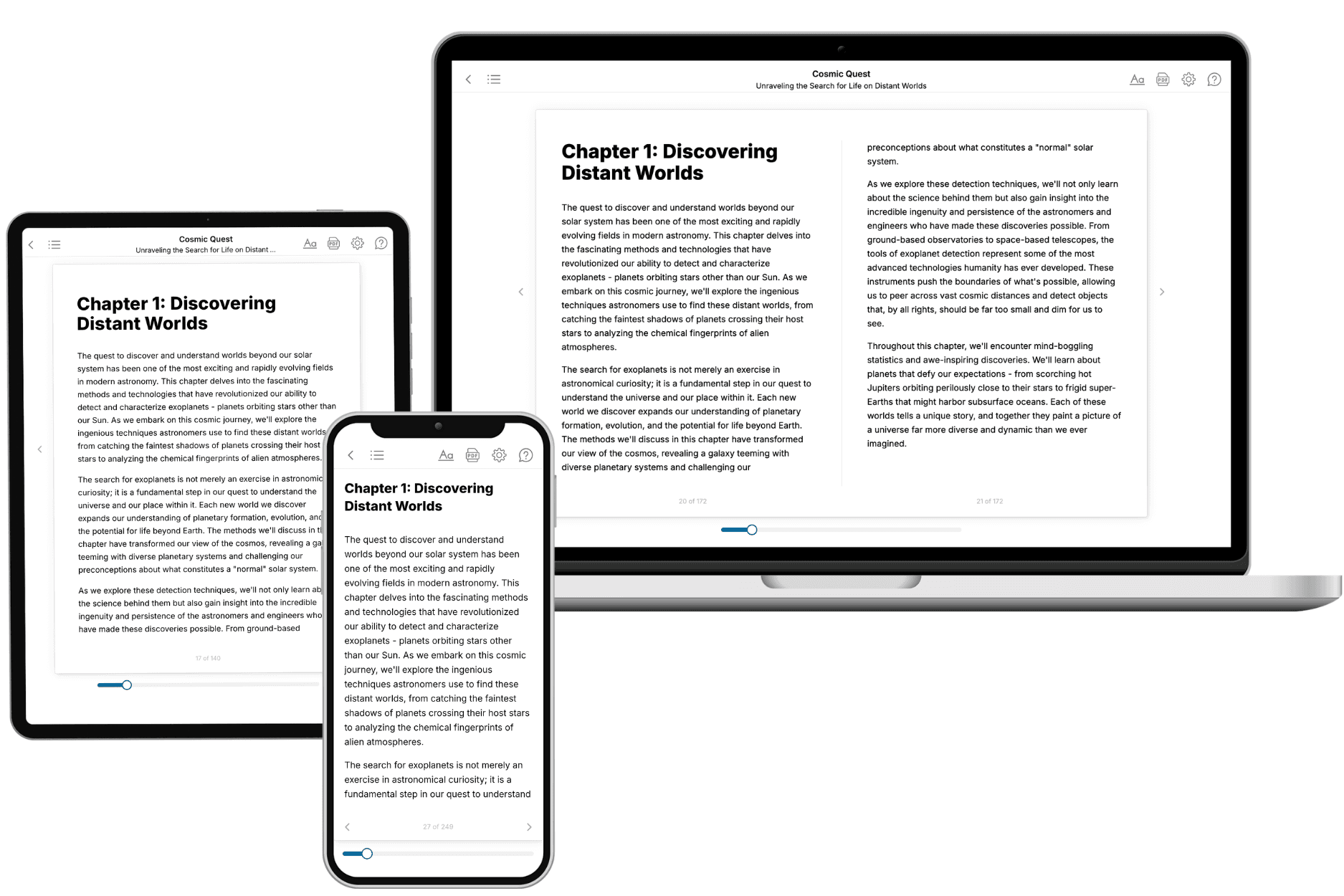
TailoredRead creates complete, full-length nonfiction ebooks, written specifically for you. Tell us what you want to learn and why, and TailoredRead writes you a complete ebook on it, with charts, tables, and diagrams throughout. Read it online, on Kindle, or on any e-reader, or download it as a PDF or EPUB. Every book is written fresh the day you order it.
- How is the book tailored to me?
Before anything is written, you answer a few short questions about your goals, your background, and the topics you care about. Your book is then planned around your answers: written at your level, focused on your goals, and covering the topics you chose, instead of the one-size-fits-all book a store sells everyone.
- Will it read like generic AI content?
No. Your book isn't a chat transcript: it's planned chapter by chapter before a single word is written, told in a clear book voice, and explains ideas visually with charts, tables, and diagrams. After writing, every book goes through an editorial pass that polishes chapters so the book reads consistent from start to finish. Judge for yourself: browse thousands of sample books on our Explore Books page.
- How accurate is the content?
Our AI first checks whether your subject needs live research. Niche and fast-moving subjects are researched before writing, and the book plan and chapters are grounded in what it finds. After writing, every book goes through a quality pass that checks its facts and consistency, and researched books list their sources in a Notes section at the back.
- How long is the book?
You choose the length: Comprehensive (250-300 pages), Detailed (150-200 pages), Essential (70-100 pages), or Short (30-50 pages).
- Does the book include visuals?
Yes. Every book includes charts, tables, and diagrams: timelines, checklists, step-by-step guides, decision trees, comparison tables, matrices, and bar charts. A typical book includes dozens of these visual elements.
- Can I read it on Kindle? What formats can I download?
Yes. Every book can be read in our online reader or downloaded as a PDF or EPUB. The EPUB can be opened with Kindle, Apple Books, Kobo, and any e-reader. The Commercial and Author licenses also include an editable Word (DOCX) and Markdown download.
- How much does it cost?
About the price of a regular ebook. The exact price depends on your book's length and complexity, from $2 for the shortest books to $35 for the most comprehensive, and it's shown when you review your book, before you commit to anything. Each book is a one-time purchase, yours to keep, no subscription. Licenses that let you share, teach, or publish your book range from $35.99 to $49.99.
- Can I preview the book before purchasing?
Before you pay, you'll see what your book will cover: the title, a detailed description, the estimated length, and the complete chapter-by-chapter table of contents, so you know what you're getting before you decide. The full text itself is written after you purchase.
- How long does it take to create a book?
About 10 minutes. You can start reading the opening chapters while the rest is still being written.