Generative AI for Engineers
From Fundamentals to Production-Ready Applications with Python and Azure OpenAI
You'll move from understanding how generative AI models work at a fundamental level to architecting and deploying production-grade applications that solve real engineering and research challenges.
207 pages10 chaptersDec 16, 2025Generative AI
About this book
This book bridges the gap between AI theory and practical implementation, showing you how to leverage your technical expertise to build systems that integrate seamlessly with Python, Azure OpenAI, and enterprise environments. You'll master prompt engineering as a systematic discipline, learn to chain complex operations for sophisticated workflows, and discover how to accelerate research through AI-driven data analysis. Each chapter builds on your existing engineering knowledge, using familiar concepts like signal processing and system architecture to explain transformer models and neural networks. By the end, you'll have the skills to design effective ChatGPT prompts, integrate AI models into production systems, optimize costs and performance, and apply generative AI across marketing, research, and custom applications—transforming how you work and innovate.
Table of contents
- IntroductionWhy Engineers Need Generative AI, What You'll Learn in This Book, How to Use This GuideRead below
- Chapter 1: Generative AI FundamentalsUnderstanding Transformer Architecture Through Signal Processing, How Generative Models Generate Text, GPT Models and Their Capabilities
- Chapter 2: Prompt Engineering FundamentalsStructuring Effective Prompts, Context, Clarity, and Specificity, Iterative Refinement and Testing
- Chapter 3: Advanced Prompt Engineering TechniquesFew-Shot Learning and In-Context Examples, Prompt Chaining for Complex Workflows, Designing Reusable Prompt Templates
- Chapter 4: Python Integration and API DevelopmentGetting Started with OpenAI API, Building Applications with Python, Error Handling and Resilience
- Chapter 5: Azure OpenAI Services and Enterprise DeploymentSetting Up Azure OpenAI Resources, Authentication, Security, and Compliance, Cost Optimization and Rate Limiting
- Chapter 6: AI-Driven Data Analysis and InsightsProcessing and Analyzing Data with AI, Pattern Recognition and Anomaly Detection, Automated Visualization and Reporting
- Chapter 7: Accelerating Research with Generative AIAutomated Literature Review and Synthesis, Hypothesis Generation and Validation, Integrating AI into Research Workflows
- Chapter 8: Boosting Productivity with AI ToolsAutomating Daily Engineering Workflows, Code Generation and Documentation, Knowledge Management and Learning
- Chapter 9: Generative AI for Marketing and CommunicationsContent Creation and Personalization, Customer Engagement and Chatbots, Campaign Analysis and Optimization
- Chapter 10: Enterprise AI Use Cases and ArchitectureRetrieval-Augmented Generation (RAG) Systems, Designing Scalable AI Systems, Monitoring, Evaluation, and Continuous Improvement
- ConclusionYour Generative AI Journey Ahead, Next Steps and Continuous Learning
- AppendixCode Examples and Snippets, Glossary of Terms, Additional Resources and References
Introduction
Generative AI represents the most significant technological shift in engineering practice since the widespread adoption of computational tools. As an engineer with advanced technical expertise, you're positioned at a unique inflection point where your analytical skills, systems thinking, and mathematical foundation provide distinct advantages in understanding and implementing AI systems. This isn't about replacing your engineering judgment with automated tools—it's about amplifying your capabilities, accelerating your research, and solving problems that were previously intractable or prohibitively time-consuming. The transformer models powering today's generative AI operate on principles you already understand: pattern recognition, statistical inference, and optimization under constraints.
The landscape of engineering work is transforming rapidly. Tasks that once consumed hours—literature reviews, data analysis, code documentation, technical writing—can now be completed in minutes with properly engineered AI systems. But this efficiency gain comes with a critical requirement: you must understand how these systems work, how to integrate them effectively, and how to architect solutions that are reliable, scalable, and production-ready. Generic tutorials and surface-level explanations won't suffice for enterprise applications or research-critical workflows. You need systematic approaches grounded in engineering principles, with attention to error handling, cost optimization, security, and performance metrics.
This book bridges the gap between AI theory and practical implementation specifically for engineers. You'll learn to think about generative AI models as systems with measurable inputs, outputs, and behaviors—systems you can design, test, optimize, and deploy with the same rigor you apply to any engineering project. Whether you're building custom applications with Python and Azure OpenAI, accelerating research through automated analysis, or integrating AI into existing workflows, you'll gain the technical depth and practical skills needed to implement solutions that deliver real value. The following chapters build progressively from fundamentals to advanced techniques, always maintaining focus on actionable implementation rather than abstract theory.
Why Engineers Need Generative AI
The engineering profession faces an accelerating information challenge. Technical literature doubles approximately every nine years, patent filings continue to grow exponentially, and the complexity of systems you're expected to design and maintain increases continuously[1]. Traditional approaches to staying current—reading papers, attending conferences, consulting colleagues—remain valuable but insufficient. You need tools that can process vast amounts of information, identify relevant patterns, and synthesize insights at speeds that match the pace of technological change. Generative AI provides exactly this capability when properly implemented and integrated into your workflows.
Consider the typical research workflow for a complex engineering problem. You might spend several days conducting literature reviews, reading dozens of papers, extracting relevant methodologies, and synthesizing findings into a coherent understanding. With properly engineered AI systems, this process compresses dramatically. You can process hundreds of papers in hours, identify methodological patterns across disciplines, and generate structured summaries that highlight gaps and opportunities. This isn't about eliminating critical thinking—it's about spending your cognitive resources on analysis and decision-making rather than information gathering and basic synthesis. The AI handles the mechanical aspects while you focus on the engineering judgment that truly requires your expertise.
Beyond research acceleration, generative AI transforms how you approach routine engineering tasks. Documentation that once required hours of tedious writing can be generated from code and specifications. Data analysis workflows that demanded custom scripting can be prototyped through natural language descriptions. Technical explanations for stakeholders at different expertise levels can be adapted automatically. These efficiency gains compound over time, freeing you to focus on innovation, design, and problem-solving rather than administrative overhead. The engineers who master these tools gain significant competitive advantages in productivity, output quality, and the ability to tackle more ambitious projects.
The enterprise context adds another dimension to why AI skills matter. Organizations increasingly expect engineers to deliver not just technical solutions but also insights, documentation, and communication that span multiple audiences. You might need to explain complex systems to executives, document APIs for developers, generate reports for regulatory compliance, and create training materials for operators—all from the same underlying technical work. Generative AI excels at this kind of multi-format content generation when guided by someone who understands both the technical substance and the audience requirements. Your ability to architect AI-enhanced workflows becomes a force multiplier for your entire team.
Cost considerations also drive AI adoption in engineering contexts. A single engineer equipped with effective AI tools can accomplish work that previously required multiple team members or external consultants. Literature reviews that might have cost thousands in research assistant time become routine tasks. Technical writing that required specialized contractors can be handled in-house. Data analysis that demanded dedicated analysts can be integrated into standard workflows. These aren't hypothetical savings—organizations report productivity improvements of 30-50% for engineers who effectively integrate AI tools into their daily practice[2]. The return on investment for developing these skills is measured in weeks, not years.
Perhaps most importantly, generative AI enables entirely new approaches to engineering problems. You can now explore design spaces that were previously too large to evaluate manually. You can generate and test hypotheses at scales that reveal patterns invisible to traditional analysis. You can prototype solutions in hours that would have taken weeks using conventional methods. This isn't incremental improvement—it's a qualitative shift in what's possible within project timelines and budgets. Engineers who understand how to leverage these capabilities will define the next generation of solutions across every technical domain.
Your background in electronics engineering provides specific advantages in this landscape. You already think in terms of systems, signals, and transformations. You understand feedback loops, optimization, and the relationship between model complexity and performance. These concepts map directly onto how generative AI models work and how to engineer effective prompts and applications. The transformer architecture that powers modern language models operates on principles analogous to signal processing—attention mechanisms function like adaptive filters, embeddings represent signals in high-dimensional spaces, and training optimizes parameters through gradient descent. Your existing mental models accelerate your understanding of AI systems far beyond what general tutorials provide.
What You'll Learn in This Book
This book provides a systematic path from understanding generative AI fundamentals to deploying production-ready applications. You'll start with the technical foundations—how transformer models work, what happens during text generation, and why certain architectural choices matter for performance and capability. These aren't abstract theoretical concepts but practical knowledge that directly informs how you design prompts, structure applications, and troubleshoot issues. The explanations leverage your existing understanding of signal processing, neural networks, and system architecture, making connections explicit rather than assuming you'll discover them independently.
Prompt engineering forms the core practical skill you'll develop. You'll learn to approach prompting as a systematic engineering discipline with measurable techniques and predictable outcomes. This includes:
- Structural principles for crafting prompts that consistently produce desired outputs
- Context optimization techniques that maximize model performance within token constraints
- Few-shot learning approaches that teach models through examples rather than lengthy instructions
- Prompt chaining methods that break complex tasks into manageable, reliable steps
- Template design strategies that enable reusable, maintainable prompt systems
- Testing and refinement processes that ensure output quality and consistency
Python integration receives extensive coverage because it's the primary interface for production AI applications. You'll learn to work with both OpenAI's API and Azure OpenAI services, understanding the architectural differences and when each makes sense for your use case. The code examples progress from basic API calls to sophisticated applications with proper error handling, retry logic, rate limiting, and cost optimization. You'll see how to structure applications for maintainability, how to handle edge cases and failures gracefully, and how to implement monitoring and logging that provides visibility into system behavior. These aren't toy examples—they're patterns you can adapt directly to production environments.
Azure OpenAI coverage addresses the enterprise requirements that distinguish production systems from prototypes. You'll learn to configure authentication and security properly, implement compliance controls for regulated industries, optimize costs through model selection and caching strategies, and architect systems that scale reliably under load. The book covers deployment patterns, integration with existing enterprise systems, and the operational considerations that determine whether an AI application succeeds or fails in real-world use. This includes practical guidance on topics like API key management, network security, data residency requirements, and audit logging.
Data analysis applications demonstrate how to leverage AI for tasks central to engineering work. You'll learn to process and analyze datasets using natural language queries, identify patterns and anomalies through AI-assisted exploration, and generate visualizations and reports automatically. The examples show how to integrate AI into existing Python data science workflows using pandas, NumPy, and visualization libraries. You'll see how to validate AI-generated insights, handle uncertainty and confidence levels appropriately, and combine AI capabilities with traditional statistical methods for robust analysis.
Research acceleration techniques address the specific challenges of staying current with technical literature and generating novel insights. You'll learn to automate literature reviews while maintaining quality and relevance, synthesize findings across multiple papers and domains, generate and evaluate hypotheses systematically, and integrate AI tools into your existing research workflows. The book provides concrete examples of prompts and workflows for common research tasks, along with guidance on when AI assistance is appropriate and when traditional methods remain superior.
Productivity applications cover the daily engineering tasks where AI provides immediate value. This includes code generation and documentation, technical writing and communication, knowledge management and learning, and workflow automation. You'll learn to use AI as a coding assistant effectively, generate documentation that's actually useful, adapt technical content for different audiences, and build personal knowledge systems that leverage AI for retrieval and synthesis. Each application includes specific prompts, integration approaches, and quality control measures.
Advanced topics in the later chapters address enterprise-scale challenges. You'll learn to implement Retrieval-Augmented Generation (RAG) systems that combine AI with your organization's proprietary knowledge, design scalable architectures that handle production loads reliably, and establish monitoring and evaluation frameworks that ensure continued performance. The book covers real-world use cases across marketing, customer engagement, and custom applications, showing how the techniques you've learned apply to diverse business contexts. You'll see complete examples of production systems, including their architecture, implementation, and operational characteristics.
How to Use This Guide
This book is structured for progressive learning but designed to support multiple reading approaches. If you're new to generative AI, start with Chapter 1 and work through sequentially—each chapter builds on concepts and techniques from previous ones. The progression moves from understanding how models work, to crafting effective prompts, to building applications, to deploying production systems. This path ensures you develop both conceptual understanding and practical skills in a logical sequence. Plan to spend time with the code examples, running them in your own environment and modifying them to explore how changes affect behavior.
If you already have some AI experience, you can navigate more selectively based on your specific needs:
- For prompt engineering skills: Focus on Chapters 2-3, which cover fundamental and advanced prompting techniques
- For Python integration: Jump to Chapters 4-5 for API development and Azure deployment
- For research applications: Chapters 6-7 address data analysis and research acceleration specifically
- For enterprise deployment: Chapters 5 and 10 cover production architecture and scalability
- For specific use cases: Chapters 8-9 provide domain-specific applications and examples
The code examples deserve special attention. They're not meant to be read passively but executed, modified, and experimented with. Set up a development environment with Python 3.8 or later, install the required libraries (primarily openai, requests, and standard data science packages), and obtain API access to either OpenAI or Azure OpenAI services. The appendix provides detailed setup instructions and troubleshooting guidance. As you work through examples, try variations—change prompts, adjust parameters, handle different input types. This experimentation builds intuition about model behavior that you can't gain from reading alone.
Practical exercises appear throughout the book, marked clearly and designed to reinforce key concepts. These aren't busywork—they're carefully chosen to build skills you'll use in real applications. Some exercises ask you to implement variations of example code, others to design prompts for specific scenarios, and still others to analyze and improve existing solutions. Treat these as essential learning opportunities rather than optional supplements. The difference between engineers who successfully integrate AI into their practice and those who struggle often comes down to hands-on experimentation and iteration.
The book includes extensive footnotes and references for readers who want deeper technical detail or academic context. These citations serve multiple purposes: they provide sources for claims and statistics, point to research papers that explain concepts in greater depth, and identify resources for continued learning. You don't need to follow every reference to benefit from the book, but they're there when you want to explore topics further. The appendix also includes a curated list of additional resources, organized by topic and annotated with guidance on what each resource provides.
Consider maintaining a personal notebook or repository as you work through the material. Document prompts that work well for your specific use cases, save code snippets you've adapted and tested, and record insights about what works and what doesn't in your domain. This personal knowledge base becomes increasingly valuable as you apply AI to real projects. Many engineers find that their collection of tested prompts and code patterns becomes one of their most valuable professional resources, saving hours on each new project.
The book assumes you have strong technical fundamentals but doesn't require prior AI or machine learning experience. Mathematical concepts are explained when necessary but kept at a level appropriate for someone with an engineering master's degree. You should be comfortable with Python programming, basic statistics, and general software development practices. If you need to refresh Python skills, the appendix includes recommendations for resources. The focus throughout is on practical implementation rather than theoretical depth—you'll learn enough about how models work to use them effectively, but this isn't a machine learning textbook.
Finally, recognize that generative AI is a rapidly evolving field. Models improve, APIs change, and best practices evolve as the community gains experience. The principles and techniques in this book are designed to be durable—they're based on fundamental concepts that will remain relevant even as specific models and services change. However, you should supplement this book with current documentation, community resources, and continued experimentation. The appendix includes guidance on staying current with developments and connecting with the broader AI engineering community. Your learning doesn't end with the last chapter; it's the foundation for ongoing skill development as the technology matures.
This is the end of the free sample. The full book has 10 chapters.
Want this book written for you?
Tell us your goals and background, and get your own version of this book, tailored by AI to you.


Benefits of AI-tailored books
- Read one book, not ten:
- all the Generative AI knowledge you need, gathered into a single book.
- Save days of learning:
- tell us your goals, choose your topics, and the whole book is built around them.
- Learn effortlessly:
- Generative AI book written for your specific background and expertise.
- Understand at a glance:
- includes charts, tables, timelines, checklists, decision trees, and more.
- Stay current:
- written the day you order it, not years ago.
- Trust what you read:
- every book is checked for accuracy, with real research when your subject needs it.
Create your unique book in 3 steps
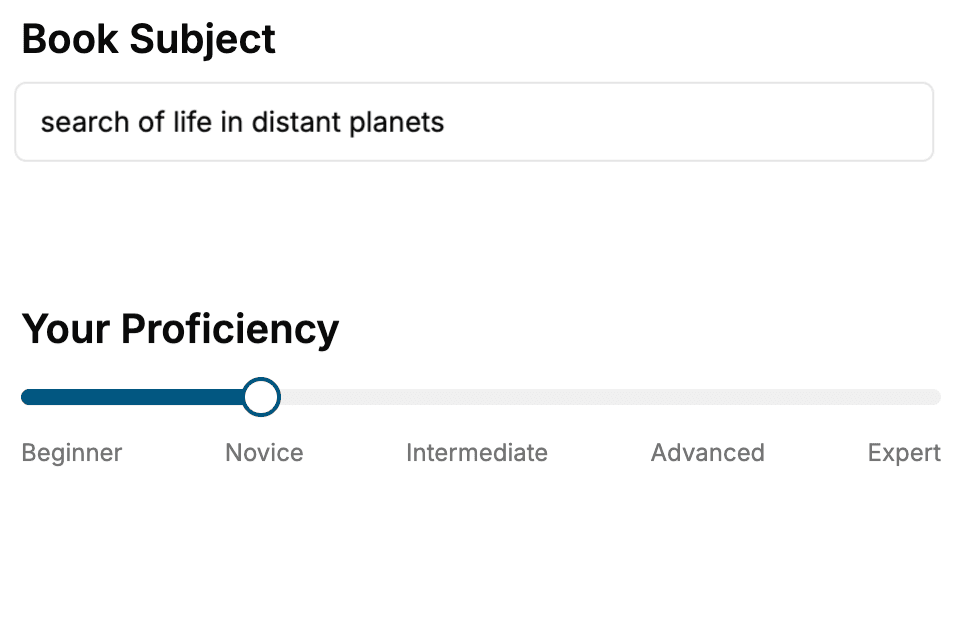
- 1. Select your focus
Select the focus of your Generative AI book and share your background
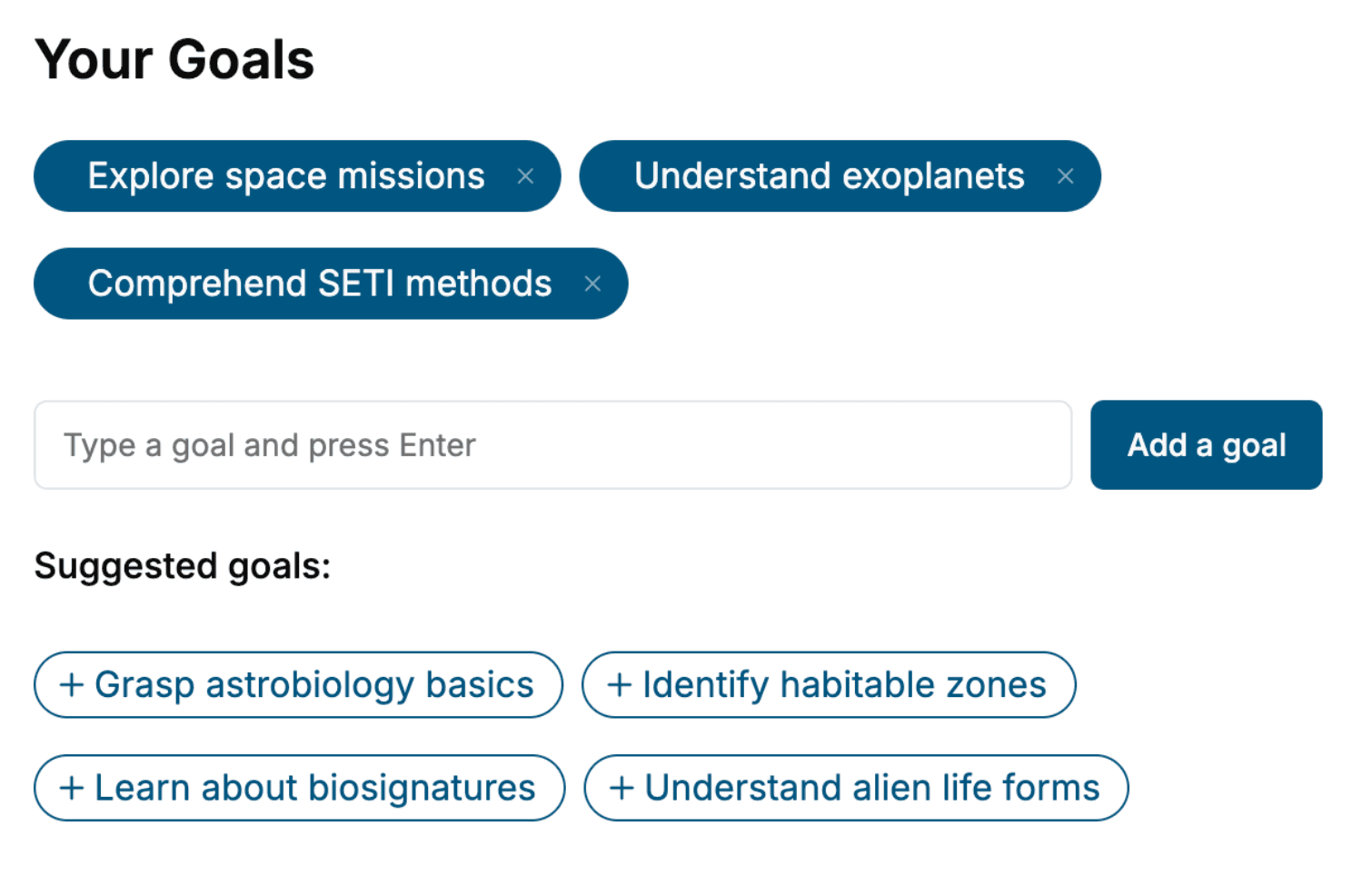
- 2. Personalize your book
Specify your goals and choose sub-topics to include
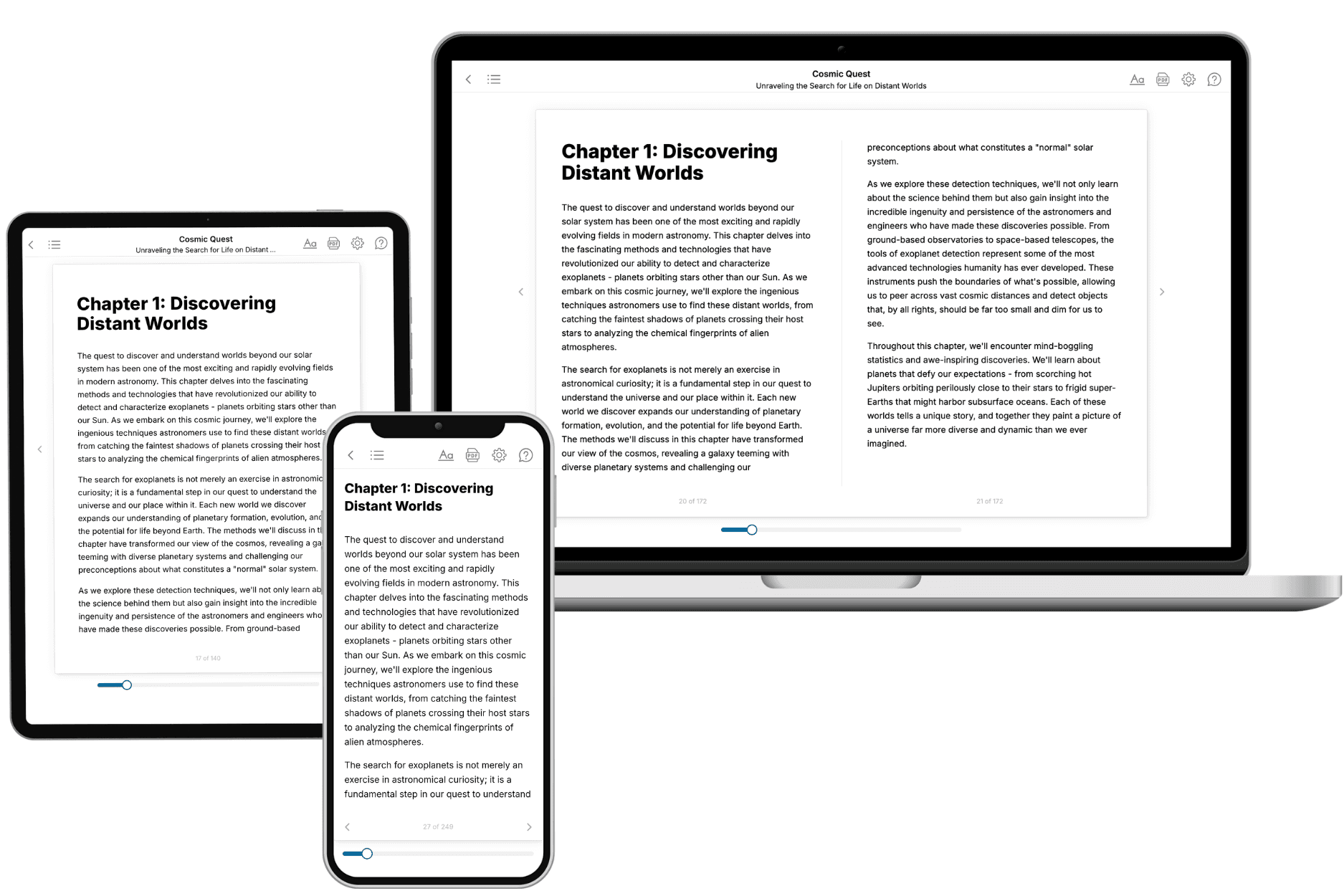
- 3. Get your tailored book
Your book is ready in 10 minutes. Read it online, download as EPUB or PDF, or send to Kindle.
Frequently asked questions
- What is TailoredRead?
TailoredRead creates complete, full-length nonfiction ebooks, written specifically for you. Tell us what you want to learn and why, and TailoredRead writes you a complete ebook on it, with charts, tables, and diagrams throughout. Read it online, on Kindle, or on any e-reader, or download it as a PDF or EPUB. Every book is written fresh the day you order it.
- How is the book tailored to me?
Before anything is written, you answer a few short questions about your goals, your background, and the topics you care about. Your book is then planned around your answers: written at your level, focused on your goals, and covering the topics you chose, instead of the one-size-fits-all book a store sells everyone.
- Will it read like generic AI content?
No. Your book isn't a chat transcript: it's planned chapter by chapter before a single word is written, told in a clear book voice, and explains ideas visually with charts, tables, and diagrams. After writing, every book goes through an editorial pass that polishes chapters so the book reads consistent from start to finish. Judge for yourself: browse thousands of sample books on our Explore Books page.
- How accurate is the content?
Our AI first checks whether your subject needs live research. Niche and fast-moving subjects are researched before writing, and the book plan and chapters are grounded in what it finds. After writing, every book goes through a quality pass that checks its facts and consistency, and researched books list their sources in a Notes section at the back.
- How long is the book?
You choose the length: Comprehensive (250-300 pages), Detailed (150-200 pages), Essential (70-100 pages), or Short (30-50 pages).
- Does the book include visuals?
Yes. Every book includes charts, tables, and diagrams: timelines, checklists, step-by-step guides, decision trees, comparison tables, matrices, and bar charts. A typical book includes dozens of these visual elements.
- Can I read it on Kindle? What formats can I download?
Yes. Every book can be read in our online reader or downloaded as a PDF or EPUB. The EPUB can be opened with Kindle, Apple Books, Kobo, and any e-reader. The Commercial and Author licenses also include an editable Word (DOCX) and Markdown download.
- How much does it cost?
About the price of a regular ebook. The exact price depends on your book's length and complexity, from $2 for the shortest books to $35 for the most comprehensive, and it's shown when you review your book, before you commit to anything. Each book is a one-time purchase, yours to keep, no subscription. Licenses that let you share, teach, or publish your book range from $35.99 to $49.99.
- Can I preview the book before purchasing?
Before you pay, you'll see what your book will cover: the title, a detailed description, the estimated length, and the complete chapter-by-chapter table of contents, so you know what you're getting before you decide. The full text itself is written after you purchase.
- How long does it take to create a book?
About 10 minutes. You can start reading the opening chapters while the rest is still being written.