The Geography of Things
How Objects Shape Culture, Place, and Human Experience
Discover how the objects surrounding you tell the story of human culture and geography.
191 pages9 chaptersJan 5, 2026Cultural Studies
About this book
This book reveals the hidden connections between the things we own, the places we inhabit, and the societies we build. Rather than viewing material goods as mere commodities, you'll learn to read them as cultural texts that expose how people organize their lives, express identity, and navigate their environments. From ancient pottery to modern smartphones, from vernacular architecture to fashion choices, material culture provides a window into understanding human behavior at both local and global scales. You'll explore how geography influences what we make and use, how objects carry meaning across cultures, and why studying everyday items matters for understanding our world. Whether you're a student, educator, or curious observer, this book equips you with frameworks for analyzing the material world and recognizing how deeply intertwined objects are with human experience.
Table of contents
- IntroductionWhy Objects Matter More Than You Think, What Is Material Culture?, How to Read This BookRead below
- Chapter 1: Foundations of Material CultureDefining Material Culture and Its Scope, Historical Development of the Field, Interdisciplinary Approaches to Studying Objects, Why Geographers Care About Material Culture
- Chapter 2: Objects as Cultural TextsLearning to Read Objects Like Texts, Embedded Meanings and Symbolism, The Role of Cultural Context in Interpretation, Case Studies: Objects Across Cultures
- Chapter 3: Geography and Material ProductionHow Place Determines Available Materials, Local Production Systems and Craft Traditions, Environmental Constraints and Opportunities, How Geography Creates Regional Identity in Objects
- Chapter 4: Power, Economics, and Material CultureObjects as Markers of Social Status and Power, Consumption Patterns and Economic Systems, Global Supply Chains and Material Flows, Labor, Production, and Ethical Consumption
- Chapter 5: Architecture and the Built EnvironmentVernacular Architecture and Local Knowledge, Buildings as Cultural Expressions, Urban Landscapes and Material Change, Home, Domesticity, and Personal Identity
- Chapter 6: Everyday Objects and Daily LifeThe Significance of Mundane Objects, Food, Cooking, and Eating Practices, Clothing, Fashion, and Body Adornment, Technology and Contemporary Material Culture
- Chapter 7: Memory, Heritage, and ObjectsObjects as Keepers of Memory and History, Heritage, Preservation, and Cultural Identity, Museums, Collections, and Public Interpretation, Connecting Material Objects to Intangible Heritage
- Chapter 8: Global Flows and Local MeaningsHistorical Trade Routes and Material Exchange, Cultural Hybridity and Creolization Through Objects, Globalization and the Homogenization of Material Culture, Local Resistance and the Persistence of Distinctive Objects
- Chapter 9: Sustainability and the Future of Material CultureCritiquing Consumer Culture and Overconsumption, Waste, Disposal, and Environmental Impact, Sustainable Practices and Alternative Economies, Emerging Materials and Ethical Production
- ConclusionSynthesizing Material Culture and Geography, Applying Material Culture Analysis in Your Life
- Further Reading and Resources
Introduction
Look around you right now. What do you see? Perhaps a coffee mug sits on your desk, its handle worn smooth from years of use. Maybe you're sitting on a chair that someone designed, manufactured, and shipped across continents before it arrived in your space. The clothes you're wearing, the device you're reading this on, the walls surrounding you—each of these objects tells a story. These stories aren't just about the things themselves. They're about the people who made them, the cultures that value them, and the places where they exist. Every object in your environment is a thread in a vast tapestry connecting geography, culture, economics, and human experience.
Most of us move through our days surrounded by thousands of objects without giving them much thought. We use them, discard them, replace them, and rarely pause to consider what they reveal about our world. Yet these material things are far from neutral or passive. They shape how we behave, influence our relationships, and reflect the values of our societies. A smartphone in your pocket connects you to global supply chains spanning dozens of countries. The architecture of your neighborhood reveals historical patterns of wealth, migration, and urban planning. Even something as simple as the food on your plate carries information about agricultural systems, trade networks, and cultural preferences that have evolved over generations.
This book invites you to develop a new way of seeing the material world. You'll learn to read objects as cultural texts, to understand how geography shapes what we make and use, and to recognize the profound ways that things influence human societies. Whether you're interested in cultural geography, anthropology, history, or simply understanding the world around you more deeply, the study of material culture offers powerful tools for analysis. By the end of this journey, you'll never look at everyday objects the same way again. You'll see the hidden connections, the embedded meanings, and the geographic stories that objects carry with them wherever they go.
Why Objects Matter More Than You Think
Objects are not merely tools we use to accomplish tasks or decorations that make our spaces pleasant. They actively participate in shaping human behavior, social structures, and cultural meanings. Consider how a simple door changes human interaction. It creates boundaries between public and private space, determines who can enter and who must remain outside, and establishes protocols for politeness and permission. The door doesn't just respond to human needs—it creates them. This is what scholars mean when they say that objects have agency. They act upon us even as we act upon them, creating a reciprocal relationship that fundamentally shapes human experience.
The material world serves as a primary medium through which cultures express themselves and individuals construct identity. When you choose to wear certain clothes, arrange furniture in a particular way, or display specific items in your home, you're making statements about who you are and what you value. These choices aren't made in isolation. They're influenced by cultural norms, economic constraints, geographic availability, and social expectations. A teenager in Tokyo expresses identity differently through material culture than a teenager in rural Montana, not because one is more authentic than the other, but because each operates within different material possibilities and cultural frameworks. Understanding these differences requires examining both the objects themselves and the contexts that give them meaning.
Material culture also reveals power dynamics and social hierarchies that might otherwise remain invisible. Throughout history, access to certain objects has marked social status and reinforced inequality. In medieval Europe, sumptuary laws dictated what clothing different social classes could wear, using material culture to maintain rigid hierarchies[1]. Today, the dynamics are more subtle but no less powerful. The objects you can afford, the brands you can access, and the technologies you can use all signal your position within economic and social structures. By studying material culture, you can decode these signals and understand how societies organize themselves through things.
Objects function as memory keepers, preserving cultural knowledge across generations and allowing communities to maintain continuity with their past. A grandmother's recipe box, a family heirloom, or a community's traditional craft techniques all serve as vessels for cultural transmission. When these objects disappear or are replaced, something more than the physical item is lost. The knowledge, skills, and cultural meanings embedded within them also vanish. This is why indigenous communities often fight to repatriate cultural objects from museums—they're not just reclaiming things, but reclaiming the relationships, stories, and cultural practices those objects embody. Material culture is inseparable from intangible heritage, and understanding this connection is crucial for appreciating why objects matter.
The geographic dimension of material culture adds another layer of significance. Where you live fundamentally determines what materials are available, what objects are practical, and what cultural meanings things carry. A wool sweater means something different in Iceland than in Indonesia. Adobe architecture makes sense in the American Southwest but would be impractical in the Pacific Northwest. These aren't just practical adaptations—they're expressions of how human cultures develop in relationship with specific places. Geography shapes material culture, and material culture in turn shapes how people understand and interact with their environments. This reciprocal relationship between place and things is central to understanding human geography.
In our contemporary moment, the study of material culture has become more urgent than ever. We live in an era of unprecedented material abundance in some parts of the world and desperate scarcity in others. Global supply chains connect distant places through the objects we consume daily. Environmental crises force us to reckon with the consequences of our material choices. Digital technologies are transforming what we mean by "material" culture itself. Understanding how objects shape culture, place, and human experience isn't just an academic exercise—it's essential for navigating the complex material world we inhabit and for making informed choices about the future we want to create.
This book argues that developing literacy in material culture is as important as developing literacy in language. Just as you learned to read words and sentences to understand written communication, you can learn to read objects and environments to understand cultural communication. This skill allows you to:
- Recognize how your own material choices reflect and reinforce cultural values
- Understand cultural differences through the lens of material practices rather than stereotypes
- Analyze power structures and economic systems by examining who makes, owns, and controls objects
- Appreciate the diversity of human adaptation to different geographic environments
- Make more conscious and ethical decisions about consumption and material engagement
- Preserve and honor cultural heritage through understanding material traditions
The framework you'll develop through this book applies across scales, from analyzing a single artifact to understanding global economic systems. You'll learn to ask questions like: Where did this object come from? Who made it and under what conditions? What materials were used and why? What does this object mean to different people in different contexts? How does geography influence its form and function? What power relationships does it reflect or reinforce? These questions open up new ways of understanding not just objects themselves, but the human societies and geographic spaces they inhabit. Material culture becomes a lens through which the entire world comes into sharper focus.
What Is Material Culture?
Material culture encompasses all the physical objects, resources, and spaces that people use to define their culture and shape their social relationships. This definition is deliberately broad because material culture includes everything from monumental architecture to disposable packaging, from ancient artifacts to digital devices. The field examines not just the objects themselves, but the entire system of relationships between people and things: how objects are made, used, exchanged, displayed, preserved, and discarded. Material culture scholars study the physical manifestations of human culture, recognizing that what people make and use reveals fundamental truths about how they organize their lives, express their values, and understand their world.
The term "material culture" emerged from anthropology and archaeology, where scholars needed ways to understand past and present societies through their physical remains. Archaeologists, working with fragments of pottery, tools, and structures, developed sophisticated methods for extracting cultural information from objects. Anthropologists studying living cultures recognized that material goods provided insights into social organization, belief systems, and cultural change. Over time, the concept expanded beyond these disciplines to include geography, history, sociology, art history, and cultural studies. Today, material culture is an interdisciplinary field that draws on multiple methodologies to understand the relationship between people and things across time and space.
Material culture operates at multiple scales simultaneously. At the individual level, it includes personal possessions that construct identity and memory—the objects you keep in your wallet, display on your shelves, or wear on your body. At the household level, it encompasses domestic spaces and the objects that make daily life possible—furniture, appliances, decorations, and tools. At the community level, material culture includes shared spaces, public architecture, and objects that facilitate collective life—parks, monuments, infrastructure, and communal resources. At the regional and global levels, it involves trade networks, industrial production systems, and the movement of goods across borders. Understanding material culture requires examining all these scales and recognizing how they interconnect.
A key distinction in material culture studies is between form and function. Form refers to the physical characteristics of an object—its shape, size, materials, decoration, and construction. Function refers to what the object does or what purpose it serves. However, this distinction is more complex than it first appears. Objects often have multiple functions: practical, social, symbolic, and aesthetic. A chair functions practically by providing a place to sit, but it also functions socially by indicating status (compare a throne to a folding chair), symbolically by representing cultural values (consider the design differences between a Japanese floor cushion and a Victorian armchair), and aesthetically by contributing to the visual environment. Material culture analysis examines all these dimensions simultaneously, recognizing that form and function are deeply intertwined.
Material culture also includes the built environment—the human-made spaces and structures that shape daily life. Architecture, urban planning, infrastructure, and landscape design all fall within the scope of material culture studies. These large-scale material forms have profound effects on human behavior and social organization. The layout of a city determines how people move through space, who encounters whom, and what activities are possible in different locations. The design of a house reflects and reinforces cultural assumptions about family structure, privacy, gender roles, and social interaction. By studying the built environment as material culture, you can understand how physical spaces embody cultural values and shape human experience in fundamental ways.
Contemporary material culture increasingly includes digital and virtual objects, raising interesting questions about what counts as "material." While a smartphone is clearly a material object, what about the apps it contains, the digital photos you store, or the virtual goods you might purchase in an online game? Material culture scholars debate these boundaries, but most agree that digital culture remains material in important ways. Digital objects require physical infrastructure—servers, cables, devices, and energy systems. They're produced through material labor and have material consequences. The distinction between material and immaterial culture is becoming less clear, and this ambiguity itself is an important feature of contemporary material culture worth examining.
Understanding material culture requires recognizing that objects are polysemic—they carry multiple meanings simultaneously and can be interpreted differently by different people. Consider a simple example: a cross. To one person, it's a religious symbol representing Christian faith. To another, it's a piece of jewelry chosen for aesthetic reasons. To a historian, it's an artifact revealing information about metalworking techniques and trade networks. To a cultural geographer, it's evidence of religious diffusion and cultural contact. All these interpretations are valid, and the cross doesn't have a single "correct" meaning. Material culture analysis embraces this multiplicity, examining how objects accumulate meanings through different contexts, uses, and interpretations over time.
The study of material culture rests on several core principles that guide analysis:
- Context matters: Objects cannot be understood in isolation from the cultural, geographic, and historical contexts that give them meaning
- Objects have biographies: Things have life histories that include creation, use, exchange, modification, and disposal, and these biographies reveal cultural patterns
- Material and social are inseparable: Physical objects and social relationships co-constitute each other in ongoing processes
- Power is embedded in things: Objects reflect and reinforce social hierarchies, economic systems, and power relationships
- Geography shapes materiality: Place fundamentally influences what materials are available, how objects are made, and what meanings they carry
- Change is constant: Material culture is always in flux, responding to technological innovation, cultural contact, environmental change, and social transformation
Material culture analysis provides a methodology for reading objects systematically. When examining any object, you might consider questions organized into several categories. Physical description: What is it made of? How is it constructed? What are its dimensions and physical characteristics? Production: Who made it? Where and when? What technologies and skills were required? What materials were sourced and from where? Function and use: What is it used for? How is it used? Who uses it and in what contexts? Has its use changed over time? Meaning and symbolism: What does it represent? What cultural values does it embody? How do different people interpret it? Distribution and exchange: How did it move from maker to user? What economic systems facilitated its circulation? Who has access to it and who doesn't? These questions provide a framework for systematic analysis that reveals the rich information objects contain.
How to Read This Book
This book is organized to build your understanding progressively, moving from foundational concepts to specific applications and contemporary challenges. Each chapter focuses on a particular dimension of material culture while reinforcing connections to geography, culture, and human experience. You don't need prior expertise in geography or cultural studies to engage with this material. The book is written for intermediate learners who bring curiosity and a willingness to look at familiar things in new ways. The concepts and frameworks presented here will deepen your existing knowledge while providing new tools for analysis that you can apply immediately to the world around you.
The structure follows a logical progression designed to develop your analytical skills systematically. The first chapters establish theoretical foundations, defining material culture and explaining why geographers and other scholars study objects. You'll learn about the historical development of the field and the interdisciplinary approaches that inform contemporary material culture studies. These chapters provide the conceptual toolkit you'll use throughout the rest of the book. Middle chapters apply these concepts to specific domains—architecture, everyday objects, memory and heritage, and global flows. Each application deepens your understanding while demonstrating the versatility of material culture analysis. The final chapters address contemporary challenges, particularly sustainability and the future of material culture in an era of environmental crisis and technological transformation.
Each chapter includes concrete examples and case studies that illustrate abstract concepts. Material culture is fundamentally about specific things in specific places, and the book reflects this through detailed examinations of particular objects, buildings, and material practices. These examples are drawn from diverse geographic and cultural contexts, demonstrating both the universal patterns and the local variations in how humans relate to material things. You'll encounter examples ranging from ancient pottery traditions to contemporary smartphone design, from vernacular architecture in different climates to the global supply chains that produce everyday consumer goods. These specific cases make abstract concepts tangible and demonstrate how to apply analytical frameworks to real-world situations.
Throughout the book, you'll find several recurring themes that connect different chapters and reinforce key messages. The relationship between local and global appears repeatedly, examining how objects connect specific places to worldwide networks of production, trade, and cultural exchange. The tension between continuity and change explores how material traditions persist even as technologies and cultures transform. The question of power and inequality runs through discussions of who makes objects, who owns them, and what access to material goods reveals about social structures. The connection between material and immaterial culture examines how physical objects embody intangible values, knowledge, and relationships. Recognizing these themes will help you see connections across chapters and develop a more integrated understanding of material culture.
The book encourages active engagement rather than passive reading. You'll get the most value by applying concepts to your own environment as you encounter them. When you read about vernacular architecture, look at the buildings in your neighborhood with new eyes. When you learn about objects as cultural texts, practice reading the things around you. When you explore global supply chains, trace the origins of items you use daily. This active application transforms abstract knowledge into practical skills. Consider keeping a material culture journal where you document observations, sketch objects, and reflect on what they reveal about culture and place. This practice will deepen your learning and help you develop the habit of reading the material world critically.
Each chapter can stand alone to some extent, allowing you to focus on topics of particular interest. However, the book is designed to be read sequentially, with each chapter building on concepts introduced earlier. If you do skip around, you may want to refer back to earlier chapters when you encounter unfamiliar terms or concepts. The book includes cross-references to help you navigate these connections. Key terms are emphasized when first introduced, and the context should make their meanings clear. The goal is to build a comprehensive framework for understanding material culture while allowing flexibility in how you engage with the material based on your interests and needs.
The book balances theoretical concepts with practical applications, but it leans toward accessibility and engagement rather than academic jargon. When specialized terms are necessary, they're explained clearly with examples. The writing assumes you're intelligent and curious but doesn't assume prior expertise in geography, anthropology, or related fields. Complex ideas are broken down into manageable components, and abstract concepts are always grounded in concrete examples. The tone is conversational but substantive, aiming to make sophisticated ideas accessible without oversimplifying them. You should feel challenged but not overwhelmed, stretched but not lost.
As you read, consider how the concepts apply to your own life and context. Material culture isn't just about distant places or historical periods—it's about the world you inhabit right now. The frameworks presented here can help you understand:
- Why your hometown looks the way it does and what that reveals about its history and culture
- What your personal possessions say about your identity and values
- How the objects you consume connect you to global systems of production and trade
- What the built environment of your daily life reveals about social organization and power
- How material traditions in your community preserve cultural knowledge and identity
- What choices you can make to engage more consciously and ethically with material culture
The book concludes with practical guidance on applying material culture analysis in your own life, whether for academic purposes, professional work, or personal enrichment. You'll find suggestions for further reading, resources for continued learning, and frameworks for conducting your own material culture research. The goal is not just to inform you about material culture but to equip you with skills and perspectives you can use long after you finish reading. Material culture literacy is a lifelong practice, and this book aims to launch you on that journey with confidence and curiosity.
Finally, approach this book with openness to seeing familiar things in unfamiliar ways. Material culture studies asks you to defamiliarize the everyday, to question assumptions about objects you've taken for granted, and to recognize the extraordinary complexity hidden in ordinary things. This can be disorienting at first. You might find yourself suddenly aware of how many objects surround you, or troubled by questions about where things come from and what they cost in human and environmental terms. This discomfort is part of the learning process. Developing critical consciousness about material culture means recognizing both the wonder and the problems embedded in our relationships with things. The goal is not to make you feel guilty about consumption or overwhelmed by complexity, but to empower you with understanding that enables more conscious, informed, and ethical engagement with the material world.
Notes
Introduction
- 1. Alan Hunt, Governance of the Consuming Passions, St. Martin's Press, 1996
This is the end of the free sample. The full book has 9 chapters.
Want this book written for you?
Tell us your goals and background, and get your own version of this book, tailored by AI to you.


Benefits of AI-tailored books
- Read one book, not ten:
- all the Cultural Studies knowledge you need, gathered into a single book.
- Save days of learning:
- tell us your goals, choose your topics, and the whole book is built around them.
- Learn effortlessly:
- Cultural Studies book written for your specific background and expertise.
- Understand at a glance:
- includes charts, tables, timelines, checklists, decision trees, and more.
- Stay current:
- written the day you order it, not years ago.
- Trust what you read:
- every book is checked for accuracy, with real research when your subject needs it.
Create your unique book in 3 steps
- 1. Select your focus
Select the focus of your Cultural Studies book and share your background
- 2. Personalize your book
Specify your goals and choose sub-topics to include
- 3. Get your tailored book
Your book is ready in 10 minutes. Read it online, download as EPUB or PDF, or send to Kindle.

Frequently asked questions
- What is TailoredRead?
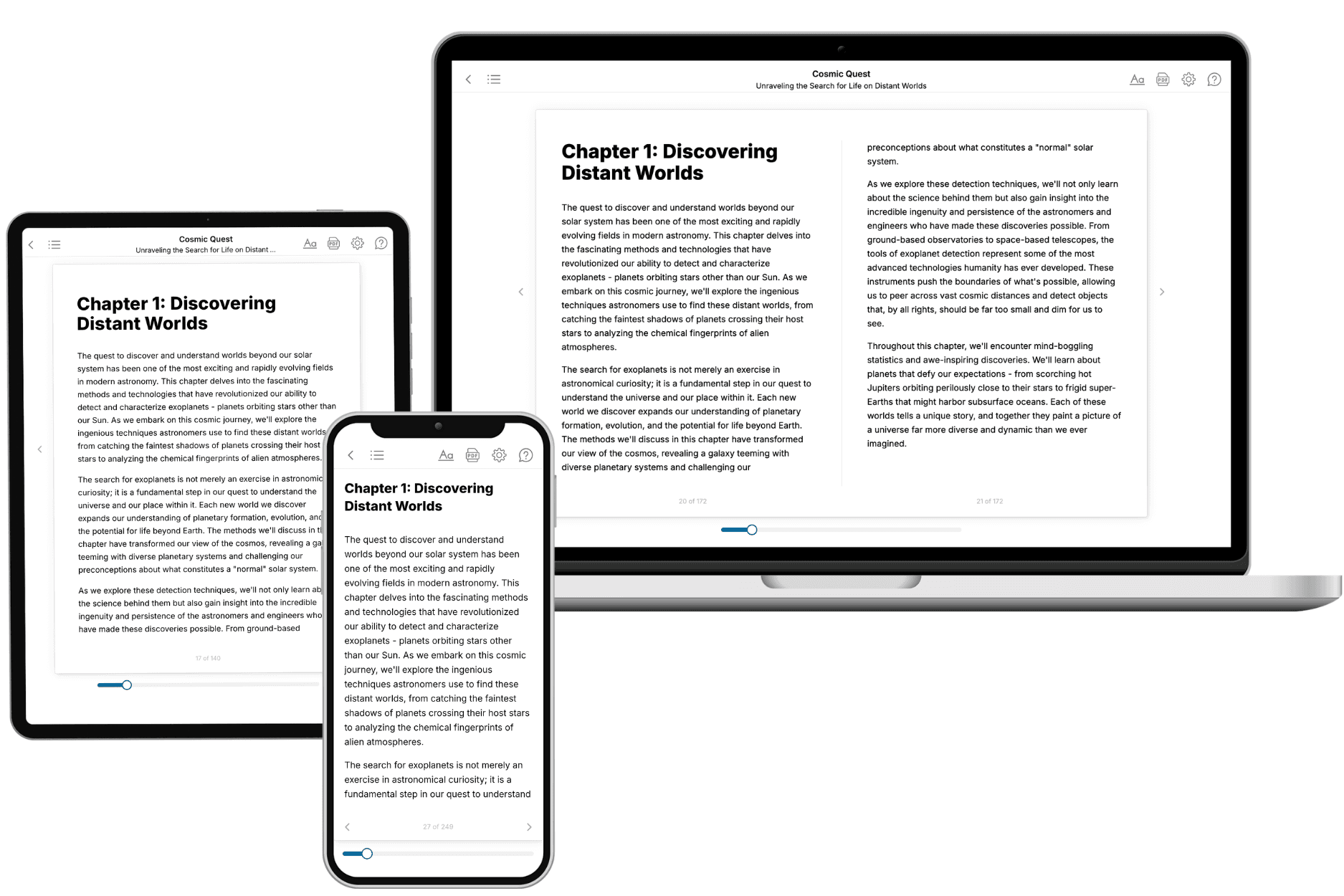
TailoredRead creates complete, full-length nonfiction ebooks, written specifically for you. Tell us what you want to learn and why, and TailoredRead writes you a complete ebook on it, with charts, tables, and diagrams throughout. Read it online, on Kindle, or on any e-reader, or download it as a PDF or EPUB. Every book is written fresh the day you order it.
- How is the book tailored to me?
Before anything is written, you answer a few short questions about your goals, your background, and the topics you care about. Your book is then planned around your answers: written at your level, focused on your goals, and covering the topics you chose, instead of the one-size-fits-all book a store sells everyone.
- Will it read like generic AI content?
No. Your book isn't a chat transcript: it's planned chapter by chapter before a single word is written, told in a clear book voice, and explains ideas visually with charts, tables, and diagrams. After writing, every book goes through an editorial pass that polishes chapters so the book reads consistent from start to finish. Judge for yourself: browse thousands of sample books on our Explore Books page.
- How accurate is the content?
Our AI first checks whether your subject needs live research. Niche and fast-moving subjects are researched before writing, and the book plan and chapters are grounded in what it finds. After writing, every book goes through a quality pass that checks its facts and consistency, and researched books list their sources in a Notes section at the back.
- How long is the book?
You choose the length: Comprehensive (250-300 pages), Detailed (150-200 pages), Essential (70-100 pages), or Short (30-50 pages).
- Does the book include visuals?
Yes. Every book includes charts, tables, and diagrams: timelines, checklists, step-by-step guides, decision trees, comparison tables, matrices, and bar charts. A typical book includes dozens of these visual elements.
- Can I read it on Kindle? What formats can I download?
Yes. Every book can be read in our online reader or downloaded as a PDF or EPUB. The EPUB can be opened with Kindle, Apple Books, Kobo, and any e-reader. The Commercial and Author licenses also include an editable Word (DOCX) and Markdown download.
- How much does it cost?
About the price of a regular ebook. The exact price depends on your book's length and complexity, from $2 for the shortest books to $35 for the most comprehensive, and it's shown when you review your book, before you commit to anything. Each book is a one-time purchase, yours to keep, no subscription. Licenses that let you share, teach, or publish your book range from $35.99 to $49.99.
- Can I preview the book before purchasing?
Before you pay, you'll see what your book will cover: the title, a detailed description, the estimated length, and the complete chapter-by-chapter table of contents, so you know what you're getting before you decide. The full text itself is written after you purchase.
- How long does it take to create a book?
About 10 minutes. You can start reading the opening chapters while the rest is still being written.