Geometric Brownian Motion Demystified
Mastering Stochastic Processes and Monte Carlo Integration for Real-World Applications
Many professionals encounter geometric Brownian motion in their work but struggle to connect the abstract mathematics to practical implementation.
207 pages10 chaptersAug 24, 2026Stochastic Modeling
About this book
The gap between theoretical understanding and real-world application leaves you uncertain about when to use GBM, how to simulate it correctly, and whether your results are trustworthy. This book bridges that gap by building your intuition from first principles while equipping you with practical tools for implementation. You'll learn how GBM models random behavior in complex systems, master Monte Carlo integration for solving problems that traditional methods can't handle, and discover techniques to make your simulations faster and more accurate. Whether you're working in quantitative finance, scientific computing, or engineering, this guide provides the conceptual clarity and technical depth you need to confidently apply these powerful mathematical tools to real problems.
Table of contents
- IntroductionWhy Geometric Brownian Motion Matters, What You'll Learn in This Book, How to Use This GuideRead below
- Chapter 1: Foundations of Randomness and Stochastic ProcessesDeterministic vs. Stochastic Systems, Random Walks and Brownian Motion, Probability Distributions in Modeling
- Chapter 2: Introduction to Geometric Brownian MotionFrom Arithmetic to Geometric Brownian Motion, The GBM Differential Equation, Key Properties and Characteristics, Real-World Applications of GBM
- Chapter 3: Stochastic Calculus EssentialsItô's Lemma Explained, Stochastic Differential Equations, Solving SDEs Analytically
- Chapter 4: Monte Carlo Integration FundamentalsCore Principles of Monte Carlo Methods, Sampling and Estimation Techniques, Convergence and Error Analysis, When to Use Monte Carlo Integration
- Chapter 5: Simulating Geometric Brownian MotionDiscretization Schemes: Euler and Beyond, Random Number Generation and Quality, Implementing GBM Simulations
- Chapter 6: Variance Reduction TechniquesAntithetic Variates, Control Variates, Importance Sampling, Stratified Sampling
- Chapter 7: Financial Applications of GBMOption Pricing and Black-Scholes, Portfolio Risk Assessment and VaR, Pricing Exotic Derivatives
- Chapter 8: Scientific and Engineering ApplicationsParticle Diffusion and Physics Simulations, Biological and Population Modeling, Engineering Reliability and Failure Analysis
- Chapter 9: Validation and DiagnosticsTesting Simulation Accuracy, Sensitivity Analysis and Parameter Testing, Common Pitfalls and Solutions
- Chapter 10: Advanced Topics and ExtensionsMulti-Dimensional GBM and Correlated Processes, Jump-Diffusion Models, Machine Learning and GBM Integration
- ConclusionKey Takeaways, Next Steps in Your Learning Journey
- Appendix: Quick Reference and ResourcesMathematical Notation and Symbols, Code Examples and Implementation Templates, Further Reading and Resources
Introduction
On March 16, 1973, a paper by Fischer Black and Myron Scholes appeared in the Journal of Political Economy that gave traders a closed-form price for a stock option based on a handful of inputs: the stock price, the strike price, time to expiration, interest rates, and volatility[1]. Behind that formula sits a single assumption about how stock prices move through time. That assumption is Geometric Brownian Motion. Fifty years later, the same mathematical object shows up in labs modeling how proteins diffuse through cell membranes, in engineering departments estimating when a turbine blade will fail, and in trading desks running millions of simulated futures every night before markets open.
The distance between reading a formula in a textbook and trusting a number produced by a simulation is larger than most courses admit. A finance graduate can recite the Black-Scholes formula without knowing why a stock price should follow a log-normal distribution rather than a normal one. An engineer can write a loop that generates random numbers without understanding why the resulting path depends on the size of each time step. Both gaps come from the same place: treating Geometric Brownian Motion as a formula to memorize rather than a model built from specific, checkable assumptions about randomness.
This book treats those assumptions as the main event, not a footnote. Geometric Brownian Motion did not appear out of nowhere. It descends from Robert Brown's observations of pollen grains jittering in water in 1827, from Louis Bachelier's 1900 doctoral thesis modeling French government bond prices as a random process, and from Norbert Wiener's rigorous construction of the mathematical object now called the Wiener Process[2]. Each of these threads solves a different piece of the puzzle: how to describe pure randomness, how to keep quantities from going negative, and how to compute with objects that are continuous everywhere but smooth nowhere.
Two practical skills sit at the center of everything that follows. The first is understanding the equation of Geometric Brownian Motion well enough to know when it applies and when it does not. Stock prices, chemical concentrations, and population sizes share a property: they cannot go negative, and their percentage changes matter more than their absolute changes. The second skill is Monte Carlo Integration, the technique of replacing an equation that is too hard to solve directly with thousands or millions of simulated random paths, then reading the answer off their average behavior. Neither skill is optional for the other. A perfect model with a broken simulation is worthless, and a fast simulation of the wrong model is worse than worthless because it looks trustworthy.
Readers arrive at this material from different directions: a quantitative analyst pricing a barrier option, a physicist modeling particle diffusion, a reliability engineer estimating mean time to failure for aircraft components. What ties them together is not the industry but the shared mathematical scaffolding underneath. Building that scaffolding carefully, from the coin flip to the trading algorithm, is the task ahead.
Why Geometric Brownian Motion Matters
Consider two ways to describe how a stock price might move tomorrow. The first says the price will go up or down by a fixed dollar amount, say plus or minus two dollars, regardless of whether the stock trades at ten dollars or ten thousand. The second says the price will move by a fixed percentage, say plus or minus two percent. The second description matches how markets actually behave and how most growth processes in nature work. Geometric Brownian Motion is the mathematical machinery built specifically to capture that second kind of randomness, where the size of a random step scales with the current value of the thing being measured.
This distinction matters enormously in practice. A model using additive, dollar-based randomness (Arithmetic Brownian Motion) allows a stock price to go negative, which never happens in reality. A model using multiplicative, percentage-based randomness keeps the price positive forever, no matter how many random shocks accumulate, because each shock multiplies the current value rather than adding to it. This single structural choice, additive versus multiplicative noise, separates models that produce nonsensical outputs from models that produce usable ones. Anyone who has tried to model bacterial population growth, radioactive decay, or asset prices with the wrong kind of noise has run into this wall directly.
The reach of this one equation is unusually wide for a piece of applied mathematics. In finance, it underlies the Black-Scholes Formula for European Options, portfolio Value at Risk calculations, and the pricing of complex Exotic Derivatives. In physics, the same mathematical structure describes particle diffusion in fluids and the spread of pollutants in the atmosphere. In biology, it captures how population sizes fluctuate under proportional birth and death rates. In engineering, variants of it model the degradation of materials under stress, feeding into Mean Time to Failure estimates that determine maintenance schedules for bridges, aircraft, and power plants.
What makes the model worth the effort to learn properly, rather than treating it as a black box, is that its assumptions are testable and its failures are informative. When a market crashes and prices jump discontinuously instead of drifting smoothly, that is a visible failure of the continuous-path assumption behind standard Geometric Brownian Motion, and it motivates the Jump-Diffusion Model extensions covered later in this book. When two assets move together more than a simple model predicts, that points toward the correlated, Multi-Dimensional GBM framework. Learning where the plain model breaks is just as valuable as learning where it works, because both diagnoses are professional skills.
A concrete case makes the stakes clear. In 1997, Robert Merton and Myron Scholes received the Nobel Memorial Prize in Economic Sciences for extending option pricing theory built on this exact stochastic process[3]. A year later, Long-Term Capital Management, a hedge fund whose principals included Merton and Scholes, collapsed in part because real markets deviated from the model's assumptions during a period of extreme stress. That episode is not an argument against learning the model. It is the strongest possible argument for learning exactly what the model assumes, so its limits are visible before they become expensive.
Beyond finance, the model's presence in scientific computing keeps growing precisely because so many natural processes share the same proportional-randomness structure. A drug's concentration in the bloodstream decays at a rate proportional to how much remains, with random fluctuations layered on top from metabolic variability. A company's revenue grows at a rate proportional to its current size, with random shocks from market conditions. Whenever a quantity's future change scales with its present value, and that change carries an element of unpredictability, Geometric Brownian Motion or one of its close relatives becomes a natural candidate model, worth testing even outside finance.
What You'll Learn in This Book
The chapters ahead build in a deliberate sequence, moving from bedrock concepts to specialized applications. Early chapters establish what a Stochastic Process is and how a simple Random Walk, repeated many times and shrunk toward continuous time, becomes Brownian Motion. From there, the book constructs Geometric Brownian Motion itself: its differential equation, its Drift Parameter and Volatility Parameter, and the reason its solution follows a Log-Normal Distribution rather than the more familiar Normal Distribution. Understanding this progression matters because each later technique assumes the previous layer is solid, much like calculus assumes algebra.
A middle section addresses the calculus needed to work with these processes rigorously. Ordinary calculus rules break down when applied to paths that are continuous but nowhere differentiable, which is exactly what a Wiener Process is. Itô's Lemma supplies the corrected chain rule for this setting, and Stochastic Differential Equations become solvable analytically once that tool is in hand. This is not abstract mathematics for its own sake. It is the exact machinery that produces the Black-Scholes Formula from the underlying GBM equation, so grasping it converts option pricing from a memorized recipe into a derivation you could reconstruct.
Parallel to the calculus, a full treatment of Monte Carlo Integration builds the numerical side of the toolkit. The book covers why random sampling can solve integration problems that defeat deterministic methods once dimensionality climbs past a handful of variables, a phenomenon called the Curse of Dimensionality. It covers the Monte Carlo Estimator's Convergence Rate, which behaves the same regardless of how many dimensions a problem has, an unusual and valuable property. Concrete guidance follows on when Monte Carlo Integration beats traditional numerical quadrature and when it does not, since the technique carries real computational cost and is not always the right tool.
Practical simulation forms the next block of material. Discretization schemes such as the Euler-Maruyama Scheme and the more accurate Milstein Scheme translate the continuous GBM equation into code that runs on a computer, one small time step at a time. This section covers the Discretization Error each scheme introduces, how the choice of Pseudo-Random Number Generator or Quasi-Random Sequences affects simulation quality, and step-by-step implementation guidance for building a working GBM simulator from scratch. Readers who want to price an option or simulate a diffusion process on their own machine will find the concrete recipes here.
Because raw Monte Carlo simulations often converge slowly, a dedicated section covers variance reduction techniques: Antithetic Variates, Control Variates, Importance Sampling, and Stratified Sampling. Each method reduces the noise in a simulation's output without demanding more computing power, often cutting the number of required simulation paths by a factor of ten or more for well-chosen problems. These are not exotic tricks reserved for specialists. They are standard practice in any production pricing system, and skipping them means leaving accuracy and speed on the table for no good reason.
The second half of the book turns to applications and quality control. Financial chapters work through option pricing, portfolio Value at Risk, and Exotic Derivatives in enough detail to reproduce the calculations independently. Scientific and engineering chapters extend the same machinery to particle diffusion, population biology, and reliability analysis, showing that the underlying mathematics does not change even though the vocabulary does. A validation chapter then supplies the tools to check a simulation's correctness through Sensitivity Analysis and known failure patterns, because a simulation that has never been stress-tested against a known answer is not one to bet a business decision on. A final advanced chapter previews Multi-Dimensional GBM, Jump-Diffusion Models, and Neural SDE approaches that extend the classical framework toward current research.
How to Use This Guide
This book assumes a reader with foundational mathematical training, comfortable with calculus, basic probability, and enough programming exposure to read a short code snippet without translation. It does not assume prior exposure to stochastic calculus or measure-theoretic probability, and it introduces those ideas from first principles rather than citing them as known. If a term like Quadratic Variation or Itô Integral feels unfamiliar on first encounter, that is expected. The chapter introducing it will build the concept up gradually rather than dropping the definition and moving on.
The chapters are ordered to be read sequentially rather than sampled at random, since later material leans on earlier definitions without restating them in full. A reader who skips ahead to the option pricing chapter without covering Itô's Lemma will find the Black-Scholes derivation opaque, not because the material there is unclear, but because the necessary tools were introduced earlier and are used without re-explanation. That said, professionals with a specific, urgent need (say, an engineer who only needs the reliability applications) can treat chapters as reasonably self-contained reference material once the foundational chapters have been read once.
Code examples throughout the book use plain, readable syntax rather than optimized production code, on the principle that clarity teaches better than cleverness. A reader following along is encouraged to actually run the simulations described, not just read them, since intuition for Monte Carlo methods comes from watching convergence happen, seeing a jagged early estimate settle into a stable number as sample size grows. Typing out even a short simulation and watching its output change as parameters shift builds intuition that no amount of passive reading replicates.
A short worked example illustrates the intended rhythm of each technical chapter. When the book introduces the Euler-Maruyama Scheme, it does not simply state the discretization formula. It walks through simulating a single asset price path step by step, shows what the code producing that path looks like, and then shows what happens to the result when the time step is made too large, producing a visibly wrong distribution of final prices. That three-part rhythm (concept, implementation, common failure) repeats through the simulation and application chapters, since abstract correctness and practical correctness are different things that both need checking.
Mathematical notation follows the conventions standard in quantitative finance and applied probability texts, and a full reference table appears in the appendix for quick lookup. Readers who forget whether σ denotes the Volatility Parameter or something else can check there rather than hunting back through earlier chapters. The appendix also collects code templates for the core simulation patterns covered in the book, intended as starting points for adapting to a reader's own project rather than as finished production systems.
Each major chapter closes with the kind of implicit checkpoint that comes from working through its examples rather than a formal quiz, since the goal is durable understanding rather than test performance. A reader who can explain, in their own words, why a Log-Normal Distribution rather than a Normal Distribution describes GBM outcomes, or why Antithetic Variates work, has absorbed the material in a way that memorizing formulas never achieves. Progress through this book should feel like accumulating tools that connect to each other, not like collecting isolated facts. By the closing chapters on jump-diffusion and machine-learning extensions, the classical GBM machinery built early on should feel like familiar ground rather than borrowed jargon, ready to be extended, questioned, and applied to problems this book never explicitly covers.
Notes
Introduction
- 1. Fischer Black and Myron Scholes, "The Pricing of Options and Corporate Liabilities," Journal of Political Economy, 1973
- 2. Louis Bachelier, "Théorie de la Spéculation," Gauthier-Villars, 1900
- 3. The Royal Swedish Academy of Sciences, "Press Release: The Sveriges Riksbank Prize in Economic Sciences 1997," Nobelprize.org, 1997
This is the end of the free sample. The full book has 10 chapters.
Want this book written for you?
Tell us your goals and background, and get your own version of this book, tailored by AI to you.


Benefits of AI-tailored books
- Read one book, not ten:
- all the Stochastic Modeling knowledge you need, gathered into a single book.
- Save days of learning:
- tell us your goals, choose your topics, and the whole book is built around them.
- Learn effortlessly:
- Stochastic Modeling book written for your specific background and expertise.
- Understand at a glance:
- includes charts, tables, timelines, checklists, decision trees, and more.
- Stay current:
- written the day you order it, not years ago.
- Trust what you read:
- every book is checked for accuracy, with real research when your subject needs it.
Create your unique book in 3 steps
- 1. Select your focus
Select the focus of your Stochastic Modeling book and share your background
- 2. Personalize your book
Specify your goals and choose sub-topics to include
- 3. Get your tailored book
Your book is ready in 10 minutes. Read it online, download as EPUB or PDF, or send to Kindle.


Frequently asked questions
- What is TailoredRead?
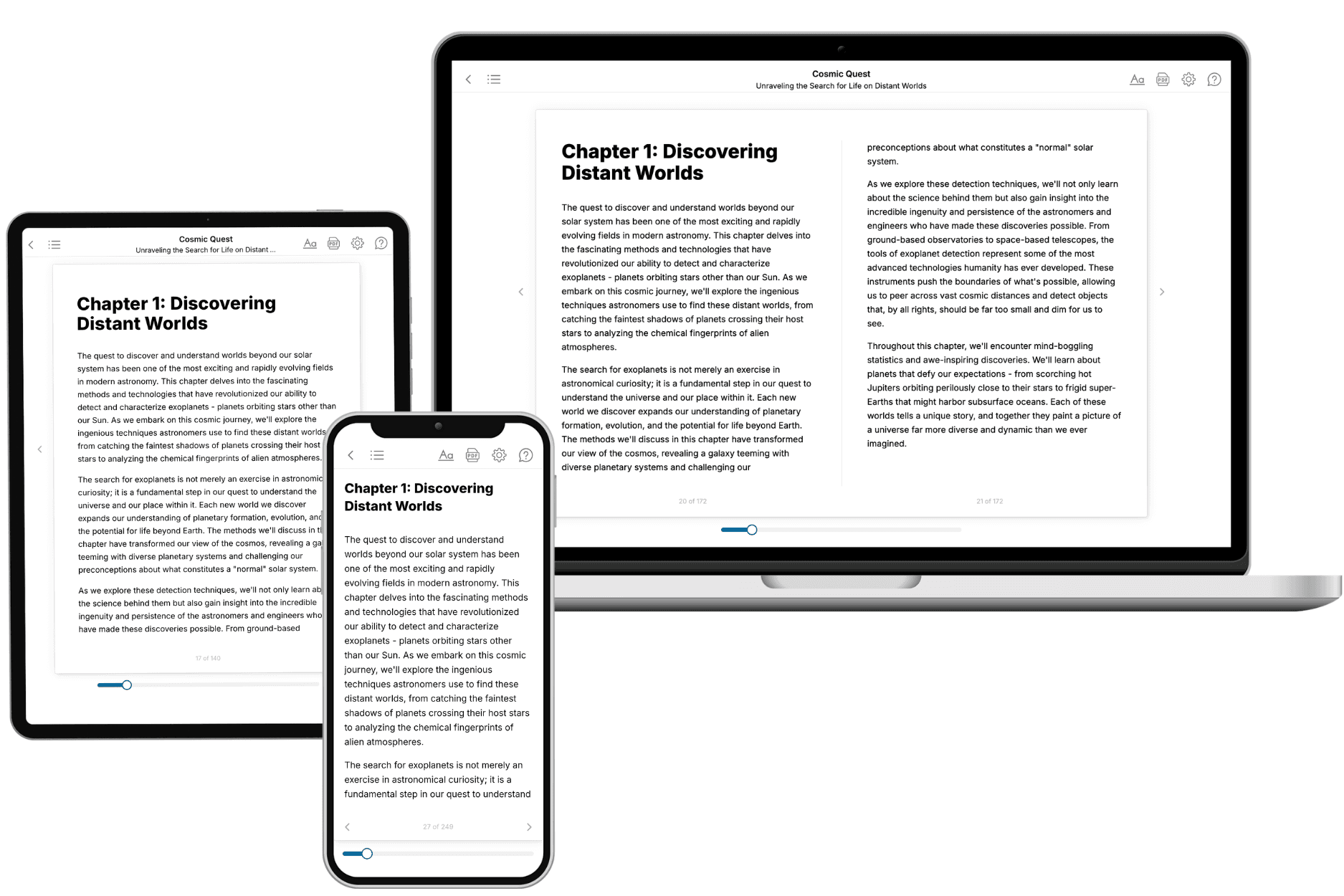
TailoredRead creates complete, full-length nonfiction ebooks, written specifically for you. Tell us what you want to learn and why, and TailoredRead writes you a complete ebook on it, with charts, tables, and diagrams throughout. Read it online, on Kindle, or on any e-reader, or download it as a PDF or EPUB. Every book is written fresh the day you order it.
- How is the book tailored to me?
Before anything is written, you answer a few short questions about your goals, your background, and the topics you care about. Your book is then planned around your answers: written at your level, focused on your goals, and covering the topics you chose, instead of the one-size-fits-all book a store sells everyone.
- Will it read like generic AI content?
No. Your book isn't a chat transcript: it's planned chapter by chapter before a single word is written, told in a clear book voice, and explains ideas visually with charts, tables, and diagrams. After writing, every book goes through an editorial pass that polishes chapters so the book reads consistent from start to finish. Judge for yourself: browse thousands of sample books on our Explore Books page.
- How accurate is the content?
Our AI first checks whether your subject needs live research. Niche and fast-moving subjects are researched before writing, and the book plan and chapters are grounded in what it finds. After writing, every book goes through a quality pass that checks its facts and consistency, and researched books list their sources in a Notes section at the back.
- How long is the book?
You choose the length: Comprehensive (250-300 pages), Detailed (150-200 pages), Essential (70-100 pages), or Short (30-50 pages).
- Does the book include visuals?
Yes. Every book includes visual elements such as timelines, checklists, step-by-step guides, decision trees, comparison tables, and matrices, and many include bar charts. A typical book includes dozens of these visual elements.
- Can I read it on Kindle? What formats can I download?
Yes. Every book can be read in our online reader or downloaded as a PDF or EPUB. The EPUB can be opened with Kindle, Apple Books, Kobo, and any e-reader. The Commercial and Author licenses also include an editable Word (DOCX) and Markdown download.
- How much does it cost?
About the price of a regular ebook. The exact price depends on your book's length and complexity, from $2 for the shortest books to $35 for the most comprehensive, and it's shown when you review your book, before you commit to anything. Each book is a one-time purchase, yours to keep, no subscription. Licenses that let you share, teach, or publish your book range from $35.99 to $49.99.
- Can I preview the book before purchasing?
Before you pay, you'll see what your book will cover: the title, a detailed description, the estimated length, and the complete chapter-by-chapter table of contents, so you know what you're getting before you decide. The full text itself is written after you purchase.
- How long does it take to create a book?
About 10 minutes. You can start reading the opening chapters while the rest is still being written.