Geometric Brownian Motion Essentials
Mastering Stochastic Processes and Monte Carlo Integration for Real-World Applications
Master the mathematics and practical implementation of geometric Brownian motion combined with Monte Carlo integration.
191 pages8 chaptersAug 24, 2026Stochastic Modeling
About this book
You'll progress from foundational concepts to advanced simulation techniques, gaining the skills to model complex stochastic systems with confidence. This book bridges theory and practice, showing you how to implement these powerful methods in real-world scenarios—from financial derivatives pricing to engineering reliability analysis. Through clear explanations, worked examples, and practical guidance, you'll understand not just how these techniques work, but why they matter and when to apply them. Whether you're working in quantitative finance, scientific computing, or data analysis, you'll develop the competency to tackle high-dimensional problems that traditional methods cannot solve efficiently.
Table of contents
- IntroductionWhy Geometric Brownian Motion Matters, The Power of Monte Carlo Integration, Your Learning Roadmap, How to Use This BookRead below
- Chapter 1: Foundations of Stochastic ProcessesFrom Random Walks to Continuous Processes, Understanding Brownian Motion, Introduction to Stochastic Differential Equations
- Chapter 2: Geometric Brownian Motion ExplainedDefining Geometric Brownian Motion, Drift, Volatility, and Model Parameters, The Itô Calculus and GBM Solutions, Key Properties and Characteristics
- Chapter 3: Monte Carlo Integration FundamentalsCore Principles of Monte Carlo Methods, Random Sampling and Probability Distributions, Convergence and Error Analysis
- Chapter 4: Simulating Geometric Brownian MotionDiscretization: From Continuous to Discrete, The Euler-Maruyama Scheme, Practical Implementation and Coding, Ensuring Numerical Stability
- Chapter 5: Variance Reduction TechniquesWhy Variance Reduction Matters, Antithetic Variates and Control Variates, Stratified Sampling and Quasi-Monte Carlo, Comparing and Selecting Techniques
- Chapter 6: Financial ApplicationsOption Pricing and Black-Scholes, Portfolio Risk and Value-at-Risk, Pricing Exotic Derivatives
- Chapter 7: Scientific and Engineering ApplicationsParticle Dynamics and Diffusion Processes, Reliability Analysis and Failure Prediction, Uncertainty Quantification in Complex Systems
- Chapter 8: Advanced Topics and OptimizationMulti-Dimensional Geometric Brownian Motion, Advanced Discretization Schemes, Parallel Computing and Scalability, Performance Optimization Strategies
- ConclusionKey Takeaways and Mastery Checklist, Next Steps in Your Learning Journey
- Appendix: Mathematical ReferenceProbability Theory Review, Calculus and Linear Algebra Essentials
- Further Reading and Resources
Introduction
On March 16, 1973, Fischer Black and Myron Scholes published a formula that let traders compute the fair price of a stock option in seconds, using nothing more than five inputs and a calculator[1]. Behind that formula sits a single mathematical assumption: stock prices move according to a process now called Geometric Brownian Motion. That assumption turned an intractable pricing problem into something a trading desk could compute before the market closed. Decades later, the same process shows up in models of particle diffusion, population growth, and the spread of failures across engineered systems. This book exists because that one process, paired with a simulation technique called Monte Carlo Integration, gives you a working toolkit for an enormous range of real-world problems.
What makes this pairing worth a full book, rather than a single chapter of a finance textbook, is the gap between knowing a formula and knowing how to use it. Plenty of people can recite that a stock price follows Geometric Brownian Motion. Far fewer can explain why the Drift Parameter and Volatility Parameter behave the way they do, simulate a thousand price paths in code, or know when a naive simulation will quietly give a wrong answer. This introduction lays out why the process matters, why Monte Carlo methods are the natural computational partner for it, how the book is organized, and how to get the most out of the chapters that follow.
The approach here is deliberately hands-on. Each later chapter builds a specific, usable skill: deriving the closed-form solution to the GBM equation, writing a discretization scheme in code, reducing the noise in a simulation, or pricing a financial derivative that has no closed-form answer at all. None of this requires an advanced degree in stochastic calculus. It requires comfort with basic probability, some calculus, and a willingness to work through equations slowly rather than skip past them.
By the end of the book, you should be able to look at a system that evolves randomly over time, whether it is a stock price, a diffusing particle, or a machine degrading toward failure, and ask the right questions about it. Does it grow multiplicatively or additively? Is the randomness proportional to the current value or fixed in size? Once you can answer those questions, Geometric Brownian Motion and Monte Carlo Integration give you a concrete path from a vague real-world question to a number you can defend.
Why Geometric Brownian Motion Matters
Picture two savings accounts. The first earns a fixed dollar amount of interest every year, regardless of its size. The second earns a fixed percentage of whatever it currently holds. Almost every real financial asset behaves like the second account, not the first. A stock priced at $200 does not move by the same dollar amount as one priced at $20, but it often moves by a comparable percentage. Geometric Brownian Motion is the mathematical structure built specifically to capture that idea: random changes that scale with the current value of the thing being modeled, rather than staying fixed in absolute size.
This distinction explains why plain Brownian Motion, sometimes called a Wiener Process, is not enough on its own to model prices. A raw Wiener Process can wander into negative territory, which makes no sense for a stock price or a population size. Wrapping that process inside an exponential function, which is the essence of Geometric Brownian Motion, guarantees the modeled quantity always stays positive. This single design choice is why GBM became the default building block for financial models rather than the simpler additive alternative, and later chapters will formalize this construction using Itô's Lemma.
The practical stakes of this choice are large. Consider a $10,000 investment. If prices are modeled additively, a bad year and a good year of equal magnitude cancel out in dollar terms. But real markets do not work that way. A 50 percent loss requires a 100 percent gain to recover, an asymmetry that only shows up naturally when returns are modeled multiplicatively. Institutions that ignore this asymmetry misprice risk. GBM builds the asymmetry into its mathematical DNA through the Log-Normal Distribution it produces, so anyone using it correctly gets that behavior for free rather than having to bolt it on afterward.
Outside finance, the same mathematical shape appears wherever quantities grow or shrink by a random percentage rather than a random amount. Bacterial colonies whose growth rate fluctuates with temperature and nutrient availability, radioactive decay chains under measurement uncertainty, and even the spread of a rumor through a proportionally engaged population all share this multiplicative character. A materials scientist modeling how a crack in a metal component grows under repeated stress can reach for the same equation a bond trader uses to price a callable bond, because the underlying mathematics of proportional random growth does not care which discipline is asking the question.
Consider a concrete example from reliability engineering. An engine component degrades over time, and the rate of degradation on any given day depends on how worn the component already is. A component that is 80 percent degraded tends to degrade faster in absolute terms than one at 20 percent, because the same relative stress produces a larger absolute effect on a weaker part. Modeling this degradation as a Diffusion Process governed by Geometric Brownian Motion lets an engineer estimate the probability that the component crosses a failure threshold within a given time window, a technique explored fully under reliability analysis later in the book.
The mathematical properties that make GBM tractable are not accidents. The process is built from a Wiener Process, which has independent, normally distributed increments and a precisely defined Quadratic Variation. These properties let mathematicians derive a closed-form solution for GBM using Itô's Lemma, something that is rare in the world of stochastic processes. Most random processes resist neat, closed-form answers. GBM is one of the few that yields one, which is exactly why it became the workhorse of quantitative finance rather than a purely academic curiosity.
That said, GBM is a model, not reality itself, and its assumptions matter. It assumes volatility stays constant over the period being modeled, an assumption that real markets violate regularly during crises. It assumes returns are log-normally distributed, which understates the frequency of extreme market moves compared to what history actually shows. Recognizing these limitations up front is not a weakness of the model. It is the beginning of using it responsibly, since every model in applied mathematics trades some realism for tractability, and knowing where that trade happens tells you when to trust the output and when to treat it skeptically.
A natural question at this point is why not use a more complicated, more realistic process from the start. The answer is pedagogical and practical at once. GBM is simple enough to solve by hand, simulate efficiently, and reason about intuitively, yet rich enough to capture the core multiplicative behavior seen in countless real systems. Learning GBM first builds the intuition and the mathematical vocabulary, including Filtration, Martingale properties, and stochastic integration, needed to later understand more elaborate models such as those with time-varying volatility or jumps.
Consider how a portfolio manager might use GBM day to day. Rather than trying to predict tomorrow's exact stock price, which is essentially impossible, the manager uses GBM to describe a distribution of plausible future prices. This shifts the question from an unanswerable one, What will the price be?
, to an answerable one, What is the probability the price falls below a certain threshold within the next month?
That reframing, from point prediction to probabilistic forecasting, is the single biggest mindset shift this book asks of you, and it applies just as well to an aerospace engineer forecasting fatigue failure as to a portfolio manager forecasting drawdown risk.
The versatility of GBM ultimately comes down to a simple observation: many systems in nature and finance grow or shrink proportionally rather than additively, and few mathematical tools model proportional randomness as cleanly. Mastering GBM means gaining a lens that applies far beyond any single industry. The chapters ahead will build that lens piece by piece, starting with the Random Walk foundations and moving through the full derivation, but the motivation for the effort is exactly what has been laid out here: a huge share of interesting random phenomena are, at heart, geometric.
The Power of Monte Carlo Integration
Suppose you need to estimate the value of a complicated integral in twenty dimensions, representing the expected payoff of a financial contract that depends on twenty correlated assets. Classical numerical integration methods, such as Simpson's rule or Gaussian quadrature, work beautifully in one or two dimensions but collapse under their own computational weight as dimensions increase, a phenomenon often called the curse of dimensionality. Monte Carlo Integration sidesteps this problem entirely. Instead of laying down a grid that grows exponentially with dimension, it draws random samples from the relevant distribution and averages the results, and its accuracy barely cares how many dimensions are involved.
The idea traces back to Stanislaw Ulam and John von Neumann's work on neutron diffusion during the Manhattan Project, where physical experiments were impossible but random sampling on early computers could approximate the behavior of neutron chains[2]. The name itself, a nod to the Monte Carlo casino, captures the method's reliance on randomness as a computational engine rather than a nuisance to be eliminated. That same reliance on randomness is what makes it so well suited to Geometric Brownian Motion, since GBM is itself defined through random increments, and simulating many random paths of a GBM process is a direct application of Monte Carlo thinking.
The mathematical justification for why Monte Carlo Integration works at all rests on the law of large numbers, a result you likely encountered in an introductory statistics course. Draw enough independent samples from a distribution, average them, and that average converges to the true expected value with a predictable rate. Later chapters will formalize this through Standard Error analysis and Convergence Rate calculations, but the essential intuition can be captured now: doubling the number of samples does not double the accuracy of a Monte Carlo estimate, it only improves it by a factor related to the square root of two, a fact that shapes every practical decision about how many simulations to run.
Consider a simplified example to make this concrete. Estimating the area of a circle inscribed in a square can be done by randomly throwing darts at the square and counting the fraction that land inside the circle. With 100 darts, the estimate might be off by a noticeable margin. With 10,000 darts, the estimate tightens considerably, but not by a factor of 100, only by a factor of roughly 10, since Monte Carlo error shrinks with the square root of the sample size. This same square-root relationship governs every Monte Carlo application in this book, from estimating an option's fair price to estimating the failure probability of an engineered system.
What makes Monte Carlo Integration especially suited to GBM is the natural correspondence between simulating a stochastic process and generating random samples for integration. To price a financial option, for instance, you do not need to solve a partial differential equation analytically. You can instead simulate thousands of possible future price paths for the underlying asset, compute the option's payoff along each path, and average those payoffs to estimate the option's expected value. This simulate-and-average approach, formalized in the option pricing material later in the book, turns an abstract mathematical problem into a concrete computational recipe that a modest laptop can execute.
A common misconception is that Monte Carlo methods are a last resort, used only when nothing else works. In practice, they are often the preferred approach even when closed-form solutions exist, because they generalize so easily. A closed-form solution for a simple European option, derived from the Black-Scholes Model, does not extend cleanly to a path-dependent Exotic Derivative whose payoff depends on the entire price history rather than just the final price. Monte Carlo Integration handles both cases with almost identical code, changing only the payoff calculation rather than requiring an entirely new derivation, which is a major reason it remains standard practice in quantitative finance decades after Black-Scholes.
The flexibility extends well beyond finance. In Uncertainty Quantification for engineering systems, Monte Carlo methods let analysts propagate uncertainty in input parameters, such as material strength or manufacturing tolerance, through a complex simulation to see how that uncertainty affects the final output, such as the probability of structural failure. Techniques like Sobol Indices, covered in the scientific applications material later in the book, extend Monte Carlo thinking to identify which input uncertainties matter most, letting engineers focus their attention and resources efficiently rather than treating every uncertain input as equally important.
None of this comes for free computationally. A naive Monte Carlo simulation can require millions of samples to achieve the precision a financial or engineering decision demands, and each sample might itself require simulating an entire path of a stochastic process over hundreds of time steps. This computational cost is precisely why variance reduction techniques matter so much, and why an entire part of this book is devoted to methods like Antithetic Variates, Control Variates, and Quasi-Monte Carlo sequences built on Low-Discrepancy Sequences. These methods do not change the fundamental Monte Carlo recipe, they simply make it dramatically more efficient, often cutting the required number of samples by a factor of ten or more for the same level of precision.
Modern computing power has also transformed what counts as practical for Monte Carlo work. Simulations that once took hours on a single desktop machine now run in seconds using Parallel Monte Carlo techniques distributed across multiple processor cores, or even faster using GPU Acceleration on graphics hardware originally designed for video games. This shift matters practically: a risk manager who once ran overnight batch simulations to compute a portfolio's Value-at-Risk can now recompute that estimate throughout the trading day as new market data arrives, a capability explored in the advanced computing material later in the book.
The combination of GBM and Monte Carlo Integration, then, is not a matter of convenience so much as a genuine mathematical fit. GBM gives you a precisely defined, tractable model of proportional randomness. Monte Carlo gives you a general-purpose engine for extracting answers from that model, no matter how complicated the question becomes. Mastering both together, rather than in isolation, is what lets you move from textbook examples to real pricing desks, real engineering labs, and real scientific research, which is exactly the destination this book is built to reach.
Your Learning Roadmap
This book is organized as a deliberate climb, with each part resting on the one before it, so skipping ahead without the earlier foundation tends to backfire. The journey starts with the raw mathematical building blocks of randomness over time, moves through the precise definition and derivation of Geometric Brownian Motion, builds the general Monte Carlo machinery needed to extract answers from stochastic models, and finally applies that combined toolkit to real problems in finance, physics, and engineering. Understanding this structure now will help you see why a chapter that seems purely theoretical, like the early material on stochastic calculus, earns its place before the more visibly practical material on option pricing.
The first stretch of the book builds the probabilistic scaffolding needed for everything that follows. You will move from simple Random Walks, the discrete coin-flip processes familiar from introductory probability, toward their continuous-time limit in Brownian Motion. From there, the material introduces the language of a Stochastic Differential Equation, the mathematical grammar used to describe systems that evolve continuously under the influence of randomness. This foundation might feel abstract at first, but it is what makes precise statements about GBM possible later, rather than relying on vague verbal descriptions of how prices or particles move.
With that scaffolding in place, the book turns to Geometric Brownian Motion itself. You will see it defined precisely, examine how its Drift Parameter and Volatility Parameter shape its behavior, and derive its closed-form solution using Itô's Lemma, a cornerstone result of stochastic calculus. This part of the book also establishes the Log-Normal Distribution as GBM's signature statistical fingerprint, along with the other defining properties that separate GBM from other stochastic processes. By the end of this stretch, you should be able to write down the GBM equation, explain what each term means physically, and derive its solution rather than just quoting it from memory.
The book then pivots to Monte Carlo Integration as a standalone numerical method, deliberately separated from GBM so you can appreciate its generality. You will study the core principle of random sampling as a substitute for deterministic integration, work through Inverse Transform Sampling and other techniques for generating random draws from specific probability distributions, and analyze Convergence Rate and error behavior in careful mathematical detail. This separation matters: Monte Carlo Integration is useful for countless problems that have nothing to do with GBM, and understanding it on its own terms prevents you from thinking of it as a narrow, finance-specific trick.
Only after both foundations are solid does the book bring them together in practical simulation. You will learn how Discretization converts a continuous-time GBM equation into a form a computer can actually compute, centered on the Euler-Maruyama Scheme, and you will implement that scheme directly in code. This part of the book also addresses Numerical Stability concerns that trip up many first attempts at simulation, such as choosing time steps too large or mishandling floating-point precision, so the simulations you build behave reliably rather than producing subtly wrong answers that look plausible.
A dedicated part of the book then tackles variance reduction, a topic that separates competent Monte Carlo practitioners from expert ones. You will learn how Antithetic Variates and Control Variates reduce the noise in a simulation without adding computational cost, how Stratified Sampling and Quasi-Monte Carlo methods built on Low-Discrepancy Sequences improve coverage of the sample space, and how to compare these techniques to choose the right one for a given problem. Skipping this material is tempting for readers eager to reach the applications, but doing so leaves substantial efficiency gains on the table, often the difference between a simulation that runs in seconds and one that takes hours.
The applications material that follows is organized around two major domains. The financial applications part covers Option Pricing through the Black-Scholes Model and Risk-Neutral Measure, portfolio risk metrics including Value-at-Risk, and the pricing of path-dependent Exotic Derivative contracts that resist closed-form solutions. The scientific and engineering applications part extends the same toolkit to particle Diffusion Process modeling, Reliability Analysis for predicting equipment failure, and Uncertainty Quantification for complex systems with many uncertain inputs. Working through both domains, rather than just the one most relevant to your immediate goals, will sharpen your sense of which parts of the GBM and Monte Carlo toolkit are universal and which are domain-specific adaptations.
The final technical part of the book addresses scale. Real-world problems rarely involve a single asset or a single uncertain parameter, so you will learn how Multi-Dimensional GBM extends the single-variable case using tools like Cholesky Decomposition to model correlated random variables, how Advanced Discretization Schemes such as the Milstein Scheme improve on basic Euler-Maruyama accuracy, and how Parallel Computing strategies including GPU Acceleration make large-scale simulations computationally feasible. This material rewards patience, since it builds directly on every earlier part of the book, but it is also where the practical payoff becomes most visible for anyone working with real production-scale models.
The book closes with a conclusion that consolidates the key ideas into a mastery checklist, an appendix reviewing the probability, calculus, and linear algebra concepts assumed throughout, and a further reading section pointing toward primary sources and advanced texts. The appendix is worth bookmarking now rather than waiting until you hit a wall, since a quick refresher on a particular calculus rule or probability concept can save considerable frustration partway through a technical chapter. Treat it as a reference you return to, not a chapter to read once and set aside.
Throughout this roadmap, one theme recurs deliberately: theory and implementation are taught side by side rather than in separate silos. Every mathematical derivation in the earlier parts of the book has a corresponding computational implementation in the later parts, and every application in the later parts traces back to a specific mathematical result established earlier. This design is intentional, built to prevent the common failure mode where a reader can either recite the math or run the code but cannot connect the two. By the final page, both halves should feel like a single, coherent skill rather than two separate ones.
How to Use This Book
The material in this book rewards active engagement far more than passive reading. Mathematical notation for a Stochastic Differential Equation or an application of Itô's Lemma can look intimidating on first pass, but the meaning usually becomes clear once you work through a derivation with pencil and paper rather than just reading it on the page. Set aside the assumption that stochastic calculus needs to be read the way a novel is read, from start to finish at a steady pace. Expect instead to slow down considerably at certain derivations, re-read them, and only move on once the algebra makes sense step by step.
A practical habit worth adopting from the start: keep a notebook, physical or digital, dedicated specifically to working through the equations presented in each chapter. When the text derives the closed-form solution to the GBM equation using Itô's Lemma, pause and reproduce that derivation independently before reading the next section. This single habit does more for retention than any other reading strategy, because stochastic calculus notation only becomes intuitive through repeated hands-on manipulation, not through recognition alone. Readers who skip this step often find themselves able to follow later chapters but unable to reconstruct earlier results when they need them for a new problem.
Code examples throughout the book, particularly from the simulation chapters onward, are written to be typed out and run, not just read. A code block implementing the Euler-Maruyama Scheme, for instance, is far more useful if you actually execute it, change a parameter such as the Volatility Parameter, and observe how the simulated paths shift in response. Small experiments like this build intuition that pure reading cannot provide. If you do not have a programming environment set up already, choose a language you are at least somewhat comfortable with. The concepts in this book do not depend on any specific language, so translating the provided examples into your preferred tool is a productive exercise in its own right.
Because the book builds cumulatively, resist the temptation to jump straight to the applications chapters that interest you most, such as option pricing or reliability engineering, without first working through the foundational material. This is a common shortcut for readers with a specific practical goal in mind, and it usually backfires, because the applications chapters assume fluency with GBM's mathematical structure and with Monte Carlo Integration's core mechanics. A reader who jumps straight to Exotic Derivative pricing without understanding the Risk-Neutral Measure or the basic Monte Carlo simulate-and-average recipe will find the material confusing in ways that a small amount of earlier groundwork would have prevented.
That said, the book is structured so that once you have completed the first several parts, the later application chapters can be read somewhat more selectively depending on your interests. A reader focused entirely on quantitative finance can move quickly through the scientific applications material and spend more time on the financial applications, and vice versa for a reader coming from an engineering background. The underlying mathematics and simulation techniques are shared across both domains, so the selective reading strategy works precisely because the earlier foundational chapters were not skipped.
Pay particular attention to the worked examples embedded throughout each subsection. These are not decorative additions meant to break up the text visually. Each one is chosen to illustrate a specific point that the surrounding prose alone cannot fully convey, whether that is the asymmetry of multiplicative losses and gains, the square-root relationship governing Monte Carlo error, or the specific numerical instability that arises from a poorly chosen discretization time step. Working through these examples by hand, rather than skimming past them, is often where genuine understanding clicks into place.
Use the appendix actively rather than reactively. Rather than waiting until you hit a wall in the middle of a derivation to look up a forgotten calculus rule, skim the appendix's probability and calculus review sections before starting the foundational chapters. This preview will not teach you anything new if your background is already solid, but it will surface any gaps early, when they are cheap to fill, rather than midway through a dense derivation, when they can derail your momentum for an entire session.
The footnoted references throughout the book point to primary sources, including the original papers by figures like Fischer Black, Myron Scholes, and the early developers of the Monte Carlo method. These are not included merely for academic completeness. Reading even portions of the original papers, once you have the background this book provides, offers a different kind of understanding than a textbook summary can, since you see the ideas in the words and notation of the people who first developed them, often with the historical context that shaped why they framed the problem the way they did.
If a particular technique does not click on first exposure, especially in the variance reduction material where multiple related methods are introduced in sequence, it can help to implement a small toy problem using that technique before moving forward. For example, if Control Variates feels abstract after a first reading, try applying it to a simple integral you can also solve analytically, so you can directly compare the variance-reduced Monte Carlo estimate against the true answer. This kind of small, self-contained exercise, built around a problem simple enough to check by hand, often clarifies a technique faster than re-reading the explanation a second or third time.
Finally, treat the mastery checklist in the conclusion as a genuine diagnostic tool rather than a formality to skim at the end. After finishing the book, work through that checklist honestly and identify any items where your confidence feels shaky. The further reading section that follows is organized specifically to help you shore up those weaker areas, whether that means a deeper mathematical treatment of stochastic calculus or a more specialized text on computational finance. Learning GBM and Monte Carlo Integration well is a multi-pass process for most people, and returning to specific chapters after finishing the book once is a normal, expected part of building lasting competency rather than a sign that the first pass failed.
This is the end of the free sample. The full book has 8 chapters.
Want this book written for you?
Tell us your goals and background, and get your own version of this book, tailored by AI to you.


Benefits of AI-tailored books
- Read one book, not ten:
- all the Stochastic Modeling knowledge you need, gathered into a single book.
- Save days of learning:
- tell us your goals, choose your topics, and the whole book is built around them.
- Learn effortlessly:
- Stochastic Modeling book written for your specific background and expertise.
- Understand at a glance:
- includes charts, tables, timelines, checklists, decision trees, and more.
- Stay current:
- written the day you order it, not years ago.
- Trust what you read:
- every book is checked for accuracy, with real research when your subject needs it.
Create your unique book in 3 steps
- 1. Select your focus
Select the focus of your Stochastic Modeling book and share your background
- 2. Personalize your book
Specify your goals and choose sub-topics to include
- 3. Get your tailored book
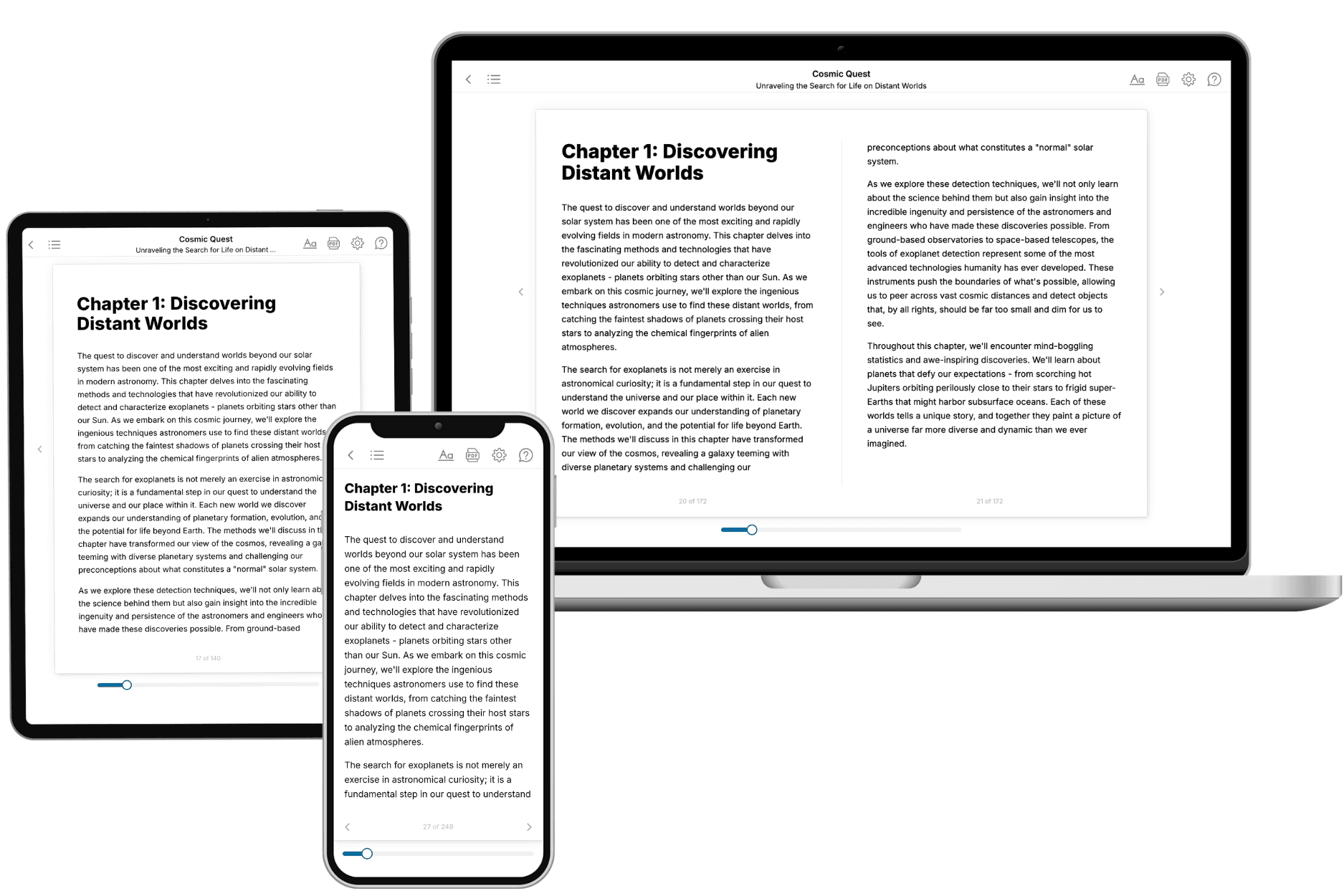
Your book is ready in 10 minutes. Read it online, download as EPUB or PDF, or send to Kindle.


Frequently asked questions
- What is TailoredRead?
TailoredRead creates complete, full-length nonfiction ebooks, written specifically for you. Tell us what you want to learn and why, and TailoredRead writes you a complete ebook on it, with charts, tables, and diagrams throughout. Read it online, on Kindle, or on any e-reader, or download it as a PDF or EPUB. Every book is written fresh the day you order it.
- How is the book tailored to me?
Before anything is written, you answer a few short questions about your goals, your background, and the topics you care about. Your book is then planned around your answers: written at your level, focused on your goals, and covering the topics you chose, instead of the one-size-fits-all book a store sells everyone.
- Will it read like generic AI content?
No. Your book isn't a chat transcript: it's planned chapter by chapter before a single word is written, told in a clear book voice, and explains ideas visually with charts, tables, and diagrams. After writing, every book goes through an editorial pass that polishes chapters so the book reads consistent from start to finish. Judge for yourself: browse thousands of sample books on our Explore Books page.
- How accurate is the content?
Our AI first checks whether your subject needs live research. Niche and fast-moving subjects are researched before writing, and the book plan and chapters are grounded in what it finds. After writing, every book goes through a quality pass that checks its facts and consistency, and researched books list their sources in a Notes section at the back.
- How long is the book?
You choose the length: Comprehensive (250-300 pages), Detailed (150-200 pages), Essential (70-100 pages), or Short (30-50 pages).
- Does the book include visuals?
Yes. Every book includes visual elements such as timelines, checklists, step-by-step guides, decision trees, comparison tables, and matrices, and many include bar charts. A typical book includes dozens of these visual elements.
- Can I read it on Kindle? What formats can I download?
Yes. Every book can be read in our online reader or downloaded as a PDF or EPUB. The EPUB can be opened with Kindle, Apple Books, Kobo, and any e-reader. The Commercial and Author licenses also include an editable Word (DOCX) and Markdown download.
- How much does it cost?
About the price of a regular ebook. The exact price depends on your book's length and complexity, from $2 for the shortest books to $35 for the most comprehensive, and it's shown when you review your book, before you commit to anything. Each book is a one-time purchase, yours to keep, no subscription. Licenses that let you share, teach, or publish your book range from $35.99 to $49.99.
- Can I preview the book before purchasing?
Before you pay, you'll see what your book will cover: the title, a detailed description, the estimated length, and the complete chapter-by-chapter table of contents, so you know what you're getting before you decide. The full text itself is written after you purchase.
- How long does it take to create a book?
About 10 minutes. You can start reading the opening chapters while the rest is still being written.