Geometric Transforms Unlocked
Master Translations, Rotations, Reflections, and Scaling to Solve Real-World Problems
Imagine confidently solving complex geometry problems by understanding exactly how shapes move, rotate, and scale in space.
222 pages10 chaptersMar 12, 2026Geometry
About this book
This book takes you from basic transformation concepts to mastery, building your intuition for how geometric transforms work and why they matter. You'll explore translations that shift objects through space, rotations that spin them around fixed points, reflections that create perfect mirror images, and scaling that changes their size. Each concept builds logically on the previous one, with clear explanations and practical examples that show how these transforms apply to computer graphics, architecture, engineering, and design. By combining individual transforms into powerful sequences and learning to represent them algebraically using matrices, you'll gain the tools to solve real-world problems efficiently. Whether you're designing digital graphics, engineering structures, or simply deepening your mathematical understanding, this book equips you with both the conceptual clarity and practical skills to work with geometric transforms with confidence and precision.
Table of contents
- IntroductionWhy Geometric Transforms Matter, What You'll Learn in This Book, How to Use This Book, Quick Review of Geometric FoundationsRead below
- Chapter 1: Understanding Geometric TransformsWhat Is a Geometric Transform?, The Four Main Types of Transforms, Coordinate Systems and Reference Frames, Rigid Transforms vs. Non-Rigid Transforms
- Chapter 2: Translations: Moving Objects in SpaceThe Basics of Translation, Vectors and Displacement, Translations in Coordinate Systems, Real-World Applications of Translation
- Chapter 3: Rotations: Spinning Objects Around PointsRotation Fundamentals, Understanding Centers of Rotation, Angles, Direction, and Trigonometry, Rotations in Design and Engineering
- Chapter 4: Reflections: Creating Mirror ImagesReflection Basics, Lines of Reflection and Symmetry, Properties of Reflections, Reflections in Nature and Design
- Chapter 5: Scaling: Changing Size and ProportionScaling Fundamentals, Uniform vs. Non-Uniform Scaling, Centers of Scaling and Dilation, Scaling in Graphics and Architecture
- Chapter 6: Composite Transforms: Combining Multiple OperationsCombining Transforms in Sequence, Why Order Matters in Composite Transforms, Visualizing Composite Transformations, Complex Transforms in Real Applications
- Chapter 7: Matrix Representation of TransformsIntroduction to Transformation Matrices, Matrix Operations and Multiplication, Homogeneous Coordinates and 2D Transforms, 3D Transformation Matrices
- Chapter 8: Inverse Transforms and Problem SolvingUnderstanding Inverse Transforms, Computing Inverse Transformations, Solving Problems by Working Backward, Practical Applications of Inverse Transforms
- Chapter 9: Invariants and Properties: What Stays the SameWhat Are Invariants?, Distance and Angle Preservation, Identifying Invariants in Different Transforms, Using Invariants to Solve Problems
- Chapter 10: Geometric Transforms in Computer GraphicsTransforms in Digital Graphics, Transforms in Animation and Motion, 3D Graphics and Perspective Transforms, Tools and Software for Geometric Transforms
- ConclusionYour Path to Mastery, Next Steps in Your Learning Journey
- Glossary of Key Terms
- Further Reading and Resources
Introduction
Every time a video game character spins around, a building blueprint gets scaled to fit a page, or a logo gets flipped to create a mirror version, geometric transforms are doing the work behind the scenes. These mathematical operations are everywhere, quietly powering the digital and physical world around you. Yet for many learners, transforms feel abstract and disconnected from anything real. This book is here to change that. By the time you finish it, you'll see transforms not as dry formulas but as practical tools you can actually use.
Geometric transforms are, at their core, systematic rules for moving, turning, flipping, and resizing shapes. What makes them powerful is their predictability. When you apply a transform, you know exactly what will change and what will stay the same. That predictability is what engineers, designers, animators, and architects rely on every day. Understanding transforms means understanding how objects behave in space, and that understanding opens doors across a wide range of fields and problems.
This book is designed for learners who already have a basic familiarity with geometry but want to go deeper. You know what a coordinate plane looks like. You've worked with shapes, angles, and maybe even a little algebra. Now you're ready to connect those foundations to something more powerful and more applicable. The chapters ahead will build your understanding step by step, starting with the big picture and moving toward increasingly sophisticated tools and techniques.
Whether your goal is to sharpen your mathematical thinking, prepare for more advanced coursework, or apply transforms in a creative or technical field, this book meets you where you are. The explanations are clear and grounded in real examples. The concepts build on each other logically. And throughout, the focus stays on understanding, not just memorizing. Let's get started.
Why Geometric Transforms Matter
Geometric transforms are not just a topic in a math textbook. They are a fundamental language that professionals use to describe how objects exist and move in space. Architects use scaling transforms when they convert a hand-drawn sketch into a precise technical drawing. Game developers use rotation and translation matrices to move characters through 3D environments in real time. Robotics engineers use transforms to calculate where a robotic arm will reach after a series of joint movements. The math is the same across all of these fields.
Consider something as familiar as Google Maps. When you zoom in on a map, that's a scaling transform. When you rotate the map to align with the direction you're walking, that's a rotation transform. When the map pans as you drag it across the screen, that's a translation. Every interaction you have with that map is powered by geometric transforms running in the background, often dozens of times per second.[1]
In physics and engineering, transforms help describe how forces act on objects and how structures respond to stress. In medical imaging, transforms are used to align and compare scans taken at different times or from different angles. In machine learning and computer vision, transforms are applied to images to train models that can recognize objects regardless of their orientation or size. The reach of this topic is genuinely vast.
Even in everyday design work, transforms matter. A graphic designer who understands reflections can create perfectly symmetrical logos without guessing. A textile designer who understands rotations can generate repeating patterns with mathematical precision. An animator who understands composite transforms can choreograph complex motion sequences that look natural and fluid. These are not abstract skills. They are practical advantages.
What makes transforms especially valuable is that they are composable. You can chain them together, applying one after another, to achieve complex results from simple building blocks. A rotation followed by a translation produces a different result than a translation followed by a rotation. Understanding why that is, and how to control it, is one of the most useful things you can learn in applied geometry. This book will take you there.
Finally, transforms matter because they train a particular kind of spatial thinking. When you work through transform problems, you develop the ability to visualize how objects move and change in space. That skill transfers. It makes you better at reading technical diagrams, understanding 3D models, and reasoning about physical systems. It's the kind of mathematical thinking that sticks with you long after you've closed the book.
What You'll Learn in This Book
This book covers the four core geometric transforms in depth: translations, rotations, reflections, and scaling. Each one gets its own dedicated chapter, with clear explanations, worked examples, and real-world context. Beyond the individual transforms, the book also covers how to combine them, how to represent them algebraically using matrices, and how to reverse them when you need to work backward from a result.
Here's a quick overview of what each part of the book covers:
- Chapter 1 sets the stage by defining what a geometric transform is, introducing the four main types, and explaining the difference between rigid and non-rigid transforms.
- Chapter 2 dives into translations, showing how vectors describe displacement and how to apply translations in coordinate systems.
- Chapter 3 covers rotations, including how to identify the center of rotation, work with angles and direction, and apply trigonometric relationships.
- Chapter 4 explores reflections, focusing on lines of reflection, symmetry, and the properties that reflections preserve.
- Chapter 5 examines scaling, including the difference between uniform and non-uniform scaling and how the center of scaling affects the result.
- Chapter 6 tackles composite transforms, explaining how to combine multiple operations and why the order in which you apply them matters.
- Chapter 7 introduces matrix notation as a powerful tool for representing and computing transforms, including homogeneous coordinates and 3D matrices.
- Chapter 8 covers inverse transforms, showing how to reverse any transformation and use backward reasoning to solve problems.
- Chapter 9 explores invariants, the properties that remain unchanged during a transform, and how to use them as problem-solving tools.
- Chapter 10 brings everything together in the context of computer graphics, animation, and 3D rendering.
By the end of this book, you will be able to apply each of the four core transforms confidently, both by hand and using matrix notation. You'll understand how to combine transforms in sequence and predict the outcome. You'll know how to identify what a transform preserves and what it changes. And you'll be able to connect these mathematical ideas to real applications in design, engineering, and digital media.
One of the key skills this book builds is the ability to move fluidly between visual and algebraic representations of transforms. Some people find it easier to think geometrically, picturing shapes moving on a coordinate plane. Others prefer the precision of equations and matrices. This book develops both modes of thinking and shows how they complement each other. You'll learn to sketch a transform, write it as an equation, and express it as a matrix, all for the same operation.
The book also emphasizes why things work, not just how to apply them. Understanding the reasoning behind a formula makes it far easier to remember, adapt, and apply in new situations. When you understand why a rotation matrix looks the way it does, you don't need to memorize it. You can reconstruct it from first principles whenever you need it. That kind of deep understanding is the goal throughout.
Practical examples appear throughout every chapter. These aren't abstract toy problems. They're drawn from real contexts: designing a floor plan, animating a character, aligning a satellite image, or programming a simple graphics engine. Seeing transforms in action in familiar contexts makes the mathematics feel grounded and purposeful, which makes it easier to learn and retain.
How to Use This Book
This book is designed to be read in order, from Chapter 1 through Chapter 10. Each chapter builds on the concepts introduced in the previous ones. Translations are simpler than rotations, and both are needed before composite transforms make full sense. If you skip ahead, you may find yourself missing context that makes a later concept harder to grasp. The sequence is intentional and has been designed to make your learning as smooth as possible.
That said, if you already have solid experience with one or more of the core transforms, feel free to move through those chapters more quickly. Use the Quick Review of Geometric Foundations section at the end of this introduction to check whether your background knowledge is solid. If you can work through those concepts comfortably, you're ready to start Chapter 1 without hesitation.
As you read, keep a notebook or scratch paper nearby. Geometric transforms are a topic where doing is just as important as reading. When a worked example appears, try to work through it yourself before reading the solution. When a new formula is introduced, test it on a simple case to make sure you understand what it's doing. Active engagement with the material will accelerate your learning significantly compared to passive reading.
Pay special attention to the visual diagrams and coordinate examples throughout the book. Transforms are inherently spatial, and building strong visual intuition is a core part of mastering them. When you encounter a new transform, try to picture it in your mind before working through the algebra. Ask yourself: what does this operation look like? Where does each point end up? What shape does the result have? These questions will sharpen your geometric thinking.
The matrix chapters (Chapters 7 and 8) introduce more algebraic machinery than the earlier chapters. If you find matrix notation unfamiliar, don't worry. Chapter 7 starts from scratch and builds up the notation step by step. The goal is not to turn you into a linear algebra expert overnight, but to give you enough fluency with matrices to use them as a practical tool for working with transforms. Take your time with those chapters and work through the examples carefully.
Finally, look for connections between chapters as you go. The concept of a center of rotation in Chapter 3 connects directly to the center of scaling in Chapter 5. The idea of invariants in Chapter 9 applies to every transform you've studied. The matrix representations in Chapter 7 unify all four core transforms into a single algebraic framework. Noticing these connections will deepen your understanding and help you see the subject as a coherent whole rather than a collection of separate techniques.
A practical tip: After finishing each chapter, take five minutes to write down the three most important ideas from that chapter in your own words. This simple habit dramatically improves retention and helps you identify any concepts that still feel unclear before you move on.
Quick Review of Geometric Foundations
Before diving into transforms, it's worth making sure the foundational concepts are solid. This section gives you a quick review of the geometric and algebraic ideas that will appear throughout the book. If any of these feel unfamiliar or rusty, it's worth spending a few minutes refreshing your memory before moving on. None of this is complicated, but having it clearly in mind will make the chapters ahead much easier to follow.
The Coordinate Plane. Most of the transforms in this book take place on a two-dimensional coordinate plane, also called the Cartesian plane. This is the familiar grid with a horizontal x-axis and a vertical y-axis. Every point on the plane is described by an ordered pair (x, y), where x is the horizontal position and y is the vertical position. The point where the axes cross is called the origin, written as (0, 0). You'll be working with this system constantly, so make sure it feels natural.
Points, Lines, and Shapes. A point is a location in space with no size. A line extends infinitely in both directions and is defined by any two points on it. A line segment is the portion of a line between two specific points. A polygon is a closed shape made up of straight line segments. Common polygons include triangles, rectangles, and hexagons. When transforms are applied to shapes, they are typically applied to each vertex (corner point) of the shape, and the edges follow automatically.
Angles. An angle measures the amount of rotation between two rays that share a common endpoint. Angles are measured in degrees (where a full rotation is 360°) or in radians (where a full rotation is 2π radians). Both units appear in this book. The conversion is straightforward: 180° = π radians. So a 90° angle equals π/2 radians, and a 45° angle equals π/4 radians. Rotations in particular rely heavily on angle measurement, so being comfortable with both units is helpful.[2]
Vectors. A vector is a quantity that has both a magnitude (size) and a direction. In two dimensions, a vector is written as (Δx, Δy), where Δx is the horizontal component and Δy is the vertical component. Vectors are used extensively in the chapter on translations to describe how far and in what direction an object moves. For example, the vector (3, -2) means "move 3 units to the right and 2 units down." Vectors are also used in rotation and scaling calculations.
Basic Trigonometry. Rotations require a working knowledge of sine and cosine. These are functions that relate angles to ratios of side lengths in a right triangle. For an angle θ in a right triangle, sin(θ) is the ratio of the opposite side to the hypotenuse, and cos(θ) is the ratio of the adjacent side to the hypotenuse. You don't need to be a trigonometry expert, but you should be comfortable with the basic definitions and with the values at common angles like 0°, 30°, 45°, 60°, and 90°. The table below shows the key values:
Angle (degrees) | sin(θ)       | cos(θ)
----------------|--------------|------------
0°              | 0            | 1
30°             | 0.5          | √3/2 ≈ 0.866
45°             | √2/2 ≈ 0.707 | √2/2 ≈ 0.707
60°             | √3/2 ≈ 0.866 | 0.5
90°             | 1            | 0
Distance Between Points. The distance between two points (x₁, y₁) and (x₂, y₂) is calculated using the distance formula, which comes directly from the Pythagorean theorem: d = √((x₂ - x₁)² + (y₂ - y₁)²). This formula appears in discussions of rigid transforms, where preserving distances between points is a defining property. If you can apply this formula comfortably, you're in good shape for the chapters ahead.
Basic Matrix Concepts. Chapters 7 and 8 use matrix notation, so a brief preview is helpful here. A matrix is a rectangular array of numbers arranged in rows and columns. A 2×2 matrix has 2 rows and 2 columns. Matrices can be multiplied together following specific rules, and this multiplication is what makes it possible to represent complex transforms compactly. If you've never worked with matrices before, don't worry. Chapter 7 introduces everything you need from the ground up. If you have some prior exposure, the notation will feel familiar quickly.
With these foundations in place, you're ready to begin. The first chapter introduces the concept of a geometric transform in full, defines the four main types, and sets up the framework that the rest of the book builds on. The journey from here is logical, progressive, and genuinely rewarding. Geometric transforms are one of those topics where the more you understand, the more you see them everywhere. Let's begin.
This is the end of the free sample. The full book has 10 chapters.
Want this book written for you?
Tell us your goals and background, and get your own version of this book, tailored by AI to you.


Benefits of AI-tailored books
- Read one book, not ten:
- all the Geometry knowledge you need, gathered into a single book.
- Save days of learning:
- tell us your goals, choose your topics, and the whole book is built around them.
- Learn effortlessly:
- Geometry book written for your specific background and expertise.
- Understand at a glance:
- includes charts, tables, timelines, checklists, decision trees, and more.
- Stay current:
- written the day you order it, not years ago.
- Trust what you read:
- every book is checked for accuracy, with real research when your subject needs it.
Create your unique book in 3 steps
- 1. Select your focus
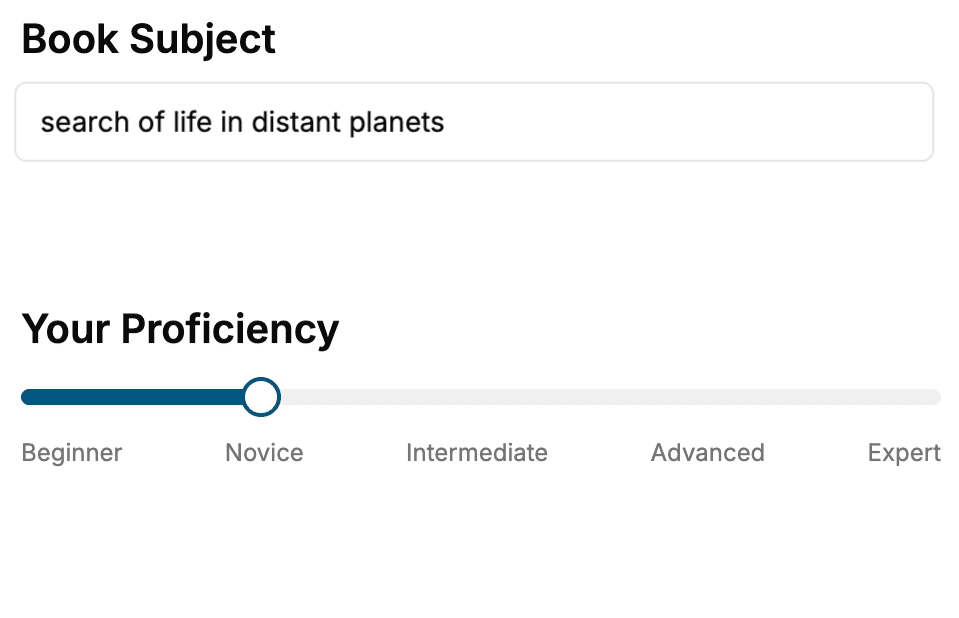
Select the focus of your Geometry book and share your background
- 2. Personalize your book
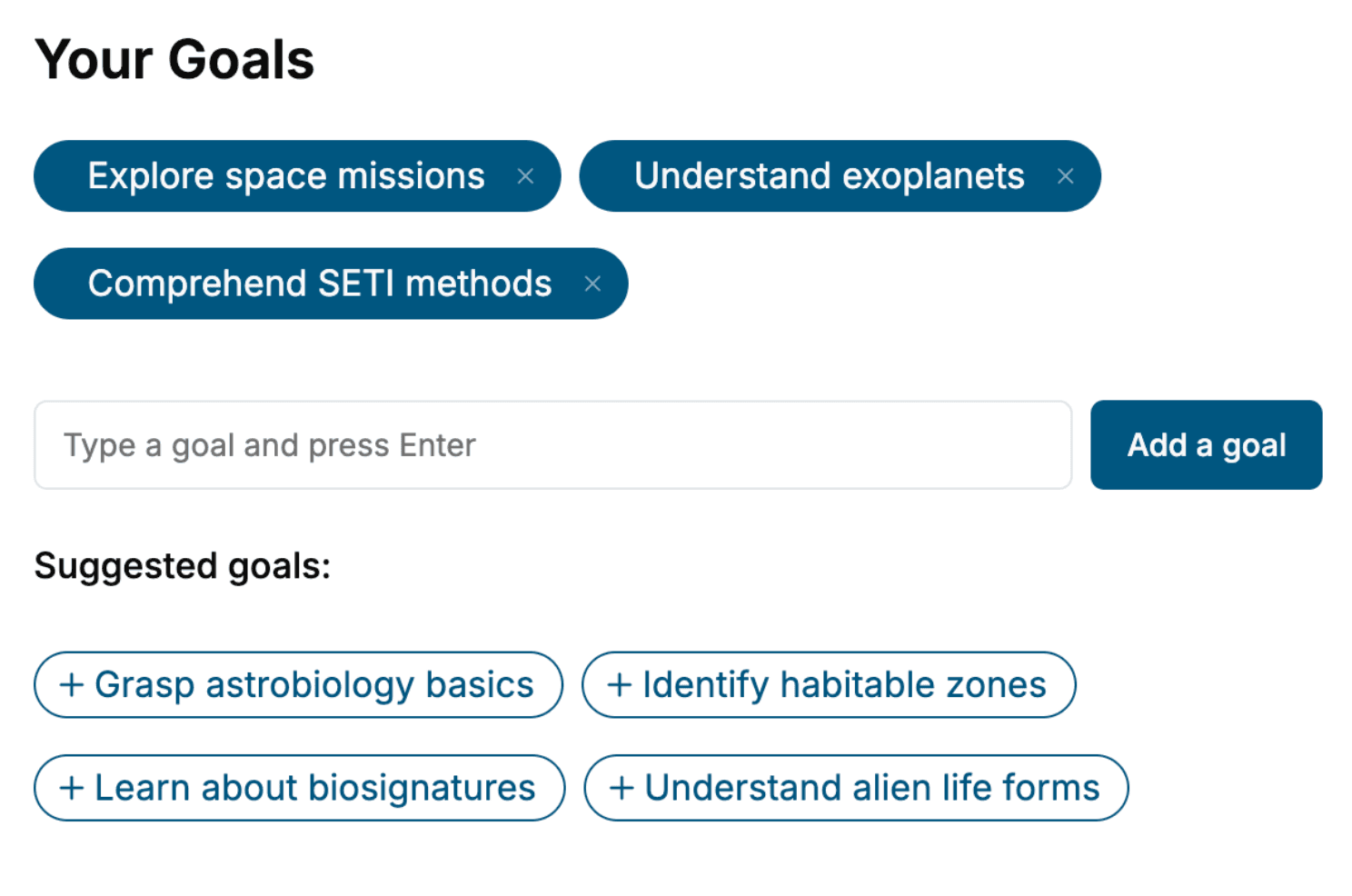
Specify your goals and choose sub-topics to include
- 3. Get your tailored book
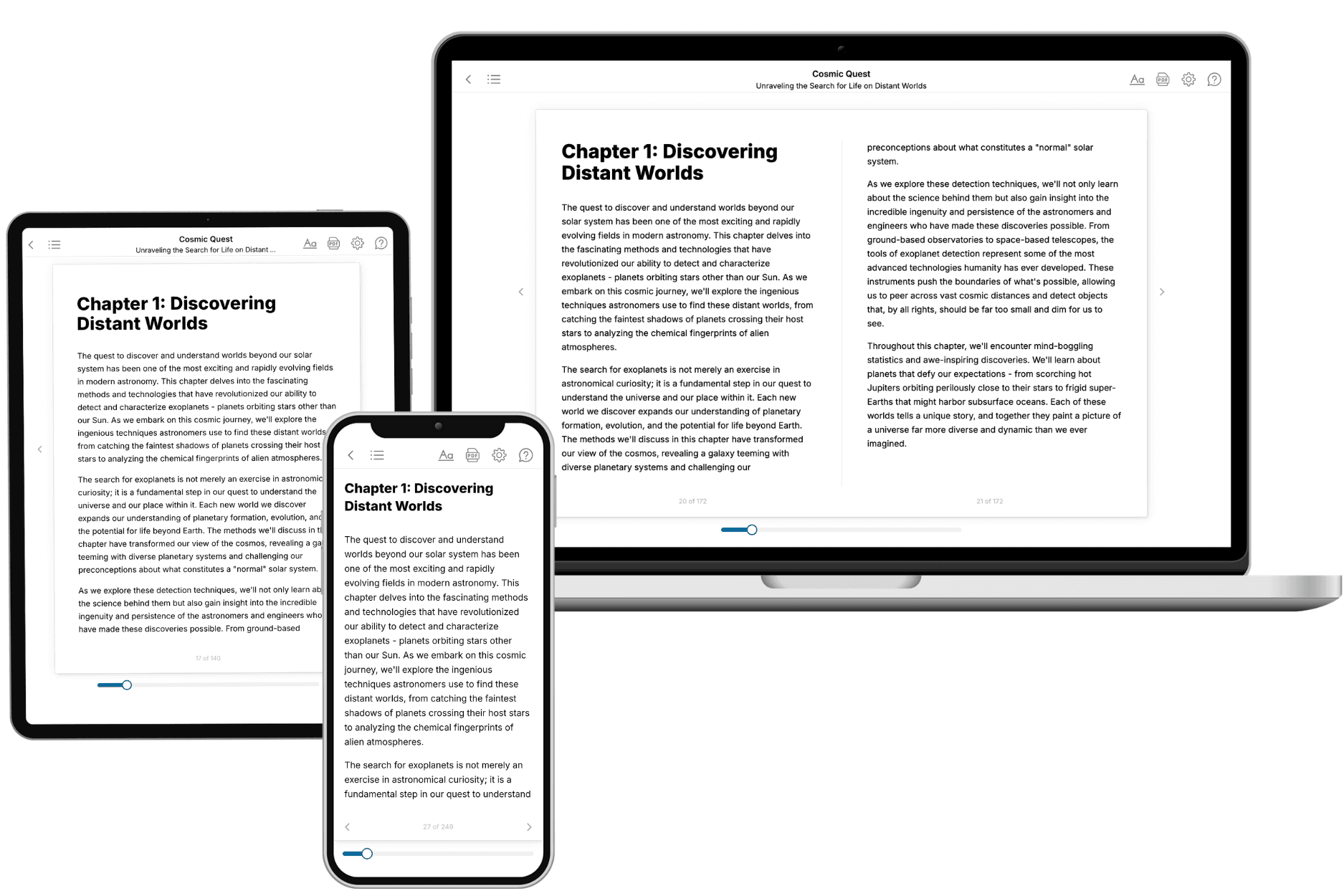
Your book is ready in 10 minutes. Read it online, download as EPUB or PDF, or send to Kindle.
Frequently asked questions
- What is TailoredRead?
TailoredRead creates complete, full-length nonfiction ebooks, written specifically for you. Tell us what you want to learn and why, and TailoredRead writes you a complete ebook on it, with charts, tables, and diagrams throughout. Read it online, on Kindle, or on any e-reader, or download it as a PDF or EPUB. Every book is written fresh the day you order it.
- How is the book tailored to me?
Before anything is written, you answer a few short questions about your goals, your background, and the topics you care about. Your book is then planned around your answers: written at your level, focused on your goals, and covering the topics you chose, instead of the one-size-fits-all book a store sells everyone.
- Will it read like generic AI content?
No. Your book isn't a chat transcript: it's planned chapter by chapter before a single word is written, told in a clear book voice, and explains ideas visually with charts, tables, and diagrams. After writing, every book goes through an editorial pass that polishes chapters so the book reads consistent from start to finish. Judge for yourself: browse thousands of sample books on our Explore Books page.
- How accurate is the content?
Our AI first checks whether your subject needs live research. Niche and fast-moving subjects are researched before writing, and the book plan and chapters are grounded in what it finds. After writing, every book goes through a quality pass that checks its facts and consistency, and researched books list their sources in a Notes section at the back.
- How long is the book?
You choose the length: Comprehensive (250-300 pages), Detailed (150-200 pages), Essential (70-100 pages), or Short (30-50 pages).
- Does the book include visuals?
Yes. Every book includes charts, tables, and diagrams: timelines, checklists, step-by-step guides, decision trees, comparison tables, matrices, and bar charts. A typical book includes dozens of these visual elements.
- Can I read it on Kindle? What formats can I download?
Yes. Every book can be read in our online reader or downloaded as a PDF or EPUB. The EPUB can be opened with Kindle, Apple Books, Kobo, and any e-reader. The Commercial and Author licenses also include an editable Word (DOCX) and Markdown download.
- How much does it cost?
About the price of a regular ebook. The exact price depends on your book's length and complexity, from $2 for the shortest books to $35 for the most comprehensive, and it's shown when you review your book, before you commit to anything. Each book is a one-time purchase, yours to keep, no subscription. Licenses that let you share, teach, or publish your book range from $35.99 to $49.99.
- Can I preview the book before purchasing?
Before you pay, you'll see what your book will cover: the title, a detailed description, the estimated length, and the complete chapter-by-chapter table of contents, so you know what you're getting before you decide. The full text itself is written after you purchase.
- How long does it take to create a book?
About 10 minutes. You can start reading the opening chapters while the rest is still being written.