The Goldbach Conjecture
Exploring One of Mathematics' Greatest Unsolved Mysteries
The Goldbach Conjecture appears deceptively simple: every even number greater than 2 is the sum of two primes.
222 pages10 chaptersEnglishJan 10, 2026Number Theory
About this book
Yet this elegant statement has resisted proof for nearly 300 years, captivating mathematicians and challenging our understanding of prime numbers. This book explores why such a straightforward-sounding claim remains one of mathematics' greatest unsolved mysteries. You'll discover the historical journey from Christian Goldbach's original letter to Euler through centuries of failed attempts and partial breakthroughs. Learn how the conjecture connects to fundamental questions about prime distribution, why computational verification differs from mathematical proof, and how related conjectures have yielded to modern techniques. Whether you're fascinated by unsolved problems, interested in number theory's frontiers, or curious about what makes mathematics genuinely difficult, this exploration reveals the profound depth hidden within one of mathematics' most famous open questions.
Table of contents
- IntroductionWhy This Problem Matters, What You'll Learn in This Book, How to Read This BookRead below
- Chapter 1: The Birth of a ConjectureGoldbach's Original Letter to Euler, Euler's Reformulation and Interest, Early Verification and Initial Observations
- Chapter 2: Prime Numbers: The FoundationWhat Are Prime Numbers?, How Primes Are Distributed, Gaps Between Consecutive Primes, Prime Density and the Prime Number Theorem
- Chapter 3: Understanding the ConjectureAnalyzing the Conjecture's Statement, Why Focus on Even Numbers?, Testing the Conjecture with Examples
- Chapter 4: Computational VerificationHow Computers Verify the Conjecture, How Far Have We Verified?, Why Verification Isn't Proof
- Chapter 5: Related Conjectures and VariantsThe Weak Goldbach Conjecture, The Twin Prime Conjecture, Other Related Problems in Number Theory
- Chapter 6: Attempted Proofs and Partial ResultsMajor Attempts Throughout History, Vinogradov's Breakthrough and Circle Method, Modern Approaches and Incremental Progress
- Chapter 7: Sieve Theory and Analytic MethodsIntroduction to Sieve Theory, How Sieves Help Study Prime Pairs, Analytic Number Theory Approaches
- Chapter 8: Probabilistic PerspectivesTreating Primes as Random Objects, Heuristic Arguments for the Conjecture, Statistical Evidence and Density Arguments
- Chapter 9: Why Is This Problem So Hard?The Paradox of Simple Statements, Fundamental Mathematical Obstacles, Limitations of Current Proof Techniques
- Chapter 10: Impact on MathematicsMathematical Techniques Developed from Attempts, Connections to Other Areas of Mathematics, Computational and Algorithmic Advances
- ConclusionWhere We Stand Today, Future Directions and Open Questions
- Glossary of Terms
- Further Reading and Resources
Introduction
In 1742, a Prussian mathematician named Christian Goldbach wrote a letter to his colleague Leonhard Euler, one of history's most prolific mathematicians. Within that correspondence lay a simple observation about numbers that would become one of mathematics' most enduring mysteries. Goldbach noticed a pattern: every even number he examined could be expressed as the sum of two prime numbers. The number 8 equals 3 plus 5. The number 20 equals 13 plus 7, or alternatively 3 plus 17. This pattern seemed to hold without exception, yet nearly three centuries later, no one has proven it must always be true. This deceptively simple statement has resisted the efforts of countless brilliant minds, spawned entire branches of mathematical research, and continues to captivate mathematicians today.
The Goldbach Conjecture represents something profound about mathematics itself. It demonstrates how a problem that anyone with basic arithmetic can understand might conceal extraordinary depth and complexity. You don't need advanced degrees to grasp what the conjecture claims, yet proving it requires navigating some of the most challenging terrain in number theory. This gap between accessibility and difficulty makes the conjecture particularly fascinating. It invites curiosity from anyone interested in numbers while simultaneously humbling professional mathematicians who have dedicated careers to its pursuit. The conjecture sits at the intersection of the intuitive and the impossibly complex, reminding us that mathematical truth often lies deeper than our initial observations suggest.
This book invites you into the world of the Goldbach Conjecture, not as a distant observer but as an engaged explorer. You'll discover why this problem matters beyond academic curiosity, how it connects to fundamental questions about prime numbers, and what makes it so remarkably resistant to proof. Whether you're drawn to unsolved mysteries, fascinated by the nature of mathematical proof, or simply curious about why some problems remain open for centuries, this exploration offers insights into both a specific conjecture and the broader landscape of mathematical inquiry. The journey ahead requires no specialized background beyond comfort with basic mathematical concepts, though it will challenge you to think deeply about numbers, patterns, and the nature of mathematical certainty.
Throughout this book, you'll encounter ideas that have occupied some of history's greatest mathematical minds. You'll see how computational power has verified the conjecture for numbers beyond human comprehension, yet why this verification falls short of proof. You'll explore related problems that have yielded to modern techniques, offering hope and frustration in equal measure. Most importantly, you'll gain appreciation for why mathematics values proof over pattern, certainty over probability, and why a problem that seems simple on its surface can reveal such profound complexity. The Goldbach Conjecture isn't just about even numbers and primes; it's about the limits of human knowledge and the persistent drive to push those boundaries further.
Why This Problem Matters
The Goldbach Conjecture matters first and foremost because it addresses fundamental questions about prime numbers, the building blocks of all integers. Prime numbers are the atoms of mathematics, indivisible except by themselves and one. Understanding how primes combine, distribute, and relate to other numbers lies at the heart of number theory. The conjecture proposes a specific relationship between primes and even numbers, suggesting a hidden structure in how primes populate the number line. If proven true, it would confirm that primes are sufficiently abundant and well-distributed to represent every even number as a sum. This would tell us something profound about the architecture of numbers themselves, revealing order within what often appears chaotic.
Beyond its intrinsic mathematical interest, the conjecture has driven the development of powerful analytical tools and techniques. Attempts to prove it have led mathematicians to create new methods in analytic number theory, sieve theory, and probabilistic approaches to prime distribution. The circle method, developed by Hardy, Littlewood, and Ramanujan, emerged partly from work on additive problems related to Goldbach's question[1]. Vinogradov's techniques for estimating trigonometric sums, crucial to proving the weak Goldbach Conjecture, have found applications far beyond this specific problem. These mathematical innovations represent lasting contributions regardless of whether the original conjecture is eventually proven or disproven.
The conjecture also serves as a perfect case study in the difference between empirical evidence and mathematical proof. Computers have verified the conjecture for even numbers up to extraordinarily large values, currently beyond 4 × 10¹⁸[2]. This represents billions upon billions of confirmations without a single counterexample. Yet mathematicians remain unsatisfied, insisting on proof rather than pattern. This stance isn't stubbornness but reflects a deep understanding that patterns can break, that infinity is genuinely different from "very large," and that mathematical truth requires logical certainty rather than empirical confidence. The Goldbach Conjecture thus illustrates why mathematics demands proof and what distinguishes mathematical knowledge from other forms of understanding.
The problem's accessibility makes it particularly valuable for mathematical education and public engagement. Unlike many unsolved problems that require years of specialized study just to understand the question, the Goldbach Conjecture can be explained to anyone familiar with basic arithmetic. This accessibility invites broader participation in mathematical thinking and demonstrates that unsolved problems aren't always hidden behind impenetrable jargon. Students can test the conjecture themselves, developing intuition about primes and even numbers. Amateur mathematicians can engage with the problem meaningfully, even if solving it requires professional-level techniques. This democratic quality makes the conjecture an ambassador for mathematics, showing that profound questions can emerge from simple observations.
The conjecture connects to practical applications in cryptography and computer science, fields that depend heavily on properties of prime numbers. While the conjecture itself may not directly impact encryption algorithms, the techniques developed to study it have influenced computational number theory. Understanding prime distribution, estimating prime densities, and developing efficient algorithms for working with primes all relate to the mathematical landscape surrounding Goldbach's question. The sieve methods and analytic techniques refined through work on this problem have found applications in algorithm design and complexity theory. Thus, even an unsolved problem generates practical value through the methods developed in pursuit of its solution.
Perhaps most importantly, the Goldbach Conjecture matters because it represents the frontier of human knowledge. It stands as a reminder that despite centuries of mathematical progress, fundamental questions about basic objects like integers and primes remain unanswered. This humility is valuable. It prevents complacency and drives continued innovation. The conjecture challenges each generation of mathematicians to develop new tools, think in new ways, and push the boundaries of what can be proven. Its persistence as an unsolved problem doesn't represent failure but rather the genuine difficulty of mathematical truth. Some questions resist easy answers not because we lack intelligence but because they touch something deep and complex about the mathematical universe we're exploring.
The cultural significance of the conjecture extends beyond mathematics departments. It has appeared in popular science writing, inspired amateur investigations, and even prompted prize offers for its solution. The conjecture demonstrates that mathematics isn't a closed book of known facts but an ongoing exploration with genuine mysteries remaining. This narrative counters the common perception that mathematics is merely calculation or the application of known formulas. Instead, the Goldbach Conjecture reveals mathematics as a creative, exploratory discipline where fundamental questions remain open and where the next breakthrough might come from unexpected directions. This perspective makes mathematics more human, more accessible, and more exciting to those outside the field.
What You'll Learn in This Book
This book provides a comprehensive journey through the Goldbach Conjecture, beginning with its historical origins and progressing through the mathematical concepts necessary to understand why it remains unsolved. You'll start by exploring the conjecture's birth in the correspondence between Goldbach and Euler, understanding the intellectual context of 18th-century mathematics and how this simple observation emerged. You'll see how Euler reformulated Goldbach's original statement into the version we know today, and why this reformulation matters. The historical narrative establishes not just what the conjecture says but why it captured mathematical attention and how it has evolved over nearly three centuries of investigation.
The book dedicates substantial attention to prime numbers themselves, the essential ingredients of the conjecture. You'll develop a deeper understanding of what makes primes special, how they're distributed along the number line, and why their behavior is both regular and irregular. Key concepts include:
- The fundamental theorem of arithmetic and why primes are considered building blocks
- The Prime Number Theorem and what it tells us about prime density
- Gaps between consecutive primes and how these gaps grow
- The apparent randomness of prime distribution despite underlying patterns
- Why predicting the next prime remains computationally challenging
You'll gain insight into computational verification and its limitations. The book explains how computers test the conjecture for specific numbers, what algorithms make this verification efficient, and how far computational methods have pushed the boundary of confirmed cases. More importantly, you'll understand the crucial distinction between verification and proof. Even if computers confirmed the conjecture for every even number up to 10100, this wouldn't constitute mathematical proof. This section addresses why mathematicians insist on proof rather than accepting overwhelming empirical evidence, revealing fundamental principles about mathematical certainty and the nature of infinity.
The exploration of related conjectures and variants provides context for understanding the Goldbach Conjecture's place in number theory. You'll learn about the weak Goldbach Conjecture, which states that every odd number greater than 5 can be expressed as the sum of three primes, and how this was finally proven in 2013 by Harald Helfgott[3]. This proof represents a major achievement and demonstrates that progress is possible on Goldbach-type problems. You'll also encounter the twin prime conjecture, Legendre's conjecture, and other problems about prime distribution that share mathematical DNA with Goldbach's question. Understanding these connections reveals how the conjecture fits into a broader landscape of questions about additive properties of primes.
The book examines major proof attempts and partial results, showing how mathematicians have approached the problem over time. You'll explore Vinogradov's circle method and how it led to proving the weak conjecture for sufficiently large odd numbers. You'll see how sieve theory provides tools for estimating how many representations an even number might have as a sum of two primes. Modern approaches combining analytic number theory, probabilistic reasoning, and computational methods receive detailed attention. These sections don't just catalog attempts but explain the mathematical reasoning behind them, helping you understand both the power and limitations of current techniques.
A critical chapter addresses why the problem is so difficult despite its simple statement. You'll discover the fundamental obstacles that have prevented proof for nearly 300 years:
- Why local information about primes doesn't easily extend to global statements
- How the irregularity of prime distribution creates analytical challenges
- Why techniques that work for related problems fail for the strong Goldbach Conjecture
- The gap between probabilistic arguments and rigorous proof
- Limitations of current mathematical frameworks for handling additive problems
Throughout the book, you'll encounter specific examples, worked calculations, and concrete illustrations of abstract concepts. Rather than remaining purely theoretical, the text grounds mathematical ideas in tangible demonstrations. You'll see how to test the conjecture for specific even numbers, how to count prime representations, and how to apply basic sieve principles. These practical elements make abstract concepts concrete and accessible. The book balances rigor with readability, providing enough mathematical detail to be substantive while remaining accessible to readers without specialized training in advanced number theory.
Finally, you'll gain perspective on the conjecture's impact on mathematics beyond the question of its truth or falsehood. The techniques developed in pursuit of its proof have enriched number theory, influenced computational mathematics, and demonstrated the value of persistent investigation even without immediate success. You'll see how unsolved problems drive mathematical progress, how partial results contribute to broader understanding, and why some questions remain valuable precisely because they resist easy answers. This meta-mathematical perspective reveals how the Goldbach Conjecture serves mathematics not just as a problem to solve but as a catalyst for deeper exploration of number theory's fundamental questions.
How to Read This Book
This book is structured to build understanding progressively, with each chapter laying groundwork for subsequent material. The recommended approach is to read sequentially, especially if you're encountering these concepts for the first time. Early chapters establish essential background about prime numbers, the conjecture's statement, and basic verification methods. Later chapters assume familiarity with these foundations when discussing advanced techniques like sieve theory and analytic methods. However, the book is also designed to accommodate different reading styles and interests. If you're already comfortable with basic number theory, you might skim the foundational chapters and focus on later material about proof attempts and why the problem remains difficult.
Each chapter contains multiple subsections that break complex topics into manageable pieces. These subsections function as semi-independent units, allowing you to pause and reflect before continuing. Don't rush through the material. The concepts presented, while explained accessibly, often require careful thought to fully absorb. When you encounter a new mathematical idea, take time to work through the examples provided. Test the conjecture yourself with different even numbers. Calculate prime representations. This active engagement transforms passive reading into genuine understanding. Mathematics is not a spectator sport; you learn by doing, even when "doing" means working through examples and verifying claims on paper.
The book includes various types of content that serve different purposes:
- Historical narrative provides context and shows how ideas developed over time
- Mathematical explanations build conceptual understanding of key ideas
- Worked examples demonstrate how to apply concepts to specific cases
- Technical discussions explore advanced methods for readers seeking depth
- Reflective sections consider broader implications and connections
Mathematical notation appears throughout the book but is always explained when introduced. If you encounter an unfamiliar symbol or term, check the glossary at the book's end for quick reference. The book strives to balance precision with accessibility, using formal notation where it clarifies rather than obscures meaning. When mathematical expressions appear, read them carefully and make sure you understand what each symbol represents. Don't skip over equations assuming they're incomprehensible; most are more accessible than they initially appear. If a particular expression seems confusing, try working through it with specific numbers to see how it behaves in practice.
Some chapters contain more technical material than others. Chapter 7 on sieve theory and Chapter 8 on probabilistic perspectives present more advanced concepts that may challenge readers without strong mathematical backgrounds. Don't be discouraged if these sections require extra effort or multiple readings. The core narrative remains accessible even if you don't master every technical detail. You can understand why the Goldbach Conjecture is difficult and significant without following every nuance of Vinogradov's method or the large sieve. Conversely, readers with stronger mathematical backgrounds will find these chapters offer substantial depth and can serve as entry points for further study.
Consider keeping notes as you read, particularly for key definitions, important theorems, and interesting examples. Creating your own summary of each chapter helps consolidate understanding and provides a reference for later chapters that build on earlier material. You might also maintain a list of questions that arise during reading. Some questions will be answered in subsequent chapters; others might lead you to additional resources listed in the further reading section. This active, questioning approach to reading transforms the book from a passive information source into a dialogue between you and the material.
The book includes footnotes citing sources for specific claims, historical facts, and technical results. These citations serve multiple purposes: they allow you to verify claims, provide entry points for deeper investigation, and acknowledge the mathematicians whose work underlies the narrative. You don't need to chase down every citation during initial reading, but they're available if you want to explore particular topics more deeply. The further reading section at the book's end offers curated recommendations for continuing your exploration beyond this volume, organized by topic and difficulty level.
Finally, remember that understanding develops gradually. You may not grasp every concept fully on first encounter, and that's perfectly normal. Mathematical understanding often requires multiple exposures to an idea from different angles before it clicks. If a section seems unclear, continue reading and return to it later. Subsequent chapters may provide additional context that illuminates earlier material. The goal isn't to memorize every detail but to develop genuine understanding of what the Goldbach Conjecture says, why it matters, and what makes it so remarkably difficult to prove. This understanding emerges through engagement with the material, reflection on the concepts, and patience with the learning process. Approach the book as an exploration rather than a race, and you'll find the journey rewarding regardless of your mathematical background.
Notes
Introduction
- 1. G. H. Hardy and J. E. Littlewood, Some problems of 'Partitio numerorum'; III: On the expression of a number as a sum of primes, Acta Mathematica, 1923
- 2. Oliveira e Silva and others, "Empirical verification of the even Goldbach conjecture and computation of prime gaps up to 4·10^18," Mathematics of Computation, 2014
- 3. H. A. Helfgott, Major arcs for Goldbach's theorem. arXiv preprint arXiv:1305.2897, 2013
This is the end of the free sample. The full book has 10 chapters.
Want this book written for you?
Tell us your goals and background, and get your own version of this book, tailored by AI to you.


Benefits of AI-tailored books
- Read one book, not ten:
- all the Number Theory knowledge you need, gathered into a single book.
- Save days of learning:
- tell us your goals, choose your topics, and the whole book is built around them.
- Learn effortlessly:
- Number Theory book written for your specific background and expertise.
- Understand at a glance:
- includes charts, tables, timelines, checklists, decision trees, and more.
- Stay current:
- written the day you order it, not years ago.
- Trust what you read:
- every book is checked for accuracy, with real research when your subject needs it.
Create your unique book in 3 steps
- 1. Select your focus
Select the focus of your Number Theory book and share your background
- 2. Personalize your book
Specify your goals and choose sub-topics to include
- 3. Get your tailored book
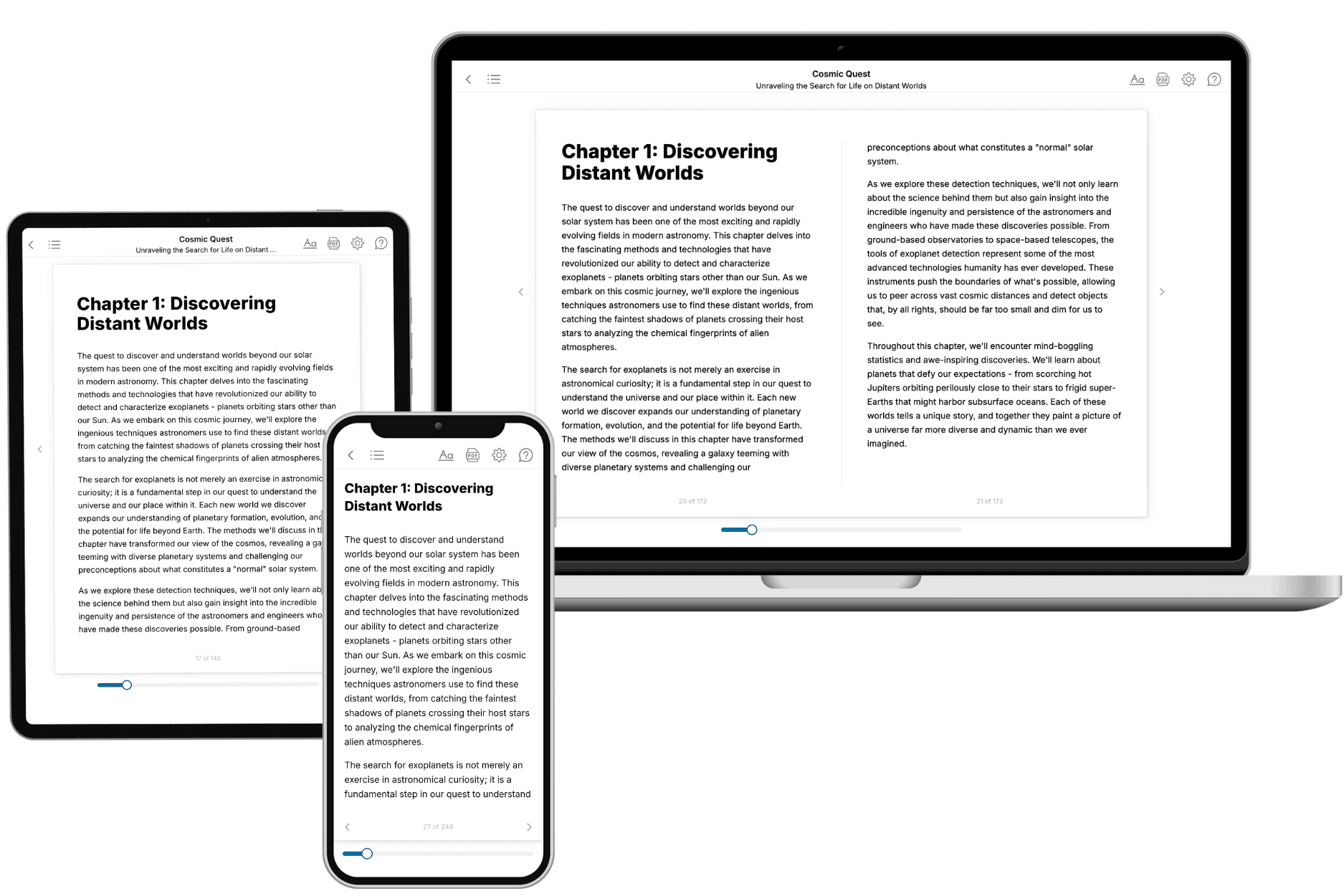
Your book is ready in 10 minutes. Read it online, download as EPUB or PDF, or send to Kindle.
Frequently asked questions
- What is TailoredRead?
TailoredRead creates complete, full-length nonfiction ebooks, written specifically for you. Tell us what you want to learn and why, and TailoredRead writes you a complete ebook on it, with charts, tables, and diagrams throughout. Read it online, on Kindle, or on any e-reader, or download it as a PDF or EPUB. Every book is written fresh the day you order it.
- How is the book tailored to me?
Before anything is written, you answer a few short questions about your goals, your background, and the topics you care about. Your book is then planned around your answers: written at your level, focused on your goals, and covering the topics you chose, instead of the one-size-fits-all book a store sells everyone.
- Will it read like generic AI content?
No. Your book isn't a chat transcript: it's planned chapter by chapter before a single word is written, told in a clear book voice, and explains ideas visually with charts, tables, and diagrams. After writing, every book goes through an editorial pass that polishes chapters so the book reads consistent from start to finish. Judge for yourself: browse thousands of sample books on our Explore Books page.
- How accurate is the content?
Our AI first checks whether your subject needs live research. Niche and fast-moving subjects are researched before writing, and the book plan and chapters are grounded in what it finds. After writing, every book goes through a quality pass that checks its facts and consistency, and researched books list their sources in a Notes section at the back.
- How long is the book?
You choose the length: Comprehensive (250-300 pages), Detailed (150-200 pages), Essential (70-100 pages), or Short (30-50 pages).
- Does the book include visuals?
Yes. Every book includes charts, tables, and diagrams: timelines, checklists, step-by-step guides, decision trees, comparison tables, matrices, and bar charts. A typical book includes dozens of these visual elements.
- Can I read it on Kindle? What formats can I download?
Yes. Every book can be read in our online reader or downloaded as a PDF or EPUB. The EPUB can be opened with Kindle, Apple Books, Kobo, and any e-reader. The Commercial and Author licenses also include an editable Word (DOCX) and Markdown download.
- How much does it cost?
About the price of a regular ebook. The exact price depends on your book's length and complexity, from $2 for the shortest books to $35 for the most comprehensive, and it's shown when you review your book, before you commit to anything. Each book is a one-time purchase, yours to keep, no subscription. Licenses that let you share, teach, or publish your book range from $35.99 to $49.99.
- Can I preview the book before purchasing?
Before you pay, you'll see what your book will cover: the title, a detailed description, the estimated length, and the complete chapter-by-chapter table of contents, so you know what you're getting before you decide. The full text itself is written after you purchase.
- How long does it take to create a book?
About 10 minutes. You can start reading the opening chapters while the rest is still being written.