Grammar Essentials
Master the Most Common Grammatical Errors and Write with Confidence
Many writers struggle with persistent grammatical errors that weaken their message and undermine their credibility.
207 pages10 chaptersMar 14, 2026English Grammar
About this book
Whether you're teaching English, writing professionally, or simply wanting to communicate more effectively, identifying and correcting these mistakes can feel overwhelming. This book cuts through the confusion by focusing on the grammatical errors that appear most frequently in real-world writing. You'll discover why these mistakes happen, how to spot them instantly, and practical strategies to eliminate them from your work. Each chapter tackles a specific category of errors—from subject-verb agreement to misplaced modifiers—with clear explanations, authentic examples, and actionable techniques. Rather than memorizing complex rules, you'll develop an intuitive understanding of how English grammar works, making correct choices automatic. Whether you're an educator looking to help students improve or a writer committed to polishing your craft, this guide provides the focused, practical approach you need to master grammar and communicate with greater clarity and confidence.
Table of contents
- IntroductionWhy Grammar Matters in Communication, The Most Common Patterns of Error, How to Use This Book EffectivelyRead below
- Chapter 1: Subject-Verb AgreementIdentifying the True Subject, Collective Nouns and Plural Confusion, Practical Exercises and Corrections
- Chapter 2: Pronoun Reference and AgreementAmbiguous Pronoun References, Pronoun-Antecedent Agreement, Ensuring Pronoun Clarity
- Chapter 3: Verb Tense and ConsistencyAvoiding Unnecessary Tense Shifts, Understanding Perfect Tenses, Choosing the Right Tense for Your Purpose
- Chapter 4: Misplaced and Dangling ModifiersIdentifying Dangling Modifiers, Correcting Misplaced Modifiers, Strategic Modifier Placement
- Chapter 5: Comma Errors and PunctuationComma Splices and Run-On Sentences, Essential Comma Rules, Using Punctuation for Clarity
- Chapter 6: Parallel StructureMaintaining Parallel Lists and Series, Parallel Structure in Comparisons, Building Parallel Sentences
- Chapter 7: Articles and DeterminersUnderstanding A, An, and The, Articles in Different Contexts, Common Determiner Mistakes
- Chapter 8: Preposition MisuseCommon Preposition Pairs and Phrases, Idiomatic Preposition Usage, Correcting Preposition Errors
- Chapter 9: Word Choice and Commonly Confused WordsDistinguishing Between Commonly Confused Words, Understanding Subtle Differences in Meaning, Selecting Words Based on Context
- Chapter 10: Sentence Structure and FragmentsIdentifying and Fixing Sentence Fragments, Building Complex Sentences Correctly, Creating Variety in Sentence Structure
- ConclusionMoving Forward with Confidence, Strategies for Continuous Improvement
- Quick Reference Guide
Introduction
Every writer has experienced that uncomfortable moment of doubt. You finish a sentence, read it back, and something feels slightly off. Maybe the verb doesn't quite match the subject. Maybe a pronoun seems to float without a clear anchor. Maybe the whole thing just sounds awkward, even though you can't immediately explain why. These moments are not signs of failure. They are signs that you are paying attention, and paying attention is exactly where improvement begins.
Grammatical errors are remarkably democratic. They appear in the work of students, seasoned professionals, published authors, and experienced educators alike. The difference between writers who consistently produce clear, credible prose and those who struggle is rarely raw intelligence or even years of experience. More often, it comes down to knowing which specific patterns to watch for and having reliable strategies to address them. That knowledge is learnable, and this book is designed to give it to you in a direct, practical way.
This book focuses on the errors that actually show up most often in real writing, not an exhaustive catalog of every grammatical rule in the English language. The goal is not to turn you into a walking grammar textbook. The goal is to help you recognize the mistakes that undermine your credibility and clarity, understand why they happen, and build the habits that prevent them. Whether you are writing a professional report, grading student essays, or simply trying to communicate more effectively in everyday life, the skills covered here will make a measurable difference.
Each chapter in this book targets a specific category of error, from subject-verb agreement and pronoun reference to misplaced modifiers and comma misuse. The explanations are clear and grounded in real examples. The strategies are practical and immediately applicable. By the time you finish, you will not just know the rules. You will understand the logic behind them, which makes applying them consistently far easier than memorization alone ever could.
Why Grammar Matters in Communication
Grammar is not just a set of arbitrary rules invented to make writing more difficult. It is the shared system that allows language to carry meaning reliably from one person to another. When grammar breaks down, meaning becomes unstable. A sentence that should communicate one clear idea can suddenly suggest something unintended, confuse the reader, or require extra effort to decode. In professional and academic contexts, that extra effort has real consequences.
Consider a simple example. The sentence The manager told the employee that she needed to improve
contains a pronoun reference problem. Who needs to improve? The manager or the employee? The grammar is technically functional, but the meaning is genuinely ambiguous. A reader cannot be certain what the writer intended. In a performance review, a legal document, or an academic paper, that kind of ambiguity is not a minor stylistic issue. It is a communication failure.
Research consistently shows that grammatical errors affect how readers perceive a writer's credibility and competence. A study published in the Journal of Business and Technical Communication found that readers rated writers with frequent grammatical errors as significantly less professional and less trustworthy than writers who produced clean, error-free prose, even when the content of both pieces was identical.[1] The words you choose matter, but so does the framework that holds them together.
This credibility effect is especially significant in professional settings. Hiring managers, editors, professors, and clients all form rapid judgments based on the quality of writing they receive. A cover letter with subject-verb agreement errors, a business proposal with inconsistent verb tenses, or an academic essay with dangling modifiers all signal something to the reader, even if that signal is unfair. Correct grammar does not guarantee great writing, but consistent grammatical errors create a barrier that can prevent even strong ideas from landing effectively.
For educators, the stakes are slightly different but equally important. Teaching grammar well means helping students understand not just what the rules are, but why those rules exist and how breaking them affects communication. When students grasp the communicative purpose behind a grammar rule, they are far more likely to internalize it and apply it independently. That shift from rule-following to genuine understanding is one of the central goals of this book.
It is also worth acknowledging that grammar is not static. Language evolves, and what counts as an error in one context may be perfectly acceptable in another. Formal academic writing follows different conventions than casual email. A legal brief operates under different expectations than a personal essay. Understanding grammar well means understanding these contextual differences, not just applying a single rigid standard to every piece of writing you encounter. This book will help you develop that kind of flexible, context-aware grammatical judgment.
Key insight: Grammar matters not because rules are sacred, but because clear grammar enables clear communication. Every rule covered in this book exists to serve that purpose.
The Most Common Patterns of Error
One of the most useful things to understand about grammatical errors is that they are not random. The same mistakes appear again and again across different writers, different contexts, and different levels of experience. This predictability is actually good news. It means that by focusing your attention on a specific set of high-frequency error patterns, you can dramatically improve the quality of your writing without having to master every corner of English grammar.
Researchers and writing instructors have studied error frequency for decades. The findings are remarkably consistent. A landmark study by Andrea Lunsford and Karen Lunsford analyzed thousands of student papers and identified the errors that appeared most frequently in college-level writing.[2] Their list included wrong word choice, missing or unnecessary commas, incomplete or missing documentation, vague pronoun reference, and spelling errors. Similar patterns appear in professional writing research, suggesting that these error categories are not limited to student writers.
The errors covered in this book were selected based on exactly this kind of frequency data. They represent the categories that cause the most trouble for the most writers. Here is a quick overview of the main error types you will work through:
- Subject-verb agreement errors: The verb does not match the subject in number, often because a phrase between them creates confusion.
- Pronoun reference problems: A pronoun does not clearly point to a specific antecedent, leaving the reader uncertain about who or what is being discussed.
- Verb tense inconsistency: The tense shifts without reason, disrupting the timeline of events and confusing the reader.
- Misplaced and dangling modifiers: A descriptive phrase is positioned incorrectly, making it appear to modify the wrong word or no word at all.
- Comma errors: Commas are used where they do not belong, omitted where they are needed, or used to join independent clauses incorrectly.
- Faulty parallel structure: Items in a list or comparison do not follow the same grammatical form, creating an unbalanced sentence.
- Article and determiner errors: The wrong article is used, or an article is omitted where one is required, which is especially common among non-native English speakers.
- Preposition misuse: The wrong preposition is paired with a verb, noun, or adjective, producing a phrase that sounds unnatural or unclear.
- Confused word pairs: Words that sound similar or have related meanings are used interchangeably when they actually have distinct functions.
- Sentence fragments and run-ons: Sentences are either incomplete or improperly joined, disrupting the flow and logic of the writing.
What makes these errors so persistent is that they often stem from a specific kind of confusion rather than simple carelessness. Writers who produce subject-verb agreement errors are usually not unaware that subjects and verbs must agree. They are confused by a particular structural pattern, such as a long prepositional phrase between the subject and verb, that makes the true subject harder to identify. Understanding the source of the confusion is the key to eliminating the error.
Another important pattern is that many errors cluster around transitions between grammatical structures. Tense shifts often happen at the boundary between narration and analysis. Pronoun reference problems frequently appear when a writer moves from discussing one person or thing to another. Modifier errors tend to occur at the beginning of sentences, where writers place descriptive phrases before establishing a clear subject. Recognizing these structural hotspots helps you know exactly where to focus your proofreading attention.
It is also worth noting that some errors are more socially significant than others. Certain mistakes, such as using they was
instead of they were,
carry strong social stigma and are likely to affect how readers perceive the writer's education and background. Other errors, such as a misplaced comma in a complex sentence, may go unnoticed by most readers. This book will help you distinguish between high-stakes errors that demand immediate attention and lower-stakes issues that matter more in formal contexts.
Example of a high-frequency error in action: Incorrect: "The list of requirements are attached to the email." Correct: "The list of requirements is attached to the email." The subject is
list,notrequirements,so the verb must be singular. This is one of the most common subject-verb agreement errors in professional writing.
How to Use This Book Effectively
This book is designed to be flexible. You can read it straight through from beginning to end, which will give you a comprehensive overview of the most common grammatical error categories and how they relate to each other. Alternatively, you can use it as a targeted reference, jumping directly to the chapter that addresses the specific error type you are working on right now. Both approaches work, and neither is wrong.
If you are an educator using this book to support your teaching, the chapter structure maps naturally onto a curriculum sequence. Subject-verb agreement and pronoun reference are foundational, so starting there makes sense for students who are building their grammar knowledge from the ground up. Modifier placement and parallel structure tend to be more advanced concerns, better suited to students who have already mastered the basics. The chapters can be assigned individually or in sequence depending on your students' needs.
If you are a writer using this book to improve your own work, the most effective approach is to start with the error type that appears most frequently in your writing. Not sure which that is? Here is a quick diagnostic process you can use right now:
- Pull out a recent piece of your writing, ideally something at least two or three paragraphs long.
- Read through it slowly, sentence by sentence, and mark any spot where something feels uncertain or awkward.
- Look at the table of contents and identify which chapter title best describes the kind of uncertainty you noticed.
- Start with that chapter, work through the examples and strategies, then return to your writing and apply what you learned.
- Repeat this process with a new piece of writing after finishing each chapter.
Each chapter in this book follows a consistent structure. It opens with a clear explanation of the error category, including why the error happens and what it looks like in real writing. It then moves into specific examples, showing both the incorrect version and the corrected version side by side. After the examples, you will find practical strategies for identifying and fixing the error in your own work. Each chapter closes with exercises that let you practice what you have learned before moving on.
The examples throughout this book are drawn from a range of real-world writing contexts, including professional emails, academic essays, news articles, and everyday communication. This variety is intentional. Grammar does not exist in a vacuum, and the same error can look quite different depending on the context in which it appears. Seeing errors across multiple contexts helps you develop the kind of flexible recognition skills that transfer to your own writing, whatever form that writing takes.
One of the most important habits you can build while working through this book is the habit of reading your writing aloud. Many grammatical errors that slip past your eyes will catch your ear immediately. A sentence with a subject-verb agreement error often sounds wrong before you can consciously identify why. A run-on sentence tends to leave you breathless. A dangling modifier can produce an unintentionally comic effect that becomes obvious the moment you hear it spoken. Reading aloud is not a substitute for careful proofreading, but it is one of the most powerful and underused tools available to any writer.
Technology can also play a supporting role in your grammar improvement process. Tools like grammar checkers in word processors, browser extensions, and dedicated writing apps can flag many common errors automatically. However, these tools have real limitations. They miss context-dependent errors, they sometimes flag correct sentences as wrong, and they cannot explain the reasoning behind a correction in a way that helps you learn. Use technology as a first pass, but always apply your own judgment as the final check. The goal of this book is to develop that judgment so it becomes reliable and automatic.
Progress in grammar improvement is rarely linear. You will likely find that some error types click immediately while others require repeated practice before they feel natural. That is completely normal. Language learning, even for native speakers refining their formal writing skills, involves cycles of understanding, practice, forgetting, and relearning. Be patient with the process. The writers who improve most consistently are not the ones who never make mistakes. They are the ones who notice their mistakes, understand them, and keep practicing.
A practical tip for educators: When using this book in a classroom setting, consider having students collect their own error examples from real writing they encounter, whether from their own work, published articles, or online sources. Analyzing authentic errors is far more engaging and memorable than working only with textbook examples. It also reinforces the idea that grammatical errors are a normal part of real-world writing, not just a classroom exercise.
Finally, keep in mind that the goal of this book is not perfection. Perfect grammar is a moving target, and even the most careful writers produce errors under time pressure or in unfamiliar genres. The goal is competence and confidence: the ability to recognize the most common error patterns, correct them efficiently, and make informed choices about your writing in any context. That kind of practical mastery is entirely achievable, and every chapter in this book is a step toward it.
The chapters ahead cover ten of the most significant and frequently occurring grammatical error categories in English writing. Each one builds your understanding of a specific aspect of how English grammar works and gives you concrete tools to apply that understanding immediately. By the time you reach the conclusion, you will have a complete, practical toolkit for identifying and eliminating the errors that most commonly undermine clarity and credibility in writing. The work starts now, and it starts with the most fundamental agreement in all of English grammar: the relationship between a subject and its verb.
This is the end of the free sample. The full book has 10 chapters.
Want this book written for you?
Tell us your goals and background, and get your own version of this book, tailored by AI to you.


Benefits of AI-tailored books
- Read one book, not ten:
- all the English Grammar knowledge you need, gathered into a single book.
- Save days of learning:
- tell us your goals, choose your topics, and the whole book is built around them.
- Learn effortlessly:
- English Grammar book written for your specific background and expertise.
- Understand at a glance:
- includes charts, tables, timelines, checklists, decision trees, and more.
- Stay current:
- written the day you order it, not years ago.
- Trust what you read:
- every book is checked for accuracy, with real research when your subject needs it.
Create your unique book in 3 steps
- 1. Select your focus
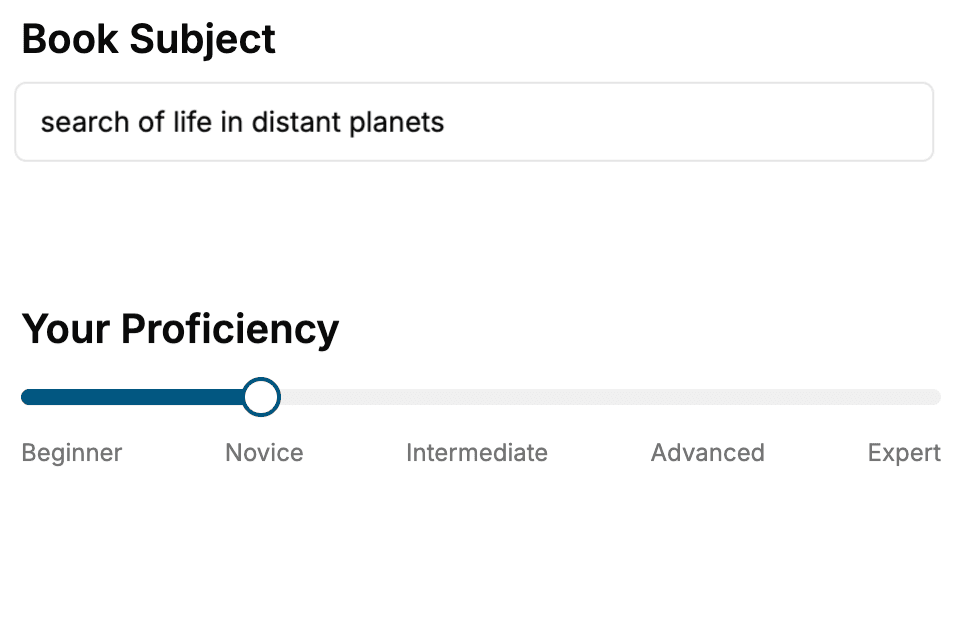
Select the focus of your English Grammar book and share your background
- 2. Personalize your book
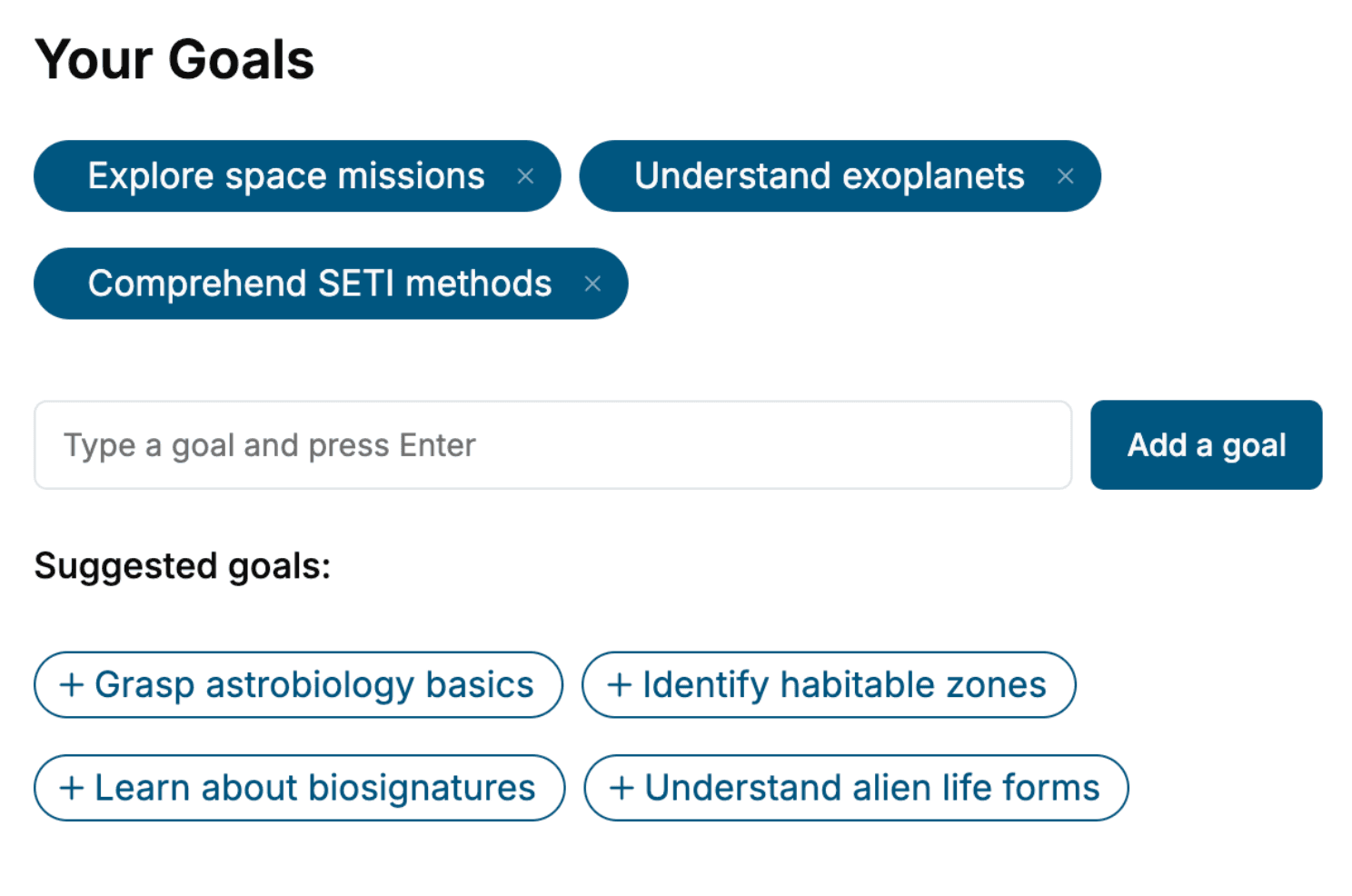
Specify your goals and choose sub-topics to include
- 3. Get your tailored book
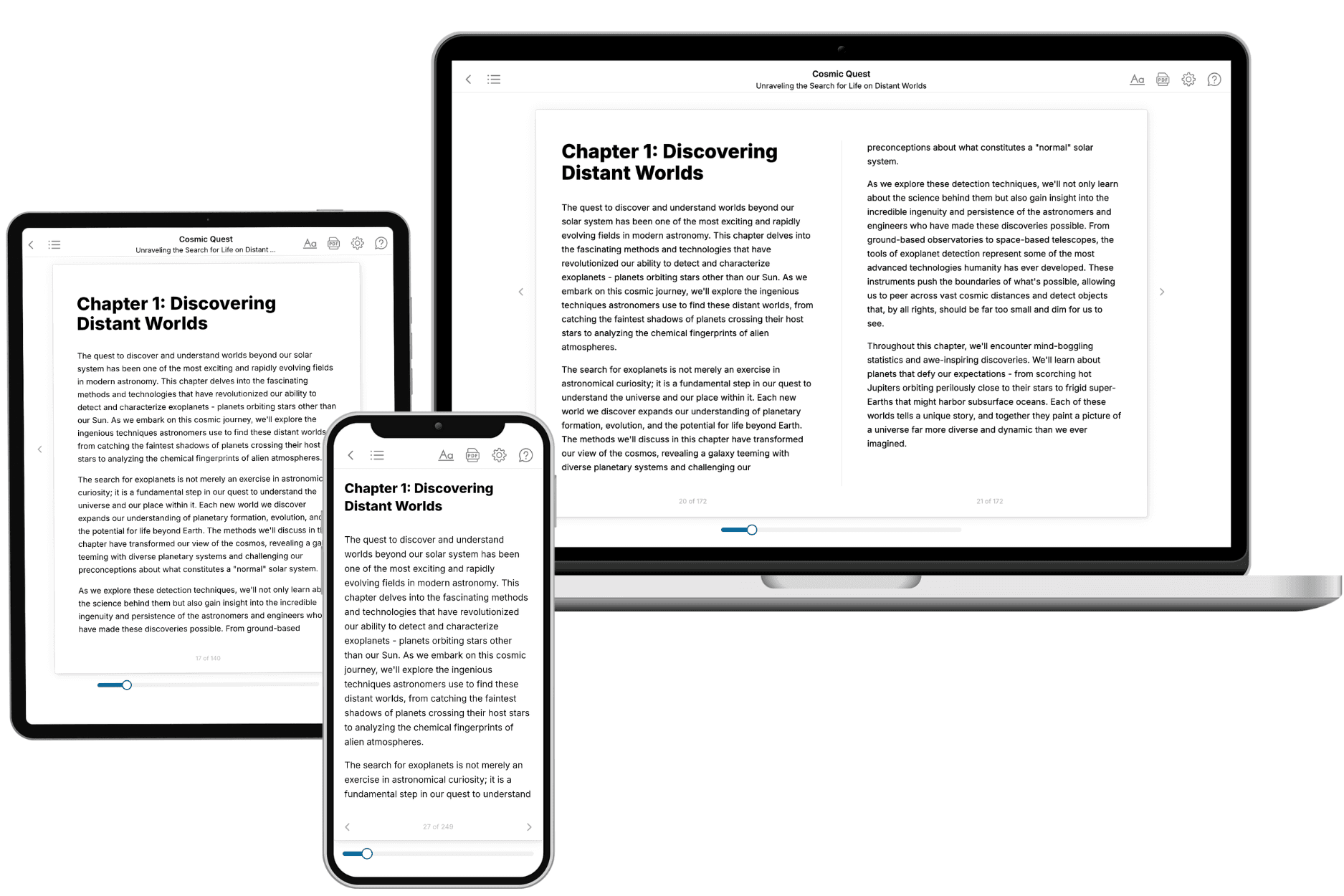
Your book is ready in 10 minutes. Read it online, download as EPUB or PDF, or send to Kindle.
Frequently asked questions
- What is TailoredRead?
TailoredRead creates complete, full-length nonfiction ebooks, written specifically for you. Tell us what you want to learn and why, and TailoredRead writes you a complete ebook on it, with charts, tables, and diagrams throughout. Read it online, on Kindle, or on any e-reader, or download it as a PDF or EPUB. Every book is written fresh the day you order it.
- How is the book tailored to me?
Before anything is written, you answer a few short questions about your goals, your background, and the topics you care about. Your book is then planned around your answers: written at your level, focused on your goals, and covering the topics you chose, instead of the one-size-fits-all book a store sells everyone.
- Will it read like generic AI content?
No. Your book isn't a chat transcript: it's planned chapter by chapter before a single word is written, told in a clear book voice, and explains ideas visually with charts, tables, and diagrams. After writing, every book goes through an editorial pass that polishes chapters so the book reads consistent from start to finish. Judge for yourself: browse thousands of sample books on our Explore Books page.
- How accurate is the content?
Our AI first checks whether your subject needs live research. Niche and fast-moving subjects are researched before writing, and the book plan and chapters are grounded in what it finds. After writing, every book goes through a quality pass that checks its facts and consistency, and researched books list their sources in a Notes section at the back.
- How long is the book?
You choose the length: Comprehensive (250-300 pages), Detailed (150-200 pages), Essential (70-100 pages), or Short (30-50 pages).
- Does the book include visuals?
Yes. Every book includes charts, tables, and diagrams: timelines, checklists, step-by-step guides, decision trees, comparison tables, matrices, and bar charts. A typical book includes dozens of these visual elements.
- Can I read it on Kindle? What formats can I download?
Yes. Every book can be read in our online reader or downloaded as a PDF or EPUB. The EPUB can be opened with Kindle, Apple Books, Kobo, and any e-reader. The Commercial and Author licenses also include an editable Word (DOCX) and Markdown download.
- How much does it cost?
About the price of a regular ebook. The exact price depends on your book's length and complexity, from $2 for the shortest books to $35 for the most comprehensive, and it's shown when you review your book, before you commit to anything. Each book is a one-time purchase, yours to keep, no subscription. Licenses that let you share, teach, or publish your book range from $35.99 to $49.99.
- Can I preview the book before purchasing?
Before you pay, you'll see what your book will cover: the title, a detailed description, the estimated length, and the complete chapter-by-chapter table of contents, so you know what you're getting before you decide. The full text itself is written after you purchase.
- How long does it take to create a book?
About 10 minutes. You can start reading the opening chapters while the rest is still being written.