The Great Chicago Fire
How a City Burned and Rose Again
What if a single night could erase an entire city from the map?
207 pages10 chaptersMar 27, 2026United States History
About this book
On October 8-10, 1871, the Great Chicago Fire consumed over 3 square miles of urban landscape, killed hundreds, and left tens of thousands homeless. Yet within years, Chicago rose from the ashes to become America's architectural and industrial powerhouse. This book explores the perfect storm of conditions that made the fire possible—from wooden construction and drought to inadequate firefighting resources—and reveals how the city's recovery reshaped American urban development. Discover the stories of those who lived through the inferno, the visionary architects who rebuilt the skyline, and the lasting lessons this catastrophe taught America about resilience, planning, and progress. The Chicago Fire wasn't just a tragedy; it was a turning point that defined a city and influenced a nation.
Table of contents
- IntroductionWhy Chicago's Story Matters Today, What This Book Covers, How We Know What HappenedRead below
- Chapter 1: Chicago Before the FireFrom Frontier Trading Post to Boomtown, The Explosive Growth of the 1860s, A City Built of Wood
- Chapter 2: The Perfect StormDrought and Dry Timber, Inadequate Fire Protection, Dangerous Construction Methods
- Chapter 3: The Night the City BurnedHow the Fire Started, The Unstoppable Spread, Desperate Firefighting Efforts
- Chapter 4: Survival and LossThe Toll in Lives and Property, Stories of Escape and Survival, The Refugee Crisis and Relief Efforts
- Chapter 5: Chaos and Recovery BeginA City in Ruins, Emergency Response and Governance, Aid from Across the Nation
- Chapter 6: Architects of the New ChicagoNew Building Technologies and Materials, The Rise of the Chicago School of Architecture, Visionary Architects Shape the Skyline
- Chapter 7: Building a Modern CityThe Remarkable Speed of Reconstruction, Fire Safety and Building Code Reforms, Infrastructure and Urban Planning Advances
- Chapter 8: Economic Consequences and OpportunitiesThe Insurance Industry Transformed, Economic Opportunity and Investment, Effects on the National Economy
- Chapter 9: Society TransformedImmigrant Communities and Displacement, Class Divisions in Recovery, A New Civic Identity Emerges
- Chapter 10: The Fire's Lasting LegacyInfluence on American Urban Planning, Lessons for Disaster Preparedness, Chicago's Identity Today
- ConclusionWhat Resilience Really Means, Remembering the Fire
- Further Reading and Resources
Introduction
On the evening of October 8, 1871, a fire broke out in a barn on the southwest side of Chicago. Within hours, it had grown into something almost impossible to comprehend. By the time the flames finally died down two days later, more than 17,000 buildings had been destroyed, roughly 300 people were dead, and nearly 100,000 residents had been left without homes.[1] An entire city, one of the fastest-growing in the world at the time, had been reduced to smoldering rubble across more than three square miles of urban landscape.
What makes the Great Chicago Fire so compelling, even 150 years later, is not just the scale of the destruction. It is the story of what came next. Chicago did not simply recover. It rebuilt itself into something entirely new, something more ambitious, more modern, and more influential than the city that had burned. The disaster cleared the ground for a generation of visionary architects and engineers who would go on to invent the modern skyscraper and reshape how cities around the world were designed and built.
But the fire was also a human story, and that dimension deserves equal attention. Thousands of ordinary people lost everything they owned in a single night. Immigrant families who had spent years building a foothold in America watched their neighborhoods turn to ash. Workers, merchants, and homeowners faced a crisis that no insurance policy or government program was fully prepared to handle. Their experiences reveal something important about how disasters expose the fault lines already present in a society, and how recovery is never equally shared.
This book tells the full story of the Great Chicago Fire, from the dry summer that set the stage to the architectural revolution that followed. It examines the causes, the catastrophe, and the consequences, drawing on historical records, survivor accounts, and the work of scholars who have spent decades piecing together what really happened. The goal is not simply to recount events but to understand them, to ask why the fire happened, what it meant for the people who lived through it, and what it still means for the way Americans think about cities, resilience, and recovery.
Why Chicago's Story Matters Today
It might be tempting to treat the Great Chicago Fire as a piece of distant history, a dramatic episode from a world very different from our own. But the questions it raises are strikingly relevant to the present. How do cities become vulnerable to catastrophic failure? What happens when infrastructure, governance, and planning cannot keep pace with rapid growth? And when disaster strikes, who bears the cost, and who gets to shape what comes next?
Chicago in 1871 was a city that had grown faster than its systems could manage. In just four decades, it had expanded from a small frontier settlement into a metropolis of roughly 300,000 people.[2] That growth brought wealth and opportunity, but it also brought overcrowding, inadequate infrastructure, and a built environment that was dangerously flammable. The fire was not a random act of nature. It was the predictable result of choices made over decades, choices about how to build quickly and cheaply, how to allocate resources, and how to prioritize economic growth over safety.
That pattern is not unique to nineteenth-century Chicago. Cities around the world today face similar tensions between rapid development and the systems needed to support it safely. When wildfires tear through communities built at the edge of forests, when floods overwhelm drainage systems in fast-growing urban areas, or when aging infrastructure fails under pressure, the underlying dynamics often echo what happened in Chicago. The fire offers a case study in how vulnerability accumulates quietly over time, until a single spark sets everything in motion.
The recovery story matters just as much. Chicago's rebuilding was not inevitable. It required deliberate decisions by civic leaders, investors, architects, and ordinary residents to commit to something better rather than simply restore what had been lost. That choice produced one of the most remarkable periods of architectural and urban innovation in American history. The lessons embedded in that process, about the role of building codes, the value of long-term planning, and the importance of including all communities in recovery, remain directly applicable to how cities respond to disasters today.
There is also a cultural dimension worth considering. The Great Chicago Fire became part of the city's identity in a way that shaped how Chicagoans understood themselves for generations. The phrase I Will
, which became an unofficial motto of the city after the fire, captured a spirit of determination that residents genuinely felt and actively cultivated.[3] Understanding where that identity came from, and what it cost to build it, adds depth to any engagement with Chicago's history and character.
Finally, the fire matters because it changed American cities far beyond Chicago. The building codes, fire safety standards, and urban planning practices that emerged from the disaster spread across the country in the years that followed. The architectural innovations pioneered in Chicago's reconstruction influenced skylines from New York to San Francisco. In a very real sense, the way American cities look and function today was shaped, at least in part, by what happened on those two October nights in 1871.
The Great Chicago Fire was not just a local tragedy. It was a national turning point that forced Americans to rethink how cities were built, governed, and protected against catastrophe.
What This Book Covers
This book is organized to take you through the full arc of the Chicago Fire story, from the conditions that made the disaster possible to the long-term legacy it left behind. Each chapter focuses on a distinct phase or dimension of the event, building toward a comprehensive picture of what happened and why it mattered. The chapters are designed to stand on their own as well, so if you have a particular interest in, say, the architectural innovations of the rebuilding period or the social impact on immigrant communities, you can move directly to those sections without losing the thread.
The first two chapters set the scene. Chapter 1 examines Chicago before the fire, tracing the city's extraordinary growth from a small trading post in the 1830s to a booming industrial center by 1871. Understanding that growth is essential to understanding the fire, because the speed and character of Chicago's expansion created the conditions that made the disaster so severe. Chapter 2 then looks at the specific factors that turned a barn fire into a citywide catastrophe, including the summer drought, the limitations of the fire department, and the construction practices that had filled the city with highly flammable buildings.
Chapters 3 and 4 cover the fire itself and its immediate human cost. Chapter 3 reconstructs the night of October 8 through the morning of October 10, following the fire's path through the city and examining the efforts made to stop it. Chapter 4 focuses on the human dimension: the lives lost, the stories of escape and survival, and the refugee crisis that unfolded in the fire's wake. These chapters draw heavily on firsthand accounts and contemporary newspaper reports to bring the experience as close to the ground level as possible.
The middle section of the book, Chapters 5 through 7, covers the immediate aftermath and the rebuilding process. Chapter 5 examines the chaos of the days immediately following the fire, including the emergency response, the role of martial law, and the outpouring of aid from across the country. Chapters 6 and 7 then turn to the reconstruction itself, exploring the new building technologies and architectural ideas that transformed Chicago's skyline and the practical reforms in fire safety and urban planning that followed.
Chapters 8 and 9 broaden the lens to examine the economic and social consequences of the fire. Chapter 8 looks at the impact on the insurance industry, the opportunities created for investors and entrepreneurs, and the effects on the national economy. Chapter 9 examines the social dimensions of the disaster and recovery, with particular attention to the experiences of immigrant communities and working-class residents who bore a disproportionate share of the burden. Chapter 10 and the conclusion then step back to assess the fire's lasting legacy, both for Chicago and for American urban life more broadly.
Throughout the book, the aim is to balance narrative and analysis. The fire is a gripping story, and it deserves to be told with the drama and human detail it contains. But it is also a historical event with causes, consequences, and lessons that reward careful examination. The goal is to offer both: a compelling account of what happened and a thoughtful exploration of what it means.
- Chapters 1-2: The city before the fire and the conditions that made disaster inevitable
- Chapters 3-4: The fire itself and the human cost in lives, property, and displacement
- Chapters 5-7: The immediate aftermath, emergency response, and the rebuilding process
- Chapters 8-9: Economic and social consequences of the disaster and recovery
- Chapter 10 and Conclusion: The fire's lasting legacy for Chicago and American cities
How We Know What Happened
One of the most interesting challenges in writing about the Great Chicago Fire is the nature of the historical record itself. The fire destroyed an enormous amount of documentation, including city records, business archives, and personal papers. At the same time, it generated a remarkable volume of new documentation almost immediately, as newspapers, relief organizations, insurance companies, and government bodies all scrambled to record what had happened. The result is a historical record that is both rich and uneven, full of vivid detail in some areas and frustratingly sparse in others.
The most immediate sources are the newspaper accounts published in the days and weeks following the fire. Chicago's own papers, including the Chicago Tribune, managed to resume publication within days despite losing their own buildings, and their coverage provides an invaluable contemporaneous record of events.[4] Papers from other cities also sent reporters to Chicago, and their dispatches offer outside perspectives on the scale of the disaster and the city's response. These accounts are vivid and often moving, but they also reflect the biases and limitations of journalism in the 1870s, including a tendency to sensationalize and a frequent inattention to the experiences of poor and immigrant communities.
Survivor accounts form another crucial layer of the historical record. Many Chicagoans wrote letters, diary entries, and memoirs describing their experiences during and after the fire. Some of these were published at the time; others have been preserved in archives and libraries. The Chicago History Museum holds an extensive collection of fire-related materials, including firsthand accounts that have been invaluable to historians studying the event.[5] These personal narratives bring the human dimension of the disaster to life in ways that official records cannot, though they also reflect the perspectives of those who were literate and had the means and motivation to write.
Official investigations and reports provide a different kind of evidence. The city of Chicago conducted an inquiry into the fire's origins and the performance of the fire department, and the resulting testimony offers detailed information about the night of October 8 and the decisions made in the hours that followed. Insurance company records, while incomplete due to the destruction of many archives, provide data on the scale of property losses and the financial impact of the disaster. These sources are more systematic than personal accounts but often reflect institutional interests and blind spots.
Scholarly historians have been working with these sources for well over a century, and their work forms the backbone of what is known about the fire today. Key works include Donald Miller's sweeping history of Chicago, City of the Century; Karen Sawislak's detailed social history of the fire and its aftermath, Smoldering City; and Carl Smith's cultural analysis, Urban Disorder and the Shape of Belief.[6] These scholars have done the painstaking work of cross-referencing sources, identifying gaps and contradictions in the record, and placing the fire in its broader historical context. This book draws on their research extensively.
It is worth being honest about what remains uncertain. The exact cause of the fire, for example, has never been definitively established. The story of Mrs. O'Leary's cow kicking over a lantern became famous almost immediately, but it was almost certainly a myth, or at least a significant oversimplification.[7] The precise death toll is also uncertain; estimates range from around 200 to over 300, with the true number likely somewhere in that range but impossible to pin down exactly given the destruction of records and the displacement of the population. Where the evidence is uncertain, this book says so rather than presenting a false confidence.
The approach throughout is to let the evidence speak as clearly as possible while being transparent about its limitations. Where sources disagree, the disagreement is noted. Where the historical record is silent, particularly on the experiences of those who left fewer written traces, the gaps are acknowledged. The goal is not to present a tidy, definitive account of events that were, in reality, chaotic and complex, but to offer the most accurate and honest picture that the available evidence allows.
History is rarely as clean as the stories we tell about it. The Great Chicago Fire is no exception. Understanding what really happened requires sitting with uncertainty, weighing conflicting accounts, and resisting the temptation to simplify a messy reality into a neat narrative.
A note on terminology and perspective: throughout this book, the term the fire
refers specifically to the Great Chicago Fire of October 8-10, 1871, unless otherwise indicated. The book also makes a deliberate effort to include the perspectives of communities that are sometimes overlooked in popular accounts of the disaster, particularly immigrant workers and poor residents whose experiences were central to the story but whose voices are less well represented in the historical record. Recovering those perspectives requires reading against the grain of sources that were often written by and for more privileged observers, but it is essential to understanding the full human meaning of what happened.
Notes
Introduction
- 1. Cromie, Robert. The Great Chicago Fire. Nashville: Rutledge Hill Press, 1994
- 2. Miller, Donald L. City of the Century: The Epic of Chicago and the Making of America. New York: Simon & Schuster, 1996
- 3. Sawislak, Karen. Smoldering City, 1871-1874. Chicago: University of Chicago Press, 1995
- 4. Chicago Tribune, October 9-31, 1871. Available through the Library of Congress Chronicling America digital archive.
- 5. Chicago History Museum Research Center, Great Chicago Fire Collection, 1871-1900.
- 6. Smith, Carl. Urban Disorder and the Shape of Belief, and the Model Town of Pullman. Chicago: University of Chicago Press, 1995
- 7. Bales, "Richard F. The Great Chicago Fire and the Myth of Mrs. O'Leary's Cow. Jefferson," NC: McFarland, 2002
This is the end of the free sample. The full book has 10 chapters.
Want this book written for you?
Tell us your goals and background, and get your own version of this book, tailored by AI to you.


Benefits of AI-tailored books
- Read one book, not ten:
- all the United States History knowledge you need, gathered into a single book.
- Save days of learning:
- tell us your goals, choose your topics, and the whole book is built around them.
- Learn effortlessly:
- United States History book written for your specific background and expertise.
- Understand at a glance:
- includes charts, tables, timelines, checklists, decision trees, and more.
- Stay current:
- written the day you order it, not years ago.
- Trust what you read:
- every book is checked for accuracy, with real research when your subject needs it.
Create your unique book in 3 steps
- 1. Select your focus
Select the focus of your United States History book and share your background
- 2. Personalize your book
Specify your goals and choose sub-topics to include
- 3. Get your tailored book
Your book is ready in 10 minutes. Read it online, download as EPUB or PDF, or send to Kindle.


Frequently asked questions
- What is TailoredRead?
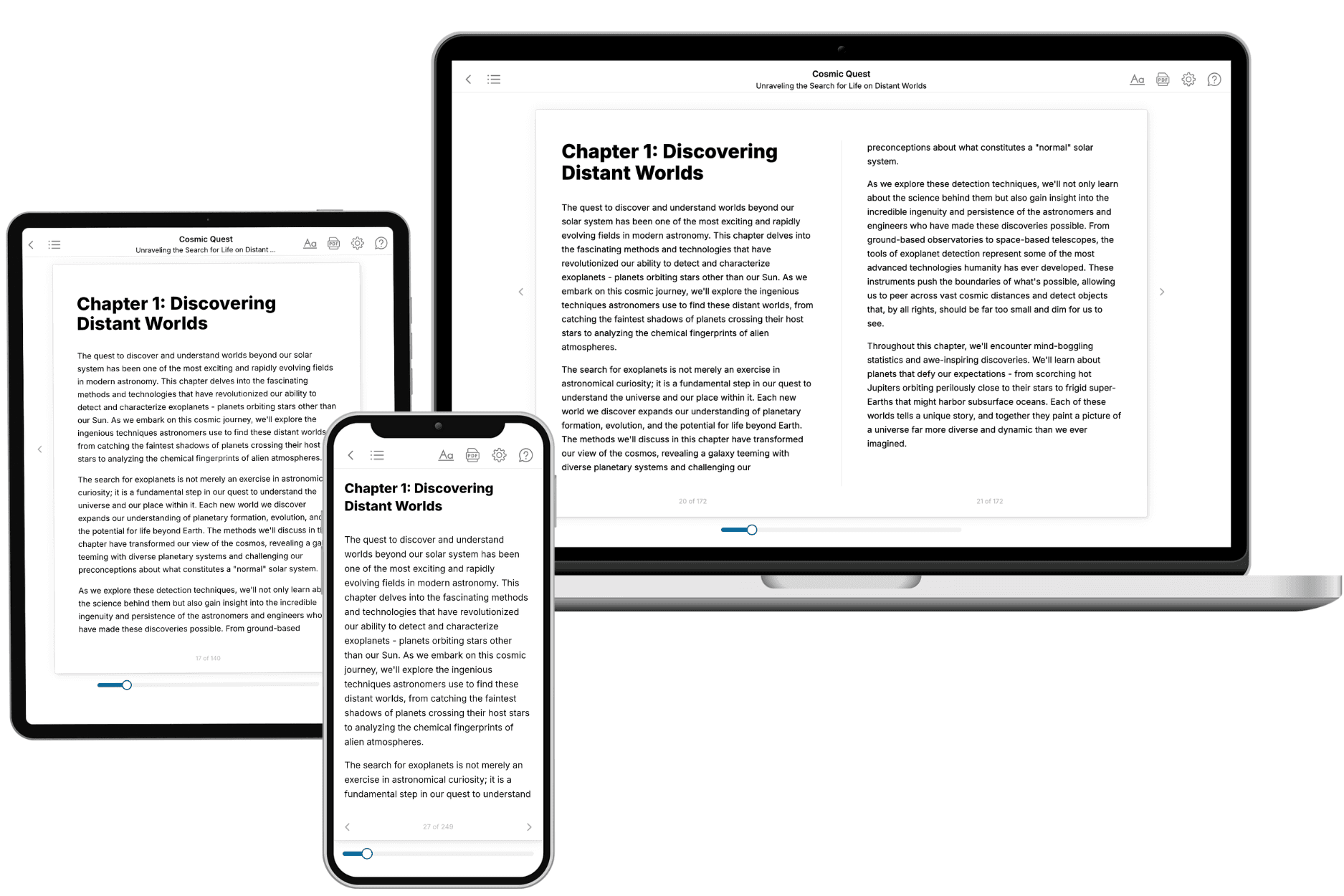
TailoredRead creates complete, full-length nonfiction ebooks, written specifically for you. Tell us what you want to learn and why, and TailoredRead writes you a complete ebook on it, with charts, tables, and diagrams throughout. Read it online, on Kindle, or on any e-reader, or download it as a PDF or EPUB. Every book is written fresh the day you order it.
- How is the book tailored to me?
Before anything is written, you answer a few short questions about your goals, your background, and the topics you care about. Your book is then planned around your answers: written at your level, focused on your goals, and covering the topics you chose, instead of the one-size-fits-all book a store sells everyone.
- Will it read like generic AI content?
No. Your book isn't a chat transcript: it's planned chapter by chapter before a single word is written, told in a clear book voice, and explains ideas visually with charts, tables, and diagrams. After writing, every book goes through an editorial pass that polishes chapters so the book reads consistent from start to finish. Judge for yourself: browse thousands of sample books on our Explore Books page.
- How accurate is the content?
Our AI first checks whether your subject needs live research. Niche and fast-moving subjects are researched before writing, and the book plan and chapters are grounded in what it finds. After writing, every book goes through a quality pass that checks its facts and consistency, and researched books list their sources in a Notes section at the back.
- How long is the book?
You choose the length: Comprehensive (250-300 pages), Detailed (150-200 pages), Essential (70-100 pages), or Short (30-50 pages).
- Does the book include visuals?
Yes. Every book includes charts, tables, and diagrams: timelines, checklists, step-by-step guides, decision trees, comparison tables, matrices, and bar charts. A typical book includes dozens of these visual elements.
- Can I read it on Kindle? What formats can I download?
Yes. Every book can be read in our online reader or downloaded as a PDF or EPUB. The EPUB can be opened with Kindle, Apple Books, Kobo, and any e-reader. The Commercial and Author licenses also include an editable Word (DOCX) and Markdown download.
- How much does it cost?
About the price of a regular ebook. The exact price depends on your book's length and complexity, from $2 for the shortest books to $35 for the most comprehensive, and it's shown when you review your book, before you commit to anything. Each book is a one-time purchase, yours to keep, no subscription. Licenses that let you share, teach, or publish your book range from $35.99 to $49.99.
- Can I preview the book before purchasing?
Before you pay, you'll see what your book will cover: the title, a detailed description, the estimated length, and the complete chapter-by-chapter table of contents, so you know what you're getting before you decide. The full text itself is written after you purchase.
- How long does it take to create a book?
About 10 minutes. You can start reading the opening chapters while the rest is still being written.