Griffith Park Trails
Your Complete Guide to Hiking Los Angeles's Most Iconic Park
Griffith Park is one of Los Angeles's greatest natural treasures, yet many visitors struggle to navigate its 4,210 acres and 50+ miles of trails without a clear plan.
207 pages10 chaptersJun 4, 2026Hiking
About this book
Whether you're a local seeking weekend adventures or a tourist wanting to experience LA beyond the beaches, this guide cuts through the confusion and gets you on the right trail. You'll discover detailed descriptions of the park's most rewarding hikes, from the iconic Hollywood Sign trek to lesser-known gems that offer solitude and stunning views. Learn how to choose trails that match your fitness level, prepare for Southern California's unique climate, and avoid common mistakes that ruin hiking days. This guide covers everything from what to pack and when to visit, to trail safety, wildlife awareness, and the park's fascinating history. Whether you have two hours or a full day, this book helps you experience Griffith Park's diverse landscapes—chaparral hillsides, oak woodlands, and panoramic vistas—while staying safe and respecting this urban oasis.
Table of contents
- IntroductionWhy Griffith Park Matters, How to Use This Guide, What to Expect from Your VisitRead below
- Chapter 1: Getting Started: Park Basics and PlanningPark Overview and Geography, Access Points and Parking, Understanding Trail Difficulty Ratings
- Chapter 2: Preparation: What You Need Before You GoEssential Gear and What to Pack, Physical Preparation and Fitness, Permits, Rules, and Regulations
- Chapter 3: Timing Your Visit: Seasons and WeatherSeasonal Hiking Guide, Southern California Weather Patterns, Best Times to Hike Each Trail
- Chapter 4: Safety and Wildlife: Staying ProtectedSun Protection and Hydration, Wildlife Awareness and Encounters, Emergency Preparedness and First Aid
- Chapter 5: Iconic Trails: Must-Do HikesHollywood Sign Trail, Mount Hollywood Summit, Griffith Observatory Loop
- Chapter 6: Moderate Trails: Building Your SkillsBronson Canyon and Batcave Trail, Fern Dell Nature Trail, Mulholland Ridge Trail
- Chapter 7: Challenging Trails: Advanced AdventuresMount Lee and Backbone Trail, Chapel Trail to Inspiration Point, Extended Loop Hikes
- Chapter 8: Hidden Gems: Lesser-Known TrailsTrails for Solitude and Quiet, Best Trails for Wildlife Viewing, Scenic Overlooks and Photo Spots
- Chapter 9: Beyond the Trails: Park Attractions and CultureGriffith Observatory and Planetarium, Hollywood History and Cultural Significance, Visitor Facilities and Amenities
- Chapter 10: Trail Etiquette and Environmental ResponsibilityLeave No Trace Principles, Protecting Wildlife and Habitats, Respecting Other Hikers and the Community
- Conclusion: Your Griffith Park Adventure AwaitsTaking Your First Steps, Continuing Your Exploration
- Appendix: Quick Reference and ResourcesTrail Quick Reference Chart, Emergency Contacts and Resources, Further Reading and Online Resources
Introduction
Los Angeles is famous for its freeways, its film studios, and its beaches. But tucked into the hills above Hollywood sits one of the most remarkable urban parks in the entire United States. Griffith Park covers 4,210 acres of rugged chaparral, shaded oak woodland, and open ridgeline, all within a short drive of downtown LA. It is larger than many national parks, and yet millions of people live within a few miles of its trailheads without ever truly exploring what it holds. This guide exists to change that.
Whether you are a Los Angeles local looking for a reliable weekend escape or a visitor who wants to experience the city from a completely different angle, Griffith Park delivers something that no beach or boulevard can match. From the summit of Mount Hollywood, you can see the Pacific Ocean to the west, the San Gabriel Mountains to the north, and the sprawling grid of the city in every other direction. That view alone is worth the effort of getting here. But the park offers far more than a single iconic panorama.
Over 50 miles of trails wind through the park's diverse terrain, ranging from flat, shaded walks suitable for a casual morning stroll to steep, exposed ridge routes that will genuinely challenge experienced hikers. The park is home to mule deer, coyotes, red-tailed hawks, and a surprising variety of native plant communities. It also carries a rich human history, from its origins as a private estate to its role as a backdrop for countless Hollywood productions. Understanding that history adds a layer of meaning to every step you take on these trails.
This guide is designed to be practical above all else. It will not overwhelm you with unnecessary detail, but it will give you everything you need to plan a safe, enjoyable, and genuinely rewarding visit. The chapters ahead cover trail descriptions, seasonal planning, safety essentials, gear recommendations, and the park's cultural significance. Think of it as a knowledgeable friend who has already hiked every trail and wants to save you the guesswork.
Why Griffith Park Matters
Griffith Park is not just a park. It is a living argument for the idea that wild nature and dense urban life can coexist. The park sits at the eastern end of the Santa Monica Mountains, and its hills form a genuine ecological corridor connecting urban green space to larger natural areas beyond the city. That ecological role is easy to overlook when you are standing at a busy trailhead, but it becomes clear the moment you round a bend and find yourself completely alone on a quiet ridge with nothing but chaparral and sky around you.
The park was donated to the city of Los Angeles in 1896 by Colonel Griffith J. Griffith, a Welsh immigrant who made his fortune in mining and real estate.[1] His stated intention was to give ordinary working people access to open land and fresh air, a vision that was genuinely progressive for its era. That founding purpose still resonates today. On any given weekend morning, you will find trail runners, families with young children, birdwatchers, photographers, and solo hikers all sharing the same paths. The park belongs to everyone, and that democratic spirit is part of what makes it special.
From a purely practical standpoint, Griffith Park is also one of the most accessible natural spaces in Southern California. Unlike the Angeles National Forest or the Santa Monica Mountains National Recreation Area, the park requires no parking permit for most entry points, no advance reservation for day hiking, and no long drive from the city center. You can be on a trail within minutes of leaving a Hollywood hotel or a Silver Lake apartment. That accessibility is a genuine gift in a region where traffic and logistics can make outdoor adventures feel like a major undertaking.
The park also plays an important role in the mental and physical health of the communities surrounding it. Research consistently shows that access to green space reduces stress, improves mood, and encourages physical activity.[2] For the millions of Angelenos who live in dense neighborhoods with limited private outdoor space, Griffith Park functions as a shared backyard. That is not a small thing. It is a public health resource as much as it is a recreational one.
Beyond its ecological and social value, the park holds a unique place in American cultural history. The Hollywood Sign, one of the most recognized landmarks on earth, sits within park boundaries on the slopes of Mount Lee. The Griffith Observatory has appeared in dozens of films, most famously in the 1955 James Dean classic Rebel Without a Cause. Bronson Canyon, tucked into the park's eastern hills, served as the Batcave entrance in the original 1960s Batman television series. Hiking here means walking through layers of both natural and cultural history simultaneously.
Understanding why this park matters helps you approach it with the right mindset. This is not just a place to get some exercise. It is a place to connect with the landscape, the history, and the broader community of people who value open space in one of the world's most urbanized environments. That perspective will enrich every hike you take here, whether it is your first visit or your fiftieth.
A quick fact worth knowing: Griffith Park is one of the largest urban parks in the United States, roughly five times the size of New York's Central Park. Its 4,210 acres include over 50 miles of trails, a zoo, an observatory, a golf course, a carousel, and multiple picnic areas, all within the city limits of Los Angeles.
The park's size is both its greatest asset and its biggest challenge for first-time visitors. It is easy to arrive without a plan and feel overwhelmed by the options. That is exactly the problem this guide is designed to solve. By the time you finish reading, you will know which trails suit your fitness level, which entry points to use, and how to make the most of whatever time you have available.
How to Use This Guide
This guide is organized to serve you at every stage of your visit, from the moment you start planning to the moment you lace up your boots at the trailhead. You do not need to read it cover to cover before your first hike. Instead, think of it as a reference tool that you can dip into based on what you need right now. That said, if you are completely new to Griffith Park, reading the first few chapters in order will give you a solid foundation before you dive into the trail descriptions.
The opening chapters cover the essentials that apply to every visit, regardless of which trail you choose. Chapter 1 gives you a clear picture of the park's geography and layout, explains the different access points, and breaks down how trail difficulty ratings work in this specific environment. Chapter 2 covers preparation, including gear, fitness, and the rules you need to know. Chapter 3 addresses timing and weather, which matters more in Southern California than many visitors expect. Chapter 4 focuses on safety and wildlife, topics that deserve serious attention even on short, easy hikes.
Chapters 5 through 8 are the heart of the guide. They describe specific trails organized by difficulty level, from the iconic must-do hikes that every visitor should experience to the hidden gems that most people never find. Each trail description follows a consistent format so you can quickly compare your options:
- Distance: Total round-trip mileage
- Elevation gain: Total feet climbed
- Difficulty rating: Easy, moderate, or challenging
- Estimated time: Typical completion time for an average hiker
- Best season: When this trail is at its best
- Trailhead location: Where to start and how to get there
- Key highlights: What makes this trail worth doing
Chapter 9 covers the park's major attractions beyond the trails themselves, including the Griffith Observatory, the Los Angeles Zoo, and the park's deep connections to Hollywood history. Chapter 10 addresses trail etiquette and environmental responsibility, topics that matter for the long-term health of the park. The appendix at the back of the book provides a quick-reference trail chart, emergency contact information, and resources for further exploration.
A few practical notes on how to get the most from this guide. Trail conditions in Griffith Park can change quickly, especially after rain or during periods of high fire risk. Always check current conditions before heading out. The Los Angeles Department of Recreation and Parks maintains an updated website with trail closures and alerts. The AllTrails app also provides real-time user reviews and condition reports that are genuinely useful for planning purposes.[3]
The distances and elevation figures in this guide are based on GPS data and official park measurements. Your own experience may vary slightly depending on your route and the specific trailhead you use. When in doubt, round up your estimates for both distance and time. It is always better to finish a hike earlier than expected than to be caught on an exposed ridge as the sun goes down.
Finally, this guide is written for hikers with a moderate level of experience. That means you are comfortable walking several miles on uneven terrain, you understand the basics of sun protection and hydration, and you have some familiarity with reading trail maps. If you are a complete beginner, the easy trail descriptions in Chapter 5 and the preparation advice in Chapter 2 will give you everything you need to get started safely. If you are an experienced hiker, the challenging routes in Chapter 7 will give you something genuinely worth working toward.
What to Expect from Your Visit
Setting realistic expectations before you arrive will make your visit significantly more enjoyable. Griffith Park is a beloved and heavily used public space, and that means certain realities come with the territory. Popular trailheads, especially those near the Hollywood Sign and Griffith Observatory, can be genuinely crowded on weekend mornings. Parking lots fill up early. Trails near major attractions see heavy foot traffic throughout the day. None of this should discourage you, but it should inform your planning.
The good news is that the crowds thin out dramatically once you move away from the most famous landmarks. Hike just a mile or two beyond the main tourist corridors and you will often find yourself in near-complete solitude. This is one of the park's best-kept secrets. Many of the trails described in Chapter 8 of this guide see only a fraction of the foot traffic that the Hollywood Sign route receives, yet they offer equally stunning views and a far more peaceful experience. Learning to look beyond the obvious destinations is one of the most rewarding skills you can develop as a Griffith Park hiker.
In terms of terrain, expect dry, exposed hillsides covered in chaparral vegetation for most of the park's upper elevations. Chaparral is a dense, scrubby plant community dominated by species like chamise, toyon, and various species of sage. It is beautiful in its own right, especially in spring when wildflowers bloom across the hillsides, but it provides very little shade. This matters enormously for planning purposes. On a warm day, hiking an exposed ridge in Griffith Park feels significantly harder than hiking the same distance in a shaded forest environment.
The lower elevations of the park, particularly around Fern Dell and the areas near the Los Feliz entrance, offer a very different experience. Here you will find mature oak trees, sycamores, and in some areas genuine riparian vegetation along seasonal stream corridors. These shaded lower trails are ideal for hot days, for families with young children, or for anyone who simply wants a gentler, more contemplative walk. The contrast between the park's upper and lower zones is one of its most interesting ecological features.
Wildlife encounters are a real possibility in Griffith Park, and they add genuine excitement to any hike. Mule deer are commonly seen in the early morning and late afternoon, particularly in the quieter northern sections of the park. Coyotes are present throughout and are occasionally spotted on trails at any time of day. Rattlesnakes are native to the area and are most active in warm weather, typically from spring through early fall. Chapter 4 covers wildlife awareness in detail, but the key point to absorb now is this: wildlife encounters in Griffith Park are almost always safe as long as you maintain a respectful distance and avoid surprising animals.
From a practical standpoint, here is what a typical successful visit to Griffith Park looks like:
- Arrive early. On weekends, aim to be at your trailhead by 8:00 AM or earlier. Parking is easier, temperatures are cooler, and the trails are quieter.
- Bring more water than you think you need. There are very few water sources on the trails themselves. A general rule is one liter of water per hour of hiking in warm weather.
- Wear sun protection. Sunscreen, a hat, and sunglasses are not optional in Southern California. The UV index here is consistently high, even on overcast days.
- Download an offline map. Cell service can be unreliable in parts of the park. Download the trail map on AllTrails or a similar app before you leave home.
- Tell someone your plan. Let a friend or family member know which trail you are hiking and when you expect to be back.
The experience of hiking in Griffith Park is genuinely different from hiking in a remote wilderness area, and that difference is worth embracing rather than resisting. You are in the middle of one of the world's great cities. The sound of traffic occasionally drifts up from the streets below. Helicopters pass overhead. The Hollywood Sign is visible from half the trails in the park. These are not flaws in the experience. They are part of what makes Griffith Park unique: the way it holds wild nature and urban life in the same frame, side by side, without apology.
That juxtaposition is ultimately what draws people back to this park again and again. There is something deeply satisfying about standing on a ridge above Los Angeles, watching the city spread out below you in every direction, knowing that you got here on foot from a trailhead that was itself just a few blocks from a coffee shop and a freeway on-ramp. Griffith Park does not ask you to leave the city behind. It asks you to see the city differently, from above, from within the chaparral, from a perspective that most people never find. This guide will help you find it.
What first-time visitors often say: "I had no idea this was here." That reaction, from people who have lived in Los Angeles for years, is one of the most common responses to a first real hike in Griffith Park. The park is hiding in plain sight, and discovering it feels like finding a secret that was always available to you.
By the time you finish this guide and complete your first few hikes, you will understand exactly what those first-time visitors mean. Griffith Park rewards curiosity, preparation, and a willingness to go just a little further than the obvious path. Everything you need to do that is in the pages ahead. The trails are waiting.
This is the end of the free sample. The full book has 10 chapters.
Want this book written for you?
Tell us your goals and background, and get your own version of this book, tailored by AI to you.


Benefits of AI-tailored books
- Read one book, not ten:
- all the Hiking knowledge you need, gathered into a single book.
- Save days of learning:
- tell us your goals, choose your topics, and the whole book is built around them.
- Learn effortlessly:
- Hiking book written for your specific background and expertise.
- Understand at a glance:
- includes charts, tables, timelines, checklists, decision trees, and more.
- Stay current:
- written the day you order it, not years ago.
- Trust what you read:
- every book is checked for accuracy, with real research when your subject needs it.
Create your unique book in 3 steps
- 1. Select your focus
Select the focus of your Hiking book and share your background
- 2. Personalize your book
Specify your goals and choose sub-topics to include
- 3. Get your tailored book
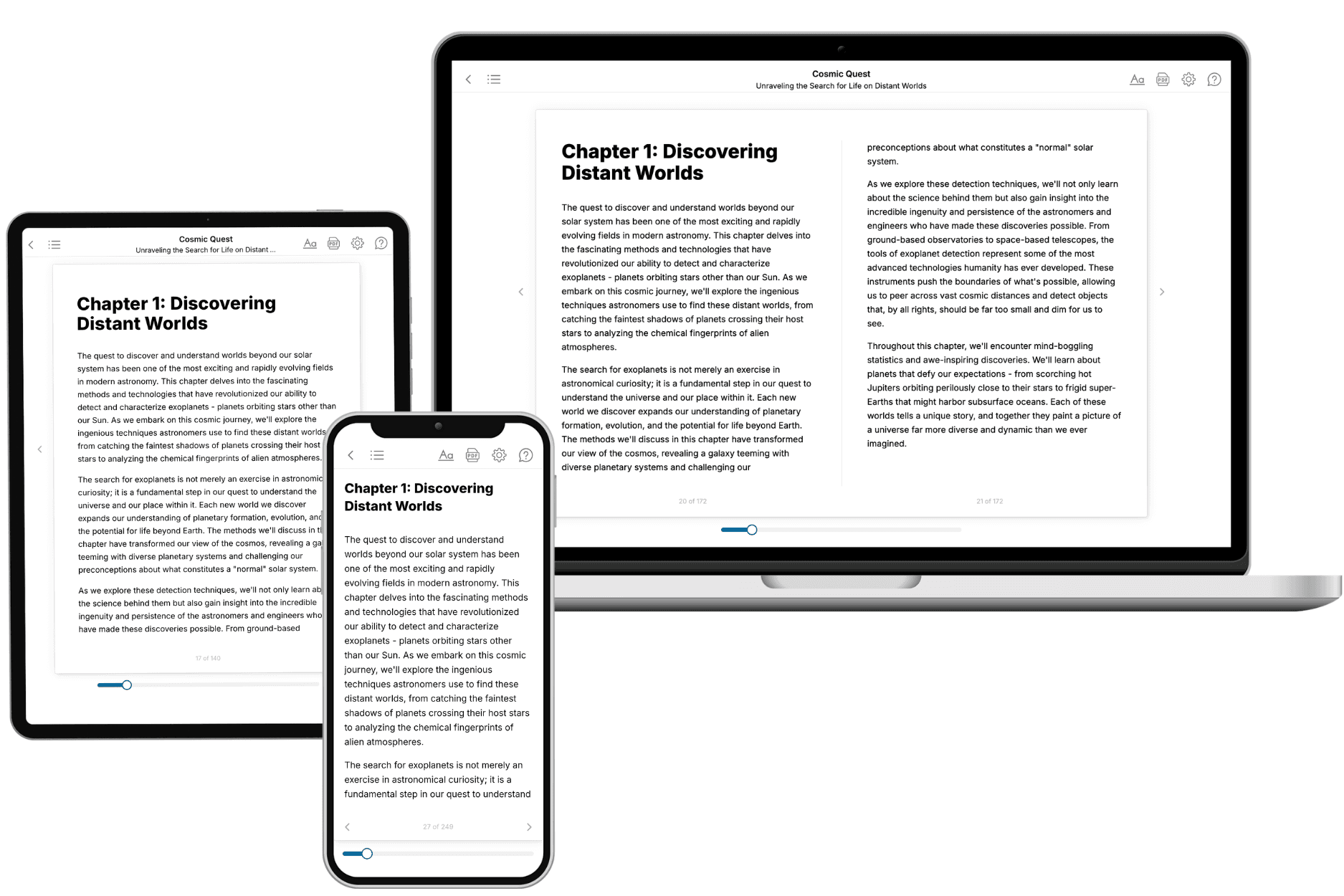
Your book is ready in 10 minutes. Read it online, download as EPUB or PDF, or send to Kindle.

Frequently asked questions
- What is TailoredRead?
TailoredRead creates complete, full-length nonfiction ebooks, written specifically for you. Tell us what you want to learn and why, and TailoredRead writes you a complete ebook on it, with charts, tables, and diagrams throughout. Read it online, on Kindle, or on any e-reader, or download it as a PDF or EPUB. Every book is written fresh the day you order it.
- How is the book tailored to me?
Before anything is written, you answer a few short questions about your goals, your background, and the topics you care about. Your book is then planned around your answers: written at your level, focused on your goals, and covering the topics you chose, instead of the one-size-fits-all book a store sells everyone.
- Will it read like generic AI content?
No. Your book isn't a chat transcript: it's planned chapter by chapter before a single word is written, told in a clear book voice, and explains ideas visually with charts, tables, and diagrams. After writing, every book goes through an editorial pass that polishes chapters so the book reads consistent from start to finish. Judge for yourself: browse thousands of sample books on our Explore Books page.
- How accurate is the content?
Our AI first checks whether your subject needs live research. Niche and fast-moving subjects are researched before writing, and the book plan and chapters are grounded in what it finds. After writing, every book goes through a quality pass that checks its facts and consistency, and researched books list their sources in a Notes section at the back.
- How long is the book?
You choose the length: Comprehensive (250-300 pages), Detailed (150-200 pages), Essential (70-100 pages), or Short (30-50 pages).
- Does the book include visuals?
Yes. Every book includes visual elements such as timelines, checklists, step-by-step guides, decision trees, comparison tables, and matrices, and many include bar charts. A typical book includes dozens of these visual elements.
- Can I read it on Kindle? What formats can I download?
Yes. Every book can be read in our online reader or downloaded as a PDF or EPUB. The EPUB can be opened with Kindle, Apple Books, Kobo, and any e-reader. The Commercial and Author licenses also include an editable Word (DOCX) and Markdown download.
- How much does it cost?
About the price of a regular ebook. The exact price depends on your book's length and complexity, from $2 for the shortest books to $35 for the most comprehensive, and it's shown when you review your book, before you commit to anything. Each book is a one-time purchase, yours to keep, no subscription. Licenses that let you share, teach, or publish your book range from $35.99 to $49.99.
- Can I preview the book before purchasing?
Before you pay, you'll see what your book will cover: the title, a detailed description, the estimated length, and the complete chapter-by-chapter table of contents, so you know what you're getting before you decide. The full text itself is written after you purchase.
- How long does it take to create a book?
About 10 minutes. You can start reading the opening chapters while the rest is still being written.