The Ham Radio Electronics Handbook
Master RF Circuits, Antenna Design, and License Exam Success
Imagine confidently designing your own antenna systems, troubleshooting radio failures with precision, and passing your amateur radio license exam on the first attempt.
253 pages12 chaptersApr 25, 2026Electronics
About this book
This comprehensive handbook bridges the gap between theoretical RF electronics and practical ham radio applications, written specifically for technically-minded individuals ready to master the fundamentals. You'll progress from essential decibel calculations and transmission line theory through advanced topics like impedance matching, digital modulation techniques, and power amplifier efficiency. Each chapter builds systematically on previous concepts, with real-world examples that connect abstract theory to your station setup. Whether you're preparing for license certification, designing efficient antennas, or troubleshooting equipment problems, you'll find practical guidance grounded in electromagnetic principles. This book treats you as the intelligent professional you are—no oversimplification, but clear explanations of complex concepts. You'll understand not just how to perform calculations, but why they matter for your radio system's performance. By the final chapter, you'll possess the technical foundation to make informed design decisions and operate your station with confidence.
Table of contents
- IntroductionWhy Ham Radio Electronics Matter, How to Use This Book, What You Need to Know Before StartingRead below
- Chapter 1: Decibel Fundamentals and RF MeasurementsUnderstanding Logarithmic Scales, dBm, dBW, and Power Calculations, Gain, Loss, and System Analysis
- Chapter 2: Electromagnetic Wave PropagationWave Characteristics and Frequency Relationships, Ground Wave, Sky Wave, and Line-of-Sight Propagation, How Environment and Frequency Affect Range
- Chapter 3: Transmission Line Theory and PracticeCharacteristic Impedance and Cable Selection, Standing Waves and Reflections, Measuring and Interpreting SWR, Calculating Transmission Line Loss
- Chapter 4: Antenna Impedance MatchingImpedance Basics and Mismatch Effects, L-Networks and Pi-Networks for Matching, Transmission Line Transformers and Baluns
- Chapter 5: RF Circuit Design FundamentalsResonance, Q-Factor, and Bandwidth, Selecting Capacitors, Inductors, and Resistors for RF, Analyzing RF Circuits with Smith Charts
- Chapter 6: Antenna Systems and DesignDipoles, Yagis, Verticals, and Loops, Understanding Radiation Patterns and Gain, Tuning and Optimizing Antenna Performance
- Chapter 7: Radio Frequency AmplifiersClass A, B, AB, and C Amplifier Operation, Designing Efficient Power Amplifiers, Measuring and Optimizing Amplifier Efficiency
- Chapter 8: Receiver Design and Signal AnalysisReceiver Sensitivity and Noise Figure, Signal-to-Noise Ratio and Detection Limits, Superheterodyne and Direct Conversion Receivers
- Chapter 9: Digital Modulation and Modern ModesAM, FM, SSB, and CW Fundamentals, FSK, PSK, OFDM, and Advanced Modulation, Morse Code and Digital Mode Operation
- Chapter 10: Grounding, Shielding, and EMI ControlProper Grounding Techniques and Safety, Shielding Strategies and Faraday Cages, Preventing Interference and RFI Issues
- Chapter 11: Troubleshooting and Equipment MaintenanceSystematic Troubleshooting Procedures, Identifying and Fixing Common Equipment Failures, Preventive Maintenance and Equipment Care
- Chapter 12: Amateur Radio License Exam PreparationUnderstanding the License Exam Format, Critical Concepts for Exam Success, Study Strategies and Practice Techniques
- ConclusionYour Path Forward in Ham Radio
- Glossary of Terms
- Further Reading and Resources
Introduction
There is a particular kind of satisfaction that comes from making contact with another operator thousands of miles away using equipment you understand completely. Not just pressing a button and hoping for the best, but knowing exactly why your antenna is resonant at that frequency, why your transmission line is matched, and why your signal is cutting through the noise when others cannot. That level of understanding is what separates a technically confident ham radio operator from someone who simply follows instructions without grasping the underlying principles.
Ham radio sits at a fascinating intersection of physics, engineering, and communication. The electromagnetic principles that govern your antenna are the same ones your medical imaging equipment relies on. The signal processing concepts behind modern digital modes share DNA with the diagnostic instrumentation you use every day. If you already think analytically and work comfortably with technical concepts, you are better positioned than most to master RF electronics. This book is built on that assumption. It does not oversimplify, but it does explain clearly, because clarity and rigor are not opposites.
The amateur radio license exam is one concrete goal this book helps you reach. But the deeper goal is genuine technical fluency. Passing an exam by memorizing answers is one thing. Understanding why a mismatched transmission line wastes power, how a superheterodyne receiver separates signals, or what makes a Yagi antenna directional is something far more valuable. That understanding lets you design better systems, troubleshoot failures faster, and make informed decisions every time you modify or expand your station. This book builds that foundation systematically, from decibel arithmetic through antenna design, digital modulation, and beyond.
Each chapter in this handbook connects theory to practice with real calculations, concrete examples, and actionable guidance. The progression is deliberate. Early chapters establish the mathematical and physical tools you will use throughout the rest of the book. Later chapters apply those tools to specific systems and design challenges. By the time you reach the license exam preparation chapter, the exam questions will feel less like a test of memorization and more like a review of concepts you already understand deeply.
Why Ham Radio Electronics Matter
Amateur radio is one of the few remaining technical hobbies where individuals design, build, and operate their own communication systems from the ground up. Unlike consumer electronics, where the engineering is hidden behind sealed enclosures and proprietary firmware, ham radio invites you to understand every stage of the signal chain. From the oscillator in your transmitter to the feedpoint of your antenna, every component has a measurable, explainable effect on performance. That transparency is intellectually rewarding and practically powerful.
The technical skills developed through ham radio have real-world applications that extend well beyond the hobby itself. RF circuit design, impedance matching, signal analysis, and noise management are all skills that appear in medical device engineering, telecommunications infrastructure, aerospace systems, and emergency communications networks. Operators who understand these principles at a deep level are not just better hams. They are better engineers, better problem-solvers, and better equipped to evaluate technical claims critically.
Emergency preparedness is another dimension that gives ham radio genuine societal importance. When conventional communication infrastructure fails during natural disasters, amateur radio operators provide critical links between emergency responders, hospitals, and relief organizations. The American Radio Relay League (ARRL) documents hundreds of activations each year where licensed operators provided the only reliable communication in affected areas.[1] Understanding your equipment deeply means you can deploy it reliably under pressure, not just under ideal conditions.
The physics of radio propagation also connects directly to broader scientific literacy. Understanding how electromagnetic waves travel through the ionosphere, how frequency determines propagation characteristics, and how antenna geometry shapes radiation patterns gives you a working mental model of electromagnetic phenomena that applies across many domains. For a physician, this kind of cross-disciplinary technical fluency is genuinely enriching. The same wave mechanics that govern a 40-meter HF signal also underlie MRI physics, ultrasound imaging, and optical coherence tomography.
Ham radio also provides a uniquely hands-on laboratory for RF experimentation. You can measure SWR in real time, observe the effects of impedance mismatch directly, compare antenna designs empirically, and verify theoretical predictions against actual performance. This feedback loop between theory and measurement is one of the most effective ways to build lasting technical intuition. Books teach principles; your station teaches you whether those principles are working.
Finally, the global community of amateur radio operators represents an extraordinary resource. From contesting and DXing to satellite communication and moonbounce experiments, the hobby encompasses an enormous range of technical challenges. Operators who understand the underlying electronics can participate meaningfully in all of these activities, contribute to technical discussions, and continue learning throughout their operating career. The license is a starting point, not a destination.
How to Use This Book
This handbook is designed to be read sequentially on a first pass. Each chapter builds on concepts introduced in earlier chapters, so jumping ahead can leave gaps that make later material harder to follow. The decibel fundamentals in Chapter 1, for example, appear constantly in discussions of antenna gain, transmission line loss, amplifier performance, and receiver sensitivity. Skipping that foundation creates friction throughout the rest of the book.
That said, once you have completed a first reading, this book works well as a reference. The chapter structure is organized around specific technical domains, so when you need to revisit impedance matching concepts before a station modification, or review digital modulation theory before experimenting with a new mode, you can navigate directly to the relevant section. The glossary at the back provides quick definitions for technical terms, and the further reading section points you toward deeper resources for topics you want to explore beyond what a single handbook can cover.
Each chapter follows a consistent structure designed to move you from concept to application efficiently:
- Core concepts: The fundamental principles and definitions you need to understand the topic
- Mathematical tools: The calculations and formulas used to analyze and design systems
- Worked examples: Specific numerical problems solved step by step, showing how the math connects to real equipment
- Practical applications: How the concepts apply to your station, your antenna system, or your license exam
- Common mistakes: The errors that trip up operators most often, and how to avoid them
The worked examples throughout this book use realistic numbers drawn from actual amateur radio equipment and operating scenarios. When a calculation involves a coaxial cable loss figure, it uses a real cable specification. When an antenna gain example is given, it references a real antenna type. This grounding in real equipment makes the math feel purposeful rather than abstract, and it helps you recognize when a calculation result is reasonable versus when something has gone wrong in your arithmetic.
For license exam preparation specifically, Chapter 12 provides a structured review of the most heavily tested concepts across all license classes. However, the most effective exam preparation strategy is to work through the entire book first, then use Chapter 12 as a consolidation tool. Operators who understand the material deeply consistently outperform those who rely on rote memorization, and they retain that knowledge long after the exam is over.
A practical note on mathematics: This book uses algebra, logarithms, and basic trigonometry. It does not require calculus, though calculus concepts are occasionally referenced to explain why certain formulas take the form they do. If your algebra is rusty, a brief review of logarithm rules before starting Chapter 1 will pay dividends throughout the rest of the book. The ARRL Handbook and Khan Academy both offer accessible refreshers on the relevant mathematical tools.
Footnotes throughout the text point to primary sources, technical standards, and reference materials. These are worth following when a topic connects to your professional background or sparks particular curiosity. The FCC regulations referenced in several chapters are publicly available and worth reading in their original form, since the exam tests your knowledge of the actual regulatory language, not just paraphrased summaries.
Consider keeping a notebook alongside this book. Working through the calculations by hand, even when the answers are provided, builds the kind of fluency that makes exam problems feel routine. Operators who have done the arithmetic dozens of times in practice rarely struggle with it under exam conditions. The same applies to conceptual questions: writing out explanations in your own words is one of the most reliable ways to identify gaps in your understanding before they become problems.
What You Need to Know Before Starting
This book assumes you have some prior exposure to ham radio concepts. You should be familiar with basic terminology: frequency, wavelength, modulation, transceiver, antenna, and feedline are all terms used without extensive definition. If you have held a Technician license or spent time reading introductory ham radio materials, you are well positioned to engage with the technical depth this book offers. Complete beginners may want to spend a few hours with an introductory resource before diving in.
On the mathematics side, the prerequisites are modest but real. You need to be comfortable with the following:
- Algebra: Solving equations for unknown variables, working with fractions and exponents
- Logarithms: Understanding what a logarithm represents, converting between logarithmic and linear scales, applying log rules for multiplication and division
- Scientific notation: Expressing very large and very small numbers efficiently (megahertz, picofarads, milliwatts)
- Basic trigonometry: Sine and cosine functions, understanding phase relationships between sinusoidal signals
- Complex numbers: A basic familiarity with imaginary numbers is helpful for impedance calculations, though the book explains the relevant concepts as they arise
Physics prerequisites are similarly focused. A working understanding of Ohm's Law (voltage, current, and resistance relationships) is essential and used throughout the book. Familiarity with basic circuit concepts, including series and parallel circuits, capacitors, and inductors, will make the RF circuit chapters much more accessible. If you studied physics at any point in your education, even at the introductory level, you likely have the background needed. The book reinforces these concepts as it builds on them rather than assuming perfect recall.
No prior experience with RF-specific concepts like transmission line theory, Smith charts, or impedance matching is assumed. These topics are introduced from first principles, with careful attention to building intuition before introducing formulas. The Smith chart, in particular, intimidates many operators at first glance. By the time Chapter 5 introduces it, you will have enough background in impedance concepts to approach it with confidence rather than apprehension.
On the equipment side, you do not need to own a radio station to benefit from this book. The concepts apply whether you are designing a station from scratch, upgrading an existing setup, or simply preparing for an exam. That said, having access to even a basic transceiver and antenna system gives you opportunities to verify the concepts you are learning through direct measurement. An SWR meter, a multimeter, and a simple wire antenna are enough to make many of the practical examples in this book tangible and testable.
Software tools can also supplement your learning significantly. Free simulation programs like EZNEC for antenna modeling and LTspice for circuit simulation allow you to experiment with designs before building anything physical.[2] Online Smith chart tools let you practice impedance matching calculations interactively. These tools are referenced at appropriate points throughout the book, and using them alongside the text accelerates the development of practical intuition considerably.
One final note on mindset: the technical depth in this book is intentional, not intimidating. Every formula exists because it describes something real about how radio systems behave. Every calculation produces a number that corresponds to a measurable physical quantity. Approaching the material with curiosity rather than anxiety, and treating each new concept as a tool that makes your station more understandable, will carry you further than any amount of raw memorization. The goal is not to pass a test. The goal is to understand radio, and the test will take care of itself.
The amateur radio community has a long tradition of technical generosity. Elmers, the informal mentors of the hobby, have guided generations of new operators through exactly the kind of material covered in this book. That tradition reflects something important about the culture: technical knowledge in ham radio is meant to be shared, applied, and built upon. This handbook is offered in that same spirit, as a resource that helps you develop the technical foundation to operate confidently, design intelligently, and contribute meaningfully to a community that has been advancing the state of radio communication for over a century.
This is the end of the free sample. The full book has 12 chapters.
Want this book written for you?
Tell us your goals and background, and get your own version of this book, tailored by AI to you.


Benefits of AI-tailored books
- Read one book, not ten:
- all the Electronics knowledge you need, gathered into a single book.
- Save days of learning:
- tell us your goals, choose your topics, and the whole book is built around them.
- Learn effortlessly:
- Electronics book written for your specific background and expertise.
- Understand at a glance:
- includes charts, tables, timelines, checklists, decision trees, and more.
- Stay current:
- written the day you order it, not years ago.
- Trust what you read:
- every book is checked for accuracy, with real research when your subject needs it.
Create your unique book in 3 steps
- 1. Select your focus
Select the focus of your Electronics book and share your background
- 2. Personalize your book
Specify your goals and choose sub-topics to include
- 3. Get your tailored book
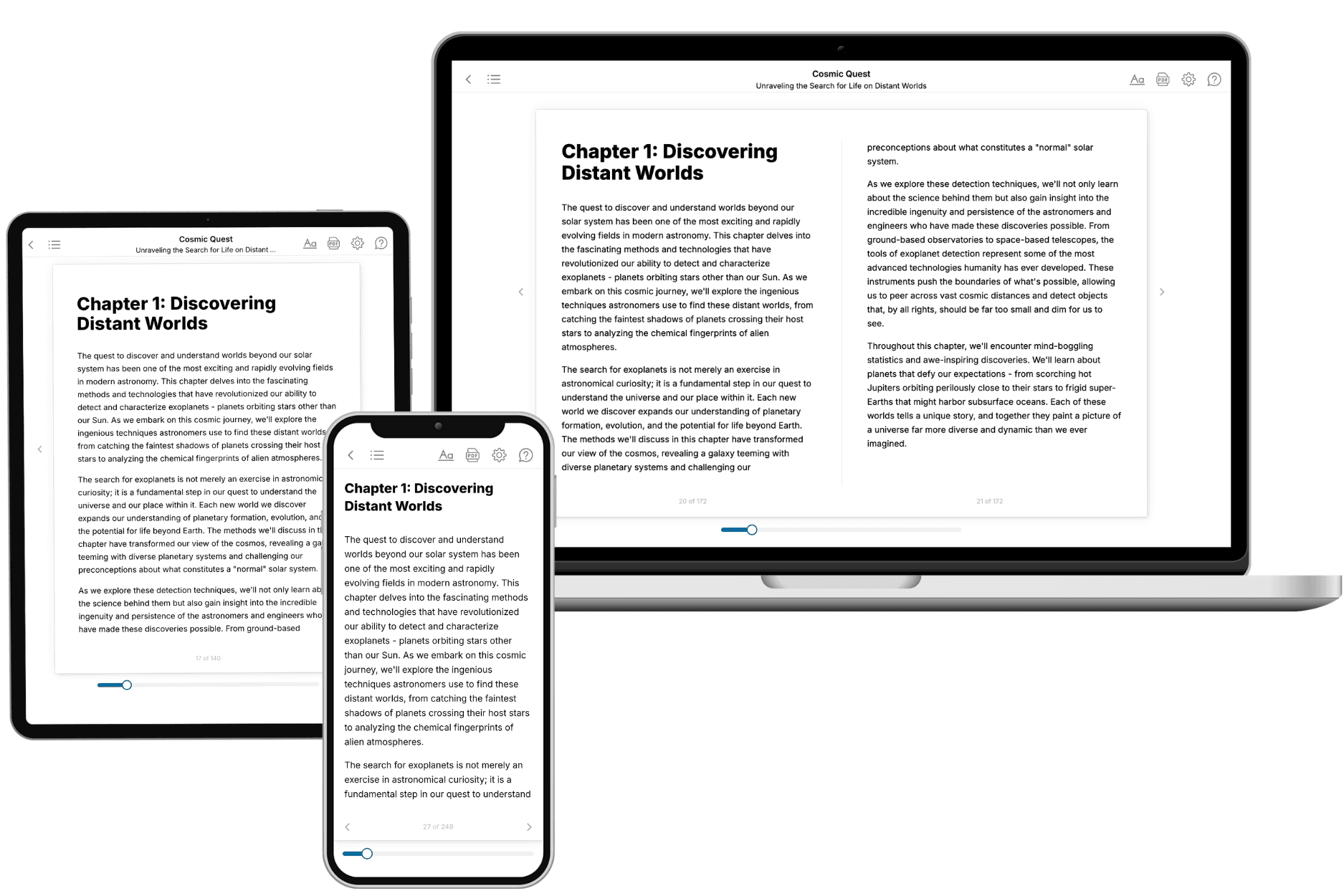
Your book is ready in 10 minutes. Read it online, download as EPUB or PDF, or send to Kindle.

Frequently asked questions
- What is TailoredRead?
TailoredRead creates complete, full-length nonfiction ebooks, written specifically for you. Tell us what you want to learn and why, and TailoredRead writes you a complete ebook on it, with charts, tables, and diagrams throughout. Read it online, on Kindle, or on any e-reader, or download it as a PDF or EPUB. Every book is written fresh the day you order it.
- How is the book tailored to me?
Before anything is written, you answer a few short questions about your goals, your background, and the topics you care about. Your book is then planned around your answers: written at your level, focused on your goals, and covering the topics you chose, instead of the one-size-fits-all book a store sells everyone.
- Will it read like generic AI content?
No. Your book isn't a chat transcript: it's planned chapter by chapter before a single word is written, told in a clear book voice, and explains ideas visually with charts, tables, and diagrams. After writing, every book goes through an editorial pass that polishes chapters so the book reads consistent from start to finish. Judge for yourself: browse thousands of sample books on our Explore Books page.
- How accurate is the content?
Our AI first checks whether your subject needs live research. Niche and fast-moving subjects are researched before writing, and the book plan and chapters are grounded in what it finds. After writing, every book goes through a quality pass that checks its facts and consistency, and researched books list their sources in a Notes section at the back.
- How long is the book?
You choose the length: Comprehensive (250-300 pages), Detailed (150-200 pages), Essential (70-100 pages), or Short (30-50 pages).
- Does the book include visuals?
Yes. Every book includes visual elements such as timelines, checklists, step-by-step guides, decision trees, comparison tables, and matrices, and many include bar charts. A typical book includes dozens of these visual elements.
- Can I read it on Kindle? What formats can I download?
Yes. Every book can be read in our online reader or downloaded as a PDF or EPUB. The EPUB can be opened with Kindle, Apple Books, Kobo, and any e-reader. The Commercial and Author licenses also include an editable Word (DOCX) and Markdown download.
- How much does it cost?
About the price of a regular ebook. The exact price depends on your book's length and complexity, from $2 for the shortest books to $35 for the most comprehensive, and it's shown when you review your book, before you commit to anything. Each book is a one-time purchase, yours to keep, no subscription. Licenses that let you share, teach, or publish your book range from $35.99 to $49.99.
- Can I preview the book before purchasing?
Before you pay, you'll see what your book will cover: the title, a detailed description, the estimated length, and the complete chapter-by-chapter table of contents, so you know what you're getting before you decide. The full text itself is written after you purchase.
- How long does it take to create a book?
About 10 minutes. You can start reading the opening chapters while the rest is still being written.