The Harmonious Path
Integrating Humanism, Taoism, and Secular Buddhism for a Meaningful Life
Embark on a transformative journey with "The Harmonious Path," a groundbreaking exploration of life's most profound questions through the lens of Humanism, Taoism, and Secular Buddhism.
253 pages13 chaptersNov 26, 2024PhilosophyCreated by Rob
About this book
This illuminating guide offers a unique blend of Eastern and Western philosophical traditions, tailored for the modern seeker of wisdom and purpose. As you navigate the pages of this book, you'll discover how to cultivate a robust set of secular virtues, enhance your critical thinking skills, and develop a deeper sense of self-awareness. The Harmonious Path doesn't just present abstract concepts; it provides practical tools for applying these timeless wisdoms to your everyday life, helping you build resilience, practice non-attachment, and embrace the ever-changing nature of existence. Whether you're grappling with life's big questions or seeking to refine your personal values, this book serves as your compass. It demystifies complex philosophical ideas and presents them in an accessible, engaging manner, allowing you to create a personalized life philosophy that resonates with your experiences and aspirations. Prepare to embark on a journey of self-discovery and growth, as you learn to navigate life's challenges with grace, wisdom, and a renewed sense of purpose.
Table of contents
- Introduction: The Quest for a Harmonious Life PhilosophyWhy Integrate Humanism, Taoism, and Secular Buddhism?, The Journey Ahead: What to Expect from This Book, Crafting Your Personal Philosophy: A RoadmapRead below
- Chapter 1: Foundations of Our Integrated ApproachHumanism: Celebrating Human Potential, Taoism: Flowing with the Natural Order, Secular Buddhism: Mindfulness and Non-Attachment, Finding Common Threads: Where These Philosophies Intersect
- Chapter 2: The Bedrock of Secular EthicsDefining Secular Ethics: Morality Without Dogma, Humanist Values: Compassion, Dignity, and Reason, Buddhist Precepts in a Secular Context, Taoist Virtues: Simplicity, Spontaneity, and Harmony, Integrating Ethical Frameworks for Daily Life
- Chapter 3: Cultivating Critical ThinkingThe Humanist Approach to Rational Inquiry, Buddhist Analytical Meditation Techniques, The Taoist Perspective on Knowledge and Wisdom, Balancing Reason and Intuition
- Chapter 4: The Path to Self-AwarenessHumanist Approaches to Self-Reflection, Buddhist Mindfulness Practices, Taoist Self-Cultivation Techniques, Integrating Self-Awareness Practices
- Chapter 5: Embracing ImpermanenceThe Buddhist Concept of Impermanence, Taoist Perspectives on Change and Transformation, The Humanist View of Progress and Change, Practical Strategies for Accepting Change
- Chapter 6: The Art of Non-AttachmentBuddhist Teachings on Non-Attachment, Taoist Principles of Letting Go, A Humanist Perspective on Detachment, Practicing Non-Attachment in Daily Life
- Chapter 7: Finding Balance: The Middle WayThe Buddhist Concept of the Middle Way, Taoist Yin-Yang Balance, Humanist Approaches to Moderation, Applying the Middle Way in Modern Life
- Chapter 8: Cultivating Compassion and EmpathyHumanist Perspectives on Compassion, Buddhist Loving-Kindness Meditation, Taoist Approaches to Empathy and Compassion, Practical Exercises for Developing Compassion
- Chapter 9: The Power of MindfulnessSecular Mindfulness: Beyond Religious Contexts, Buddhist Mindfulness Techniques, Taoist Approaches to Present-Moment Awareness, Mindfulness from a Humanist Perspective, Incorporating Mindfulness into Daily Life
- Chapter 10: Wu Wei: The Art of Effortless ActionUnderstanding the Taoist Concept of Wu Wei, Buddhist Parallels to Wu Wei, Humanist Perspectives on Efficiency and Flow, Practicing Wu Wei in Work and Life
- Chapter 11: Exploring Secular SpiritualityDefining Secular Spirituality, The Humanist Sense of Wonder and Awe, Buddhist Insights for Secular Spiritual Practice, Taoist Approaches to Connecting with Nature, Developing Personal Spiritual Practices
- Chapter 12: Building Resilience and AdaptabilityStoic Influences on Resilience, Buddhist Equanimity in Face of Adversity, Taoist Principles of Flexibility and Adaptation, Humanist Approaches to Problem-Solving, Practical Exercises for Building Resilience
- Chapter 13: Discovering Your Life PurposeHumanist Perspectives on Meaning and Purpose, Buddhist Concepts of Dharma and Life Path, Taoist Views on Personal Destiny, Integrating Different Views of Life Purpose, Exercises for Uncovering Your Life Purpose
- Conclusion: Living Your Integrated PhilosophyKey Takeaways from Our Journey, Crafting Your Personal Philosophy Statement, The Path Forward: Ongoing Practice and Growth
- Appendix: Resources for Further ExplorationRecommended Readings, Meditation and Mindfulness Resources, Philosophical Organizations and Communities
Introduction: The Quest for a Harmonious Life Philosophy
In the complex tapestry of modern life, the search for meaning, purpose, and a guiding philosophy has become increasingly important. As you navigate the challenges of a rapidly changing world, you may find yourself yearning for a comprehensive framework that can provide both practical wisdom and spiritual fulfillment. This book, "The Harmonious Path," is designed to be your companion on a transformative journey, blending the insights of Humanism, Taoism, and Secular Buddhism to create a holistic approach to life that is both deeply rooted in ancient wisdom and relevant to contemporary realities.
The integration of these three philosophical traditions offers a unique opportunity to develop a personal philosophy that is rich, nuanced, and adaptable to the diverse situations you encounter in your daily life. By drawing on the strengths of each tradition, you can craft a worldview that embraces reason and compassion, flows with the natural order of things, and cultivates mindfulness and non-attachment. This synthesis allows for a balanced approach that neither rejects the material world nor becomes overly attached to it, fostering a sense of purpose and well-being that is grounded in both rational thought and experiential wisdom.
As you embark on this exploration, it's important to approach the journey with an open mind and a willingness to question your existing beliefs and assumptions. The path ahead may challenge some of your long-held views, but it also promises to enrich your understanding of yourself and the world around you. By engaging with the ideas presented in this book, you'll have the opportunity to develop a more nuanced perspective on life's big questions and to cultivate a set of practical tools for navigating its inevitable ups and downs.
Throughout this book, you'll find that the integration of Humanism, Taoism, and Secular Buddhism is not about creating a rigid new doctrine, but rather about fostering a flexible and evolving approach to life. This integrated philosophy encourages critical thinking and self-reflection, allowing you to continually refine your understanding and adapt your practices as you grow and change. It's a philosophy that acknowledges the complexity of human experience while offering clear principles to guide your actions and decisions.
As we delve deeper into each aspect of this integrated approach, you'll discover how these seemingly disparate traditions can complement and reinforce each other, creating a robust framework for living a meaningful and fulfilling life. From the Humanist emphasis on reason and human dignity to the Taoist focus on harmony with nature, and from the Buddhist insights into the nature of mind and reality to the secular approach that grounds these ideas in everyday experience, each element contributes to a comprehensive life philosophy that is both practical and profound.
Why Integrate Humanism, Taoism, and Secular Buddhism?
The decision to integrate Humanism, Taoism, and Secular Buddhism into a cohesive life philosophy is rooted in the recognition that each of these traditions offers unique and valuable insights into the human condition. By bringing them together, we create a synergy that addresses the multifaceted nature of human experience and provides a more comprehensive toolkit for navigating life's challenges. This integration allows us to draw upon the strengths of each tradition while mitigating their individual limitations, resulting in a more balanced and adaptable approach to life.
Humanism, with its emphasis on reason, critical thinking, and the inherent dignity of human beings, provides a solid foundation for ethical decision-making and personal responsibility. It encourages us to rely on empirical evidence and rational inquiry to understand the world around us and to work towards the betterment of humanity. However, Humanism alone may sometimes fall short in addressing the more intangible aspects of human experience, such as the need for spiritual fulfillment or the sense of connection to something greater than ourselves.
This is where Taoism enters the picture, offering a perspective that emphasizes harmony with the natural world and the importance of flowing with the ever-changing currents of life. Taoism introduces concepts like Wu Wei (effortless action) and the balance of Yin and Yang, which can help us navigate complex situations with greater ease and adaptability. The Taoist emphasis on simplicity and spontaneity serves as a counterbalance to the sometimes overly analytical approach of pure Humanism, reminding us of the wisdom that can be found in aligning ourselves with the natural order of things.
Secular Buddhism, in turn, provides powerful tools for understanding the nature of mind and reality, offering practices like mindfulness and meditation that can help us cultivate greater self-awareness and emotional regulation. The Buddhist concepts of impermanence and non-attachment offer valuable perspectives on dealing with change and suffering, complementing the Humanist focus on human potential and the Taoist emphasis on flow. By secularizing these Buddhist principles, we can apply them in a way that is compatible with a rational, evidence-based worldview.
The integration of these three traditions allows us to address the full spectrum of human needs and experiences. For instance, when faced with a difficult ethical decision, we can draw upon Humanist principles of reason and compassion, temper them with the Taoist understanding of natural balance and unintended consequences, and apply Buddhist mindfulness to maintain clarity and equanimity throughout the decision-making process. This multifaceted approach enables us to navigate complex situations with greater wisdom and resilience.
Moreover, this integration provides a framework that can adapt to different aspects of our lives. In our professional endeavors, we might lean more heavily on Humanist principles of rationality and ethical conduct. In our personal relationships, we might find Taoist concepts of harmony and non-forcing particularly useful. And in our inner life and personal development, Buddhist practices of mindfulness and self-reflection might take center stage. The beauty of this integrated approach is that it allows for flexibility and personalization, recognizing that different situations may call for different tools and perspectives.
By integrating these traditions, we also create a philosophy that is both timeless and timely. The ancient wisdom of Taoism and Buddhism, when combined with the more modern perspective of Humanism, results in an approach that honors our historical and cultural heritage while remaining relevant to contemporary challenges. This integration allows us to address modern issues like technological advancement, environmental concerns, and global interconnectedness with a wisdom that draws from millennia of human thought and experience.
Furthermore, this integrated approach aligns well with the increasingly globalized and multicultural world we live in. By drawing from both Eastern and Western philosophical traditions, we create a more inclusive worldview that can resonate with people from diverse cultural backgrounds. This cross-cultural synthesis can foster greater understanding and cooperation in our increasingly interconnected world.
Ultimately, the integration of Humanism, Taoism, and Secular Buddhism offers a comprehensive framework for living a meaningful, balanced, and fulfilling life. It provides us with the tools to think critically and act ethically, to flow with the changes of life while maintaining inner peace, and to cultivate deep self-awareness and compassion for others. As we explore this integrated philosophy throughout the book, you'll discover how these different elements can work together to create a harmonious and resilient approach to life's joys and challenges.
The Journey Ahead: What to Expect from This Book
As you embark on this exploration of an integrated life philosophy, it's important to have a clear understanding of what lies ahead. This book is designed to be both a comprehensive guide and a practical toolkit, offering you a blend of theoretical insights and actionable strategies. Throughout the chapters that follow, you'll be taken on a journey that progressively builds your understanding of how Humanism, Taoism, and Secular Buddhism can be woven together to create a robust and flexible approach to life.
The book begins by laying out the foundations of our integrated approach. You'll be introduced to the core principles of Humanism, Taoism, and Secular Buddhism, exploring how each tradition views the world and the human experience. This section will help you understand the unique contributions of each philosophy and begin to see how they can complement and reinforce each other. By the end of this foundational section, you'll have a solid grasp of the key concepts that will form the basis of our integrated approach.
From there, we'll delve into the bedrock of secular ethics, examining how we can derive a strong moral framework without relying on supernatural beliefs or dogmatic rules. This section will draw heavily on Humanist values of compassion and dignity, while also incorporating Buddhist precepts and Taoist virtues. You'll learn how to navigate ethical dilemmas using a combination of rational analysis, intuitive wisdom, and mindful awareness.
The journey continues with an exploration of critical thinking, a cornerstone of the Humanist tradition that is equally valued in secular interpretations of Buddhism and Taoism. You'll learn techniques for sharpening your analytical skills, questioning assumptions, and evaluating evidence. At the same time, you'll discover how to balance this rational approach with the intuitive insights offered by Taoist and Buddhist practices, creating a more holistic way of understanding the world.
As we progress, you'll be introduced to various practices for cultivating self-awareness, drawing on Buddhist mindfulness techniques, Taoist self-cultivation methods, and Humanist approaches to self-reflection. This section will provide you with practical tools for deepening your understanding of yourself and your place in the world, setting the stage for personal growth and transformation.
One of the key themes that runs throughout the book is the concept of impermanence, a fundamental principle in Buddhist thought that finds echoes in Taoist philosophy and Humanist understandings of change and progress. You'll learn how to embrace impermanence in your own life, developing greater resilience and adaptability in the face of life's inevitable changes.
Closely related to impermanence is the practice of non-attachment, which we'll explore in depth. Drawing on Buddhist teachings and Taoist principles of letting go, tempered by Humanist perspectives on engagement and responsibility, you'll discover how to navigate life with greater ease and less suffering. This section will offer practical strategies for loosening the grip of attachments that may be causing you unnecessary stress or pain.
The book also delves into the concept of the Middle Way, exploring how to find balance in all aspects of life. You'll learn about the Buddhist understanding of the Middle Way, the Taoist concept of Yin-Yang balance, and Humanist approaches to moderation. This section will provide you with tools for avoiding extremes and finding a harmonious middle ground in your thoughts, actions, and lifestyle choices.
As we continue our journey, we'll explore the cultivation of compassion and empathy, drawing on Humanist ideals of human dignity and solidarity, Buddhist practices of loving-kindness, and Taoist perspectives on interconnectedness. You'll learn practical exercises for developing greater compassion for yourself and others, enhancing your relationships and contributing to a more caring society.
The power of mindfulness, a practice with roots in Buddhism that has gained widespread secular acceptance, will be a significant focus. You'll learn various mindfulness techniques and discover how to incorporate them into your daily life, enhancing your awareness, reducing stress, and improving your overall well-being.
We'll also explore the Taoist concept of Wu Wei, or effortless action, and how it can be applied in modern life. You'll learn how to align yourself with the natural flow of events, reducing struggle and increasing effectiveness in your personal and professional life. This concept will be examined through Buddhist and Humanist lenses as well, providing a multifaceted understanding of how to act with greater ease and impact.
The book will then guide you through an exploration of secular spirituality, showing how it's possible to cultivate a sense of awe, wonder, and connectedness without relying on supernatural beliefs. Drawing on Humanist perspectives on the beauty of the natural world, Buddhist insights into the nature of consciousness, and Taoist approaches to harmonizing with nature, you'll discover ways to nurture your spiritual side within a rational, evidence-based framework.
As we near the conclusion of our journey, we'll focus on building resilience and adaptability, crucial skills in our rapidly changing world. You'll learn how to integrate Stoic influences (which share common ground with our three main traditions), Buddhist equanimity, Taoist flexibility, and Humanist problem-solving approaches to become more resilient in the face of life's challenges.
Finally, we'll tackle the profound question of life purpose, examining how our integrated philosophy can help you discover and pursue a meaningful life path. Drawing on Humanist ideas about creating meaning, Buddhist concepts of Dharma, and Taoist views on personal destiny, you'll be guided through exercises to uncover your own sense of purpose and align your life with your deepest values.
Throughout the book, you'll find practical exercises, reflective questions, and real-life examples that will help you apply these concepts to your own life. By the end of this journey, you'll have a comprehensive toolkit for living a more balanced, meaningful, and fulfilling life, grounded in an integrated philosophy that draws on the best of Humanism, Taoism, and Secular Buddhism.
Crafting Your Personal Philosophy: A Roadmap
As you embark on this journey of philosophical exploration and integration, it's important to remember that the ultimate goal is not just to absorb information, but to craft a personal philosophy that resonates with your own experiences, values, and aspirations. This process of crafting your own philosophy is both an art and a science, requiring self-reflection, critical thinking, and a willingness to experiment with new ideas and practices. In this section, we'll outline a roadmap for developing your personal philosophy, providing you with a structure to guide your journey through the rest of the book.
The first step in crafting your personal philosophy is self-assessment. Before you can effectively integrate new ideas and practices into your life, it's crucial to have a clear understanding of your current beliefs, values, and worldview. Take some time to reflect on the following questions: What are your core values? What do you believe about the nature of reality and human existence? What gives your life meaning and purpose? What ethical principles guide your decisions? By articulating your current stance on these fundamental questions, you'll have a baseline from which to grow and evolve as you explore the integrated philosophy presented in this book.
As you progress through the chapters, you'll be introduced to a wide range of concepts and practices drawn from Humanism, Taoism, and Secular Buddhism. It's important to approach these ideas with an open mind, but also with a critical eye. Not every concept will resonate with you, and that's perfectly fine. The goal is not to accept everything wholesale, but to thoughtfully consider each idea and how it might (or might not) fit into your evolving worldview. As you encounter new concepts, ask yourself: How does this align with my current beliefs? What aspects of this idea challenge my existing views? How might incorporating this concept enhance my understanding of life or improve my well-being?
One effective strategy for developing your personal philosophy is to keep a philosophical journal throughout your reading of this book. Use this journal to record your thoughts, questions, and insights as you explore each chapter. Write about how the concepts you're learning relate to your own experiences and observations. Reflect on how you might apply these ideas in your daily life. By actively engaging with the material in this way, you'll deepen your understanding and begin to see how different elements of the integrated philosophy can work together in your own life.
As you progress, you'll likely find that some ideas resonate more strongly with you than others. This is where the process of integration becomes personal. Your task is not to force all the concepts into a single, rigid framework, but to weave together those elements that speak to you most powerfully. Think of it as creating a philosophical tapestry, where threads from Humanism, Taoism, and Secular Buddhism are interwoven to create a unique pattern that reflects your individual perspective and life experience.
Experimentation is a crucial part of this process. As you learn about different practices and techniques - whether it's mindfulness meditation, Taoist qigong exercises, or Humanist methods of ethical reasoning - try incorporating them into your daily routine. Pay attention to how these practices affect your thoughts, emotions, and behaviors. Some may have a profound impact, while others might not resonate as strongly. This practical experimentation will help you discern which elements of the integrated philosophy are most valuable and applicable in your own life.
It's important to remember that crafting your personal philosophy is an ongoing process, not a one-time event. As you grow and change, and as you encounter new experiences and challenges, your philosophy may evolve. Be open to this evolution, and don't be afraid to revisit and revise your beliefs and practices over time. A truly living philosophy is one that grows and adapts with you, providing a flexible framework for navigating life's complexities.
As you near the end of the book, take some time to synthesize what you've learned and experienced. Review your journal entries and reflect on how your thinking has changed or expanded. Consider writing a personal philosophy statement that articulates your current worldview, values, and approach to life. This statement can serve as a touchstone, helping you stay grounded in your core principles even as you continue to grow and evolve.
Remember that the goal of crafting your personal philosophy is not to achieve some perfect, final state of wisdom, but to develop a practical, evolving framework that enhances your life and helps you navigate its challenges with greater ease and clarity. Your personal philosophy should be a tool for living, not just an intellectual exercise. As you integrate elements of Humanism, Taoism, and Secular Buddhism, always ask yourself: How does this help me live a more meaningful, balanced, and fulfilling life?
Finally, don't underestimate the value of community and dialogue in this process. While developing your personal philosophy is inherently an individual journey, discussing your ideas with others can provide valuable insights and perspectives. Consider joining a philosophy discussion group, attending lectures or workshops, or simply engaging in thoughtful conversations with friends and family about the concepts you're exploring. These interactions can help you refine your thinking and discover new applications for the integrated philosophy you're developing.
As we proceed through the chapters of this book, keep this roadmap in mind. Approach each section not just as a source of information, but as an opportunity for personal reflection, experimentation, and growth. By actively engaging in this process of crafting your personal philosophy, you'll not only gain a deeper understanding of Humanism, Taoism, and Secular Buddhism, but you'll also develop a practical, personalized approach to living that can guide you through life's joys and challenges with greater wisdom, resilience, and fulfillment.
This is the end of the free sample. The full book has 13 chapters.
Want this book written for you?
Tell us your goals and background, and get your own version of this book, tailored by AI to you.


Benefits of AI-tailored books
- Read one book, not ten:
- all the Philosophy knowledge you need, gathered into a single book.
- Save days of learning:
- tell us your goals, choose your topics, and the whole book is built around them.
- Learn effortlessly:
- Philosophy book written for your specific background and expertise.
- Understand at a glance:
- includes charts, tables, timelines, checklists, decision trees, and more.
- Stay current:
- written the day you order it, not years ago.
- Trust what you read:
- every book is checked for accuracy, with real research when your subject needs it.
Create your unique book in 3 steps
- 1. Select your focus
Select the focus of your Philosophy book and share your background
- 2. Personalize your book
Specify your goals and choose sub-topics to include
- 3. Get your tailored book
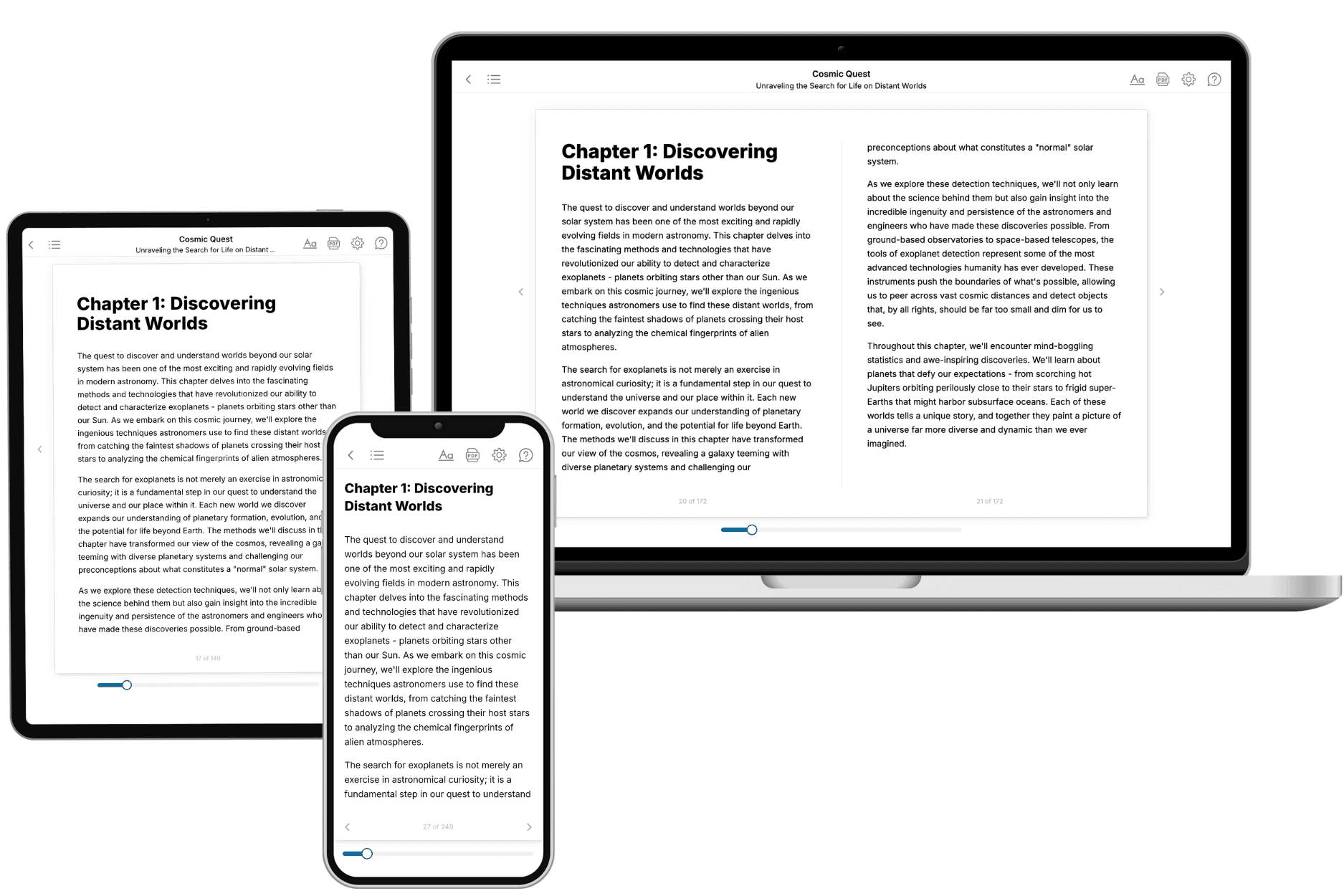
Your book is ready in 10 minutes. Read it online, download as EPUB or PDF, or send to Kindle.
Frequently asked questions
- What is TailoredRead?
TailoredRead creates complete, full-length nonfiction ebooks, written specifically for you. Tell us what you want to learn and why, and TailoredRead writes you a complete ebook on it, with charts, tables, and diagrams throughout. Read it online, on Kindle, or on any e-reader, or download it as a PDF or EPUB. Every book is written fresh the day you order it.
- How is the book tailored to me?
Before anything is written, you answer a few short questions about your goals, your background, and the topics you care about. Your book is then planned around your answers: written at your level, focused on your goals, and covering the topics you chose, instead of the one-size-fits-all book a store sells everyone.
- Will it read like generic AI content?
No. Your book isn't a chat transcript: it's planned chapter by chapter before a single word is written, told in a clear book voice, and explains ideas visually with charts, tables, and diagrams. After writing, every book goes through an editorial pass that polishes chapters so the book reads consistent from start to finish. Judge for yourself: browse thousands of sample books on our Explore Books page.
- How accurate is the content?
Our AI first checks whether your subject needs live research. Niche and fast-moving subjects are researched before writing, and the book plan and chapters are grounded in what it finds. After writing, every book goes through a quality pass that checks its facts and consistency, and researched books list their sources in a Notes section at the back.
- How long is the book?
You choose the length: Comprehensive (250-300 pages), Detailed (150-200 pages), Essential (70-100 pages), or Short (30-50 pages).
- Does the book include visuals?
Yes. Every book includes charts, tables, and diagrams: timelines, checklists, step-by-step guides, decision trees, comparison tables, matrices, and bar charts. A typical book includes dozens of these visual elements.
- Can I read it on Kindle? What formats can I download?
Yes. Every book can be read in our online reader or downloaded as a PDF or EPUB. The EPUB can be opened with Kindle, Apple Books, Kobo, and any e-reader. The Commercial and Author licenses also include an editable Word (DOCX) and Markdown download.
- How much does it cost?
About the price of a regular ebook. The exact price depends on your book's length and complexity, from $2 for the shortest books to $35 for the most comprehensive, and it's shown when you review your book, before you commit to anything. Each book is a one-time purchase, yours to keep, no subscription. Licenses that let you share, teach, or publish your book range from $35.99 to $49.99.
- Can I preview the book before purchasing?
Before you pay, you'll see what your book will cover: the title, a detailed description, the estimated length, and the complete chapter-by-chapter table of contents, so you know what you're getting before you decide. The full text itself is written after you purchase.
- How long does it take to create a book?
About 10 minutes. You can start reading the opening chapters while the rest is still being written.