High Availability Mastery
Building Resilient Networks with F5 Technologies
You're about to discover how to build network infrastructure that stays online when it matters most.
191 pages10 chaptersJan 26, 2026Networking
About this book
This comprehensive guide walks you through the principles, technologies, and practical strategies for achieving true high availability using F5 Networks solutions. Starting with foundational concepts, you'll progress through real-world scenarios that show how redundancy, intelligent load balancing, and automated failover work together to eliminate single points of failure. You'll learn how to assess your current infrastructure, design resilient architectures, and implement F5 technologies that keep your applications running 24/7. Whether you're managing critical business applications or supporting enterprise operations, this book provides the knowledge and frameworks you need to design systems that your organization can depend on. By the end, you'll understand not just the "how" but the "why" behind high availability decisions, enabling you to make informed choices that align with your business requirements and technical constraints.
Table of contents
- IntroductionWhy High Availability Matters in Modern Networks, What You'll Learn in This Book, How to Use This GuideRead below
- Chapter 1: Foundations of High AvailabilityDefining High Availability and Reliability, Understanding Availability Metrics and SLAs, Cost-Benefit Analysis of High Availability
- Chapter 2: Identifying Single Points of FailureAssessing Your Current Infrastructure, Common Single Points of Failure, Building a Risk Assessment Framework
- Chapter 3: Redundancy Strategies and ArchitectureActive-Passive Redundancy Models, Active-Active Redundancy Models, Geographic Redundancy and Disaster Recovery
- Chapter 4: Introduction to F5 Networks SolutionsThe F5 Product Ecosystem, BIG-IP Platform Overview and Architecture, Deployment Models: Hardware, Virtual, and Cloud
- Chapter 5: Load Balancing FundamentalsLoad Balancing Algorithms and Methods, Layer 4 vs. Layer 7 Load Balancing, Session Persistence and Affinity
- Chapter 6: Health Monitoring and Failover MechanismsHealth Check Strategies and Best Practices, Automated Failover and Recovery, Monitoring, Alerting, and Visibility
- Chapter 7: Security in High Availability ArchitecturesSSL/TLS Termination and Encryption, DDoS Protection and Application Security, Maintaining Security During Failover Events
- Chapter 8: Capacity Planning and Performance OptimizationCapacity Assessment and Forecasting, Performance Tuning and Optimization, Scaling Strategies for Growth
- Chapter 9: Implementing High Availability SolutionsDesign Planning and Requirements Gathering, Deployment Best Practices and Methodologies, Testing and Validation Procedures
- Chapter 10: Maintenance, Monitoring, and Continuous ImprovementOperational Procedures and Runbooks, Ongoing Monitoring and Performance Analysis, Continuous Optimization and Improvement
- ConclusionKey Takeaways and Next Steps
Introduction
Network downtime doesn't just frustrate users—it costs businesses millions of dollars, damages reputations, and can even threaten organizational survival. In today's always-connected world, your customers, employees, and partners expect applications and services to be available around the clock. A single hour of downtime for a major e-commerce platform can result in lost revenue exceeding hundreds of thousands of dollars, while critical infrastructure failures can have far-reaching consequences across entire industries. The question isn't whether your organization can afford to implement high availability solutions, but rather whether it can afford not to.
High availability architecture represents a fundamental shift in how we think about network infrastructure. Rather than accepting that systems will occasionally fail and planning to restore them quickly, high availability takes a proactive approach by designing systems that continue operating even when individual components fail. This philosophy requires understanding redundancy principles, implementing intelligent traffic management, and deploying technologies that automatically detect and respond to failures before users notice any disruption. F5 Networks has emerged as a leader in this space, providing sophisticated solutions that go far beyond simple load balancing to deliver comprehensive application delivery and traffic management capabilities.
This book bridges the gap between theoretical high availability concepts and practical implementation using F5 technologies. You'll discover how to assess your current infrastructure for vulnerabilities, design resilient architectures that eliminate single points of failure, and leverage F5's powerful platform to keep your applications running when it matters most. Whether you're responsible for a handful of critical applications or managing enterprise-scale infrastructure serving millions of users, the principles and strategies in these pages will help you build systems your organization can depend on. The journey from reactive firefighting to proactive resilience starts here.
Why High Availability Matters in Modern Networks
The financial impact of downtime has reached unprecedented levels as businesses become increasingly dependent on digital services. According to industry research, the average cost of IT downtime across all industries exceeds $5,600 per minute, with some sectors experiencing costs that soar into the hundreds of thousands per hour[1]. These figures encompass not just immediate lost revenue from interrupted transactions, but also productivity losses, recovery costs, regulatory penalties, and the long-term damage to customer trust and brand reputation. For financial services firms processing thousands of transactions per second, even a brief outage can cascade into significant financial losses and regulatory scrutiny.
Beyond direct financial costs, downtime creates ripple effects throughout your organization and customer base. When critical applications become unavailable, employees cannot perform their jobs effectively, customer service teams face angry users, and executives scramble to understand what went wrong and when services will be restored. Social media amplifies these incidents, with frustrated customers broadcasting their experiences to thousands of followers within minutes. Consider the case of a major airline whose reservation system failure stranded thousands of passengers and generated weeks of negative press coverage—the reputational damage far exceeded the immediate operational costs of the outage.
Modern business models have fundamentally changed the availability equation. Software-as-a-Service providers commit to uptime guarantees in their service level agreements, with financial penalties for failing to meet these commitments. E-commerce businesses operate globally across time zones, meaning there's never a convenient maintenance window when all customers are offline. Healthcare providers rely on electronic health records that must be accessible during emergencies. Manufacturing facilities depend on just-in-time inventory systems that cannot tolerate network interruptions. In each of these scenarios, high availability isn't a luxury—it's a business requirement that directly impacts the bottom line and competitive positioning.
The complexity of modern application architectures has made availability more challenging to achieve. Today's applications rarely consist of a single server responding to requests. Instead, they comprise distributed systems with multiple tiers:
- Web servers handling user requests and serving dynamic content
- Application servers executing business logic and processing transactions
- Database servers storing and retrieving critical data
- Cache layers improving performance and reducing backend load
- External APIs providing third-party services and integrations
- Content delivery networks distributing static assets globally
Security threats have added another dimension to the availability challenge. Distributed Denial of Service (DDoS) attacks specifically target availability, overwhelming systems with malicious traffic designed to exhaust resources and prevent legitimate users from accessing services. These attacks have grown in sophistication and scale, with some recent incidents generating traffic volumes exceeding one terabit per second. Ransomware attacks encrypt critical systems and data, effectively creating availability outages until organizations pay ransoms or restore from backups. High availability architectures must now incorporate security considerations, ensuring that redundancy and failover mechanisms don't create new attack vectors or security vulnerabilities.
Customer expectations have evolved alongside technology capabilities. Users who once tolerated occasional downtime and slow response times now expect instant access to services from any device, anywhere in the world. Mobile applications have conditioned users to expect sub-second response times, and they'll quickly abandon slow or unreliable services in favor of competitors. Research shows that 53% of mobile users will abandon a site that takes longer than three seconds to load[2]. This means that availability isn't just about keeping systems online—it's about maintaining performance levels that meet user expectations even during peak traffic periods or partial system failures.
Regulatory compliance requirements have made high availability a legal obligation for many organizations. Financial regulations require institutions to maintain business continuity plans and demonstrate their ability to continue operations during disruptions. Healthcare regulations mandate that patient data remains accessible to authorized providers. Data protection laws impose strict requirements on organizations to protect personal information, including ensuring its availability to data subjects upon request. Failing to meet these regulatory requirements can result in substantial fines, legal liability, and even criminal penalties for executives. High availability has thus moved from a technical consideration to a compliance imperative that requires board-level attention and investment.
What You'll Learn in This Book
This book provides a comprehensive roadmap for implementing high availability using F5 Networks technologies, starting with foundational concepts and progressing through advanced implementation strategies. You'll begin by understanding what high availability really means, moving beyond vague notions of "keeping systems online" to precise definitions involving availability metrics, service level agreements, and the mathematical relationships between redundancy and reliability. Chapter 1 establishes the theoretical foundation you need to make informed decisions about availability investments, including frameworks for conducting cost-benefit analyses that justify high availability initiatives to business stakeholders and budget holders.
The early chapters focus on assessment and planning, teaching you systematic approaches for identifying vulnerabilities in your current infrastructure. You'll learn how to conduct thorough infrastructure audits that reveal single points of failure, from obvious issues like non-redundant network links to subtle problems like shared dependencies that aren't immediately apparent. Chapter 2 provides practical frameworks for risk assessment, helping you prioritize which vulnerabilities to address first based on their likelihood and potential impact. These assessment skills are critical because you cannot design effective high availability solutions without first understanding your current state and specific risk profile.
Redundancy strategies form the core of high availability architecture, and Chapters 3 through 5 explore these concepts in depth. You'll discover the differences between active-passive and active-active redundancy models, learning when each approach makes sense for your specific requirements. The book examines geographic redundancy and disaster recovery, showing how to protect against site-level failures that could take down entire data centers. You'll understand load balancing fundamentals, including the various algorithms available and how to select the right approach for different application types. These chapters include specific examples and decision frameworks:
- Active-passive scenarios where simplicity and cost-effectiveness matter most
- Active-active deployments that maximize resource utilization and performance
- Geographic distribution strategies for global applications serving users across continents
- Layer 4 versus Layer 7 load balancing trade-offs for different application architectures
- Session persistence mechanisms that maintain user experience during load distribution
The middle chapters dive deep into F5 Networks technologies and their practical application. Chapter 4 introduces the F5 product ecosystem, explaining how different components work together to deliver comprehensive application delivery services. You'll gain a thorough understanding of the BIG-IP platform architecture, learning how it processes traffic, makes load balancing decisions, and implements health monitoring. The book covers deployment models ranging from traditional hardware appliances to virtual editions and cloud-native implementations, helping you select the right approach for your infrastructure. These chapters transform F5 from a mysterious black box into a well-understood tool you can confidently deploy and manage.
Health monitoring and failover mechanisms receive detailed treatment in Chapter 6, as these capabilities separate truly resilient systems from those that merely appear redundant. You'll learn how to design health checks that accurately detect application problems without creating excessive overhead or false positives. The book explains automated failover mechanisms that respond to failures in seconds rather than minutes, minimizing user impact. You'll discover monitoring and alerting strategies that provide visibility into system health while avoiding alert fatigue that causes teams to ignore important warnings. Real-world examples illustrate common pitfalls, such as health checks that only verify network connectivity without testing actual application functionality.
Security considerations are woven throughout the book, with Chapter 7 specifically addressing how to maintain both availability and security simultaneously. You'll learn about SSL/TLS termination strategies that offload encryption overhead while maintaining end-to-end security. The book covers DDoS protection mechanisms that distinguish between legitimate traffic spikes and malicious attacks, ensuring your high availability infrastructure doesn't become a liability during security incidents. You'll understand how to design failover procedures that don't compromise security controls or create windows of vulnerability during transitions between redundant systems. This integrated approach ensures your availability solutions enhance rather than undermine your security posture.
The final chapters focus on implementation, optimization, and ongoing operations. Chapter 8 addresses capacity planning and performance optimization, teaching you how to size your infrastructure appropriately and tune configurations for maximum efficiency. Chapter 9 provides detailed implementation guidance, from initial design and requirements gathering through deployment and validation. You'll learn testing methodologies that verify your high availability solutions actually work before you need them in production. Chapter 10 covers operational procedures, monitoring strategies, and continuous improvement processes that keep your systems performing optimally over time. By the end, you'll have a complete framework for building, deploying, and maintaining highly available infrastructure using F5 technologies.
Throughout the book, you'll encounter practical examples drawn from real-world scenarios across various industries. These examples illustrate how theoretical concepts apply to actual business problems, showing both successful implementations and cautionary tales of what happens when high availability principles are ignored or improperly applied. You'll see specific configuration examples, architecture diagrams, and decision trees that you can adapt to your own environment. The goal isn't just to teach you about F5 technologies, but to develop your ability to think critically about availability challenges and design solutions that align with your organization's specific requirements, constraints, and risk tolerance.
How to Use This Guide
This book is designed to serve both as a comprehensive learning resource and as a practical reference you'll return to during implementation projects. If you're new to high availability concepts or F5 technologies, reading the chapters sequentially provides the most effective learning path. Each chapter builds on concepts introduced in previous sections, creating a logical progression from foundational principles through advanced implementation strategies. The early chapters establish the theoretical framework and assessment skills you need, while later chapters apply these concepts to specific technologies and scenarios. This structured approach ensures you understand not just the "how" of implementing F5 solutions, but the "why" behind design decisions.
For experienced network engineers already familiar with basic high availability concepts, you can use the book more selectively. The table of contents and chapter introductions help you quickly locate information relevant to your current challenges. Perhaps you're planning a new F5 deployment and need guidance on selecting between hardware, virtual, and cloud deployment models—Chapter 4 provides detailed comparisons and decision frameworks. Maybe you're troubleshooting health monitoring issues in an existing implementation—Chapter 6 offers comprehensive coverage of health check strategies and common pitfalls. The book's structure allows you to dive directly into specific topics while providing cross-references to related concepts covered elsewhere.
Each chapter follows a consistent structure designed to maximize learning and retention:
- Conceptual foundation establishing the theoretical basis for the topic
- Practical examples demonstrating how concepts apply to real-world scenarios
- Implementation guidance providing specific steps and configurations
- Best practices distilled from industry experience and F5 recommendations
- Common pitfalls highlighting mistakes to avoid and how to recognize them
- Decision frameworks helping you choose between alternative approaches
The book includes numerous examples and code snippets that you can adapt to your environment. When you encounter configuration examples, don't simply copy them verbatim—take time to understand what each component does and how it relates to your specific requirements. The examples are intentionally generic to illustrate concepts clearly, but your production environment will have unique characteristics requiring customization. Use the examples as starting points and templates, modifying them based on your application architecture, traffic patterns, security requirements, and business objectives. The explanatory text surrounding each example provides the context you need to make informed adaptations.
As you read, consider maintaining a notebook or digital document where you record insights specific to your environment. When a chapter discusses identifying single points of failure, document the potential vulnerabilities you recognize in your own infrastructure. When you learn about different load balancing algorithms, note which ones might work well for your specific applications and why. This active engagement transforms passive reading into active learning, helping you develop an implementation plan tailored to your organization's needs. By the time you finish the book, you'll have not just general knowledge but a customized roadmap for improving availability in your specific environment.
The book assumes you have intermediate networking knowledge, including familiarity with TCP/IP, routing, switching, and basic network security concepts. You don't need prior experience with F5 products, as the book introduces these technologies from the ground up. However, you should be comfortable with networking terminology and concepts like VLANs, routing protocols, firewalls, and load balancing at a conceptual level. If you encounter unfamiliar networking terms, consider supplementing this book with general networking resources to fill knowledge gaps. The focus here is on high availability architecture and F5-specific implementation rather than foundational networking concepts.
Hands-on practice is essential for truly mastering the concepts in this book. While reading provides theoretical understanding, actually configuring F5 systems, testing failover scenarios, and troubleshooting issues develops the practical skills you need in production environments. If possible, set up a lab environment where you can experiment with configurations without risking production systems. F5 offers virtual editions suitable for lab use, and many organizations maintain dedicated test environments for this purpose. Use the book's examples as lab exercises, implementing configurations and verifying they work as expected. This experimentation builds confidence and reveals nuances that aren't apparent from reading alone.
Finally, remember that high availability is not a one-time project but an ongoing discipline requiring continuous attention. Technology evolves, business requirements change, and new threats emerge. Return to this book periodically as your environment grows and your needs evolve. A solution that worked perfectly for 100 users might require rethinking when you're serving 10,000. An architecture designed for a single data center needs revision when you expand to multiple geographic locations. The principles and frameworks in this book remain relevant even as specific technologies and products evolve, providing a foundation for making sound availability decisions throughout your career. Your journey toward high availability mastery doesn't end with the final chapter—it's just beginning.
This is the end of the free sample. The full book has 10 chapters.
Want this book written for you?
Tell us your goals and background, and get your own version of this book, tailored by AI to you.


Benefits of AI-tailored books
- Read one book, not ten:
- all the Networking knowledge you need, gathered into a single book.
- Save days of learning:
- tell us your goals, choose your topics, and the whole book is built around them.
- Learn effortlessly:
- Networking book written for your specific background and expertise.
- Understand at a glance:
- includes charts, tables, timelines, checklists, decision trees, and more.
- Stay current:
- written the day you order it, not years ago.
- Trust what you read:
- every book is checked for accuracy, with real research when your subject needs it.
Create your unique book in 3 steps
- 1. Select your focus
Select the focus of your Networking book and share your background
- 2. Personalize your book
Specify your goals and choose sub-topics to include
- 3. Get your tailored book
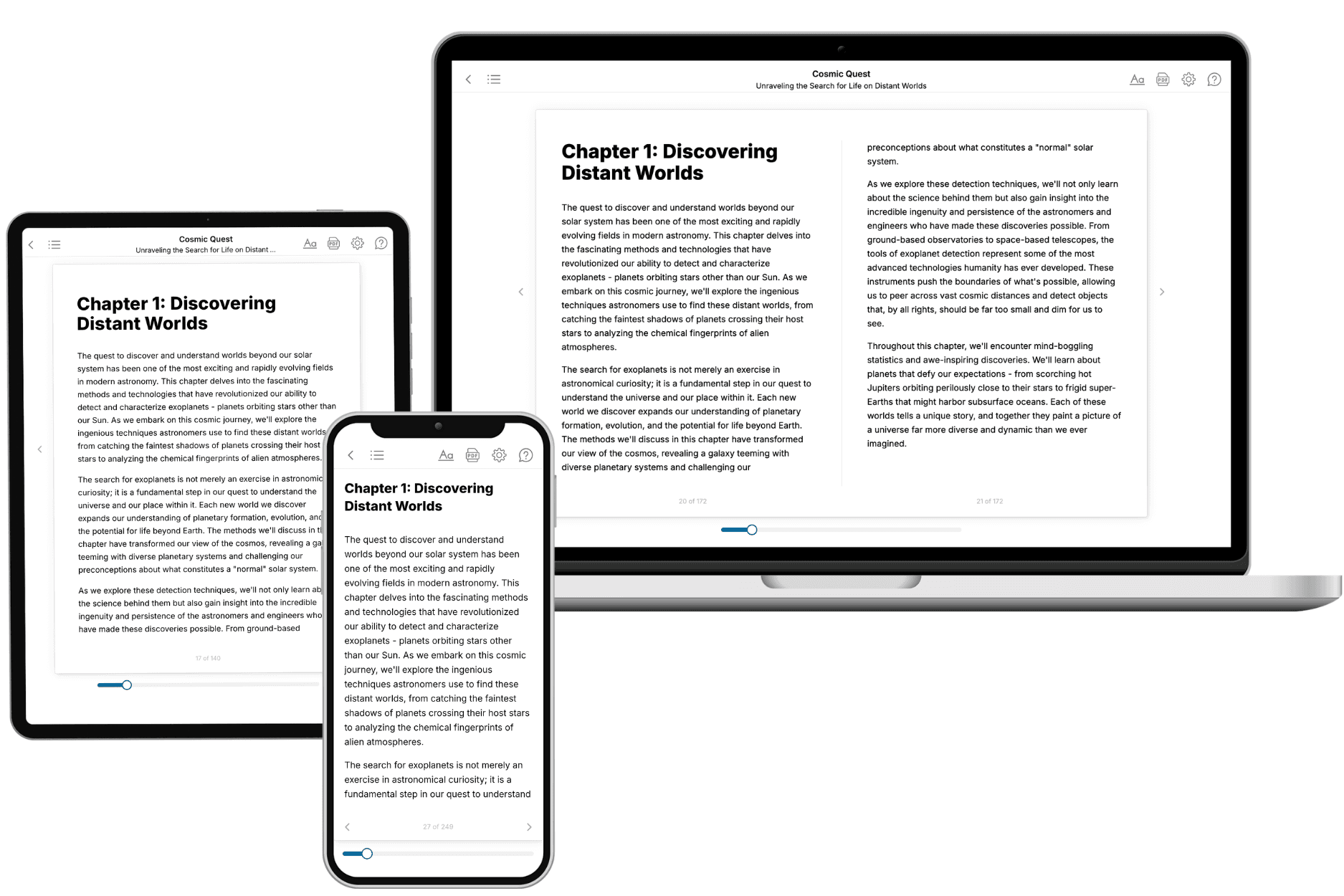
Your book is ready in 10 minutes. Read it online, download as EPUB or PDF, or send to Kindle.

Frequently asked questions
- What is TailoredRead?
TailoredRead creates complete, full-length nonfiction ebooks, written specifically for you. Tell us what you want to learn and why, and TailoredRead writes you a complete ebook on it, with charts, tables, and diagrams throughout. Read it online, on Kindle, or on any e-reader, or download it as a PDF or EPUB. Every book is written fresh the day you order it.
- How is the book tailored to me?
Before anything is written, you answer a few short questions about your goals, your background, and the topics you care about. Your book is then planned around your answers: written at your level, focused on your goals, and covering the topics you chose, instead of the one-size-fits-all book a store sells everyone.
- Will it read like generic AI content?
No. Your book isn't a chat transcript: it's planned chapter by chapter before a single word is written, told in a clear book voice, and explains ideas visually with charts, tables, and diagrams. After writing, every book goes through an editorial pass that polishes chapters so the book reads consistent from start to finish. Judge for yourself: browse thousands of sample books on our Explore Books page.
- How accurate is the content?
Our AI first checks whether your subject needs live research. Niche and fast-moving subjects are researched before writing, and the book plan and chapters are grounded in what it finds. After writing, every book goes through a quality pass that checks its facts and consistency, and researched books list their sources in a Notes section at the back.
- How long is the book?
You choose the length: Comprehensive (250-300 pages), Detailed (150-200 pages), Essential (70-100 pages), or Short (30-50 pages).
- Does the book include visuals?
Yes. Every book includes charts, tables, and diagrams: timelines, checklists, step-by-step guides, decision trees, comparison tables, matrices, and bar charts. A typical book includes dozens of these visual elements.
- Can I read it on Kindle? What formats can I download?
Yes. Every book can be read in our online reader or downloaded as a PDF or EPUB. The EPUB can be opened with Kindle, Apple Books, Kobo, and any e-reader. The Commercial and Author licenses also include an editable Word (DOCX) and Markdown download.
- How much does it cost?
About the price of a regular ebook. The exact price depends on your book's length and complexity, from $2 for the shortest books to $35 for the most comprehensive, and it's shown when you review your book, before you commit to anything. Each book is a one-time purchase, yours to keep, no subscription. Licenses that let you share, teach, or publish your book range from $35.99 to $49.99.
- Can I preview the book before purchasing?
Before you pay, you'll see what your book will cover: the title, a detailed description, the estimated length, and the complete chapter-by-chapter table of contents, so you know what you're getting before you decide. The full text itself is written after you purchase.
- How long does it take to create a book?
About 10 minutes. You can start reading the opening chapters while the rest is still being written.