High-Entropy Alloys
Engineering Superior Materials Through Compositional Complexity
Most engineers assume that the best alloys come from carefully controlling composition to minimize unwanted phases and defects.
222 pages10 chaptersFeb 16, 2026Materials Science
About this book
High-entropy alloys challenge this fundamental assumption by proving that adding more elements—not fewer—can create materials with extraordinary properties. This comprehensive guide explores how compositional complexity generates thermodynamic stability, unique microstructures, and performance characteristics that conventional alloys cannot match. You'll discover the scientific principles behind high-entropy alloy design, learn how to predict and optimize their properties, and understand their emerging applications in aerospace, energy systems, and extreme environments. Whether you're developing next-generation materials, evaluating new alloy systems, or seeking to understand this transformative field, this book provides the knowledge and frameworks you need to harness the power of entropy in materials engineering.
Table of contents
- IntroductionThe Paradigm Shift in Alloy Design, Why Entropy Matters in Materials Science, What You'll Learn in This Book, How to Use This GuideRead below
- Chapter 1: Fundamentals of High-Entropy AlloysDefinition and Core Concepts, Historical Evolution and Discovery, Distinction from Traditional Alloys
- Chapter 2: Thermodynamic Principles and EntropyEntropy Fundamentals in Materials, Configurational Entropy and Solid Solutions, Gibbs Free Energy and Phase Stability, How Entropy Stabilizes Multi-Principal Element Systems
- Chapter 3: Design Strategies and Composition SelectionCore Design Principles, Element Selection and Criteria, Empirical Parameters and Predictive Models, Composition Optimization Strategies
- Chapter 4: Microstructure Development and ControlPhase Formation and Evolution, Crystal Structures in High-Entropy Alloys, Grain Refinement and Microstructural Control
- Chapter 5: Mechanical Properties and PerformanceStrength and Ductility Relationships, Toughness and Fracture Behavior, Fatigue and Creep Resistance, Predicting Mechanical Properties
- Chapter 6: Corrosion Resistance and Environmental StabilityCorrosion Mechanisms in High-Entropy Alloys, Oxidation and High-Temperature Stability, Performance in Extreme Environments
- Chapter 7: Processing and Manufacturing MethodsCasting and Solidification Techniques, Powder Metallurgy and Additive Manufacturing, Thermomechanical Processing and Heat Treatment, Process Optimization for Property Control
- Chapter 8: Computational Modeling and Machine LearningComputational Thermodynamics and CALPHAD, Molecular Dynamics and Atomistic Simulations, Machine Learning for Property Prediction and Discovery
- Chapter 9: Applications Across IndustriesAerospace and High-Temperature Applications, Energy Systems and Nuclear Applications, Biomedical and Structural Applications, Emerging and Future Applications
- Chapter 10: Challenges and Future DirectionsCurrent Limitations and Challenges, Scalability and Manufacturing Economics, Future Research Directions and Opportunities
- ConclusionKey Takeaways and Synthesis, Your Next Steps in High-Entropy Alloy Development
- Glossary of Terms
- Further Reading and Resources
Introduction
For over a century, metallurgists and materials scientists have followed a fundamental principle: the best alloys emerge from carefully controlled compositions built around a single primary element. Steel centers on iron, aluminum alloys on aluminum, titanium alloys on titanium. This approach has delivered remarkable materials that power modern civilization, from the structural steel in skyscrapers to the aluminum alloys in aircraft wings. Yet this traditional paradigm inherently limits what materials can achieve. When you optimize around one principal element, you constrain the property space available to you. The question that sparked a revolution in materials science was deceptively simple: what happens when you abandon this constraint entirely?
High-entropy alloys represent a radical departure from conventional thinking. Instead of one principal element with minor additions, these materials combine five or more elements in roughly equal proportions. The name itself captures the essence of the concept: by maximizing compositional complexity, you increase the configurational entropy of the system. This high entropy can stabilize simple solid solution phases that would seem impossible based on traditional metallurgical wisdom. Where conventional alloys seek simplicity and purity, high-entropy alloys embrace complexity and diversity. This isn't merely an academic curiosity—it's a fundamentally different approach to materials design that unlocks property combinations previously thought unattainable.
The implications extend far beyond laboratory curiosities. High-entropy alloys have demonstrated exceptional strength at cryogenic temperatures, outstanding thermal stability at elevated temperatures, superior corrosion resistance in aggressive environments, and remarkable combinations of hardness and ductility. Some compositions maintain their mechanical properties across temperature ranges that would cause conventional alloys to fail catastrophically. Others resist oxidation and corrosion in conditions that rapidly degrade traditional materials. These capabilities position high-entropy alloys as transformative materials for aerospace propulsion systems, next-generation nuclear reactors, biomedical implants, and countless other demanding applications where conventional materials reach their fundamental limits.
This book provides you with a comprehensive framework for understanding, designing, and implementing high-entropy alloys in practical applications. Whether you're evaluating these materials for specific engineering challenges, conducting research to develop new compositions, or seeking to understand how this field is reshaping materials science, you'll find the knowledge and tools you need. The content balances fundamental scientific principles with practical implementation guidance, recognizing that effective materials engineering requires both theoretical understanding and hands-on expertise. You'll learn not just what high-entropy alloys are, but how to predict their behavior, optimize their properties, and manufacture them successfully.
The Paradigm Shift in Alloy Design
Traditional alloy development follows what materials scientists call the base element approach. You select a primary element that provides the foundation for desired properties, then add small amounts of other elements to enhance specific characteristics. This methodology has proven extraordinarily successful. Consider aluminum alloys: pure aluminum is soft and weak, but adding 4-5% copper, along with smaller amounts of magnesium and manganese, creates the 2000-series alloys that combine high strength with low density. The aluminum remains the dominant element, typically comprising 90-95% of the composition. This approach allows systematic optimization because you're working within a relatively constrained compositional space centered on one element's properties.
The base element approach emerged naturally from early metallurgical practice and was reinforced by thermodynamic considerations. Phase diagrams—the maps that show which crystal structures form at different compositions and temperatures—become exponentially more complex as you add elements. A binary system (two elements) produces a two-dimensional diagram. A ternary system (three elements) requires a three-dimensional representation. Beyond three elements, visualization becomes impractical, and the number of possible phases multiplies dramatically. Traditional metallurgy responded to this complexity by simplifying: focus on one element, add others sparingly, and work within well-characterized regions of the phase diagram. This strategy minimized the risk of unwanted intermetallic phases that could make alloys brittle or difficult to process.
High-entropy alloys invert this logic entirely. Instead of avoiding compositional complexity, they embrace it as a design tool. The foundational insight came from recognizing that configurational entropy—the thermodynamic quantity that measures disorder in how atoms are arranged—increases dramatically when multiple elements are present in similar proportions. At high temperatures, this entropy contribution to the Gibbs free energy can become large enough to stabilize simple solid solution phases even when conventional wisdom predicts complex intermetallic compounds should form. The result is a material with five, six, or even more principal elements, each present at 5-35 atomic percent, that maintains a relatively simple crystal structure like face-centered cubic or body-centered cubic.
This paradigm shift opens an enormous compositional space for exploration. Consider the mathematics: if you're designing a traditional alloy with one base element and three minor additions, you're exploring a relatively small region of composition space. With high-entropy alloys containing five principal elements in varying ratios, the number of possible compositions explodes into millions of potential alloys. This vast design space contains materials with property combinations that don't exist in conventional alloys. The challenge shifts from optimizing within narrow constraints to efficiently exploring and navigating this expanded territory. Modern computational tools and machine learning algorithms are becoming essential for this exploration, helping identify promising compositions without synthesizing and testing every possibility.
The practical implications of this shift are profound. Traditional alloy development often involves trade-offs: increasing strength typically reduces ductility, improving corrosion resistance may decrease thermal conductivity, enhancing high-temperature performance often compromises room-temperature properties. High-entropy alloys can sometimes transcend these trade-offs by accessing fundamentally different strengthening mechanisms and microstructural configurations. For example, the CoCrFeMnNi alloy—one of the most studied high-entropy compositions—maintains excellent ductility while achieving strength levels that increase as temperature decreases, reaching exceptional toughness at cryogenic temperatures where many materials become brittle. This behavior emerges from the complex interactions between multiple elements in the solid solution, creating deformation mechanisms unavailable in simpler alloys.
Understanding this paradigm shift requires recognizing both its opportunities and limitations. High-entropy alloys are not universally superior to conventional materials—they're a different class of materials with distinct advantages for specific applications. The increased compositional complexity that provides their benefits also creates challenges in processing, quality control, and cost management. Raw material expenses increase when you need five or more high-purity elements instead of one base metal with minor additions. Melting and homogenization become more demanding because different elements have different melting points and diffusion rates. The key is recognizing when the unique properties of high-entropy alloys justify these additional complexities, and when conventional materials remain the more practical choice.
The shift from base element thinking to multi-principal element design also changes how you approach materials selection and development. Instead of asking which base element provides the properties I need, and what additions will optimize it?
you ask which combination of elements will generate the entropy, atomic interactions, and microstructural features that deliver my target properties?
This reframing opens new solution pathways. For instance, if you need a material that resists both oxidation and hydrogen embrittlement at elevated temperatures—a combination difficult to achieve with nickel-based superalloys—you might design a high-entropy alloy that incorporates aluminum and chromium for oxidation resistance, refractory elements like molybdenum or tungsten for high-temperature strength, and carefully balanced compositions that minimize hydrogen solubility. The design process becomes more complex but also more flexible.
Why Entropy Matters in Materials Science
Entropy is one of the most fundamental concepts in thermodynamics, yet it often remains abstract and counterintuitive. In materials science, entropy measures the number of ways atoms can be arranged in a system. Higher entropy means more possible arrangements, which translates to greater thermodynamic stability at elevated temperatures. When you heat a material, the entropy term in the Gibbs free energy equation becomes increasingly important. This is why ice melts to water and water boils to steam as temperature rises—the higher-entropy disordered states become thermodynamically favored. High-entropy alloys exploit this same principle, but instead of transitional between solid, liquid, and gas phases, they use compositional disorder to stabilize specific crystal structures.
The configurational entropy of mixing provides the thermodynamic foundation for high-entropy alloys. When you have N elements mixed randomly on a crystal lattice, the configurational entropy per mole of atoms is given by S_config = -R Σ(x_i × ln(x_i)), where R is the gas constant and x_i is the mole fraction of element i. This equation reveals a crucial insight: entropy is maximized when all elements are present in equal proportions. For a five-element alloy with equimolar composition (20% each), the configurational entropy reaches approximately 1.61R or 13.4 J/(mol·K). This might seem like a small number, but when multiplied by temperature and the number of moles in a material, it becomes a substantial contribution to the total free energy.
To understand why this matters, consider the competition between enthalpy and entropy in determining phase stability. The Gibbs free energy equation G = H - TS shows that a phase is stable when its free energy is minimized. Enthalpy (H) represents the energy of atomic bonds and interactions—it generally favors ordered structures where atoms are arranged to minimize energy. Entropy (S) favors disorder and increases with temperature (T). In conventional alloys with one dominant element, the enthalpy term usually dominates, and ordered intermetallic phases form when you add significant amounts of other elements. In high-entropy alloys, the large configurational entropy can overcome the enthalpy penalty of mixing dissimilar elements, stabilizing disordered solid solutions instead of complex ordered phases.
The practical consequence is that high-entropy alloys can maintain simple crystal structures across wide temperature ranges and compositional variations. Consider the CoCrFeNi system: these four elements have different crystal structures in their pure forms and would normally form multiple intermetallic phases when combined. Yet when mixed in roughly equal proportions, they form a single-phase face-centered cubic solid solution that remains stable from cryogenic temperatures up to near the melting point. This stability arises because the entropy of mixing these four elements randomly on the FCC lattice provides enough thermodynamic driving force to prevent the formation of lower-entropy ordered phases. The result is a material that's easier to process and more predictable in its behavior than a multi-phase alloy with complex microstructure.
Beyond configurational entropy, high-entropy alloys benefit from other entropy contributions that enhance their properties. Vibrational entropy—related to how atoms vibrate around their lattice positions—can differ significantly between elements and contributes to overall stability. Electronic entropy from the distribution of electrons across energy states becomes important at high temperatures. Magnetic entropy plays a role in alloys containing ferromagnetic elements like iron, cobalt, and nickel. While configurational entropy typically dominates and provides the primary stabilization mechanism, these additional entropy sources can influence phase stability and property evolution with temperature. Understanding these contributions helps explain why some high-entropy alloys maintain their properties across extreme temperature ranges.
The entropy concept also explains one of the most intriguing features of high-entropy alloys: their resistance to phase decomposition during thermal exposure. Conventional alloys often suffer from precipitation of unwanted phases when held at elevated temperatures for extended periods. These precipitates can embrittle the material or degrade its properties. High-entropy alloys show remarkable resistance to this degradation because the high configurational entropy creates a substantial energy barrier against phase separation. For atoms to segregate into distinct phases, they must overcome the entropy penalty of reducing compositional disorder. This resistance to decomposition makes high-entropy alloys particularly attractive for high-temperature applications where long-term microstructural stability is critical, such as turbine components or nuclear reactor internals.
However, entropy alone doesn't guarantee success in high-entropy alloy design. The enthalpy of mixing between elements remains important—if elements have extremely negative mixing enthalpies (meaning they strongly prefer to bond with each other rather than mix randomly), they may form intermetallic compounds despite high configurational entropy. Conversely, if mixing enthalpies are too positive (elements repel each other), phase separation may occur. Successful high-entropy alloy design requires balancing entropy and enthalpy contributions, selecting elements that mix with moderately negative to slightly positive enthalpies. This balance ensures that entropy can stabilize solid solutions without fighting against overwhelming enthalpic driving forces toward ordering or separation. Empirical parameters and computational tools help identify these favorable compositional regions, as you'll learn in later chapters.
What You'll Learn in This Book
This book provides a comprehensive journey through high-entropy alloy science and engineering, structured to build your understanding progressively from fundamental principles to practical applications. You'll begin with the thermodynamic foundations that explain why these materials form and remain stable, then advance through design strategies, property optimization, processing methods, and real-world implementation. Each chapter builds on previous concepts while remaining accessible if you need to reference specific topics. The goal is to equip you with both theoretical understanding and practical tools you can apply immediately in your work, whether you're evaluating high-entropy alloys for specific applications or developing new compositions.
The early chapters establish the scientific foundation you need to understand high-entropy alloy behavior. You'll explore the thermodynamic principles governing phase stability, learning how entropy, enthalpy, and free energy interact to determine which crystal structures form. You'll discover why configurational entropy becomes a powerful stabilizing force in multi-principal element systems and how to calculate and predict its effects. These chapters also cover the historical evolution of the field, showing how researchers discovered these materials and developed the conceptual frameworks that guide current work. Understanding this foundation is essential because it informs every subsequent decision in alloy design, processing, and application.
The middle chapters focus on practical design and characterization. You'll learn systematic approaches to element selection, discovering which combinations are likely to form stable solid solutions and which will produce brittle intermetallic phases. The book presents empirical parameters like atomic size difference, electronegativity difference, and mixing enthalpy that help predict phase formation without extensive experimental trials. You'll explore how to optimize compositions for specific property targets, balancing competing requirements like strength and ductility or corrosion resistance and thermal conductivity. These chapters include detailed examples of successful alloy systems, showing how design principles translate into real materials with exceptional properties.
Processing and manufacturing receive substantial attention because even the best-designed alloy is useless if you can't produce it reliably and economically. You'll learn about casting techniques that ensure compositional homogeneity despite different melting points of constituent elements. The book covers powder metallurgy approaches that enable fine microstructural control and additive manufacturing methods that allow complex geometries impossible with conventional processing. You'll discover how thermomechanical processing—controlled deformation and heat treatment—can refine grain structures and optimize properties. Each processing method is presented with practical considerations: equipment requirements, typical parameters, common challenges, and troubleshooting strategies. This knowledge helps you select appropriate manufacturing approaches for your specific applications and constraints.
The book dedicates significant coverage to computational methods that are transforming high-entropy alloy development. You'll learn how CALPHAD (Calculation of Phase Diagrams) databases and thermodynamic modeling software can predict phase stability across compositional and temperature ranges, dramatically reducing the experimental work needed to identify promising alloys. Molecular dynamics simulations reveal atomic-level deformation mechanisms that explain macroscopic properties. Machine learning algorithms can screen thousands of potential compositions, identifying candidates with desired property combinations for experimental validation. These computational tools don't replace experimental work, but they make it far more efficient by focusing efforts on the most promising compositions and processing conditions.
Applications chapters demonstrate how high-entropy alloys are being implemented across industries and where they offer genuine advantages over conventional materials. You'll see specific examples from aerospace, where high-entropy alloys enable turbine components that operate at higher temperatures with better creep resistance than nickel superalloys. Energy applications include nuclear reactor components that resist radiation damage and corrosion in extreme environments. Biomedical implementations leverage the excellent biocompatibility and corrosion resistance of certain compositions for implants and surgical instruments. Each application section includes performance data, implementation challenges, and economic considerations. This practical focus helps you evaluate whether high-entropy alloys make sense for your specific needs or if conventional materials remain more appropriate.
The final chapters address current limitations and future directions, providing honest assessment of where the field stands and where it's heading. You'll learn about scalability challenges that currently limit high-entropy alloy adoption, including raw material costs, processing complexity, and quality control requirements. The book discusses ongoing research into new compositional systems, novel processing methods, and emerging applications. You'll gain perspective on which technical barriers are likely to be overcome soon and which represent fundamental challenges requiring breakthrough innovations. This forward-looking content helps you make informed decisions about investing time and resources in high-entropy alloy development and positions you to capitalize on future advances.
Throughout the book, you'll find concrete examples, case studies, and data from published research and industrial implementations. These aren't generic illustrations but specific compositions, processing parameters, and measured properties that demonstrate real-world performance. When the text discusses a high-entropy alloy with exceptional cryogenic toughness, you'll see the actual stress-strain curves and fracture toughness values. When covering corrosion resistance, you'll find polarization curves and weight loss data from standardized tests. This evidence-based approach ensures you're learning from validated results rather than theoretical speculation, giving you confidence in applying these concepts to your own work.
How to Use This Guide
This book is designed for flexible use depending on your background, objectives, and immediate needs. If you're new to high-entropy alloys, reading sequentially from beginning to end provides the most comprehensive learning experience, building your knowledge systematically from fundamentals through applications. Each chapter assumes familiarity with concepts introduced in previous chapters, so this linear approach ensures you have the necessary foundation before encountering more advanced topics. However, if you already have materials science background and need information on specific aspects—perhaps processing methods or computational modeling—you can jump directly to relevant chapters. Cross-references throughout the text guide you to related concepts when needed.
For materials engineers evaluating whether high-entropy alloys suit specific applications, consider this targeted reading path. Start with the introduction and Chapter 1 to understand what distinguishes these materials from conventional alloys. Then skip to Chapter 5 (Mechanical Properties) and Chapter 6 (Corrosion Resistance) to see what performance characteristics are achievable. Review the relevant application section in Chapter 9 that matches your industry. Finally, examine Chapter 7 (Processing) to understand manufacturing requirements and Chapter 10 (Challenges) to assess practical limitations. This path provides the essential information for making informed materials selection decisions without requiring deep dives into thermodynamic theory or computational methods.
Researchers and graduate students developing new high-entropy alloy compositions should focus on the design and characterization chapters. After reviewing fundamentals in Chapters 1-2, spend substantial time with Chapter 3 (Design Strategies) to understand element selection criteria and predictive parameters. Chapter 4 (Microstructure) explains how processing affects phase formation and grain structure. Chapter 8 (Computational Modeling) provides tools for predicting properties and screening compositions before experimental work. Use the application chapters to understand property targets for different use cases, then return to processing chapters to optimize manufacturing approaches for your specific compositions. The challenges chapter helps identify research gaps where your work can make meaningful contributions.
Manufacturing engineers and process developers should emphasize the processing chapters while maintaining awareness of design principles that influence processability. Chapter 7 provides detailed coverage of casting, powder metallurgy, additive manufacturing, and thermomechanical processing with practical parameters and troubleshooting guidance. However, understanding Chapter 3 (Design Strategies) helps you recognize when compositional adjustments might solve processing challenges—for example, modifying element ratios to adjust melting point ranges or reduce segregation tendencies. Chapter 4 (Microstructure) explains how your processing decisions affect final properties, enabling you to optimize parameters for specific performance targets. The computational modeling chapter introduces simulation tools that can predict processing outcomes before expensive experimental trials.
Each chapter includes specific features to enhance learning and application. Key concepts are highlighted in bold text when first introduced, making them easy to identify and review. Technical terms are explained in context, with additional definitions available in the glossary. Equations are presented with clear explanations of each variable and its physical meaning—you don't need advanced mathematical background to understand the concepts, though some familiarity with thermodynamics and materials science helps. Examples and case studies appear in blockquotes to distinguish them from general explanatory text, making it easy to find concrete illustrations of abstract principles. Footnotes provide citations to original research for readers who want to explore topics in greater depth.
The book includes numerous lists and structured breakdowns of complex topics to make information accessible and actionable. When discussing element selection criteria, for example, you'll find organized lists of favorable and unfavorable characteristics rather than dense paragraphs of text. Processing parameters are presented in tables and structured formats that you can reference quickly. Design workflows are broken into step-by-step procedures you can follow directly. This structured approach recognizes that you're likely using this book as a working reference, not just reading it once cover-to-cover. The format facilitates finding specific information quickly when you need it for active projects.
To maximize value from this book, consider maintaining a working notebook where you record insights relevant to your specific applications or research. When you encounter a design principle or processing parameter that applies to your work, note it along with the chapter reference for easy retrieval. If you're developing new alloys, use the design frameworks as templates, filling in your specific element choices and property targets. For manufacturing applications, adapt the processing parameters to your equipment and scale, documenting what works and what requires adjustment. This active engagement transforms the book from a passive information source into a practical tool that evolves with your experience.
The field of high-entropy alloys continues to evolve rapidly, with new compositions, processing methods, and applications emerging regularly. While this book provides comprehensive coverage of established knowledge and current best practices, staying current requires engaging with ongoing research. The Further Reading section provides curated resources including key journals, conferences, and online databases where new developments are published. Consider this book as your foundation—a comprehensive base of knowledge that enables you to understand and evaluate new research as it appears. The conceptual frameworks and analytical tools you'll learn remain applicable even as specific compositions and techniques advance.
Finally, remember that high-entropy alloys are tools, not solutions in themselves. The goal isn't to use these materials everywhere, but to recognize situations where their unique properties provide genuine advantages over conventional alternatives. As you progress through the book, continually ask yourself: Does this property combination solve a problem that conventional materials can't address?
and Do the benefits justify the additional complexity and cost?
This critical perspective ensures you apply high-entropy alloys where they truly excel rather than adopting them simply because they're novel. The most successful materials engineers combine enthusiasm for new technologies with pragmatic assessment of when they're actually the best choice.
This is the end of the free sample. The full book has 10 chapters.
Want this book written for you?
Tell us your goals and background, and get your own version of this book, tailored by AI to you.


Benefits of AI-tailored books
- Read one book, not ten:
- all the Materials Science knowledge you need, gathered into a single book.
- Save days of learning:
- tell us your goals, choose your topics, and the whole book is built around them.
- Learn effortlessly:
- Materials Science book written for your specific background and expertise.
- Understand at a glance:
- includes charts, tables, timelines, checklists, decision trees, and more.
- Stay current:
- written the day you order it, not years ago.
- Trust what you read:
- every book is checked for accuracy, with real research when your subject needs it.
Create your unique book in 3 steps
- 1. Select your focus
Select the focus of your Materials Science book and share your background
- 2. Personalize your book
Specify your goals and choose sub-topics to include
- 3. Get your tailored book
Your book is ready in 10 minutes. Read it online, download as EPUB or PDF, or send to Kindle.


Frequently asked questions
- What is TailoredRead?
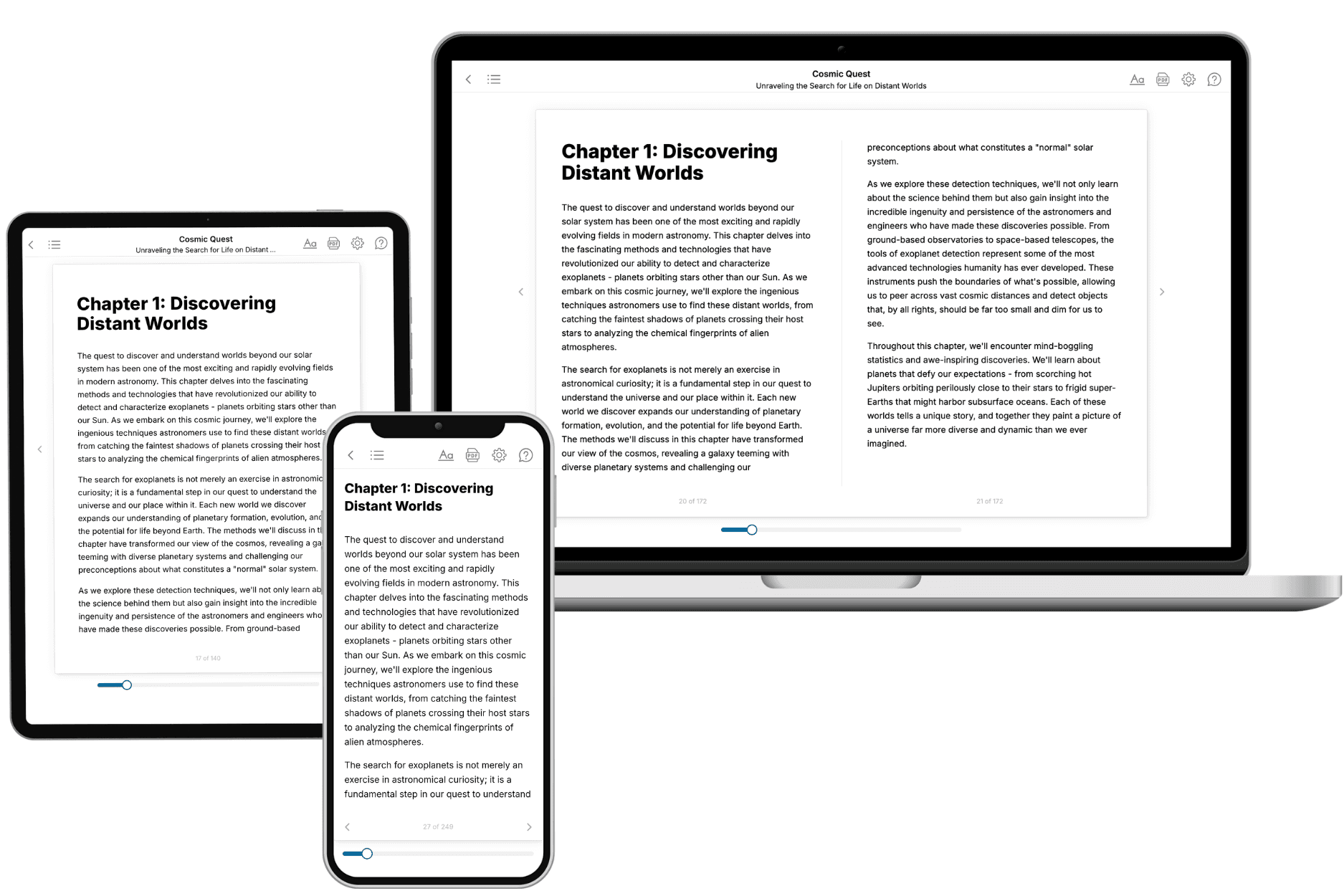
TailoredRead creates complete, full-length nonfiction ebooks, written specifically for you. Tell us what you want to learn and why, and TailoredRead writes you a complete ebook on it, with charts, tables, and diagrams throughout. Read it online, on Kindle, or on any e-reader, or download it as a PDF or EPUB. Every book is written fresh the day you order it.
- How is the book tailored to me?
Before anything is written, you answer a few short questions about your goals, your background, and the topics you care about. Your book is then planned around your answers: written at your level, focused on your goals, and covering the topics you chose, instead of the one-size-fits-all book a store sells everyone.
- Will it read like generic AI content?
No. Your book isn't a chat transcript: it's planned chapter by chapter before a single word is written, told in a clear book voice, and explains ideas visually with charts, tables, and diagrams. After writing, every book goes through an editorial pass that polishes chapters so the book reads consistent from start to finish. Judge for yourself: browse thousands of sample books on our Explore Books page.
- How accurate is the content?
Our AI first checks whether your subject needs live research. Niche and fast-moving subjects are researched before writing, and the book plan and chapters are grounded in what it finds. After writing, every book goes through a quality pass that checks its facts and consistency, and researched books list their sources in a Notes section at the back.
- How long is the book?
You choose the length: Comprehensive (250-300 pages), Detailed (150-200 pages), Essential (70-100 pages), or Short (30-50 pages).
- Does the book include visuals?
Yes. Every book includes charts, tables, and diagrams: timelines, checklists, step-by-step guides, decision trees, comparison tables, matrices, and bar charts. A typical book includes dozens of these visual elements.
- Can I read it on Kindle? What formats can I download?
Yes. Every book can be read in our online reader or downloaded as a PDF or EPUB. The EPUB can be opened with Kindle, Apple Books, Kobo, and any e-reader. The Commercial and Author licenses also include an editable Word (DOCX) and Markdown download.
- How much does it cost?
About the price of a regular ebook. The exact price depends on your book's length and complexity, from $2 for the shortest books to $35 for the most comprehensive, and it's shown when you review your book, before you commit to anything. Each book is a one-time purchase, yours to keep, no subscription. Licenses that let you share, teach, or publish your book range from $35.99 to $49.99.
- Can I preview the book before purchasing?
Before you pay, you'll see what your book will cover: the title, a detailed description, the estimated length, and the complete chapter-by-chapter table of contents, so you know what you're getting before you decide. The full text itself is written after you purchase.
- How long does it take to create a book?
About 10 minutes. You can start reading the opening chapters while the rest is still being written.